Why Aren’t The Great Courses by The Teaching Company Online?

If you aren’t familiar with The Great Courses by the Teaching Company you should be.  That is if you enjoy learning.  The Great Courses are a series of college like courses done by well known professors for educational entertainment.  I’ve bought several over the years and have checked out others from my library.  Originally they came on audio cassettes, and since evolved to DVDs, digital audio downloads, and now video downloads.  But what I’m asking is why aren’t they available for streaming?  The Teaching Company needs to create a Netflix like service for their educational videos so I can watch them on my TV, computer, iPad or even iPhone.

I don’t like owning stuff like DVDs anymore. Netflix streaming has ruined me for that.  Nor do I like owning MP3s, Rhapsody and Rdio have ruined me for owning music.  I like to pay a monthly fee and just call stuff up when I’m in the mood.  If the Teaching Company offered their library for $7.99 a month I’d subscribe.

Online education is taking the world of higher education by storm.  Educational videos from the TED Talks, Khan Academy and iTunes U are also gaining popularity.  There’s a market for fun learning, or edutainment, especially when it’s convenient.  The Teaching Company videos have always been rather staid in production format, reminding me of educational TV from the 1960s, but they are slowly learning to jazz things up with multimedia to support the lectures.  What The Teaching Company needs to do is get away from it’s old fashion 20th century marketing concepts.

The Teaching Company would do well to model its distribution on Hulu Plus and Netflix.  The $7.99 all you can eat video services are the way to go.  That’s $95.88 a year, about equal to one of their 36 part courses.  Now I’m sure The Teaching Company fears giving everything away for the price of one course, but how many people buy more than one course a year?  And would they attract more customers if they offered their courses in a much more convenient and easier to pay fashion?

Sooner or later someone is going to bring edutainment to the Netflix streaming model.  Right now there are several companies trying to copy Netflix, such as Amazon Prime Video, but they tend to offer the same kind of content – movies and old TV shows.  The same thing is happening with music.  There’s are a half dozen or more streaming music services all with almost the same 12-15 million songs.  I would think the entrepreneurial action would be delivering new kinds of content, and I’m thinking online education would be popular for a niche market.

The Power of Online Learning

Look at this sample lesson from Educator.com for Cascading Style Sheets.  It’s quite slick, and it illustrates the value of studying at the computer or TV screen.  You can pause the lecture at any point.  You can have your own text editor in another window to practice the lesson as you watch.  You can have a third window open to take notes.  Educator.com charges $35 paid by the month, or $240 paid by the year, to access all its courses, which mainly focuses on tutoring kids for high school or some basic college courses.  That’s a good value if you’re going to school and want extra help, but a little high for edutainment.

Free Online Education

These sites are offering free courses in a variety of formats. You can go to YouTube and search on any subject and find videos to help you learn too.  The Teaching Company has a lot of competition from free sources.  But their video and audio courses are well produced.  I don’t mind paying for them, but I have to say there’s lots of good free content out there.  Look at this MIT video on linear algebra.  It looks like being back in school with a professor at the blackboard.

Another free approach is from the Khan Academy.  And that’s the cool thing about having a variety of courses – if you are having trouble with a topic, just find another teacher with a different approach.

Look at this link to Educator.com’s lesson on linear algebra to see even another approach.  It uses a multiwindow technique, with the professor in one window, the exercises on a whiteboard in another, and the course outline in a third.

I wished The Teaching Company had some sample lectures I could link or show.  But here’s a lecture at YouTube on How to Read World Literature.  It is has a rather long intro, but even that explains the value of the lecture.  Often this is what The Great Courses are like, a professor who is passionate about his subject just talking to a class.  The Great Courses are a bit more slick, filming the lecture without distractions with better sound, but it’s the content that counts.

I think The Teaching Company has done a poor job of advertising itself.  I’ve asked a number of professors I know if they’ve seen one of The Great Courses videos and many have not.  Over the years I’ve met a few other Great Courses fans, but I feel The Great Courses are an acquired taste.  Most bookworms read fiction, but if you love non-fiction they may appeal to you.  Even then, you can read a book by Bart D. Ehrman or James Gleick and ingest facts far faster than you can by watching lectures.  However, there is something different about having a specialist just talk to you, and maybe show some sample photos or film clips.  Listening to people lecture sometimes helps with learning.

One reason why I like The Great Courses is they enhance my personal map of reality.  For instance I watched From Monet to Van Gogh: A History of Impressionism and learned so much, that when I went to Washington DC looking forward to seeing the Air & Space Museum, I actually ended up more thrilled at the National Gallery.  And since then I’ve read books about the history of Impressionism and the artists, bought impressionism art books, and took in every visiting exhibit of impressionistic paintings that have come to town since. 

I’ve read three books by Bart D. Ehrman on early Christian history, and now want to get his lecture series from The Great Courses.  What happens is you take up a topic and start studying it just for fun.  There are no stressful tests, no homework, no writing papers.  It’s just learning because it’s fascinating.

That’s why I believe I would enjoy The Great Courses if they were available like TV shows.  Instead of watching an old episode of Star Trek on Netflix, I could watch a lecture on British literature, or one about cosmology.  Watching the YouTube clip above about world literature makes me want to read outside of my normal territory of the US, Canada and Great Britain.

JWH – 10/22/11

Aegean Dream by Dario Ciriello

Aegean Dream by Dario Ciriello is a memoir about Dario and his wife Linda giving up their good life in California and moving to the Greek island of Skópelos.  I bought this book because I met Dario back in 2002 at the Clarion West writer’s workshop.  We were part of a class of 17 wannabe writers that lived together on a 12th floor dorm near downtown Seattle while taking daily classes with science fiction writers and editors.  Most of the people were young, but Dario, Doug Sharp and I were all 50 that year.  I think we wanted to reinvent ourselves.  Dario, from Italian heritage but born in London emigrated to America in 1989, was one hell of a charming guy.  I envied his energy, grace and social skills.  He was an artist, craftsman and musician that wanted to be a writer too.  I wasn’t surprised when a few years later he and Linda moved to Greece because of his adventurous nature.  Years later, when I heard he wrote a book about living abroad I was anxious to read it.  Dario lives the way I dream of living, and since I’ve always fantasized about living in another country, this book was a riveting read for me.

Dario and Linda had visited Skópelos on vacation after Clarion West and had fallen in love with it.  Dario then convinced Linda they should move there, and they carefully planned, work to save money, got rid of possessions, and most of all, studied Greek to prepare for their trip.  I’m going to try and not tell too much of their story because I don’t want to spoil the book’s narrative as it unfolds, but I will say learning the language before moving to a foreign land paid off a 1000% dividend.

That’s lesson one for me.  I’m terrible with languages.  I got through high school German and college Spanish, but it’s all forgotten.  My friend Janis spends all her extra time learning Spanish to make her many south of the border vacations special, and so I constantly see how hard that is.  I tried studying classical Greek one semester and couldn’t handle the strange alphabet, so I’m very impressed with Dario and Linda learning Greek.  They met other British and Americans living on Skópelos that hadn’t learned Greek and making the effort to learn the language, no matter how comical the results were sometimes, allowed Dario and Linda to break the cultural barrier and make hordes of friends.

Lesson two is don’t move to another country with a shipping container full of belongings.  Dario evidently is a packrat, to Linda’s great distress, and has been moving from country to country his whole life with his family’s belongings on his back, so to say.

Lesson three is harder to explain.  It’s about being a craftsman and artist.   Linda went from being a highly paid office manager to wanting to make natural soap for tourists.  Even when you can make something beautiful that many people admire, it’s really hard to make money at it.  We live in a world where everyone wants everything to be cheap, and it’s hard to make a living making something beautiful that takes a lot of time to make.  There were many stories of small business failures in Aegean Dreams, and that’s a story in itself.

Lessons four and five are about marriage and friendships.  Dario and Linda have a wonderful relationship and it comes out in their story, and they both have the knack for making friends, even in a foreign land with people that don’t speak their language.

I recommend this book because I learned so much from it.  On one hand living in another country is like living here.  You have to shop for food, work, clean house, deal with leaky toilets, buy furniture, go to parties, the list of similarities is long.  What’s different is how people act, think and talk – all the cultural stuff.  And there’s a huge difference between the US and Greece.  And you wouldn’t know that unless you lived there, or the next best thing, read a memoir from someone who had.  Being a tourist in no way lets you learn what its like to live in another country, and this book illustrates that perfectly.

Aegean Dream is a memoir about how hard it is to be a stranger in a strange land and live by different rules.  Dario and Linda make amazing successes integrating into their new life, but had to swim upstream against a vicious current of bureaucracy.  Aegean Dream is great background reading why Greece is doing so bad now on the world’s economic stage.  Dario and Linda came to Greece just at the time when its citizens went wild with credit.  About a third of Greece’s citizens work for the government, and all have become addicted to governmental generosity.  Corruption and a snake pit of regulations make living in Greece impossible for outsiders and cruel for its own folk.

After reading Aegean Dream  I doubt I could live in another country.  The story completely convinced me what a wimp I am.  I could never have done what Dario and Linda did.  It would have crushed me.  And to be completely honest, I wouldn’t even have the balls to try.  I really admire Dario and Linda for their great adventure.  I wish my wife Susan and I could do something like that.  Aegean Dream also showed what it takes for two people to live closely together in their life, and I really admired that too.

The book describes Skópelos as a paradise of natural beauty, and parts of the movie Momma Mia was filmed near where Dario and Linda lived.  So if you got Greek island fever after watching that show, read Aegean Dream.  The movie will make you want to visit, but read the book before you plan to move there.

[You can read about Dario and Linda’s adventures and see photos at the blog he kept. But get the book for the whole story.]

JWH – 10/20/11

Blogging and Novel Writing

I’ve always wanted to write a novel but never had the focus or determination to complete one.  November is National Novel Writing Month, or NaNoWrMo.  The goal of NaNoWrMo is to get would-be novelists to complete a first draft of 50,000 words.  Now that’s about the minimal length of fiction to be called a novel, and most editors usually want twice as many words if you submit to them, but the NaNoWrMo consider 50,000 a good writing marathon for one month’s writing.  Their goal is not for people to complete a polished novel, but just go the distance.  They’ve yet to make December National Novel Rewrite Month, but many bloggers have suggested it. 

Essentially this means knocking out 1,667 words a day of fiction.  I have no trouble writing as many words on a blog post, but fiction is different.  I love blogging and don’t expect to give it up for the month of November.  Blogging is therapeutic for me.  Writing about something that requires research exercises my memory.  And I definitely need help with my memory – it’s slipping away more every day. 

But I want to write a novel.  Of course I’ve been wanting to write a novel since I was in high school over forty years ago.  Rationally I’d think if I hadn’t written one by now I never will.  Well, I’m looking at NaNoWrMo as a shit or get of the pot test.  Either I’ve got to finish a novel now or give up thinking about ever writing one.  All my blogging indicates I like writing essays, which suggests I should work harder to polish that skill.  If I fail to produce a first draft in November that’s what I will do – but for now I want to give it one more try.

What I should do is publish my daily NaNoWrMo work here but that might screw up my chances of getting the novel published in the future.  I’ve read that most authors have to write several novels before the get one good enough to publish, so maybe I’m being too protective of my first first draft.  Also, I believe, and this might be naive, that I’ve got a unique science fiction idea and and I don’t want to spoil it by letting people read a first draft.  However, I might be willing to show versions of the opening here as a marketing research to see if anyone responds.

Working on a novel will seem strange though.  My blogging is about watching the world and reacting.  It’s about looking outward.  Novel writing is about looking inward and creating everything from scratch.  That might be why I’ve never been able to write a novel.  I’ve written about 30 short stories and even 5,000-12,000 words are an agony to produce.  I recently put my best effort online and it sank like a stone.  Writing non-fiction is engaging – writing fiction is lonely.

I haven’t signed up with NaNoWrMo yet, and I still might chicken out.  The idea of coming home from work every evening and turning off the world, shunning all my favorite hobbies to focus on one activity is scary.  I love my evening routine.  Writing fiction will be like working two jobs.  So why do it?  I don’t know.  I read a lot of fiction and I’ve always wanted to create a fictional work of art.  It’s like going to a party and always listening to everyone else talk.  Writing a novel would be like having my say.

JWH – 10/18/11

Occupy Wall Street v. The Tea Party

Occupy Wall Street protests have the reputation of being about diffused public anger with no real political agenda.  The Tea Party has always been rigidly focused on anti-taxes but defines itself around the Contract from America platform that its followers stick closely to in their political campaigning.  From their start in 2009 the Tea Party quickly organized into a grass roots federation of citizens that got many people elected around the country and in congress.  But the Tea Party isn’t 100% a single structure either, with several web sites using the Tea Party name and each having slightly different platforms.

If the Occupy Wall Street movement wants political success they too will need to organize across the country into a political movement.  First off, they need a better name, and second they need a political platform that will counter challenge the conservatives and define their movement.  And they need to coop the Democratic party like the Tea Party has taken over the Republican party.  Third parties just don’t work, unless they think Americans are ready for a complete change.  But looking at list of American political parties and their history makes this doubtful.

The phrase “occupy Wall Street” just doesn’t ring true for a long term political party moniker.  I’m not sure what these young new protestors want, but they sound like an Egalitarian Party because of their identity with the 99%.  Since the Occupy Wall Street protests quickly found sympathy with people in other countries they would do well to make it a world-wide movement.  The old phrase, Think Globally, Act Locally applies well to them because of their environmental demands.

In a world of global communications, global economy, global environment, why not a global political movement?  However, if they don’t stay focused on the critical issues they will bog down and divide their followers.  If you look at the various political platforms on the Tea Party sites you  see how they’ve broaden their anti-tax focus to other issues – for example look at the Non-negotiable 15 Core Beliefs at the TeaParty.org site that deal with guns, English and family values.

The Tea Party advocates a small government movement where individuals are expected to pull their own weight.  The Occupy Wall Street movement advocates economic fairness for all in a society that favors the rich.  Both are about money.  The Tea Party people want more money for their economic freedom by paying less taxes at the local, state and federal levels – thus the emphasis for a small government.  The Occupy Wall Street movement is about protecting the individual rather than the bottom line, and that means social engineering, big government and more taxes.  There is a direct conflict of goals.

Our society is politically polarized and getting more polarized all the time.  I fear this process is only going to get nastier.  The 2012 election will probably be a lot like the one in 1968.

JWH – 10/18/11

Occupy Wall Street–Is This Our Future?

In the 1960s the anti-war protestors would shout, “The Whole World is Watching!”  With the Occupy Wall Street movement, that is true again, but with even more eyes.  The internet is a game changer for social protest movements.  Here in the west we rejoiced at the Arab Spring, but how are our politicians really feeling about our own uprisings?  Most are giving polite sympathetic words, but what if this anti-establishment movement takes off?  What does Washington really think when they hear anti-government movements from both the right and left?

The best reportage I’ve found on Occupy Wall street is at Wikipedia.  They also provide this very informative graphic on the rate of news reports for the Tea Party and Occupy Wall Street.

File:Occupy-wall-st-vs-tea-party.png

My guess as to why there were so few news reports on Occupy Wall Street at the start is the press did not think the movement was serious and was unprepared for its rapid success.  I’m guessing the American public also thinks it will be a short lived phenomenon.  But what if it’s not?  What if it’s the beginning of several years of social upheaval like we had back in the 1960s?

As I’ve gotten older I’ve wondered why the youth of each new generation didn’t protest for something they wanted.  Since I grew up in the 1960s and saw anti-war, civil rights, feminist, gay rights, and Earth Day protests I just assumed protesting was a natural part of the political scene, but they died out and the youth of America became quiet for a very long time.  Were they all happy with the way our country worked and comfortable with their vision of the future?  So what’s changed now?

We’ve had other recessions and spikes of high unemployment since the 1960s.  And we’ve had a few protest movements, like No Nukes, and various ecological and animal rights movements, but nothing that turned into a real political movement.  Is this recession different?  Has corporate greed and Wall Street really ruined our country enough that people are willing to bite the hand that pays them?  Or maybe it’s biting the hand that used to pay them.

Young people were told to study hard, go to college and then reap the rewards of our great and rich society.  Millions have run up huge student debts, gotten good degrees and can’t find work.  Their parents have also lost their jobs, and their grandparents have lost their retirement incomes.  Is it any wonder that I’m hearing Buffalo Springfield’s “For What It’s Worth” again:

There’s something happening here
What it is ain’t exactly clear
There’s a man with a gun over there
Telling me I got to beware
I think it’s time we stop, children, what’s that sound
Everybody look what’s going down
There’s battle lines being drawn
Nobody’s right if everybody’s wrong
Young people speaking their minds
Getting so much resistance from behind
I think it’s time we stop, hey, what’s that sound
Everybody look what’s going down
What a field-day for the heat
A thousand people in the street
Singing songs and carrying signs
Mostly say, hooray for our side
It’s time we stop, hey, what’s that sound
Everybody look what’s going down
Paranoia strikes deep
Into your life it will creep
It starts when you’re always afraid
You step out of line, the man come and take you away

What really is happening? Does anyone know?  We’ve always pulled out of recessions before, but this one is lasting longer.  Of course, we’ve always been helped by an economic bubble, like the technology bubble or the housing bubble.  The trouble was the housing bubble was destructive, pervasive and ultimately devastated the economy.  A huge percentage of our economy is depended on home ownership and rising property values.  Consumer confidence drives our economy – but everyone is too afraid to spend now.  And our economy runs best when unemployment is around 5%.  That’s far from full employment, and it’s not even a real number of people who can’t find work, but it does appear to be the right number that reflects economic stability.  We’re very far away from that figure and getting further.

My guess is most people thought unemployment would be back down again, or at least heading down, and now that it’s not there growing panic is leading to protest movements.  People blame Wall Street for the problem mainly because they think Wall Street got us in the mess and felt they should have gotten us out too, and they haven’t.  Instead Wall Street decided to keep its wealth, and the GOP took this particular time to downsize all governments.

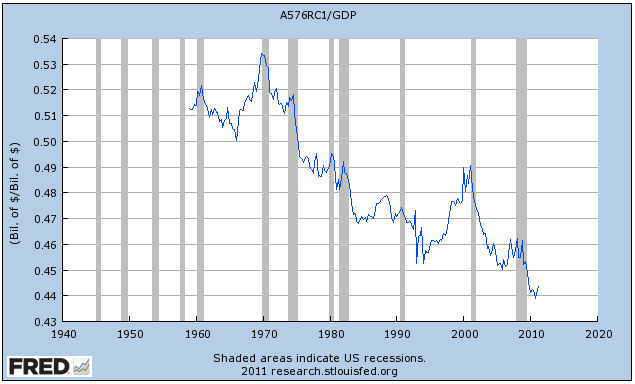
Things aren’t quite that simple and some of the Occupy Wall Street protesters know that.  Look at “Here Are the Four Charts That Explain What the Protests are Angry About….”  Here is one chart, click on the link to look at the others.  This one shows the wages as a percent of the economy.  Because we live in a global economy where all workers compete, the average wage is decreasing even though corporate profits are skyrocketing.  This is the reason behind the whole 99% versus the 1%.  Corporations are more efficient at making money, but at the expense of the workers worldwide.

wages-as-percent-of-gdp

The rich (1%) are eating everyone else’s money up (99%) and the 1% is also desperately fighting to take all the money it can get from the Federal government too.  In fact, the super rich are so good at gaining wealth that I’d think that ordinary millionaires would be feeling the pinch too and would be wanting to join Occupy Wall Street themselves.

Corporate profits are up, as well as their gross earnings and cash holdings, but they aren’t hiring people.  What they discovered is they can trim the fat and do well.  The GOP is now demanding we trim the fat from the federal government, and the extreme conservatives are also seeking to trim the fat from city and state governments.  All this fat trimming is putting millions out of work and there is no economic indicator showing they will get to go back to work anytime soon.  Does Wall Street and the GOP just want to live with 9-10% unemployment forever if that means saving money for them?

Over one half of American households earn less than $50,000 dollars and about 1/6th earn over $100,000, with the rest between the two figures.  See Wikipedia for all the figures on U.S. Household Income.  But also look at Wikipedia’s article on Wealth Inequality in the United States.  Wikipedia says at the end of 2001, which is ten year old data, 10% owned 71% of the wealth, and 1% own 38%, and we know that last decade has accelerated this divide.

Is it any wonder why people are joining the Occupy Wall Street movement?  If you look at the charts here and the ones I link to, the trends aren’t good.  Unless there’s a drastic change in the system, Occupy Wall Street is just the tip of the iceberg that we’re about to crash into.  Expect more fat trimming, which means more unemployed people joining the movement.  But also expect a lot more social upheaval as we adjust to long term high unemployment.

Our economy has gotten too efficient.  We need far fewer people to keep things running.  And it’s much cheaper to hire people in other countries to make things.  As long as corporations are only concerned with profits and their bottom line, and if our various levels of government are forced to do more with less, the trend will be towards growing unemployment.

The solution?  Raise taxes and go back to a larger government and smaller profits for corporations?  That would put more people to work, but there’s a growing anti-socialism climate in this country.  Too many people resent paying for things they don’t think they need, like school teachers or scientific researchers.  What they fail to see is big government makes for a big thriving economy.  Wishing for a small government is equal to wishing for high unemployment.  There’s not enough private enterprise to put all our citizens to work.

Either we have to accept big social programs or we’re going to have to learn to live with lots of poor people and protestors in the streets.  Me, I’d rather pay more taxes than see so much suffering.

Conservatives believe that cutting the size of the government and taxes will grow the economy.  When will we see this?  Bush cut taxes years ago.  As far as I can see, cutting taxes has lead to a faltering economy.  Cutting taxes is letting the 1% get a larger share of everyone’s pie.  And people are waking up to that, and that’s why we have Occupy Wall Street.  It’s why we’re seeing social unrest across Europe too.

Conservatives will counter that we’re running up too much debt.  But we wouldn’t have that debt if we hadn’t had the Bush tax cuts, or wasted so much money on wars and buying influence around the world.  Which is more helpful, hiring more teachers in America, or building militaries for people who want to be our enemies?  At some point it will become more important to apply our nation building funds to rebuilding America.  The Occupy Wall Street people are asking for that help now.  How long will the GOP deny that help?

JWH – 10/16/11