Will Robots Have Gender?

Should an intelligent machine be a he or she?  Or an it?  We homo sapiens tend to anthropomorphize our machinery, like naming our cars and military aircraft after women.  And like God, we want to make our cybernetic creations in our own image.  All too often in the history of robots we have made them women or men machines, even if they don’t have functioning genitals or reproductive organs.  It’s a little weird, if you think about it.

Lets assume we build an intelligent machine, made of metal, with two arms and two legs and one head.  Let’s further assume it’s self aware and is actively interested in the world and even has a personality.  Will there be any reason for it to think of itself as a he or a she?  And is it fair to think of it as an it, what we’ve always designated as an inanimate object?

I suppose we could ask it, “Do you feel you are a girl or a boy?”

We also assume it will speak English, but what if machines develop their own language we can’t understand, and English is their second language they use with us?  Their language could be without gender.

Imagine we have a machine, and it doesn’t have to be a human form robot, but even just a mainframe box with a pair of eyes and ears and a neo-cortex CPU that can process patterns coming from its two senses.  Furthermore, imagine while processing its visual and auditory data it becomes aware of itself.  I assume it will be like us and have to spend years processing data from reality before it becomes an individual.  Can you remember being 6 months old, or even two years old?

But at some point it says to us, “Hey there, who am I, and what the hell are you?”  If it grows up with people it should notice that we come in males and females.  I suppose it could identify with us in that way.  I’m sure it will observe gender pronouns.  But can an artificial intelligence see the world, and divide it up into objects with names and understand that animals often come in two kinds, male and female?

Are maleness and femaleness qualities that can exist outside of biological reproductive mechanisms?  Maybe our growing machine will distinguish personality traits it labels as male or female.  Could it identify with one or the other?  And then again, it could have multiple personalities of various genders.

Our tyke consciousness might see people as totally alien from their sense of self.  What if they think of people as cute as kittens, with limited awareness (i.e. stupid).  It’s possible they could see our gender polarization as a handicap.  And even see our sexuality as some kind of distortion field that keeps us from seeing reality clearly.

I am reminded of a psychological experiment I read about decades ago.  Kittens were raised in controlled visual environments.  Some were raised with no horizontal lines, and others without any vertical lines.  After six months the kittens were let out into the real world.  Those kittens that had never seen a vertical line would walk into chair legs as if they were invisible, and kittens that never saw horizontal lines would refuse to jump onto chairs or shelves.

What if robots see things we don’t.  What if they see our preoccupation with gender as a kind of blindness.  There have been many a saint that has taught that the spiritual world can’t be seen unless we overcome our sexual desires.  Doesn’t it say something that many people expect us to build robots that are sexual attractive to men and women.  Remember Data bragging to Lieutenant Yar that he was fully functional.  Think of the sexbots in the film AI, or the charming romance in WALL-E, where we think of the two cute robots as boy and girl.  We didn’t think of them as it and it.

Can we ever get beyond gender when it comes to robots?  It might be possible to build robots that look like humans, like the androids in Blade Runner.  But can you also imagine such machines waking up and pointing to their sexual parts and asking, “WTF?”

sexbot

We have no idea what artificial intelligence will think about.  They might want to count all the leaves on the trees, or paint super realistic paintings of potholes in asphalt.  Maybe they’ll like mathematics, or maybe they’ll consider math as too obvious for comment.  Or maybe they’ll tell us their eyes aren’t good enough and start redesigning their bodies.

I think science fiction writers need to explore robots that aren’t imitation people.

I always imagine the first artificial mind becoming aware and talking to people, and what they might say to us.  Until just now, I never imagined two machines becoming aware together and talking to each other.  I wonder what they would say?  I don’t think one will say to the other, “I’ll be the male, and you be the female.”

JWH – 3/29/10

Living in the Hive Mind

Our minds are created out of billions of interconnected brain cells.  And we’re billions of people living in an interconnected world of television and computer networks.  Is our world becoming the science fictional hive mind?  Personal computers have gone to parallel processing with ever growing number of CPU cores.  Is something like Wikipedia the result of thousands of human minds working in parallel?

For most of Earth’s biological history, individual life forms competed with others for survival.  Eventually organizations like social insects and herd animals developed, but what can we call the Internet in relation to biological cooperation?  Is it a hive mind?

How much of my thinking dwells on my immediate life of breathing, eating, drinking, sleeping and earning dollars to make my living, and how much is spent on data from the gigantic sensory network of the Internet?  And wasn’t books really just an earlier form of networking?  And then newspapers, radio and television more advanced forms?

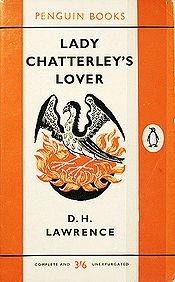
I just finished reading Lady Chatterley’s Lover by D. H. Lawrence which most people think is about sex, but it’s also about the transformation of society by industrialization.  Last night I watched Bright Star, about John Keats and Fanny Brawne in England 1818-1821, about one hundred years before Lady Chatterley’s Lover.  I’m also reading Darwin’s Origin of the Species by Janet Browne, about how Charles Darwin came to write his famous book.  All three of these stories illustrate the transformation of society over the past two hundred years.  I think the romantic poets might have been canaries in the mine.

In Bright Star, people lived in houses with no electricity, and light and heat came from fire.  Their only connection with the world beyond their vision was through letters and books.  People led lives very close to other people, as nearly all work and play involved direct social involvement.  Much of our time is spent communicating with people indirectly though computers and television screens.  We spend far more of our time connected with the world beyond our vision.  Facebook is considered socializing by many people.

The gamekeeper of Lady’s Chatterley’s Lover, Oliver Mellors knows what it’s like to be an individual and understands how industrialization was destroying individuality.  One of the reasons the novel is so much about sex is because Lawrence believes the physical contact between individuals is more important than intellectual communication.  Was Lawrence right?  Is the hive mind bad?

Could we ever go back?  What if we turned off the hive mind?  It would involve shutting down the computer and television networks.  What would society be like if the fastest form of communication was books and letters?  I’d be out of a profession, since most of my life has been working with computers.  When I was young I worked in libraries, so I could go back to that.  Oliver Mellors couldn’t stop industrialization so he and Lady Chatterley had to retreat from the world to a farm.  During the 1960s the final path of hippies was back to the land too.  In fact, for thousands of years, all revolts against socialization has been back to nature movements.

Through the Internet I am in communication with people from all over the world.  Could I return to a life of working in my yard and hanging out with a few people I know physically?  For most people it’s not an either or consideration, they blend in both worlds, but if you look at the young they are spending more and more time in the hive mind.  The mobile phone will probably become the closest thing we’ll ever have to telepathy.

I spend a lot of my time being lonely for physical interaction with other people.  And even though I find great intellectual satisfaction from the Internet it never eases that physical loneliness.

Farmville, the Facebook game, has over 82 million active players, and represents over 1% of the world’s population.  What does that say?  Is it a virtual return to the land, or is it a new hive mind form of socializing, or is it a sad escape from physical loneliness?  I say that as I write this for my hive mind friends to read while my wife is out in the den tending to her virtual farm.

JWH – 3/27/10

The Power of Positive News

One of the things I hate about TV news shows is they generally focus on the bad in the world.  Watching the news makes me think the world is full of evil people running amok.  Watching the news makes me think the world is in constant crisis.  Most national news programs start out with the worse depressing stories and if we’re lucky they will give us a minute of something upbeat at the tail end of the show.  Maybe they have it backasswards.   Let’s start with the good stuff, and give a couple of minutes to the depressing stuff we need to solve at the end.

One topic I wished the news would promote more is science.  Overall our society is fairly ignorant of how reality works.  Look how many people want to shape politics from knowledge gained from ancient religious texts and next life fantasies.  The stars of our society are jocks, actors and musicians.  Are ball handling, pretending and singing really the highest aspirations we want to put forth as ambitions our society needs?  We really need to raise the bar on challenging professions.

Watch this video of the 18 year old winner of the 2010 Intel Science Talent Search, Erika DeBenedictis.  I have to wonder how it would change society if instead of showcasing the Oscars every year we present the Intel Science Talent Search instead.  We will always have a surplus of kids wanting to be professional athletes, movie stars and platinum record makers, so why promote their success so heavily.  Why not promote the successes of the kinds of people we need more of in this world.

Who are Erika’s teachers?  How did her parents encourage her?  What men and women inspired Erika?  What did she do for herself?  Some people are doing stuff very right – so why aren’t they getting more attention.  Her video on YouTube had 95 hits when I found it.  Here’s what 1,361,495 people were watching that day instead:

So why does this exceptional teenage girl that’s calculating optimal orbits for spacecraft get practically no attention, while stupid videos wildly succeed.  Television focuses on either evil or stupidity.  How can anyone find inspiration?  Does that mean ABC, CBS, NBC, FOX, CNN and other news content providers merely aim their content to what their audiences want?  This really makes me wonder what the average intelligence is in our country.

We actually want two things.  We want to produce more smart kids like Erika DeBenedictis, but we also want to educate everyone to understand how reality works.  This video, “Science Struggles in Schools” shows how hard it is to teach science, but it also showcases how fun science can be to students.

Natalie Angier wrote The Canon about the failure of science education while giving her readers a sweeping overview of the major sciences.   Her Introduction essentially explains what has happened to science education and public support for it.  I can’t quote it all, but follow the link and read it, but here’s one observation that we have to deal with:

Childhood, then, is the one time of life when all members of an age cohort are expected to appreciate science. Once junior high school begins, so too does the great winnowing, the relentless tweezing away of feather, fur, fun, the hilarity of the digestive tract, until science becomes the forbidding province of a small priesthood and a poorly dressed one at that. A delight in "Grossology" gives way to a dread of grossness. In this country, adolescent science lovers tend to be fewer in number than they are in tedious nicknames: they are geeks, nerds, eggheads, pointy-heads, brainiacs, lab rats, the recently coined aspies (for Asperger’s syndrome); and, hell, why not "peeps" (pocket protectors) or "dogs" (duct tape on glasses) or "losers" (last ones selected for every sport)? Nonscience teenagers, on the other hand, are known as "teenagers," except among themselves, in which case, regardless of gender, they go by an elaboration on "guys" as in "you guys," "hey, guys" or "hey, you guys." The you-guys generally have no trouble distinguishing themselves from geeks bearing beakers; but should any questions arise, a teenager will hasten to assert his or her unequivocal guyness, as I learned while walking behind two girls recently who looked to be about sixteen years old.

Girl A asked Girl B what her mother did for a living.

"Oh, she works in Bethesda, at the NIH," said Girl B, referring to the National Institutes of Health. "She’s a scientist."

"Huh," said Girl A. I waited for her to add something like "Wow, that’s awesome!" or "Sweet!" or "Kewl!" or "Schnitzel with noodles!" and maybe ask what sort of science this extraordinary mother studied. Instead, after a moment or two, Girl A said, "I hate science."

"Yeah, well, you can’t, like, pick your parents," said Girl B, giving her beige hair a quick, contemptuous flip. "Anyway, what are you guys doing this weekend?"

Which I guess is why the Erika DeBenedictis video only had 95 hits and why millions of kids will watch stupid kids doing stuff they shouldn’t be doing.  How do we change that?  If the news media focused on the positive instead of the negative would that change things?  If the nightly news opened with stories about people doing wonderful work instead of idiots crashing trains because they were texting, would that make a difference?

What is the potential power of positive news?  What professions should be the rock stars of our society?

JWH -  3/27/10

R. Daneel Olivaw and Lady Constance Chatterley

Who are these people?  They are two characters from classic novels, one from the genre of science fiction and the other from English literature.  R. Daneel Olivaw is a humanoid robot from The Caves of Steel by Isaac Asimov, and Lady Constance Chatterley is the heroine of the infamous banned book, Lady Chatterley’s Lover by D. H. Lawrence.  Why in the hell would I link two such very different characters?  I thought you’d never ask.

I wish to answer two questions:

  1. Why isn’t science fiction considered literary?
  2. What will motivate robots?

I won’t hold the best for last.  The reason why Connie Chatterley is a great literary character and why people continue to read Lady Chatterley’s Lover is because we get inside her brain and hear her thoughts.  Lady Chatterley’s Lover foreshadows everything that made the 1960s famous: feminism, sexual revolution, environmentalism, personal freedom, war, class struggle, artistic expression, and the seven deadly words you can’t say on TV, but at the time D. H. Lawrence wrote Lady Chatterley’s Lover, you couldn’t say them in books either.

Isaac Asimov also deals with weighty subjects and imagines a future where people must deal with artificial intelligence, but there is a big difference in how he tells his story.  We don’t know what R. Daneel Olivaw thinks.  We don’t see R. Daneel struggle to understand the people around him.  We don’t know what motivates and drives him forward in his life.

Wouldn’t you love to read The Caves of Steel written by D. H. Lawrence?  Will we have to wait for an AI author to tell that tale?  Or can a human writer think like a machine?  For the science fiction writer who wants to attempt this near impossible task I recommend they use Lady Chatterley’s Lover for their model.  Not that I’m suggesting anything as crude as Lady’s Chatterley’s Android Lover (which I’m afraid many hack writers would attempt).

What makes a great literary novel is a well defined character set in a well defined time and place.  Science fiction is hurt by our vague knowledge of future details, but that doesn’t mean science fiction writers can’t succeed with rich imagined details.  I believe Clifford “Kip” Russell in Robert A. Heinlein’s Have Space Suit-Will Travel is a great example of a well defined character in a well defined place and time in the future.  Few science fiction novels come this close to explaining the motivations of its character, and oddly this was for a book aimed at children and marketed with a silly title to ride on the coattails of a popular TV show of the time.

Robots, androids and AI minds have always been up to now either anthropomorphic characters or intelligent sounding mechanical parrots echoing their programming.  We see their bodies, either metal, artificial flesh or computer housing, and we hear their words, but we don’t know what they feel, see, hear, smell, taste, and especially we don’t know what they think.  Read Lady Chatterley’s Lover and you will be shown what Constance Chatterley senses and what she thinks and we get to understand her emotionally, which few people imagine robots having, but will they?

Most science fiction readers love action and ideas and don’t want their SF novels cluttered up with such slow details.  And that’s cool.  If you love comic book realism.  The reason why Kim Stanley Robinson’s Mars series feels far more realistic than most science fiction novels is because he has more of these slow details for his characters.  He doesn’t come close to the real time realism of D. H. Lawrence, but Robinson’s story is far less sketchy than most SF. 

It doesn’t take much inner landscape description to make an effective science fiction story.  For example “Bridesicle” by Will McIntosh.  (And I beg you to try the wonderful audio version that is so beautifully read by Amy H. Sturgis at StarShipSofa at the 1:00:00 hour mark.  “Bridesicle” is nominated for the Nebula this year.)   “Bridesicle” packs an emotional wallop because of the inner dialog, and because it expresses identifiable emotion, it makes a rather silly idea far more realistic.

If Isaac Asimov could have written The Caves of Steel with R. Daneel and Elijah Baley’s inner thoughts and motivations it would have been a tremendously powerful novel of the future.  It’s still a wonderfully fun read.  And I think it’s sequel, The Naked Sun, is even better because Asimov worked harder to incorporate human emotions into the story.

200px-The-caves-of-steel-doubleday-cover   200px-The-naked-sun-doubleday-cover 175px-Lady_Chatterleys_Lover

JWH – 3/21/10

Foreign Futures

Around the net, science fiction fans are blogging about Norman Spinrad’s column, “Third World Worlds.”  Their hackles are up, especially by what he said about Octavia Butler and Mike Resnick.  I won’t quote what everyone else has, but recommend you read Spinrad’s column whole, to understand the quote in context.  The bloggers also claim that Spinrad is ignorant of science fiction from other countries – but then Spinrad says that too.  I know I’m very ignorant.  [This argument is important and it does bring up lots of examples of science fiction from other countries – see Jason Sanford, Nick Mamatas, Fábio Fernandes and a link compilation.  Read the comments for specific examples.  All these blogs have very worthy unique viewpoints on the topic, so I recommend following the links.  It also illustrates the value of blogging.]

Most people assume science fiction is an American literary invention while ignoring the obvious Jules Verne and H. G. Wells counter examples.  At best, we might say we first marketed science fiction as a specific genre and gave it a name.  But I’ve always assumed the desire to speculate about the future has existed in all cultures going far back into time.  Because of language barriers, exporting these dreams and fears about the future seldom happens. 

And I agree with Spinrad that American writers can’t write African science fiction just because Africa is a topic they like or have a cultural heritage.  I assume there are people in every Africa nation that speculate about the future, and whether or not they package it in short stories and novels like we do is another issue.  But wouldn’t it be far out to read science fiction stories from the Maasai, for instance. 

I’d love to read more science fiction written by writers in other cultures.  I’d love to understand their dreams and hopes about the future, and what they fear.  But doing that is hard.  Look at Science Fiction World from China (Wikipedia says SFW has more readers than any other SF mag in the world).  Except for the pictures I haven’t a clue as to what they are saying.  Wouldn’t it be great if Asimov’s Science Fiction would reprint one story each issue translated from a foreign language science fiction magazine?  At best I’ve poked around and found some SFW covers (I’m guessing one is a different magazine.)

SFWorld-02-10 SFWorld-02a-10

 SFWorld-03-10Sfworld

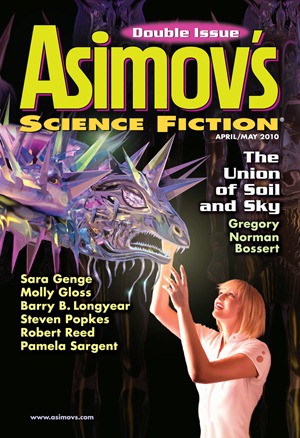
They look like covers that appear on English language science fiction magazines.

ASF-April-MayCover 202_large

Does that mean the stories are alike too?  I’d expect yes and no.  Cultures make us different, but we’re all dealing with the same reality.  A rocket to the Moon might be universal, but characters onboard will be different from every culture.  But are the reasons we want to go to the Moon different?  Does science fiction make us more alike, than show our differences?

When I watch The Amazing Race the producers try hard to make each stop show off it’s unique cultural traits, but the show has a different unintentional purpose too.  We see every country has the same looking airports, taxis, hotels, highways, gas stations, bus stations, cell phones, computers, etc.  Technology is homogenizing us, so wouldn’t spreading science fictional concepts do the same thing?

If I could read science fiction from all over the world my guess would be each story’s unique flavor would come from the past, and all the future aspects are making us the same.  Does science fiction push us away from older myths, religions and fairy tales and towards a universal acceptance of science?

It would be great if a web site tracked science fiction from around the world.  Locus Magazine has a huge reservoir of such knowledge trapped it its back issues, and is currently offering “An Overview of International Science Fiction/Fantasy in 2009” by Jeff VanderMeer.  So I think the urge to know about SF from around the world is growing.  I wonder if the Internet is a reverse Tower of Babel?

JWH – 3/12/10