
by James Wallace Harris, 6/10/25
2025 is the 60th anniversary of my living through 1965. I discovered Bob Dylan in 1965 when “Like a Rolling Stone” came on Top 40 AM radio. That was when rock and roll matured, becoming rock. I’ve never been able to forget the sixties. That’s mainly because I was an adolescent during that decade, and few people can forget their adolescence. To compound the biological factor, we were Baby Boomers, believing the whole world was watching us lead some kind of revolution.
I thought Bob Dylan epitomized the decade when I was a teenager growing up with his albums The Freewheelin’ Bob Dylan in 1962 through Nashville Skyline in 1969. I’ve been listening to those albums for sixty years, and I’ve read a lot about Bob Dylan. He wasn’t my hero, but someone I admired and envied. While watching the recent film A Complete Unknown, I couldn’t help but feel they got everything wrong. Although the film and acting were dazzling.
Bob Dylan is legendary for hiding behind a mask. He has always worn an enigmatic persona. I think to understand Dylan requires not looking directly at Dylan but at everything that surrounded him and how he reacted. Of course, that belief may only be a delusion on my part, and it’s impossible to know the man.
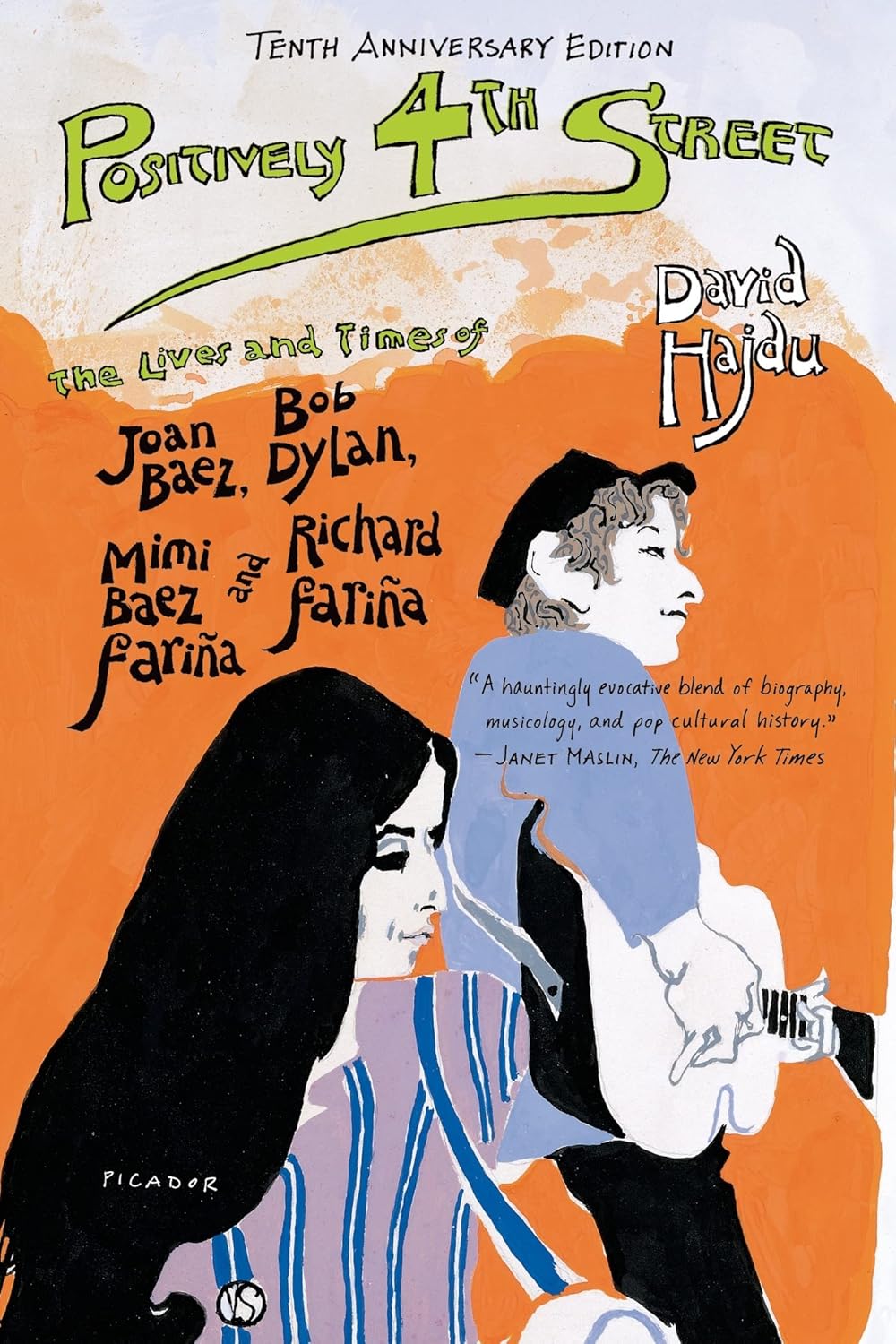
Of everything I’ve read, Positively 4th Street by David Hajdu provides the best account of Dylan, Baez, and the Folk Revival movement of the late 1950s and early 1960s. I just reread it for the third time because it was selected by my nonfiction book club. I assume the others voted for it because of the film A Complete Unknown. This 2001 book is out of print except for Kindle and audiobook on Amazon.
A Complete Unknown claims Dylan broke with the Folk Music crowd when he went electric. Positively 4th Street documents how he left Folk Music with his second album, The Freewheelin’ Bob Dylan. The Folk Music Revival was about rediscovering, recreating, and reinterpreting historical music from many subcultures and countries. As soon as Dylan and others started writing their own songs, they became singer-songwriters. That was a new music genre. Those artists left folk music behind, and changed pop music, and rock and roll.
The Sixties can be remembered in many ways. There was a great deal of turbulent political change. Many histories of the Sixties are quite ugly. But the counterculture remembers it as a transcendental revolution. I did for most of my life. On this third reading of Positively 4th Street, I’m seeing evidence that undermines that perspective.
In my book club’s discussion group, David wrote:
I almost gave up on Positively 4th Street because of the gossip and drama described in the personal lives of some of my most admired musicians who were icons of the age of the folk era in the late 50s and early 60s.


I am not one for gossip that appears in People Magazine and ET describing the drama of celebrities, but when I learn about the personal lives of some of the great artists I wonder how they ever produced things of such beauty, truth, and goodness.


So I got thinking, is “narcissistic arrogance” a necessary ingredient for a person to create great art?
My reply was successful people often come across as assholes because of their relentless self-promotion. After reading David’s comments, I paid attention to their validity while rereading the book. It became quite apparent that these icons of the Sixties were chasing fame and fortune first. To reach the top of the creative heap means brutal competition. That often meant demeaning their peers. I need to rewatch A Complete Unknown to see how it interprets this aspect.
To think Dylan broke with the Folk Music Revival crowd when he went electric in 1965 is to miss the mark by a mile. Dylan had already blown through several artistic phases by 1965. Who can imagine where the man is at sixty years later.
I was thirteen when I first heard “Like a Rolling Stone.” I thought it would be fantastic to become a singer-songwriter like Dylan, or an astronaut like Wally Schirra, or a science fiction writer like Robert A. Heinlein. I couldn’t imagine what it would take to become successful like those famous men. Years later, I learned I didn’t have what it takes, but more importantly, I didn’t really want to be successful like Dylan, Schirra, and Heinlein. Reading Positively 4th Street reveals the low-level personality details I didn’t understand at thirteen.
Positively 4th Street is a wonderful, detailed history of a tiny creative scene that occurred from 1959 to 1966. David Hajdu culled the significant facts to tell this history, making it vivid and maybe even somewhat close to the truth.
While reading, I’ve listened to the folk albums mentioned in the book, and I’ve discovered that I don’t particularly like songs from the folk music revival. They are historically interesting, but they don’t press my emotional buttons like rock and roll or classic rock. It’s understandable why Dylan quickly fled the movement. The Beatles and the British Invasion buried the Folk Music revival.
Still, Positively 4th Street is an engaging history to read.
JWH
 Auxiliary Memory