Old Man vs. Front Lawn (Round 2)

by James Wallace Harris, 10/25/24

Like I said in the first round, I don’t care about having a perfect lawn. I’m using converting my front lawn from mostly dirt to mostly anything green as a physical challenge to improve my health and stamina. Because I suffer from spinal stenosis, sciatica, neuropathy in my legs, and muscle spasms in my lower back, I can’t do much physically. However, I’m testing the theory that if I slowly do a little more, I can eventually do a lot more. It’s also a way of psyching myself out. I want to believe that I’m not too old to keep doing certain things.

This effort has worked out some. I started out wearing myself out in ten or fifteen minutes. But now, I can work up to an hour on some days. But on most days, I usually spend just twenty minutes twice a day watering the new grass. I also bought the book Back Mechanic whose author, Stuart McGill proposes that back pain is often due to weak muscles and that strengthening them will eliminate back pain. I’m hoping yard work will strengthen my core muscles.

In round two I’ve learned several new things about yardwork and about my health. Having a new challenge is good for me mentally. I dislike doing yardwork, but my body doesn’t like being sedentary. I also dislike being outdoors but being outside in my front yard is teaching me about nature, getting me to learn new skills, encouraging me to talk to my neighbors and introducing me to all the walkers, runners, roller skaters, and dog owners in the neighborhood.

Initially, I thought growing new grass would only entail spreading seeds, fertilizing, and watering twice a day for a few weeks until the grass grew in. It hasn’t been that easy.

My ground is very compact and hard. The seeds only spouted in random places. Then fall began, and leaves started covering the new grass, killing it. Damn.

I called my yard guy to come remove the leaves early. That was Monday. It’s now Friday, and the leaves are back. I’m going to need to have the leaves removed every three or four days. I can’t afford that. I bought a Worx corded leaf blower and a 100 ft. extension cord.

This morning, I tried blowing the leaves myself and made a major discovery. Besides blowing the leaves, the leaf blower blows away all the loose dirt. No wonder my ground is so hard and compact. The grass seeds struggled to pierce the smooth hard soil with their tiny roots, so I need lots of loose dirt. That means no more leaf blowing. (I did learn the leaf blower is great at cleaning off walkways, driveways, and patios, so I’ll keep it. I also imagine, if I had a thick lawn, the blower would only blow leaves.)

I need to rake the leaves manually or consider mulching them with a mower. I also need to buy several loads to topsoil and spread it over my front yard. What have I gotten myself into?

And where there aren’t bald hard dirt spots, there’s thick weeds, old crabgrass, and patches of my new grass. I’ve discovered I need to dethatch my lawn. Before I started this project, I didn’t even know that was a thing.

I bought the corded Worx leaf blower because it was cheaper and blew stronger than a battery-powered leaf blower. But I quickly learned that working with a cord is a pain. For some reason, most of the lawn geek YouTubers use corded dethatching machines. I need to research if a battery-operated dethatching machine works as well as a corded one. I’d probably only use it once or twice a year, that is if all that leaf raking doesn’t kill me first (and I give up on this project). (I also bought a 16-gauge extension cord, and it gets warm. I bet need to buy a more expensive 12-gauge cord.)

This isn’t all I’ve learned in Round 2. I’ve now bought enough garden tools and machines that I need to buy a toolshed. Maintaining a yard requires a great deal of work and a lot of equipment. I’m back to fantasizing about living in an apartment again. But then I wouldn’t have this useful purpose that helps me mentally and physically. (That’s me trying to psyche myself up.)

I’m considering trying a third seeding. My neighbor who had a groundskeeping company in his younger days, recommended I try winter rye. Can rye and tall fescue coexist? This project also involves learning a lot of new things about how nature works.

Do I have enough time before the first freeze to get some grass seeds to germinate and grow a few inches? To do it properly, I’d need run the dethatch machine with both the dethatch and scarifier blades over the lawn. Spread the seeds. Then put down some garden soil, peatmoss, or compost lightly over the seeds. And keep watering twice a day. Also do some more fertilizing. I don’t know if I have the energy for all that right now.

This is never ending. Being a lazy couch potato was so much easier.

Maybe I should put all this off until spring and see how much grass I grow from my first two seedings. It’s coming up good in some places.

I could stick to watering and raking for the rest of the year – that should be plenty of exercise and outdoor activity. Raking should loosen up the soil some, but mulching might add to the soil. I got to research that to see which is best. I can’t stop thinking about all the options. I need to AI program to help me.

I hadn’t realized how much I was killing my grass by leaving the leaves on it until Thanksgiving, and then again to Christmas.

I’ve taken a beating in round two. I’m tired, but not hurting too bad. I’m trying to figure how much should I push myself in round three. Should I just continue with what I’ve started, or push myself to a new effort level before winter comes in?

I do know that all this yardwork is draining away all my energy for doing hobbies inside the house. I wanted to believe that exercising would give me more energy, but so far that hasn’t work out.

JWH
Old Man vs. Front Lawn (Round 1)

by James Wallace Harris, 10/20/24

I grew up in the 1960s embracing the counterculture, so when I think of manicured lawns of suburbia I think of conformity and the song by the Monkees, “Pleasant Valley Sunday.” That song written by Carole King and Gerry Goffin contains the line, “Here in status symbol land.” That has always made me think poorly about lawncare.

Fifty-seven years after that song was popular, I’m now worrying about growing grass on my front lawn. I can’t believe it. How bourgeoisie of me. How anti-environmental. I’m not coveting a golf course lawn, just something that’s not mostly brown dirt, something that’s mostly green.

I live on a street that in one direction the homeowners have been having their lawns replaced with sod and sprinkler systems. Their lawns are uniform and beautifully green. In the other direction, the quality of lawn care falls off. So, depending which way I drive up to my house, I feel average or embarrassed. I guess the guilt of not living up to the suburban social contract is getting to me. My lawn looked awful. It was becoming dirt with vegetative patches, and what green stuff that did grow was mostly weeds.

Susan and I priced going the sod and sprinkler route, but I just won’t pay that kind of money to have a green monoculture in my front yard. However, I have thought about how to put a positive spin on this problem.

I don’t get much exercise. Partly that’s due to being lazy, and partly due to being old and broken. I got to wondering. I thought maybe working in the yard would be good exercise and it would ultimately give me more stamina and strength. I got on YouTube and started researching lawn maintenance. There’s a whole world of lawn nerds out there with plenty of advice.

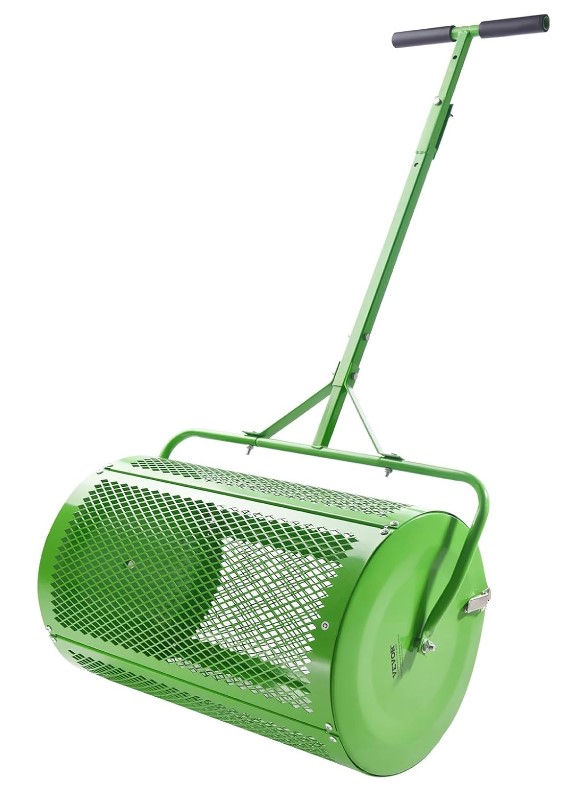
I bought enough tall fescue seeds to cover the 6,000 square feet of front law and a Scotts Edge Guard Mini seed spreader. I’m not going to worry about the backyard for now, mainly because no one sees it. But it’s a jungle. I also bought a compost/dirt/peat moss spreader (a cheap Landzie knockoff) and covered the seeds with a light layer of garden soil. Then I started watering twice a day.

After a couple of weeks, I was seeing new grass in some places, but not in other places. But I was also having back problems for the first time in months. Normally, I keep my spinal stenosis under control with daily physical therapy exercises and fifteen minutes of 15-degree inversion. But that was no longer enough. I now had to resort to heating pads and pain pills.

I thought about giving up. But I kept pushing myself. I exercised, took my pills, rested on the heating pad, and then went to Home Depot and bought more bags of garden soil, another twenty pounds of Sun & Shade tall fescue seeds, and bags of decorative rocks. Ninety-two pounds in all that trip. I wore my back out, but I put in a second planting of seeds.

I rested up, stabilized my back and went back to watering twice a day. By now, the leaves had started falling, and I was afraid they would kill the new grass by shading it from the sun. I started raking the leaves off the new grass. That really bothered my back. Maybe because I was twisting in new ways.

Which brings me up to now. Yesterday I didn’t do anything and gave my back a rest. I do feel I have more stamina then when I started this project. When I started working in the yard, I could only work just ten minutes, and that wore me out. It was still hot then. I now can put up to a whole hour’s worth of work in before my back makes me go back in, but then it’s cooler. To recover, I need the heating pad and pills again until the next day.

I turn seventy-three next month. I’m wondering just how much I can push my body. I know exercise improves things, but for how long? Since we all die in the end, I have to assume that we can’t always use exercise to extend our health. I watched this video today titled: “Is Exercise a Magic Bullet for Longevity?

It featured a graph that suggests that most people break down in their seventies. It also showed that in some societies, especially where people work hard all their lives, tend to have more folks active in their later years. But even still, for most people, the seventies are when we break down.

I don’t really care about having a beautiful lawn. I just trying to get something green to grow while testing how much I can push my body. Growing grass is like taking the GRE to see how well I might do in graduate school, but instead it tests how well I might do physically in my seventies.

But as I spend more time working on my front lawn, the more I see that needs to be done. My front yard is on a hill that drops several feet to the street. And it’s eroding. The sewer pipe is becoming exposed in one place, and roots to the big tree in the front yard are showing. I need to get several loads of dirt and sand and start building the yard back up. And the flowerbeds are full of weeds, dying azaleas, crazy holly, and vines that want to grow up the walls of the house.

Instead of fighting the Battle of the Bulge, I’m fight the Battle of the Lawn. I need to arm myself with chainsaws and weed whackers. I just don’t know if I can physically handle all of this. My friend Janis, her father is almost 100, and still works in the yard. Can I physically get into shape so I can do all the yard work I need to do? I don’t know. Maybe I’ll die trying. I can picture myself like Redd Foxx as Fred Sanford clutching my chest while standing in a pile of leaves shouting “This is the big one!” I’m not sure I want to die for lawncare, but I’m not sure I want to die watching YouTube either.

Maybe I’ll get into shape and live to be a 100 and do something else.

JWH

The Impact of Atheism on Well-Manicured Lawns

When I think of good Christians I think of close-knit families with spotless houses and beautiful lawns.  The most successful people I know, those whose lives are full of love and happiness, are my Christian friends, because I equate big loving families with social success.  These same people have great houses and yards.  Most of my non-believing friends tend to be childless, and like myself, self-centered, and our homes and yards show a difference.  Its odd, but I think our philosophical differences are reflected how our lawns compare.  My neighbors with the best lawns seem to be family oriented and Christian, whereas my own lawn is weedy and chaotic.  And the lawns of my Christian friends who don’t have children seem to fall in between.

The history of western civilization and Christianity has been one long war with nature.  Christians believe they have dominion over the Earth and wish to subdue nature.  That’s reflected in their lawns and gardens.  A well ordered yard reflects a well ordered mind, or so we thought.

lawn2 

The faithful think atheists are amoral, but most ardent nonbelievers I know tend to be liberal with strong beliefs about improving society, helping the needy and living ethical lives, but sometimes our personal habits reflect disorder.  Atheists I would contend, lean towards embracing nature, rather than ruling over it.  If I had my druthers I’d let my yard run wild and encourage more wildlife to settle in it.  We use to have a fox that lived in my neighborhood that would run through my backyard, but sadly it was killed by a car.  I’m not totally crazy—I don’t want nature coming in my house, but as long as fellow creatures don’t attack me, I don’t mind sharing my yard with as many plants, animals and insects as the natural ecology allows.

I want a Darwinian lawn.  I also want a lawn that helps the Earth and our species.  I want to lawn to helps other species from going extinct.  I want to coexist with nature and not dominate it.

I’ve often wondered about landscaping my yard so it would be perfectly adaptable to our changing climate.  I’d like the plants and other living things to adapt to the emerging weather patterns so I wouldn’t have to fertilize and water anything.  I’m not sure my neighbors and zoning czars would think about that though.  However, as soon as the perils of climate change are accepted by good Christians and they realize they must be stewards of the Earth and not conquerors, they might change their minds too.

For all their talk of heaven, Christians embrace life on Earth.  Deep down they aren’t the kind of people who commit suicide or pull the plug when the going gets tough.  They fight for life to the bitter end—and when it becomes all too obvious that they are committing species-cide they might change their minds.   We atheists accept personal extinction, but we hate the thought of humans dying off.  One day, both sides of the spiritual divide might agree on a new approach to lawn care.

For every gallon of gas you burn the warmer you make it for your descendants.  For every pesticide you add to the environment the more you poison your children, their children, and their children’s children, and so on until the Earth is cleaned up.  Denying manmade climate change is denying your own sins against the Earth, and the crimes you are committing  today will burden far more than three generations.  Easy Christianity has convinced millions to shirk their debts, because isn’t sin incurring debts to others? 

Okay, I’m an atheist, so I can’t expect you to speak my language, so let me try to speak yours.  One Christian book that impressed me was The Cost of Discipleship by Dietrich Bonhoeffer.   Modern Christianity has made the pardon of sins way too easy.  There has to be more to grace than just claiming belief.  What humanity has done to planet Earth is one giant cross that we must all bear.   You can’t escape your sins by denying they exist anymore than running away from them by believing.  We live by our actions, and any grace you seek must be earned by how you live and not how you think.

JWH – 5/12/14