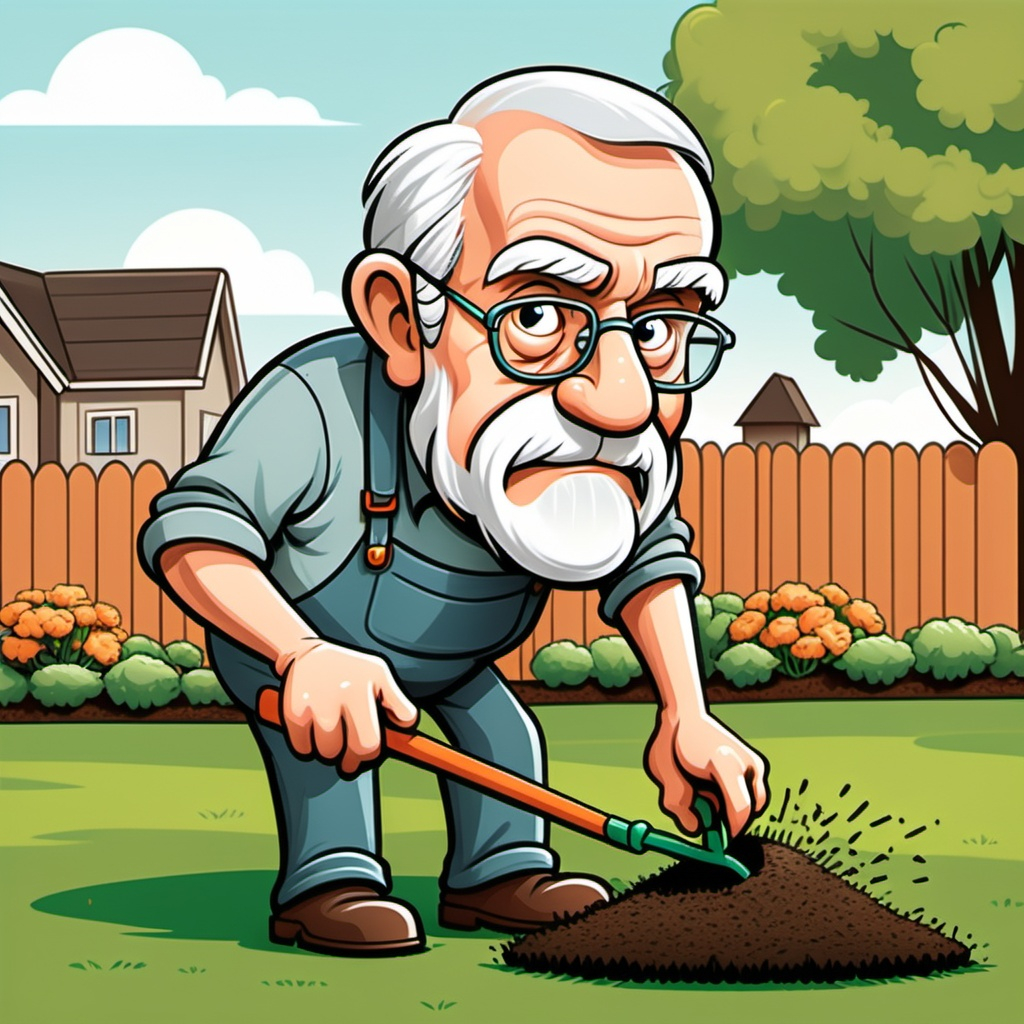
Old Man vs. Front Lawn (Round 1)

by James Wallace Harris, 10/20/24

I grew up in the 1960s embracing the counterculture, so when I think of manicured lawns of suburbia I think of conformity and the song by the Monkees, “Pleasant Valley Sunday.” That song written by Carole King and Gerry Goffin contains the line, “Here in status symbol land.” That has always made me think poorly about lawncare.

Fifty-seven years after that song was popular, I’m now worrying about growing grass on my front lawn. I can’t believe it. How bourgeoisie of me. How anti-environmental. I’m not coveting a golf course lawn, just something that’s not mostly brown dirt, something that’s mostly green.

I live on a street that in one direction the homeowners have been having their lawns replaced with sod and sprinkler systems. Their lawns are uniform and beautifully green. In the other direction, the quality of lawn care falls off. So, depending which way I drive up to my house, I feel average or embarrassed. I guess the guilt of not living up to the suburban social contract is getting to me. My lawn looked awful. It was becoming dirt with vegetative patches, and what green stuff that did grow was mostly weeds.

Susan and I priced going the sod and sprinkler route, but I just won’t pay that kind of money to have a green monoculture in my front yard. However, I have thought about how to put a positive spin on this problem.

I don’t get much exercise. Partly that’s due to being lazy, and partly due to being old and broken. I got to wondering. I thought maybe working in the yard would be good exercise and it would ultimately give me more stamina and strength. I got on YouTube and started researching lawn maintenance. There’s a whole world of lawn nerds out there with plenty of advice.
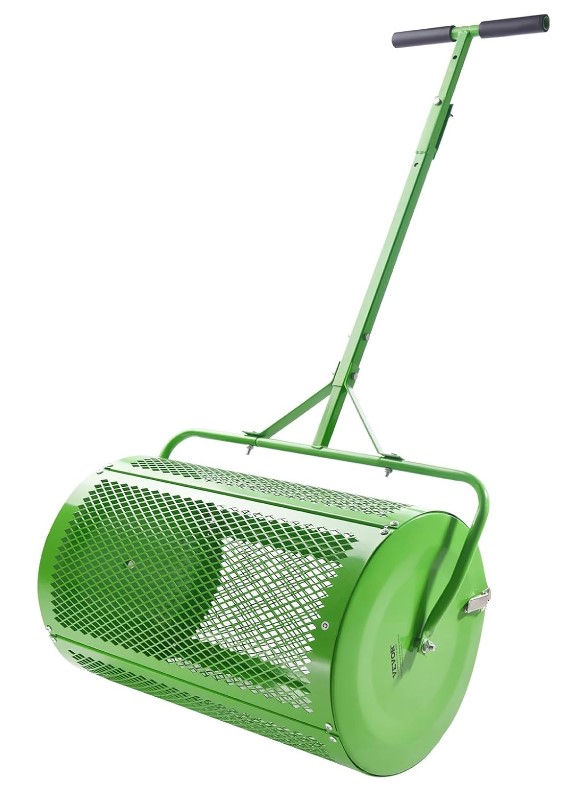
I bought enough tall fescue seeds to cover the 6,000 square feet of front law and a Scotts Edge Guard Mini seed spreader. I’m not going to worry about the backyard for now, mainly because no one sees it. But it’s a jungle. I also bought a compost/dirt/peat moss spreader (a cheap Landzie knockoff) and covered the seeds with a light layer of garden soil. Then I started watering twice a day.

After a couple of weeks, I was seeing new grass in some places, but not in other places. But I was also having back problems for the first time in months. Normally, I keep my spinal stenosis under control with daily physical therapy exercises and fifteen minutes of 15-degree inversion. But that was no longer enough. I now had to resort to heating pads and pain pills.

I thought about giving up. But I kept pushing myself. I exercised, took my pills, rested on the heating pad, and then went to Home Depot and bought more bags of garden soil, another twenty pounds of Sun & Shade tall fescue seeds, and bags of decorative rocks. Ninety-two pounds in all that trip. I wore my back out, but I put in a second planting of seeds.

I rested up, stabilized my back and went back to watering twice a day. By now, the leaves had started falling, and I was afraid they would kill the new grass by shading it from the sun. I started raking the leaves off the new grass. That really bothered my back. Maybe because I was twisting in new ways.

Which brings me up to now. Yesterday I didn’t do anything and gave my back a rest. I do feel I have more stamina then when I started this project. When I started working in the yard, I could only work just ten minutes, and that wore me out. It was still hot then. I now can put up to a whole hour’s worth of work in before my back makes me go back in, but then it’s cooler. To recover, I need the heating pad and pills again until the next day.

I turn seventy-three next month. I’m wondering just how much I can push my body. I know exercise improves things, but for how long? Since we all die in the end, I have to assume that we can’t always use exercise to extend our health. I watched this video today titled: “Is Exercise a Magic Bullet for Longevity?

It featured a graph that suggests that most people break down in their seventies. It also showed that in some societies, especially where people work hard all their lives, tend to have more folks active in their later years. But even still, for most people, the seventies are when we break down.

I don’t really care about having a beautiful lawn. I just trying to get something green to grow while testing how much I can push my body. Growing grass is like taking the GRE to see how well I might do in graduate school, but instead it tests how well I might do physically in my seventies.

But as I spend more time working on my front lawn, the more I see that needs to be done. My front yard is on a hill that drops several feet to the street. And it’s eroding. The sewer pipe is becoming exposed in one place, and roots to the big tree in the front yard are showing. I need to get several loads of dirt and sand and start building the yard back up. And the flowerbeds are full of weeds, dying azaleas, crazy holly, and vines that want to grow up the walls of the house.

Instead of fighting the Battle of the Bulge, I’m fight the Battle of the Lawn. I need to arm myself with chainsaws and weed whackers. I just don’t know if I can physically handle all of this. My friend Janis, her father is almost 100, and still works in the yard. Can I physically get into shape so I can do all the yard work I need to do? I don’t know. Maybe I’ll die trying. I can picture myself like Redd Foxx as Fred Sanford clutching my chest while standing in a pile of leaves shouting “This is the big one!” I’m not sure I want to die for lawncare, but I’m not sure I want to die watching YouTube either.

Maybe I’ll get into shape and live to be a 100 and do something else.

JWH
Am I Ill, Or Just Getting Old?

by James Wallace Harris, Sunday, May 6, 2018

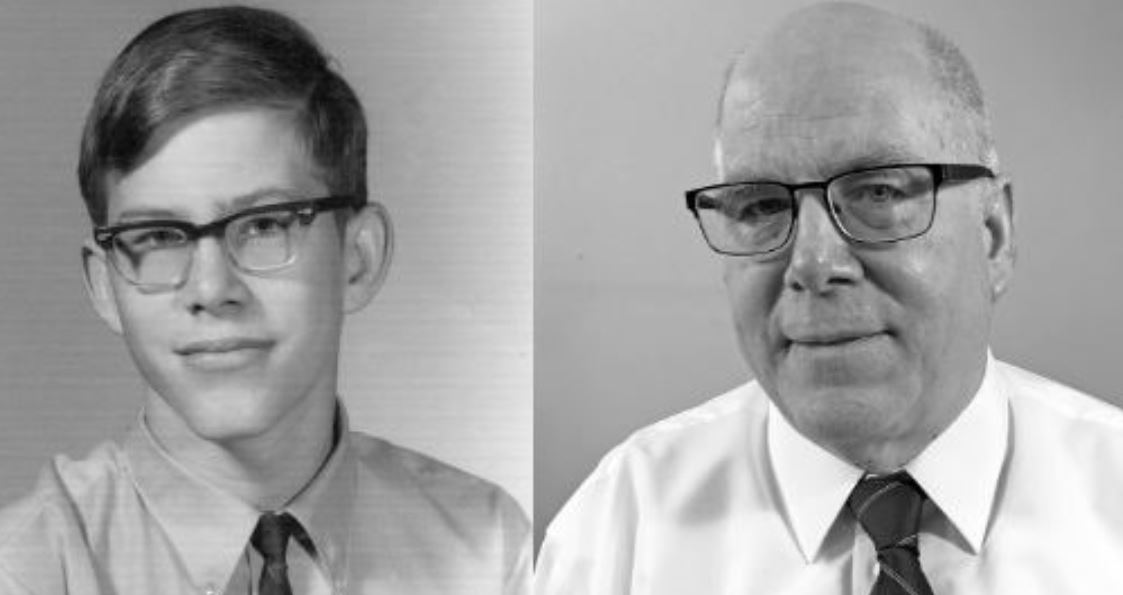
When I was young I thought growing old meant going bald and getting wrinkles. That didn’t seem too bad. I assumed I would stay the same mentally. When I was young I felt great most of the time, hardly ever got sick, and I wasn’t bothered by heat or cold. We didn’t have air conditioning until I was a senior in high school. At sixty-six I go years without getting a cold or the flu, but I do have chronic heart, stomach and back problems, and cold and heat annoys the crap out of me. I keep my chronic conditions in check with diet and exercise.

The trouble is, I don’t feel like I used to. Is that illness, or oldness.

Getting old

In recent years I’ve felt my vitality run down. I can’t decide if something is wrong with me, or this is what it feels like to get old. And I’m only young old. What will it feel like to be really old?

At my last physical my doctor said all my blood work looked good. My testosterone was at a proper level, various vitamins were on the mark, my protein level was fine, and a bunch of other numbers I didn’t understand were where they were supposed to be. She said I was doing pretty good. I needed to lose weight and lower my cholesterol, but she’s been saying that for decades. For years I’ve been eating healthier, lost some weight, and lowered my cholesterol. The only time she praised me for my cholesterol and weight were the periods I went vegan. However, I can’t keep that up.

The thing is I feel best when I’m eating sweets. Ice cream makes me feel younger. Junk food gives me mental energy, but it eventually makes me feel sick too. I constantly struggle with my diet to find the right mixture of healthy eating that gives me the most vitality, yet doesn’t lead to feeling bad.

Recently I started wondering if my problem wasn’t disease or diet, but I’m just aging. At my last physical, I asked my doctor, “How do you tell the difference between feeling old and feeling sick?” She laughed at me and gave me some sympathetic words I’ve forgotten. Besides feeling rundown, I can’t remember shit. And I was told that is normal too.

My wife thinks I’m a hypochondriac. I used to feel normal all the time, now normal is a rare few hours in the week. Is this the real reason why people hate getting old so much? Not for the decline in appearance, but the decline in feeling good?

I constantly read books about diet, health, and exercise. Many authors promise renewed vitality if I’d only do what they say. The problem is I don’t have the discipline or the vitality to consistently follow their advice. I was able to stick with a plant-based diet for several months. I lost thirty pounds, and my LDL went to 90. However, my energy levels dwindled away. I’ve since added yogurt, kefir, and eggs back into my diet and mental energy has returned, but not like it was. I’ve been a vegetarian since the 1960s, but always ate a lot of junk food. I’ve never been a high-energy person, but I was fine for a bookworm.

In my sixties, I’m feeling the creep of decay. I’ve fought it believing it could be cured. Now I’m wondering if it’s actually normal. Now I know why Ponce de Leon searched for the fountain of youth. Now I know why old people in my youth swilled Geritol. Now I understand my mother’s addiction to pain pills in her later life. Now I know why people hope B12 shots will give them a boost. It’s a shame that snorting cocaine is self-destructive because it sounds like a perfect drug for the Social Security years.

JWH

Rejuvenating With Miranda Esmonde-White

By James Wallace Harris, Thursday, August 11, 2016

Update: 1/3/19. I did the Miranda Esmonde-White exercises all year during 2018 and it's made a significant difference in reducing the pain in my back. Systematic stretching does wonders.

Last year I discovered Miranda Esmonde-White on a special for PBS, based on her book, Aging Backwards: Reverse the Aging Process and Look 10 Years Younger in 30 Minutes a Day. You can watch Esmonde-White lecture about aging backward here. Esmonde-White focuses on how a loss of muscle mass affects us as we age, claiming if we start stretching we can reverse the aging process. (If we don’t wait too late.) As we age, we shrink and begin to hunch over. If we start stretching before that process has gone too far, we can reverse it. Just watch her lecture. Esmonde-White was born in 1949 and is two years older than I am. She’s tall, agile, bendy, balanced and graceful. She looks and moves like a much younger person.

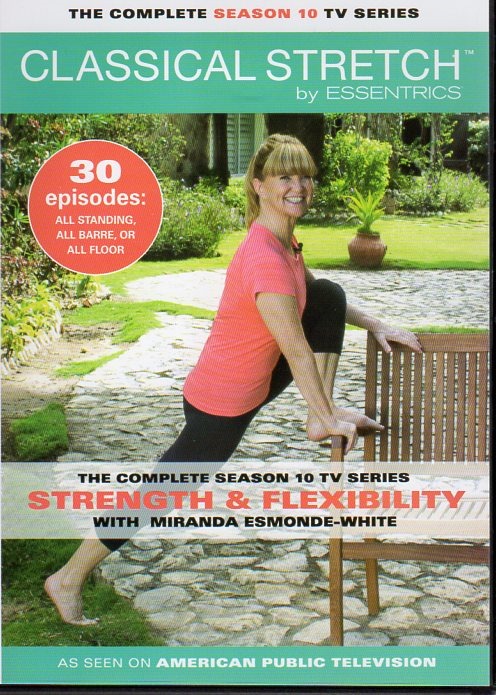
Classical Stretch 10

I was quite impressed with her PBS special and ordered three copies of Classical Stretch – The Esmonde Technique: Core Workout for Christmas presents. Two were for friends who never exercise, and one for Annie, who’s addicted to it. She loved the video and regularly uses it. My two friends who never exercises, and who will remain anonymous, never used their DVDs. But testimonials from Annie are making them reconsider. And now that I’ve started with the exercises, they are worried its catching.

I recently went off my diet. I lose discipline now and then, and binge on unhealthy food. I quickly gained five pounds, started skipping some of my daily physical therapy exercises, and my back went out. I immediately returned to my diet and exercise routine, and slowly started turning things around. But while this was happening, I decided to try the Classical Stretch program. I figured I could use some extra help. The Core Workout I bought my friends was 55 minutes and wanted something shorter to do before PT. I researched on Amazon and found Classical Stretch – The Esmonde Technique: Complete Season 10 – Strength and Flexibility.  Thirty 23-minute lessons. I thought $70 was kind of expensive for a 4-DVD set since for $65 I can buy the entire three seasons of Star Trek original series on Blu-ray. But what sold me were the customer reviews that claimed it help their backs. $70 is not much compared to doctor visits.

I’ve never liked going to the gym, and especially disliked exercise classes like yoga, even though I like the concept of yoga. What I like about Classical Stretch is Miranda Esmonde-White has designed a workout that’s appealing to the aging me that requires no extra equipment, special clothes, and can be done practically anywhere and anytime. She claims we have 650 muscles and we need to systematically stretch them. I’m just starting out with this workout but I can already feel the difference. My back recovered in days, much faster than usual. And the rest of me feels different too. Moving around is easier. I notice my body much less. That might not mean much to someone who is young, but getting older is all about noticing the body.

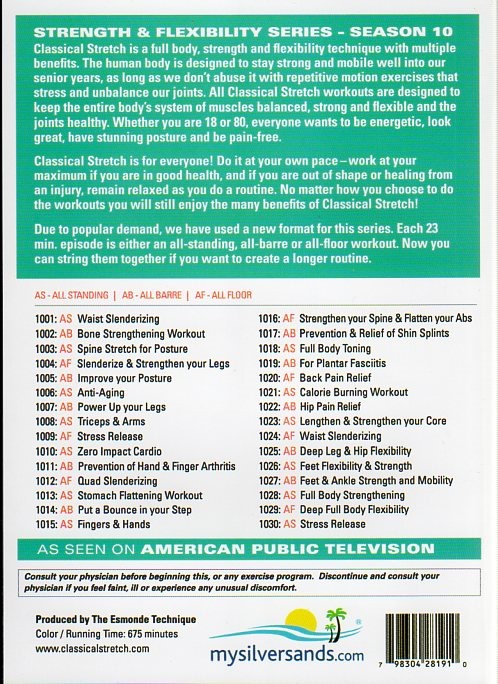
Don’t let me mislead you. These exercises are easy to try, but hard to follow exactly like Esmonde-White. I think it’s going to be a while before I’m doing them right. I feel like a gorilla taking ballet lessons. The daily lessons are varied, and I assume after weeks or months, I’ll memorize them and won’t need the videos. Click on the image of the back of the video box below. It lists all the thirty lessons.

I’ve always wondered why classes for aerobics, yoga, or Pilates were mostly filled by women. Now I know. This kind of exercising is like learning to dance. Most women I know love dancing. Guys generally don’t. I’ve always felt completely inept and foolish trying to dance. I’m doing these exercises alone, and I don’t even worry about what I look like, or that I’m not doing them perfectly – I just keep doing them. The 23 minutes goes by pretty fast. It’s not an aerobic workout, but I get a bit winded. Esmonde-White is right, these stretches make you feel younger – or at least looser. Whenever my back goes out, it feels like I age ten years. So when my back feels better, I feel younger.

I’m hoping if I make these exercises a permanent routine, I’ll actually rejuvenate. I limit my activities now because of my back problems. I’m faithful again to my plant-based diet and losing weight. I hope between weight loss and these exercises I’ll feel young enough to want to travel, or just be more active.

[click on covers to enlarge]

Classical Stretch 10 - frontClassical Stretch 10 - back

JWH

Health is Like a Laptop Battery

By James Wallace Harris, Monday, November 30, 2015

Health has to be more than the absence of disease. I sometimes hear the phrase “optimal health” or “maximum health” as if health is a fuel tank and we can fill her up. We often think of health as giving us vitality, but what then, is vitality? Our bodies and brains are the most complex “mechanism” we know of, but we can’t actually fathom how they work. Not without analogies. Our body is dead when we come to the end of health, and run out of vitality.

The ancient Greeks used the concept of the soul to explain how the body was animated. They claimed the soul made our limbs move, but that was long before science knew about different forms of energy. Getting old feels like we’re running down, running out of energy, or our mainspring needs rewinding. I shall make my philosophical analogy for health be the laptop battery. Before batteries, philosophers used the mechanical clock as a model. In the future, some future blogger will have a new technology to use in her essay.

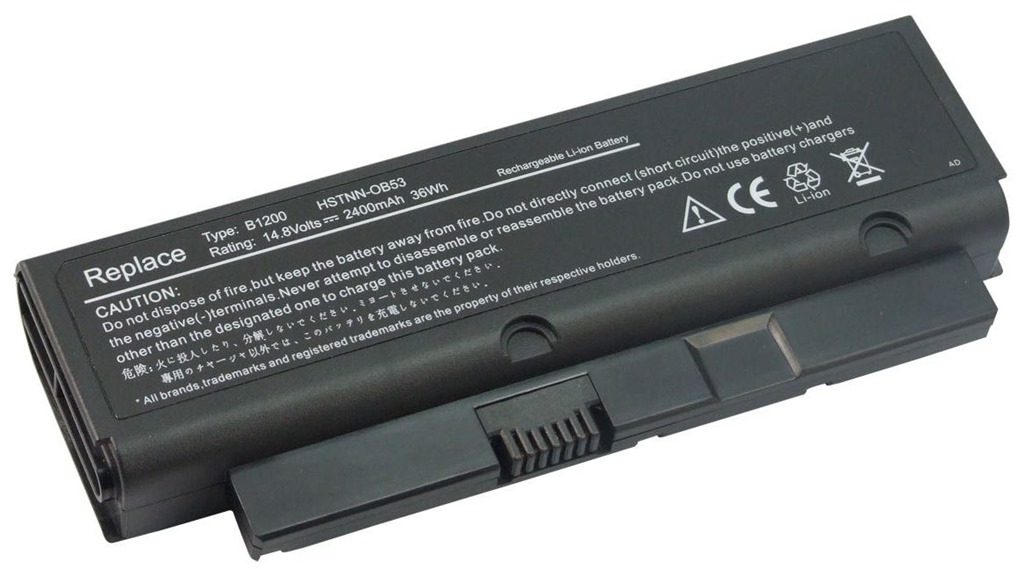
laptop battery

I went to my annual physical today, and told my doctor she made me nervous every time I visited her because it felt like I was up for an important examination. I worried I’d flunk. At the end of our visit, she laughed and told me I passed. But even though I passed, I don’t feel very healthy, or more precisely said, I don’t feel very energetic, not like when I was younger. At 64, I am not old, but I am not young either. I know my body and mind are in decline, and I wished I could recharge my battery to its maximum capacity again.

On my birthday, I went for a long walk in the botanic gardens with my friend Anne, and then she helped me change out a pole for my outdoor TV antenna. While I had the ladder out, I raked some leaves and limbs off the roof (I’m too old to be climbing on the roof). I probably spent two hours walking and climbing, and that exhausted me. It felt like all the cells in my body were screaming for glucose. When I was younger I could work ten hours at manual labor before I felt that way. Why does my battery run out of juice sooner now that I’m older? Health appears related to stamina, and stamina feels like energy. Does our battery for health shrink as we age? Does it become more inefficient?

If health is a full charge, then shouldn’t eating recharge our battery? Eating too much can make me lethargic. Eating the wrong foods can make me feel unhealthy. But it does feel if I eat the right foods, in the right amount, that I feel healthier. That I have more energy. When I was exhausted after my birthday efforts, I ate lunch, took a nap, and I felt better. But I didn’t feel back to normal until the next day, after two more meals and a good night’s sleep. Food and sleep can recharge my health battery, but only slowly, like how old laptops need longer hours plugged in to recharge.

Getting old feel exactly like an old computer battery that won’t hold a charge as long as it did when it was new. I think one reason why I don’t exert myself like I did when I was young is because I need to conserve my battery. Unfortunately, we can’t buy a new battery like we can for a laptop. Human bodies don’t have user replaceable batteries. Image if they did. I’d buy a high capacity one that recharges quickly.

Is it possible to recondition our built-in battery? When I was a kid, I could eat junk food all day long, and my battery didn’t wear down until the end of the day, often late into the night. Now I can burn up a full charge in a couple of hours. That sucks.

Getting old means learning how to nurse my battery to last out the day. I eat better to make my health recharging more efficient. I exercise to regain a bit of a charge, and keep my contacts from corroding. And sleep cleans out all the bad chemicals that using up a healthy charge creates in byproducts. We often euphemize sexual attraction as chemistry, but it seems everything about our body can be explained in terms of chemistry. Batteries are a chemical process.

Getting old means learning to be efficient. Getting old means learning to conserve energy wherever I can. It’s like being a hybrid car that does everything not to drain the battery, or even recharge on the go. Maybe I should use an electric car as my model of health. Then I could describe exercise as  regenerative charging.

No model is perfect. What I really want to know is exactly what to eat and when, that would optimize the functionality of my aging battery. How much exercise will recharge the system, and when does exercise deplete the daily charge I get from sleep? Sometimes naps are better for recharging than walks. Why? The new health mantra is “Sitting is the new smoking” but getting old seems to require more sitting. Hell, I could claim, “Napping is the new jogging.”

I just wished I knew how I worked. Reading about health, diet and exercise is very confusing. There’s no simple model to understand. I know my health is not an old laptop battery, but it certainly feels like one.

Essay #983 – Table of Contents

Treating Back Pain Without Drugs

Most people I meet with chronic back pain only fight the pain with drugs.  I’ve discovered some other techniques to try.  Overall, what I’ve learned is my back is trying to communicate with me and all pills do is tell it to shut up.

I am not a medical expert of any kind.  I’m only recounting my personal experience with living with back pain.  I’ve greatly benefited from going to physical therapy (PT) and the training the PT doctors gave me to do daily exercises on my own.  Although you can find all kinds of PT exercises for back pain online, I highly recommend talking to a doctor before doing any exercise if you are suffering from chronic back pain.  The point I want to make is I’ve discovered some ways to avoid back pain without depending on powerful drugs.

Years ago when my degenerative back disease began and I was in a lot of pain I took prescription pain pills and muscle relaxers, but when I learned my condition was chronic I stopped taking those pills

I have three kinds of symptoms:

  • inflammation/tension/tightness (lower back)
  • numbness/nerve sensations (foot and leg)
  • muscle pain (lower back, hip, leg)

The inflammation/tension/tightness is almost always present in my lower back but in varying degrees of discomfort.  If things get worse, my foot goes numb and the numbness works up my right leg.  When things get even worse, my left leg goes numb too.  When things get really bad I have increasing constant dull pain and infrequent sharp shooting pains in my lower back, hip and leg.

I can keep the sharp and shooting pains away if I do my PT exercises daily, do regularly rowing exercises on the Bowflex, and if I don’t walk or stand for longer than 10 minutes.

I can keep the numbness to a minimum if I take B vitamins and exercise regularly, and don’t stand straight or lie flat for any length of time.

I used to keep the inflammation/tension/tightness to a low level with anti-inflammation pills, over-the-counter pain pills and regular PT exercises.  However in recent months the anti-inflammation pills have messed up my stomach and intestines and I’ve had to stop them.*[See update below]  I’m learning how to keep this kind of pain at a minimum without those drugs by carefully babying my back and not inflaming it.  No lifting, lots of rest, more exercising.

I now ask younger people to lift stuff for me, and I even take the elevator sometimes.  I’m getting old and creaky.

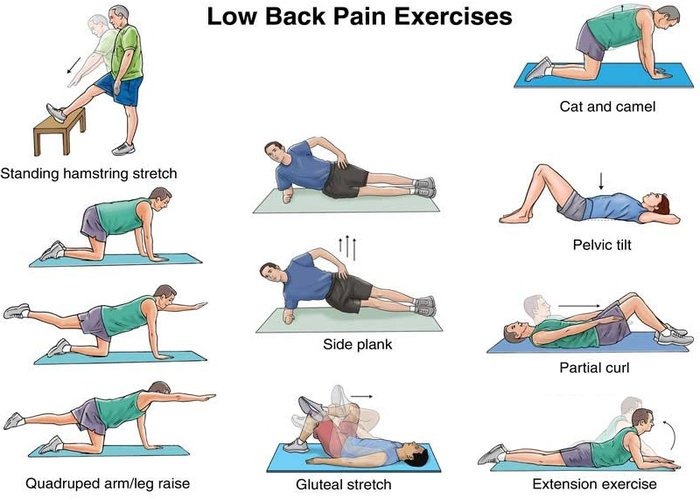
The exercises I learned from my PT classes are very simple, like these:

back-exercise

I’m writing this because I’ve had to stop taking any anti-inflammation medicine because it’s tore up my stomach and intestines, and I’ve learned that I can get about the same relief without those drugs if I’m careful.  Although my doctors have prescribed some powerful pain pills I’ve avoided taking them.  I have lived off of various anti-inflammation drugs over the last few years, but I can’t take them anymore.  Doctors keep prescribing drugs that are easier on the stomach, but evidently my stomach is on the wimpy side, or years of taking pills have beaten it up badly.

I’ve always liked the anti-inflammation drugs because they reduce the feeling of inflammation and tension in my lower back, but when I had to quit these drugs I realized that those drugs were the cause of some of that inflammation.  Taking a pill would reduce the tension, and the wearing off the pill hours later would make it spring back.   After several days of not taking the anti-inflammation pills, I had much less inflammation and tension.  I’ve started and quit several different kinds of anti-inflammation pills and I’ve noticed this affect twice now.

Lower back tightness and inflammation builds up during the workday, especially when I do a lot of walking and standing, and time and again I’ve discovered I can quiet my back by just exercising and/or resting.  That made me think some of the stuff I was feeling as inflammation was drug withdrawal or drug craving.

I’ve been dealing with my back problem for years and it’s a degenerative disease.  Walking, standing, or lying flat makes my back worse, so I’ve learned to live with limitations by altering my lifestyle.  For instance I no longer sleep in a bed.  Sleeping in a recliner significantly reduced my daily pain.  Not walking for exercise reduced my pain.  Getting a better office chair at work and home help too.

I also bought Z-Coil shoes and they have been a huge help.  Before I got Z-Coil shoes when my back was stressed I’d get weird sensations when walking.  I’d feel like I was stepping into a hole or sliding on ice with some steps.  I assumed I was compressing a nerve.  The Z-Coil shoes act like a shock absorber so I don’t compress the nerve and feel those weird sensations.  I also tried Gravity Defyers but their springs weren’t powerful enough to help me.  Z-Coil springs are very large and visible so they are very ugly shoes, but I wear them because they let me keep working, and they let me walk further than I can without them.

Z-Coil shoe
Z-Coil shoe

I’ve tried all kinds of drugs over the years, various pain pills, muscle relaxers, and anti-inflammation meds.  For my particular problem I’ve learned that physical therapy is the most effective treatment.  I do take an occasional Tylenol or aspirin, but daily PT is best.  If I don’t do my PT my back will slowly tense up, and over days I’ll get hip pain, pain down the leg, and numbness in my foot, and then a lot of lower back pain.  When the pain is very bad I have a hard time getting up or down.  Doing daily physical therapy keeps the worst pain away.

I seldom skip my daily PT, and when I do, I regret it.

I still have a certain amount of discomfort, but not the major pain.  I’ve learned I need to do  Bowflex exercises once a day to reduce a lot of tension in my lower back and fight off leg numbness.  I do a rowing exercise daily, just 130 strokes.  I’ve also learned from trial and error that taking a B-complex vitamin reduces the numbness in my foot and leg.

The last technique I’m working on to help myself is losing weight.  I’ve been overweight for decades, and at 235 pounds, just existing is like carry two sacks of cement with me at all time.  However, feeling bad makes me eat, so I’m always gaining weight.  When I get up to 240 my back gets much worse and that pain makes me diet for awhile.  As I drop back to 230 it gets better, I treat myself to junk food, and then I yo-yo back up to 240.  I’m hoping in the next year to get down to 200.

My back doctor has told me time and again to avoid surgery at all costs.  And before I consider surgery to try nerve block shots.  I’ve never liked the idea of nerve block shots and now they are in the news because of contamination, I doubt I’ll ever try them.  I did hear about a new surgical technique that’s just finished clinical trials and could come online in 2014.  The new technique involves regenerating the discs in the back, and I like that idea.  So I’m hoping exercise and losing weight will keep me going until this new technique is FDA approved and my insurance covers it.

JWH – 12/2/12

*Update 1/16/14

Last year I learned I had problems with gluten and gave it up.  I did it because of stomach and chest pains, which went away immediately.  But over the weeks of going without gluten I realized my inflammation was much improved and much of my joint pain had disappeared.  My knees seem twenty years younger.  I still have problems with the spinal stenosis, but much of my other pain has disappeared.  Over time going without gluten has made me feel much better.

I’ve told some of my friends about pain reduction through avoiding gluten, and one lady who had regular joint and arthritis pain gave up gluten and she reported she was eventually able to go without her pain pills.  If you have chronic pain of any sort, you might experiment with going gluten free and see if it helps.

Table of Contents