
The Chinese have big plans to explore space, and they are sending manned missions into orbit like the United States and Russia did in the mid-1960s. The Chinese even say they are going to the Moon. I think that’s great, and I imagine it’s a very exciting time to be Chinese. Not only are they going to become a leading space exploration nation, but in the last few decades their economy has gone from poverty to an economic miracle. All of this should have inspired their science fiction writers to write some amazing science fiction.
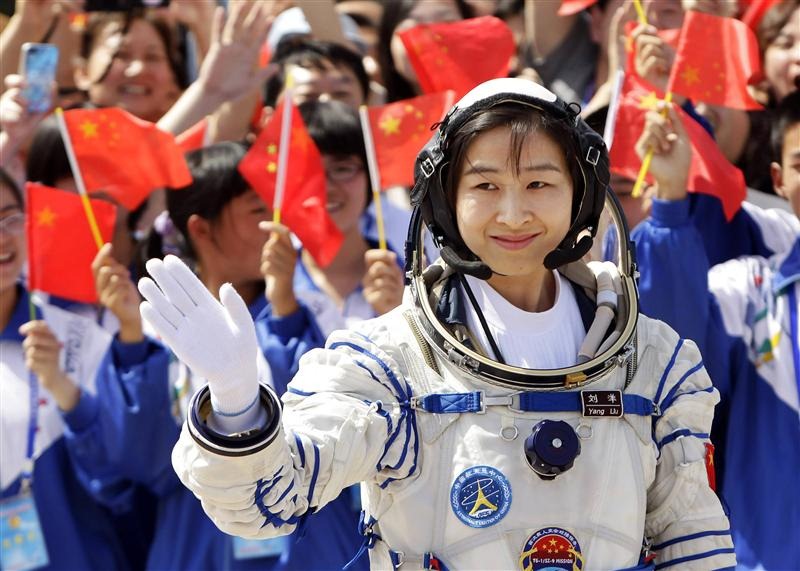
The 1950s and 1960s were very exciting times for America as we went into space, and those decades were my favorite for science fiction. At the time, the sky was no longer the limit until we succeeded. 1969, we went to the Moon and everyone thought we’d keep going, by 1972, we stopped going anywhere but low Earth orbit. Will it be different this time for the Chinese? Will it be to infinity and beyond? Will they go to the Moon, and then keep going like we dreamed back in the 1960s?
I would imagine China is living through its version of our 1960s. Culturally and artistically they should be blasting off in all areas of life.
How are Chinese science fiction writers picturing their future in science fiction novels, television shows and movies? Who are their big three like Heinlein-Clarke-Asimov were in the 1950s and 1960s? Do the Chinese have a Gene Roddenberry? Do they have an old guard and young upstarts like our 1960s Samuel R. Delany, Roger Zelazny and Harlan Ellison?
We get very little news from China. It’s on the other side of the world, and they speak a very different language. Taking the pulse of Chinese science fiction is rather difficult. There is The World SF Blog that covers the entire world, and from there I found World Chinese-language Science Fiction Research Workshop. From there I found a link to “But Some of Us are Looking at the Stars” by Kun Kun, which profiled Liu Cixin, who has a handful of novellas and short stories at Amazon for the Kindle. I found more about Liu Cixin and a history of Chinese science fiction at “Utopia, Dystopia, Heterotopias: From Lu Xun to Liu Cixin.”
China Daily did a profile on Liu Cixin and an overview of his books. I’d like to read the books they describe, but other than the character names, their plots don’t seem uniquely Chinese. Are science fiction and fantasy themes just universal? Like English writers, Liu Cixin writes about threats to the Earth, either from natural forces or alien forces. I was hoping for stories about China exploring the solar system and building colonies. Maybe the Chinese people have already learned from us that few people want to colonize the Moon and Mars.
I bought Liu Cixin’s “The Wandering Earth” but it reminds me more of England’s contemporary New Space Opera movement. It’s about the Sun going red giant much earlier than expected and how Earthmen cope. But it also reminded me of something that shatters my illusions about the SF of the 1950s and 1960s. Most SF is about catastrophes, or war, or warnings about self-destruction. SF needs conflict, and all too often it’s bleak.
For some reason my nostalgia for 1950s and 1960s is confused in my memories of the excitement for the 1960s manned space programs like Mercury, Gemini and Apollo, as well as the Mariner missions to Mars. Back then, as a teen, I equated science fiction as the cheerleading squad for the space program, and it never really was that.
I do wonder if a boom in science fiction correlates with an expanding space program? Does going into space inspire the average citizen into thinking about their descendants living in space? I think the American experience has shown that there is a disconnect between now and a Star Trek future. People want space travel to be luxury class, not pioneering in covered wagons. There’s damn little science fiction about actually doing the hard work of colonizing the solar system. We loved Star Trek because all the dirty work had been done.
Very few 1950s and 1960s science fiction books were about the joys of pioneering space travel. And the ones I remember best, were all Heinlein juveniles like The Rolling Stones, Time for the Stars, Starman Jones, and Farmer in the Sky. Have Space Suit-Will Travel had a lot of sense of wonder space travel in it, but it was mostly about interstellar conflict and judging species on their aggression. Many other classic science fiction stories at the time had space travel in them, but space travel wasn’t the main theme of the story.
The Foundation stories by Asimov had lots of space travel, but it was about the rise and fall of a galactic empire, and space travel was about as important as airplanes are to stories in The New Yorker today. I’ve always had this false assumption that science fiction was about promoting the colonization of the final frontier. But if I look at the popular books of the time that isn’t reflected. Here are the 1960s books from The Classics of Science Fiction List. [The number states the number of citations that recommended the book.]
| 1960 | Canticle for Leibowitz, A | Miller, Walter M. | 24 |
| 1960 | Deathworld | Harrison, Harry | 7 |
| 1960 | Rogue Moon | Budrys, Algis | 11 |
| 1961 | Big Time, The | Leiber, Fritz | 10 |
| 1961 | Dark Universe | Galouye, Daniel F. | 7 |
| 1961 | Lovers, The | Farmer, Philip Jose | 9 |
| 1961 | Stranger in a Strange Land | Heinlein, Robert A. | 19 |
| 1962 | Clockwork Orange, A | Burgess, Anthony | 16 |
| 1962 | Drowned World, The | Ballard, J. G. | 8 |
| 1962 | Long Afternoon of Earth, The (Hothouse) | Aldiss, Brian | 17 |
| 1962 | Man in the High Castle, The | Dick, Philip K. | 20 |
| 1963 | Way Station | Simak, Clifford | 16 |
| 1964 | Davy | Pangborn, Edgar | 11 |
| 1964 | Greybeard | Aldiss, Brian | 8 |
| 1964 | Wanderer, The | Leiber, Fritz | 9 |
| 1965 | Dune | Herbert, Frank | 25 |
| 1966 | Babel-17 | Delany, Samuel R. | 10 |
| 1966 | Crystal World, The | Ballard, J. G. | 10 |
| 1966 | Dream Master, The | Zelazny, Roger | 7 |
| 1966 | Flowers for Algernon | Keyes, Daniel | 17 |
| 1966 | Make Room! Make Room! | Harrison, Harry | 7 |
| 1966 | Moon is a Harsh Mistress, The | Heinlein, Robert A. | 17 |
| 1966 | The Witches of Karres | Schmitz, James H. | 7 |
| 1966 | This Immortal | Zelazny, Roger | 8 |
| 1967 | Dangerous Visions | Ellison, Harlan | 12 |
| 1967 | Einstein Intersection, The | Delany, Samuel R. | 10 |
| 1967 | Lord of Light | Zelazny, Roger | 15 |
| 1967 | Past Through Tomorrow, The | Heinlein, Robert A. | 9 |
| 1968 | Camp Concentration | Disch, Thomas | 16 |
| 1968 | Do Androids Dream of Electric Sheep? | Dick, Philip K. | 14 |
| 1968 | Nova | Delany, Samuel R. | 7 |
| 1968 | Pavane | Roberts, Keith | 10 |
| 1968 | Rite of Passage | Panshin, Alexei | 12 |
| 1968 | Stand on Zanzibar | Brunner, John | 24 |
| 1969 | Behold The Man | Moorcock, Michael | 7 |
| 1969 | Bug Jack Barron | Spinrad, Norman | 10 |
| 1969 | Left Hand of Darkness, The | Le Guin, Ursula K. | 24 |
| 1969 | Slaughterhouse Five | Vonnegut, Kurt | 13 |
| 1969 | Ubik | Dick, Philip K. | 13 |
It seems social unrest in very inspiring for science fiction too, maybe more so than success in space travel. If you look at the breadth and variety of subjects covered in the books above, can you imagine what the Chinese writers must be writing about now? In some ways I feel China is as far away as alien life in another stellar system. I could physically fly there to visit, but without knowing the language I’d never actually get there.
I felt the same way about Russia back in the 1960s. The Soviets were our competition and enemies back then, but I figured it had to be exciting times living there, at least for the men and women who built their space program. We eventually got a trickle of Soviet SF but never enough to really feel what their science fiction world was like.
We never saw a Dune, Canticle for Leibowitz, The Left Hand of Darkness or Stand on Zanzibar come out of Russia. Will we ever read such great stories translated from the Chinese? Hell, for all I know, Russia could have produced a library of great SF that blows our classics away, but because of the language barrier we’ll never know. If any Russian or Chinese readers read this, please post a comment below to lets all know about the state of science fiction in your country.
JWH – 7/29/12
 Auxiliary Memory