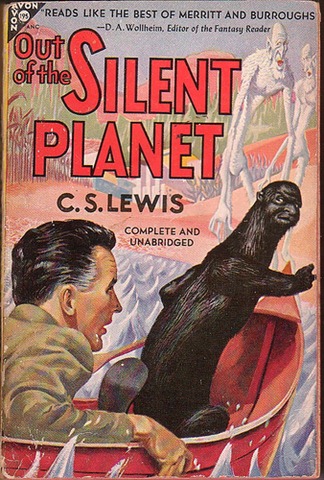
Out of the Silent Planet by C. S. Lewis should not be considered a science fiction novel, it follows more in the footsteps of The Devine Comedy and Paradise Lost than it does with H. G. Wells and Jules Verne. I would go so far and say Out of the Silent Planet is an anti-science fiction novel, although it reads much like Stanley G. Weinbaum and other pulp writers of the 1930s, and was inspired by the 1920 fantasy novel, A Voyage to Arcturus. Strangely enough, it reminds me of the recent film Avatar.
Please do not read any further if you haven’t read the book and want to avoid spoilers. What I have to say is a reply to the philosophical implications of the novel and that indirectly gives away plot elements.
The reason why I claim Out of the Silent Planet is anti-science fiction is because the story wants to convince its readers that outer space is the supernatural heavens of religious myths and is full of spiritual beings, even beings who live in the void between planets. Essentially Lewis does this for religious reasons, and not scientific, and the story feels like medieval philosophy. Now, this isn’t to say the story isn’t a ripping good yarn, nor does it imply a lack of old fashion sense of wonder about alien life on Mars, like most SF fans love from science fiction from the 1920s and 1930s.
What C. S. Lewis attempts is to claim outer space for Christianity, which is pretty interesting since most Christians focus heavily on Earth and ignore cosmology. The ending to Out of the Silent Planet reminds me of the ending in Have Space Suit-Will Travel, where in both, humanity and Earth come under the judgment of higher life forms on other planets. Strangely, the bad guy in Out of the Silent Planet makes the same case as the good guys in Have Space Suit-Will Travel.
Now this is a very essential difference in philosophy, and why I’m making a case that C. S. Lewis is writing anti-science fiction. Heinlein and most of science fiction is pro mankind, even to the point of taking Satan’s attitude in Paradise Lost, “Better to reign in hell than serve in Heaven.” Weston, a pathetic, spiritually blind, scientist in Out of the Silent Planet wants mankind to conquer the heavens and spread humanity to all the planets. Oyarsa, the archangel like ruler of Mars, or Malacandra, has godlike powers and considers Weston bent, or evil.
I am reminded of Lester del Rey’s “For I am a Jealous People” where God takes the side of aliens and mankind declares war on God. Science fiction is the ultimate hubris. Of course all of this assumes there are spiritual beings and dimensions we cannot see with our science. If you believe in those dimensions and beings, you will take the side of C. S. Lewis, but if you don’t, I expect most science fiction fans prefer to follow Heinlein and believe mankind is the most dangerous creature in the universe.
I think a new philosophy is emerging, that’s post-Lewis and post-Heinlein. There are no spiritual beings, but then we’re not going to be rulers of the universe either. I think in a few decades Heinlein will feel as archaic as Lewis in his philosophy, and Heinlein is my favorite writer. I grew up believing in the manifest destiny of space but the relentless reality of science is convincing me otherwise.
Out of the Silent Planet is a throwback and could easily have been written in 1838 instead of 1938. It’s the last of its kind, rather than being an early novel of future directed science fiction that dominates the twentieth century. Out of the Silent Planet wants to incorporate the spiritual world into the physical world – to weld them together. If you accept science there is no room in reality for angels, and the only hope of the spiritual world existing lies on the other side of the doorway of death.
JWH – 7/9/10
 Auxiliary Memory