What Was Heinlein’s Most Loved Story?

    After playing around yesterday trying to find ways to see how popular science fiction was, I decided to use the same techniques to identify Robert A. Heinlein’s most loved stories. The results, gathered on 1/22/8, were both predictable and surprising:

Starship Troopers

176,000

Stranger in a Strange Land

130,000

The Moon is a Harsh Mistress

96,700

“Gulf”

61,300

Time Enough for Love

58,900

The Puppet Masters

44,200

Red Planet

34,500

Tunnel in the Sky

27,900

Double Star

27,400

The Door into Summer

24,200

Citizen of the Galaxy

22,500

The Number of the Beast

20,400

The Rolling Stones

20,300

Space Cadet

20,200

Glory Road

19,400

Have Space Suit-Will Travel

19,300

Methuselah’s Children

19,000

I Will Fear No Evil

16,400

Destination Moon

15,400

To Sail Beyond Sunset

14,100

Time for the Stars

13,700

The Green Hills of Earth

13,500

Podkayne of Mars

13,400

Starman Jones

13,100

Orphans of the Sky

12,800

Beyond This Horizon

12,400

Farmer in the Sky

12,100

Farnham’s Freehold

11,400

The Star Beast

11,100

Between Planets

10,500

“The Menace from Earth”

9,390

Assignment in Eternity

9,090

The Past Through Tomorrow

8,970

“All You Zombies—“

8,170

Sixth Column

6,910

“By His Bootstraps”

4,800

Rocketship Galileo

2,250

“Life-Line”

864

“Jerry Was a Man”

744

“—And He Built a Crooked House—“

717


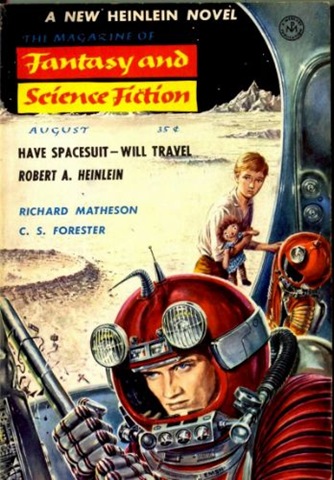
    It’s not surprising that Starship Troopers is #1, that’s because it was also a successful movie, and it probably also explains the success of The Puppet Masters in the rankings. And you’ve got to expect Stranger in a Strange Land to be at the top because of its cult status. I have a love-hate relationship with that novel. My favorite Heinlein book, Have Space Suit-Will Travel is disappointingly far down the list. I’ve written extensively why it’s my favorite, so many of those 19,300 pages are mine – I guess I need to write a whole lot more.

    I really don’t understand why Time Enough for Love has 58,900 pages on the web that mentions it. I find Heinlein after 1965 unreadable. Rocketship Galileo seems to be his least favorite novel, and it’s my least favorite Scribner juvenile, but I’ve read it a number of times, and recently bought an audio book edition. It’s still fun.

    I can’t tell if Red Planet is really the highest rated Scribner juvenile because the phrase “Red Planet” may have come up on other pages about Heinlein’s stories set on Mars. I’d like to think Tunnel in the Sky is the top Scribner juvenile because it’s my second favorite Heinlein book.

    I tried to gauge some of the short stories, but I’m not sure about the results from “The Menace from Earth” since it was also a book title. “Gulf” is rated very high, but that’s probably because it was a proto-story for Stranger in a Strange Land and might be mentioned in conjunction with that famous novel. I’m guessing “All You Zombies—” is his most popular story.

JWH

How popular is Science Fiction?

    This morning I got up wondering just how popular is science fiction. Google makes a wonderful barometer of popular culture so I did a bunch of searches and put them into Excel. Since I mainly was interested in trying to find out if Robert A. Heinlein was maintaining his popularity after death, I tried to select enough writers for comparison to give a good gauge of things. I searched on names using double quotes to get more accurate returns. Like this: “Robert Heinlein”

    To make comparisons to other genres and pop culture as a whole, I put in SF authors, mystery authors, classic authors, famous historical names, and some pop icons from when I was growing up and now. The results are thus:

God

495,000,000

Jesus

176,000,000

Science Fiction

145,000,000

Britney Spears

64,500,000

Beatles

63,300,000

Moses

31,000,000

J. R. R. Tolkien

21,900,000

Plato

21,000,000

Bob Dylan

20,200,000

Galileo

19,000,000

Charles Dickens

15,700,000

Stephen King

13,700,000

J. K. Rowling

12,200,000

Socrates

10,900,000

Beach Boys

9,190,000

George Lucas

6,870,000

Jane Austen

6,390,000

Tom Clancy

4,940,000

Terry Pratchett

4,870,000

George Orwell

4,770,000

Douglas Adams

4,380,000

Jules Verne

4,340,000

John Grisham

3,450,000

Byrds

2,750,000

Isaac Asimov

2,670,000

James Joyce

2,440,000

H. G. Wells

2,390,000

Kurt Vonnegut

2,190,000

Janet Evanovich

1,710,000

George R. R. Martin

1,580,000

Orson Scott Card

1,570,000

Jack Kerouac

1,520,000

Mary Higgins Clark

1,440,000

Frank Herbert

1,420,000

William Gibson

1,400,000

Michael Connelly

1,400,000

Audrey Niffenegger

994,000

Neal Stephenson

869,000

Robert Heinlein

733,000

Yann Martel

693,000

Sue Grafton

671,000

Edgar Rice Burroughs

636,000

Elmore Leonard

588,000

Cormac McCarthy

518,000

Arthur C. Clarke

443,000

Philip K. Dick

442,000

Michael Chabon

426,000

Connie Willis

288,000

David Brin

281,000

Harold Robbins

221,000

Theodore Sturgeon

214,000

Vernor Vinge

204,000

John Scalzi

182,000

Sara Paretsky

179,000

A. E. Van Vogt

128,000

Kage Baker

89,400

Roger Zelazny

52,100

John W. Campbell

33,500

E. E. Smith

21,000


    The phrase “science fiction” did pretty well when compared to “God” and “Jesus.” But it’s a little weird to think that Britney Spears has one third the popularity of the world’s most famous holy figure, and she’s three times more popular than Bob Dylan or Plato, and a touch more popular than the Fab Four. Further it is quite revealing that the SciFi authors with the most popularity are the guys who write silly SF books. And how bizarre is it that James Joyce is sandwiched between Isaac Asimov and H. G. Wells?

    As you can see, my guy Heinlein is just below the middle in popularity. Now I have to wonder if being alive helps or hurts. Jane Austen trumps Tom Clancy, and Philip K. Dick beats out Michael Chabon, but just barely and that’s comparing a lifetime of work, by an author with cult status and many movies made from his stories to a young writer with a very small backlog of books to his credit. How can we explain that? I can’t help but wonder if you get more press when you’re alive. Heinlein is just a touch more popular than Yann Martel who had just one bestselling book, The Life of Pi.

    Doing a search on [“The Life of Pi” Martel] brings up 48,500 hits, and searching on [“Stranger in a Strange Land” Heinlein] produces 188,000 hits. Thus doing book to book competitions produces different results over comparing author names. I’ll save that analysis for my next post and compare a long list of books to see how that barometer works.

    Cormac McCarthy just won a Pulitzer, and has a movie out with Oscar buzz and he’s about two thirds as popular as Heinlein, and a little more than twice as popular as Vernor Vinge who is probably a whole lot less famous. Heinlein is a legend in the science fiction world. Vernor Vinge is a rather famous guy among computer dudes, and since the web was created by said dudes, that may influence his overall popularity.

    Now I have to wonder, if you want to be a famous writer would it help sales to get busted for drunk driving, have a notorious marital dust-up, shave you head for photographers – oh wait, maybe it’s all of that while being a dumb blonde wearing skimpy outfits singing suggestive songs? Would J. K. Rowling get more hits on Google if she wore fewer clothes? If you search on Marilyn Monroe you get 11,500,000 hits, so is being blonde and female a fame factor?

    The main thing that helps I think, at least for writers, is if they have movies created from their books. Heinlein hasn’t been that lucky in this department, with his main success being Starship Troopers. Would Stephen King be as famous if none of his books had been filmed? After Have Space Suit-Will Travel becomes a movie it might generate considerable more than 9,550 hits. We’ll have to wait and see if I’m proven right. But generally when you search on a book title that has been made into a movie, movie sites come up first.

    John W. Campbell and E. E. Smith were giants in their day – back in the 1920s, 1930s and 1940s. “Astounding Science Fiction” gets 63,200 hits, so Campbell’s magazine has remained more popular than his famous editing. Evidently writing the classic “Who Goes There?” which was made into a hit movie twice, as The Thing from Another World and The Thing, didn’t make Campbell a household name. Or maybe that’s a lesson for not writing under a pen name.

JWH

The Road by Cormac McCarthy

The Road by Cormac McCarthy won the Pulitzer Prize for Fiction in 2007. The Road is a novel that will stun your soul. I found this stark metaphor about human nature so beautifully written I would use it as a textbook on writing. Although the term science fiction is seldom used when reviewing this literary work, its theme puts it squarely into that realm of storytelling and the sub-genre of post-apocalyptic fiction, like the magnificent Earth Abides by George R. Stewart. Predicting the end of civilization and the death of mankind goes back to Mary Shelley’s The Last Man. The list of such tales is rather long, and the approaches to the idea vary widely. Some have hope, some are about rediscovery of ancient knowledge, and some like The Road, are a kind of last judgment of mankind.

For those who only watch their science fiction, think The Road Warrior or The Postman or Waterworld, usually featuring a few good people fighting against the lawless hordes of barbaric humans. However, these stories would be about overpopulation compared to The Road, which is set in a world so bleak the reader is not even sure if plants and bugs still live. Most post-apocalyptic novels are warnings to the present, telling us to get our shit together or we’ll end up like the people in this book. When I was young and read these novels they were exciting and adventurous and I’d fantasize how well I could survive. I’m much different at fifty-six and Cormac McCarthy’s story was like standing in front of a well lit mirror. I saw I don’t have what it takes. I would be one of the millions that died off quickly. And that’s depressing.

The Road is about Mankind and Mother Nature failing to the max. Nothing lives but a few humans in a cold gray landscape. We do not know why things have failed, but by reading the book the reader will realize just how vital civilization is to our psychic well being. For me at least, reading this book made me understand that the value of being human is directly proportional to the success of society. Without our social structure life is no more meaningful than dirt.

With the dark clouds of global warming gathering over our heads I can’t help but read The Road as prophetic. If civilization collapses and economics failed and the western world fell into chaos like Afghanistan or the Sudan, we’d be reduce to the strong preying on the weak, but as The Road shows even this only goes as far as resources allow. If the machinery of society came to an abrupt halt, we’d have seven billion people scavenging for food eating anything they could digest. Humans would be worse than locus.

In The Road what nature or man didn’t destroy the remaining people ate or burned for warmth. The unnamed father and son, who are the main characters of the story, trudge along an unnamed road, constantly on the lookout for any dwelling that might still have something eatable within. The only sources of food appear to be the leftovers of civilization or the flesh of humans. In this story the man and boy avoid all other people thinking of themselves as the last good guys running from all the bad guys.

Bleak huh? While reading The Road you admire the beauty of the writing but are horrified by the vision it creates. This book has the power to turn a liberal into a conservative. This isn’t a book you read for fun or diversion. It’s a parable about human nature that will open up your philosophical veins. We’d like to think that the future is always bright because who remembers the dark ages. I think some people will read this book and want to arm themselves with enough firepower to kill a whole city. But no matter how much food and ammunition you store up you won’t be able to protect yourself and family. Anyone with anything becomes a beacon to the desperate. McCormac aptly illustrates that living like a cockroach is the superior survival strategy, if that’s what you want. You may realize it is this world or nothing.

People like to believe in heaven, and maybe millions would be anxious to leave this planet for the next world if such a collapse occurs, but the real lesson of this story is civilization, law and order, economic stability, cooperation and trust is what we really want out of reality.


I read The Road by listening to the Recorded Books edition read by Tom Stechschulte. This dramatic reading magnified all the best qualities of the novel and made McCarthy’s writing vivid. A MP3 sample can be found here. This sample is not typical of the book because it uses one of the few flowery writing segments referring to a dream. It does give a feel for the setting and the end of the sample shows the more common POV of the father. I wished the sample had included the dialog between the father and son because Mr. Stechschulte’s reading is dead on in characterization.I got my copy at Audible.com, but it’s also available at Amazon and iTunes.

  • Be sure and read Jason Sanford’s essay Dipping Their Toes in the Genre Pool: The U.S. Literary Establishment’s Need-Hate Relationship with Speculative Fiction, which goes much deeper than I do in exploring the debt the literary world owes to science fiction and other genres. I used to be in a MFA program and experienced the strong bias the literary folk have against genre writers.  Sanford documents this in great detail. He also talks about Michael Chabon’s review of The Road and how Chabon tries to bridge the gap between the literary and genre world. Sanford also summarizes many of the literary reviews of The Road and how those reviewers failed to credit earlier post-apocalyptic novels.  – Excellent read.

JWH


Inventions Wanted #5 – Cell Phone Voting

    The news is full of reports on the failures of electronic voting machines. After the 2000 election everyone expected inventors would jump on the problem and produce a full proof voting machine. That hasn’t happened. I’m wondering if there isn’t a simpler solution. Why not use the cell phone for voting.

    Imagine on voting day just picking up your cell phone and dialing the number and voting. Could it get any easier? Nearly everyone has a cell phone. And if it was easier to vote maybe more Americans would participate in democracy.

    One of the major concerns of voting machines is whether or not they can keep accurate tallies. Cell phone companies seem to be quite good at keep call records. Another concern with voting machines is to make them fraud proof. Now here’s the problem with cell phone voting – big brother will know how you voted because accurate registration and verification tied to a system with perfect tracking means they could look up how you voted. However, there are solutions to that too.

    Cell phones have unique numbers. They are registered to you. Your phone could be registered with the voting registration system. It would be possible to invent a voting system that would take only one call from every registered number. It would also be possible to separate identity from voting at some point, maybe with an encrypted key in case of recounts. That means there would be two systems. First would be the voting system via the cell phone and second a database system collecting votes. At some point they could separate identity or make a complicated mathematical system that could reconstruct the voting if necessary.

    One thing I hate about presidential elections is we have to pick one guy who wants to solve all problems in the same way we do. In other words, if there are twenty issues, we want elect the candidate that closely matches the way we think about twenty subjects. I’d much rather that have referendums and just let us vote directly. That would change things so we vote for a manager of problems rather than a decider. In the debates we always hear each candidate talk about their solution to a problem. I’m much rather that politicians research all the good options and then put them through a series of public votes until we come up with a solution that the majority wants.

    Easier voting would allow for more referendums. So why invent a complicate system that is usually set up once a year and few people participate in when an easier system may already exist that would get more people voting?

JWH

The Game of Rat and Dragon

    The job of a science fiction author is mighty tough! To write a great science fiction story requires showing the reader something they’ve never seen before, and that ain’t easy. Age of the genre and reader are big factors here. When science fiction was young, “The Time Machine” by H. G. Wells dazzled the Victorian world with its hallucinatory imagination. On the other hand, you’d need to be Amish to be dazzled by the idea of time travel anytime after turning five-years-old in our SF jaded world. But then I was in my forties and charmed by Terry Bisson’s “Bears Discover Fire,” and I was in my fifties and dazzled by Snow Crash by Neil Stephenson. In other words, even with an old genre and an old reader, it’s still possible to for a science fiction writer to succeed with creating a breathtaking vision.

    Today I decided to try another Wonder Audiobooks title, “The Game of Rat and Dragon” by Cordwainer Smith from 1955. I’m glad I did. I read this story years ago, but listening to the excellent reading by Matthew Wayne Selznick I was able to “see” it with fresh sense of wonder. Audio productions are like getting a high definition television and wanting to see all your favorite shows again. Like I explained in “How Audible.com Changed My Life,” reading with my ears lets me appreciate fiction so much better than when I read with my eyes, and this old Cordwainer Smith tale was a good example.

    Cordwainer Smith broke on the scene with a distinctive voice, working in a field known for being tone deaf. Now he wasn’t a great writer by literary standards, but the old concept of a one-eyed man living among the blind applies here. “The Game of Rat and Dragon” take cliché space opera and adds new dimensions making the story vivid, thus I think creating something new in the field. This story really does lay the foundation for stylistic explorers like Samuel R. Delany and Roger Zelazny in the 1960s.

    If you ever get a chance read some science fiction from the 1920s, like from early Amazing Stories. Then read Asimov’s Before the Golden Age, for the flavor of 1930s pulp writing. After that read Adventures in Time and Space to get the feeling of how J. W. Campbell shaped the 1940s. Science fiction genre is always evolving. The 1950s brought its own breakthrough in style, and writers like Cordwainer Smith, Jack Vance, and Alfred Bester made their impact.

    Listening to “The Game of Rat and Dragon” let me feel that difference in a magnified way. Cordwainer is at the beginning of his career, but all his elemental seeds of his later story worlds are planted here. This story, which is poorly written by MFA standards, with its heavy handed setup common for stories of the time, still takes off and shines when it comes to creating a vision of something new.

    It evokes awe and emotion in this old jaded reader, although I wonder how it will work with younger readers of today. It is primitive compared to today’s writing, so young readers may feel like they are hearing something from old time radio. If you look at ISBDF, you’ll see its still being anthologized as late as 2006, so I do have hope it’s a story with lasting impact, and I’m very appreciative that Wonder Audiobooks published the audio edition.

    I don’t want to give away any of the ideas and spoil this story, especially since it’s short and somewhat expensive, so I won’t go into what it’s about. Don’t read the links until after you have heard the story. “The Game of Rat and Dragon” is $4.88 for Audible.com members and for anyone it’s $7.95 at iTunes. I wished Wonder Audiobooks had given us two Cordwainer Smith stories for the same price to entice more readers to try Smith because I’m not sure about the market for single short stories. Let’s hope they succeed. WA could have created a nice mini Ace Double type collection with “Scanners Live in Vain.”

    Another odd idea would have been to make a complete audio edition of the October, 1955 Galaxy magazine, in which “The Game of Rat and Dragon” first appeared. I don’t know how involved it would be to get copyright permissions, but that sure would make a fun blast-from-the-past time capsule.

JWH