Avatar

First off, let me say I loved seeing Avatar, and want to go see it again.  Second, this is not a review, but a dissection of the movie and it has spoilers, so don’t read this unless you’ve seen the movie.  Avatar represents state of the art movie making and proves computer technology can turn any imagined story into a film.  I agree with the majority of reviewers that have said “Wow” to the special effects and then mumbled some grumbles.  The story retraces Dancing with Wolves, but the filmmaking blazes new territory.

However much I loved watching Avatar, I have one really big gripe:  I hate that humans are presented as stupid, cruel and blood-thirsty.  Why does Avatar portray future homo sapiens as 19th century colonial ravagers? Star Trek came up with the Prime Directive back in 1966, so why does this futuristic flick predict mankind as idiot imperialists?  I asked my friends about this and they defend the movie by saying “Oh, the film is just a liberal metaphor for how corporations and people treat the environment.”  But I can’t imagine James Cameron ruining the most expensive piece of art in history with such a crude message.  I can’t but wonder if Cameron thought the “kill them all and let God sort them out” mentality is how the majority of moviegoers want the majority of men and women characterized.  Why aren’t viewers insulted by seeing ourselves shown in such a nasty light?  Or are people sitting in their chairs thinking, that’s not how I am, I’d be one of the good scientists, but all the people around me must be like those blood-thirsty killers of the poor Na’vi. 

The film imagines technology evolving, but shows men and women devolving from our present knowledge.   Cameron presents the military as disciples of General George Armstrong Custer.  I’m surprised Colonel Miles Quaritch didn’t go around saying “The only good Na’vi is a dead Na’vi.”  Sure the solders in Avatar are passed off as private security, so as not to insult the U.S. military, but they think of themselves as Marines – thus it still attacks a stereotype.  And I worry that international film goers will naturally accept the bad humans, and especially the military in this film, as representing typical Americans and typical American thinking and philosophy.  If the Na’vi had been the bugs of Starship Troopers, I would have been pumped up by the military might of the story too.  We are a violent nation, but it’s important to know when violence isn’t the solution.  Strangely I think our real military knows that better than we do, or movie makers.

Why did Cameron spend so much money making such a cliché story?  It’s Starship Troopers at the Little Big Horn.  Sure, I can picture the story as a metaphor for how we’re destroying the Earth and its indigenous people and life forms, but that analogy is too crude to work.  How many filmgoers leave the theater thinking about how we’re destroying the rain forest?  Or does Cameron think we’re all spectators at the Coliseum, just sitting in front of his spectacle to get pumped up over a simple action picture show – hey the white hats win in the end, but we’re not wearing them.

Also, it’s time for film makes to stop relying on cliché science fiction.  The humans and the military in Avatar could have come from the same generic Sci-Fi reality as Starship Troopers, Aliens, and countless other SF movies and TV shows.  When are science fiction movie makers going to evolve and create more realistic science fiction? 

I would have been more impressed if Cameron had made almost the same movie but with a different opening premise.  Start with a generation ship that has traveled for three hundred years, finally reaching its destination, Pandora, with interstellar colonists.  The human space travelers must colonize or die.  They must find acceptance in a harsh new world, so instead of Custer’s Last Stand, they must be Jamestown and struggle to share a new world with equally intelligent creatures, and this time not follow the same path as we did with the Native Americans.  The colonists could use the same avatar technology to communicate with the Na’vi – what a fantastic first contact way to communicate.

I’m tired of science fiction films having comic book level violence.  The world is not Tom and Jerry, or Wile E. Coyote and Roadrunner.  Also unbelievably silly, is to think that anything in existence would be valuable to mine at interstellar distances.  This is pretty much basing a plot on the Santa Claus principle.  Why aren’t science fiction fans enraged at this kind of Easter Bunny thinking about the future?  If Avatar had been made in 1955 I could forgive the story, but the world has gone through a lot of enlightenment since then.

I’m sure James Cameron assumed we’d go through some catharsis of guilt and hate ourselves for being so evil.  I don’t know about you, but I’m tired of being the bad guy.  I know humanity has been evil in its treatment of the Earth.  It’s time to go past that and change.  Science fiction needs to show us evolving, and becoming wiser in the future.  Science fiction needs to show who we should aspire to be, rather than make us hate who we are.

Avatar is too beautiful to hate.  It is stunning to see.  It immerses us into an alien world better than any other science fiction film.  I just wished it didn’t have such a cliché plot.  Avatar proves that just about any science fiction or fantasy novel could be made into a film.  I’m tired of movie makers thinking the only science fictional conflict worth filming is human versus alien death matches.  What great science fiction book would you love to see filmed with the same technology as Avatar?  The first one that comes to mind for me is Hyperion by Dan Simmons.

JWH – 1/4/10
2010 Pub Challenge

publarge2010-300x244

The 2010 Pub Challenge is about reading 10 books published in 2010.  Follow the link to the official home page of the challenge to read the rules and how to sign up.  Even before I discovered this reading challenge, I had made a new years resolution to read 10-12 books in 2010 that had been published in 2010.  I have discovered that my reading feels more exciting when I mix in a good many new books.  But this challenge presents another challenge:  How to find the best books of 2010 before the end of the year when everyone publishes their Best of 2010 reviews?

The only solution I can think of is to read as many book reviews as possible and see if I can spot titles with several consistent rave reviews.  Bookmarks Magazine does just this, but unfortunately, I’ve sworn off buying paper magazines, but they do have a links page to many current book reviews.

What I’ve decided to do is collect links on this page to the best online book reviews I can find.  Hopefully this will help me spot the emerging best books of 2010.  I also create another list, one for books I want to keep an eye on.  Working on this 2010 goal is actually helping me achieve a long term goal I’ve been thinking about for years.  I’ve always wanted to find a way to systematically read book reviews.  Even if I don’t have time to read all the books I want, I’d like to at least be aware of what’s out there.  Assembling this list below has been very rewarding already.

Best Book Review Sites

2010 Books to Keep an Eye On


JWH – 1/2/10

SuperBookworms and Reading Challenges

I wrote about my discovery of SuperBookworms at the end of 2007.  I was in awe of Eva who read over 200 books that year.  Well, this year she’s read over 400!  And she’s not just reading little escapist genre novels, but mostly a diet of big meaty literary books, and she follows up her reading by writing long elegant and educational reviews.  If you love to read you will find Eva’s blog a total inspiration.  Eva is part of an Internet sub-culture of online bookworm bloggers.  These people love books and reading, and they inspire each other to read more by proposing reading challenges.  A reading challenge works to get people to read a certain type of book, or a certain number of books.  Here are some examples of 2010 reading challenges:

There’s even a blog about reading challenges, A Novel Challenge.  Each of these sites will set up the rules for the challenge, and many of them will ask you to register – all this means is your name (real or imaginary) and blog URL gets added to a public list of people joining the challenge.  That way other people can go check what you’re reading.  You can link to your blog’s home page, or to a page created just for the challenge.  Most sites that host a challenge also create a challenge logo with link that you can place on your blog to help advertize the challenge.  Some challenges get 100-200 readers.

If you love discussing books, a reading challenge is merely an informal online book club.  There’s no real obligation.  It’s a great way to find new books and meet likeminded bookworms.  And some of these bookworms are super bookworms, which I’ve define as bookworms who read over a hundred books a year.  I’ve never found anyone who has read as much as Eva read this year, but it’s not uncommon to find readers who read 100-200 books a year, and pretty easy to find a handful of readers who read more than 200 books in a year.  I once read 478 books in 18 months, but I was a college dropout at the time, avoiding work, and they were mostly little science fiction paperbacks. 

I’m lucky to finish 40-50 books a year.  I aim for 52 a year, or one book a week, but in recent years I haven’t even made that goal.  I don’t think my mind could handle 400+ books like Eva reads – that’s just too much for me to think about.  Eva has health problems and reading is a relief for her, but her mind is far sharper than mine, and can digest and process vast quantities of words.  I can’t, even though I wish I could.  I mentally move like a sloth compared to Eva’s hummingbird speed thinking.  I would love to read and review more books but there are physical limits for everyone, and I’ve long discovered my limits.

Because of my reading limitations, I’ve decided to improve my bookworm life from another angle of attack.  I want to read fewer books, but find intensely great books to read.  I have three reading goals for 2010.  First I want to read 10-12 books published in 2010, and hopeful find books that will be on the best of the year lists at the end of 2010.  Second, I want to read another 10-12 classics that are memorable across the ages.  Finally, I want to read 10-12 books off my bookshelf – I have hundreds of unread books that I couldn’t wait to read them when I bought them, but have been neglected ever since.

I was very disappointed in my 2009 year of reading. I want to make 2010 a standout year.  Since 2002, I felt I’ve been going through a reading renaissance, but things got stale last year.  This past decade was the most exciting time for reading since I became a bookworm in my youth.  Reading excitement fell off after my early college years, and it wasn’t until I discovered audiobooks in 2002 that reading got exciting again like it had been in my teen years.  I don’t want to lose that thrill, but I think it will take concentrated work.

What’s really sad is I have so many great books on my bookshelves going unread.  I took five minutes and grabbed all the books that made my heart ache that I didn’t read this year.  I should give these top considerations for 2010.  I could have grabbed ten times more.  I’ve got to stop buying books if I can’t find the time to read them.  Here is my personal reading challenge – finish 10 of these books before I write my reading roundup one year from now:

  1. The Book Nobody Read: In Pursuit of the Revolutions of Nicholas Copernicus – Owen Gingerich
  2. The Judgment of Paris: The Revolutionary Decade that Gave the World Impressionism – Ross King
  3. H. G.: The History of Mr. Wells – Michael Foot
  4. The Lunar Men: Five Friends Whose Curiosity Changed the World – Jenny Uglow
  5. A Long Fatal Love Chase – Louisa May Alcott
  6. The Blank Slate: The Modern Denial of Human Nature – Steven Pinker
  7. Emotional Intelligence:  Why it Can Matter More than IQ – Daniel Goleman
  8. Guns, Germs, and Steel: The Fate of Human Society – Jared Diamond
  9. Big Bang: The Origin of the Universe – Simon Singh
  10. A Heartbreaking Work of Staggering Genius – Dave Eggers
  11. Warped Passages: Unraveling the Mysteries of the Universe’s Hidden Dimensions – Lisa Randall
  12. Mimesis: The Representation of Reality in Western Literature – Erich Auerbach
  13. Rare Earth: Why Complex Life is Uncommon in the Universe – Peter D. Ward and Donald Brownlee
  14. The Age of Wonder: How the Romantic Generation Discovered the Beauty and Terror of Science – Richard Holmes
  15. Stories of your Life and Others – Ted Chiang
  16. The Axemaker’s Gift: Technology’s Capture and Control of Our Minds and Culture – James Burke and Robert Ornstein
  17. Body and Soul: The Making of American Modernism: Art, Music and Literature in the Jazz Age 1919-1926 – Robert M. Crunden

If I finish any of these books, I’ll write a review and make a link of the title.  Just creating this personal challenge makes me feel excited about 2010.

JWH – 1/1/10

2009 Year in Reading

Reviewing the books I read in 2009 is very psychologically revealing, and disappointing in many ways.  I had a richer reading year in 2008.

Favorite Fiction:

  1. The Naked Sun – Isaac Asimov
  2. The Time Machine – H. G. Wells
  3. Orphans in the Sky – Robert A. Heinlein
  4. Dracula – Bram Stoker

Favorite Non-Fiction:

  1. The First Three Minutes – Stephen Weinberg
  2. Why Women Have Sex – Cindy M. Meston and David M. Buss
  3. The Evolution of God – Robert Wright
  4. The Beatles – Bob Spitz

The Whole List:

  1. Farnham’s Freehold – Robert A. Heinlein (3rd time)
  2. Hyperion – Dan Simmons (2nd time)
  3. From Here to Eternity – Modern Scholar audiobook about science fiction
  4. Bellwether – Connie Willis (2nd time)
  5. The Green Hills of Earth – Robert A. Heinlein (2nd time)
  6. The Naked Sun – Isaac Asimov (2nd time)
  7. Roadmarks – Roger Zelazny
  8. More Than Human – Theodore Sturgeon (2nd time)
  9. The Interpreter of Maladies – Jhumpa Lahiri
  10. The Things They Carried – Tim O’Brien
  11. The Yiddish Policemen’s Union – Michael Chabon
  12. The Byrds (4th edition) – Johnny Rogan
  13. The Canon – Natalie Angier
  14. Dune – Frank Herbert (2nd time)
  15. Bet Me – Jennifer Cruise
  16. Variable Star – Robert A. Heinlein (2nd time)
  17. To Your Scattered Bodies Go – Philip Jose Farmer (2nd time)
  18. The Sirens of Titan – Kurt Vonnegut (2nd time)
  19. The Time Machine – H. G. Wells (3rd time)
  20. The War of the Worlds – H. G. Wells (2nd time)
  21. The Fall of Hyperion – Dan Simmons
  22. The Greatest Minds and Ideas of All Time – Will Durant
  23. Persuasion – Jane Austin
  24. Mayflower – Nathaniel Philbrick
  25. The First Three Minutes – Stephen Weinberg
  26. Dracula – Bram Stoker
  27. The Sound and the Fury – William Faulkner
  28. The Very First Light – John C. Mather & John Boslough
  29. The Beatles – Bob Spitz (abridged audio)
  30. The Year’s Ten Top Tales of SF – ed. Allan Kaster
  31. Replay – Ken Grimwood (3rd time)
  32. The Evolution of God – Robert Wright
  33. The Black Swan – Nassim Nicholas Taleb
  34. Ringworld – Larry Niven (2nd time)
  35. Magnificent Desolation – Buzz Aldrin
  36. The Good Solder – Ford Maddox Ford
  37. Orphans of the Sky – Robert A. Heinlein (3rd time)
  38. The Man Who Was Thursday – G. K. Chesterton
  39. Flood – Stephen Baxter
  40. Why Women Have Sex – Cindy M. Meston and David M. Buss

It’s pretty obvious this year I’m reliving my reading past.  I’m in two online book clubs devoted to classic science fiction and that’s dominating my selection of books.  My favorite science fiction book of the year in terms of pure entertainment was The Naked Sun by Isaac Asimov.  Dune was very impressive, a true masterpiece, but I didn’t connect with it emotionally.  On the other hand I was dazzled by the imaginative speculation in Orphans of the Sky.  Most of the other SF books were page turning fun, but ultimately not that innovative. 

Overall, my reevaluation of classic science fiction has been disappointing.  Even on the online book clubs, enthusiasm for old SF books isn’t that high, we mostly love this stuff for nostalgic reasons.  I grew up thinking science fiction was genius thinking, but it’s not. Science fiction is fun, full of wild ideas, but ultimately, it’s superficial philosophically and contains very little scientific insights.  Few science fiction stories are as brilliant as The Time Machine, most are closer to The War of the Worlds.  The absolute best science fiction, like Orphans of the Sky and Dune, stand out for imagining unique concepts, while other great science fiction novels are merely good examples of story telling. 

Two science books, The First Three Minutes and The Very First Light, and are about the discovery of the cosmic background radiation and were my most mind expanding reads this year in terms of understanding reality.  The Canon was a great overview of science history, with an abundant of fascinating details.  I highly recommend it to people wanting a quick study of science.

In terms of religious philosophy and history, The Evolution of God was quite educational and rewarding.  Again expanding my knowledge of reality significantly.  I’ve been slowly reading the Bible and The Evolution of God makes a great supplement.

The two music biographies, The Byrds and The Beatles, were fantastic reads and terrific strolls down memory lane.  I could only get the abridged version of The Beatles on audio, but I have bought the fat hardback and I’m looking forward to reading it.  However, reading these two books only reinforces my looking backwards towards the 1960s.

The lesson I’m learning from writing this post is I need to make 2010 the year of living in the present.  I’ve already started that by playing contemporary music on Lala.com.  Musically, the huge gravity well of the 1960s, 1970s, and 1980s holds me inside an event horizon and I have struggle to see the light of modern music. 

The past is obviously a black hole pulling me into it – and I realize I need to fight its powerful pull.  I desperately need to blast out of the orbit of looking backwards if I want to keep my mind expanding.  I will never be young again, and I worry that nostalgia is a kind of premature burial.  I do believe I stay current with computers and the Internet, at least more so than my age group peers.  I’m also in touch with the current pop culture of movies and television.  And I watch a lot of news and documentary shows, and I consume vast quantities of wordage from the Internet.

I find my reading year more exciting and fulfilling when I read new novels and books.  The only 2009 books I read in 2009 were The Evolution of God, Why Women Have Sex and Magnificent Desolation.  I’d like to read at least 12-15 2010 books in 2010.

JWH – 12/31/9

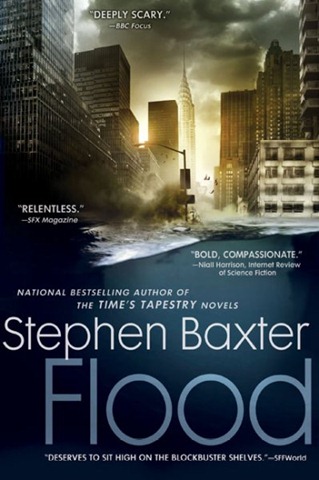
Flood by Stephen Baxter

Flood by Stephen Baxter has the feel of a typical mega-disaster novel, one where a cast of characters confronts a huge threat from all angles.  Flood, appears to be a warning about global warming, but it’s not, not really.  Baxter predicts yet another source of water flowing into the oceans to make their rise far more dramatic than the worst global warming predictions.  Flood can almost be called a prequel to the film Waterworld.

baxter-flood

For the average reader, maybe even the average science fiction reader, Flood is a scary novel that people will equate to the effects of global warming.  That’s unfortunate.  Flood is more in the tradition of end-of-the-world disaster novel, especially when you consider it’s sequel due out soon.  Think of Flood as a special effects movie, like the recent film 2012, were movie goers go to watch the special effects of Earth being destroyed.  Readers of Flood get to observe one great city after the another destroyed by water – Katrina times 1,000,000.  Along the way mankind makes one valiant stand on high ground after another, each time hoping to gain a foothold to build a new world order, and time and again, each gallant effort is drowned by relentless rising waters.  Baxter gets to show a variety of political solutions to the problem, and that in itself is interesting.

It’s quite fascinating to compare a literary end-of-the world novel like The Road by Cormac McCarthy to a science fiction genre novel like Flood.  McCarthy’s story is 90% characterization and 10% details about the end of the world.  Baxter’s story is 90% description about the end of the world and 10% characterization.  The Road was 256 pages, and Flood is 490 – so we get a lot of details.  Writing a novel like Flood is mind boggling to contemplate because of the massive amount of information involved.  While reading Flood, I kept thinking about all the research Baxter had to do to create each page.  Depending on your mood and reading tastes, Flood could seem like one long info-dump, or it could be a thrilling vision painted in words.

Now here’s the funny thing, McCarthy’s book is far more realistic.  It’s far more likely to happen than Baxter’s story.  I could even call The Road ultra hard literary science fiction.  Flood, on the other hand, is something different.  It’s totally unlikely to happen.  It’s a made up scenario to make an epic science fictional fable.  Baxter goes for the Big Wow!  A superficial glance at the story would suggest it’s a warning about global warming – but again it’s not.  If Baxter had written a more realistic tale of 2016-2052, with as much characterization as Cormac McCarthy’s story, we might be hailing him for writing a literary prophetic novel of global warming, but he didn’t. 

Science fiction generally goes to for ridiculously big story, and in this case I’m torn between really enjoying the wild ride and being disappointed that Baxter failed to be serious and write a believable SF novel about humans altering the planet.  McCarthy proved that deadly serious catastrophe novels can be big best sellers.  I doubt Flood will receive any notice in the world of books at large, and only minor notice within the small world of science fiction readers.

Science fiction has always been about ideas, but not necessary realist ideas.  On every page of Flood, Baxter gives his reader something big to think about, but the novel doesn’t have a traditional fictional structure, it’s more like a documentary that takes thirty-six years to film.  For characterization, we get to watch a handful of reporters get old.  It’s the kind of story that would have appeared in Astounding Science Fiction or Thrilling Wonder Stories.

The book does have plenty of ideas to explore philosophically.  For example, at one point people in London are wondering if they should run for the hills, and then country folk blow up the roads and bridges letting them know they aren’t wanted.  Will that happen in the real world?  It’s a lot to think about.  Throughout the book we hear about one species after another going extinct, but the one I was most chilled at was my kind, “The global extinction event has claimed the coach potato.”  Flood does try to realistically portray collapsing urban environments, and it made me realize I wouldn’t have much of a chance.

Even with the weak characterization and monumental info-dumps Flood is a real page turner.  Before mother nature gets Biblical on humanity, the book can be read as an illustration of what global warming might do to some cities, but after a point you realize Baxter is a kid bent on blowing everything up for the sense of wonder thrill of it all.  And it is epic fun, in the same way When Worlds Collide thrilled me as at thirteen.  I’m looking forward to reading the sequel Ark, which is why this book isn’t realistic, but ultimately very science fictional.

Baxter has created an amazing vision but I wished he had made the mixture at least 25% characterization and 75% details.  The characters occasionally moved me, but for the most part they were pawns in the plot.  Only when Grace does a runner did I feel any character acting on their own agenda and breaking free of Baxter’s strings.  That’s how you tell great characterization – when all the characters have their own agendas making any plot meaningless.  Characters are slave to plots in genre stories, and seldom get to break out.  Great characters take control of their strings and make puppets of their authors.  I wanted to rate Flood much lower because of the weak characterization, but the far out A+ science fiction overwhelms the story.

Final Grade:  B+

JWH – 12/30/9