Whatever Happened To The Beatles?

When I was growing up, back in the 1960s, there was a band called The Beatles that was more famous than any other band.  From 1964 to 1969 they were always in the news, always on the radio, often seen on television, setting the pace for sixties pop culture.  You heard their songs everywhere, either ordinary folks just singing, or professionals covering their tunes.  I bought all their albums as they came out, with each new release a big occasion.   Then The Beatles broke up and everyone was sad.

the-beatles

Years later, when CDs came out, I bought all The Beatles albums again, but this time the albums were different from when their songs came out on LPs in the 1960s.  The CD albums were repackaged like they had been first released in England as LPs.  For a while, this brought The Beatles back into my life.  For decades when I listened to music it was by listening to CDs, and now and then I’d play The Beatles.  I still thought of them as the most famous band on Earth.

Starting many years ago I switched to Rhapsody subscription music, and after a few years to Rdio, and after another few years to Spotify.  I listen to streaming music at my computer, or when walking around with my iPod touch, or on my big stereo through my Roku connected to my receiver.  The Beatles have never been on streaming music.  As I slowly stopped playing CDs, The Beatles were forgotten.  Then they released their albums again on remastered CDs.  I bought them all except Yellow Submarine.  However, I didn’t even play all these new CDs because I’ve gotten out of the habit of playing CDs.  Some of those remastered CDS are  still in the shrink wrap.  Maybe I’ll get around to them eventually, but streaming music is my habit.

I’ve gotten so used to listening to streaming music that if I can’t add a song to my playlists, or call the album up when I think about it, it doesn’t get played.  So I don’t’ hear The Beatles anymore.  This year when they had all the 50th anniversary stuff it was fascinating to watch on TV.  That would have triggered memories and gotten me to add some of their songs to my playlists, if they had been available on Spotify, but since they weren’t, I haven’t.

I said to my wife, “I wonder what Beatles songs I’d add to my playlist if they were available?”  I never found out, because they still aren’t on streaming.

I have two sets Beatles CDs, plus all their songs ripped to my computer, and even uploaded to my Amazon Music and Google Music accounts.  Rhapsody/Rdio/Spotify has ruined me.  I now think of music as what I hear everyday from Spotify.  I sometimes get out my favorite albums I play on Spotify and play them on CD just to hear their better sound quality, but I don’t play The Beatles because I don’t remember them anymore.  My music world has become Spotify, and The Beatles are not part of that world.

I know people who still play The Beatles, not their CDs, but digital songs they’ve stolen or bought as singles.  Those folk are still stuck in the past of owning music.  Statistics show streaming music is catching on, and even the number of illegal downloads are down.  Sales of purchased digital songs are down too.  If stolen and bought songs are in decline, and renting is on the increase, when are people going to play The Beatles?

I wonder if other people are like me, and have forgotten The Beatles because their songs aren’t available via streaming music?  Well, new people who never knew The Beatles don’t even know what they are missing.  But for us old farts, it’s, “Whatever happened to The Beatles?”  It’s a new world out there when it comes to discovering and playing music.  Some bands are bucking the trend because of the money.  And I can understand that.  But music seems to be in two places now, either live or streamed.  Who plays albums anymore?  Or the radio?

Hey, whatever happened to The Beatles?

JWH – 7/10/14

Can I Defrag My Brain?

Conventional wisdom says we only use ten percent of our brains.  Well, that’s been debunked by scientists in various ways.  There are plenty of articles on the net that explain why this meme is an urban legend.  We don’t have a lot of extra capacity idling under the hood, especially as we get older.  At sixty-two I feel my brain is so chock full of facts that to learn a new phone number requires forgetting another number.  It’s like my brain is a computer hard drive at 99.9% usage.  I need to delete files to make room.  With computer hardware we can defrag ours drives, putting all the fragmented files into continuous order, thus speeding up access to our data, freeing up space, and even discovering bad sectors.

Is it possible to defrag our wetware too?

I need to speed up access to my stored thoughts, fix links to lost facts, delete old memories to have space to learn new things, and make my old brain run more efficiently.  Is that possible?  I’m not sure if our wetware uses linked lists, but it sure does feel like it.  It seems like I recall information by association to related information.  And nowadays I often can’t remember particular tidbits of data because my links are broken.  What I need is to defrag my mind.

This little TED film is very enlightening.  It explains why multitasking is wasteful, and why I can’t think when I’m tired and hungry.  If I’m theorizing I can defrag my brain, I’ll have take energy use into consideration.  This DNews flick below shoots down the ten percent idea too, but it does claim we could do more with our brains if we worked harder.  I’m thinking I need to work more efficiently with the remaining capacity I have, especially since my mental abilities are obviously in decline, and I can’t add new capacity.  I’m not being a defeatist, but accepting the reality that aging involves decay.  I really wished I did have an auxiliary memory though.

One thing that really helps me defrag my brain is blogging.  Struggling to put my thoughts into a coherent essay is almost exactly like taking widely disperse file fragments on a hard drive and putting them in one continuous file.  Not only does writing help me organize my thoughts, but making them coalesce into a unified structure seems to delete smaller thoughts from my brain.  I have no idea if this is true or not, but it feels that way.  Each time I write a good essay I feel like I’ve deleted a bunch of aborted drafts and stacks of 3×5 cards.

Many scientists have describe dreaming as a way the brain cleans up each day’s experiences and throws out the unneeded memories.  This sounds like a kind of defragging of files too.  Often during the day when I’m too tired to write, I’ll take a nap and when I wake up my brain is clear again.  I think partly this is recharging the brain, like recharging a battery, and partly sleep must clean out chemical waste that clogs my neural pathways, but it also feels like my unconscious mind has been processing my thoughts too, like organizing paper files into folders for my conscious mind, because when I wake up my thoughts feel more orderly.

The first film takes exception with multitasking, and I think they’re right.  I find that my brain feels more efficient if I try to do fewer things.  Now that I’m retired I my brain seems freed up to think about new things.  I worry about less crap now, which makes me think the old adage, “Use or lose it” is a kind of mental defragging tool.  Want to erase memories?  Avoid thinking, worrying and studying a subject.

One of my life-long models of behavior comes from the  1950 science fiction film Destination Moon.  When making their initial lunar landing, our fictional astronauts use too much fuel, so they don’t have enough rocket juice to return to Earth.  The solution is to jettison as much mass as possible from the spaceship so the fuel they do have is enough to make it back home.  Many self-help books promote the idea that if you want to succeed with your ambitions its best to have only one goal.  I never could do that, and I’ve never been great at anything in my life.  Now that I’m old I realize the same principle applies to coping with aging.  The older I get, the more I realize I’ve got less fuel to get me through the day.  The key to fighting this problem is to jettison tasks that don’t matter so I have to fuel to to do what matters most.

But I’m learning to do things that the astronauts in Destination Moon didn’t know how to do – make more fuel.  Eating better, exercising, and sleep either give me more fuel, or makes my old brain run more efficiently so I can do more with less.  I’m still on a downward spiral towards an eventual heat death of my universe, but every little bit of order I gather now seems to fight personal entropy.

One thing I’m learning lately is being a news addict is counter productive.  More news means less news remembered.  I love reading the “news” on the internet about all kinds of subjects, watching news shows and documentaries on television, and reading as many books as I can, but I’m discovering it’s better to take in fewer stories and concentrate more on one idea at a time.  This is very hard to do, because so much is going on in the world and it feels like I’m missing out if I don’t pay attention to everything.  Not watching the NBC Nightly News feels like I missed out on what went on around the world that day.  But you know what?  I’ve watched thousands of episodes of the nightly news and I can’t remember 99.9999% of what I’ve seen.  I record the news on my computer’s DVR, and I’m learning to skip through certain kinds of stories.  This has a defragging effect on my brain.  Eventually I might stop watching the news altogether, but right now I can’t break that habit.

I’m finding it more satisfying to read a whole bunch about one interesting topic than learn a little about a hundred different of subjects.   I think either way I’m going to forget most everything I learn, but it’s more satisfying to gorge on one subject than graze on a thousand.  And maybe, just maybe, I’ll retain a little more of that one subject. 

This is analogous to a computer’s CPUs and multitasking.  Our brain’s main loop can time slice many subprograms, but the more we have going, the slower our brain runs.  Having fewer interests and worries speeds up processing on the functions we do keep running.

I don’t know if it’s scientifically possible to defrag my brain, but I sure am trying.

JWH – 7/9/14

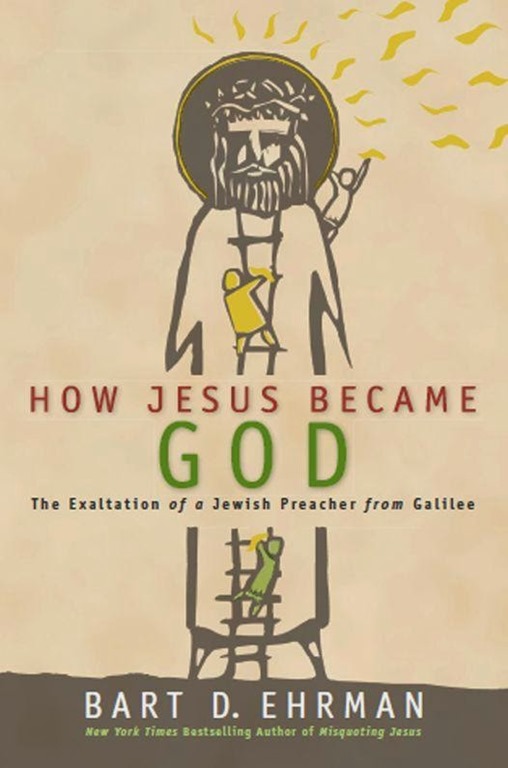
How Jesus Became God by Bart D. Ehrman

There once was a guy named Jesus.  He sounded like a pretty cool guy if you believed some of the savings he was supposed to have said.  Then his followers made him into God, and people became more interested in what was said about him, rather than what he said.  That’s too bad.  Bart D. Ehrman, has written a book that explains how Jesus became God after he died, and then became God while he was alive, and then became God before he was born, and then became God before any of us were born.  Ehrman’s book could have also been called When Jesus Became God, and to a very minor degree, it could have been called Why Jesus Became God.

I would have entitled it, Too Bad Jesus Became God.
How Jesus Became God

How Jesus Became God is a history book.  It’s not about theology, but many readers will find it undermines their beliefs.  To be fair, Ehrman bends over backwards, constantly explaining how and why he’s writing history, wanting to avoiding any theological implications.  We’ll never know the theological truth in this life, but we can get ever closer to the historical truth.  By summarizing how the followers of Jesus changed their opinions about the man they worshipped in the decades and early centuries after his death, we don’t learn anything new about Jesus, but a whole lot about the history of Christianity.  Because Jesus left no primary sources about what he believed, we can never know anything about the man, all we can know is what other people thought about him long after he died.

I’m afraid when the faithful read this book they will bring their beliefs to the reading and that will distort what Ehrman has to say.  Ehrman  stands outside of Christian faith and ask the question:  How did Jesus become God?  He is a historian, so he makes no assumption whether Jesus is actually God or not, but analyzes what we know about early Christians to decide how they made Jesus into a God.  Ehrman uses textual analysis to date each idea about Jesus that emerged after his death, and to pick through the paltry facts like a CSI detective hoping to find additional clues.  Ehrman tries to answer two main questions.  First, did Jesus think of himself as God or divine?  Second, studying the writings of Paul, the four Gospels, and Acts, Ehrman asks, when did his believers think Jesus became God – at his resurrection, his Baptism, his conception, or from the beginning of all time?

Bart D. Ehrman introduces his book at Huffington Post.  It’s a good summary to read if you’re thinking about buying the book.  He opens with:

Jesus was a lower-class preacher from Galilee, who, in good apocalyptic fashion, proclaimed that the end of history as he knew it was going to come to a crashing end, within his own generation. God was soon to intervene in the course of worldly affairs to overthrow the forces of evil and set up a utopian kingdom on earth. And he would be the king.

It didn’t happen. Instead of being involved with the destruction of God’s enemies, Jesus was unceremoniously crushed by them: arrested, tried, humiliated, tortured, and publicly executed.  And yet, remarkably, soon afterwards his followers began to say that — despite all evidence to the contrary — Jesus really was the messiah sent from God. More than that, he was actually a divine being, not a mere human. And not just any divine being. He was the Creator of the universe. After long debates among themselves they decided that he was not secondary to the one God of Israel, the Lord God Almighty himself. On the contrary, he was fully equal with God; he had always existed for eternity with God; he was of the same essence as God; he was a member of the Trinity.

How did that happen? How did we get from a Jewish apocalyptic preacher — who ended up on the wrong side of the law and was crucified for his efforts — to the Creator of all things and All-powerful Lord? How did Jesus become God?

To Christians, Jesus is God, but to historians, Jesus is no different from any human in history.  Ehrman is studying the theologians and not the theology.  If you are willing to take How Jesus Became God as a purely history book it’s quite fascinating and illuminating about the early development of Western civilization.  If you are a believer, this book could be painful because it treats Christianity no different from pagan mythology that also existed in the first centuries of the common era.

I hope this won’t be insulting to Christians, but most of the ones I know aren’t very intellectual about their theology.  Most, just want to believe in God, an afterlife, heaven, and the promise they will meet their dead kin and friends again.  How that happens is inconsequential to them.  That’s why modern Christianity is based on faith and belief.  Reading How Jesus Became God will show there is a complex history of theology to how belief in believing evolved.  Ehrman makes an excellent case that while Jesus was alive, and even just after he died, Christians believed you had to do good deeds to get into heaven, and that Jesus did not think of himself as divine.  It took decades, centuries even, to evolve the theology that Jesus was Christ who existed since the beginning of time as God and believing in him will earn you eternal life in heaven.

This book is about how the followers of Jesus went from thinking of Jesus as a human being to thinking of him as the Trinity.  Ehrman documents this from what we know from history.  Unfortunately, most of what we know comes from The New Testament, Apocrypha writings, and Gnostic texts.  Ehrman’s history is really close textual readings because we have few outside sources about these events.  Christians might appreciate Ehrman’s careful delineations between the writings of Paul, the four Gospels, and Acts.  What it comes down to is Paul, and the writers of the four gospels had different ideas on when Jesus became God – resurrection, Baptism, conception or the beginning of time.  Then the early church fathers argued over these concepts for centuries.

That might seem like meaningless quibbling to most believers, but it does explain why the four Gospels differ.  The Gospel of Mark doesn’t include the story of the virgin birth, but that’s because it suggests that Jesus became divine at the resurrection.  The writers of Matthew and Luke seem to imply Jesus became divine at Baptism or conception.  To have Jesus become divine at conception you need the virgin birth tale.  The author of John recreates the ontology of Genesis to put Jesus as God back at the beginning of time.

Now I’m an atheist, but I find all of this fascinating.  And I might have a different take on Ehrman’s book, but since I’m not widely read in Christian history, I don’t know how common my questions are.  Jesus and his disciples were lower class folk, who were probably illiterate and spoke Aramaic and Hebrew.  The writers of the Gospels were educated, literate, and spoke and wrote Greek.  I’m wondering if they knew about Greek philosophy and if their theology is a mixture of Hebrew mythology, stories about Jesus, and Greek philosophy.  Is The New Testament a cold front of religion meeting the warm front of philosophy?

By the way, we’re leaving Ehrman and moving into my own ideas.  I’m into science, but science wasn’t invented yet.  At the time of evolution of The New Testament people had very few tools to understand reality.  The first, and oldest tool is religion.  Religion basically says “God did it” to any question about the mystery of reality.  Why is there thunder?  It’s a god.  How did the universe start?  God created it.  In terms of understanding the truth, religion offers no validity or real answers.  It’s all speculation and wild ideas.

Then came philosophy.  Philosophy assumes humans can figure out how things work.  Philosophy starts observing reality for clues, but all too often it comes up with bizarre theories for answers, and eventually these are contrived into elaborate beliefs.  Because philosophy uses logic and rhetoric, it gives the impression that it’s intellectually superior to religion, even though most of its answers about reality are hardly better than religion.  However, logic is sexy, so believers prefer philosophical answers over the dictates of religion, which is basically, “God did it.”  Paul is the Plato of Christianity, and Jesus is his Socrates.  And the guy who wrote The Gospel of John is out there, way out there, both mystical and philosophical, like one of the Pythagoreans.

From my perspective, Paul is the real creator of Christianity, but he lost control of his religion to the later writers of The New Testament.  What Ehrman’s book does is try to chronicle how these later writers change the scope of Christian theology.  Even more fascinating is the Gnostic gospels, which appear to try to take Christianity in even stranger directions.  What became Orthodox Christianity in the first four centuries of the common era is what worked best at selling a belief that took hold of the Western world for the next sixteen centuries.

Modern day believers of Christianity believe because they hear a few ideas in childhood that are so powerful it overwhelms all their thinking.  What Ehrman’s book attempts to do is explain how these memes got created.  Many other writers of Christian history attempt to do this too, but Ehrman seems to be particularly good at it, with clear writing, sensible logic and a humble attitude.  Ehrman has written a series of books that reflect a lifetime of careful research that explain how and why The New Testament was written.  He’s very knowledgeable about The Old Testament, but The New Testament is his specialty, his life’s work.

Most Christians aren’t interested in an intellectual history of their faith.  Their religion gives them a wonderful sense of community, beliefs that comfort them in life, and faith that assures them they won’t die, so they know they will meet their departed loved ones in the next life.  However, there are Christians, especially evangelicals and fundamentalists who are profoundly interested in the intellectually validity of their beliefs and will go to extremes to validate their faith.  Ehrman’s book will cause these people problems.  This gets back to my point about philosophy.  Philosophy appears to reveal the truth, but it doesn’t.  Science is the only system we’ve invented yet that reveals consistencies in reality that we can accept as being true.  What we’re experiencing now is the cold front of philosophy banging into the warm front of science.

What Ehrman brings to the table is history, a discipline that is far more consistent than philosophy, but still not science.  The fundamental faithful are strong adherents of philosophy, which includes rhetoric and logic.  They are confident these tools reveal the truth of reality.  But science is showing them that their philosophy is a very poor tool for understanding the truth of this reality.

What Ehrman has accidently taught me is fundamentalists love philosophy because The New Testament is a product of philosophy, and not religion.  The Old Testament was pure religion.  The New Testament is a hybrid of religion and philosophy, with the later writers of The New Testament being the most philosophical.

And it’s not that philosophy can’t be a useful tool, but it’s only useful if it incorporates the rigors of science.  Science depends on logic, and to a degree rhetoric, but is actually about consistency of observations.   Science, for the most part, can’t be used to verify theology, because most theology involves the metaphysical, which can’t be observed, tested, and is not falsifiable.

Christianity met up with Greek philosophy again when it kicked the Muslims out of Spain.  But that’s not part of Ehrman’s book.  I’ve always thought that was Christianity’s first encounter with Greek philosophy, but now I’m thinking different.  The New Testament writers were the first influence of Greek philosophers on Christianity, they just didn’t mention their educational background.

It would be fantastic to have a time machine and track down the real Jesus and give him a copy of The New Testament and How Jesus Became God.  I get the feeling he’d probably read them and say, “Hey, these stories are about a guy with my name,” and never notice they were about him.

I’m am reminded of stuff I’ve read by Karen Armstrong and Robert Wright, especially in A History of God and The Evolution of God.  The God of The Bible has gone though quite a lot of changes himself.  He’s a combination of several gods that slowly evolved over a very long period of time.  Each time one people would conquer another people, their gods would merge, or one would supplant the other.  To me, Jesus became God because Christianity supplanted older religions and had to incorporate or bury older deities, creeds, traditions, etc.  Jesus essentially becomes the new God that usurps the Jewish God of The Old Testament, in the same way Yahweh supplanted earlier gods like El, Asherah and Baal.

The early Christians had to do this to succeed and thrive, and boy did they thrive.  But it sure is sad that they lost Jesus along the way.  It would be interesting to compare the revisionists techniques in the Quran and The Book of Mormon to see how they try to supplant Christian theology.

I wish Jesus had written down his ideas like Plato.  To me, humans are interesting, gods are not.

JWH – 7/8/14

Could You Love A Robotic Puppy?

If you could buy a robotic puppy that was indistinguishable from a real puppy except that it didn’t eat, drink and go to the bathroom, would it be as satisfying as having a real puppy?  This is probably theoretically, because I don’t know if they could ever invent a robot puppy that smelled like a real puppy, but let’s imagine they could.  One that felt, smelled, sounded and looked just like a real puppy.  I’m assuming people don’t taste their pups, but roboticists could add that feature too if needed.  If this imaginary puppy was a bundle of energy, friskiness, that squirmed and played, licked and nuzzled, just like a real little doggie, would you want one?

pugs-00305

Recently I read that a growing statistical segment of young women are choosing to buy small dogs rather than have babies.  Small dogs and puppies trigger our gotta-love-the-baby response, so many people find puppies a good substitute to love.  What if what we liked about puppies is having this baby love button pushed, and what if a robotic puppy pushed the button equal to a real puppy?  If a robot puppy triggered your need to love something cute, and it felt like it loved you unconditionally, like the way we want dogs and small children to love us, would it fulfill your needs so you no longer needed a real baby or real puppy?

Recently in Great Britain they conducted a survey asking people if they’d have sex with a robot.  Imagine being able to buy an android that looked exactly like the movie star you find most sexually attractive.  Would you bother dating if such a robot took care of all your emotional, sexual and conversational needs?

The Japanese are working on robots to be caretakers for the elderly.  If you were old, and living alone and your children didn’t visit much, or not at all, and you couldn’t get out much, would you find a robot good company?

pugs-00517

In all these cases I have to ask:  What is real?  If we can trick our brain so we satisfy its need for cuteness, receiving and giving love, sex and companionship, will we feel it’s real enough?  I’ve been thinking about getting a puppy, but when I think about how many times I’m going to have to watch it poop & pee, or take it for a walk, I tell myself I’m crazy.  But on the other hand, I’d feel that if it didn’t poop & pee that I’d be missing out on the real experience.

There’s a vast difference between current robotic puppies and real pups.

But what if a robot puppy was as cute and cuddly, warm and fuzzy, wiggly and smelly, as a real puppy, would my brain not urge me to pick it up and play with it?  What if it was an intelligent as a dog, could learn, and was as self-aware as a dog?  Would it be easier to love a robot if we thought the robot could feel our love?

Little children will play with dolls and stuffed toys for hours as substitutes for babies and animals.  Adults will read books, watch television shows and movies, and play video games that simulate reality no better than current robotic dogs.  Drug addicts will seek out their drug of choice to replicate sensations, moods, emotions and feelings they can’t find in real life.   Many people eat junk food rather than real food. We’re already quite used to fooling ourselves. 

Obviously, we’re creatures with urges, appetites, impulses and desires that can be fooled by substitutes for what evolution originally programmed us to seek out.  And what explains our desire for work that has no relationship with nature.  Why will some people spend hours doing mathematics?  In other words, we have created new, novel, and unnatural forms of stimulus to occupy our brains.

I write this essay to contemplate why I desire certain inputs and stimulus for my brain.  If you love puppies, have you ever wondered why?

pugs-00574

JWH – 6/30/14

Do You Dream About Dinosaur Attacks?

By James Wallace Harris, June 29, 2015 (Updated 5/9/21)

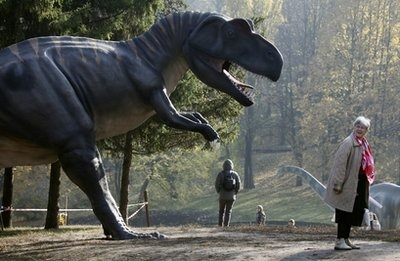
I hope this doesn’t reveal some sort of deep embarrassing Freudian complex, but my whole sleep last night was filled with dinosaur dreams.  Ever since I was about five years old I’ve had occasional dreams about dinosaurs.  They aren’t real common, but they happen now and then, and they vary in details.  Last night’s dreams were somewhat typical.  I’ll be with a bunch of other people, at home, school, work, outside in a city location, on a crosswalk, etc., and suddenly a dinosaur or dinosaurs would show up, and everyone panics.

dinosaur

In the dream we all know the way to avoid being eaten is to be lying down, don’t move, and be quiet.  But there’s always someone nearby that keeps blabbing or moving around that draws attention to the dinosaurs causing me to fear for my safety and makes me very annoyed at the noisemaker.   For some reason, the dinosaurs won’t notice us if we don’t move or make noise.  I never get eaten myself, or the people I know, but I’m always afraid some dumbass is going to get me, or us, killed.  I’m always annoyed in these dreams that other people are not freezing and shutting up.

The funny thing is I had these dreams all night long.  Even after I got up and went to pee, and went back to sleep.  Even very early in the morning when I was waking up over and over again, every time wondering if I should get up.  Each time I fell back asleep I had another dinosaur dream.  It was one scene after another, with different groups of people, in different locations, and in each scene, there was a dinosaur attack.  One scene involved my sister, and another my wife Susan, but it was always strangers causing trouble.  I don’t think I ever saw a dinosaur eat someone, but I knew they were in the distance, so the panic to hide was strong.  These dreams last night weren’t quite nightmares, but they did involve a kind of anxiety.

If dreams are sorting through the day’s events and filing long-term memories, what did I do yesterday to deserve dinosaur dreams last night?  And do other people have dinosaur dreams?  I hope these dreams don’t indicate some kind of weird psychological disorder.

When I was young, I guess around five, I had my first dinosaur dream.  I lived out in the country in South Carolina in an old two-story house.  My family didn’t use the second story, but my three-year-old sister and I would go up there to play, but it was creepy.  I would dream about those upstairs rooms as if they were evil.  That was one of my earliest reoccurring dreams, along with dreams of flying.  But it was during this time that I had my first dinosaur dream.  I and other people were working in this huge gravel pit, and we were slaves to dinosaurs and had to stand in dinosaur shit as we worked.  Later on, when I saw The Flintstones, the pit we worked in reminded me of this show.  But this dream was three or four years before The Flintstones appeared in 1960.

I’ve always wondered when I first learned about dinosaurs.  My oldest memories of dinosaurs are from these dreams, but how did I learn about dinosaurs to dream about them?  I remember as a kid after I started having these dreams, of playing with plastic dinosaurs and learning their names.  My little buddies and I liked to collect and trade these plastic dinosaurs, and we seem to know all about them.  I don’t remember being taught about dinosaurs in school, or even reading about them.  I’ve always assumed knowledge about dinosaurs is imprinted in little boys’ brains, like some kind of ancestral memory.

I’ve written about dinosaur dreams before, back in 2008.  I had completely forgotten I had written this, and the dream I described.  The dream back then was somewhat different, a more science-fictional version, because people were protected from the dinosaurs by force fields.

Does dreaming about dinosaurs mean anything?  At Dream Moods, which has a page explaining animal symbols in dreams, it says this about dinosaurs:

To see a dinosaur in your dream symbolizes an outdated attitude. You may need to discard your old ways of thinking and habits.

To dream that you are being chased by a dinosaur, indicates your fears of no longer being needed or useful. Alternatively, being chased by a dinosaur, may reflect old issues that are still coming back to haunt you.

I wonder if I have a problem with outdated attitudes?  But this commentary seems no more scientific than astrology.  I am not the only person troubled with dinosaur dreams as reflected in the Yahoo Answers column.  It’s odd, but a couple of people who replied copied the statement I quote above, and it’s repeated on other websites.  Just shows how bullshit spreads across the internet.  At least at the Dream Dictionary, they had something a bit deeper, but still on the woo-woo side.  It reassures me that other people have dinosaur dreams, so I ain’t the only crazy one here.  In fact, there are many dream interpretation sites that cover dinosaurs in dreams, and many people posting about dreaming of dinosaurs.  At Jurassic World, they even have a page collecting dinosaur dreams.

Are dreams even symbolic?  I have no idea.  It seems my dreams are saying something very big will destroy me if I stand out, and that other people are constantly being destroyed for making themselves known.  Hunkering down and being quiet sounds rather cowardly to me in waking life.  When I was young and had nightmares I used to kill anything that tried to hurt me.  The violence of my dreams was disturbing because it was like the violence of modern video games, but these dreams were decades before such games were invented.

I can’t think of anything I did or experienced yesterday that would trigger dreams about avoiding death, or large issues.  I had a nice quiet day of reading books and listening to music, and then last night my friend Anne came over for dinner and we watched Empire Falls, an old HBO mini-series based on the Richard Russo book.  Empire Falls is about a man with a repressed past that never speaks his mind.  I did identify with Miles Roby, the Ed Harris character because I hold things in to avoid emotional conflicts.  Are the dinosaurs of my dreams potential emotional conflicts?  At least this theory works with dreams because the way to be safe in the dream is to be quiet and avoid attention.  Also, the people who get eaten by dinosaurs are the loud people who won’t shut up.

This is embarrassing because now I am revealing something.

I guess I’ve got to wait for the dinosaurs to show up.

JWH

Update 5/9/21:

I had a dream last night where aliens were attacking people in the same way dinosaurs attack people in the dinosaur dreams. Instead of eating us, they zapped us with some kind of energy gun. I’ve had similar dreams where giants were attacking people, and they killed people by crushing them. In each of these dreams hiding is the key to survival, and those people who stick out are the ones caught by dinosaurs, space aliens, and giants.

I realize now that the role of T-Rex, space alien, and giant are the same in all these dreams. They represent the bad things in life, threats that kill people. And the message of the dream is some people do survive by avoiding these dangers of life. Evidently, my subconscious is telling me to keep a low profile because that’s the best way to avoid getting hurt or killed.

However, I think last night’s dream was inspired by reading chapter 3 of Being Mortal: Illness, Medicine, and What Matters in the End by Atul Gawande. That chapter was scarier than anything Stephen King ever wrote. It’s about how our bodies decay as we age and how we become less capable of taking care of ourselves. This was illustrated with horrifying case studies.   Gawande does give an overview of how society has helped the elderly over the years, and what people can do to help themselves, but death is the only escape from this fate. There is no avoiding old age by hiding like I do from the dinosaurs, giants, and space aliens.