Star Trek: Dystopia in the Utopia

By James Wallace Harris, Sunday, August 14, 2016

Star Trek has a wonderful reputation for presenting a positive future, but do we actually see that utopia in the television shows and movies? In the new film, Star Trek Beyond, we get a few minutes viewing life on Yorktown, a space city and rest stop for the crew of the Enterprise. It represents the utopian civilization of the Star Trek universe. However, if the future is what we see from the bridge of the Enterprise, it’s quite bleak indeed. The Earth, the Federation, the galaxy are always under threat from madmen and alien beings that don’t agree with the Federation’s view of how the galaxy should be ruled.

YorkTown

In the documentary Chaos on the Bridge, William Shatner interviews many of the principle individuals who created Star Trek: The Next Generation. Many of the stories told were about Gene Roddenberry’s new utopian vision for Star Trek. Writers found utopia hard to dramatize. The writers wanted violence, and Roddenberry wanted Star Trek to showcase what humanity could be at its best. The creative battle to create ST:TNG was quite dystopian itself, with one interviewee admitting he thought about pushing Roddenberry’s lawyer out an open window. The solution for providing conflict to the utopian Federation of the 24th century, was to create the Borg. A challenge from outside the utopia. This gave the actors something to do physically, and writers an antagonist for their plots. The show became a success.

But what about Star Trek’s reputation for presenting a positive future? To the crew of Star Trek Beyond, the future is hell, even though they’re defending an idyllic civilization. This time the attack is from within, a terrorist with a bioweapon. But if you look at the history of Star Trek shows, why are there so many internal and external attacks on the Federation? It’s hard to justify you’re painting a rosy picture of the future, when so many want to destroy it.

Aren’t there ways writers could show the future with fewer threats and more civilized activities? What if Star Trek Beyond had been a different movie. Imagine no galactic terrorists, but instead, a story about how the crew  spent their time at Yorktown. Could the writers have presented a view of the future that Roddenberry wanted? One where we felt that things would turn out all right. One that gave us hope for the future. Right now, all indications are the future is going to suck big time. My most successful essay on this blog for the last two years has been “50 Reasons Why The Human Race Is Too Stupid To Survive.” I’m not sure most of us believe humanity will solve its problems. Is science fiction confirming our pessimism, or generated it?

I don’t ever expect a real utopia. But if we eventually create a sustainable society without violence, want and environmental self-destruction, I’d call it good enough for the label utopia.

If Star Trek is a positive view of the future, should we see so many phasers and space battles in a 24th century? Think about this. How many TV shows and movies do you watch that have guns? And how many that don’t. Guns are an easy way to drive the plot. But there are plenty of entertaining shows without guns. Should we consider The Big Bang Theory utopian? Look at the 100 most-watch shows of 2015-2016 season. If you subtract comedies and reality shows, it’s not easy to find shows that don’t involve violence as a plot driver. And the ones that do, like Grey’s Anatomy and Scandal, generally don’t appeal to guys. It’s easy to see why writers fought Gene Roddenberry over story ideas.

Of course we have to ask what we really want. Do moviegoers plunking down ten bucks want to see Sing Street, Love & Friendship, Brooklyn, or do they want to see computer generated space battles? (By the way, try and find a blockbuster movie for adults that don’t have violence.) Why are so many escapist blockbuster movies about extreme violence? When we walk into a movie theater we’re paying to leave the real reality and experience an artificial reality. Our society is far from utopian, but many people live near utopian lives. Sure a large segment of our society also live unhappy, miserable lives. But why would either type seek out escapism that involves mass killing?

Do we even want utopias in our entertainment? Fiction is driven by conflict. The easiest conflict to create is violence. That explains most television and movie plots. But what about Roddenberry’s vision? I need to rewatch the first two years of Star Trek: The Next Generation. Many claim those seasons are the worst of the series, but yet they were the ones when Roddenberry had the most influence.

Other Takes

JWH

An Old Guy Tries To Catch Up With Current Feminism

By James Wallace Harris, Thursday, August 11, 2016

I got started reading books on feminism at the beginning of the 1970s when I was required to read The Feminine Mystique by Betty Friedan. Growing up male in the 1960s and 1970s was difficult because the females we chased were transforming. They told us we didn’t understand what it meant to be a woman and we should read the books they were reading, even though they also told us we could never understand. Since then I’ve occasionally read books on feminism trying to keep up. As a male, talking or writing about feminism, can be dangerous, so I’ve mostly kept this reading secret. Decades ago the women I knew often talked about feminism, but I seldom hear the topic mentioned by the women I know today. During the 1970s feminism was talked about as much as we talk about climate change today.

I assumed in the 1970s, before the ERA amendment failed, that all women would become feminists. Understanding why that didn’t happen is fascinating, but exceedingly complex. Reading Backlash by Susan Faludi gives one view. Feminism as a movement fractured, and became less public. It never went away, but retreated to rebuild in many different smaller movements. Trying to define feminism today is contentious. Like President Obama, males can say they are feminists, but I’m not sure what women think of that, especially by younger women who are pushing newer feminist insights. We live in very different times from the feminists of the 1960s and 1970s. Try to keep up with feminism is nearly impossible for men, but I think it’s even harder for women.

53% of voters in 2012 were women. If women voted together they could rule the country. Why don’t they? I’ve always wondered why all women weren’t at least feminists politically. Well, that’s rather naïve of me. How women think politically is just as diverse as how men think. Men don’t agree, so why should women. In fact, women disagree bitterly over the goals of feminism, and even its definition. As a man, I’m an outsider and have to be very careful how I comment on feminism. I’m hesitant to even write this essay, but as a bookworm I feel I must promote the books I admire. Liberal men have the duty of educating ourselves about gender issues, but without trying to lead. Our active role is to learn and follow, which is hard for us. The current issues of gender equality goes well beyond the old binary view of men and women. It’s hard for me to understand because I’m out-of-date, but I don’t think it’s any easier for the young and hip, of any gender.

Since I’m a life-long liberal, I want to keep up with current liberal thought, but knowing what’s happening at the front is difficult. Even trying to understand the subject of current feminism is a minefield, because some women believe it’s an outdated concept, and other women define the term with distinctions that cause conflicts. One way to understand how feminism is evolving is look at the past and study how the concept has changed over time.

Since prehistoric times there have been women who have rebelled against cultural enslavement. They weren’t labeled feminists, but they were. American feminists now talk of first wave feminists and second wave feminists, but those are inexact labels, although useful. Before the first wave feminists organized in the 19th century to get the vote, there were feminists who campaigned for equal education for girls. Even today we can see societies around the world that still don’t believe in this. After equal education, women worked for political equal rights. Most countries accepted this idea in the early 20th century. Then in the 1960s women pressed hard for equal career opportunities. We’re getting very close to electing a woman U.S. President, so this goal appears ready to be checked off, but that’s illusory too. There’s still plenty of inequality in the workplace, but our times are very different from 1960. That brings up the first book I want to recommend.

When Everything Changed by Gail CollinsWomen’s rights have transformed American society far greater than computers and smartphones. I hadn’t realized that until I read When Everything Changed: The Amazing Journey of American Women from 1960 to the Present by Gail Collins. I doubt younger people will believe that, but I’m old enough to remember life before computers, and before women had jobs like they do today . Many women now ignore current feminist thinkers, believing they already have all the rights and opportunities they want. That is far from true, but to understand why requires studying how things used to be. If you think old typewriters and dial phones are archaic, just study people from the 1950s.

When women got the vote after 200,000 years of oppression, you’d think they’d vote en bloc until they got complete equal rights. Yet, the Equal Rights Amendment failed in the 1980s – and maybe because of one woman. 2020 will mark the 100th anniversary of the ratification of the 19th amendment. So why haven’t women elected a president? Victoria Woodhull was the first woman to run for President in 1872. Why have so few run since? Why isn’t every American woman voting for Hilary Clinton?

The easy answer is people vote for what the candidate promises rather than the candidate. Clinton is not campaigning on women’s issues, nor are women’s rights an issue in 2016. Many women feel they have equality, at least in education, voting and jobs. The reason why equal rights haven’t dominated elections since 1920 is because some women want other changes in society more than equal rights.

I highly recommend When Everything Changed. It’s a fantastic overview of second wave feminists. Collins doesn’t preach, but chronicles what happened, case by case, where laws were changed and society adapted. The book profiles dozens of women who fought legal battles proving one person can make a difference.

Will gender even be an issue on November 8th? Surprisingly, I don’t think so. Electing Hilary Clinton could psychologically uplift women everywhere. Or has that time past? Most white Americans never understood what electing Obama meant to African-Americans, and people of color around the world. Maybe we won’t know the impact of a U. S. woman president until after it happens. On the other hand, maybe the changes made by the second wave feminists have already permeated society, and that’s why so many women don’t feel compelled to vote by gender.

Other Powers by Barbara GoldsmithIf Collins’ book explains the huge changes in our lifetime, what was the impact of the first wave of feminists? We need to constantly remind ourselves how we used to think. For this, I highly recommend Other Powers: The Age of Suffrage, Spiritualism, and the Scandalous Victoria Woodhull by Barbara Goldsmith to understand the first-wave feminists in 19th century America. (Sadly, it’s out-of-print except as an ebook and audio book.)

Gail Collins, a New York Times writer, gives a reporter’s chronology of events in her book. Barbara Goldsmith takes a different approach, by writing a biography of Victoria Woodhull, a prostitute, madam, medium, free lover, con-woman and women’s right advocate who was able to run for president in 1872 on a technicality (long before women could vote). Woodhull is the sex that sells Goldsmith’s story, but the heart of this book is Elizabeth Cady Stanton and Susan B. Anthony. I’ve read other books and seen documentaries about Stanton and Anthony, but Other Powers presents these two pioneers holistically alive, in ways that moved me the most.

Other Powers presents 19th century America like no other American history book I’ve read. It’s neither academic or idealistic. When Everything Changed is moving because the facts are powerful. Other Powers is powerful because it’s passionate. Goldsmith showed how women fought for three causes, often in conflict with one another.  Women fighting for suffrage had to compete with women abolitionists fighting against slavery, and with women in the temperance movement, who fought alcohol to save the family. Goldsmith fills in her portrait of the past with competing religious movements, politics, money, graft, corruption, greed, and forgotten 19th century pop culture artifacts, like spiritualism. It’s both a history of women struggling for their rights, and a dynamic story of life in United States during the time of my great grandparents.

One reason Other Powers makes the 19th century pop out, is not by revealing how the past is different, which it was, but by showing how the past is very much like now. We think our times are over-the-top exciting, but wait till you read this book.The base qualities of our souls never change, but our souls do evolve with enlightened insights, discovered in every new generation.

I’m still left wondering about the goals of modern feminism. Third wave feminism got very complicated, and fourth wave feminism may or may not exist. In developed countries, among all liberals, and probably most conservatives, there’s almost universal agreement that women should have the same educational, political and career rights as men. Third wave feminists work to stop gender violence, rape, and misogyny, but that means changing men. Evidently modern men are open to women getting an education, voting or pursuing careers, but convincing them to think differently about women sexually is an apparent impossible task. Second wave feminists transformed our society, but I think the work of third wave feminists is ongoing. We might need to wait another thirty years for a book like Gail Collins to know. The first and second waves were tsunamis. I’m sensing the next wave will be even bigger, if it happens.

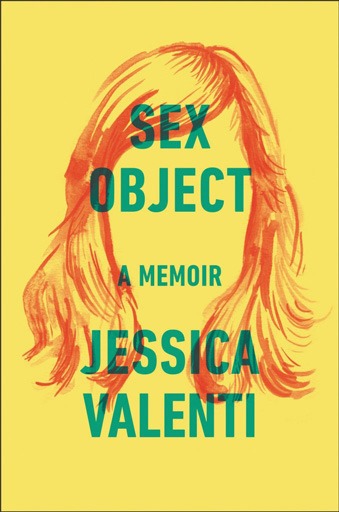
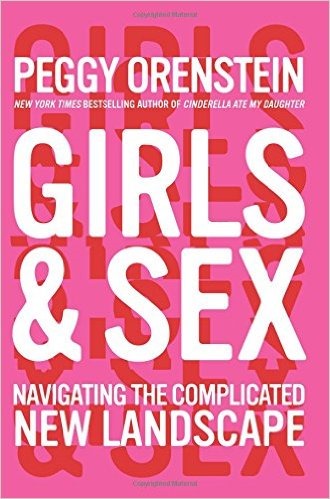
Sex-Object-by-Jessica-ValentiThere are two books I recently read to recommend for third wave feminism, Sex Object by Jessica Valenti and Girls & Sex by Peggy Orenstein. Valenti’s book is a memoir and confessional. She uses her own life as a piece of performance art to dramatize her title. Orenstein is a journalist, taking a social science approach by interviewing over seventy high school and young college girls. Even though Valenti is from an older generation, her life fits in with the data Orenstein collects, and I found a synergy to reading them back to back. The difference is we get to see Valenti as a grown woman, and mother. Most reviewers focus on Valenti’s early story, where she deals with the worst kinds of males and misogyny. But I found her later story of becoming a mother more moving, and revealing. Valenti shows how hard it is to be a feminist, but she also writes about how much harder it is to be a woman and mother.

Both of these books describe the problem of objectification without offering solutions. When second wave feminists identified these problems in the 1970s and tried to offer solutions, it caused deep divisions among feminists. Those feminists were labeled radical, and were often hated.

None of the goals of third wave feminists have found much political traction. There are no planks with the Democrats’ agenda in 2016. I don’t even try to describe third wave goals because they’re too complex to understand without reading many books. These two books only deal with sex objectification, and that’s only one puzzle piece in a complex picture.
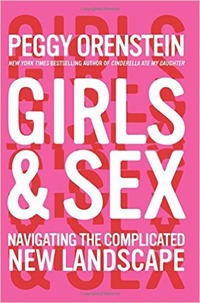
Girls and Sex by Peggy OrensteinThe more I try to understand feminism, the more I read why one word, feminism, can’t represent all women. The complexity of gender could eclipse all old ideas about feminism. Time and time again, I’ve read accounts by older feminists telling their daughters about why they should be feminists only to discover their daughters have other ambitions. They are already seeing a newer world. Both Valenti and Orenstein have daughters, and of course they desperately want a better world for them. We all do, but finding out how to achieve that is more difficult than passing laws, organizing politics or voting. It requires men to think differently. But it will also require women to think differently. And it’s not something we can even make into political correctness. I wonder if that’s why some fourth wave feminists think a spiritual component is required, because we all need to evolve into a higher awareness of a multiplex gender reality.

I am reminded of a favorite science fiction story, Empire Star by Samuel R. Delany. His young protagonist leaves a simple home world to explore a diverse galaxy and is told there are three kinds of thinking: simplex, complex and multiplex. With all the problems humans are facing today, it’s time we start multiplex thinking. You’ll have to read these books to understand what I mean, and then keep reading.

JWH
Rejuvenating With Miranda Esmonde-White

By James Wallace Harris, Thursday, August 11, 2016

Update: 1/3/19. I did the Miranda Esmonde-White exercises all year during 2018 and it's made a significant difference in reducing the pain in my back. Systematic stretching does wonders.

Last year I discovered Miranda Esmonde-White on a special for PBS, based on her book, Aging Backwards: Reverse the Aging Process and Look 10 Years Younger in 30 Minutes a Day. You can watch Esmonde-White lecture about aging backward here. Esmonde-White focuses on how a loss of muscle mass affects us as we age, claiming if we start stretching we can reverse the aging process. (If we don’t wait too late.) As we age, we shrink and begin to hunch over. If we start stretching before that process has gone too far, we can reverse it. Just watch her lecture. Esmonde-White was born in 1949 and is two years older than I am. She’s tall, agile, bendy, balanced and graceful. She looks and moves like a much younger person.

Classical Stretch 10

I was quite impressed with her PBS special and ordered three copies of Classical Stretch – The Esmonde Technique: Core Workout for Christmas presents. Two were for friends who never exercise, and one for Annie, who’s addicted to it. She loved the video and regularly uses it. My two friends who never exercises, and who will remain anonymous, never used their DVDs. But testimonials from Annie are making them reconsider. And now that I’ve started with the exercises, they are worried its catching.

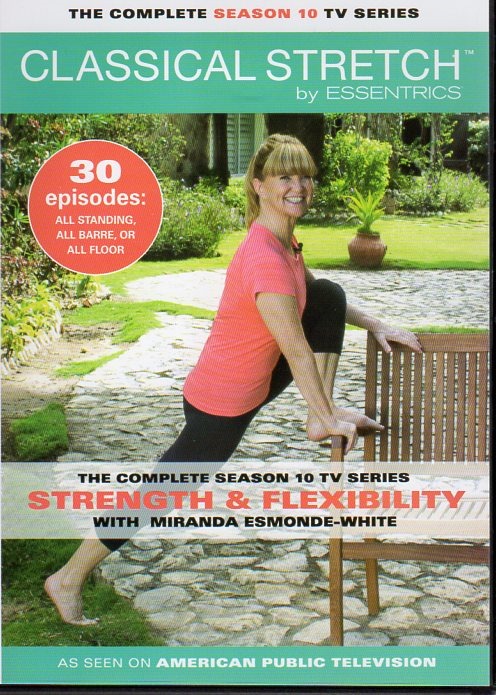
I recently went off my diet. I lose discipline now and then, and binge on unhealthy food. I quickly gained five pounds, started skipping some of my daily physical therapy exercises, and my back went out. I immediately returned to my diet and exercise routine, and slowly started turning things around. But while this was happening, I decided to try the Classical Stretch program. I figured I could use some extra help. The Core Workout I bought my friends was 55 minutes and wanted something shorter to do before PT. I researched on Amazon and found Classical Stretch – The Esmonde Technique: Complete Season 10 – Strength and Flexibility.  Thirty 23-minute lessons. I thought $70 was kind of expensive for a 4-DVD set since for $65 I can buy the entire three seasons of Star Trek original series on Blu-ray. But what sold me were the customer reviews that claimed it help their backs. $70 is not much compared to doctor visits.

I’ve never liked going to the gym, and especially disliked exercise classes like yoga, even though I like the concept of yoga. What I like about Classical Stretch is Miranda Esmonde-White has designed a workout that’s appealing to the aging me that requires no extra equipment, special clothes, and can be done practically anywhere and anytime. She claims we have 650 muscles and we need to systematically stretch them. I’m just starting out with this workout but I can already feel the difference. My back recovered in days, much faster than usual. And the rest of me feels different too. Moving around is easier. I notice my body much less. That might not mean much to someone who is young, but getting older is all about noticing the body.

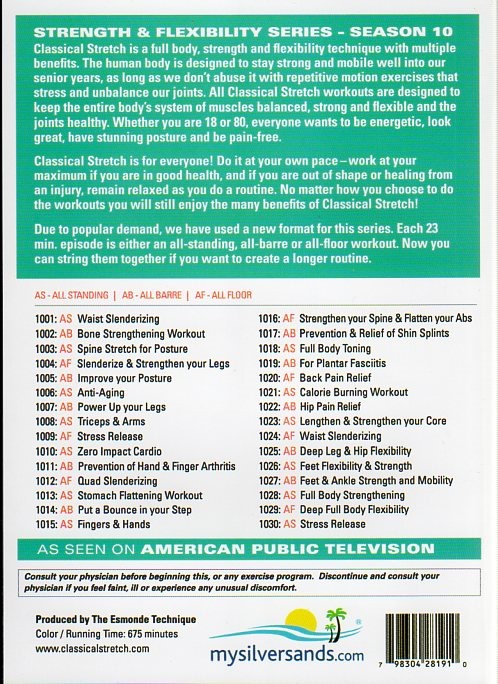
Don’t let me mislead you. These exercises are easy to try, but hard to follow exactly like Esmonde-White. I think it’s going to be a while before I’m doing them right. I feel like a gorilla taking ballet lessons. The daily lessons are varied, and I assume after weeks or months, I’ll memorize them and won’t need the videos. Click on the image of the back of the video box below. It lists all the thirty lessons.

I’ve always wondered why classes for aerobics, yoga, or Pilates were mostly filled by women. Now I know. This kind of exercising is like learning to dance. Most women I know love dancing. Guys generally don’t. I’ve always felt completely inept and foolish trying to dance. I’m doing these exercises alone, and I don’t even worry about what I look like, or that I’m not doing them perfectly – I just keep doing them. The 23 minutes goes by pretty fast. It’s not an aerobic workout, but I get a bit winded. Esmonde-White is right, these stretches make you feel younger – or at least looser. Whenever my back goes out, it feels like I age ten years. So when my back feels better, I feel younger.

I’m hoping if I make these exercises a permanent routine, I’ll actually rejuvenate. I limit my activities now because of my back problems. I’m faithful again to my plant-based diet and losing weight. I hope between weight loss and these exercises I’ll feel young enough to want to travel, or just be more active.

[click on covers to enlarge]

Classical Stretch 10 - frontClassical Stretch 10 - back

JWH

Remembering Star Trek—50 Years

By James Wallace Harris, Saturday, August 6, 2016

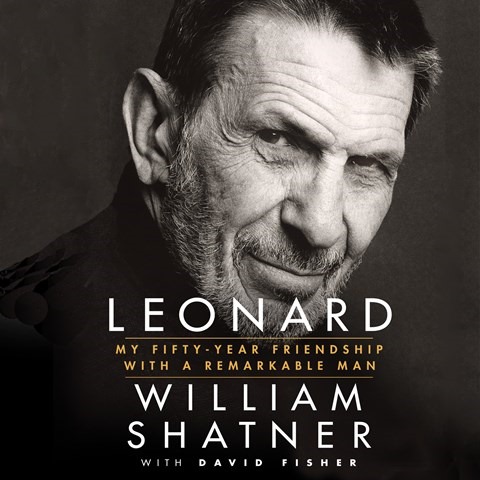
Leonard by William ShatnerThis is my week for revisiting Star Trek. Last weekend I saw Star Trek Beyond, and this weekend I read Leonard by William Shatner, a biography of Leonard Nimoy, explaining their fifty-year friendship. Between that movie and book I watched three old episodes of Star Trek:TOS just out of nostalgia. I have a rather love-hate relationship with Star Trek. Fifty years ago this summer, while staying with my dad in Key West, Florida, I saw the previews for a new science fiction show that would start in the fall. I can’t convey how excited I was waiting for Star Trek to premiere. Then the first episode was about a shape shifting monster that sucked the salt out of people. WTF? (Although, we didn’t talk in initials back in 1966.) The crew and ship was cool, especially Mr. Spock, but that first show disappointed me. Eventually, I saw other episodes that did wow me, so Star Trek was always a hit and miss kind of experience. To be honest, the only character I really liked was Mr. Spock, so what appealed to me were the stories, and their quality varied greatly from week-to-week.

The new Star Trek Beyond is a big hit – but not with me. Now I’m not saying it’s a bad movie, that would be silly when so many people love it. I just have some grumps, and that’s probably due to being old. I’m worn out on special effects. I’m tired of action movies. I’m sick to death of unrealistic violence in movies, especially the ones where the violence is less real than Three Stooges or Wile E Coyote. Superhero films have ruined action, thriller and modern westerns for me. They’ve all become power porn for people who fantasize that can pound people like Jack Reacher or Jason Bourne. Not my thing. I know I’m weak and gimpy, and would get my ass kicked by anyone over twelve. Especially those kids trained on action films.

I’d love to see a Star Trek film where special effects were kept to a minimum, with no martial arts, no space battles, and for god’s sake, where the damn crew don’t become hostages. How many times has Captain Kirk or crew been captured? How many times has the Enterprise been destroyed? And where’s the damn science fiction? Essentially Star Trek Beyond could be summed up as terrorist threatens civilization with bioweapon. The only sense of wonder I found in the film was when they introduced Yorktown. That was pretty cool. If they had spent the whole film just hanging out on that space habitat I would have been a happy moviegoer.

The three old TV episodes I watched were:

All three episodes were enjoyable, but none deserved an Emmy or even a Hugo. Each had a nice gimmick, and even though she didn’t do much, “Assignment: Earth” made me remember Teri Garr (although I had already seen in her in several films as an extra according to IMDb).

I’m going to give up on the Star Trek movies, and just watch the old TV shows from time to time. All three of the recent reboot films have been heavily laden with nostalgia I don’t feel. I like the new actors, and if they could break away from being clichés and caricatures of the originals, I would enjoy seeing a new Star Trek story that had some original science fiction concepts. The trouble is they have to make a film that will earn hundreds of millions and that means a cartoonish action film. I’d love to see them create a story that has the feel, pacing and creativity of Gattaca, Her and Ex Machina, but set it on Yorktown.

Now, the best for last. Leonard proved to be a surprisingly good read. I don’t know if Shatner or his co-writer David Fisher did the writing, but it’s very readable, and full of well research details. Shatner and Nimoy were born months apart to Jewish families. Both wanted to be actors and struggled for years to find success. Shatner’s chronicles of how he and Nimoy took any acting job they could get. I found that particularly interesting, especially when he covered television jobs in the 1950s and early 1960s.

Since I haven’t read any other histories of Star Trek or its actors, I’m not sure how much of the information in Leonard is new. It was enough to give me a satisfying sense of working on the original show and movies, plus memories about the Star Trek conventions. Shatner also summarized Nimoy’s work in theater, directing, poetry, singing, photography and philanthropy. Shatner convinced me that Leonard Nimoy was an exceptional person. The book is a moving eulogy to a friend. And like I said before, the book is very readable.

But Leonard is more than a biography. It’s a kind of confession. Shatner claims Nimoy was his best friend in life, and then admits that Nimoy had stopped talking to him years before he died. The psychology of this book is one for psychiatrists. Evidently the story of these two men is very complicated, and we’re only hearing Shatner’s side of things. I’m not sure if Shatner is very self-aware, but he does struggle to appear honest, and express his feelings. Even if you knew nothing about Star Trek, this book might be a worthy read because of how the story is told. It’s about acting, and what it means to become a pop icon success. Anyone interested in acting, old television, making movies, or working in the theater should find insight in this story.

The reader feels Shatner loved Nimoy, but like Shatner, can’t understand why Nimoy hated him in the end. I searched the internet for answers, but realize I’d be jumping into a black hole and quit. It would be interesting to read an impartial, definitive biography of Star Trek, its creators, writers and all the actors. Is there such a book? I’m not a Trekkie/Trekker, so I don’t know. Star Trek is a phenomenon, so that makes it an interesting subject separate from the show’s fan appeal.

From the details within Leonard, and a bit of Google research on Star Trek, I get the feeling the Star Trek universe is huge. If you count the number of TV episodes from all the series, all the movies, all the books, comics, and so on, there must be well over a thousand artifacts to study, maybe a lot more. Even though, from 1966 on, I watched most of ST shows, I never took it seriously enough to become a true fan. And even though I’d like to know more, I’m not sure I have the time, or even if the endeavor is worth while. Leonard does convey the immense success of Star Trek, and that might be all I need to know, but it’s beyond my comprehension to really understand the Star Trek universe.

Personally, I have a kind of resentment against Star Trek and Star Wars. I remember how science fiction was before 1966, and I preferred when the genre was mostly unknown. Those franchises exploded the world of science fiction twice. Science fiction was defined by magazines in 1926, began shifting to books in 1946, then in 1966 the audience expanded tremendously with television, and in 1977, it’s appeal exploded again worldwide. Even though media science fiction can be fun, it was never the science fiction I found in magazines and books. In many ways, I think the definitive science fiction has always come from magazines. Of course, my view might be age related, and I’m revealing I never kept up with the times.

The difference between me and real Star Trek fans, is I never fell in love with the characters. With both Star Trek and Star Wars, I think their fanatical fans love the characters and can’t forget them. And to me, science fiction has always been about insightful ideas – the sense of wonder at discovering something that could or should exist in reality but something I never imagined. For me, the science fiction digests of the 1950s and 1960s had more sense-of-wonder revelations then anything I ever found in television and movies.

I still like Star Trek about as much as I liked it during the 1966/67 TV season. It has its moments.

JWH

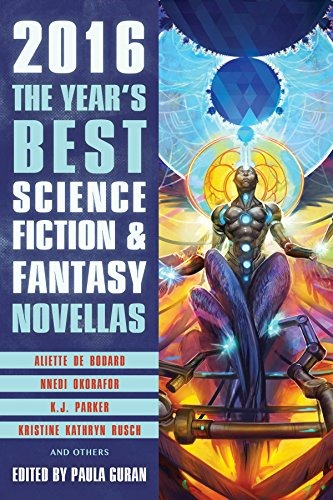
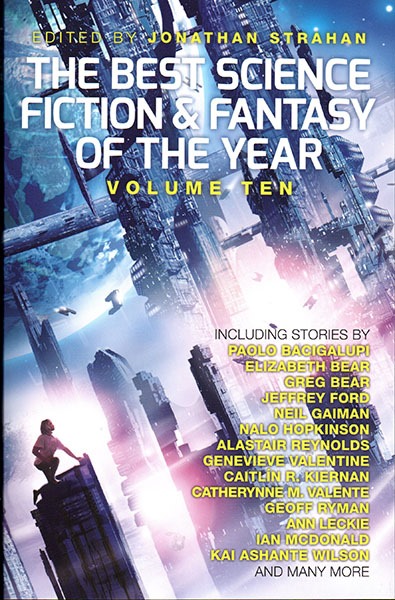
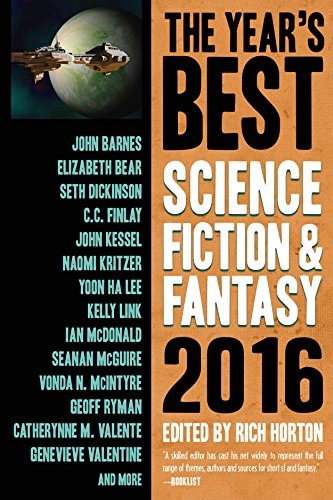
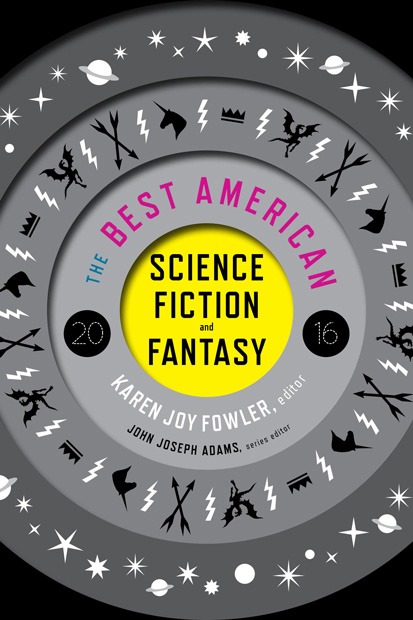
Six 2016 Best Science Fiction Anthologies Covering 2015

By James Wallace Harris, Sunday, July 31, 2016

Ever since The Best Science Fiction Stories: 1949, edited by Everett F. Bleiler and T. E. Dikty, there have been annual collections of the best short science fiction. For many decades now, there have been two or three. For some reason, in 2016 we have at least six big anthologies looking back at the short work of the previous year. There will be at least one more, because the Nebula Showcase that covers 2015 stories hasn’t come out yet.

clarke Dozoisguran
StrahanHortonFowler-Adams

Links below are to Amazon, where you can buy, preview the table of contents, and maybe read the introductions in the Look Inside feature. I’ve already bought one ebook and one audio edition to read or listen on my iPhone. I might buy another in print. I’d buy them all if they were available on audio.

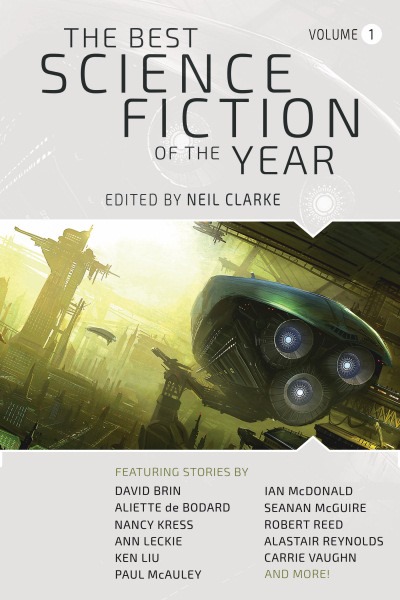
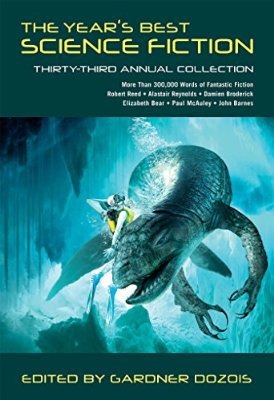
I’m the most excited about the Neil Clarke collection, because it’s also available on audio at Audible.com. I’ve been wishing for years that the Dozois, Strahan or Horton volumes would show up at Audible. Allan Kaster has been my only source of annual best short science fiction on audio, via his series The Year’s Top-Ten Tales of Science fiction (v1-7) and The Year’s Top Short SF Novels (v1-5), Kaster’s collections were never as giant as the Dozois or Strahen volumes. I wonder if Kaster has stopped his series, because his collections only cover through 2014 stories. I hope not.

Does this wealth of anthologized short science fiction represent increased interest in reading short science fiction? For decades the print magazines have struggled to survive with dwindling subscribers. Decades ago some SF magazines had over 100,000 subscribers. Now the major print magazines have only 7,500-20,000 paying readers and that’s declining. Has the internet changed the way we read?

Is the internet increasing readership of short SF? I love being able to read on my phone whenever I have a free moment, or listen to a short story while I walk or do dishes, or even have Alexa on my Amazon Echo play a story for me in the middle of night when I can’t sleep.

These stories are being collected from a much more diverse collection of sources. We’re moving away from print to digital. Here are some of the periodicals that publish science fiction short stories. Some magazines still print their issues, but my guess is buying and reading short stories on paper is going the way of the land line.

Many of these year’s best stories came from original anthologies.

I wish I had the time and patience to put all these short stories into a database and see which ones were most reprinted. For example, I noticed that “Capitalism in the 22nd Century or A.I.r.” by Geoff Ryman, is in the Clarke, Dozois and Strahan volumes.

It would also be wonderful if I could read all these stories and grok the nature of current science fiction. That probably won’t happen. Even though I’m retired, and have all my time free, I never have enough time for all the projects I want to pursue. But it sure would be fun to gorge myself on 2015 science fiction, then gorge myself on 1950s science fiction short stories, and after all that mass-consumption of short stories, write a comparison of how science fiction has evolved and changed.

I can’t imagine how these editors read so much. I wish Dozois would write a book about editing science fiction. And he could write a wonderful history of the evolution of the science fiction short story.

JWH