I’m Known for Human Stupidity and Dinosaur Dreams

By James Wallace Harris, August 26, 2016

If you search Google for “humans are stupid” my essay “50 Reasons Why the Human Race is Too Stupid to Survive” comes up in the #1 spot. At least it does for me, and for my friend Connell in Miami. I’ve been wondering why that essay gets 50-75 hits a day. I just searched on “why are humans so stupid” and I’m the #1 return again. If I use Bing, I don’t come up at the top of the returns. It’s weird to think that people are wondering why humanity is stupid, and come to my blog for answers. So far I’ve gotten around 15,000 hits. I feel a little guilty about spreading negativity. I guess it’s a positive sign I’m not getting more hits. Some of my readers who leave comments have been pretty down on the world. I suppose I can use the number of hits I get each day as a barometer to measure unhappiness in the world.

Smoking Dinosuars - Gary Larson

If you happen to search on “dinosaur dreams” I’m the #2 return on Google and #21 on Bing. (Why doesn’t Bing like me?) This is very weird too. Evidently, 30-50 people each day have a dream about dinosaurs, search Google to find out why, and come to my blog to read “Do You Dream About Dinosaur Attacks?” So far, over 13,000 people have done that. That’s pretty amazing that so many people dream about dinosaurs. Even more amazing – some of my readers have dreams just like mine, where dinosaurs show up, and everyone knows to be quiet and still, but some dumbass always makes a noise near us to attract their attention. I’m always more mad at the noisemaker in these dreams than scared of the dinosaur.

JWH

Tidying Up Beyond Marie Kondo

By James Wallace Harris, Tuesday, August 23, 2016

The KonMari Method of tidying up one’s life focuses on household possessions, but I’ve been thinking of ways of decluttering my mind, my routine activities, my computer, my physical and digital subscriptions, and what I own in the cloud. In the 21st century, ownership can be quite different from the 20th century, because many of the things we once physically held can be digitized. Then, there’s the whole issue of own versus rent – house v. apartment, car v. Uber, DVDs v. Netflix, magazines v. Texture, CDs v. Spotify.

I have many rooms in the cloud that need tidying up.

minimal1

For example, I have this blog at Auxiliary Memory, but I also have a traditional web site at a hosting service for The Classics of Science Fiction. That site has been static for years because I’ve forgotten how to program in PHP and MySQL. I’ve been meaning to update my data, but that would mean a tremendous amount of work. I recently moved the content from my web site to this site, and that has simplified things. I will soon be able to cancel my hosting service. One less bill, and one less room in the cloud to keep tidy.

My friend Mike and I are working to update the Classics of Science Fiction list. My first plan to simplify was to move from a hosted MySQL server to using Access on my local computer. Then Mike suggested we jettison the database and use a spreadsheet for our data. Even simpler. Then we decided to even jettison the spreadsheet, and keep the data in .csv text files that we process on the fly. Mike is writing a program that will generate HTML code for using on my blog. Once you take the tidying up process beyond mere possessions, it become obvious that clutter is everywhere.

Another way I could reduce the psychological clutter in my life is by focusing my writing. Right now I write about whatever idea grabs my fancy – often because I’m fascinated by everything. The trouble is I can put in hours of work on some ideas and get no readers, and for other topics get hundreds of hits. Auxiliary Memory could be greatly improved if I narrowed the topics I covered. This would spill over to my reading, documentary watching and thinking. I could declutter my mind by deciding which subjects I want to truly learn, and which I should ignore.

Marie Kondo has a lot to say about getting rid of books. For a bookworm, that’s very hard to do. One way I’ve cheated is to stop buying physical books when I can, and bought ebooks instead. Out-of-sight is out-of-mind. But now my Kindle library is becoming cluttered. The same thing has happened with my music. I ripped my CDs and put them in the cloud, but I mostly play music from Spotify, so I have three large libraries of music to deal with – physical, cloud and rented. If I committed completely to Spotify I could simplify things greatly. I got rid of about 600 CDs, kept 600 that were my absolute favorites, and have another 600 I’m trying to decide if I should keep or jettison. I only play CDs on rare occasions. I wonder if it’s time go completely digital?

I moved my photographs to the cloud, so I have two large collections – one physical, one in the cloud. Is it time to commit to just one?

I gave up cable TV years ago, but ended up subscribing to several digital services. I just canceled Hulu, Pandora and The Great Courses Plus. They are all great services, but ones I seldom use. I was also subscribing to several digital magazines through the Kindle. I canceled them. I’m torn about Texture. It’s $15 a month and lets me read 150 magazines, but I hardly use it. On the other hand, it lets me have access to magazines that would otherwise clutter up the house. Then again, maybe it’s time to give up magazine reading. I actually spend most of my journalistic reading via free web content on my iPhone. I subscribe to The New York Times on the web. It’s great content. But I often forget to read it.

I do worry that all this decluttering is impacting the economy. If everyone followed a Zen-like path of simplicity, the economy would go down the drain. Can we create a decluttered economy that provides jobs for all?

The biggest way I can simplify my life would be to sell the house and downsize. I’m tired of repairs and worrying about the yard. I’m tired of furnishing rooms we don’t use. I’d love to move to a retirement community where I lived in an apartment or condo without a yard, but I worry about noise pollution. I love playing my music loud, and my movies in surround sound, and I hate hearing neighbors. I’m sure they’d hate hearing me. I suppose to could live with headphones.

I’m not quite ready to pull the trigger on moving, which means I need to keep tidying up this house. After Susan and I went through one phase of Marie Kondoizing, getting rid of several hundreds pounds of junk, we felt much better. But I think we could still jettisons hundreds of pounds more.

Once you start thinking about clutter, you see it everywhere.

JWH

Rethinking Star Trek: “The Cage”

By James Wallace Harris, Monday, August 22, 2016

“The Cage” was the first pilot for Star Trek, made in 1964-65. Wikipedia has an excellent history and plot summary, so I won’t repeat it. I’m sure most fans remember this proto Star Trek with Mr. Spock as the only main character from the regular series. The sets, special effects, costumes, models, gadgets, were are all much more primitive than what we see in later episodes. However, the story is exactly the kind of story Star Trek was known for, and was later recycled into the two-part episode “The Menagerie.”
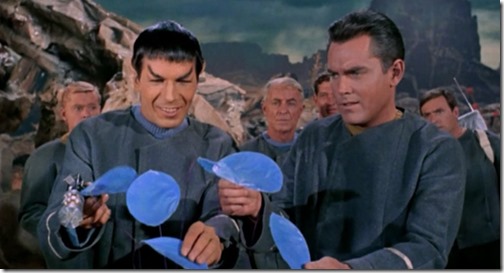
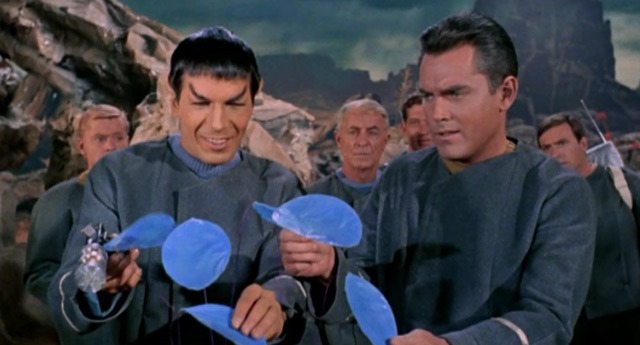
spock smiles the-cage

What I discovered watching “The Cage” a half-century after seeing “The Man Trap” on 9/8/66, is a different impression of Star Trek. I was never a fanatical fan, but I loved the original series, and watched all the later series as they came out. To be honest, I’ve always thought of Star Trek as Sci-Fi Lite. Quite often television and movies make science fictional ideas look silly, and all too often I criticized Star Trek for not being scientific. In recent decades I found it almost impossible to sit through the old shows because I lost the patience for 20th century television. But something in me changed recently, when I began watching the old shows as a way of understanding myself as I was fifty years ago.

For some reason, I got into a headspace where Star Trek worked again. I was able to forget the limitations of 1960s television production, my skepticism about scientific plausibility, the silliness of plotting, and enjoyed the show as its creators intended. This time around I discovered Roddenberry was less into science fiction than I remembered.

As I watch each episode with my friend Annie, I’m actually looking forward to seeing Star Trek again. We’re playing the series in order the episodes were broadcast in 1966-69 using Netflix streaming. Annie and I were both born in 1951, and we watched the show when it first came out, me in Mississippi and Florida, and she in New Mexico. This time traveling is bringing back memories of discovering science fiction, first in television and movies in the 1950s, and then in books in the early 1960s. Star Trek actually repackages all the common science fictional ideas of the times. We like to think of Star Trek as being an original television series, and it was, but sometimes it was The Beatles, but quite often it was The Monkees. Don’t get me wrong, The Monkees had some great tunes, but they were manufactured hits. What fascinates me now is how Roddenberry repacked 1950s science fiction for his 1960s philosophy.

Gene Roddenberry never had the science fiction originality of science fiction writers of the 1950s. I don’t think he was even a big fan of the genre before discovering Star Trek fans in the 1970s. Except for a few episodes written by science fiction writers, Star Trek wasn’t contemporary with 1960s written science fiction. The New Wave in science fiction hit just before the series premiered. Watching these old shows again in the 21st century lets me see them differently from how they appeared in 1966. This time around, I’m focusing on the history of science fiction, and the ideas science fiction were exploring at that time.

Watching these shows again, I realized that Star Trek was less about science fiction, and more about allegory. Roddenberry was using science fiction to express his political beliefs. For those who didn’t live through 1964-1966, these were exciting years intellectually. Science fiction is the main ingredient in Star Trek, but there’s many other ingredients as well, including 1950s television, Civil Rights, feminism, anti-war, Pop Art, the Counter Culture, and so on. Each screenwriter brought something different, and Roddenberry squeezed all of it into allegories.

The Allegorical View

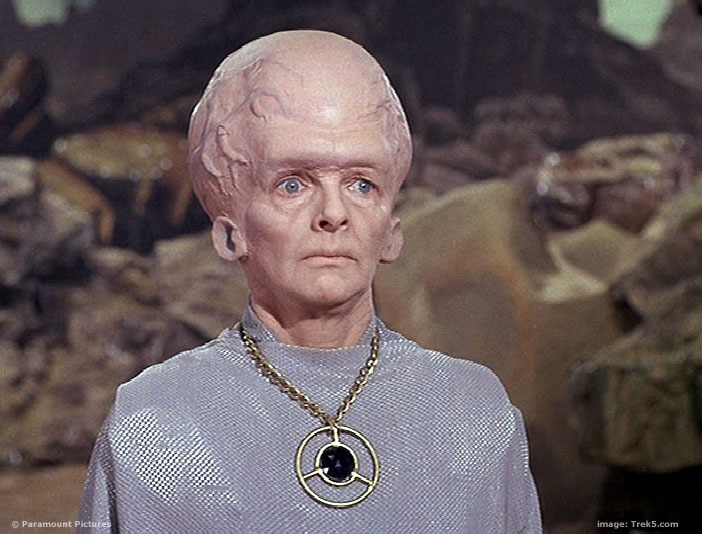
cage-talosian

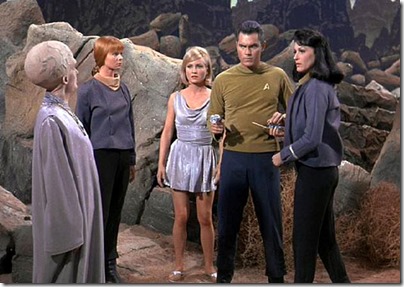
The words Talos and Talosians sound close to theology and theologians. In “The Cage” the Talosians have god-like powers. Gene Roddenberry was an atheist, and “The Cage” seems less about aliens from outer space, and more about beings from heaven. The show is about how theologians keep us imprisoned by our thoughts and the promise of heaven. Throughout the episode, the Talosians struggle to convince Captain Pike (Jeffrey Hunter) to accept their fantasies for reality, tempting him with a beautiful woman, Vina (Susan Oliver). They want Pike and Vina to play Adam and Eve, and repopulate their planet. To be their servants, their hands in the physical world. It’s very Biblical.

The symbolism of this first show is rather striking. Humans reject god, leaving a rundown Eden to escape into space. Vina stays home, trapped in god’s delusion, disfigured by god’s image of what she should be. Rewatch “The Cage” and think allegory rather than science fiction. Think about the last temptation of Christ.

The Science Fiction
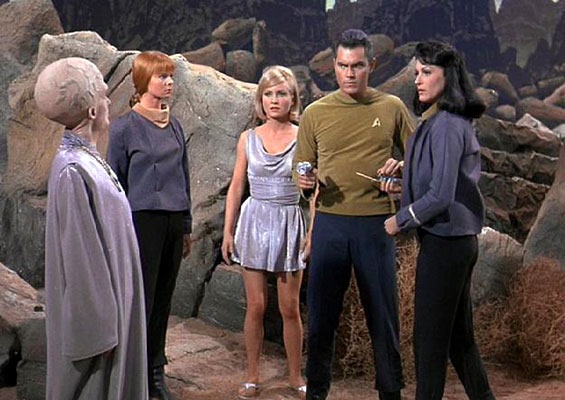
Pike-holding-Phaser

The warp drive was one of Star Trek’s most famous science fictional ideas, and it evolved over time. Science fiction has come up with many ideas about traveling faster than light. Ultimately, they’re all gimmicks to further the plot. In Star Trek, interstellar travel takes about as much time to get between the stars as ocean liners traveling between the continents did in the 1960s. In Star Wars, interstellar travel is faster than jet travel between countries in the 1970s. Science fiction seldom deals with the reality that interstellar travel, which will probably take centuries, if we’re lucky.

The transporter was another “invention” of Star Trek,  even though matter transporters had existed in science fiction before 1966. The story that’s always told, is the producers of Star Trek couldn’t afford using a shuttle craft, so they came up with the transporter to save on production costs. That’s fine, but there is a huge logic hole in their design. Why does it take a machine to send people, but not another machine to receive people? If they could grab people off a planet, why didn’t Scotty just beam Kirk from the bridge to the planet? Why did they always have to go to the transporter room to beam down, but didn’t need a machine to beam up. Think of the jokes Scotty could have played on Kirk, beaming him to a different Yeoman’s bedroom every night after he had gone to sleep.

Also, how many exabytes of data are required to describe a human in transporter logic? And the transporter appears to beam people faster than light. Does that require warping space? And how are people decoded at a distance without a machine?

The aliens in Star Trek often had super-powers, or even god-like powers. The Talosians could create perfect delusions in humans. The first regular episode of Star Trek, “The Man Trap,” the creature was called a shape shifter, but obviously that was incorrect, because it appeared in one scene to several men, looking different to each. It evidently had the same power as the Talosians. But think about what such a power means. First it means faster-than-light data communication between two minds, with very massive amounts of data transferred. And with multiple humans, means multitasking at a tremendous rate.

Our minds can create very realistic, vivid hallucinations, but only when our senses are turned off. Like when we’re asleep and dreaming, or in a sensory deprivation tank, or we’ve taken some powerful drugs. Even then, the details of hallucinations are never even close to details of how we experience reality processed through our senses. Creating perfect illusions is impossible. This is only a gimmick for the allegory.

I don’t know why, but most “advanced” aliens are always given PSI-powers in science fiction. These super-powers are always very similar to the powers we attribute to gods. There’s no scientific reasons to think such powers exist in us, or aliens. Quite often in Star Trek, Kirk and crew meet aliens with such god-like powers. In each case Kirk is required to outthink such beings, and he does, although often with silly gimmicks. I get the feeling Roddenberry hated authority, religion, and any kind of mind control, and many of his science fiction stories reflect this in allegory. Often Roddenberry is much closer to The Twilight Zone than Astounding/Analog. But then again, maybe I need to revisit 1950s/1960s science fiction to see if it was more allegorical than science fiction.

To me, real science fiction was always about preparing us to go to the stars. Fans think that’s true of Star Trek. I’m not so sure, at least for the original series. My hunch is Roddenberry didn’t get the science fiction religion until after Star Trek:TOS. As I watch the shows, I’m wondering if the fans didn’t read the pro-space theology into the original series. I’ll see as we watch.

JWH

“Humans Are Such Dicks!” Say all the animals.

If animals could talk, can you imagine their trash talk about us? Nothing for children to overhear. Imagine how furious they’d get if they could read books like The Sixth Extinction by Elizabeth Kolbert or Learning to Die in the Anthropocene by Roy Scanton. Humans are now the cause of the sixth great mass extinction event in the history of the Earth. We’ve fucked this world up so bad that scientists are now naming the geologic age after us – the Anthropocene. And since we’re such collective dumbasses, the age will probably be a short one. To make it even more tragic, scientists are discovering that animals are more aware, more sentient, than we thought. Consciousness of reality, is a spectrum, not a quantum leap. We may be the crown of creation on this planet, but we’re despotic rulers.

After I read The Sixth Extinction by Elizabeth Kolbert, I started feeling very guilty about what our species is doing to all the other species. Then I started reading Half-Earth, Our Planet’s Fight For Life by Edward O. Wilson, who suggests we can absolve our guilt if we shared the planet fairly. I’m not sure most of my fellow humans feel that way. And then I bought, Are We Smart Enough To Know How Smart Animals Are? by Frans De Waal. This one makes me feel even guiltier. Can we even comprehend minds not like our own? For the past year, I’ve noticed in my news reading more stories dealing with animal intelligence and sentience. Most people love animals, but do they love them enough to give them their fair share of the world?

I’m still reading on the last two books, but when I went looking for customer comments about them on Amazon, I noticed these other books. There seems to be a flood of animal awareness books coming out. Can we read enough books to actually mind-meld with animals? Can we expand our awareness of the natural world quick enough to change who we are, before we destroy us all?

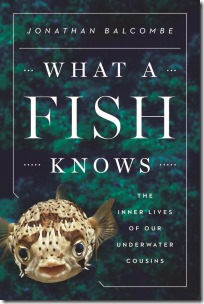
What a Fish Knows: The Inner Lives of Our Underwater Cousins by Jonathan Balcombe (June, 2016)

What A Fish Knows by Jonathan Balcombe

Just as water influences the dynamics of vision, so it does for hearing, smell, and taste. Water is a superb conductor of sound waves, where they are almost five times longer than in air, as sounds travel five times faster in water. Fishes have benefited from this since the dawn of bones and fins, using sound for both orientation and communication. Water is also an excellent medium for diffusing water-soluble chemical compounds, and is well suited for the perception of smells and tastes. Fishes have separate organs for smelling and tasting, although the distinction is blurred because all substances are encountered in a water solution.

As they did color vision, fishes probably invented hearing. Despite the common assumption that fishes are silent, they actually have more ways of producing sounds than any other group of vertebrate animals. None of these methods involve the main method of all the other vertebrates: the vibration of air against membranes. Fishes can rapidly contract a pair of vocal muscles to vibrate their swim bladder, which also serves as a sound amplifier. They have the options of grating their teeth in their jaws, grinding additional sets of teeth lining their throat, rubbing bones together, stridulating their gill covers, and even—as we’ll see—expelling bubbles from their anuses. Some land-dwelling vertebrates get creative in producing nonvocal sounds, such as the drumming of woodpeckers and the chest pounding of gorillas, but fishes’ terrestrial cousins possess just two types of vocal apparatus—the syrinx of birds and the larynx of all the rest.

“What a Fish Hears, Smells, and Tastes” by Jonathan Balcombe

Makes you wonder what a fish feels and screams when hooked on a line, and then jerked out of the water. Imagine being that fish. Pescatarians probably feel fish are lesser creatures, and thus ethically consumable. But is that true?

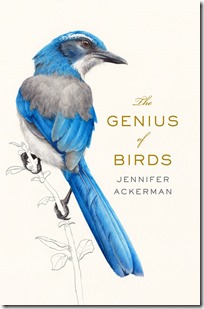
The Genius of Birds by Jennifer Ackerman (April, 2016)

The Genius of Birds by Jennifer AckermanFor a long lime, the knock on birds was that they’re stupid. Beady eyed and nut brained. Reptiles with wings. Pigeon heads. Turkeys. They fly into windows, peck at their reflections, buzz into power lines, blunder into extinction.

Our language reflects our disrespect. Something worthless or unappealing is “for the birds.” An ineffectual politician is a “lame duck.” To “lay an egg” is to flub a performance. To be “henpecked” is to be harassed with persistent nagging. “Eating crow” is eating humble pie. The expression “bird brain,” for a stupid, foolish, or scatterbrained person, entered the English language in the early 1920s because people thought of birds as mere flying, pecking automatons, with brains so small they had no capacity for thought at all.

That view is a gone goose. In the past two decades or so. from fields and laboratories around the world have flowed examples of bird species capable of mental feats comparable to those found in primates. There’s a kind of bird that creates colorful designs out of berries, bits of glass, and blossoms to attract females, and another kind that hides up to thirty three thousand seeds scattered over dozens of square miles and remembers when it put them months later. There’s a species that solves a classic puzzle at nearly the same pace as a five-year-old child, and one that’s an expert at picking locks. There are birds that can count and do simple math, make their own tools, move to the beat of music, comprehend bask principles of physics, remember the past, and plan for the future.

“One – From Dodo to Crow: Take the Measure of a Bird Mind”  by Jennifer Ackerman

My friend Anne raised a baby starling this spring, and I hung out with her when she released the bird. For a couple weeks the bird would come see her. You could see that it had imprinted on Anne, and for a while, that bird lived in two worlds – his natural world, and ours. When you’re that close to nature, you see that nature is more than what we dismiss.

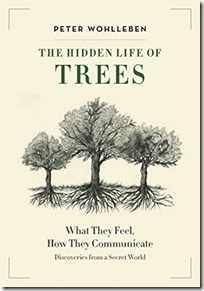
The Hidden Life of Trees: What They Feel, How They Communicate—Discoveries from a Secret World by Peter Wohlleben (Sept, 2016)

I can’t quote from the book, but here’s the blurb at Amazon:

The Hidden Life of Trees by Peter WohllebenIn The Hidden Life of Trees, Peter Wohlleben shares his deep love of woods and forests and explains the amazing processes of life, death, and regeneration he has observed in the woodland and the amazing scientific processes behind the wonders of which we are blissfully unaware. Much like human families, tree parents live together with their children, communicate with them, and support them as they grow, sharing nutrients with those who are sick or struggling and creating an ecosystem that mitigates the impact of extremes of heat and cold for the whole group. As a result of such interactions, trees in a family or community are protected and can live to be very old. In contrast, solitary trees, like street kids, have a tough time of it and in most cases die much earlier than those in a group.

Drawing on groundbreaking new discoveries, Wohlleben presents the science behind the secret and previously unknown life of trees and their communication abilities; he describes how these discoveries have informed his own practices in the forest around him. As he says, a happy forest is a healthy forest, and he believes that eco-friendly practices not only are economically sustainable but also benefit the health of our planet and the mental and physical health of all who live on Earth.

I’ve been a vegetarian since 1969, and I have always assumed that plants didn’t suffer. This will be a hard book for me to read. Humans are animals, and in the animal world, everything eats some other creature. But I think, because we’re more aware of reality, we have an obligation to be more than an animal. If we used the animal world for our precedent on ethics, murder would be acceptable. We need to be more conscious of what we eat, how it affects our own health, how it effects the biosphere, and its impact on the ethical treatment of other species. If we stopped raising cattle, it would be one route to Wilson’s plan to share the planet. That would give back a tremendous amount of land to the plants and animals, and greatly reduce our carbon footprint. We should also cut back on fishing the oceans, and let the seas recover.

Of course, that means humans giving up something. We’re not really good at do-be-sharers. But if we gave up beef and at least half of the seafood we eat, we could dramatically change the direction of the sixth extinction. Will we? I don’t think so. I doubt many people will even read these books.

And I don’t mean to be cynical.

It’s just everything the animals say about us is true.

JWH

Star Trek Histories at 50

By James Wallace Harris, Monday, August 15, 2016

My celebration of Star Trek at 50 continues, which began with “Remembering Star Trek—50 Years” and then “Star Trek: Dystopia in the Utopia.” I was never a Trekkie/Trekker, never went to a Star Trek convention, and I’ve only read a couple of the novels, so I don’t know why I’ve developed this sudden fascination with Star Trek. For decades I’ve had a hard time watching any old TV shows again—they were just too simplistic. Only the latest and best TV keeps my attention. Then something happened, something clicked, and I didn’t hate ancient television anymore. WTF?

It all started when I caught a few episodes of Gunsmoke, and then I read Leonard by William Shatner, which described working in 1950s television. This week I’ve caught episodes of I Love Lucy, The Life and Legend of Wyatt Earp, Make Room For Daddy, and Perry Mason, all from the 1950s. And, Annie, my Star Trek buddy, and I, are chronologically going through the 1960s Star Treks. I’m in some kind of time warp, and I can’t get out. Why?

Maybe it started when I was bingeing on 1950s science fiction books, and that somehow altered my consciousness so I could enjoy the old television again. Maybe the 1950s is just a comfortable place to hide out for a while. Living in the 1950s for a while evidently prepared me to enjoy 1960s Star Trek again. After reading Leonard and beginning the systematic rewatching of ST:TOS, I began craving more data about Star Trek.

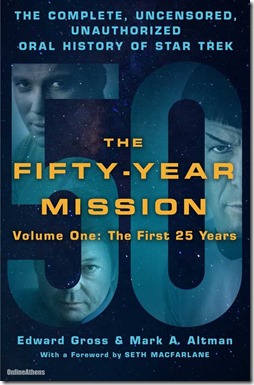
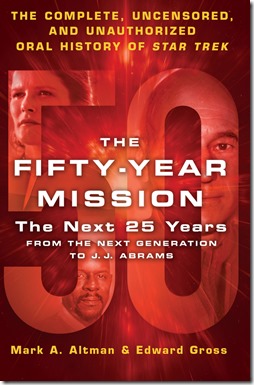
The Fifty-Year Mission v1The Fifty-Year Mission v2

That’s when I discovered the two-volume, The Fifty-Year Mission: The First 25 Years and The Fifty-Year Mission: The Next 25 Years: From The Next Generation to J. J. Abrams, both by Edward Gross Mark A. Altman. The first volume is even available on audio. These are beautiful books, massive in scope, that includes hundreds of new interviews, that attempt to cover the entire subject of Star Trek and its legacy. What Gross and Altman do is cut and paste thousands of quotations from everyone involved into one long, two-volume, chronological narrative. It’s both a history of Star Trek and a study in how television and movies are made, and how a cult phenomenon was created.

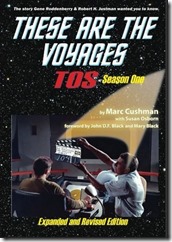
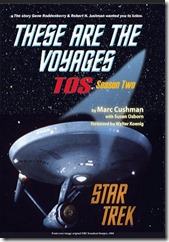
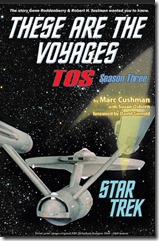
These-are-the-Voyages-v1-CushmanThese-are-the-Voyages-v2-CushmanThese-are-the-Voyages-v3-Cushman

Because there was so much written about Star Trek, I wondered what are considered the most comprehensive books on just ST:TOS, so I started poking around Amazon and found this three volume set by Marc Cushman:

Because these books are an episode-by-episode history of the classic 79 ST:TOS shows, I bought the first volume to read along with my rewatching of the series. These five books should keep me busy for years. Maybe three years. I’ve been thinking of writing a review of each show on it’s 50th anniversary. Of course, that sounds like one of those projects that I’ll start and give up quickly. However, my new fascinating with these old Star Trek shows is different this time. Fifty years ago I judged each show by my then standard for science fiction. Many episodes seemed way too silly to be considered science fiction because the science didn’t seem believable. This time around, I’m seeing the shows as allegories and metaphors, and not concerning myself as much with the science.

From the handful of episodes we’ve seen again, I realize each episode makes a statement about science fiction, the social and political climate of the day, and the ambitions of their creators. Fifty years down the road, I’m using Star Trek to study what we were all like in the 1960s – a kind of cultural anthropology. With 79 episodes, I’m sure Star Trek probably said everything anyone could about what’s possible with science fiction.

Star Trek was never my vision of science fiction. I’ve never really liked television and movie science fiction as much as I love written science fiction. Quite often, visual science fiction seems silly, even demeaning to written science fiction. Now, that’s my POV, and I know it’s not a common one. For example, the first four episodes of Star Trek (as seen on Netflix streaming, including the first pilot) have stories built around aliens or humans with god-like powers. Annie and I were arguing about that last night. She claims aliens could have super-powers, because we don’t know what’s possible. I say destroying a space ship and its crew light years away with just a thought is an unbelievable god-like power. I’m an atheist – not only do I not believe in God, I don’t believe in god-like powers. But what does it say when science fiction creators and fans do?

Roddenberry was known to be an atheist, so why does he write about god-like beings? In the first pilot, humans reject any paradise the Talosians promise because we refuse to be their playthings. In the second pilot, Kirk kills the two crewmen who become gods. How symbolic! Are those stories allegories, and Gary Mitchell, and later Q, stand in for something Roddenberry wants to attack? Is this science fiction or theology? What do the Talosians stand for in the story? Are they merely powerful aliens, or metaphor for gods? The crew of Star Trek always rejects, escapes, destroys or outwits powerful god-like aliens. Hell, they have a tough time accepting Spock, and his cold logical mind. This show is amazingly pro-human. Should I even say, humanistic.

If I study these history books about Star Trek will I find out why each show was written? Are their academic books that critically analyze the stories. Or, are the stories merely cribbed from 1950s science fiction. “Charlie X” seems to borrow from Stranger in a Strange Land and “The Good Life” by Jerome Bixby. How often in the original 79 episodes of Star Trek do the the writers reprocess for the current week’s show something they read in F&SF, Galaxy, If and Astounding during the previous decade? Science fictional ideas that were spread to thousands in the 1950s with magazines, were now being spread to millions on television.

I’m currently fascinating by Star Trek for many reasons. I’m rethinking my own brain programming. I rejected God and religion back when I began embracing science fiction. But after a lifetime of accepting my science fictional faith, I’m developing skeptical thoughts. The foundation of my thinking comes from 1950s television, reading science fiction in the 1960s, and absorbing the 1960s counter culture. Strangely, I believe Star Trek did the same thing.

JWH