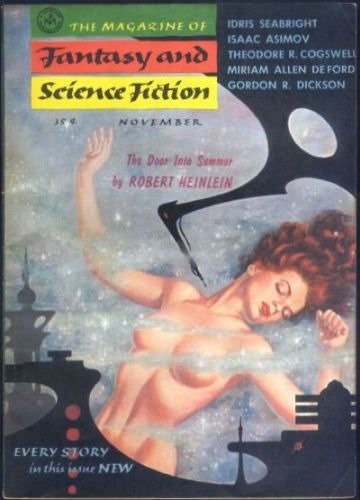
“The Veldt” by Ray Bradbury

When does science fiction work even when it’s broken?  “The Veldt” is the opening short story in Ray Bradbury’s classic collection The Illustrated Man, and it’s a highly effective story that doesn’t make much sense if you try to take it apart.  “The Veldt” appears to be Bradbury’s reaction to the deployment of television in 1950.  Essentially, the tale is an allegory that says the new technology loved by the young will kill off the older generation.

“The Veldt” could be filmed today, modernizing the story, and the allegory would work with the Internet, computer games, or even iPods.  If you take the story apart looking for the science fictional technology that creates lions that dine on parents you won’t find it.  Bradbury hopes his slight of hand distraction will keep the reader from looking behind the curtain, but I think many hardcore SF readers get hung up on that and shout, “Cheat!”

Ray Bradbury is often a science fiction writer that non science fiction readers think of when they think of a science fiction writer.  Most readers don’t like science, not even the toy science of science fiction, so they readily respond to Bradbury allegories of anti-science.  If Bradbury’s goal was to fight off new technology and preserve the quaint minds of the 1940s he of course failed.

“The Veldt” is a shocking story for the time.  The children kill the parents.  And Bradbury was reacting to TV of the late 1940s, which was incredibly innocent.  Most TV at the time was local in production, featuring puppet shows for kids, gardening and cooking shows for moms, and wrestling for dads.  What television really killed was the short story, but I don’t know if Bradbury knew that at the time or even feared it.  The half-hour TV show killed the pulp magazines that filled the newsstands of the time with hundreds of titles.

Technology and change does kill off the culture of the previous generation, and I think Bradbury sensed that.  That’s why the story is so popular, getting made into a movie in 1969, and is scheduled for a remake in 2010.  This story gets the study guide treatment on many web sites that create literary summaries for kids needing to write school papers.  There are even sites that will write a paper about “The Veldt” for you.  This implies the story is studied in schools.  How many science fiction stories can claim that honor?

If the TV of the late 1940s scared Bradbury, what kind of story would he have written if we could time travel back to 1950 and spend an evening with young Ray and show him a high definition TV featuring episodes of True Blood and Dexter?  Or even show him the kind of porn children can easily get on their homework computers.  I love Dexter and True Blood, but I’ve got 50 years of television evolution to ready my mind for those shows.  Those TV programs would make Ray’s noggin explode.

Would 1950 Bradbury recognize the sophisticated art of Dexter, a show featuring an appealing serial killer, or recoil in horror at the kinky sex and violence of True Blood?  Even if we gave him kid friendly shows like Hanna Montana wouldn’t he still be shocked at the cultural changes?  I’m listening to The Green Hills of Earth by Robert A. Heinlein, a collection of short stories from the same time period.  The people in those stories don’t exist anymore.  The culture, slang, speech patterns, art, theories about life and science, and so on are long gone.

The mental and cultural life I grew up with in the 1960s is gone too.  My mind has evolved with television, but it hasn’t for popular music.  I’m still stuck back in 1965 with the Byrds, Barry McGuire, Petula Clark, and The Mamas and the Papas.  I’m sure the teenagers of today would be willing to symbolically feed my kind to the lions, just like my generation wanted to with our parents.

The children in “The Veldt” horrify the 1950 readers of Bradbury like my generation was horrified by the real-life Eric Harris and Dylan Kiebold, the Columbine shooters, when we wanted to ban violent video games.  Whether the warning is allegorical or real life, the future keeps on rolling towards us and we never even bother to step out of the street.

Science fiction can present scary stories but do we ever really listen to them?  “The Veldt” is even taught in schools.  But will a young generation ever exclaim they’ve had enough change and draw their own line in the sand?  Despite all the protests of conservatives, liberal thought keeps on evolving.  On one hand many science fiction stories are cautionary tales warning us about the future, but on the other hand, the other tales of science fiction are thrilling adventures of living in a new world.

How many kids reading “The Veldt” secretly wanted their own version of that high-tech nursery?

JWH – 2/26/9

How Smart Can Robots Become?

We like to think we all have unlimited potential.  And there is a common myth that we only use five percent of our brains.  Sadly, neither of these beliefs are true.  Most people are of average intelligence by definition, and few brains tear up reality like Einstein.  Brain capacity is limited, so why shouldn’t intelligence.  That’s why I’m asking about robots.  If the brains of AI computers and robots can be larger, and their density limited only to the laws of physics, then obviously artificial intelligence can grow to astoundingly high levels of IQ.

There are many many kinds of intelligence.  Some people think Ken Jennings, who won so many Jeopardy games represents a major kind of intelligence.  AI machines will be able to memorize whole university bookstores and beat any human at Trivial Pursuit.  But can an AI machine study all the books and journals on economics and tell Barack Obama how to solve the current economic crisis?  Memorizing facts is one kind of intelligence, but synthesizing knowledge is another.  The human mind can only juggle so many ideas at once, and even if a robot can juggle more, will that mean AI can solve all problems, or big problems?  We throw a lot of supercomputing power at trying to understand the weather but only get so far at predicting it.

Rocket scientists and physicists who talk to each other in mathematical symbols represent what many people consider the big brains on the planet.  Can you imagine a robot with vision that overlays tiny formulas of mathematical analysis onto everything it sees?  Will robots just be able to visualize the grand unification theory (GUT) of physics in their idle thoughts? 

Will giant AI astronomers have their minds hooked up to every telescope in the world and every satellite in the sky and just daydream in cosmology?  Will scientists of the future just read the journals that AI specialists write that explain everything in human terms?  Once you start thinking about the limits of robotic minds, you realize how far they can take things.  But even then, there will be limits.  At some point, even robots will preface their conversations with, “With what we know today we can only say so much about exoplanets.”

I’ve always thought it’s a good thing that God doesn’t just hang out on Earth with us because he’d be such a pain in the ass know it all.  Is that how we’ll feel about uber-geek robots?  Or will it really matter?  There’s plenty of superbrain dude and dudettes walking the planet and the average Earthling has no trouble ignoring their brilliance while pursuing their dumb-ass beliefs.  If some AI the size of Utah tells the world there is absolutely no evidence of God in reality I doubt the entire human population of Earth will become atheists.  If tomorrow’s newspaper printed the most eloquent equation for GUT discovered by Stephen Hawking and confirmed by legions of physicists I doubt it would make much of an impact with 99.9999% of the Earth’s population.

I have a feeling that in the future, with a world full of AI thinkers, many of them will sit around and lament how much they don’t know and write blog essays about inventing even more powerful artificial minds.  Can you imagine the put-downs the smartest of the AIs will use to burn the dumbest of their bunch?  “You’re no smarter than a human.”  Ouch.

Most of the people who commented on my last essay about robots worried that smart machines would get together and decide that the best way to solve the problems of the planet Earth is to stamp out those pesky humans.  That really is a potential worry we must face, but for some reason I naively believe we needn’t worry, although most science fiction ends up predicting the same thing that Jack Williamson did in his classic novel The Humanoids.  I guess I should worry about AI tyrants who seek fascist solutions to their theories about how Earthly reality should be run. 

I guess I believe we’ll build the AIs first, and if they get uppity we’ll just quickly pull the plug.  Many people do not want to open Pandora’s box even once.  They may be right, but I think we can isolate AIs easy enough.  Wouldn’t it be wonderful to have an AI Economic Guru to get us through this current crisis?  If we assemble such a machine and then ask it how to create an economy with maximum jobs for all and steady sustainable growth, do you think any AI mind could ever tell us the answer?  Or what if AI doctors could tell us how to cure cancer and Alzheimer’s?  What if you could watch a movie directed by an AI auteur that magnificently comments on the human condition?  Or listen to AI music?  The temptations are too great.

JWH – 1/26/9

Birds and Robots

The goal of AI scientists is to create an intelligent robot but many people feel that goal is impossible.  These people believe that the human mind is beyond nature and contains a soul that transcends our physical world.  If that is true, then the goal of silicon life is probably a fantasy.  However, if men and women are merely the most complex example of intelligent beings and leaves behind a trail of previous experiments by mother nature to fashion biological machines that can think, then there is a good chance we may one day give birth to our evolutionary descendants.

Folks who believe that man is different from the creatures of the Earth do so because they believe that animals lack our kind of intelligence and self-awareness.  Animals studies are showing more and more that our relatives on the tree of life often show cognitive traits that we once defined as the sole providence of human nature.  As intelligence and awareness are explored we’re starting to see that we homo sapiens are not that unique.

What we are learning from both robotics and animal studies is intelligence is a huge collection of tricks.  To be human actually means many things, including a fantastic repertoire of abilities, any one of which standing alone can be faked by machines or revealed in animals.  Robots can be programmed or designed to do one thing we can, and even do it better, like playing chess, but that doesn’t mean the robot is intelligent.  The same can be said of animals and their special traits.

Animals far exceed what any robot can do today, and they too are collections of abilities.  We’re starting to see robots that do more than one thing in a way that makes us see ourselves in their struggle to evolve.

Look at this video of Snowball, a head-banging Cockatoo and ask yourself if this bird is not enjoying himself rocking out to the music, and how is his response to music different from yours.

Snowball keeps better time than I do and I can’t match his dance moves.  Building a robot to dance to the beat probably would be easy for today’s robot engineers, but could we build a machine that enjoys a good downbeat as much?  Snowball stands above anything we’ve done with robots as people tower over ants.  Right now each artificial intelligence experiment struggles to create a single intelligent function that works in the most minimal of fashion.  Most people won’t think that Snowball perceives reality like a person, but if we make a list of all the things this bird can do and compare it with what we can do, there is a huge overlap.

Now look at this violin playing robot.  The robot is not aware of playing music, but it can do something that most humans can’t.

But can we say that Snowball is aware of music?  For all we know, the dance to the beat the bird is doing might be its way of showing pain, and we’re just anthropomorphizing that it’s getting down with the tune.  I don’t think so, though.

Now look at this news story about artificial intelligence to get some idea how complex the challenge of programming abilities into a machine.

Notice how many different projects this news story covers where the robot just does one simple thing.  Snowball and you have subsystems to do thousands if not millions of functions that could be considered an intelligent reaction to reality.  How did evolution program all those functions?

Now look at this video of Alex the talking parrot.  This bird seems to think.  Alex even asks for things it wants.  This is way beyond what robots can do, even though some of Alex’s tricks have been pursued in AI studies.  The question becomes can a robot ever think for itself?  Can a robot be created that learns from interacting with its environment like Alex the parrot?

Here’s a collection of videos that shows off robotic abilities.  None of these robots think for themselves, although some give the illusion they do.  Are we just highly evolved illusions?  There is a difference between perceiving or reacting to reality and being able to think about and understand reality.  Anyone who knows people who have suffered strokes or live with dementia know how fragile our unique abilities are, and how they can be taken away.  We also know how severely the body can be damaged and yet the mind inside can soar to brilliant levels, like Helen Keller or Stephen Hawking.  We have no idea what’s going on inside of the mind of an animal.  Dolphins could be just as aware and intelligent as humans.  How will we know when a robot becomes aware?

Robotics is the one area of science fiction prediction that is rushing ahead as fast as science can apply itself.  It’s not costly like manned space exploration and the general public anticipates more benefits of its results, especially in Japan.  Theoretically, an AI intelligence could be created by a high school kid in his bedroom.  How soon will we see an AI robot that has the intelligence of Alex the parrot?

If you’ve studied this concept at all you’ll know it’s not something that will be programmed.  Someone needs to invent an artificial brain that learns, and pattern recognition is the key.  Vision, hearing, taste, touch and smell are all sensory inputs that process patterns.  The brain appears to be general purpose enough to adapt the same kind of physical neural structures to handle each of these sensory pattern types.  Are we, that is our minds or our souls, a byproduct of pattern recognition?  What abilities do Alex the parrot have that scales up to become us?  Alex can hear questions, observe something in his field of view, and reply correct.  Do you see that trait in the robot films?

Spend some time and watch the film of Alex over and over.  Also watch the robot films carefully too.  Do you see patterns of behavior?

JWH 1/21/9

Surviving Bad Times

I have lived through six previous recessions, but I only remember four of them.  Bad economic times are downers, for the economy and our state of minds.  Even knowing those six economic downturns only lasted 1-2 years each, it always feels like we’re on the brink of doom when we go into one.  It doesn’t help that the talking heads constantly bring up the Great Depression, which lasted 10 years, and peaked with 25 percent unemployment. 

I’m glad those commentators don’t know about the Long Depression, 1873-1896 that lasted 23 years.  I wonder how many people remember the survivalists back during the early 80s depression, when people bought land and guns thinking the end of civilization was around the corner.  It’s very easy for dark economic clouds to bring doom and gloom that make us all a little paranoid and crazy.  What we need is light therapy for our economic depression.

My favorite movies were those made during the ten years of the Great Depression, including both the gritty social ones focusing on the bad times, and the glittery ones that help people escape their daily woes.  Tom Brokaw’s book The Greatest Generation tells us how greatness came out of those bad times.  If we’re entering into long years of hard times it might help to study that decade.

If we’re lucky, times won’t get that bad.  And how bad are bad times anyway?  The worst is losing a job and your home – check out The Grapes of Wrath for insight into that kind of bad times.  I remember my parents and grandparents talking about the great depression and how bad it was, but they also had lots of fond memories from those years.

Things are much different now than back then.  We have social security, medicare, unemployment checks, food stamps, and all kinds of other social programs and charities to help people.  I don’t think we’ll see hobo jungles outside our large cities, or hordes of men riding the rails looking for work, or long bread lines.  We are going to see a lot of people out of work.  We’ll probably see a lot of people sharing apartments and homes, and a lot of two family incomes become one.  I expect a fair number twenty-somethings deciding it’s a good time to move in with their parents awhile and finish up that college degree.

Back during the depression the number of people in a household was much higher than it is today, sometimes including three or even four generations.  We live in times when everyone wants their own house or apartment and that’s an extravagance.  Bad times cause people to band together and share expenses, and everyone learns to be frugal.

Of course, everyone suddenly concentrating on the value of a buck only causes more layoffs and worsens the recession and makes people talk about depression.  Recessions are psychological as much as economic.  If you’re afraid for the future you won’t spend money, but consumer confidence and spending is how we get out of a recession.

A recession is when the economy pulls back from a boom, and business and families decide to cut the fat and go on a spending diet.  Recessions are a readjustment period where we excise the excesses and get practical.  I expect a lot of people to cancel their $100 a month cell phone plans, cut their Netflix plan from 5 discs to 2 out at a time, trim a lot of cable television options, stop buying toys they just have to have but only use for a week or two before thinking about new toys, or rethinking $50 dinners that are wolfed down like fast food.  People who used to brag about drinking $25 dollar bottles of wine will now brag about the $12 great discoveries they are making.

Folks shopping at Target who have been loyal brand users will suddenly notice store brands have the same chemical compositions for dollars less.  When people realize that $400,000 houses are really worth $150,000, they will start wondering about the value of a $50 video game or $10 movie tickets.  Women with husbands making six figures will strangely discover coupons and thrift shop clothing.

My advice is if you’ve been living paycheck to paycheck, now is the time to learn how to manage money.  But if you’ve always managed your money well and have savings, now is the time to be patriotic and go shopping. 

If you’ve got money to spend, it’s a great time to do green remodeling.  Read Hot, Flat and Crowded to get an idea of what Thomas Friedman calls ET economics.  Friedman predicts America could get out of this economic slump and create a world-wide boom by focusing on environmental technology, ET, that will rival the IT boom, caused by information technology.

I hope Barack Obama uses the recession to redesign the growth economy into a green steady-state economy.  The NY Times is reporting that bad economic times is pushing global climate problems out of the news.  Reengineering our society to be green, will cost jobs and create them.  Now is the time to remember that.

What I hate about recessions are the funding cuts to big science as if the quest to understanding reality is one of our most wasteful extravagances.  How many jobs and spin-off technologies would be created if Congress took that $34 billion they are thinking of giving to the Detroit Big 3 and put it into the colonization of the Moon and Mars?  Or at least starting a renewable energy industry.

I don’t know why I write these essays about economics.  They get no hits.  I think they are therapeutic.  We really could be on the brink of a terrible economic collapse and my writing Pollyannaish blog posts of hope help me get through the chills of economic ghost stories.

JWH 12/7/8  

10,000 Hours to Greatness

What was your adolescent dream ambition?  Rock star, football player, violinist, chess master, actress, master chef, writer, film director, video game programmer, reporter, politician?   I wanted to be another Robert A. Heinlein on most days.  On other days, I pictured myself competing with Bob Dylan or Neil Young, but during those rare moments when I thought I was being down-to-Earth, I figured I’d become an astronomer.  I became a computer programmer, and not even a very exciting kind of programmer, like those guys who program artificial vision or Mars rovers, but a name and address kind of database guy.  Probably all of us, in our teenage fantasies, expected to do a whole lot more with our lives than we actual did.  So why didn’t we become rock stars?

Malcolm Gladwell explains why in his new book, The Outliers: The Story of Success.   To learn about one of the factors of success, read a significant extract in The Guardian.  Gladwell makes the case that successful people, the kind that become rock stars or computer programming billionaires, succeeded because they all have devoted at least 10,000 hours of practice to their craft.  That figure has been reported for years, but Gladwell explores the idea further and wider.  Want to be the next Bob Dylan, Bruce Springsteen or the Beatles, then practice a lot, a whole lot, for about 10,000 hours and you’ll be ready for Carnegie Hall.

I must be a genius at television watching because I’ve probably logged more than 25,000 hours watching TV.  Ditto at listening to music and reading novels, but those passive activities really don’t count.  And I know I’ve put in 10,000 hours at work programming computers, but I’m no Bill Joy.  I’m nowhere near as good a programmer as my friend Mike.  Mike has spent thousands of hours studying programming after work.  I seldom do that.  My guess, the 10,000 hours Gladwell is talking about, are those hours where you’re pushing your brain to learn something new, where you’re constantly trying to get something right, where you stay on the cutting edge of discovery.

Another factor I wonder about is age.  Many of the examples Gladwell covers deal with people putting their 10,000 hours in before they were 20.  That’s practicing 2.7 hours a day from the time you’re 10 till 20.  What kind of kid has that discipline?  Bobby Fischer, Bill Gates, John, Paul, George and Ringo.

To test this concept, we should start teaching about the rewards of 10,000 hour of practice to every kid that begins kindergarten and remind them every day until they finish high school.  What if we all gave copies of The Outliers to every tiny tot expressing a desire to be famous, could we create a super ambitious next generation?

Would every seven year-old that was actually able to grind out his 10,000 hours of practice become a major success?  If I could time travel back to my younger self and convince him to pick something and stick with it, would I have been able to become a rock star or science fiction writer?  We like to think winners are big successes because of lucky genes, or the lucky bastards were at the right place at the right time.  Malcolm Gladwell suggests it isn’t always so.

The answer I am seeking is whether or not I can use this knowledge now, at age 57.  I’ve tried to play the guitar more than once in my life, but I doubt I’ve put 20 hours of solid effort into the endeavor.  If someone had shown me this article before I bought my first guitar at a pawn shop when I was a teenager I might have saved myself $25.  Then again, maybe I would have bought the guitar with more realistic expectations.  But do the math.  Let’s say I was disciplined enough to practice 1 hour a day.  That’s 365 hours in one year.  Ten years of study will log me 3,650 hours of practice time.  That’s almost three decades to mastery.  Gee, I could become a studio musician by the time I’m 97.  I could speed up the process by practicing 2.7 hours a day and be looking for music work by the time I’m 67.

Are old dogs too old to become virtuosos.  Gladwell said that music students who only gotten in 4,000 hours of practice were destined to teach.  That makes me ask:  How many hours until I’d be a competent hobbyist?  Let’s say I wanted to take up the guitar again.  How many hours would it take to learn 10 of my favorite songs, and be able to perform them for my friends so they could 1) recognize the tunes, 2) endure listening to all ten songs, 3) be willing to testify that I could play the guitar without smirking, and 4) be able to play those songs in time with other musicians?  I’m not talking about being great, but being able to play like people used to do back in 19th century, when friends would play for fun because back then, if you wanted to hear music you had to make it yourself.

I can think of several hobbies I would like to be moderately accomplished at.  I’ve recently taken up digital photography.  I’m better than most snapshot shooters, but light years away from the good amateurs that I see presenting their work in online galleries or selling photos at arts and craft fairs.

I’d also like to be a better web graphic artist and master Photoshop.  At work I develop web pages, but mostly for data entry and reports.  I’d like to have the skills to create better looking web sites.  This desire overlaps somewhat with the digital photography because people wanted more photos on the web pages I maintain.

Would 1,000 hours of applied practice make me a skilled amateur?  There’s a chance I’ve already put in 100 hours at digital photography, and I can already feel a great deal of improvement.  Would 1 hour a day of dedicate study and practice get me a quantum leap ahead by next holiday season?  I think it would, despite the fact that I’m 57.  I went and shot some friends yesterday for about 2 hours.  Before I left I studied my camera’s manual and picked out a handful of new techniques to try.  Knowing about those tricks didn’t magically make me shoot better pictures, but I was seeing different looking photos than what I’ve been shooting before.

Taking MFA writing courses helped me improve my fiction writing.  Where I failed was the daily practice.  If only I had developed the discipline to practice one hour a day since Clarion West Writer’s Workshop in 2002, I would have logged 2,200 hours of practice.  I think I have put in 600 hours on blogging since last year, and I see improvements there.  To be honest, I would be much better if I consciously studied creative non-fiction techniques and applied them in a systematic disciplined way.  I should dissect great essays for practice.  To work, I think practice means pushing the envelope.

January 1 is still over a month away, but an interesting New Year’s resolution experiment for 2009 would be to apply the techniques I’m learning from Gladwell’s book to see how far I can take this old dog brain of mine.  If I really wanted to scientific, I should pick the guitar, something I’ve got about zero skill with and see how far I can get in one year.  Does the 10,000 rule apply to everything?  Or does it only apply to a person’s natural inclinations to pursue certain skills?  If we all put an hour a day into juggling, would we all reach the same skill level after a 1,000 hours of practice?

The only song I can remember the words to is “Happy Birthday,” and I still stumble on that third line.  I’ve listened to “Like A Rolling Stone” at least a 1,000 times, but I can’t recite the lyrics, nor could I hum the tune.  A friend once taught me the chords to that song, and I got so I could play them through consistently, but few people could ever guess what I was playing.  Logic tells me since I’m rounding the bend towards the home stretch to the social security years, I shouldn’t waste any of my practice hours chasing skills that have little chance of paying off.  Would any number of hours of practice help a tune-deaf person lacking any sense of rhythm learn to play music?

The only endeavor I’ve stuck to in recent years has been this blog, and piddling around with my three other web sites, The Classics of Science FictionLady Dorothy Mills and Classic Booklists, which are all extremely homely when it comes to web design.  Let’s see what 400-600 hours of disciplined practice would do for these existing efforts.

To be honest, I’d still like to be great at something, but I think I’m too old for that.  How many late bloomers make a success at 57?  Sounds silly, doesn’t it?  But is age really the factor?  If success is dedicated focus and discipline, could it be those traits always show up by the adolescent years not because those are they best years to learn, but because if you’re going be focused and disciplined person those traits would have shown up by then?

I was never great at anything because I never wanted to pick one thing and stick to it, pursuing that one skill like an idiot savant.  What would be fascinating to know if I could somehow discipline my brain to focus on one pursuit and ignore all other interests, would mastering that skill be any different at 7 or 57?  If I was 27 or 37 or even 47, I think I’d try hard to find out.

JWH 11/29/8