JCPenney–Customer Service

The other day I saw a story on the news about how angry people get over customer service.  It was about how unhappy people are over what they feel is a major decline in customer service.  Now I understand that companies and their employees can make simple mistakes, so I’m not talking about how often we get bad service.  What I’m talking about is how companies go about fixing their mistakes once they make them.  How I rate a company’s customer service is by how they solve problems that they caused themselves.

I’m a guy that doesn’t like to shop, so I buy online.  Buying online is convenient unless you have to send something back, and I hate to send things back.  So I try to always order exactly what I want.  I’m not one of those people who order three different digital cameras and send the two back they don’t like.  I especially hate buying something and then discovering it’s a returned item.  When I pay for new I expect new.

If I do take a chance on ordering something sight unseen and I don’t like it, I’ll just give it to Goodwill rather than take it back.  With clothes I tend to find brands and styles that don’t change and order them time and again, expecting that what I buy online will be just like what I’ve bought before.

I like undershirts with long tails, so I buy Stafford Vneck Tees that are X-Large Tall from JCPenney.  I like to get them in a six pack.  Recently I ordered another six pack but I received three tees in a plain plastic bag with a computer label slapped on it.  The three tees looked new, but I was grossed out by the idea that someone probably bought a bag of six and returned them and some flunky in shipping threw the three shirts in a plastic bag without counting and sealed it with a computer label which clearly says Pk6.  There wasn’t even a cardboard photo of a guy modeling a tee shirt like you’d expect with a new package.

You’d think they’d have a law against selling returned underwear?

But anyway, I believe it’s obvious that JCPenney made a mistake.  I called them up and my options are to send the shirts back at my expense or return them to a JCPenney store.  They offered to immediately send out new shirts, but to bill my credit card.  I would only get credit when the others were returned.  I believe that is horrible customer service!

At best I would have been impressed if they had said, sorry, we shouldn’t have sent you returned underwear, so throw those away, and we’ll send you an unopened new package right away.  Next best, because I understand they can’t trust customers not to cheat them, would be to send me shipping bag with automatic postage so I could just leave it for my mailman or UPS guy to pick up.

It’s their mistake, why should I pay for it?

I can understand telling customers to pay for return shipping for items the customer didn’t like.  That’s not JCPenney’s fault.  But when a company makes a mistake they should do everything to fix it at no cost to the customer.  That’s good customer service.  Evidently JCPenney feels that it’s more profitable to have a certain level of customer dissatisfaction over bad customer service than to spend the money for good customer service.

My final choices are:

  • Throw the shirts away and never shop with JCPenney again and lose my money
  • Assume the three shirts are okay and wear them and actually pay twice as much
  • Take them back to a store and get credit and quit shopping at JCPenney

In none of the three options does JCPenney end up paying for its mistake.   I either let JCPenny rip me off, or spend the money and time driving out to the mall to take the shirts back, or wrap them up, drive to the post office and pay to send the shirts back.  I got 90 days, so the easiest thing to do that would get my money back would be to wait until I need to go to Best Buy and then run the shirts back to JCPenney.

JWH – 12/5/10
Don’t Fear the Future

Whenever our country goes into an economic downturn we have outbreaks of Chicken Littles crying the sky is falling.  In today’s New York Times there is an article “Imagining Life Without Oil” by John Leland.  Leland profiles new groups claiming the end is near because oil is running out.  Kevin Kelly gives all Chicken Littles a modern name,  Collapsitarians, which is a good enough word for me.  Science fiction has always loved Collapsitarian stories.  While some people like to plot a future where everything gets better, other people like to plot a downward slope for civilization. 

These end of oil is near folks will love The Windup Girl, which just won a Nebula and has a good chance of winning the Hugo in a few months.  But bleak stories of the future should only be lessons in teaching us what to avoid.

We have a weird national psychology, when things are booming on Wall Street everyone thinks they’re going be billionaires, but when stock prices head south, everyone thinks the USA will become a set for Mad Max chaos.  Few people see life as merely a bumpy road.

Our world has only depended on oil for a little over a hundred years.  Even if we’ve reach peak production like the Collapsitarians claim, it doesn’t mean all our tanks will go empty on the same day.  It will take decades to finish off the global supplies of petroleum.  We should have plenty of time to transition to new energy technologies.  Oil disasters like current Gulf Coast nightmare, and the evil Avatar like rape of the Amazon, only illustrates it’s time to give up the oil habit.

The problem is not oil, but people.  What the Collapsitarians fear is society going through withdrawal from it’s oil addiction and how painful that will be.  The Gulf Coast oil disaster only teaches us how painful living with oil is, like a heroin addict realizing their drug is destroying their body.  What we need to do is man up, admit our problem, go on a global 12 step treatment program, and change our lives.  That will certainly be less painful than what the doomsters are predicting.

Many Americans have embraced Big Oil like evangelicals embracing Jesus – they put all their faith in the word of Big Oil.  Whereas, the Big Oil companies should merely transition to thinking of themselves as Big Energy companies and embrace alternative forms of energy themselves, rather than trying to stomp out alternative energies as heretics of the faithful.

Just applying conservation techniques and energy efficiency should match the rate of oil production decline for a few decades.  The eight Bush years has nearly ruined our chances of becoming the world leaders in green technology, but we could still catch up if we stop running around crying the sky is falling.  We must fight the Drill Baby Drill desire with Build Baby Build competition of constructing massive green energy producing sites.  We have to transfer our faith in oil and coal to wind, solar, bio-fuels,  geothermal, nuclear and all the other emerging technologies.

Actually, we have two major addictions, oil and coal, like heroin and cocaine, that we need to throw off.  The way to fight negative addictions, is with positive additions, like a alcoholic who goes on the wagon and takes up running.  Things might look bad now, and bad on numerous fronts, but there are lots of positive fronts too.  Too many people see the gloom in each scenario.  For example the health care crisis.  Yes, it’s costing us too much.  But on the other hand, modern medicine is working miracles.  Oil is running out, but technology is inventing numerous alternatives.  The sky is not falling.  It’s just a little cloudy.

The key is always us.  The future only looks dark when millions get scared.   When those same millions find hope, people start seeing the return of good times.  We need to be realistic Pollyannas, because when we get depressed we’re our own worst enemy.  Don’t listen to the Collapsitarians.   

JWH – 6/6/10

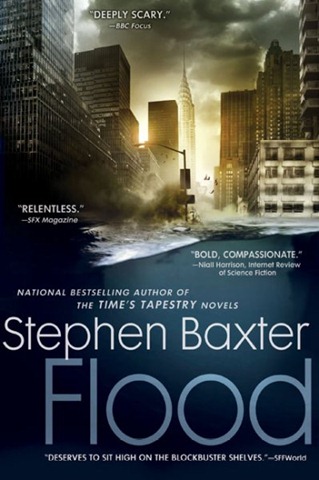
Flood by Stephen Baxter

Flood by Stephen Baxter has the feel of a typical mega-disaster novel, one where a cast of characters confronts a huge threat from all angles.  Flood, appears to be a warning about global warming, but it’s not, not really.  Baxter predicts yet another source of water flowing into the oceans to make their rise far more dramatic than the worst global warming predictions.  Flood can almost be called a prequel to the film Waterworld.

baxter-flood

For the average reader, maybe even the average science fiction reader, Flood is a scary novel that people will equate to the effects of global warming.  That’s unfortunate.  Flood is more in the tradition of end-of-the-world disaster novel, especially when you consider it’s sequel due out soon.  Think of Flood as a special effects movie, like the recent film 2012, were movie goers go to watch the special effects of Earth being destroyed.  Readers of Flood get to observe one great city after the another destroyed by water – Katrina times 1,000,000.  Along the way mankind makes one valiant stand on high ground after another, each time hoping to gain a foothold to build a new world order, and time and again, each gallant effort is drowned by relentless rising waters.  Baxter gets to show a variety of political solutions to the problem, and that in itself is interesting.

It’s quite fascinating to compare a literary end-of-the world novel like The Road by Cormac McCarthy to a science fiction genre novel like Flood.  McCarthy’s story is 90% characterization and 10% details about the end of the world.  Baxter’s story is 90% description about the end of the world and 10% characterization.  The Road was 256 pages, and Flood is 490 – so we get a lot of details.  Writing a novel like Flood is mind boggling to contemplate because of the massive amount of information involved.  While reading Flood, I kept thinking about all the research Baxter had to do to create each page.  Depending on your mood and reading tastes, Flood could seem like one long info-dump, or it could be a thrilling vision painted in words.

Now here’s the funny thing, McCarthy’s book is far more realistic.  It’s far more likely to happen than Baxter’s story.  I could even call The Road ultra hard literary science fiction.  Flood, on the other hand, is something different.  It’s totally unlikely to happen.  It’s a made up scenario to make an epic science fictional fable.  Baxter goes for the Big Wow!  A superficial glance at the story would suggest it’s a warning about global warming – but again it’s not.  If Baxter had written a more realistic tale of 2016-2052, with as much characterization as Cormac McCarthy’s story, we might be hailing him for writing a literary prophetic novel of global warming, but he didn’t. 

Science fiction generally goes to for ridiculously big story, and in this case I’m torn between really enjoying the wild ride and being disappointed that Baxter failed to be serious and write a believable SF novel about humans altering the planet.  McCarthy proved that deadly serious catastrophe novels can be big best sellers.  I doubt Flood will receive any notice in the world of books at large, and only minor notice within the small world of science fiction readers.

Science fiction has always been about ideas, but not necessary realist ideas.  On every page of Flood, Baxter gives his reader something big to think about, but the novel doesn’t have a traditional fictional structure, it’s more like a documentary that takes thirty-six years to film.  For characterization, we get to watch a handful of reporters get old.  It’s the kind of story that would have appeared in Astounding Science Fiction or Thrilling Wonder Stories.

The book does have plenty of ideas to explore philosophically.  For example, at one point people in London are wondering if they should run for the hills, and then country folk blow up the roads and bridges letting them know they aren’t wanted.  Will that happen in the real world?  It’s a lot to think about.  Throughout the book we hear about one species after another going extinct, but the one I was most chilled at was my kind, “The global extinction event has claimed the coach potato.”  Flood does try to realistically portray collapsing urban environments, and it made me realize I wouldn’t have much of a chance.

Even with the weak characterization and monumental info-dumps Flood is a real page turner.  Before mother nature gets Biblical on humanity, the book can be read as an illustration of what global warming might do to some cities, but after a point you realize Baxter is a kid bent on blowing everything up for the sense of wonder thrill of it all.  And it is epic fun, in the same way When Worlds Collide thrilled me as at thirteen.  I’m looking forward to reading the sequel Ark, which is why this book isn’t realistic, but ultimately very science fictional.

Baxter has created an amazing vision but I wished he had made the mixture at least 25% characterization and 75% details.  The characters occasionally moved me, but for the most part they were pawns in the plot.  Only when Grace does a runner did I feel any character acting on their own agenda and breaking free of Baxter’s strings.  That’s how you tell great characterization – when all the characters have their own agendas making any plot meaningless.  Characters are slave to plots in genre stories, and seldom get to break out.  Great characters take control of their strings and make puppets of their authors.  I wanted to rate Flood much lower because of the weak characterization, but the far out A+ science fiction overwhelms the story.

Final Grade:  B+

JWH – 12/30/9 

The First Three Minutes by Steven Weinberg

The First Three Minutes by Nobel Prize winning Steven Weinberg, is a short little book about how our universe began.  It is not new, first appearing in 1977, and updated in 1993, but still very readable and not quite out of date, a scientific classic.  While reading The First Three Minutes, I can’t help but compare it to The Book of Genesis.  Weinberg chronicles the science behind, “Let there be light.”

I would like to say this book is readable by any well educated person, but I don’t know if that’s true.  I do think any reader who has kept up with popular science should find it a thrilling quick read.  The first link I give at the top is to Google Books where you can read as much as you like online and decide if you want to buy a copy, but I will say Weinberg has done an excellent job of explaining an extreme mathematical subject with very little actual mathematics.

It is quite presumptuous of scientists to talk about the first three minutes of creation from 13.7 billion years ago, except that we have one direct existing clue, the cosmic background radiation discovered by Arno Penzias and Robert Wilson in 1965.  However, that’s like saying we should predict a cake recipe by taking the temperature of a slice of German chocolate before we pop it in our mouth.  What Weinberg is saying, by knowing the average temperature of the universe now, by measuring its rate of expansion, by studying all the sub-atomic particles we can, we can plot backwards to a point in time when the universe was infinitely tiny and very hot.

This is why we spend billions on high energy particle accelerators like the Large Hadron Collider.  The more we know about all the sub-atomic tiny, the more we can say about the super big cosmos.  Once you get a taste for reading about this kind of science, the more you realize that speculating about the first three minutes after the big bang isn’t just idle chatter.  Our scientific view of reality is based on putting a puzzle together of logical pieces.  A student of popular science might begin with a 50 piece puzzle, to get a vague image of the universe, but eventually you’ll want to move on to 500 and 1,000 piece puzzles.  Every science book read helps create a finer mental model of how reality works.  The First Three Minutes by Weinberg provides many major puzzle pieces.

I like to think of our universe as rather hot, because of all the fiery stars, but in actuality, our universe is in a very cooled state.  The average temperature of the universe is just a few degree above absolute zero, whereas during it’s early stages it was millions upon millions of degrees hot, so hot that the particles and atoms we all know and love could not exist as we see them now.  Our visible universe, full of empty clear space, through which light from distant stars and galaxies shine, didn’t develop until the universe got relatively cool.  Before that the universe was opaque.

The First Three Minutes was written just a dozen years after Penzias and Wilson discoveries in New Jersey, and the updated edition was written after early results from the COBE satellite was put into orbit in 1989, giving more confirmation to ideas that were originally just speculation.  I highly recommend people read the CMB and COBE links at Wikipedia.  I wish Weinberg would write a totally new edition of The First Three Minutes, and expand it greatly to show what science has learned about the Big Bang since 1993.  For example, Weinberg had only known the Hubble Telescope during its early failure state, and not the mega success it would become.  He still thought Texas was going to have a super collider.  And there’s no telling what will go in the science books when research from the Planck spacecraft starts coming in.

Weinberg has continued to write science books, such as last year’s Cosmology, but it is expensive and more suited for graduate students, being The First Three Minutes with all the math left in.  It would be nice to have a complete rewrite of The First Three Minutes for us cosmological ground hogs.  I’m having a difficult time finding a current popular science book that covers the same territory as The First Three Minutes but catches up with all the latest scientific discoveries.  Even the 2004 Big Bang by Simon Singh is barely past the early COBE results.  I’d appreciate anyone posting recommendations to more current reading.

JWH – 7/5/9

Why I Blog

The NY Times recently ran a piece, “Blogs Falling in an Empty Forest” by Douglas Quenqua, which told how 95% of blogs are abandoned by their creators.  According to Technorati, the paper said, only 7.4 million blogs, out of the 133 million blogs that Technorati tracks, have been updated in the last 120 days.  Most people just don’t stick with blogging, especially when they find out there is no money in it.  I never thought I’d find riches in blogging, but I do find the hobby very rewarding.  It’s a shame Mr. Quenqua only focused on people who quit blogging.

Blogging for me is therapeutic.  Since I’ve grown into my 50s, I’ve been forgetting more and more words.  The more I write, the better I remember.  Recently when I had an eye problem and couldn’t write on my blog for weeks, my memory went into a decline.  Picking a topic and focusing on it for several hours is good exercise for my mind.  Writing about the past has psychoanalytical benefits too.  I’m constantly examining where I got an idea, and why I believe something.  I’ve spent a lot of blog time examining the science fiction I read in my teens, trying to figure out how those fantastic stories shaped the thoughts of my life.  It’s been amazingly revealing to me.  That’s just one of many blogging projects I pursue.

Blogging is like practicing the piano in public though, because writing fast often produces sentences with many sour notes.  I try hard to revise my essays before hitting the publish button, but all too often I find bumpy passages and mistakes the next day.  This is actually good for me, because it pushes me to try harder, although I think I’m currently on a plateau.  Seeing how I’m not improving as fast as I was a year ago, makes me want to try something new, like reading books on writing essays, or studying fine prose in magazines to improve my sentence structure.  Lately, I’ve even thought of studying poetry, something I hated in school.

WordPress provides statistics about my blog pages, that I use to examine which ideas I write about are popular  This is probably a false assumption, but I assume if a piece gets a lot of hits it means it’s interesting.  That doesn’t mean my writing is better in that piece, but at least I found something that people want to read about.  My most successful essay has been “The Greatest Science Fiction Novels of the 20th Century.”  My stats tell me that 8,505 people have loaded that essay into their browser for whatever reason.  My ego would like to believe people actually read the essay, but all it really means is 8,505 folks have stumbled upon that page, whether or not they have read it is another story.  The act of writing it is what’s important.

My least popular essay is, “Super Men and Mighty Mice,” with 3 hits, but I think it’s one of my better efforts.  Hits don’t mean a thing.  Actually, both essays are very informative to me, and help me remember things I noticed about the world.  That’s why my blog is called, “Auxiliary Memory – Things I Want to Remember.”  I think Douglas Quenqua missed a great story by not researching why 7.4 million people do keep blogging.

Not only am I getting to know myself better, but I’m also meeting so many fascinating people online.  If you read blogs, you get to know people in a way you seldom do by just talking with acquaintances at work or parties.  I wished all my friends wrote blogs.  If my wife published her thoughts in little essays I expect I’d discover a whole new woman that I never got to know during the 31 years we’ve been married.  I’m constantly discovering things about myself that I didn’t know.  Writing is revealing.

Every evening after work I have about three hours of freedom where I can do absolutely anything I want.  All too often, I pick watching television.  I love television, it’s quite stimulating, but it’s basically parking my brain – unless I respond in some way.  If I watch a show, whether fiction or non-fiction, and then write about it in a blog, I will see that show far differently.  It becomes a real experience.

In my hours of freedom I could choose to read, listen to music, work at a hobby, play on the Wii, cruise the net, clean house, listen to an audio book, call friends on the phone, cook a better than average dinner, study a Great Course on DVD – the list goes on and on.  Writing on a blog post pushes my mind more than anything else.  Struggling to find the right words to capture a fleeting concept that came to me as a mini-epiphany during the day takes a great deal of concentration.  More concentration than I put into anything else I do. 

I wished I could have blogged when I was seven and first learned to string words together into sentences like they taught us in grade school.  I think it would have transformed my life and greatly improved my K-12 experience.  If I had had to write an essay about every lesson I studied, from math to PE, I think I would have learned so much more during my educational years.

Pedagogy puts a tremendous focus on reading.  At the College of Education where I work, students can get a master’s degree or doctorate in Reading, but we don’t offer any educational degrees that focus on writing.  Inputting words is important, but I think outputting words is more important for a good education.  It’s a shame that blogging is not catching on.  It’s a shame that it’s seen as a scheme to get rich quick on the net.  It has so much more potential.

We should encourage children to blog, and we should also support the permanent archiving of blogs, so kids growing up can look back over their own development.  We should develop a curriculum that asks children to explain what they studied each day by writing essays that explain their subjects in words, drawings, diagrams, videos, photos and so on, and not in checking multiple variations of A) … B) …  C) …  D) … at the end of the week in a quiz.

So Douglas Quenqua, write another article for your Fashion & Style section, and explore the positive aspects of blogging that those hundred million plus are missing by giving up on blogging.  I think if you examine a 100 different good blogs you’d find a 100 different reasons why blogging is too valuable to just dismiss as a passing fad.  Here’s just one creative example, Golden Age Comic Book Stories, that I discovered the same day as your article.  I don’t even like comic books, but I could spend endless hours exploring Mr. Door Tree’s passion for illustrations.  There’s real history in his pages.

Everyone should scrapbook their life in a blog.

JWH – 6/8/9