A New Kind of Bestseller: WE ARE LEGION (WE ARE BOB)

by James Wallace Harris, Friday, September 8, 2017

[reprinted and slightly updated from Book Riot]

Digital technology is again disrupting the rules of book selling. Ebook self-publishing allowed Andy Weir, Hugh Howey, E. L. James, among others, to become best-selling authors. Now Dennis E. Taylor has written an under-the-radar bestseller by selling first to Audible.com with his science fiction novel We Are Legion (We Are Bob). The book is relatively unknown because Taylor is still selling self-published printed copies on Amazon, but it’s a huge hit on Audible.
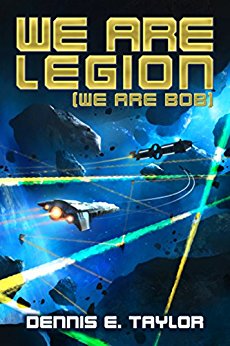
We Are Legion We Are Bob by Dennis E. TaylorWe Are Legion (We Are Bob) came out 9/20/16 on Audible. As of 9/8/17 has 36,360 ratings, with an average score of 4.7 out of 5 stars. It’s sequel, For We Are Many came out 4/18/17 and has 22,635 ratings with an average of 4.8 out of 5. The final book in the trilogy, All These Worlds, before it was released on 8/8/17 was at 5th place out of 27,980 science fiction titles at Audible based on sales, just after Ready Player One, The Dark Tower, A Game of Thrones, and The X-Files: Cold Cases, all titles with movie tie-ins. In comparison, American Gods by Neil Gaiman, just a few titles above the current position of We Are Legion (We Are Bob) has 29,484 ratings with an average of 4.5 out of 5 stars. 1984 by George Orwell only has 13,851 ratings with a score of 4.4 out of 5 stars.

What the hell did Taylor write to create such a success? The book is a lot of fun! It’s not a literary masterpiece, doesn’t really have a plot, and most of the characters are the same person. Yet, it works very well as entertaining science fiction. Ray Porter, who narrates the trilogy on audio, is pitch-perfect for the job. I expect he’s a major factor in the success of the Bobiverse trilogy.

I’m also wondering if Audible and audio books are changing the way bestsellers are created. I was recently doing statistics on the way books are rated on Goodreads, Amazon, and Audible (all companies owned by Amazon). Generally, Goodreads has the most ratings for books by far, but that’s to be expected. It’s a site for collecting and rating books. But books on Audible generally get way more ratings than Amazon. Are more bookworms listening than reading? Then I realized that people listen to books on their smartphones. When a book ends empty stars pop up to rate the book – almost impossible to ignore. It’s just more convenient to rate books on Audible. Far few readers go back to Amazon to rate a title.

Still, how much does Audible influence the success of books? We Are Legion (We Are Bob) proves Audible by itself can create a bestseller. Of course, it takes a good book too. Again, are more bookworms listening to their books than reading them?

I bought We Are Legion (We Are Bob) because I told my friend Mike I was in the mood for a new science fiction novel that would be as fun as the science fiction I first discovered as a teen fifty years ago. He said he just bought We Are Legion (We Are Bob) for that very reason. Overall, I got a big Sci-Fi kick out the story. Mike thought it was fun but slight, but he’s more of a critical thinker than I am. There is something very definite about We Are Legion (We Are Bob) that’s likable.

My guess is the book was written to push all the buttons science fiction fans have for loving science fiction. We Are Legion (We Are Bob) is science fictionally recursive. (You might need a high Geek score to understand it.) Dennis E. Taylor is the James Thurber of science fiction, turning all of us into Walter Mittys imagining ourselves having Bob’s Big Sci-Fi adventure. Of course, it’s the Jimiverse in my mind. And even though this story has a male POV – there are damn few women characters – plenty of women readers love the book at Goodreads. Evidently, women readers have no trouble renaming Bob after themselves for their own personal fantasies.

The book only gets 11,834 ratings with an average score of 4.33 out of 5 stars at Goodreads. One of the few books I found with fewer ratings at Goodreads than Audible (32,137). I wonder if that’s because more of the people rating the book at Goodreads only read it. Around 120 people are adding this title to their Goodreads library each day. Compare that to New York 2140 by Kim Stanley Robinson, a recent SF book that’s getting a lot of mainline press. It’s adding around 60-75 titles a day currently, and several hundred a day just after it came out.

So Dennis E. Taylor is doing extremely well.

We Are Legion (We Are Bob) has a serial problem-solving plot like The Martian by Andy Weir, and tons of geeky pop culture references like Ready Player One by Ernest Cline. Does that mean there’s a chance that We Are Legion (We Are Bob) will be made into a movie?

Taylor’s story has just about every science fictional idea known to science fiction. I don’t want to list them all because it might create spoilers. But yes, I think the Bobiverse could be made into a movie, and should.

JWH

The Twilight Zone: Lessons in Storytelling

by James Wallace Harris, Monday, August 28, 2017

The Twilight Zone is the classic science fiction television show that ran five seasons on CBS from 1959-1964 producing 156 black and white episodes. Because each episode was a standalone story, the series makes a great laboratory for dissecting storytelling. The overall quality of TZ writing is very high, with many memorable episodes, but it’s also true the show had its clunkers.

I recently bought The Twilight Zone:  The Complete Series Blu-ray on Amazon for $64.99, but that price changes almost daily and can run much higher. I also snagged a copy of The Twilight Zone Companion Second Edition by Marc Scott Zicree. However, you can stream The Twilight Zone on CBS All Access, Netflix, Hulu, and Amazon. (Netflix and Amazon only have four seasons.) And Wikipedia has a list of all the shows with links to essays on each. Each episode entry on Wikipedia often provides more information than the book I bought, but that volume makes a handy companion to keep by my TV recliner. I bought the Blu-ray set because of the glowing reviews about pristine transfers and all the extras.

Modern television fans (meaning young folks) might prefer studying Game of Thrones or Breaking Bad for their exceptionally high-quality storytelling and addictiveness. But those stories are so huge and complex that I can’t grasp their bigger structures. I figured I’d be better off analyzing tiny 22-minute tales. This coincides with my rediscovery of short story reading. I’ve been listening to The Collected Stories of Philip K. Dick and Untouched by Human Hands by Robert Sheckley and I’m amazed at how dramatic and compelling their stories were from their early career in the 1950s, doing so much with so little.

Nothing in the Dark

Last night I watched two TZ episodes, “Nothing in the Dark” which featured Gladys Cooper as an old woman afraid of dying, and Robert Redford playing a beat cop that gets shot on her doorstep. The story was told with one set and three actors. What amazed me was how much was conveyed without putting it into the dialog. The old woman wouldn’t leave her basement apartment in a condemned tenement because she feared meeting Mr. Death. Watching makes you imagine her life and how she lived. In one scene, she sits on the edge of a dirty bathtub and you question how often she bathes. Cooper’s face is old and wrinkled, and you wonder just how long she’s evaded death.

And of course, we learn her fear of death is unfounded, not because Robert Redford isn’t Mr. Death trying to trick her, but because her death is peaceful. This is one of the episodes of The Twilight Zone that stuck in my memory, but I only remembered Robert Redford being shot, lying in the snow in his dark police uniform. However, I’m not sure when I first saw it. My family often watched TZ together in the late 1950s and early 1960s and I’m positive I remember some shows from when I was young. But I think I first saw this one in the 1970s as a rerun.

A Quality of Mercy - Salmi and Stockwell

The second episode I watched was “A Quality of Mercy” about a squad of American soldiers on August 6, 1945, the day before the first A-bomb was dropped. Again, the set was sparse, with just a handful of actors, mainly Dean Stockwell and Albert Salmi. (It did have a couple short vivid scenes with Leonard Nimoy without his Mr. Spock ears.) Salmi is the wise sergeant that’s war weary, leading squad of men that’s tired of killing and being killed. This comes across amazingly well via limited dialog and acting expressions. Their short scenes recall so many war movies that their cliché lines feel like intensely distilled encryptions of dozens of great war movies. The plot of the story involves a green officer, Lieutenant Katell played by Stockwell, wanting to get into the fighting before the war is over. The fantasy of the show begins when he drops his field glasses. After picking them up we see Dean Stockwell made up as Lieutenant Yamuri with a squad of Japanese soldiers attacking the same position now held by Americans. The show’s title comes from The Merchant of Venice, “The quality of mercy is not strained, it droppeth as the gentle rain from heaven upon the place beneath. It blesseth him that gives and him that takes” by William Shakespeare.

Both shows might feel like slight nothings to the average 21st-century television watcher. 30-minute television is only used for sitcoms today. We need an hour for drama, and we’ve become so addicted to continuing story dramas that we binge on them hour after hour. So it might be hard to take seriously anything that begins and ends so swiftly.

Do we need all those hours to tell a good story with a soulful insight? Wouldn’t Ernest Hemingway have written the seven-volumes of A Song of Ice and Fire in one-volume of about 400 pages? I can’t finish Proust’s epic work, but I do find a few paragraphs now and then worth contemplation. The Twilight Zone isn’t Proust or even Hemingway, but it is as good as The Magazine of Fantasy & Science Fiction or Galaxy was back in the 1950s. I believe The Twilight Zone captures the Happy Days decade more faithfully than any show from its era. That’s because it took 156 different snapshots. I suppose if I had access to other anthologies shows of the time I’d give them the same credit.

I’m not the only one remembering The Twilight Zone:

JWH


What Do We Talk About When We Talk About Science Fiction?

by James Wallace Harris, Wednesday, August 23, 2017

[Reprinted from Book Riot with minor revisions]

To encourage discourse at the online science fiction book club I moderate, I began thinking about what we talk about when we talk about science fiction. At the broadest level, we talk about storytelling and writing, which is part of all fiction. At the next level, we discuss how we felt about experiencing a book. Essentially, this level is about entertainment value and doesn’t directly deal with science fiction either. At the third level, we compare the science fictional elements in the story to science fiction we’ve read in the past. Most science fictional concepts are unoriginal, recursive, and depend on previous science fiction. At the final level, the level where we actually talk about science fiction is where we examine the original science fictional speculation in a story.

It’s rather hard to write original science fiction after H. G. Wells and Olaf Stapledon, even though I’m quite sure they cribbed their inspiration from others, too. If you read enough science fiction, you’ll discover most science fictional concepts have been around for a long time. Many go back at least a hundred years, some for hundreds of years, and few for thousands. If you compare science fiction, fantasy, and religion you’ll find many overlapping core questions about reality. Eventually, you’ll see how science fiction evolved out of myths, religion, and fantasy. Science fiction’s current claim to distinction is it explores far out concepts that might be possible with the aid of science and technology.

What we talk about when we talk about science fiction is the possibility of making changes to reality. Science fiction is a sliding window of speculation. Once upon a time, science fiction theorized how humans could build flying machines. Now that we have American Airlines it’s no longer science fiction. It’s hard to write a new story about the first humans to land on the Moon after Armstrong and Aldrin left their footprints there.

Once I began thinking about what we talk about when we talk about science fiction, I realized it involved a very limited number of topics explored in infinite variations. What differentiates our science fictional hopes from the desires reflected in religion and fantasy is the belief that we can make our dreams come true using brain power rather than depending on the miracles of God or the magic of the paranormal. Science fiction is all about hubris.

When we talk about science fiction we’re mainly talking about these subjects:

  • The possibility of other worlds
  • Life on those worlds
  • Travel between worlds
  • Other intelligent beings like us
  • Are some aliens superior to us
  • Making ourselves immortal
  • How humans can evolve to be different
  • How we can reprogram ourselves (genetics, cyborgs)
  • Creating intelligent life (robots, AI, artificial life)
  • Creating a utopian society (or failing at one)
  • New inventions and their impact
  • Travel in time
  • Alternate histories

Astronomers are discovering new extrasolar worlds every day. So that’s becoming less science fictional. It’s still within the realm of science fiction to speculate what those worlds might contain. Mathematically, we assume life is possible on many of them. We’ve been theorizing about other worlds and other life forms at least since the ancient Greeks and probably earlier. Aren’t stories about gods, angels, and other metaphysical beings of religions and myths just historical residue of speculations about intelligent life from off-Earth worlds from the far past?

Isn’t any discussion about God or gods really a discussion about intelligent aliens? All science fiction has done is relocate theories of Heaven to more realistic sites in the galaxy. Religion has been speculating how it might be possible for our lives to go on existing after we die. Aren’t all the ideas about scientific immortality in science fiction just a continuation of those speculations?

When we talk about becoming immortal using science fiction and we dream of copying our brains to robot or clone bodies, aren’t we just participating in the latest speculation of how life-after-death could happen? Hasn’t that speculation been going on since our species began to think and talk? Could it have been science fiction when the authors of the Old Testament theorized that a powerful alien being would reanimate our bodies after the end of time? Aren’t myths and religious beliefs really science fiction that’s gone stale from learning too much about how reality really works?

Once you realize that what we talk about when we talk about science fiction is a discussion of our hopes and fears about the future and how we might change reality for better or worse? Hasn’t such speculation always existed? Why is old speculation called myths and new speculation called science fiction? Will 20th-century science fiction one day be remembered as myths?

Most science fiction stories we talk about today are really adventure stories set in older science fictional speculations. For example, Star Wars, probably the most famous of all science fiction stories, has no original speculation about reality. Star Wars uses science fictional speculations from the 1940s and 1950s to create a sprawling setting for conventional tales of adventure, romance, empire, rebellion, war, and aristocracy.

Aurora by Kim Stanley Robinson and The Three-Body Problem by Liu Cixin are examples of current science fictional speculation about the possibilities of humans traveling to other stellar systems or aliens from other stellar systems coming to visit us. Infomocracy by Malka Older is science fictional speculation about creating a new kind of democracy.

What we talk about when we talk about science fiction is whether or not the author has imagined something that could be made possible that doesn’t currently exist. Either good or bad. To be original the author must come up with something new or a new twist on an old idea. I thought Charlie Jane Anders had something new to say about the nature of science fiction and fantasy in All the Birds in the Sky (which won the Nebula Award and was nominated for the Hugo this year). Isn’t fantasy v. science fiction really magic v. science, and isn’t that deeply psychological? How much of our polarized society is due to a split between believers in magic and science?

Isn’t what we talk about when we talk about science fiction really a psychological reflection of our own desires and fears for the future? Most bookworms read to escape. They want to immerse their minds in an old-fashion form of virtual reality. I believe the hardcore science fiction fan is a reader seeking new ideas about what might be possible in reality. They expect writers to imagine possible futures that no one has imagined before.

As readers and book club members we want to talk about those possibilities.

The End of Print Journalism

by James Wallace Harris, Sunday, August 20, 2017

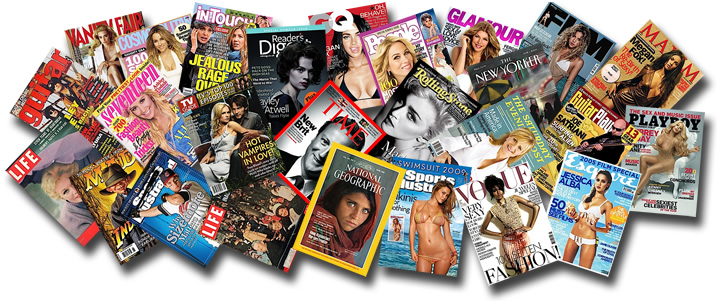
I’ve always been addicted to magazines. I even worked in a periodicals department at a university library for six years. Magazines used to provide reading content that was longer than a newspaper story but shorter than a novel. A good magazine essay might take more time to read than viewing a whole episode of the evening news. Reading some of the longest articles in The New Yorker or The Atlantic could take more time than watching a movie. However, as magazines compete more with television and the internet the content of each piece became shorter, no longer than the average crap or restless idle moment of internet boredom.

1-magazines

Even though I subscribe to a number of print magazines, get over 200 magazines via Texture, and subscribe to the online edition of The New York Times, I spend 90% of my periodical reading time on Flipboard.

Today I read “When Silicon Valley Took Over Journalism” by Franklin Foer at The Atlantic. Foer was the editor of The New Republic and worked with Chris Hughes, a rich Silicon Valley entrepreneur to save the historic magazine from the internet reader. The article comes from his forthcoming book World Without Mind: The Existential Threat of Big Tech.

Foer described what I’ve been seeing and wondering about already. Online journalism is not the same as the old print journalism I grew up with. Foer describes how writers and editors must write pieces that get massive hits on the web. Magazines of old had readers and subscribers and were sold as issues or subscriptions. Magazines were like albums, and today’s online essays are like buying hit songs on iTunes. To generate ad revenue essays must attract eyeballs. Most readers find their way to essays via Google searches or sharing on Facebook. So writers, editors, and publisher fine-tune each piece to get attention, and even the most serious pieces of journalism must act as click-bait.

Everything depends on unresistible titles. Writers write what titillate people into reading, rather than writing what people need to be reading. Reading Flipboard is like watching a thousand sharks being fed a barge of chum. Only the biggest creatures get fed.

Reading off my iPhone and iPad has ruined me for reading paper copies of magazines in the same way that they ruined me for reading newspapers. About once a year I’ll buy a copy of The New York Times for nostalgia’s sake. But it’s uncomfortable to hold, stains my fingers, and is stressful to my eyes. Last year I subscribed to National Geographic for the same nostalgic reasons, remember the magazine being visually stunning. Now, their printed images all look small compared to my 28″ 4K monitor and dull compared to my brightly lit iPad. Because I wanted to see the photographs enlarged, I subscribed to the online edition this year, and the pictures wow me, but I seldom read at my monitor even though it’s the absolute best way I’ve found to consume National Geographic content. (I just wish they’d stop their constant nagging to subscribe when I’m already logged in.)

My most common and convenient way I read periodicals now is on my iPhone 6s Plus. I always have my phone with me, and that convenience has made me addicted to reading by iPhone. I also read The New York Times on my iPhone, and listen to audio books from Audible on it too. It’s not the web that has changed my reading habits but the smartphone.

Foer warns us against the dangers of high tech journalism. I’m trying to go back to reading whole magazines, but it’s hard. Some magazines I loved like Discover and Popular Science are now laid out to like web pages, with countless short articles vying for my attention. Their tiny print and cramped layout are just too painful. I won’t re-subscribe. Scientific American is less frantic, an album of half-a-dozen long articles, but I’ve been ruined by the buy-a-hit-song mentality.

About a decade ago I gave up all printed periodicals for environmental reasons. Then a few years ago I decided to try print magazines again as an experiment to see what I’m missing from online reading. Their inflexible layout discourages me from reading them, and smartphone reading is now my habit. I’m letting all my subscriptions lapse except for The Magazine of Fantasy & Science Fiction, Asimov’s Science Fiction and Analog. I’ve just resubscribed to these mags in print because I miss their covers, want to refer back to them, and never could develop the habit of reading their short stories when I subscribed to the digital editions.

And then there’s the sad fact that most non-fiction content in printed periodicals is available on the web for free. Foer describes the nightmare of trying to make money publishing journalism this way. To be honest, though, I resist all their money making efforts. I know online magazines need to make a profit but I find their methods annoying. Which is why I subscribe to Texture. My $15 a month is a contribution towards maintaining journalism. But it’s not the solution either. Texture doesn’t allow me to save and share articles like Flipboard. When I read something good in Texture I go to my computer, find the article and then share it on Twitter and Facebook, and save it to Evernote and Instapaper.

I wish Texture had a web edition. When I read for writing inspiration I’m sitting at the computer. I’m wondering if I shouldn’t train myself to read off the monitor. I tend to quickly churn through content via Flipboard. One of the complaints Foer noted was content was becoming homogenized. I’ve noticed that too. Each day I see several lists of the-greatest-books-ever to read, many kinds of advice on happiness, productivity, retirement, investments, etc.

I should read, take notes, save essays, write reviews, and become more interactive in my reading. I should integrate periodical reading into both studying and memorizing. One thing I’ve noticed from hyper-reading Flipboard is the repetitive nature of story ideas. When that dentist killed Cecil the lion it generated 3.2 million stories on the internet. I sometimes do that myself when blogging, writing essays about what other people are writing about. Internet journalism gets readers into subject frenzies and we can’t let go. I’m not sure if that’s good. I’m thinking I should be more organized and careful about what I read. Reading from the monitor instead of the smartphone might help in that. I thought returning to printed magazines would help, but it didn’t. I need to be able to save and share, and photocopying and mailing just too inconvenient.

I have friends that also compulsively read Flipboard daily. Some of them have started to wonder if it’s a bad habit or at least too much of a time-waster. I think Flipboard has found an addictive way to read the news. Whether it’s a negative addiction or positive addition, I don’t know. Would we agree with a nineteenth-century person who complained the telephone has ruined face-to-face communication?

JWH


Planned Forest Communities

by James Wallace Harris, Saturday, August 12, 2017

One of the major causes of climate change denial is self-interest. Owners of oil, gas, and coal reserves have trillions of dollars in potential wealth they don’t want to give it up. These people will do anything to protect those riches, including intensive propaganda campaigns against science. So any solution should involve ways to compensate their loss of income.

The meat industry is also a major contributor to greenhouse gases. If all the lands that are currently used to produce meat were converted into forests it would be a significant step towards solving climate change. Of course, it would be unfair expect meat producers to sacrifice their wealth for public good. What we need are alternative income sources for each industry that would be hurt by economic disruption required to stabilize the climate.

The meat industry could be paid to not raise cattle equal to what they currently make. But it would be better for the environment if the land was returned to nature, and especially to forest ecologies. Can we imagine alternative economic activities for those landowners?

This got me to thinking about how to commercialize nature so it profited humans but also profited plants, animals, and the biosphere. Many people love nature, so I wondered if it would be possible to build planned communities embedded in forests. So instead of neat lawns, they’d have unfettered nature.

Is it possible to build houses that produced their own energy and coexisted with nature? Such houses would need to be fire and storm proof, could handle trees falling on them, last for centuries, be warm and cool as needed, not be tied to sewers and street systems, have access to water, safe from tiny to large critters, impervious to the elements,  and be appealing to live in? Plus, could such communities provide jobs for its inhabitants?

I would assume planned forest communities would have low human population densities. Maybe one family per 10-100 acres. The inhabitants could become caretakers, observers, scientists, researchers, users, and lovers of the forest.

I wonder if agriculture or minimal horticulture could be embedded into the forest ecosystem without major impact to the ecosystem. Such forest communities could support tourism, camping, hunting, fishing, bird watching, wildlife study, and so on. Also, if these communities were closed to being self-sufficient means their inhabitants wouldn’t need large incomes. We don’t need billionaires living in the forest, but people who require little economic success because they want other kinds of rewards from life.

forest community

[Photo is one of a series from “Eco-Friendly Forest Communities.”]

There is already a movement called community forestry where people volunteer to maintain a forest. Can you imagine living inside a forest? And there are already countless indigenous communities living in forests around the world. We can learn from them and should protect their way of life. The World Bank already does this. Urban living can theoretically be very energy efficient, but I think a significant portion of our population are tired of city life and might want to return to nature.

What appealed to me while meditating on this idea this morning was the challenge of constructing a modern home that fits harmoniously into the forest. How could we design back-to-nature communities that benefit the global ecosystem yet expand the local economic system? The push-back to solving climate change comes from people wanting to protect their wealth. Is it possible to generate compensatory wealth, and even generate new wealth from an eco-social-capitalistic system?

Our problem is a failure of imagination. Too many people can only imagine things being the way they were. We literally have an infinity of possibilities. Maybe even an infinity of better choices.

JWH