
During the glory days of NASA, between President Kennedy’s great 1961 proclamation committing the United States to going to the Moon within a decade, and Apollo 11 landing on the Moon in July 1969, there were three great space programs: Mercury, Gemini and Apollo. Each manned rocket launch during those years was covered by all three television networks. ABC, CBS and NBC would stop broadcasting game shows and soap operas and the missions would become national events. The 1960s represented a tremendous time for the public’s interest in the space program.
Next month marks the 40th anniversary of mankind’s first landing on the Moon. Popular interest in space exploration appears to have dwindled significantly ever since Apollo 11, with even Apollo 18, 19, and 20 being cancelled. Our lunar exploration years only lasted from July 1969, through December 1972. And when was the last time you took off from school or work to spend the day watching television of a space mission? I would have taken vacation days to watch the recent Hubble repair mission if any of my damn 200 cable stations had covered it live.
Since 1982, the Space Shuttle has been our vehicle for traveling into space, but it’s scheduled to be retired next year. The Space Shuttle never left low-earth orbit (LEO). I wonder how many people know about our next manned space system that’s currently on the drawing boards? It’s called the Constellation Program, that will use the Ares 1 rocket combined with the Orion space capsule, both in early design development. It is a dramatic change from the 30 years of Shuttle flights, in that Orion will eventually leave LEO.
The Constellation program was conceived officially in 2005, and scheduled to blast-off in 2015, with the exciting goal of returning humans to the Moon by 2020. How many Americans know about this, and do they care?
NASA plods on, year after year, with a decent budget that’s prone to suffer booms and busts depending on the political weather. NASA goals are constantly up for debate. NASA is a prestige agency for the United States. Space flight has always been political, and the only real reason we rushed to the Moon was not for science, but as competition in the cold war. The current Constellation plans probably came into being because of China’s new space program that’s aiming at the Moon, with India and Japan echoing Chinese ambitions.
Like atomic bombs, manned space missions are the symbol of national pride. Only the most elite of nations belong to the club. Even though NASA doesn’t get a lot of public support, it’s budget will never be zeroed out because the President and Congress fear the United States would be seen as a declining world power if it did. Within Congress and NASA the debate has always been how to get the biggest political and scientific bang for our buck. There are two factions fighting for dollars: those campaigning for exciting manned missions and those who advocate scientific robotic missions. Robots have been our real space explorers, going where no man has gone before, or likely ever.
Many scientists, and maybe most of the public would be fine with letting robots have all the glory when it comes to space exploration. Let’s be honest here. The only real value of exploring space beyond thumping our nationalistic chests, is science, and it appears that the public has little interest in real scientific research. NASA’s web site for the Mars rovers Spirit and Opportunity have had millions of unique visitors, showing the biggest peak of interest in space exploration since the 1960s, but how many people does that represent?
Let’s say seven million. There are nearly seven billion people on Earth. Do the math. 1 million people is 1/1000 of a billion. Let’s even say NASA has seven million hard core fans world-wide. That would give them one tenth of one percent of popular support. Probably more people spend time thinking about drinking beer than exploring space. (If NASA only had the money people spent on getting high.) Seven million people seems like a big political block, but really it’s just a tiny sub-culture.
And are there really 7,000,000 people on Earth who actively spend a lot of their time thinking about space exploration? That’s saying 1 person in a 1,000 has a serious interest in the final frontier. These people would keep up with news on Space.com, read books about space exploration and technology, sign up for Twitter news feeds covering space vehicle development, and are members of one of the many space societies, like The Planetary Society, The Moon Society or the National Space Society. But membership in The Planetary Society is only around 100,000. What if the real figure is only 700,000, or .01%?
My guess that real world-wide space advocates number far less than seven million. “Revision for Space Vision?” from MSNBC’s Cosmic Log, a blog by Alan Boyle, gives a listing of recent news articles about the Ares rocket that’s being built for the Constellation project, and other related news stories that would interest space advocates. When I ask my friends if they knew there was space program in development to return men to the Moon, they say no. For all I know, we could return to the Moon in 2020 and most of the people of the world won’t even notice this time.
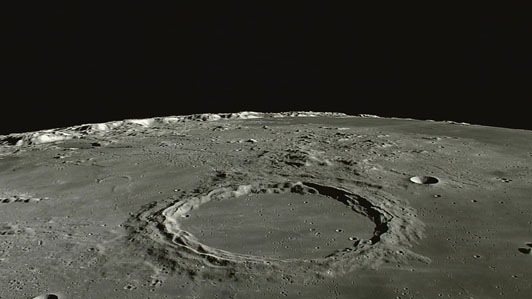
Why is something as exciting as the universe get so little attention? Why does the latest iPhone get more press than NASA’s latest lunar mission? Did you even know about the Lunar Reconnaissance Orbiter that’s scheduled to reach the Moon on Tuesday? Or about Lunar Crater Observation and Sensing Satellite that will crash into the Moon in October hoping to discover water ice? The orbiter will take photos so detailed they will be able to see the tracks left by the Apollo astronaut’s rovers. A lot is happening on the Moon right now, with spacecraft from many nations exploring it remotely, or will be in the near future. But how many people care?
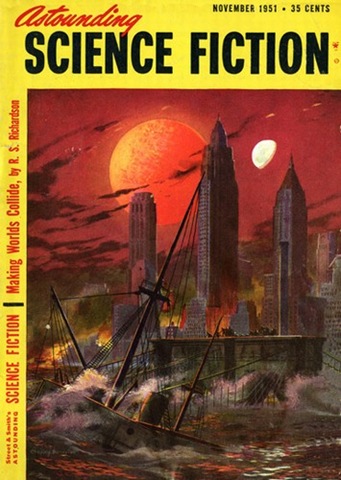
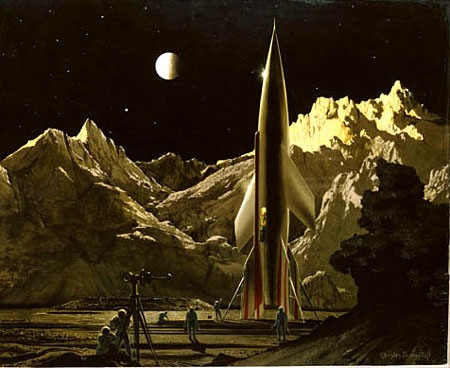
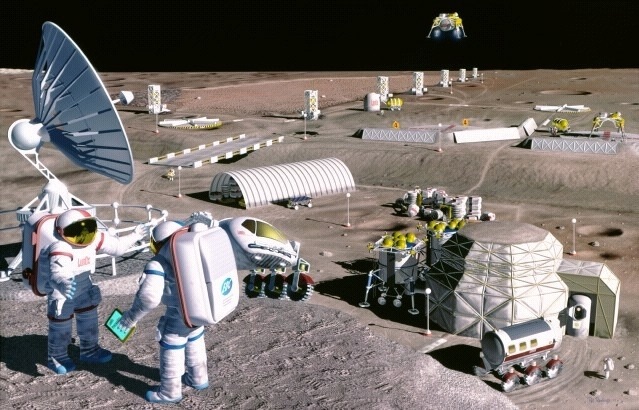
Within the very small community of humans that are interested in space exploration, the Moon is becoming a hot destination. There is even a web site, Moon Daily, for keeping up with all the activity. Over at Asimov’s Science Fiction, James Patrick Kelly has an story in the current issue set on the Moon, “Going Deep,” which he reads for an MP3 audio edition, so the Moon is still of interest to science fiction writers and fans. And NASA recently held an art contest called “The Moon: Back to the Future,” with a very nice gallery of winners.
Hopefully, between now and 2020, the public will take a fresh interest in lunar exploration, but is that being too hopeful on my part. Most people consider learning about the Moon as exciting as studying rocks, and geology has never been one of the glamour sciences like astronomy and biology. (And when was the last time you met someone at a party talking about those topics???) The public is probably more than willing to let scientists play with the Moon as much as their little hearts want, as long as they aren’t asked to listen to any of the boring facts.
I’ve always cherished the assumption that space was the final frontier, and the manifest destiny of humanity was to explore the cosmos, but I’m starting to believe that is a false assumption on my part. I’ve started writing a novel about colonists on the Moon, but I’m wondering about its potential audience. If I want to make any money, I’d need to call it “Vampires on the Moon.” Science fiction is very popular in pop culture, but interest in science fiction doesn’t translate into interest in space exploration. I wonder if space exploration was as popular as rock music or professional sports, if humans would have already visited all the places our surrogate explorers, the robots, have reached?
JWH – 6/21/9
 Auxiliary Memory