The Age of Wonder and Joseph Banks

I started reading The Age of Wonder: How the Romantic Generation Discovered the Beauty and Terror of Science by Richard Holmes, but because each chapter features a different historical person, I decided to review the book chapter by chapter, as I read it, and discuss the biographies separately.  The Age of Wonder came out last year, getting glowing reviews.  I immediately bought it, but didn’t start reading it until after I saw it on several best books lists of 2009.  Chapter one starts off like gangbusters with a thrilling tale of Joseph Banks, an unknown historical figure to me, but after finishing the chapter, I wondered why he isn’t one of the more famous dudes in history.
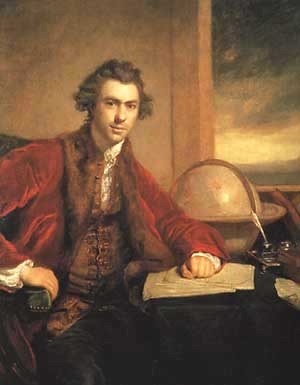
Joseph_Banks_1773_Reynolds

Sir Joseph Banks (1743-1820) was a handsome Englishman that would have put Jane Austen’s Mr. Darcy’s riches to shame.  Banks was wealthy enough to finance himself, and his assistants, as the botanist on James Cook’s first voyage around the world in 1768-1771, and he could be one of the many models for James Cameron’s Avatar, because Banks went totally native in Tahiti decades before Fletcher Christian, falling in love with sexual free island women, the Eden-like Tahitian culture, learning their language and ways, shocking his fellow crewmen on the Endeavor, and bringing back concepts of free love and earthly paradise to European society on his return.  By exploring new ideas about morals and behavior, Banks became a proto-anthropologist.  Joseph Banks became famous in a time when it was hard to become famous, when the only mass media were the newspaper and the recently invented general circulation magazine – literacy was far from universal.

Richard Holmes could have written a whole book on Joseph Banks the size of The Age of Wonder and it would have been riveting,  leaving his readers begging for more.  I know I wanted more, but when I went looking, the pickings were slim.  Patrick O’Brian, author of the popular Jack Aubrey-Stephen Maturin  sea novels, wrote Joseph Banks: A Life which I plan to buy, even though the reviews on Amazon have been less than enthusiastic.  Amazon also offers Journal of the Right Hon. Sir Joseph Banks: During Captain Cook’s First Voyage in H.M.S. Endeavour in 1768-71 to Terra del Fuego, Otahite, New Zealand, Australia, the Dutch East Indies, etc, but I don’t know if I’m hard core enough to read that book yet.   I really wish for a David McCullough biography of Banks, because I love reading the big predigested cerebral view of history, rather than reading contemporary journals and diaries myself.  Amazon also has Sex, Botany, and Empire: The Story of Carl Linnaeus and Joseph Banks by Patricia Fara, which tempts me with the big picture, but not enough to buy yet because of limited reviews.

Banks claim to fame now, and in his own time, was more than just titillating adventure stories about getting his penis polished by South Sea babes.  Banks was the Internet Entrepreneur of his day, not for being rich, but for being part of a 18th century gang of geeks ushering in the new paradigm shift of science.  We think we live in exciting times because of the Internet Age, but is that really true?  What blows our minds today are but spring storms compared to the mental hurricanes of the Age of Enlightenment.  We debate freedom of information, they fought for personal freedoms, and dared to step away from God to discover science.  We’re excited about ebooks, but they were excited about real books becoming popular with the common man and woman.  We’re excited by Twitter and Facebook, but they were discovering scientific journals and the magazine.  We have Google, but Joseph Banks was promoting Carl Linnaeus and the classification of plant and animal life and building a natural history database.  Banks crawled the real world indexing its features.

We take too much for granted in the 21st century.  And we’ve all forgotten far too much about how we got here.  Few of us even have a glimmer of the real story.  Reading The Age of Wonder is a voyage of discovery into the 18th century where the foundation of modern mind was created.  Slowly, as I’ve gotten older, I’ve been working my way backwards in time.  Growing up meant getting comfortable with the 20th century, but I’ve spent a lot of time exploring the 19th century in books, and only now at 58 am I starting to really push back into the 18th century.  I routinely flit up and down the timeline of history, and even prehistory, but I seldom get comfortable in any era for anything length of time.  Reading The Age of Wonder convinces me I need to make a major expedition into the 1700s.

Some websites to browse:

JWH – 1/23/10

Mommy, I’ve Gotta Go To Number 3, Bad

Now that my friends and I are in our fifties I’m amazed that the differences between the sexes remain so baffling and mysterious, and still such a huge topic of conversation.  A lady friend reminded me of this recently when she asked, “Don’t men feel romantic like women do?”  She had gone through a bad divorce and was gearing up to reenter the battle of the sexes, and I think she was wary of being fooled again.  She leaned over and whispered embarrassedly, “You know, when a man is inside a women, when they’re having sex, don’t men feel a psychic bond with women?”

I told her I couldn’t answer for all men but I said it helps to picture men in simple terms.  “Remember when we were kids, and we needed to go to the bathroom?”

“Yes,” she replied surprised by the change of subjects.

“You’d say, ‘Mommy, I’ve got to go to number 1’ or ‘number 2.’”

“Yeah,” she said giving me an odd look.

“Well, sex for men is number 3.”

“That’s disgusting.  That’s the most horribly unromantic thing I’ve ever heard.  I don’t think it’s true.”

“Okay, think back to all your boyfriends and husbands.  How often did they want to have sex and how often did you want to have sex?”

She open her mouth to argue back immediately, and then paused, “OK, I can see what you mean.”

I’m reading a book called Why Women Have Sex by Cindy M. Meston and David M. Buss and it makes it abundantly clear that women are complicated, giving 237 reasons why women have sex.  As a male, I found it very informative, because it explained 237 reasons why I seldom got laid. 

Why Women Have Sex feels like a freshman survey textbook, and reading it suggests that both men, and women, will need graduate work, if not a doctorate before they will understand female sexuality.  There is no need to write a book about why men have sex.  Their physiology programs them to reproduce.  They feel this programming as a strong biological urge that requires release.  Thus, the reference to number 3.

My lady friend complained about science intruding into the topic.  “What about romance?”

“Some men are romantic and some are not,” I replied.  “But I don’t think it’s connected to sex, but I’m not sure.”  I went on to explain a story in the book Why Women Have Sex, which illustrates my point. 

I can’t remember the exact details, but the book described a small mammal that came in two species.  One was monogamous and one was not.  Scientists eventually found a chemical in the monogamous species that wasn’t in the other.  They injected the chemical into the life-long bachelor species, and they became monogamous. 

All I can tell my friend is maybe some men have a romantic gene and others don’t.  If women ever get an over-the-counter test for the monogamy hormone, guys we’re in trouble.  And what if science creates a monogamy pill?  Will men have to take their faithful drug every evening when their mates take their birth control pill?

I’ve talked to a number of women about this conversation and they all dislike it.  They don’t like science analyzing human nature.  One lady said she wanted men to be like my blogging friend Carl.  I was amazed at this because it was many months ago when a few women in the office read Carl’s comments to one of my blogs and they all immediately loved his romantic ways.  Evidently romantic guys are memorable.  Notice that my lady friend above never asked why men wanted sex, she just wanted to know if men were romantic like women.  If fact, she implied she didn’t want to believe that men were unromantic.

I’m reading Why Women Have Sex because women’s sexual urges are baffling, not as simple as going to number 3.  If women were like men, we’d all be mating like Bonobos.  If men were romantic like women, wouldn’t the world be very different?  That might be the answer to my friend. 

Women should be reading this book more than men because it explains why women love and hate men.  But time and again my lady friends are repelled by the details I relay to them from the book.  So I’ll suggest another topic for Meston and Buss.  They should write a book about why women hate scientific inquiries into romance.  Whenever I talk to a woman about relationships and suggest there might be a biological basis, most women get annoyed.  It’s anti-romantic. 

I know its terrible to generalize like this, but it does appear to be a common attitude among the women I know.  One lady friend gave me a clue though.  She said science might explain animal biology, but it can’t explain human behavior.  I wonder if this is a religious bias.  Are humans divine and unexplainable by research, and animals are lowly aspects of the physical world that can be explained.  It makes me wonder if romance and religion have similar biological causes, and for some people it’s territory that scientists shouldn’t explore. 

JWH – 12/22/9

Pale Blue Dot

I discovered over at Mike Brotherton’s blog that today, 11/7/9, is Carl Sagan Day, and Mike makes some interesting observations about Sagan and Richard Dawkins and the public’s attitude towards their atheism.  For awhile, Carl Sagan was the face of science to the general public, sort of like Stephen Hawking is today.  Any second rate pop/rock/movie/sports star is more famous than these scientists, but they have great influence on millions of Earthlings.  I think Sagan’s Cosmos book and TV documentary series introduced cosmology and science to a generation of people and it’s impossible to judge his impact.

Mike Brotherton’s blog is a favorite of mine because he and I share a similar fascination with science and constantly wonder why science isn’t more widely accepted by the public.  Read his recent essay “Smarts, Spontaneity, Science, and Science Fiction.”  It explores just how hard it is to teach science, or even just express scientific ideas.  That’s why Carl Sagan was so admired, he could communicate scientific ideas.  And I agree with Mike, Sagan wasn’t as successful as his popularity, too often Carl Sagan was ridiculed on SNL other LCD comedy shows as being a geeky guy, too overly enthusiastic about billions of stars.

The people of our planet focus too narrowly on their own personal immediate reality, and all too often they believe silly theories about ontology.  Carl Sagan tried to show people we live in a vast Cosmos and reality can’t be explained by just what we see in front of our noses.  Look at this photo:

Pale-blue-dot

If you look close you’ll see a little pale blue dot in the center, a bit bigger than all the other dots in this grainy photograph.  That’s Earth as seen from Voyager 1 on the way out of the solar system.  By astronomy standards, this is an extreme close-up.  We’re use to seeing high-powered electron-microscope photos of our planet in comparison. If a photograph could be taken of the universe as a whole, our galaxy wouldn’t even be visible.  It’s hard to take our silly ideas about the meaning of life seriously when we see the relative perspective of our existence in relationship to all of space and time. 

That’s why I call existence the foam of reality.  From most perspectives, whether 10 to the +25 or 10 to the -25 magnitude vantage points, reality looks like a homogenous foam or fuzzy collection of points of reflected light.  We only see details at magnitude 0

The universe is so vast in scope and dimensions, that it’s hard to imagine a deity even noticing us.  One of the major lessons that Carl Sagan taught us, is we are insignificant in relation to the rest of the universe.  That little dot is home to seven billion people, and from their perspective their lives are the center of the universe, but we must remember that’s an illusion. 

Carl Sagan is most famous for his book Cosmos, but he wrote a sequel that is less famous, based on this photograph, and also called, The Pale Blue Dot.  Any philosophy or theology that tries to explain the meaning of reality must incorporate our true position in the universe, anything less will be delusional.  Science is hard to teach because you have to get little minds to think big, and Carl Sagan could do that.

JWH – 11/7/9

NOVA – Becoming Human

The PBS show NOVA began a three part series called Becoming Human that is an excellent roundup on the science exploring the evolution of humans.  The show aired on Tuesday night but most PBS stations repeats NOVA throughout the week, and you can also watch the episode online.

Evolution is a controversial topic in this country, and a good portion of the population refuse to accept the concept, especially regarding the ascent of man from earlier species.  From the time of Darwin through the Scopes trial, attackers of evolution have claimed that anthropologists have never found the missing link between man and monkey.  Well this show covers a range of fossils that provide a succession of missing links.  Not only that, but the show covers many new theories that go well beyond anything Darwin imagined in the 19th century.  The time range and scope of human evolution is expanding as we gain more evidence.  This is a very rich in ideas documentary.

I doubt this show will change anybody’s mind about evolution, but it does summarize the current knowledge in an excellent manner and provides terrific graphics to help imagine the immensity of the topic.  I do believe that most of the people who refuse to believe in evolution do so because of their religion.  I also believe those religions will die off in the future if they refuse to incorporate scientific knowledge and evolve.

JWH – 11/5/9

Rethinking Interstellar Travel for Science Fiction

If you read science fiction we live in a small universe, but if you read science, the universe if horrendously huge.  There is no way with words to convey the immensity of space – even math fails to give us a feeling for the size of reality.  If we drove over to Proxima Centauri in a Camry it would take 50,000,000 years and if Voyager 1 was going that way, it would take 76,000 years.  Of course, if we could travel as fast as light it would take a mere 4.28 years.

So what does it say about our SciFi fundamentalist belief when we imagine Hans Solo or James T. Kirk making the trip in a matter of hours?  How close is this to believing a man in  a red suit can visit every house in the world in one night?  Now I know all the science fiction true believers will come back at me with testimony about a short-cut to the the stars can be discovered any day now.  Just for the sake of this argument, lets assume Albert Einstein is right (we have no real other reason to believe otherwise).  Hell, even if there were no FTL speed limits we’d find it it damn hard to build anything that could travel even at 1/10th the speed of light.

Let’s say we create the technology that gets that trip down to Proxima Centauri to 100 years, and thus need to rethink science fiction.  (My personal feeling is we’ll have tremendous trouble getting the trip down to 1,000 years, but none of us will ever know that final answer.)  To get an astronaut to another star when the trip takes 100 years means either using generational ships, extending the life of the astronaut or developing some kind of suspended animation technology, or so the SciFi gospel has preached so far.

I have some weird alternate ideas – I mean, there’s always more than one way to skin a flat cat.  We could send machines that have the ability to grow people from an in vitro culture.  Imagine being born on a spaceship in its last years approaching the target stellar system?  Of course, if the destination lacked a habitable planet, those poor souls would be doom to a limited existence – but it might  make for a fantastic philosophical SF novel.

Another idea is just give the job of interstellar travel to robots.  Then whenever they find a potential womb for biological life they could whip up a DNA soufflé from a recipe book inspired by life on Earth.  Our AI children could be the Johnny Appleseeds spreading carbon life forms across the galaxy, and given enough time, intelligent life would re-evolve.  We just wait for our star children to phone home.  OK, we’ll need to develop some real patience.

Using our SciFi minds I think we could all come up with many kinds of seed pods to shoot at the stars.  We could even engineer life to live where our kind of DNA couldn’t.  But that doesn’t sound like much fun for us, does it?  What if we built huge robotic telescopes to launch in all the directions of the celestial compass that we could tap into as a hive mind VR input and commune with the stars?  We could become cyborg space minds – I’m sure this will appeal to the Spocks among us more than it does to the action oriented Kirks types – those guys can invent STL travel and crawl to the stars.  

The more I study science and cosmology it feels like life on Earth is about as practical as one atom somewhere on Earth becoming conscious and wondering why none of his buddy atoms ever talk back.  If life is important, why is it such a tiny aspect of reality?  If life isn’t common, maybe it’s our duty to spread the complexity. 

Life is all around us, so living things dominates our awareness, but if we measure our world against the rest of the universe, life is freakishly well hidden.  If there is a God, why did she make us so small compared to the rest of existence?  We’re hardly the center of the universe.  From our perspective, if we played God, comparing the size of the Universe to the Earth, the children of Homo Sapiens would live on a world no larger than a charm quark in size.  Good luck getting our little beings to spot us.

My guess is we don’t have a creator other than reality churning through all the possibilities.  Intelligent, self-aware life, is a fluke that may exist elsewhere in reality, but maybe not, or maybe not close by.  We are doomed to be snuffed out with the same indifference by reality as all the other millions of species that have become extinct on this planet so far.  Interstellar travel could extend humankind’s lifetime a few billion years, until we needed to travel further afield.

Travel between galaxies is well beyond speculation but imagine if we could spread our species across the entire universe, so it was finally obvious that our strange self-aware kudzu filled the universe, would any being outside our reality take notice?  Maybe there is no one to impress or judge us, but isn’t it a better aspiration than letting ourselves go extinct while assuming we get to live in another reality after this one.  Like man, what are the odds of our personal self-awareness striking two existences in a row?

Star Trek’s Enterprise like space travel will probably soon be seen as a fun fantasy like It’s A Wonderful Life angels or Harry Potter wizards, so I think science fiction needs to rethink interstellar travel.  From Doc Smith to Stephen Baxter, we’ve had some fantastically fun science fiction, but just how realistically visionary has it been?  When science fiction fans die, and their last thoughts are on future possibilities, is Star Trek really any better than fantasies of Heaven’s streets of gold and immortal life with wings?  We can’t know the future, but it’s science fiction’s job to try harder than we’ve done so far.

JWH – 10/12/9