A Choice of Two Creation Stories: Cosmos v. The Book of Genesis

Although the new documentary series Cosmos is a science show, it can also be seen as a creation myth.  It tells how the universe was created and how people came about.  This puts it in direct competition with all other creation myths, such as The Book of GenesisCosmos represents the creation myth of 2014.  Trying to find a date for when the Book of Genesis was written is very hard.  We don’t know when or who wrote it, but there is great speculation, both by scholars and the faithful.  Unfortunately the faithful have come up with endless theories to when The Book of Genesis was written and by who.  Some of them are very creative, but they are all self-serving, in that they are meant to validate a particular view of religion.  Let’s just say The Book of Genesis was orally created thousands of years ago, before written language, before history, before science, before philosophy, before most every kind of systematic form of learning that we know today.
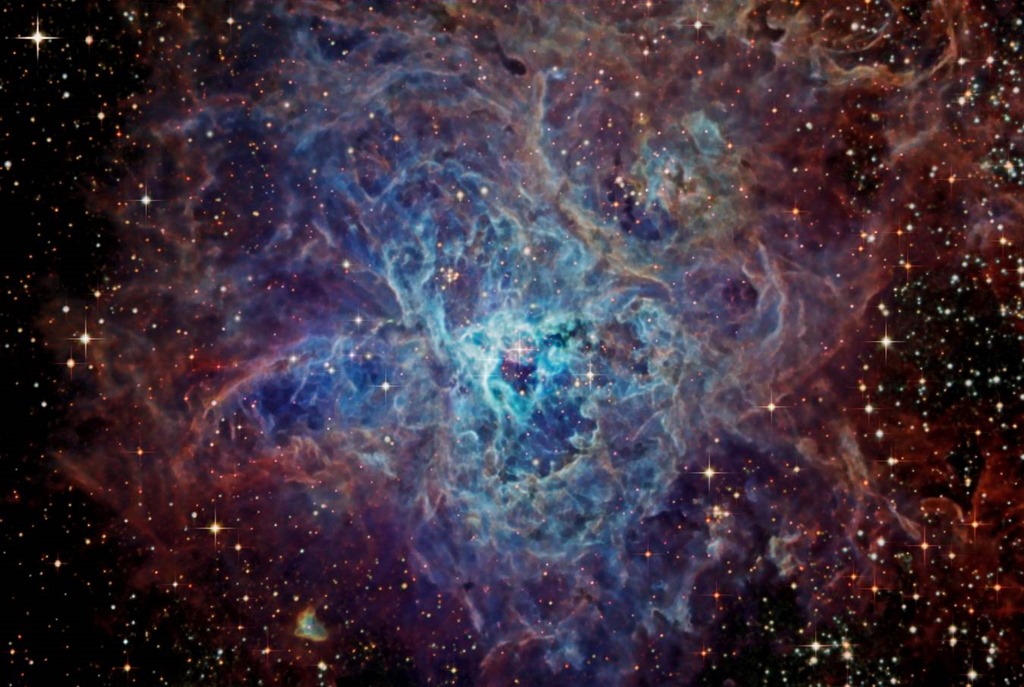
For-Cosmos

My point here, is we’re constantly creating stories to explain reality and our origins.  Three thousand years from now, the science of Cosmos will seem quaint – maybe as quaint as The Book of Genesis seems to most educated people today.  And maybe there will be a small segment of the population that clings to the ideas of Cosmos 2014 because it rationalizes some idea we treasure now but is rejected in the future.

Young Earth Creationism is the idea that reality has only existed for about 6,000 years and any suggestion that anything is older is a challenge to their theory.  Basically, these believers do everything possible to rationalize that The Book of Genesis is literally true, even though its full of internal inconsistencies.  They believe Moses wrote the first five books of The Bible around 1445 BC, even though Moses is a character that comes generations later.  They’ve even come up with an idea of how Moses could have done this, The Tablet Theory.

Cosmos is based on science, and science claims to be based on directly studying reality.  Because science is logical to most people, people with opposing creation myths like the young Earth creationists, now attempted to be scientific.  Sadly, their pseudo science is pathetic.  Both sides will reject the myth label, and insist their story is the actual explanation of how reality works.  That puts them into direct competition for the hearts and minds of citizens of the Earth.

Trying to understand how many Americans believe young Earth creationism is hard, but here is one study, “How many Americans actually believe the earth is only 6,000 years old?”  Tony Ortega estimates this is around 31 million.

The new Cosmos will be seen in 170 countries in 45 languages, but how many people will accept it as the best possible current creation story is hard to calculate.   Neil deGrasse Tyson is the new Moses of science, and he claims the universe is 13.8 billion years old, and instead of structuring his story around 6 days, uses an analogy of the 365 day calendar to picture how 13.8 billion years would unfold.  The image is our modern world since the Renaissance would fit into the very last second of that imaginary year is just bind blowing!  One year has  31,536,000 seconds, so this creation myth is quite complex. 

The Book of Genesis, a single chapter in one book, and is merely a few thousand words.  To understand those 13.8 billion years Cosmos covers you’ll need to read hundreds of books just to get the basic ideas how how things works, and thousands of books to get a fairly accurate picture.  I wouldn’t be surprised if there weren’t at least one scholarly book for each of those 31,536,000 representational seconds.  Maybe the faithful prefer The Bible for their explanation of reality because it’s requires reading only one book.

For most people, watching the whole series of Cosmos will only be educational in the vaguest sense.  Fundamentally, it will just be another creation story to accept or reject unless they study more science books to dig into the details.  I’ve often wondered just how many science books an average person had to read before they could claim they have a decent sense of scientific understanding.  To get some idea of the variety of science books available, read Gary’s Book Reviews at Audible.com.

Fans of the new Cosmos after finishing the series could read ten of the best popular science books on cosmology and still not understand much.  It’s a shame that K-12 schooling isn’t structured so children end up recreating the classic experiments of science.  Educating a scientific mind might be beyond reading books – it might require a series of AH HAH! moments of doing actual experiments.

Cosmos is a magnificent television show, but it’s only a beginning.  I’m sure the producers only expect it to inspire rather than teach.  It is Glenda telling Dorothy that the Yellow Brick Road exists, and viewers need to follow it to discover the real meaning of science.

The Great Books of Science

Encyclopedia Britannica has Great Books of the Western World – 60 volumes of the most influential writing in history.  This set was inspired by the 1909 idea of Harvard University and their Harvard Classics.  Which is also imagined in Harold Bloom’s Western Canon.  What we need now is The Great Books of Science series.  It doesn’t have to be an actual publication, but a constantly updated list of the best 100 books to read to understand science.  Science books get dated quickly, so the list needs to be constantly monitored and revised.  The editorial board needs to be scientists, or at least popular science writers of great experience.  Here are some attempts of coming up with such a list of science books.

As you can see, I didn’t find that many lists, so it’s a great project waiting to happen.  There’s many more lists of great science fiction books than science books, which is sad.  I love science fiction, but shouldn’t real science be more popular?

JWH – 3/13/14
We Can See Far, But Can We See Forever?

Why is there something rather than nothing?  The people who work hardest to answer that question are called physicists.  Physics is the study of the very large and very small.  The study of physics looks in four directions:  expanding out to the large, shrinking in to the small, looking back in time, and looking forward in time.

We can see far, but can we ever see an end to any of these directions?  Does time have a beginning, or end?  What is the largest object in existence, what is the smallest?  During our lifetimes, especially if you are older, how far we see in any of those directions has gotten further and further, and yet we see no sign of an end anywhere or anywhen.  Whenever we detect smaller particles, theorists come out and suggest they might be composed of even smaller particles.  Before 1929 the universe was the size of the Milky Way galaxy, now it’s billions of galaxies, and scientists are speculating about a multiverse – a reality of endless universes, each a bubble in a sea of infinity.  When there was just one universe, many scientists wondered if the Big Bang was the beginning of time, and the final expansion or contraction, the end.  If there are multiverses, time might have no beginning or end.

Scientists currently have instruments to see so far, and no further – telescopes and particle accelerators.  Beyond those limits lies speculation and conjecture.  Long ago, during the time of classical Greece, there were men who speculated that everything was made of atoms, and that the stars were suns.  It took many centuries before we could prove those speculations.  Today we live in a time when we speculate on strings and the multiverse, whether they will be proven to be true will take time and a lot of money.  Building machines that see farther are very expensive.

The question is:  Can we see forever?  Can we know the ultimate truth?  Can we ever answer:  Why is there something rather than nothing?  How can there be a creator if “creation” is infinite?  To tell children that God created everything is like saying the Tooth Fairy left money under the pillow or that a man in a red suit left presents under the tree.

Back in the times we now think of mythic, people were told if they could see into the minds of gods they would go mad.  That human minds would burn out with too much knowledge, too much truth.  Is that why people prefer religion over physics?  Recently Oprah Winfrey challenged swimmer Diana Nyad that a person can’t be in awe of existence and be an atheist.  The trouble is no matter how much awe Winfrey can feel, it’s only the smallest fraction imaginable over what science can teach us.  And what science can show is is tiny compared to the theoretical size of reality.  But from where we can see, science owns awe, and the religious are blind and cannot see.

We can all see far, but we can’t see forever.  The question you must ask yourself, do you want to see further?  If you are happy living in the fantasy of a Santa Claus like answer, that’s fine, but don’t talk about the awe of existence.  Learn some physics and math to understand how far you are looking before you claim too see far.  The best tool for the average person to do this is The Power of Ten, the classic film from 1977.

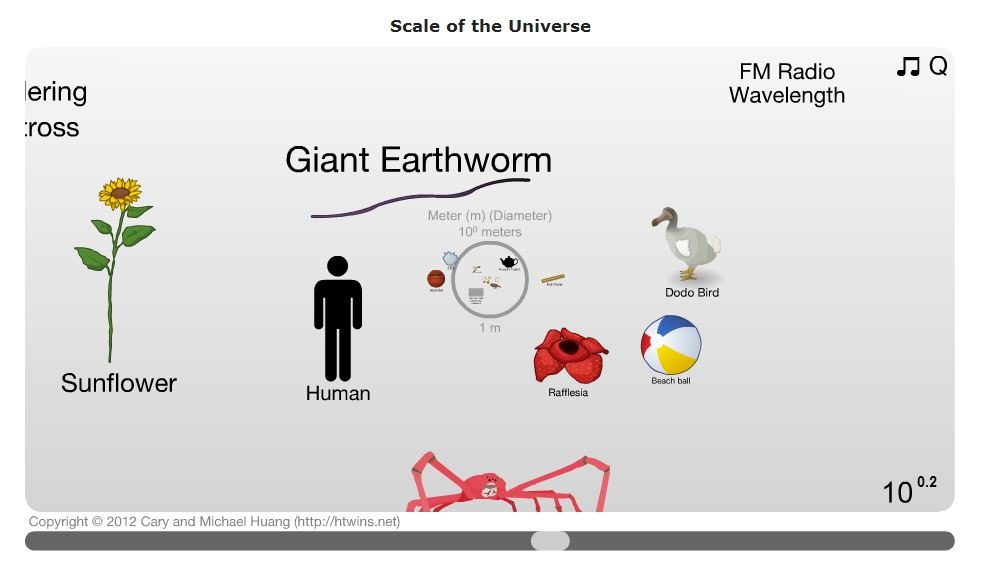
A more modern and stunningly beautiful web site is Scale of the Universe.

scaleoftheuniverse

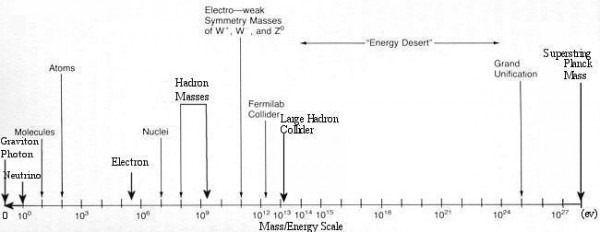
This is just a start.  Watching it once won’t do.  You have to really study it.  Powers of ten is a wonderful concept to understand the size and magnitude of reality.  Powers of tens work both ways.  Humans are at the 1 meter level, or 100.  101 is ten meters, 102 is 100 meters.  Just beyond 107 gets to the level of the whole earth.  But we can also go small with the negative powers of 10.  At beyond 10-9 we’re at the size of an atom.  I’m going to borrow some images from “The Rise and Fall of Supersymmetry” at ScienceBlogs to help illustrate.

Planck_scale

To “see” the very small requires what used to be called an atom smasher, but are now called particle accelerators.  The most famous one at the moment is the Large Hadron Collider (LHC).  It requires tremendous amounts of energy to see small.  Here’s another graph using the powers of ten, but this time using energy, to show how much energy it takes to see small.  You can click on both pictures to get larger versions.

I15-51-massscale-600x232

If you haven’t studied much physics this might not make sense, but between these two tables it indicates how far small we can see, and how much energy it will take to see to the edge of what we’ve speculated about.  About the middle of each chart is the edge of the known universe of the small.  We know there’s much further to see, but we don’t have the tools to see further – at the moment.  And when I say “see” we don’t see directly, but detect.

To understand this better I recommend reading The Trouble with Physics by Lee Smolin.  It’s a rigorous attack on string theory, but it’s also an explanation of how science works, and about the limits of what we can see now via detection, and what we speculate is beyond the edge of the known universe.  Smolin worries that we’re in an era of mostly speculation and not enough actual detection.  And here is where the title of this essay comes into play.

We can see far, and hopefully we can see further, but it will be expensive.  But ultimately, how far can we see?  Is there a limit to science and what it can detect?  The LHC is huge and costs a lot of money.  The LHC was supposed to be a big step up from the Fermilab collider, but if you look at the energy chart, it’s just one magnitude.

The thing is people inhabit a level of perception of around 10-3  to 103.  Astronomers might be concerned with 107 through 1027, but few other people.  Many scientists, including medical researchers are concerned with the range of 10-3 to 10-9, only particle physicists want to explore smaller.  For people who live in the 100 to 103 range, religion is an easy answer, but not a correct one.  If you want to know the whole truth, you have to study the known universe, roughly  10-24 to 1027, and beyond, as we speculate and explore further.  That’s a lot of territory.

Maybe next century we’ll be speculating that reality is 10-100 to 10100 in scope, but at some point, being just humans on Earth, we’ll come to an end of how far we can see.  We might be getting close to that limit now, and just don’t know it, or it might be we’re getting to the limit of what we can afford to see.  Our lives are limited in scope.  Our lives do have a beginning of time and an end.  It’s amazing that humans can see so far, but when it comes down to the nitty gritty, our well known living space is 10-7 to 107 meters in scale.  That’s our environment, which offers an almost unlimited possibilities, which could last for billions of years.  It’s a damn shame we’re using it all up so fast, and trashing everything.  Now that’s something to be in awe of Miss Winfrey.

JWH – 2/24/14

How To Become an Atheist?

Many of my atheist friends like to argue with religious people.  I don’t.  As long as people don’t try to make their religious beliefs into laws, and turn this country into a theocracy, I don’t care what they believe.  However, I find it very intriguing how some atheists believe they can enlighten the faithful with science, as if new and better explanations of reality will supplant myth driven memes.  I’m not sure it works that way.  Think of a meme as virus of thoughts and knowledge.  Concepts – memes – have a powerful life of their own.  They infect our brains in ways beyond logical understanding.

horse-1520

My theory is you have to go further into religion to find your way out.  Religious beliefs are deep-seated memes acquired in our formative years.  These memes are ancient and deeply routed in our culture.  It requires some serious soul searching to deprogram oneself.  I suppose some people might argue with an atheist or read Richard Dawkins and abruptly change their mind, but I’m not sure it’s a significant number.  Personally, I think most people are indifferent or only mildly accepting of religious beliefs.  They aren’t philosophical, and life after death isn’t that important to them one way or another.  It’s the true believer we’re really talking about. But true believers are hard wired to accept what they are taught as a child and won’t give up their ingrained beliefs easily.  Religion promises two things that science can’t, purpose and immortality.  True believers would rather have a purpose driven life with the promise of heaven, than the truth and death.

Converting true believers to evidence based thinking is probably a near impossible task.  I’m not actually interested in working at it, but as a philosophical problem of how to reprogram the mind, it’s a fascinating puzzle.  My hypothesis for my atheist friends is to suggest a different approach.  Instead of teaching science, teach religion.  Here’s what I would suggest that might work better.  Advise your God obsessed friends to:

Read the Bible

As a teen one of the most powerful deprogramming tools I discovered for myself was reading The Bible.  Start at the beginning and read it like a book.  Later in life I started listening to audiobook editions, and they are very powerful tools for revealing the book’s secrets.  The Bible is a very weird book.  It’s obvious written by many people, and for many reasons.  While reading it, constantly ask:  Who wrote this part?  Who did they write it for?  Why?  What did they hope to achieve?  Don’t just whiz past all the words and stories.  Think about their purpose.  Remember they were written 2,000-3,000 years ago, and they were first told as oral stories, not written, to people who were not literate, who had no concept of science, philosophy, history, medicine, mathematics, etc.  The Old Testament is fascinating because it’s obviously more of a book about social management than a textbook for spiritual education.  It’s about a history of people becoming a nation, about rulers inspiring a sense of history and social cohesion, and a means to justify the ownership of a piece of land.

The New Testament is totally different.  It’s a history of how Christianity started, but told from side of the winners.  Christianity had a myriad of forms in the first century.  Just reading The New Testament without historical supplements, it’s easy to spot that Paul is imposing his will on how people will conceive of Christianity.  Through his attacks on other proto-Christians we see there was many differences of opinions.

Study the Bible as History

Start with studying how The Bible has been translated into English many times over the last four hundred years.  That’s very fascinating.  Then study different approaches to modern translations – literal versus lyrical approaches.  Bart Ehrman was a fundamentalist believer until he went to divinity school to study The Bible in its original languages.  Ehrman is not an atheist, but his scholarly studies of how The Bible was put together has changed his beliefs.  I highly recommend reading his books.  Ehrman is also a specialists on early Christian sects and the battle for orthodoxy.  Be sure and study Gnosticism.  Elaine Pagels is a good writer for this.

Study the Gospels in a horizontal fashion.  They often retell stories about the same events but with different facts.  Learn how to put the various stories in chronological order to see when various belief memes arose.  Many cherished Christian beliefs were added long after Jesus died, and deal with concepts he never spoke about.  Read The Five Gospels created at The Jesus Seminar.

There are literally millions of books on religion, try to find the ones that use a scholarly historical approach, rather than speculation and interpretation books.

After studying The Bible itself, start studying history and anthropology of Biblical times.  Learn to overlay stories in The Bible with real history.  Study the cultures that existed concurrent to Israel and see how they saw events The Bible.

Study Other Religions

Going ecumenical is a great way to undermine your own parochial beliefs.  Start attending a variety of Christian churches and compare their specific doctrines.  Attend and study Buddhist, Hindu and Muslim religious services and holy books.  Start reading about everyone’s saviors and saints.  Study the origins of religions before monotheism.  Gods and religions existed for thousands and thousands of years before anything in The Bible was even thought about.   Karen Armstrong is a writer I like that explores the origins of religion.  Study Joseph Campbell, for myths and mythology.  I learned Buddhism from Alan Watts and Hinduism from Ram Dass, but I’m sure there are more comprehensive scholars have emerged since way back then.

Conclusion

I’m not sure how much is involved with getting people to change their minds about cherish beliefs and desires.  I’m a lifelong science fiction fan, who believes in many science fiction memes that I acquired early in childhood and have clung to my entire life.  Science undermines my beliefs too, and I hate to give them up.

However, it’s my theory that more knowledge about our cherished beliefs will change them faster than learning about other ways of thinking, or just being told they are wrong.  Over the decades I’ve actually studied faster-than-light travel, robotics, interplanetary travel, interstellar travel, colonizing the Moon and Mars, and many other science fictional memes, and it has been learning the limits of these concepts that has changed my mind.  Sure, it meant learning more science, but it took time for me to live with my cherished beliefs to understand how they wouldn’t work.

JWH – 1/22/14

Project Nim (2011)–How Much Are Animals Like Us?

Project Nim is a biographical documentary about Nim Chimpsky (1973-2000), a rather famous chimpanzee, cruelly stolen from his mother, and who was taught sign language while growing up living in a family home with human children.  Sadly, and very painful to watch, Nim is taken from his human family, first to be cared for by graduate assistants who loved him, and then tragically after the experiment was over, to live in cages at various primate facilities around the country.  The documentary is both inspiring and heart breaking. 

We learn how human a chimpanzee can be, and how inhuman humans can be. 

The hero of this story, the human apes should measure us by, Nim’s friend with the biggest heart, is Bob Ingersoll, who worked tirelessly to rescue Nim, and to a minor degree offers some release for the suffering viewer – not a happy ending, but something.  I tell you this not to spoil the ending, but hopefully convince the kind of people who avoid any film where an animal might suffer to give it a try.

I highly recommend seeing this film is you can handle the animal cruelty and suffering.  And if you’re the sensitive type that can’t, I still recommend trying, because it will inspire you to fight even harder against animal cruelty.  I can understand that you don’t want to suffer too, but turning a blind eye is no help.   Even if you can’t watch the film, please visit the Nonhuman Rights Project.

Imagine being raised by a large loving family of privilege, given everything thing you needed and more, with lots of love, a fantastic education, and then being sent to prison, spending long stretches in solitary, always hoping you could return to the good life.  The documentary gives plenty of evidence that Nim remembered.  The documentary gives plenty of evidence that Nim is a truly sensitive being that knows far more than just being a dumb animal.  He should have hated all humans, but he didn’t. 

[Some YouTube uploaders promise the entire film – but I got it from Netflix.]

I think all pet owners who have loved their furry children have wished “If only they could speak.”  Project Nim is about an experiment where scientists try to teach a chimpanzee American Sign Language (ASL).  The success of this project, to this day, is uncertain and controversial.  Many of Nim’s handlers believed he could sign, including simple sentences, and even made up his own signs.  Herbert S. Terrace, the project leader, eventually concluded that Nim was not using language, but could sign with very limited ability.

Chimpanzees are cute when little, but dangerous when grown, so they make very difficult subjects for life long experiments.  The tragedy of Nim’s wretched existence was sort of like Charlie in Flowers for Algernon, he had a brief period of being much more aware of things, and then a fall from paradise into abject boredom of caged life with no intellectual stimulation.  Herbert Terrace should have foreseen the cruelty he was putting Nim through, and the defects of his experiment.  To me the obvious place to conduct such experiments is in the wild, in natural habitats of chimpanzees, and not American suburbs.   

I’m curious if any researcher has worked with wild chimps and gorillas to teach them sign language.  If apes were capable of using sign language it’s ability would persist, spread from ape to ape, and be passed on from generation to generation.  I need to research if any work has been done like that.  The article “Great ape language” at Wikipedia doesn’t mention such research, and its conclusions are rather pessimistic.

Part of the controversy is trying to define what language is, and the critics of ape language experiments think it’s more complicated than what apes can handle.  However, I think it’s obvious they are capable of a proto-language.  Many animals have ways to communicate warnings, but this isn’t the same as a grammatical language.  Terrace is quoted at Wikipedia as saying Nim’s longest sentence was “Give orange me give eat orange me eat orange give me eat orange give me you.”  We’ve all had pets that communicated specific wants with no words.  And as far as anyone knows, maybe Nim thought each and every hand sign he was making was a kind of hope that expressed “I want to eat that orange!”

Last month  the Nonhuman Rights Project tried to get legal person status for chimpanzees but failed.  I consider them a new kind of animal rights movement, and eventually they will prevail.  Back in 1947, Robert A. Heinlein wrote a story “Jerry Was A Man” about such a court case happening in a science fiction story.  Heinlein’s imagined future is now our present.  The basis of the tale was to convince a court that Jerry, an old circus chimp, was human, and thus deserved human rights.  Now there is a position between animal rights and human rights, which I think is well named with nonhuman rights.  We have to recognized that some animals are self-aware, have a kind of consciousness that is close to ours that we can empathize with, even if they lack our language ability, that should not suffer at our hands. 

Animals with certain levels of consciousness need a legal status.  If such a legal status had existed back in the 1970s, the experiment with Nim would never have taken place.  Nor would all the apes now being used in medical research.  Our research facilities, zoos, lives of exotic pets, circuses, animal attractions, would all have to be redesigned for their level of awareness.  I don’t know how far down the tree of life from the human branch this compassion would stretch, but it might be many branches below us.

I discovered the Project Kim documentary from an article in The Best American Science and Nature Writing 2013,  “The Last Distinction?” by Benjamin Hale from Harper’s Magazine.  Unfortunately, Harper’s is not generous with full text of copyrighted material.  The whole Best American volume is worth owning and reading though.  In fact, the next article in the book is “Talk to Me” by Tim Zimmerman.  That article is about communicating with dolphins in the wild.

As a plug for the Best American Science and Nature Writing 2013 here’s some of the articles that are still online to read.  This gives you a sample of what the whole book is like, which is wonderful.

If you read only one, read “False Idyll” by J. R. MacKinnon.

JWH – 1/10/14

What Would Be The Bible of Science?

Christians have only one book to explain reality, The Bible.  What one book is there to explain science for scientific believers?

That’s a hard question to answer, because to truly understand science requires reading dozens, if not hundreds of books.  There are many books that survey the history of science, but often they don’t convey why science works, or how scientists think.  For most of my life I’ve thought of myself as a scientific person, but I don’t understand science at the working scientist levels, or even understand it well at its philosophical levels, and I have read hundreds of science books.

I’m currently reading a book that could be the bible for scientific thinking.

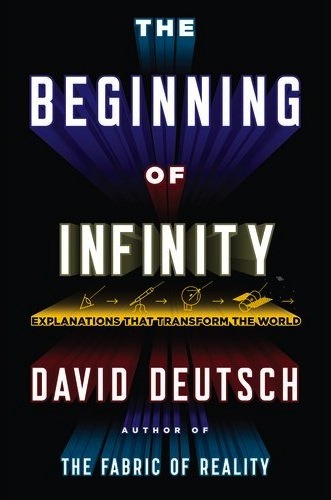
the-beginning-of-infinity  

Now David Deutsch doesn’t intend his book The Beginning of Infinity to be the bible of science, I’m just nominating it as one possibility.  It has one major strike against it though, I’m not sure anyone reading it that doesn’t have a decent grasp of science and philosophy already, will understand it.  The reason I nominate The Beginning of Infinity as the one book to study to grasp the scientific mindset is because it works to explain the why of science rather than the how.  David Deutsch is the Plato and Aristotle of the early 21st century.

I am only halfway through reading this book and it’s inspired me to buy three editions of it to study, the hardback, the ebook and the audio edition.  I will not comprehend this book in one reading, or ten.  And the reason why I’m writing about it even before I finish it is because I need to struggle with writing words about it to understand it as I read it.

Deutsch believes techniques humans developed during and since The Enlightenment are our best tools for exploring and explaining reality, but to understand these techniques requires more than understanding the scientific method.  What we want are good explanations that stand up to rigorous criticism, so science needs the best philosophical tools to constantly hammer away at the results of our scientific experiments.  Ultimately, Deutsch is writing about knowledge creation, and the impact of this knowledge on reality.  Deutsch goes beyond understanding reality into the science fictional area of shaping reality. 

As the physicist Richard Feynman said, ‘Science is what we have learned about how to keep from fooling ourselves.’ By adopting easily variable explanations, the gambler and prophet are ensuring that they will be able to continue fooling themselves no matter what happens. Just as thoroughly as if they had adopted untestable theories, they are insulating themselves from facing evidence that they are mistaken about what is really there in the physical world.

Deutsch refers to gambler and prophet here because they both try to predict reality.  Religion is an authority based knowledge that attempts to explain reality with easy explanations – God did it – that fail to explain reality at all.  A gambler is someone who thinks they understands an aspect of reality and bets on future events.  Followers of religious thinking also bet on future outcomes.  The trouble is we can’t know the future, and at best, we can only explain what has or is happening with explanations that hold up to rigorous criticism.

Deutsch explains why religion and most of philosophy are miserable failures at explaining reality.  The trouble is religious and philosophical thinking so cloud our thoughts that it’s almost impossible to clear our thinking of their faulty logic.  Science is more than evidence based thinking.  It’s more than the scientific method and experimentation.  Science has to be critical thinking.  This is why an understanding of philosophy, logic and rhetoric is important to understanding scientific thinking.

The quest for good explanations is, I believe, the basic regulating principle not only of science, but of the Enlightenment generally. It is the feature that distinguishes those approaches to knowledge from all others, and it implies all those other conditions for scientific progress I have discussed: It trivially implies that prediction alone is insufficient. Somewhat less trivially, it leads to the rejection of authority, because if we adopt a theory on authority, that means that we would also have accepted a range of different theories on authority. And hence it also implies the need for a tradition of criticism. It also implies a methodological rule – a criterion for reality – namely that we should conclude that a particular thing is real if and only if it figures in our best explanation of something.

Time and again Deutsch references The Enlightenment.  Most historians believe the Enlightenment was a time in our past, but I believe until religious thinking is removed from the world, we’re still fighting Enlightenment battles.  Yes, we live in a technological and scientific age, but most people still think by ancient thought patterns.  Deprogramming ourselves of these thinking habits that give us faulty explanations about reality is very hard, including the most scientific among us.   Even life-long atheists have a hard time thinking completely clearly.

Long before the Enlightenment, there were individuals who sought good explanations. Indeed, my discussion here suggests that all progress then, as now, was due to such people. But in most ages they lacked contact with a tradition of criticism in which others could carry on their ideas, and so created little that left any trace for us to detect. We do know of sporadic traditions of good-explanation-seeking in narrowly defined fields, such as geometry, and even short-lived traditions of criticism – mini-enlightenments – which were tragically snuffed out, as I shall describe in Chapter 9. But the sea change in the values and patterns of thinking of a whole community of thinkers, which brought about a sustained and accelerating creation of knowledge, happened only once in history, with the Enlightenment and its scientific revolution. An entire political, moral, economic and intellectual culture – roughly what is now called ‘the West’ – grew around the values entailed by the quest for good explanations, such as tolerance of dissent, openness to change, distrust of dogmatism and authority, and the aspiration to progress both by individuals and for the culture as a whole. And the progress made by that multifaceted culture, in turn, promoted those values – though, as I shall explain in Chapter 15, they are nowhere close to being fully implemented.

This is why I’m reading this book.  This is why I’m going to study this book like no other.  I plan to read The Beginning of Infinity several times this year.  But this is only preparation for what Deutsch is setting up with his book, and what is explained by the title.  The book is really about the impact of human generated knowledge on reality.  He compares it to forces of nature, like gravity.  Biology has already been collecting and processing knowledge for billions of years, but it is unaware knowledge.  Where we’re at is the beginning of aware knowledge.

Here is a short video by Jason Silva that explains the impact of The Beginning of Infinity in another way, a visual way.  Please watch it full screen with your sound cranked up.

I’m promoting reading The Beginning of Infinity in the same way the faithful promote reading of The Bible.  I’m not sure the faithful will understand it, but I believe atheists need to study it.  Strangely enough, I think science fiction fans and computer geeks will love it because it will resonate with their kinds of thinking.

You can read more at the book’s website, including an excerpt.

JWH – 1/2/14