Free Science Fiction

It’s a great time to be poor, tight or miserly because there’s lots of free science fiction offerings on the Internet.  Heinlein was wrong about that free lunch deal.  Just subscribing to two web sites, SF Site and SFF Audio via RSS feeds will keep you informed of more good free SF&F reading and listening than you can handle, even if you’re out-of-work or out-of-school.  All you’ve got to do is read the regular posts and these sites will spot the goodies for you. 

Hell, a couple months ago Tor let people sign up to get 12 free ebooks novels from them, in PDF, HTML and unprotected Mobi formats, which is good for the new Amazon Kindle.  I socked them away for a rainy day when I want to try out some new authors, but I especially appreciated getting a copy of Old Man’s War by John Scalzi because I already bought and listened to it on audio.  Audio books are the best way to fully experience a book, in my humble opinion, but audio books are not so good for reference and study.  eBooks are great for snagging a quote.  I wished all paper editions came with ebook editions for reviewing purposes – but I digress from my main topic.

I don’t know why there is so much free reading and listening on the Internet.  I do know there’s a theory that a certain amount of free promotion helps with sales, but currently there’s enough free promotion to exist completely without buying.

Some writers like Cory Doctorow even offer their latest novels for free, such as his new book Little Brother.  Read the intro in the HTML edition to see just how far his generosity extends.  I’m waiting for the audio edition to show up on Audible.com to buy.  I’ve read Cory’s stories in anthologies I’ve bought, but his name has stuck with me because of his free work on the Internet.  Finding his brilliant “Anda’s Game” made me remember his name as a standout writer.  The same thing happened with Charlie Stross, because of free stories on the net, or stories in anthologies, I’ve gone on to buy his books.

A good way to dip your toe in the free story waters is to read BestScienceFictionStories.com where Rusty reviews standout SF short stories, many of which are on the net to read for free and Rusty provides the links.  He even offers a guide to finding free stories, “Nine Secrets For Finding Your Favorite Science Fiction Short Stories Online,” as well as “The 10 Best Web Sites for Free Online Science Fiction Short Stories.”  When I was a kid I had to haunt musty used bookshops all over Miami to find classic SF stories to read.  Now story hunting is as easy as a mouse-click away.

And these stories aren’t submissions from would-be writers, or trunk stories from published writers, but award winning stories, stories that have appeared in best-of-the-year anthologies, and stories that have appeared on lists like The Top 100 Sci-Fi Short Stories.

For the last decade I’ve been doing far more listening to fiction than reading.  At first audio science fiction was rare, but in the last year there has been a boom in SF&F for your ears, including free productions.  At first free audio featured amateur readers no better than the best student you’d hear when we had to take turns reading aloud in class.  The best professional readers today act out audio books in performances I often find better than those I see in Oscar winning movies.  Free audio productions have a long way to go to compete with professional productions, but surprisingly, they are evolving fast!

The granddaddy of SF audio is probably Escape Pod, currently broadcasting it’s 159th episode.  You no longer have to mess with podcast software to listen to the shows, so go sample its stories with the on-page sound controls.  The production quality is now equal or better to many of the commercial stories I buy at Audible.com.  Escape Pod offers a lot of quality for free.  Again, these aren’t just third-tier stories, but stories that have appeared in professional story magazines like F&SF, Asimov’s, Interzone, Realms of Fantasy, Strange Horizons, Jim Baen’s Universe, and other magazines that SF writers love to sell to.

Also, the above linked magazine sites often offer free stories to read from their for-sale magazines, especially during award times when they want to promote their nominated authors.  Just following the links on this page will keep you up-to-date with what’s going in with the genre of science fiction.  You’ll learn who the famous authors are as well as the new and upcoming writers.

Free audio book novels are showing up but most of them are read by amateur readers, something not to my taste, but if you like free and are patient and forgiving, you might find a lot in these offerings.  I expect this category to grow in the future as amateur actors discover audio books are a way to audition their talents and get their names known.  Digital recording equipment is relatively cheap, but producing a ten-twenty hour novel is quite a commitment, but they are appearing.  Keep an eye on SFF Audio.

And if you want to know about classic science fiction, visit Feedbooks, where you can get ebook novels for free.  Their Science Fiction page offer books from Mary Shelley’s Frankenstein to George Orwell’s 1984 to Cory Doctorow’s Little Brother, the new book mentioned above.  And all the books are nicely formatted for a wide range of electronic reading devices.  Teachers and professors could offer a class on science fiction and their students could get all their textbooks for free on this site.

I don’t understand how all this generosity works.  It’s a hippie dream – a commie’s philosophy come true.  Feedbooks doesn’t even have ads on their page.  It’s a mystery, like WordPress, how do they make their money?  There are even radio magazine shows like StarShipSofa.com, that appear to be the work of energetic individuals unmotivated by capitalism.  It’s like the old days of fanzines, creating a new generation of online fandom, fashioning an audio genzine.

Like I said, it doesn’t take much to join this community, just add the RSS feeds from SF Signal and SFF Audio.  Having online access allows web surfers to join a never ending science fiction convention, again for free, without having to buy a membership or pay for hotels, cabs and airline tickets.  If you follow SFF Audio, links to panels and con speeches often show up too.  And again, it’s all for free.

This makes me wonder about the financial health of the little audio book publishers and small press publishers.  Is all this free competition hurting them?  SF Signal and SFF Audio also link to these commercial sites, so if you want to see them succeed, patronize their online stores too.  The commercial SF&F magazines have been losing paid readership for years – is the Internet partially at fault – either through free offerings, or just a diversion from old fashion pastimes?  It’s all too hard to know, but we do know there were a lot more short story magazines on sale at newsstands before the advent of television, again a system that offered content for free, usually paid for by ads.

The science fiction short story may go the way of poetry – moving out of the realm of commercial sales to exist and be supported by love of the art form and its fans.  I hate to see that, but I sure do love the fact that the art form of the science fiction short story seems to be growing on the Internet.

Learning to adapt to this free medium takes a bit of training and equipment.  Listening to audio via on-page controls is the easiest way to join in.  Just play a story and kick back.  They are nice company for doing the dishes, or pursuing hobbies like modeling or knitting.  Next up is learning to subscribe to podcasts in iTunes and take the stories with you when you run or walk.  If you like to read on your phone, PDA, notebook computer or ebook reader, find you favorite reading software and learn where the best places that offer that format for free.  I’ve barely touched on the free sites available. 

Like I said, I mostly listening to books because I’ve found so many ways to integrate audio books into my routine.  It’s quite wonderful to be walking down the street while classic novels are whispered into my ear.

Jim

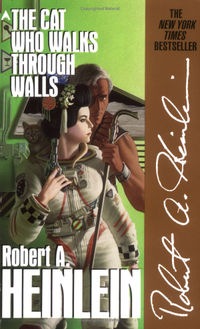
The Cat Who Walks Through Walls

Reviewing books is a touchy subject.  On one side of the coin, publicly calling someone’s creative baby ugly is just a mean thing to do.  Flipping the coin over reveals the whole needy world of authors begging for any kind of press they can get.  I’ve always dreamed of writing a book and getting published – what joy that would bring.  But I can also imagine the soul wrenching torture of waiting for reviewers and readers that never come.  Anyone who takes the time to review books is a generous human being, at least in the eyes of new writers.  Most magazines and newspapers have cut way back on their space devoted to book reviews, and I think bloggers have come to the rescue.

I wish had the time and talent to review books.  Those reviewers who can read a new novel and write a review that promotes the book without giving anything away, that sets the context in relation to other books of similar style and stories, who gives just the right snippets to hook potential readers and provides a bit of background about the writer, are people with a very special knack.  Really good reviews of this sort will not only introduce you to a new book but will teach you something about literature in general.

I don’t have that knack, so I don’t try to review books.  However I love books and I love talking about them and I love exploring where books take me on intellectual safaris.  I like to think of myself as an explorer of reality, but I’m not a pioneering explorer.  I follow in the footsteps of others where they leave notes along their path – those clues are called books.  I don’t read to be entertained, although I do love entertaining reading.  I think of books as very complicated messages – not messages with meaning, but messages with information about exploring reality.

Most people get bored if their friends spend more than a minute talking to them in a stretch.  Few people have the patience for lectures.  Well, a book, either fiction or nonfiction, is a very long speech from another person, sometimes ten or twenty hours, and even forty or fifty hours in some special cases.  No one will be patient enough to let a friend drone on and on like that.  Thus writing, either essay or fiction, is the art of capturing attention.

This long winded intro, which I hope hasn’t tried your patience, is leading up to something.  I’m trying to do two things here.  One, get clear in my mind what I’m doing when I talk about books, and two clarify or justify statements I have made in the past that have caused problems.  I’m hoping the next time you say, “I hated that book” you will have a new context to express yourself, because this essay will be about calling people’s intellectual babies ugly.  The public often hates critics because they come off as superior, and it is true, some critics are downright snooty, gleefully firing down their cannonball sarcasms from a superior vantage point.

I sometimes annoy people with sweeping statements I make about books.  For example, I frequently say I find books written by Robert A. Heinlein after The Moon Is A Harsh Mistress are painfully unreadable.  Now I know there are many Heinlein fans that love these later books even more than his earlier classics that I cherish, and I think its these people I annoy the most.  I don’t mean to offend or be inflammatory.  At one level when I say I find a book painfully unreadable all I mean is I personally experienced those books as painfully unreadable.  The real question here, for scientific purposes we might say, is whether or not books have absolute qualities that can be judged and compared.

I don’t like reviewing books in the sense that I’m going to say yea or nay as to whether someone should buy and read the book.  I love reading good book reviews, and I consider quality reviews a real art form.  I’ll mention again, I can’t carry that tune.  What I do like writing about is my impression of books, and how they affected my life.  Hey, it’s all about me, isn’t it?  That’s a joke, and not my vanity slipping, but it’s also a truism.  Blogging is news at a personal level.  Blogging is memoirs in bite-size chunks.  I’m can’t write scholarly reviews like I read in The New York Review of Books.  I would love to be that well educated so I could put each book I read into a larger context and relate it to its peers.

When I write about a book I want to relate how it fits into my life.  When I criticize Heinlein’s later books people need to know I how much I admired Heinlein’s earlier books.  The first paycheck I ever earned when I turned 16 was spent on ordering all twelve of the Charles Scribner’s Sons books by Heinlein in hardback direct from the publisher.  I once wrote an essay for Lan’s Lantern, an old fanzine from the 1980s, about how Heinlein was my father figure growing up.  I remember waiting for each new Heinlein book after The Moon is a Harsh Mistress, expecting so much and always be so disappointed.

There are many factors to explore here.  Did I change by growing up?  Did Heinlein change as a writer?  Or if I had read the later books at age 13 when I discovered and read all my favorite Heinlein books would my opinions be different about them?  Have I gotten older enough, and well read enough, to look at all of Heinlein’s books and judge them with a mature perspective?

The_Cat_Who_Walks_Through_Walls_bookcover_amazon

I just finished listening to The Cat Who Walked Through Walls which many Heinlein fans love because this story includes so many characters from Heinlein’s earlier much loved books.  Now I’ve read this book once and listened to it once, and it is probably the least offensive of all the later Heinlein books to me, but my personal opinion is the book is still mediocre Heinlein.  Oh, it’s more readable to me than The Number of the Beast or Friday, and its amusing to see what he does with the characters I loved from his older classic stories, and I do get a kick out of the meta-fiction, but ultimately I have to come down hard on this story.

Now if you love The Cat Who Walks Through Walls I’m not here to convince you that you are wrong.  I think the reasons why we bond with books are emotional and out of the range of analysis.  However, I do believe books have qualities that can be discussed and compared and maybe even judged.  The qualities are not as precise as the elements of physics and chemistry, but they are concepts we can get behind and even point to and say they exist.  Some of these qualities are characterization, plot, narrative, point-of-view, the accumulation of significant details, drama, and emotional conflicts.

If you enjoy reading The Cat Who Walks Through Walls and don’t want to be an English professor, critic, writer or literary scholar than these points won’t matter to you.  You buy the book, get your kicks and go on to your next read.  No big deal.  Maybe books do not have qualities that can be absolutely measured with scientific instruments, but those qualities can be discussed and judged.  The quality of any ruling is related to the quality of the judge and jury.  The judgement of giving The Cat Who Walks Through Walls to the MFA professors at the Iowa University writer’s program or Harold Bloom will be different from a group of fans at the hotel bar of a science fiction convention or panel discussion.

It is my thesis that The Cat Who Walks Through Walls could have been an outstandingly great novel but instead is a huge belly-flop.  Getting back to that explorer metaphor, let me say that Heinlein was aiming at a very ambitious idea, exploring new fictional territory with his World as Myth theory.  I don’t know if he was old and losing his writing abilities, lazy, or just corrupt by the power of writing, but The Cat Who Walks Through Walls fails miserably as a work of art.  I’m sure there are hordes of Heinlein fans who reread this book every year and find it delightful, but I’m not one.  Heinlein let me down big time.

Now here’s where my slip starts showing.  As an amateur explorer of the realms of fiction can I leave the notes that scientifically explain where I’ve been?  A good novel is built from many kinds of building blocks, and a great novel reflects the craftsmanship of each.  When I was a kid I liked to take mechanical alarm clocks apart to stare at the fascinating maze of mechanisms.  Exploring the world of fiction means learning how stories tick.

I know Heinlein intimately knew story engineering because he wrote so many masterpieces.  How can I judge him?  I’ve read a lot of great novels, and I’m slowly developing the sense for what makes them great.  I’m still in high school though.  How do I know that the later Heinlein books don’t involve master skills that I haven’t even come to recognize?  That’s a good question.  Like I said, I’m an explorer that follows in the footsteps of others.  I only have a vague sense of where the event horizon of the unknown lies.

I think quite a lot can be said about how The Cat Who Walks Through Walls is put together.  First off its a book that depends on older novels for characterization.  If you haven’t read The Rolling Stones, Stranger in a Strange Land, The Moon is a Harsh Mistress, The Number of the Beast and other stories, you’re shortchanged when you read The Cat Who Walks Through Walls. And even if you are very familiar with these stories, there is still trouble.  Hazel Stone is not the same character in The Rolling Stones and The Cat Who Walks Through Walls.

I know I’m about to make one of my statements that offends people, but here goes anyway.  The Cat Who Walks Through Walls is fan fiction, but of instead of being written by fans of Heinlein, Heinlein is writing the book for his fans.  However, the quality of the story telling is more like fan fiction in general, a poor parody of the original.  I know this was probably an emotional book for Heinlein to write, and I know his fans have a great emotional attachment for his characters, but is it only me that feels this books does a great disservice to the fictional people living in the original stories?

I’m not a reader who like sequels or long story series.  I often find a great novel is best left to stand alone, and writers shouldn’t cash in on earlier successes.  As far out as the concept World as Myth is, I can’t help think such stories are not much better than daydreaming about your favorite books and characters and making up your own fantasies.  I consider Heinlein a master storyteller – and I think it would have been far better for his career to have kept inventing new stories, characters and plots instead of recycling old ones.

However, if The Cat Who Walks Through Walls had at its foundation a novel as good as Have Space Suit-Will Travel, Tunnel in the Sky, Starman Jones and The Rolling Stones, and the World as Myth unfolded naturally as part of the storytelling this would have been a brilliant work of fiction.  Instead it’s a long meandering novel about crappy topics Heinlein was obsessed with and then near the end he throws in some World as Myth ideas and wraps things up quickly.  He should have stopped the book when he got these ideas, thrown out what he had, and then worked out a real plot to fit the idea.

To make this book a masterpiece requires letting the reader in on the gimmick as soon as possible, like the Jasper Fforde novels.  Second, and this is absolutely vital, is he needs to make his classic characters act and sound just like they did from the original novels.  Third, an again this is vitally important, he needs to make the mysterious enemies vivid and realistic.  To build proper tension and page turning power readers need to know what’s at risk as soon as possible.  A last minute explanation of the bad guys told and not shown at the end of the book is just pathetic writing.

I’m not a prude, but my most vicious attack on this novel will make me sound like one.  Having all of his “good” guys sound like a convention of smarmy talking wife-swappers is just gross.  I hate to sound like a teenage girl, but damn, Heinlein’s kissy-kissy talk and innuendo just made me want to puke.  And making his classic characters act out in this limp-dick porn flick is just tragic.  Having them go on and on about how they were going to kill people for bad manners is just a little psycho to me.  Evidently a lot of people and situations annoyed the hell out of Heinlein and he used this book to vent.  Some people want to call this satire but I think that’s whitewash.

Maybe Heinlein lost his mojo and these multiverse stories were the best he could do.  Personally, I thought The Rolling Stones was a perfect novel, and bringing back Hazel Stone was a fictionally fuck-up of an idea, ditto for the cast of The Moon is a Harsh Mistress.  Maybe I am a prude because I just don’t want the Hazel Stone, grandmother of Castor and Pollux, joking about being stretched out of shape by giant 25 centimeter cock.

All of Heinlein’s personally favorite characters get put into a fictional juicer and blended into weird rabble of sex obsessed mob that chirp a weird innuendo patter and are almost impossible to tell apart.  When I read these multiverse stories I can’t help but believe that horniness was driving Heinlein crazy.  These later stories are preoccupied with sex, killing people, responding to annoying people, the reliability of witnesses, rude people deserving capital punishment, and so on.  Not only does Heinlein recycle his characters to death, he constantly recycles his pet peeves.

The trouble with writers who keep recycling characters is their lovely fictional children get abused and mangled till they become unrecognizable from the characters of the original classic works.  The books Heinlein wrote in the 1950s contain some of the most inventive science fiction ever written.  He create fantastic science fictional ideas and matched those ideas with believable characters.  At the time he was on the cutting edge of exploring the boundaries of science fiction.

The Cat Who Walks Through Walls like the other multiverse stories, end up being a convention of swingers flirting with each other in endless pages of cutesy sex talk and solipsism arguments.  The lesson here for writers is don’t write in too many characters, and don’t have them all sound alike, and most especially don’t have them all sound like teenage girls trying to write porn.  Two people in a complicated plot that leads to sex is one thing, but stories that end up in orgies of leering conversation is a huge writing mistake.

Another story telling mistake is to give your characters too much power, and The Cat Who Walks Through Walls illustrates this perfectly.  If your heroes can time travel, dimension travel, live forever, then nothing feels real or believable, and no fictional conflict builds tension, and all bad guys feel like straw men put up for target practice.  Characters are built through the limitations they face, not from the magical powers they weld.

I actually believe that The Cat Who Walks Through Walls could have been as great as any of my favorite Heinlein stories.  Heinlein hated editors, but if he had his own Maxwell Perkins it’s no telling how good these later books could have been.

I do think Heinlein was exploring new territory, he just left poor notes.  As Heinlein neared death I think he feared his own end and worried about the mortality of his beloved characters, so these World as Myth stories created a heaven for them and himself to live in.  It’s a fantastic idea, and maybe why so many Heinlein fans love these stories.  It doesn’t mean they are good novels.  What I ask is to imagine if they had been great stories with the same theoretical ideas.  I don’t know why Heinlein became so sex-obsessed in his later years.  Maybe he always had been like that but stern editors censored him.  Or maybe he believed if we were all free from hang-ups and lived in the future we’d be wife-swappers, and all men and women would be horn-dogs.

Right after I finished The Cat Who Walks Through Walls I put on Ethan Frome by Edith Wharton to listen to and instantly heard master story telling.  Ethan Frome was first published by Charles Scribner’s, the publisher of Heinlein’s best books.  If Heinlein could have written The Cat Who Walks Through Walls with Wharton’s skill of narrative and characterization it would have been lighthouse on the shore of a new fictional ocean.  Recycling famous characters and authors into new stories is sailing on a dangerous sea.  Look at what they are doing to Jane Austen and her children.  Theoretically it might become a new art form, but it’s going to be hard to please the lovers of the original classic stories.  Heinlein couldn’t please me and he’s my favorite author.

Finally, I have to wonder if the sexual relationships that Heinlein wrote about is something he really expected for future people.  Today conservative thinking believes that sex should be between couples, and we’re arguing over whether those couples can include same sex partners.  We liberals answer yes.  Heinlein is speculating that in the future we’ll accept group sex marriages and even relationships we consider taboo now, such as incest, which I think is hard to believe even for liberals.  Like I said, I think of these ideas as swinger fantasies.  And we are a lot more liberated about sex than we were before Heinlein wrote Stranger in a Strange Land.  Even Ethan Frome is exploring the boundaries of sexual relationships in 1911.  What human behavior will be in the future is solid ground for speculative fiction, so I can’t object to Heinlein trying.

However, even the best of Heinlein’s stories shows a weak knowledge of human behavior.  Heinlein wrote great stories for teenagers, but his adults all seem a bit daffy, mainly because the characters from his adult novels were talky, opinionated and horny to strange degrees.  For all his later stories that speculate about group marriages he never once wrote realistically about people in such a dynamic relationship.

Now this gets me back to novels being complex messages.  The best novels contain treasures of data about how humans and society work.  They contain lots of intimate observations.  Heinlein didn’t write these kinds of stories.  He wrote about fantasy people, like the fantasy people of the Oz books or the Edgar Rice Burroughs books.  Look at how many lives that Tarzan has lived.  I think Heinlein was hoping his characters would have the fictional vitality of of Tarzan, John Carter, Dorothy, Toto, and The Wizard of Oz.

In these times of genre writers stretching out the lifetime of their characters in book after book. like some Days of Our Lives never-ending soap opera, was Heinlein’s ambition all that strange?  Readers love hanging onto favorite characters, but I don’t know if that’s healthy.  If the Heinlein juveniles would have been twelve books about one character it would have meant eleven fictional universes never seeing the light of creation.  Will we ever know if seven Harry Potter books are superior to seven different stories J. K. Rowling could have written?

Again, I think if Heinlein had written The Cat Who Walks Through Walls with original characters about a fictional reality where authors, fans, editors, movie directors and other writers could easily reshape the lives of those characters in fantastic ways he could have created a memorable original novel.  I think he confused the idea by recycling his older characters, because they aren’t his old characters really, nor are they new original characters, that get to be born fresh into a new virginal fictional reality.

Ultimately, The Cat Who Walks Through Walls is an excellent lesson for me on how not to write a novel.  Heinlein, indeed was exploring new territory and I have learned from his efforts.  I could write a whole book tearing this story apart line by line but would it really be worth the effort?  I wouldn’t mind seeing other writers try using this idea and inventing a World as Myth with Heinlein and his characters.  Especially if the writer was very astute at analyzing Heinlein psychologically.  And just because I don’t think this is a very successful book it doesn’t mean I don’t think Heinlein fans shouldn’t read it.

Jim

Slower Than Light Imagination

Science fiction has always entertained the idea that travel between the stars would be no more arduous than travel between countries around the world today.  Because science fiction is basically adventure fiction, rocketing between Star A and Star B isn’t very exciting plotwise, so writers long ago imagined theoretical faster-than-light drives.  Anyone who has studied physics knows that these ideas are fantasies, and they contradict the notion that science fiction is based on science.  So as readers, should we accept science fiction as unscientific fun, or should we ask science fiction writers to be more scientific?

If travel between the stars was as slow as it took knowledge to evolve from Aristotle to Einstein would it still make for exciting fiction?  Science fiction has hinted at the immensity of generational ship travel, but it’s hard to write a novel that contains centuries of human activities.  I would think most novels would end up being about just the journey or jump to the destination and be just about the evolved world-building of starting a civilization on a new planet.  Interstellar war wouldn’t make any sense storywise, and neither would commerce between planets within a galactic empire, killing off two main sub-genres of SF.

Has any science fiction writer pictured a future where there are dozens of settled worlds and communication between them take years and decades?  Imagined if we had already colonized six other star systems, how would that feel to us people living on Earth?  Would it really feel any different than watching stories about China in the news?  Or imagine blogging with people from the six colonies – reading a steady stream of daily posts could be exciting – but commenting would be pointless.

There are hundreds of diverse countries around this globe that most people ignore in their daily life.  Sure, future people might watch an occasional documentary set on another world just like we watch a National Geographic show about an exotic Pacific island now.  Slower than light travel and speed of light communication will make an odd expansion of the human sphere of influence.  We could stay constantly in contact with generation ships and influence each other’s language and culture.  Just imagine new songs, television shows, books and movies coming from generation ships and colonies on distant planets.

A cool novel would be following two friends, one on Earth and one on a generation ship, staying in contact by a steady stream of messages where the time lag of replies grows ever longer.  Heinlein hinted as the possibilities of such a story with his novel Time for the Stars, but he cheated and used instantaneous telepathy as a form of communication.

Once I started thinking about STL travel to the stars I realize that science fiction hasn’t even begun to explore the idea.  Science fiction has fixated on space opera, military conflict and galactic civilizations, all from the realm of fantasy to the almost complete exclusion of how things might be.  Why is this?  Obviously, adventure fiction is built on conflict – where fighting nasty aliens is thrilling and the politics of interstellar empires offers far more intrigue.

It also shows a lack of imagination.  Two recent literary novels using fantasy and science fiction techniques, The Life of Pi by Yann Martel and The Time Traveler’s Wife by Audrey Niffenegger, absolutely kicked our genre’s ass when it came to plotting outside of the traditional genre box.  Too often science fiction writers find their inspiration from science fiction tradition, like John Scalzi’s Old Man’s War, a book I had much fun reading and which felt like delicious SF nostalgia rather than Cirque du Soleil storytelling dazzle that I got out of The Life of Pi or The Time Traveler’s Wife

I’m guessing that future SF writers of the talent of Heinlein, Asimov and Clarke won’t use golden age giants for their models, but come out of left field with stories that surprise us.  And one area where I’d love to be surprised is by reading stories that make me think I might be reading real possible futures.  I used to think reading history was a way to know the past, and reading science fiction was a way to imagine possible futures.  I hate the idea of dying and not know the future of mankind, so I always loved science fiction as a way to speculate and sooth my existential sadness about the future, however the older I get the more I’m disappointed with the help I’m getting from science fiction.  Some science fiction stories do admirably work at what I want, but too often science fiction has become recursive, like standing between two mirrors, mesmerizing but limited.

I’m not saying that generation ships are the only way to envision mankind traveling to the stars.  What if travel could be speeded up to a significant fraction of the speed of light?  Then it’s possible to write about people who make the whole trip from one star to the next.  It is physically possible to travel such speeds but it is highly unlikely it will ever be done by humans, but I’m more than willing to explore the possibilities.  I don’t think science fiction has really explored the nature of relativity all that well.  There were some stellar examples like Tau Zero by Poul Anderson and The Forever War by Joe Haldeman.

One inherent barrier to what I’m talking about is SF novels are from the POV of the characters on the cutting edge of the action.  The reader gets to experience reaching another world but never understands what the rest of humanity feels about such a success for our species. 

Imagine a classroom of students adopting a young astronaut on the first near-light speed trip to another star.  To the astronaut, the trip will be a few years to him, but a lifetime to those kids.  What if Neil Armstrong’s whole trip to the Moon took our entire lifetime, and his story was one we followed avidly our whole life, sharing with friends.  Can you imagine a novel about thirty 13-year-old school kids meeting a 25-year old man before his trip, and then a group of 83-year-old grown-up kids meeting him again when he returned and was only 35? 

Now the kicker, whose story would be more interesting?  The guy who got to go to another star, or the group that got to experience seventy years of life on Earth during a time when mankind was going to the stars?  The genre writer would pick the astronaut, but the literary writer would pick the kids.

Living in space is so much different from the dreams of science fiction.  It has been my theory that science and science fiction diverged back in the 1960s when space travel became a reality.  It is theoretically possible for mankind to live in space despite all the harsh realities of the dangers it poses.  Future space ships that travel between the stars will probably be large asteroids that are flung between the stars, to drift at speeds far below the speed of light.  They would have be self-contained worlds, with energy systems that could function for centuries.  The art of recycling would have to be near perfect.

Such space travel is a far cry from the adventures of Hans Solo and Captains Kirk and Picard.  Do science fiction readers have the patience for such stories?  Robert A. Heinlein imagined the fantastic tale of people forgetting they were the crew on such ship in Orphans of the Sky.   Brian Aldiss wrote a very similar story called Non-Stop/Starship.  In fact, most generation ship stories, including the more modern ones like Ship of Fools by Richard Paul Russo and The Book of the Long Son by Gene Wolfe can’t get past the idea that the inhabitants of such voyages will forgot their missions.  Wolfe goes go way beyond Heinlein by imagining a vastly complex society that is far more interesting than space travel itself.

Has any science fiction writer imagined such a generation ship society that remembers their purpose and creates a society that reflects what living between the stars would be like with the full knowledge of where they are and why they are there?  Like I said earlier, it’s probably easier to just skip the journey and create a new world for your characters to have their adventures.  But isn’t this just a way to set Lord of the Rings on another planet?

When does science fiction turn into fantasy?  Think about it.  Wherever we go in the universe, humans will all face the same problems.  Air, water, food and shelter.  After that comes community and civilization.  If we don’t forget like those characters in the Heinlein story, we’ll always have an ever-growing body of science and knowledge to work with and use.  In other words, physics, chemistry, biology, geology, astronomy.  It will be like on Earth, but somewhere else, but with a vastly different society and culture, but will it be that different?

Science fiction was born during a time when the knowledge about other planets could easily fit into a single volume.  In the 21st Century a SF writer needs to read dozens of books to scratch the surface about what astronomy now knows about outer space.  It seems when NASA probes starting sending back photos SF stopped trying to deal with space reality.  I find it amazing that when NASA started succeeding, Heinlein shifted his focus from outer space science fiction, to the inner space of sexual/social science fiction.  That was a brilliant career move, but unfortunately he stopped being speculative and entered a personal recursive mode, restating the same ideas over and over again in each new book.  If only he had been as inventive as he had been in his 1950s space books.

What if mankind never goes to the stars, or even to Mars?  That’s one area that science fiction has totally failed to explore.  Science fiction has always assumed the final frontier is outer space – what if that’s a bust?  What if our species is trapped on Earth for millions of years, what does that do to us psychologically?  What if robots get to conquer the galaxy but we don’t?

Has science fiction become a steady-state recursive universe because of faster-than-light travel fantasies?  Has science fiction become entrenched in a Ptolemaic world view and desperately in need of a Copernicus?  Has our faith in FTL stories kept us from understanding what modern day Galileos are telling us?

Science fiction will always be exciting to kids because all of its great ideas are still new to them.  However, as readers grow older and have several hundred stories under their belt, science fiction stops being novel.  It gets harder to find truly sense-of-wonder stories.  I’d like to think if science fiction tried to recapture its relationship with science it might find new realms of wonder.

Jim  

Is It Time To Remake Blade Runner?

What I’m really asking: Is it time to make another movie version of Do Androids Dream of Electric Sheep?   Blade Runner was a masterpiece film adaptation of Philip K. Dick’s masterpiece novel, but it was just one interpretation of a very complex story.  I first read the novel in 1968 when I discovered it on the 7-day new book shelf at the Coconut Grove Library in Miami.  I can still remember reaching up to pull this very strangely titled book off the top shelf.  Even the cover was bizarre, far beyond the weird science fiction standards of the time.

I have read the book and seen the movie many times, and just recently I listened to an unabridged audio edition read by Scott Brick entitled Blade Runner, even though he was actually reading the novel Do Androids Dream of Electric Sheep?  It’s sort of sad when the public has to be sold a classic book by using the movie title.  Whenever I reread the book I’m always amazed by how well the movie got the book but also disturb by how much was changed and left out.  As soon as I started listening to the novel this time I kept thinking they really need to make a movie version that’s closer to PKD’s original vision.

Blade Runner is famous, and Ridley Scott keeps trotting out tweaked versions every decade or so, keeping his film version prominent in the public eye.  The Library of America just released Four Novels of the 1960s that includes Do Androids Dream of Electric Sheep?, which ups the ante on the novel’s value.  Dune has had one movie version, a television miniseries version and now another film version is in the works.  There have been many science fiction novels that have had two or more media productions, including The Time Machine, The War of the Worlds, The Thing, and so on, so the idea of remaking Blade Runner isn’t totally crazy.

The reason to make a new version of the novel is to try and get closer to PKD’s actual story.  Blade Runner used most of the major plot, but left out most of the subplots and many fascinating themes, and it reversed the polarity of the audience’s attitude towards the androids.  In the PKD novel the androids are bad and the reader ends up wanting them killed.  In the movie, the audience feels sympathetic to androids and wish they could live.  The movie leaves out the obsession about owning live animals, Mercerism, the fake police station, the mood organ, the other bounty hunter, Rick having sex with a very different Rachael, Rachel killing the goat, kipple, and so many other fascinating ideas.

Philip K. Dick wrote Do Androids Dream of Electric Sheep? at a particularly significant time in U.S. history, during the peak of the sixties, facing the issues of the Vietnam War, civil rights, psychedelic drugs, and so on.  PKD was obsessed with two questions:  What is human? and What is real?  I believe the androids in his story had nothing to do with science fictional robots and future tech – they were metaphors for what Dick hated about people and what he thought made them inhuman.  Dick could not believe humans could have committed the atrocities of the holocaust and wondered how to explain the human-looking creatures that ran the ovens?  Ridley Scott and crew seem to be asking:  Can mankind recreate humans?  This is a very different theme.

Should A New Version Be Faithful To the Novel

Would a new version of Do Androids Dream of Electric Sheep? have to be faithful to the PDK book?  A lot has happened in the world since 1966 when PKD wrote the book.  Now that humanity is destroying the planet and making animal species go extinct faster than mother nature, what if there were a race of androids that were fighting humans to stop us and save the world for their reasons?  In PKD’s story, humans are superior because they have empathy and love animals – well, it appears Dick was wrong because we have failed at both.

Robots in today’s society are popular and loved.  I have an issue of the hobby magazine Robot sitting right beside me and it shows our drive to build androids.  Commander Data is one of the most loved all all the Star Trek characters.   There is something that challenges the modern mind to build an android that’s better than ourselves.  If the 1982 audiences felt sympathy for the androids of Blade Runner, what would the audiences of 2008 feel?  The 2004 film I, Robot got away again with evil robots, so we know audiences can accept robots in bad guy roles, but is that what people really want?

Even in the original 1966 novel, Philip K. Dick walks a tightrope by creating a race of artificial slaves that want to pass for humanity – doesn’t that beg for the reader’s empathy?  Well, at the time PKD ends up saying no.  In the novel, androids will kill humans, betray their own kind, but most importantly they will kill and torture animals with a total lack of feelings.  They are all intellect and no emotion.  Rachael has sex with Deckard, not out of love, but because she knows bounty hunters become sympathetic to androids and can’t kill them after having sex with her.

In the novel androids are incapable of feeling love.  Dick wants the reader to believe there are humans that look just like us but ultimately lack that qualities that make us good.  I feel that in the violent times of the 1960s PKD had specific people in mind.  I assume Dick is not writing a book advocating killing off empathy lacking humans but is merely telling us we all need to kill off that portion of our psyche.   Blade Runner confused the issue by suggesting that androids do deserve our sympathy.  It further screws up the story by suggesting that Deckard is an android.  I really hate this twist of Ridley Scott.  It actually hurts his own work of art.  Part of the beauty of the film is a human falls for an android and an android falls for a human.  If they are both androids you lose a lot of philosophical zest.

What I’d Like to See

Ultimately, what I’d like to see is a new version that is extremely faithful to the book except that it will be ambiguous as to whether humans or androids are truly good.  As long as they kill each other who can be the morally superior species?  If homo robotica can develop a will to live, an empathy for life, a sense of ethics, and a desire to preserve Earth, mankind, as well as all the other species, will such an artificial life-form be bad and worthy of destroying even if it kills out of self-preservation?

The next version needs to add the philosophical aspects of religion and mass culture that Dick explored with Mercer and Buster Friendly.  Also, Deckard needs his wife to contrast any possible relationship he will have with Rachael.  At one point in the book Deckard comments that Rachael and her kind have more will to live than his wife, Iran.

Then there is the whole choice of casting.  Harrison Ford brought an action hero aspect to the film that wasn’t in the book.  From the recent audio production I pictured Deckard being a lot like a younger William H. Macy, more of an average guy with a tendency to doubt over action.  Rick and Iran have a lot of marital problems that help set the philosophical stage when we ask what it is to be human.  A Sean Young type actress is perfect to represent the temptation of an artificially perfect woman.

And that brings up we humans want to be as perfect as artificial beings.  After PKD’s death there emerged a science fictional story line of downloading human minds into artificial bodies, which essentially combines humans and androids into a yet unnamed construct.  This new being goes beyond the bionic man and woman.

I had a friend that used to argue most vehemently that if an artificial intelligence was ever created it would always turn itself off.  My friend could never fathom programming the artificial will to live.  I, on the other hand, never could imagine any creature, live or artificial, that was self-aware willing to turn itself off if it wasn’t suffering.  I always assumed that awareness is always preferable over non-existence as long as there is no real incentive to shut down.

Any future film version of Do Androids Dream of Electric Sheep? will need to deal with these philosophical issues of identity.  In 1968 and 1982 we imagined PKD’s fictional world dark and decaying, suffering from the effects of a nuclear holocaust.  Any future film version will probably use the backdrop of an ecological holocaust.  The current debate over global warming centers around a very deep conflict over whether mankind is the cause of our own potential doom.  In any mythic archetypal story about the lethal conflict between human versus artificial humans and the ethical considerations of which species is superior will have to deal with this ecological issue.

Like the classic SF short story, “Farewell to the Master,” which was made into the memorable science fiction film, The Day the Earth Stood Still, we have to remember the roll of the robot, Gort, who belongs to a race of robots that rule the humans to protect them from themselves.

The science fiction stories Do Androids Dream of Electric Sheep? and Blade Runner exists on the razor’s edge between the hated world of robots in the Terminator movies and the acceptance of Commander Data in Star Trek: The Next Generation.   Any future film version of our story needs to continue being a blade runner riding the razor’s edge between those two positions.

Engineers and computer scientists are working full tilt to build robots and artificial intelligence.  The question will not be if robots will shut themselves off – the question will be how they judge us, their gods.  Most science fiction that gets to this point, imagine homo robotica taking the dominant position and wanting to snuff us humans out like cockroaches.   Do Androids Dream of Electric Sheep? and Blade Runner explores the Romeo and Juliet world of the ever feuding Capulets and Montagues, which is why it remains so fascinating.

Jim

Hugo Winners on Audible

Years ago when I first started listening to audio books I felt there wasn’t much available in the way of great science fiction. Recorded Books did have a lot of good Sci-Fi titles, but they weren’t easy to get. This week I noticed many of those Recorded Books titles have come to Audible, and many other award winning science fiction books are now available. I decided to see just how many Hugo winning novels could be bought at Audible.com and I was surprised to find quite a few.

The Hugo winning novel I’d like to hear the most on audio is Hyperion by Dan Simmons.  But if you’re an audio book publisher there’s plenty of good titles to produce.

I also checked these other sites to see if I could fill in any gaps – but with limited luck.

  • BA – Blackstone Audio
  • BOT – Books on Tape
  • RB – Recorded Books
  • AB – AudioBookstandDL
  • Year Title Audible Other
    2009 The Graveyard Book
    by Neil Gaiman
    Yes
    2008 The Yiddish Policemen’s Union
    by Michael Chabon
    Yes
    2007 Rainbows End by Vernor Vinge Yes  
    2006 Spin by Robert Charles Wilson Yes  
    2005 Jonathan Strange & Mr Norrell by Susanna Clarke Yes  
    2004 Paladin of Souls by Lois McMaster Bujold Yes  
    2003 Hominids by Robert J. Sawyer Yes  
    2002 American Gods by Neil Gaiman Yes  
    2001 Harry Potter and the Goblet of Fire by J.K. Rowling   Yes
    2000 A Deepness in the Sky by Vernor Vinge Yes  
    1999 To Say Nothing of the Dog by Connie Willis Yes  
    1998 Forever Peace by Joe Haldeman Yes  
    1997 Blue Mars by Kim Stanley Robinson Yes  
    1996 The Diamond Age by Neal Stephenson Yes  
    1995 Mirror Dance by Lois McMaster Bujold Yes  
    1994 Green Mars by Kim Stanley Robinson Yes  
    1993 A Fire Upon the Deep by Vernor Vinge
    Doomsday Book by Connie Willis
    Yes/
    Yes
     
    1992 Barrayar by Lois McMaster Bujold Yes  
    1991 The Vor Game by Lois McMaster Bujold Yes  
    1990 Hyperion by Dan Simmons Yes  
    1989 Cyteen by C. J. Cherryh    
    1988 The Uplift War by David Brin Yes  
    1987 Speaker for the Dead by Orson Scott Card Yes  
    1986 Ender’s Game by Orson Scott Card Yes  
    1985 Neuromancer by William Gibson   BOT
    1984 Startide Rising by David Brin Yes  
    1983 Foundation’s Edge by Isaac Asimov    
    1982 Downbelow Station by C. J. Cherryh    
    1981 The Snow Queen by Joan D. Vinge    
    1980 The Fountains of Paradise by Arthur C. Clarke Yes  
    1979 Dreamsnake by Vonda McIntyre Yes BA
    1978 Gateway by Frederik Pohl Yes  
    1977 Where Late the Sweet Birds Sang by Kate Wilhelm Yes  
    1976 The Forever War by Joe Haldeman Yes  
    1975 The Dispossessed by Ursula K. Le Guin    
    1974 Rendezvous with Rama by Arthur C. Clarke Yes  
    1973 The Gods Themselves by Isaac Asimov    
    1972 To Your Scattered Bodies Go by Philip José Farmer Yes  
    1971 Ringworld by Larry Niven Yes  
    1970 The Left Hand of Darkness by Ursula K. Le Guin    
    1969 Stand on Zanzibar by John Brunner    
    1968 Lord of Light by Roger Zelazny Yes  
    1967 The Moon Is a Harsh Mistress by Robert A. Heinlein Yes  
    1966 Dune by Frank Herbert
    This Immortal by Roger Zelazny
    Yes/Yes  
    1965 The Wanderer by Fritz Leiber Yes  
    1964 Way Station by Clifford D. Simak Yes  
    1963 The Man in the High Castle by Philip K. Dick Yes  
    1962 Stranger in a Strange Land by Robert A. Heinlein Yes  
    1961 A Canticle for Leibowitz by Walter M. Miller    
    1960 Starship Troopers by Robert A. Heinlein Yes  
    1959 A Case of Conscience by James Blish Yes  
    1958 The Big Time by Fritz Leiber Yes  
    1957 Double Star by Robert A. Heinlein Yes  
    1956 They’d Rather Be Right by Mark Clifton and Frank Riley    
    1954 The Demolished Man by Alfred Bester