The Decline of Science Fiction

I was playing with Google Insights for Search and Google Trends and discovered that science fiction is in decline, or at least the popularity of searching on the term in Google.  I started with this Google Trends chart on science fiction:
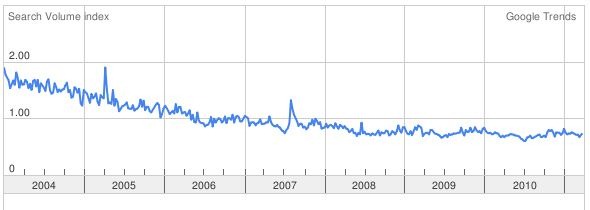
SF-trands

I then switched to Google Insights for the rest of the comparisons.

Warning, the totals given on the graphs are not always accurate – they vary with the cursor position on the time graph.  So ignore them.  Just look at the lines, or I’ll give you the averages from the Google page.
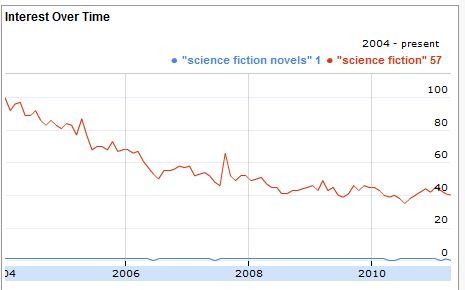
decline-of-science-fiction

Trying to understand what the numbered scale means is hard, but here is Google’s explanation,

The numbers on the graph reflect how many searches have been done for a particular term, relative to the total number of searches done on Google over time. They don’t represent absolute search volume numbers, because the data is normalized and presented on a scale from 0-100. Each point on the graph is divided by the highest point, or 100. When we don’t have enough data, 0 is shown. The numbers next to the search terms above the graph are summaries, or totals.

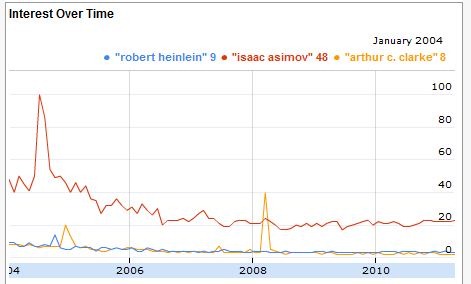
When I was growing up they talked about the big three of SF writers, Heinlein, Asimov and Clarke, so I did a graph of them.
big-three-SF-authors

Asimov is by far the more popular writer now, but all three writers show a decline in interest.  And why did Asimov have a spike in July 2004, and Clarke in March, 2008?

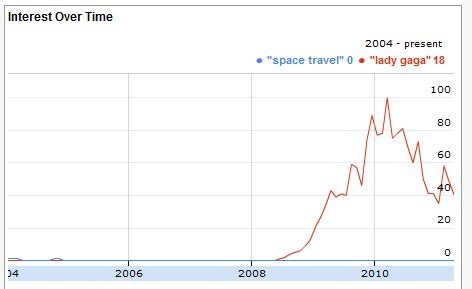
Because Google doesn’t give actual numbers it’s hard to gauge absolute interest, so I plotted “space travel” versus “Lady Gaga” and got a rather sad graph:
lady-gaga-space-travel

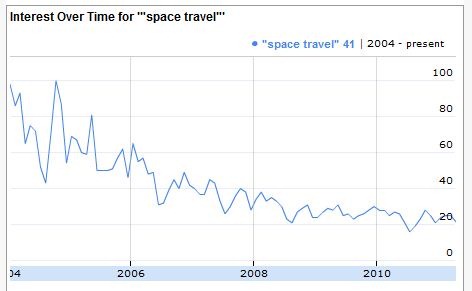
Space travel hits the 0 mark in comparison.  So I did space travel by itself and got this:
space-travel

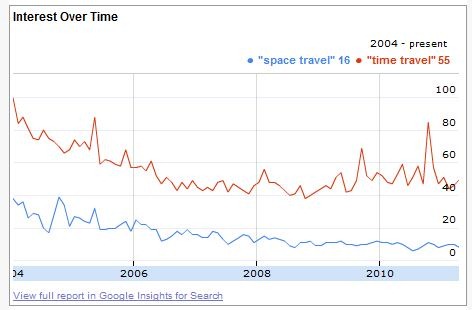
Interest in space travel is in sharp decline.  So I wondered how science compared to science fiction and created this chart:
time-travel-v-space-travel

Now I’m starting to doubt my methodology.  Why is time travel so much more popular than space travel?  Or is it a matter of how the phrases are used in popular culture.  I thought I try another comparison to test things.

science-fiction-v-nasa

Science fiction is 2 compared to NASA’s 19.  But notice, interest in NASA is in decline too.
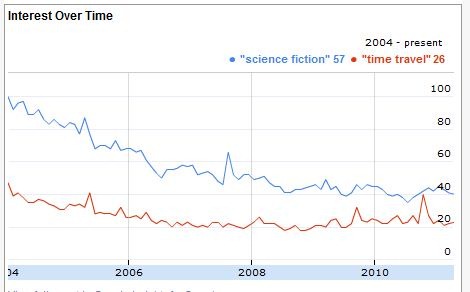
time-travel-v-sf

But science fiction is 57 compared to time travel’s 26.  Time travel is probably a common term that’s well used in popular culture outside of the field of science fiction, as is science fiction, but it’s hard to gauge phrase from genre.
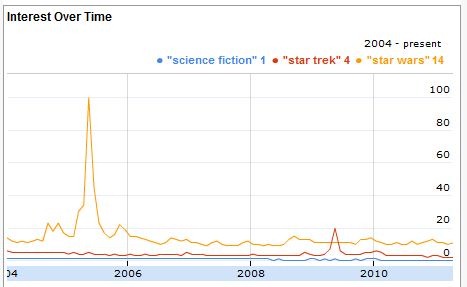
st-sw-sf

Star Wars is way more popular than Star Trek and both are more popular than science fiction.   Is that huge spike for Star Wars due to films or the discussion of the defense anti-missile program?

To get some real world perspective I did a comparison to iPods and iPhones.  On the Google page the totals were SF is 0 and the iPhone and iPods averaged 28 each.
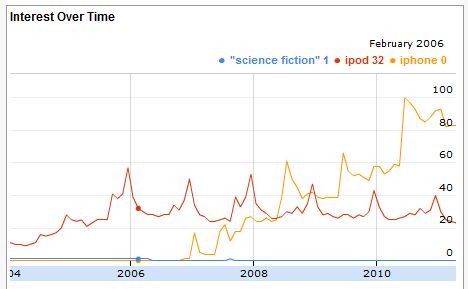
sf-ipod-iphone

Trying to zero in on the popularity of science fiction I tried:
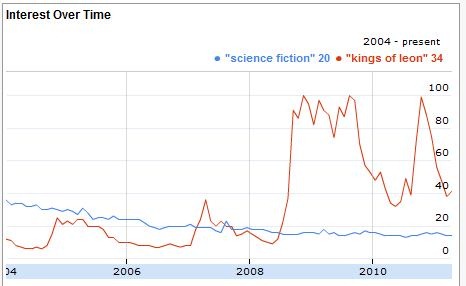
sf-kings-of-leon

So science fiction is about as popular as the Kings of Leon before they hit the big time – or at least on Google.

Finally, how does science fiction compare to other genres.
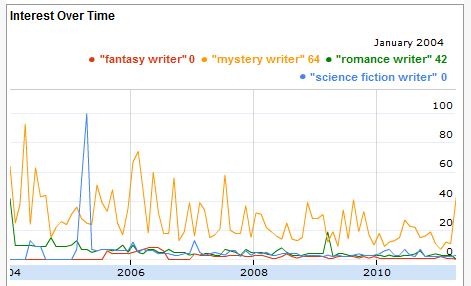
writers

On the web page fantasy and science fiction each get a 2, romance gets a 6, and mystery gets a 28.

Why is murder a more a interesting fictional topic than the future?  Go figure.

I don’t know if any of this means anything, but it is interesting to play with.  I linked to the two services at the top, so go test them yourself.

JWH – 4/9/11

Among Others by Jo Walton

My friend Carl first convinced me to read Among Others by Jo Walton with his blog review.  He loves Among Others so much that he’s immediately rereading it, this time aloud to his wife.  To further explain why the book is so important to him, he compares the story to the friends he’s made in the Classic Science Fiction Book Club in his post “A Karass.”  With that kind of personal impact how could I not immediately go buy a copy and read it – which is exactly what I did.

Jo Walton has written a creative fictionalized memoir about two troubled years in the life of Morweena Phelps, that may or may not be autobiographical with her own life.  Mori, as she wants to be known to her friends, loves libraries and reading, especially science fiction and fantasy, and uses books to stabilize her connection with reality, which strangely enough includes fairies and  magic.  Mori  is psychologically damaged by family tragedies and through making friends with other science fiction fans begins a healing process.  I can completely identify with Mori from my own teen years as a bookworm.  I had alcoholic parents that should have made me remember growing up as a miserable time, but I don’t.  I loved childhood because I used science fiction to create my own happiness and stability.

among-others-hc-final

I say it’s a fictionalized memoir because Among Others is written as a diary starting Wednesday 5th September 1979 and runs through Wednesday 20th February 1980, with a tantalizing glimpse from 1975 as an intro.  It feels like a real memoir except that in Mori’s world magic is real, or is it?  Morwenna Phelps, Walton’s alter ego, has the ability to use magic to influence people and talk to fairies.  Phelps, like Walton comes from Wales, but is forced to attend a boarding school in England.  The fictional story is about a young girl running away from her mother after her twin is killed and living with her estranged father.  Mori is a bookworm of the first order, and is pleasantly surprised to find that her father is a science fiction fan with a large library.  As an emotional outsider, Mori has trouble getting close to people until she meets a small group of science fiction fans that meet at a library near her posh boarding school.

Now, this is how I grew up, being an outcast until I met other SF fans, and how many science fiction fans also grew up.  Aren’t we all outcasts until we meet our others?  To make Among Others even more endearing to the science fiction and fantasy fan, Mori liberally references the books she and her friends are reading, and all too often I have read these books.  And I felt particularly close to her when refers to Empire Star by Samuel R. Delany several times as one of her favorites.  It’s a particular favorite of mine too.  Walton has a blog at Tor.com where she’s written over 500 posts, most of them reviewing SF/F books, including Empire Star.

I recommend reading Among Others if you are a science fiction fan, or are a hardcore bookworm, or if you grew up as an outsider.  And after you read Among Others, I recommend that you should follow Walton’s Live Journal blog where she talks about her writing, reactions to this book, and even gives sales information.  So far she’s sold 864 copies.   Walton also maintains a FAQ about Among Others, where visitors can post questions and comments.  This all makes for a wonderful meta-fiction quality to the story.  It’s sort of like the literary fun of finding the James Joyce in Stephen Dedalus.

Like Carl, I’m already ready to reread Among Others, but I’m hoping for an audio book edition.  Science fiction is often accused of being very unliterary, and Among Others is a literary look at science fiction and fantasy readers.  And for me the very best way to appreciate writing is by listening to it read by a great narrator.  I don’t know if Walton is successful enough yet to have her books to come out on audio, but the buzz this book is getting should help.  Audible, are you listening?

JWH – 2/13/11

Starman Jones, Then and Now

Memory is a peculiar attribute of consciousness.  Who we are, and what we know, is based on memory, but our memories are so damn faulty.  I first read Robert A. Heinlein’s Starman Jones back in the 8th grade, which was 1964-65, making me about twelve or thirteen.  That’s as good as my memory gets.  I wish I was one of those people like Isaac Asimov, who could say, on November 17th, 1964, a Tuesday, I was visiting my school library when I discovered a green book called Starman Jones – and it changed my life.  Well, I can’t.  I do know I discovered Red Planet first among the Heinlein juveniles, but I haven’t the slightest idea in what order I read the next eleven.  I doesn’t matter, but I wish I knew.  I think remembering all the details would have saved me from a life of absentminded existence.

I do have a few artifacts from the past that help verify my memory.  Below is a scan of a hardback copy I bought with my first paycheck of my first hourly job.  The book is signed by me 2/8/68.  I had gotten a job at the Winn-Dixie Kwik-Chek in Coconut Grove, Florida in November of 1967, when I turned 16.  I ordered all twelve Heinlein juvenile titles directly from the publishers and it took about six weeks to get them.  Next to my signature in this edition are three tick marks, meaning I had read it three times, but I stopped making those tick marks decades ago.

StarmanJones

I am sure I discovered Heinlein in the 8th grade because my 8th grade English teacher had put Heinlein on an approved reading list we could use for extra credit.  I had discovered a few classic science fiction books by then on my own, like H. G. Wells and Jules Verne, but I had not yet discovered the genre of science fiction.  I am 59 now and it’s extremely hard to imagine my 12 year-old self.  I’d give anything to have perfect memory of being 12 and reading this book for the first time.  I do know I was seriously into Heinlein by the Gemini space mission years and dreamed of growing up and becoming an astronaut.

I bring all this up because I recently listened to an audiobook edition of Starman Jones.  This is the second time I listened to the story, and I’m quite confident I read Starman Jones at least four times between 1964 and 1992.  For me, the book holds up extremely well.  And in the Classic Science Fiction book club I’m in, we’re reading it for our December selection.  Several people are reading it for the first time, and I get the impression they like it.  [Here’s Carl’s review.]  

Maybe Starman Jones will become a science fiction classic.  It’s among my Top 10 favorite Heinlein stories, and I consider it one of the Top 25 science fiction books of all time – but that’s my prejudice nostalgia talking.

Can I make an objective case why I think Starman Jones is a great science fiction novel?  Why does a book first published in 1953 for boys deserved to still be read by people of all ages in 2010?  Does it have qualities like Jane Austen’s Pride and Prejudice or Great Expectations by Charles Dickens that make them readable and loved so long after they were first published?  Austen and Dickens wrote two of the greatest love stories of all time, and I’m afraid Max and Ellie are no Pip and Estella.  Max Jones is more like Jim Hawkins in Treasure Island, a young man who gets to travel very far from home.

Starman Jones is for anyone who daydreams of exotic adventures.  Starman Jones is for readers who want to escape their mundane life and see the universe.  That’s the key, I didn’t say, “See the world.”   The quintessential science fiction novel is about going to the planets or the stars.  Max Jones is an Ozark farm boy in the future that has an eidetic memory and has memorized his Uncle’s astrogation manuals – the mathematics for navigating in space.  Many of the book club members got into science fiction because of seeing Star Wars when they were nine.  Luke Skywalker was also a farm boy that wanted to go into space, and he had his own special hidden talent too. 

I think those overlapping story aspects reveal qualities that go into great science fiction.

I wish I could remember what being Jimmy Harris was like in 1964 – because being Jim Harris of 2010 isn’t the same.  Back then I was naïve enough to believe I would actually go into space like Max.  Now, I can only read books and judge them for their ability to help me forget that I didn’t grow up to live the life of the romantic fiction of my youth.  Why has the Harry Potter books become so successful with young and old alike?  I think we all want to be 11 again, and live in a world where we can find Platform 9 3/4.  Kid readers don’t know that magic doesn’t exist – us old farts don’t care that it doesn’t.

Starman Jones has that quality that makes readers believe in the magic of space travel.  At 59 I know I would hate being an astronaut, so I’m not reading Starman Jones for the same reason I loved it as age 12.  But this revelation might point to why Pride and Prejudice and Great Expectations are great books in the same way.  When we’re young, reading those books make us  want to find love and romance in our real lives, but when we’re older, we read those books differently.  We know we’re too old for new love and romance, travel and adventure, except through books.  We understand why Dickens made up the story about Pip and Estella.  (Dickens wrote Great Expectations while he was an old man chasing a very young woman chaperoned by her mother.)

A great classic has to sell the future as a possibly reality to fuel our youthful dreams, but it is also has to satisfy us late in life as a substitute for waning love and adventure as a dying fantasy we embrace to fuel our wilting spirits.  I wish I could perfectly remember who I wanted to be when I was young, but then I wish my younger self could have experienced what I became – in other words, if I could have only known then what I know now.  If I did, would I have known when I first read Starman Jones what it would eventually mean to the 59 year old me?  Could a wise young me have thought, “This is the fantasy of my life.”

JWH – 12/7/10

Science Fiction Immortality

Everyone wants to live as long as they can, and that’s true of books too.  A writer sells a book to a publisher and they print up a bunch of copies.  As long as the book keeps selling they keep printing.  Most books never sell out their original print run and  go out of print.  Some books are popular enough that they stay in print – that’s a sign of a great book.

I’m in an online science fiction book club called Classic Science Fiction.  We have just voted on the 24 books we want to read in 2011 and I thought it would be interesting to see how many are in print, and whether or not they have an ebook edition available, or even an audio edition.  Real classics should be available in all formats.

As a rule, if a book isn’t easily available, it doesn’t get read by many members in the book club.  Some members won’t read the book unless they already own it, can find a cheap copy at a local used bookstore or get it from the library.  Used bookstores and libraries are very important for keeping a book alive.  I’m hoping ebooks will catch on as a new form of literary life extension.

The prices I used below are from Amazon, and I used the cheapest edition in each category.   As can quickly be seen, some books are out of print in all formats, not a good sign.  The book title is linked to the Internet Science Fiction Database to reveal it’s publication history.  Finally, I decided to see if the book is at my public library.  It’s wonderful to think that libraries are Heaven for books, where they never die and will be protected and preserved for all time.  Sadly, that’s not true.  Modern public libraries routinely purge uncirculated titles.

Title Print Ebook Audio Library
Midnight at the Well of Souls
Jack Chalker
Yes
Monument
Lloyd Biggle, Jr
$15.00 Yes
Brain Wave
Poul Anderson
$3.99
Rite of Passage
Alexei Panshin
$12.74 $4.79 Yes
Restoree
Anne McCaffrey
$7.99 $6.29 Yes
The Mote in God’s Eye
Niven and Pournelle
$7.99 $17.24 Yes
The Cosmic Puppets
Philip K. Dick
$11.07
Earthlight
Arthur C. Clarke
Yes
The Man Who Folded Himself
David Gerrold
$11.86
Tau Zero
Poul Anderson
$3.99 Yes
Galactic Patrol
E.E. Smith
$14.17 Yes
Empire Star
Samuel R. Delany
$10.20 Yes
Earth
David Brin
$7.99 $6.29 Yes
Flashforward
Robert J. Sawyer
$7.79 $7.99 $15.73 Yes
Brasyl
Ian McDonald
$12.46 $9.99
Beggars in Spain
Nancy Kress
$11.16 $9.99 $9.44 Yes
Primary Inversion
Catherine Asaro
$13.99 Free $14.68 Yes
Risen Empire
Scott Westerfield
$10.17
Calculating God
Robert J. Sawyer
$5.98 $9.99 $18.71 Yes
The Life of Pi
Yann Martel
$8.30 $7.78 $19.40 Yes
The Barsoom Project
Niven and Barnes
$10.87 $9.99 Yes
Replay
Ken Grimwood
$10.97 $18.99
Spin
Robert Charles Wilson
$7.99 $7.99 $30.95
On Basilisk Station
David Weber
$7.99 Free $18.71 Yes

JWH – 11/27/10

The Other Side of the Future

If you live long enough you can get to the other side of the future.  In the 1960s I consumed massive amounts of science fiction and quite a bit of it was set in years that have already past.  I have lived through a lot of futures.  1984 was just another year in life, and so was 1999, 2000, and 2001.  One of my favorite novels growing up was The Door Into Summer by Robert A. Heinlein, which was written in 1956, that I read in 1965, about a man in 1970 taking the cold sleep and waking up in 2001, and who eventually time travels back to 1970.  Even in 1965 the year 1970 was so full of futuristic possibilities.

Of course its 2010 now, and that novel is way in the past, from so many perspectives.

suenos-diurnos

I’m in an online science fiction book club called Classic Science Fiction where a bunch of members are like me, who came of age reading science in the 1950s and 1960s.  We’re reading the great science fiction stories of our youth from the other side of the future, and it’s a whole different vista than we saw from that distant shore of the past.  Now it’s not like we don’t have a lot of future still to outlive, especially when you think we might live another 40-50 years, the amount of time we’re looking back over.  But we have lived long enough to live past many speculative fictional years.

Let’s just say that the future is everything I never imagined.  I’m sitting here typing on a computer that’s linked to the world wide web while listening to Katy Perry sing “Teenage Dream” over digital streaming, from a library of over 10 million songs that I have access online.  Didn’t see that one coming back in 1965 when I was mowing lawns to buy the latest Byrds’ album to play while reading Robert A. Heinlein’s Have Space Suit-Will Travel.

The thing is, back in 1965 I thought I knew the future because I was reading so many science fictional roadmaps.  I was youthfully confident that by 2001 we’d have a colony on the Moon, and we’d have hundreds of men and women roving all over Mars, and there would be manned spaceships heading out to Titan and Ganymede.  Quite a few of us old fart guys and gals at Classic Science Fiction are crying in our beer over that lost future.  How could Heinlein/Clarke/Asimov have been so wrong?  Of course we’re haven’t reached Clifford Simak’s future of City either, but I still wonder about that one.

ValigurskyCitySimak

In 1964 Arno Penzias and Robert Wilson discovered the cosmic background radiation while I was discovering 1940s and 1950s astronomy in musty old books in the Miami Public Library.  I never imagined anything like the Hubble Space Telescope, or all the magnificent robotic explorers that have flown across the solar system in our lifetime.  And who imagined a future with only eight planets?  Isn’t that a step backwards?  On the other hand, just rent The Universe from Netflix and watch several seasons.  What we’ve learned about cosmology is mind blowing, far beyond the wildest imaginations of legions of science fiction writers.

Back in the sixties our parents told us to clean our dinner plates because it was horrible to let food go to waste when people were starving in China, but now China is about to eat our lunches racing to new far out futures.  Did any SF writer see that change coming?  Did anyone foresee America retiring from manned exploration of space?  Or that maybe the Chinese might do what we once dreamed.

One of the strangest things for me living on the other side of the future are the deaths of Heinlein/Clarke/Asimov.  In the book club we’re mostly partial to books from the 1950s and 1960s and we feel science fiction itself has changed.  In that old back to the future world, science fiction was about conquering reality, but now it’s either about escaping from reality, or dark stories about how reality is going to conquer us.  Science has discovered a universe far vaster and more slower to travel than we ever imagined.

Nostalgia seems to be the order of the day for us old folks at Classic Science Fiction.  We read and reread the good old days of science fiction.  Political and scientific realities make us dream of simpler days of rocket ships and ray guns.  Do we return to the classics of science fiction like opium addicted dreamers giving up on reality?  Do we cherish the dreams of youth more than reality on the other side of the future?

JWH – 11/15/10