SETI: What Can Aliens Tell Us That We Don’t Know?

First off, decoding any messages from the stars will be difficult.  Just think about what aliens would have to figure out if they received Morse Code from us?  First, there’s the code, and then there’s the language behind the code.  Any kind of pattern recognition program would figure out the code quickly enough, and even discover the alphabet behind the code, but then what?  They might number our alphabet 1-26.  So they end up with a word like 7-18-5-5-14.   Of course, they don’t know that A=1, so the sequence 7-18-5-5-14 could be 26 different words if they knew the order of our alphabet without the starting point, and a whole lot more if they don’t the order at all.  But isn’t alphabetical order even an illusion for us?  Words are far more than letters.  Writing itself is a code, and language is hardwired in our brains.  Could we ever communicate with a differently evolved life form?

Would it be any easier if they got a radio signal with our voices without any kind of coding?  If they heard us say “green” would that be any use to them?  Okay, let’s go to video and have someone point to a color chart and say green.  Now we’re getting somewhere, we need video to have a visual Rosetta Stone.

Now imagine we get TV from the stars, what can aliens tell us that we don’t know?

Religion

Unless our bug eyed friends tell us about a God that’s just like one of ours, we’re going to think anything they say about religion to be just another one.  But what if they smugly inform us they rejected religion 100,000 years ago?  Or they draw a complete blank when we ask about their gods?  After thousands of years, we’re discovering that religion is make-believe, so any religion we hear about from the stars will probably be just as make believed.  But what if they try to convert us to some big-ass wild and wooly story about a creator that looks like living 1955 Buick?

If you want to read about alien religions there’s plenty you can hear about from anthropologists.  But if birdmen from Arcturus  emphatically state that metaphysical realms don’t exist, and neither do metaphysical beings, will the people of Earth believe them?

Ultimately, there are only so many outcomes to expect in this area, here are a quick handful of replies we might get over our SETI TV.

  • There is no God
  • There is a God, but our God is better than your God
  • Our God is much like your God
  • Our God says you should serve us or be destroyed
  • Hello God, you finally answered our call
  • Who do you think you’re talking to, we are God
  • What the heck are you guys talking about, we don’t comprehend

Philosophy

Like religion, philosophy is on the decline in our world, so why would we value the works of an alien Plato?  Would we embrace highly developed alien works of rhetoric, logic and ethics?  Wouldn’t it be bizarre if our new friends have a philosophical tradition that went through similar phases as our philosophers?

What if our new alien buddies give us something to think about that we’ve never thought about before?  Is that even possible?  What if their philosophy only works in the context of their biological framework and environment?  Has anything imagined on Star Trek for alien ways of thinking ever been new?  Earth people have thought of some crazy shit over the centuries.

And how many philosophical practices and disciplines do you follow now?  How often do you read Northrup Frye, Michel Foucault or Ludwig Wittgenstein?  Compared to what you know now, to what you could know if you studied, you could make many quantum leaps in your knowledge without SETI.

Mathematics

This is one area that scientists expect us to be in full agreement.  Will we become depressed if we find all the answers to the mathematical puzzles we hoped to solve ourselves for the next thousand years on an interstellar web site?  What if they give us the answer to the grand unified theory of the universe, and we can’t understand it, ever!

Again, is any BEM math we could get from SETI any less far out than all the math you ignore now?

Science

Shouldn’t their science just correlate our science and vice versa?  The whole idea of science is it should be reproducible anywhere.  To the average citizen of the Earth that pays no attention to science now, will it matter that our science will be validated by alien science?

If our new friends have been around millions of years longer than we have,  should we expect them to have science that makes us feel like dinosaurs?

Technology

Alien technology is what we want.  Movies like Contact (1997) and This Island Earth (1955) imagine getting a signal from another star with blueprints that tell us how to build super-science gadgets that will help us travel to the stars.  Would our far away friends trade the specs for a spaceship for the design for the iPad?  We want the tech to hotrod it out of the solar system.  Will we be disappointed if we don’t get it, either because it doesn’t exist or because their Federation bars them from giving it to us?

Art

Will the creatures from afar care about Monet or Breaking Bad?  Will they want to groove to Lady Gaga and Arcade Fire?  Will we want to read their version of Anna Karenina?  How many Japanese pop hits do you play while reading Vietnamese novels?

Does it Matter?

I think it will matter greatly when we discover we’re not alone in this universe, but beyond that, I tend to think we concentrate on very immediate surroundings and ignore the far away, so will stuff that’s very far away really matter that much?  Most Americans pay little attention to illegal aliens from Mexico, so why care about creatures from Epsilon Eridani?  Think about it, we have excellent science for global warming and evolution but most Americans reject those ideas for some stories they heard as kids at Sunday school.

Our world is full of alien concepts we’ve never explored, far out science and math we’ve never learned, mind blowing technology that’s beyond our current comprehension.  What do we do with this cornucopia of knowledge now?  Yeah, I thought so.  We spend most of our time figuring out how to rub genitals or some other physical impulse programmed into our DNA, so do we really expect to be uplifted by video from the stars by super beings?

Science Fiction

And if we do find SETI pen pals, what will they make of our science fiction?  Our dreams are so much bigger than our beings.  If intelligent life on nearby planets pick up this video on their SETI dishes, what will they think?  What if they don’t know it’s fiction.  What if the SETI signals we receive are their science fiction?

What if the most exciting stuff we get from the stars will be alien Sci-Fi?

JWH – 4/10/12

Losing My Faith in Space Travel

Science fiction promised children growing up in the 1950s something different than what it does to our children today.  The innocent expectations of tomorrow culminated in the 1964 World’s Fair which seemed all about the future and the promise of space travel?  Was there ever another time in history where kids truly believed they would walk on the Moon or Mars when they grew up?  Between 1961 and 1972 NASA always went further and faster with Mercury, Gemini and Apollo space programs.  For the forty years since 1972 we’ve been retracing old orbital paths below those reached in Project Gemini in 1965.  Now, the U.S. can’t even launch men and women into orbit.  When did the final frontier fizzle out?  I’m sure the budget bean counters know.

It’s not like we don’t have the technology to travel to the planets, we just don’t have the desire, or at least the desire to spend the money.

Like religion, science fiction promised true believers life in the heavens.  As long as NASA kept rocketing to new heights it was easy to believe the faith of space travel.  Like religion, space travel has failed to answer the prayers of its devoted – nobody leaves Earth.  Could it be that humans are meant to stay on Earth?  Forever?

What if it becomes obvious we’re not going to the planets and stars, and humans must live for thousands, if not millions of year here on planet Earth?  How does that change science fiction and the faith in the final frontier?  What if we come to realize that travel in space isn’t practical or even desirable?  What if we come to realize that alien spaceships will never visit us either?  That gulf between the stars is too vast for travel by biological creatures.  Robots might go, but not us.  How will that change our faith in science fiction?

We won’t know our limits in space until we hit them.  So far, we’ve only hit the money barrier!

I always believed science fiction was the sacred writing of the space travel faithful, but again like other belief systems, tenets of the faithful change.  If humans aren’t meant to travel to the stars, what is our destiny?  Science fiction, instead of selling space travel, promotes turning inward with artificial intelligence, cybernetic worlds, brain downloading, biological immortality, and other fabulous speculation about living on Earth.   I can accept the confinement if there are real limitations to humans traveling in space, but I’d sure hate it if we’ve just reached the limits of our vision.

Oh sure, there are still true believers who can’t give up the idea there’s a world just 35 million miles away that’s ripe for terraforming.  They keep preaching their gospel hoping to convert enough believers to make their visions come true, but their creed dwindles.

Yes, there is another time when kids grow up thinking they will walk on the Moon and Mars.  It’s now, and those kids live in China.  Do they dream my old 1950s dreams?  Will their dreams come true this time for all us humans?

This is what we get for cutting taxes.

A small government leads to smaller dreams.

China will get bigger with bigger dreams, while we grow small, clutching our tax dollars.

Thank you, Republicans.

New_York_Worlds_Fair_1964

JWH – 4/9/12

How Famous is Robert A. Heinlein Outside the Science Fiction Genre?

At the peak of his career, Robert A. Heinlein was the most famous and influential science fiction writer within the genre, but how famous was he ever outside of the community of written science fiction?  There are legions of science fiction fans and writers who tell stories about how Heinlein influenced their reading and writing lives.  Yet, how influential is Robert A. Heinlein as a 20th century writer?  How famous is Robert A. Heinlein in the at large pop culture world outside of the tiny ghetto of science fiction?  As a life-long fan of Robert A. Heinlein, I’d like to know just how important my literary father figure is to everyone else.

Recently the Science Discovery channel ran a series The Prophets of Science Fiction, and episode 7 featured Robert A. Heinlein.  Before I saw this episode I thought “Wow, Heinlein is finally going to get the recognition he deserves!”  After I watched the show I felt, “WTF!”  If that’s the best that can be said about Robert A. Heinlein then the poor guy really is dead and buried, both physically and literarily.  The show was so murky in its focus that it neither described Heinlein’s life nor his work.  Sure, Heinlein is a hard guy to pin down, but he deserved better than that.

What else does the public know about Heinlein?  Last year, volume one of a serious biography came out, Robert A. Heinlein: In Dialogue with His Century by William H. Patterson, Jr., which I reviewed here.   It got a mere 32 customer reviews at Amazon, and it’s current sales rank is #360,570.  I’d really love to know how many copies were sold in total, but I don’t know if it would be polite to ask the author that question.  However, the CATO Institute presented William H. Patterson, Jr. in a hour talk about the book that’s on YouTube.  So far it’s gotten 2,353 viewers.  There are several videos on YouTube about Heinlein, and there seems to be little interest in them.  The Patterson talk is very worthy of watching, at least to us Heinlein fans, but why is no one else interested in Heinlein?

This begs the question:  How important is written science fiction to the world?  Sure, we know movie goers love science fiction and it makes billions for Hollywood, but let’s focus on written science fiction.  As a literary form, how worthy is science fiction?  The Science Discovery show, The Prophets of Science Fiction, gives the world the absolutely wrong idea about science fiction.  Prophecy is a bogus concept, whether in religion, history, science or science fiction.  The future is unknowable, period.  Science fiction writers aren’t prophets, and to call them that is insulting.  Sometimes they can be accidently prophetic, but that’s all.

I’ve always believed that science fiction was a serious tool to speculate about the future, but it’s been corrupted and hijacked by the entertainment business for creating thrill rides.  I think Heinlein took his job speculating about the future very seriously, but I’m afraid the world at large never saw that.  David Boaz, who introduces Patterson in the above video tells us a quote from Heinlein in his introduction.  He says that Heinlein left a 3×5 card in a safety deposit box to be read after his death.  The handwritten note said if people name three of his books as their favorites, Stranger in a Strange Land, Starship Troopers and The Moon is a Harsh Mistress, then they have grokked him.  He said all three books are on one subject, freedom and responsibility.

Is that the legacy Heinlein wants?  That he had something important to say about freedom and responsibility?  And what does he say about those subjects?  I’ve read all three of those books at least four times each, and yet I could not summarize them in that way.  I’m not sure I’ve ever read an essay about Heinlein that saw those books in that way either.  And those aren’t even my favorite Heinlein books.

Starship Troopers (1959), Stranger in a Strange Land (1961) and A Moon is a Harsh Mistress (1965) have become Heinlein’s most famous books.  It really helps that Starship Troopers was made into a movie because a film adaptation is one of the few validations that the world at large uses to remember a writer.  In The Greatest Science Fiction Novels of the 20th Century, my most popular blog essay (50k hits), I show how very few science fiction genre novels are remembered by the public at large, and that Stranger in a Strange Land is Heinlein’s most famous book with people outside of the science fiction genre.

I also wrote “What Was Heinlein’s Most Loved Story” based on stats from the Internet.  Troopers, Stranger and Mistress are the top three.  Another form of validation is how many books are on audio, and Heinlein does very well here.  I wrote “Heinlein on Audio” and have tried to maintain the list.  Heinlein is getting very close to having all his books in print as audio books.  Of course, this only proves he’s still a popular writer with his old fans.

Another clue to Heinlein’s popularity is the book, The Top Ten, edited by J. Peder Zane.  Zane asked 125 writers to list their top ten favorite books.  Heinlein gets one vote, or 4 points, for Stranger in a Strange Land by David Foster WallaceDune by Frank Herbert also got one vote, but only earned 2 points by Zane’s system.  The Top Ten shows that the literary world doesn’t think much of science fiction.

Even within my own system of ranking science fiction, “The Classics of Science Fiction,” Heinlein doesn’t score high – but I’ve always thought that was because he had too many popular books competing with each other.  My list includes the above three famous titles plus Double Star and The Past Through TomorrowThe Sci-Fi Lists Top 100 Sci-Fi Books also validates Heinlein is still popular with science fiction fans, and Troopers, Stranger and Mistress are the favorites.

But the more modern site, SFFMeta shows Heinlein falling from memory.  Their All-Time High Scores shows Heinlein is pretty much forgotten, but that’s how their system works.

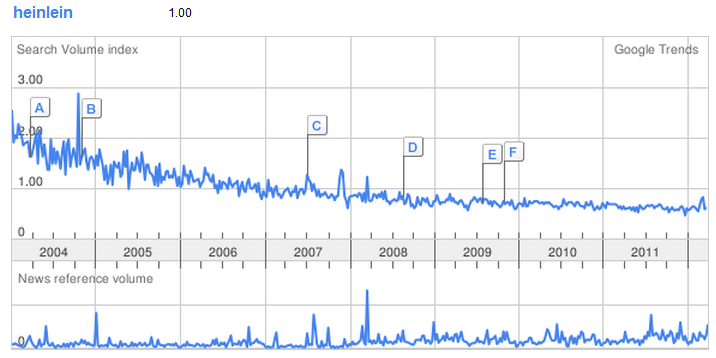
A Google search on “Robert A. Heinlein” only returns 759,000 hits.  I’ve only got my memory to go on, but I think Heinlein used to get in the millions.  Here’s the Google Trends graph for Heinlein.

heinlein-google-trends

I think I need to accept that my literary hero is declining in popularity, that his most famous books were his favorites and the ones Heinlein wanted to be remembered for, but not the ones I wanted remembered.  Here are my favorites and the ones I actually think say way more about science fiction than Heinlein’s own favorites:

  • Have Space Suit-Will Travel
  • Tunnel in the Sky
  • Time for the Stars
  • The Rolling Stones
  • Farmer in the Sky
  • Starman Jones
  • The Star Beast
  • The Door Into Summer
  • Citizen of the Galaxy

Essentially, those are his young adult books.

Now here’s the thing.  Is Heinlein being remembered for his ideas, or his stories?  The three books Heinlein states he wants to be remembered for and why, suggests he wanted to be remembered for what he had to say.  Wrong answer Bob.  Ideas are a dime a dozen, and they do poorly with the test of time.  Novelists are remembered for their stories and characters.  Sadly, Heinlein never wrote an Anna Karenina, the most popular novel in The Top Ten list, or even something as memorable as The Sun Also Rises, nor anything like Nineteen Eighty-Four, Brave New World, Fahrenheit 451, Slaughterhouse Five, Dune, or Earth Abides, books using science fiction techniques that the literary world does remember.  Stranger in a Strange Land and Starship Troopers are his best competitors and I’m not sure if they have real lasting power.

The above Heinlein novels I list as my personal favorites are books I love because I bonded with them in adolescence, but I know they can’t compete with the standard classics.

Heinlein deserves more of a literary reputation than was seen in his episode of The Prophets of Science Fiction.  I’d like to think he’ll at least attain the status of Edgar Rice Burroughs, H. Rider Haggard or Robert Louis Stevenson have today, but in the world at large one hundred years from now.  However, he will be defined by the genre of science fiction, and I think that’s where the show The Prophets of Science Fiction failed miserable – they couldn’t define the scope, value and purpose of literary science fiction.  Science fiction has always been a vague term and its getting vaguer.

I had always hoped Heinlein would be remembered as the American Jules Verne and H. G. Wells of the 20th century.  In 100-150 years from now, Heinlein might be remembered like the book, Frank Reade: Adventures in the Age of Invention, because I’d like to think Heinlein’s juveniles helped inspire a generation that wanted to make space travel the final frontier.

I associate Heinlein with 1950s science fiction, but I think that generation is fading now.  I’m afraid the public now thinks of science fiction not in association with space travel, but movies and toys, like “Twenty Things Every Sci-Fi Nerd Should Own Physically and Emotionally,” – as  geeky fantasies of obsessed fans.

William H. Patterson claims Heinlein’s legacy will be:

And even among this select group of writers-cum-culture-figures, Heinlein is unique.  He galvanized not one, but four social movements of his century:  science fiction, and its stepchild, the policy think tank, the counterculture, the libertarian movement, and the commercial space movement.

I totally disagree that science fiction influenced the development of the think tank. Historians of science fiction will give Heinlein a lot of credit for influencing 20th century science fiction, but claiming anything else science fiction maybe have inspired is very hard. Heinlein hated the counter culture and I don’t think he’d want credit for any accidental influence on hippies. I’m pretty sure inventors in the commercial space movement loved Heinlein’s books and might even say their careers were inspired by him, but I don’t know how much credit Heinlein can take for their success. Heinlein was a writer and his legacy must be literary.

If science fiction has a serious purpose other than escapist entertainment, it has yet to be acknowledged. I believe science fiction can be a cognitive tool like philosophy for examining reality that is separate from both science and literature. Science is the premier tool for exploring reality but it has limitations. Science fiction, using what-if and extrapolation can anticipate what science has yet to discover. Unfortunately, science fiction has been corrupted by the fantasy of desired miracles, just like religion. Too many people want more from reality than exists in reality.

Science fiction really needs to be carefully defined to be considered a cognitive tool or true art form.  Right now it’s just a catch all term.  How can we say someone is a great science fiction writer when we can’t define science fiction?  Heinlein said he wanted to be remembered for writing about freedom and responsibility, and that’s not even science fictional.  The makers of The Prophets of Science Fiction want people to believe science fiction is about prophecy, but that’s bullshit.  We really need to define science fiction so we can judge if writers hit the target.

The Hunger Games trilogy is immensely popular book right now and I believe it is science fiction.  Suzanne Collins is not trying to predict the future, or even warn us against a possible future.  “Suzanne Collins” returns 56,400,000 results from a Google search.  Orson Scot Card, probably the most popular writer within the genre, returns 3,800,000, and remember, Heinlein only got 759,000 hits.  I guess that makes Suzanne Collins the new Dean of Science Fiction.  What is she saying about freedom and responsibility?  What is she saying about science fiction?

When the baby boomer science fiction fans die off, I’m afraid interest in reading Robert A. Heinlein will disappear.  The only thing that could revive his literary reputation for the younger generations is if Hollywood makes several movies based on his novels.

By the way, Lady Gaga gets 602,000,000 results from Google.  In comparison “science fiction” only gets 233,000,000 hits.  If I could filter out interest in movies and television shows that number would be tiny.  Why is the literary world of science fiction so ignored?

JWH – 3/31/12

What is the Kindle Doing to the Science Fiction Genre?

Here is the Kindle Best Sellers in Science Fiction showing two lists, Top 100 Paid and Top 100 Free.

The #1 book on the paid list is A Dance with Dragons by George R. R. Martin.  Okay, that’s natural, it tops other bestseller lists too.

#2 is five John Carter novels bundled together for 99 cents.  I can see that, the movie is getting people to read the old ERB books.

#3 is Ender’s Game – another natural, but it’s old.  I guess people with a new reading gadget are rereading their old favorites.  Cool.

#4 is Wool Omnibus by Hugh Howey.  WTF?  Who is Hugh Howey?  And he’s got 277 customer reviews!  In fact, Hugh Howey has several Kindle books in the Top 100 paid.  How did this unknown writer get in the Top 100 Kindle SF books?

Going down this Kindle Top 100 list for Science Fiction I realize that unknown authors are grabbing many positions on both the paid and free Top 100 lists.  There’s a smattering of old time favorite SF writers, Heinlein has two titles, Asimov, one, and a few modern SF writers of note like Dan Simmons and Orson Scott Card have a few more, but for the most part the these best sellers are books I haven’t heard of before, by authors unknown to me.

Is the Kindle changing the reading habits of science fiction readers?  And other genres as well?

My favorite science fiction writer is Robert A. Heinlein, but then I’m 60 and my reading tastes are as old as I am.  When I started reading science fiction in the 1960s Heinlein-Clarke-Asimov were the big three of the genre.  Most of the SF authors I’ve discovered in the last 50 years don’t have books on this list.   Why?  Are they out of fashion, or has Kindle reading habits changed things dramatically?

How are low cost and free Kindle books going to affect professional writers?  Also, notice the name of the publishers of these books – they are unknown to me, so I have to wonder if they aren’t self-published.

Supposedly, Kindle books are outselling all other forms of books, so is this what people are really reading in the SF genre today?

Many of Heinlein’s books are available for the Kindle, but only two are in the Top 100, and one of those is there because Amazon put it on sale last month.  There are many Kurt Vonnegut books in the Top 100 Paid listing, but again, they are on sale this month.  Amazon uses the technique of lowering the price of a book for a few days to get attention and then upping the price.  New, unknown writers, are using the same technique with their self-published books, and evidently its working very well.  Better than book reviews, better than word of mouth reviews.  Establish writers are now using that trick too.  That trick only works with Kindle ebooks.  It would be interesting to see if it worked with printed books.

If you look at Locus Bestsellers for March 2012, many of their books aren’t on the Kindle bestseller list.  If you look at Amazon’s Best Sellers in Science Fiction general list that includes printed books and Kindle books, the makeup of this list is different, but the Kindle books are having a huge impact.  Here is the Science Fiction Book Club Top 100 Bestsellers.  Notice how it’s dominated by series, media tie-ins and non-science fiction titles.   The SFBC has little science fiction.  Not so for the Kindle list.  Evidently would-be writers are very anxious to write science fiction and readers are finding it on Amazon to consume in mass quantities on their Kindles.

There’s more new science fiction, and dare I say, more exciting sounding science fiction by the unknown authors at the Kindle store.  Big publishers push blockbusters and name authors, and media related books, so the unknown writer doesn’t have much of a chance, but that’s not true in the wild west gold rush of self-published ebooks.  Something is happening here, and we don’t know what it is.

The press has been full of stories for the last two years about how ebooks are impacting traditional publishing, but I don’t think they imagined the paradigm change that self-publishing is making on bookselling.  Self-published ebooks are becoming the  universal slush pile for all readers to work through to find that gem they want to make a success.  Discovering a new author and promoting her can become a new form of social networking.

Think about that.  In the old days assistant editors would cull the slush pile for worthy books to show editors.  Getting a book published was a long slow process that winnowed out the bad.  Now Amazon has made free ebooks the slush pile anybody can read.  If it gets a lot of downloads they put a price on it, if it sells, they promote it.  If it keeps selling, they publish paper copies.  If it keeps selling, a big name publisher will grab up the author.

But do we really want to be slush pile readers?  I’m old, and have little time, so I usually go with the definitive classic now, but young people with lots of time seem to have no problem trying an unknown writer.  Those people are pushing Hugh Howey forward.

I’ve thought science fiction has lost most of its vitality in recent years.  Writers have become obsessed with series, trying to build their book sales by pushing a popular character.  That’s comfortable for some readers, but I liked when science fiction writers were always trying to top each other with far out ideas.  I don’t know if the self-publishing revolution will bring back those days, but maybe.

Finally, does it mean if you don’t own a Kindle you’ll be out of touch with the popular reading reality?  Yes!

SF Signal is a good site to keep up with free SF.  They feature almost a daily roundup of free science fiction.  Today Chasing Vegas by Tad Vezner caught my attention.  The customer reviews at Amazon are very encouraging and it has a great cover.  The old saying is you can’t judge a book by its cover, but I don’t know if that’s completely true.  It seems to me, the best of the self-published books have nice covers.  I don’t know if that’s a real indicator or not.  But in this new paradigm of reading from the slush pile I’m not willing to try just any book.  I look for customer reviews and a good cover.  I hope self publishing authors will do two things.  Hire an editor and buy a cover.

JWH – 3/24/12

Science Fiction’s New Future

Back in the 1950s and 1960s classic science fiction promised a future of space travel, with Star Trek epitomizing our hopes. That future has been revised constantly for us Baby Boomers so what does contemporary science fiction promise the youth of today? Will it be The Windup Girl, The Hunger Games or Ready Player One? Is the Final Frontier off the table? The fact that the United States continues to ignore global warming does not bode well for science fictional speculation. Since we refused to solve our problems we must live with the results.

In Ready Player One people are happy to live in a virtual reality that lets them escape the bleak actual reality.  The United States at mid-21st century is still in today’s recession.  In The Hunger Games, the 22nd century U.S. has collapsed and a new government has formed that’s nothing like what we have today.  In The Windup Girl corporations are even more powerful and the negative effects of technology even more pervasive.  If you combined the speculation in The Windup Girl with Ready Player One they have probably foreseen a future closer to what will happen than what Heinlein/Clarke/Asimov imagined.

There’s little reason to picture the super-science futures of modern space opera happening at all, and at least not any time soon.  By soon, I mean before the year 3000.  And what about what Robert J. Sawyer imagined for us in his WWW Trilogy?  How close is IBM’s Watson to Webmind?

I grew up believing the future would be what Heinlein/Clarke/Asimov showed us.  How do teens see the future today?  A generation ago kids imprinted on Star Wars, but is their faith still firm in that galactic empire fantasy?  Not if they are paying attention to reality.  Ignoring global warming offers plenty of addictive delusions, but really, what science fiction do today’s teens read to see their future in 50 years?  That would be a great topic for a SF Signal Mind Meld.  Is it dark or bright?

Fifty years ago I was ten and all excited about the Mercury program, waiting for Gemini and Apollo.  My early teen years were filled with science fiction books and The Jetsons, Lost in Space and Star Trek on TV.  The future was so bright we had to wear mirrored shades.  As a high school kid I was absolutely positive I’d be watching men and women walking on Mars by 1980 – instead I got MTV and an Atari 400.

Do today’s kids see the future through rose colored glasses?  Do they realize the 1% has already stolen their future by refusing to allow America to work on the problem of global warming, guaranteeing a life like The Windup Girl?  The effects of global warming won’t end our world, but it will but the kibosh on Star Trek and Star Wars space age dreams.

JWH – 1/15/12