Occupy Wall Street v. The Tea Party

Occupy Wall Street protests have the reputation of being about diffused public anger with no real political agenda.  The Tea Party has always been rigidly focused on anti-taxes but defines itself around the Contract from America platform that its followers stick closely to in their political campaigning.  From their start in 2009 the Tea Party quickly organized into a grass roots federation of citizens that got many people elected around the country and in congress.  But the Tea Party isn’t 100% a single structure either, with several web sites using the Tea Party name and each having slightly different platforms.

If the Occupy Wall Street movement wants political success they too will need to organize across the country into a political movement.  First off, they need a better name, and second they need a political platform that will counter challenge the conservatives and define their movement.  And they need to coop the Democratic party like the Tea Party has taken over the Republican party.  Third parties just don’t work, unless they think Americans are ready for a complete change.  But looking at list of American political parties and their history makes this doubtful.

The phrase “occupy Wall Street” just doesn’t ring true for a long term political party moniker.  I’m not sure what these young new protestors want, but they sound like an Egalitarian Party because of their identity with the 99%.  Since the Occupy Wall Street protests quickly found sympathy with people in other countries they would do well to make it a world-wide movement.  The old phrase, Think Globally, Act Locally applies well to them because of their environmental demands.

In a world of global communications, global economy, global environment, why not a global political movement?  However, if they don’t stay focused on the critical issues they will bog down and divide their followers.  If you look at the various political platforms on the Tea Party sites you  see how they’ve broaden their anti-tax focus to other issues – for example look at the Non-negotiable 15 Core Beliefs at the TeaParty.org site that deal with guns, English and family values.

The Tea Party advocates a small government movement where individuals are expected to pull their own weight.  The Occupy Wall Street movement advocates economic fairness for all in a society that favors the rich.  Both are about money.  The Tea Party people want more money for their economic freedom by paying less taxes at the local, state and federal levels – thus the emphasis for a small government.  The Occupy Wall Street movement is about protecting the individual rather than the bottom line, and that means social engineering, big government and more taxes.  There is a direct conflict of goals.

Our society is politically polarized and getting more polarized all the time.  I fear this process is only going to get nastier.  The 2012 election will probably be a lot like the one in 1968.

JWH – 10/18/11

Occupy Wall Street–Is This Our Future?

In the 1960s the anti-war protestors would shout, “The Whole World is Watching!”  With the Occupy Wall Street movement, that is true again, but with even more eyes.  The internet is a game changer for social protest movements.  Here in the west we rejoiced at the Arab Spring, but how are our politicians really feeling about our own uprisings?  Most are giving polite sympathetic words, but what if this anti-establishment movement takes off?  What does Washington really think when they hear anti-government movements from both the right and left?

The best reportage I’ve found on Occupy Wall street is at Wikipedia.  They also provide this very informative graphic on the rate of news reports for the Tea Party and Occupy Wall Street.

File:Occupy-wall-st-vs-tea-party.png

My guess as to why there were so few news reports on Occupy Wall Street at the start is the press did not think the movement was serious and was unprepared for its rapid success.  I’m guessing the American public also thinks it will be a short lived phenomenon.  But what if it’s not?  What if it’s the beginning of several years of social upheaval like we had back in the 1960s?

As I’ve gotten older I’ve wondered why the youth of each new generation didn’t protest for something they wanted.  Since I grew up in the 1960s and saw anti-war, civil rights, feminist, gay rights, and Earth Day protests I just assumed protesting was a natural part of the political scene, but they died out and the youth of America became quiet for a very long time.  Were they all happy with the way our country worked and comfortable with their vision of the future?  So what’s changed now?

We’ve had other recessions and spikes of high unemployment since the 1960s.  And we’ve had a few protest movements, like No Nukes, and various ecological and animal rights movements, but nothing that turned into a real political movement.  Is this recession different?  Has corporate greed and Wall Street really ruined our country enough that people are willing to bite the hand that pays them?  Or maybe it’s biting the hand that used to pay them.

Young people were told to study hard, go to college and then reap the rewards of our great and rich society.  Millions have run up huge student debts, gotten good degrees and can’t find work.  Their parents have also lost their jobs, and their grandparents have lost their retirement incomes.  Is it any wonder that I’m hearing Buffalo Springfield’s “For What It’s Worth” again:

There’s something happening here
What it is ain’t exactly clear
There’s a man with a gun over there
Telling me I got to beware
I think it’s time we stop, children, what’s that sound
Everybody look what’s going down
There’s battle lines being drawn
Nobody’s right if everybody’s wrong
Young people speaking their minds
Getting so much resistance from behind
I think it’s time we stop, hey, what’s that sound
Everybody look what’s going down
What a field-day for the heat
A thousand people in the street
Singing songs and carrying signs
Mostly say, hooray for our side
It’s time we stop, hey, what’s that sound
Everybody look what’s going down
Paranoia strikes deep
Into your life it will creep
It starts when you’re always afraid
You step out of line, the man come and take you away

What really is happening? Does anyone know?  We’ve always pulled out of recessions before, but this one is lasting longer.  Of course, we’ve always been helped by an economic bubble, like the technology bubble or the housing bubble.  The trouble was the housing bubble was destructive, pervasive and ultimately devastated the economy.  A huge percentage of our economy is depended on home ownership and rising property values.  Consumer confidence drives our economy – but everyone is too afraid to spend now.  And our economy runs best when unemployment is around 5%.  That’s far from full employment, and it’s not even a real number of people who can’t find work, but it does appear to be the right number that reflects economic stability.  We’re very far away from that figure and getting further.

My guess is most people thought unemployment would be back down again, or at least heading down, and now that it’s not there growing panic is leading to protest movements.  People blame Wall Street for the problem mainly because they think Wall Street got us in the mess and felt they should have gotten us out too, and they haven’t.  Instead Wall Street decided to keep its wealth, and the GOP took this particular time to downsize all governments.

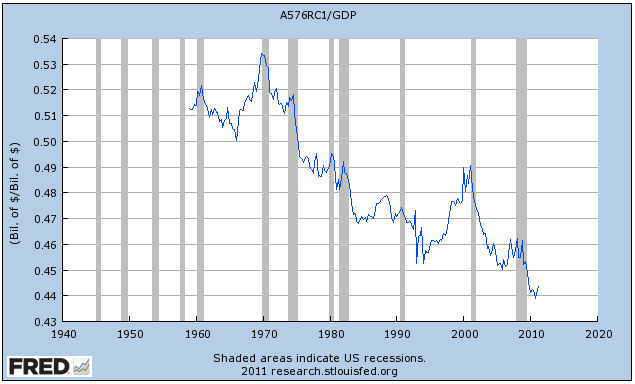
Things aren’t quite that simple and some of the Occupy Wall Street protesters know that.  Look at “Here Are the Four Charts That Explain What the Protests are Angry About….”  Here is one chart, click on the link to look at the others.  This one shows the wages as a percent of the economy.  Because we live in a global economy where all workers compete, the average wage is decreasing even though corporate profits are skyrocketing.  This is the reason behind the whole 99% versus the 1%.  Corporations are more efficient at making money, but at the expense of the workers worldwide.

wages-as-percent-of-gdp

The rich (1%) are eating everyone else’s money up (99%) and the 1% is also desperately fighting to take all the money it can get from the Federal government too.  In fact, the super rich are so good at gaining wealth that I’d think that ordinary millionaires would be feeling the pinch too and would be wanting to join Occupy Wall Street themselves.

Corporate profits are up, as well as their gross earnings and cash holdings, but they aren’t hiring people.  What they discovered is they can trim the fat and do well.  The GOP is now demanding we trim the fat from the federal government, and the extreme conservatives are also seeking to trim the fat from city and state governments.  All this fat trimming is putting millions out of work and there is no economic indicator showing they will get to go back to work anytime soon.  Does Wall Street and the GOP just want to live with 9-10% unemployment forever if that means saving money for them?

Over one half of American households earn less than $50,000 dollars and about 1/6th earn over $100,000, with the rest between the two figures.  See Wikipedia for all the figures on U.S. Household Income.  But also look at Wikipedia’s article on Wealth Inequality in the United States.  Wikipedia says at the end of 2001, which is ten year old data, 10% owned 71% of the wealth, and 1% own 38%, and we know that last decade has accelerated this divide.

Is it any wonder why people are joining the Occupy Wall Street movement?  If you look at the charts here and the ones I link to, the trends aren’t good.  Unless there’s a drastic change in the system, Occupy Wall Street is just the tip of the iceberg that we’re about to crash into.  Expect more fat trimming, which means more unemployed people joining the movement.  But also expect a lot more social upheaval as we adjust to long term high unemployment.

Our economy has gotten too efficient.  We need far fewer people to keep things running.  And it’s much cheaper to hire people in other countries to make things.  As long as corporations are only concerned with profits and their bottom line, and if our various levels of government are forced to do more with less, the trend will be towards growing unemployment.

The solution?  Raise taxes and go back to a larger government and smaller profits for corporations?  That would put more people to work, but there’s a growing anti-socialism climate in this country.  Too many people resent paying for things they don’t think they need, like school teachers or scientific researchers.  What they fail to see is big government makes for a big thriving economy.  Wishing for a small government is equal to wishing for high unemployment.  There’s not enough private enterprise to put all our citizens to work.

Either we have to accept big social programs or we’re going to have to learn to live with lots of poor people and protestors in the streets.  Me, I’d rather pay more taxes than see so much suffering.

Conservatives believe that cutting the size of the government and taxes will grow the economy.  When will we see this?  Bush cut taxes years ago.  As far as I can see, cutting taxes has lead to a faltering economy.  Cutting taxes is letting the 1% get a larger share of everyone’s pie.  And people are waking up to that, and that’s why we have Occupy Wall Street.  It’s why we’re seeing social unrest across Europe too.

Conservatives will counter that we’re running up too much debt.  But we wouldn’t have that debt if we hadn’t had the Bush tax cuts, or wasted so much money on wars and buying influence around the world.  Which is more helpful, hiring more teachers in America, or building militaries for people who want to be our enemies?  At some point it will become more important to apply our nation building funds to rebuilding America.  The Occupy Wall Street people are asking for that help now.  How long will the GOP deny that help?

JWH – 10/16/11

Why People Who Should Be Democrats Vote Republican

It has always puzzled me why middle class and poor people vote Republican and support conservative ideals.  Don’t they know which way their bread is buttered?  Republicans mainly help the rich and special interests, which are the corporate rich.  If you don’t have a pile of money to protect, or a business that you want the government to bestow special favors upon, then why go Republican?  Well, this article from The New York Times, “Why Voters Tune Out Democrats” explains it very well.  Stanley B. Greenberg has analyzed polls about voter attitudes and he sees trends why people are supporting conservatives, not just in the United States, but all over the world.

Republicans have always been anti big government, but it seems that people who previously voted Democratic are now developing their own anti-government bias, and they are moving to the Republican Party to join their anti-government stand.  Greenberg suggests for the Democrats to fight back they need to deal with issues their voters are upset about.  Even though a majority of voters support most of the policies of the Democrats, including social programs and rejecting tax-cuts, they are mad at the Democrats for several particular issues, and that’s making them swing to voting Republican.  Those issues are:

  • The government bailed out failing companies without punishing their executives
  • Wall Street gets a free pass even when it brings down the economy
  • Big businesses can get help from the government but not small businesses
  • The banks and bankers were saved but not home owners
  • The government is rigged for special interest groups
  • The government supports globalization over American workers
  • They don’t like illegal immigration
  • Congress helps itself more than it helps the people (my cousin emailed me as I write this a protest promoting a 28th amendment advocating no pension/no tenure for congressmen)

Greenberg sees these as a trend.  People resent the government acting unfairly, supporting special interest groups, and rewarding the unjust, privilege, incompetent, and underserving rather than helping the common American.  Whether this is true or illusion doesn’t matter, it’s the perception in polls.  And because Republicans, especially Tea Party voters, are so anti-government, that people who normally votes Democrat on other issues are moving into the conservative groups because of these perceptions.

What Greenberg recommends to the Democrats is they also get on a Fix Washington campaign too.

I’m against unfair practices too, but I’m not going to join the conservatives.

Personally, I blame all these issues on the Republicans anyway.  I believe they are the party that set things up in Washington so special interests control the government.  Of course the Democrats are not without blame.  When they wanted the Republicans to vote on social programs they made deal with Republicans to support their big business goals.  Now the Republicans are saying no more deals, no more compromises, because they have sensed they’ve got more of what the people want than the Democrats.

I think this New York Times article is very perceptive.  I think we liberals need to see which way the wind is blowing, and WHY.  This explains why so many Tea Party voters, many of which are ironically on social security and Medicare, are so riled up about big government politics at the moment.

I find our current political climate very unsettling and depressing.  But maybe there’s a silver lining.  Maybe all of this will lead to governmental reforms that will make us feel better about our rulers in Washington.  Maybe I don’t really hate Republicans, maybe I just hate how big money has corrupted the government and special interest groups with money get more representation than they are due.

JWH – 8/1/11

Balanced Budget Amendment

There is a movement among the most conservative of Republicans to get an amendment to the Constitution that requires the federal budget to balance every year.  Mike Lee, one of these newly elected Republican Senators has written a book The Freedom Agenda:  Why  a Balanced Budget Amendment is Necessary to Restore Constitutional Government.  I’m a liberal and his case is even convincing to me.  The most damning evidence he has is the federal budget was 2 percent of the GDP a hundred years ago and is 25 percent in 2011.  It’s obvious the government can’t keep growing.  He also points out the national debt is over $14 trillion dollars, equal to every man, woman and child owing $50,000, and those same people are running their up their bill by $5,000 a year.  OK, Senator Lee, you’ve convinced me we’ve got to do something, but what?

First off, we need to clarify some things.  If the current budget is truly 25% of the GDP, it’s because of extra spending due to the recession and the cost of the war in Afghanistan – so 25% is not the natural figure.  In fact, that percentage should automatically lower and rise with good times and bad.  But Senator Lee, lets assume the budget is too big and that we have to pay down the national debt.  Is this the time to do it?  The federal government is always a job stimulus feature of our economy, so to monkey with it now probably means causing more unemployment.  But I assume you Republicans are going to get your way and we’ll start spending cuts.  However, this is also were the bargaining starts – as well illustrated by recent weeks of gridlock between the White House and Congress.

The difference between conservatives and liberals is how big should the budget be.  What if 20% of GDP is the perfect figure for Democrats and 15% is what the Republicans would love?  We need to decide just how big the government needs to be.  I’m willing to agree it’s too big, and we’re spending too much, and we’re running up too much debt.  But how we cut spending and reduce the debt will be a war in Congress for years, even if the Tea Party leads the nation to pass a balanced budget amendment (BBA), which has been tried several times before and has never passed.

Passing a balanced budget amendment is almost a fantasy, but it would have a far better chance of becoming a reality if Republicans would change their mind about new taxes.

Instead of crying “No new taxes” we should be crying “No more tax cuts” until the deficit is drastically reduced.  And Senator Lee, I know you guys are adamant about about no new taxes, but I think if you seriously want to change the size of the federal government and reduce the deficit you should be willing to repeal all of the Bush tax cuts.  If the rich feel put upon by just rolling back their cuts, we should roll back all of the Bush tax cuts until the deficit is close enough to where a balanced budget amendment would work.

Now I’m not against drastically cutting the federal budget, but we should be careful not to hurt the economic recovery, which is mighty weak at best.  I think Americans public can handle more taxes right now than higher unemployment.  We know what balancing budgets are doing to the states and its not pretty.  I’d hate to see more hardships brought on across the nation by hacking away at the federal budget too.  However, if your goal is really a BBA, then conservatives have to consider increasing revenue.

I think the balanced budget is a great idea in theory.  My wife and I have been far happier now that we balance our budget and no longer go into debt.  Debt is a terrible thing, but sometimes bad things happen and you have to go into debt, even nations.

Let’s imagine that the Balanced Budget Amendment passes.  I know you Republicans also want it passed with a rule that says taxes can only be raised with a supermajority.  Let’s not go there right away.  Let’s plan for bad times, because there will always be bad times.  I suggest we have two automatic taxes in case of war or recession.  The War Tax would automatically kick in if the military has to spend more than it’s share of the balanced budget because of a war or warlike action.  And a Recession Tax would automatically kick in if the government needs to pay to help people during bad economic times.  And logically, we could also have automatic tax reductions in good economic times if we have a surplus (after we pay off the national debt).

What this would allow is the creation of a steady state balanced budget that is tied to a certain percentage of the GDP.  We should determine that percentage in the future after the deficit is paid off and when we can figure what size government is the absolute best for the economy.  Personally I’d prefer a prosperous economy and that might mean a larger government than conservatives want, but if Republicans can whittle away the government and still having a thriving economy, so be it.

I am just an ordinary citizen watching two giant political parties fight over their ideals, but it’s scary and creates uncertainty about the future, which I’m sure is felt by all my fellow citizens.  I know the arch conservatives want lower taxes immediately and they are using the fear of an uncontrolled rising deficit to concoct a plan to reduce the size of the government.  As a Democrat I’ll buy into the idea the deficit is insane – let’s reduce it.  I’ll even buy into the idea of a balanced budget, but you guys need to give in on taxes until we solve the deficit.

What if we repeal the Bush tax cuts and apply them to the deficit and then cut the federal budget to the size it was before the recession, and then work on balancing the budget.  Then while we’re paying off our national debt work on slowly reducing the annual budget with program cuts.  Then when we see drastic deficit reductions and an improved economy we can gradually reintroduce the Bush tax cuts.

Republicans think they have a mandate from the people to cut taxes, and I’m sure most citizens would love lower taxes, but I also think most citizens don’t want to see millions more Americans put out of work from cutting budgets.  What’s happening in the states is more than just cutting the fat.

The Bush tax cuts grew the deficit dramatically, so applying such revenue back into paying off the deficit should reduce it just as quickly.  If you really want a balanced budget then the quickest way to get one is pay down the national debt so it’s practical.  If you try to pay down the national debt with program cuts now you’re only going to scuttle the economy.

JWH – 7/27/11

Why We Fail to Fix Our Large Problems

Today I read “Was the $5 Billion Worth It?” an interview with Bill Gates, Jr. at the Wall Street Journal, which asked him if he felt his money spent on fixing education in America was well spent.  Here is one significant reply:

Asked to critique these endeavors, Mr. Gates demurs: "I applaud people for coming into this space, but unfortunately it hasn’t led to significant improvements." He also warns against overestimating the potential power of philanthropy. "It’s worth remembering that $600 billion a year is spent by various government entities on education, and all the philanthropy that’s ever been spent on this space is not going to add up to $10 billion. So it’s truly a rounding error."

Every night when I watch the evening news I get depressed because we are facing so many huge problems that we can’t seem to fix, no matter how much money, effort and brain power we put into finding solutions.  We have education, the budget deficit, global warming, health care, unemployment, the economy, religious conflicts, over population, and the list goes on and on.  At first I was going to list the war in Afghanistan, but wars always seen to end someday, so they fix themselves – the problems I’m talking about are the ones that never get fixed and we argue over the solutions our entire lives.

If we spend $600 billion a year on education, how come education in America is seen as a huge honking failure?  Today I read that only 12% of the American public believes in evolution and that around 50% believe that Jesus is due to return to Earth sometime soon.  Is that a failure of the education system, or does it show a basic inability for the average person to learn.

But if you look at our big problems there is one consistent factor that few people want to address, and that is we’re polarized over how we view the fundamental working of reality.  Essentially there are two philosophical opposing groups which I’ll label Science versus the Faithful.

The largest group are the metaphysical believers – people that think the Earth is our temporary home while God decides our true destination.  They believe Earth is the center of God’s creation and humans are his chosen beings, and this life is a test of our souls.

The other group, sees the universe as being very old and very big, and the Earth and humans are insignificant compared to the rest of the cosmos.  They see reality working by very exact laws that can be discovered through science and mathematics.  These people believe our lives are only as important as we make them for ourselves. 

God’s faithful, whether Christian, Muslim, Jew, or the many spiritual followers of Eastern religions believe in ancient holy books, written before science or history.  These spiritual texts can’t coexist with science.  The worshipers of these books firmly believe the key to metaphysical reality is within their scriptures.  Most of the faithful accept the tenets of their beliefs after only a brief exposure to their basic concepts.  Believing is very easy.  Giving up these beliefs are very hard.

The followers of science believe knowledge is vast and to understand reality requires reading hundreds of books.  They are the believers in good liberal educations, which means it takes twenty years of solid study to get a decent grasp on reality.  Learning is very hard, and it’s so easy to forget.

The faithful believe much of education is a waste, and that a good deal of it are lies.  They refuse to believe in evolution because they can’t comprehend it and because they intuitively understand it invalidates their most cherish belief, that we have souls that can exist in an afterlife.  They refuse to believe in global warming because they can’t comprehend the science and because they believe this life is not important, but the next one, an eternal life in paradise should be our ultimate concern.

It’s probably more than obvious that I’m on the side of science.  The really good question is:  If we were all on the side of science, could we solve the really big problems we face?  I think so.  But I know the faithful also believe if everyone believed the tenets of their holy books the world would be a beautiful place too.

I wish there was some kind of compromise so we could make everyone happen, but there isn’t.  The strange thing is the faithful think Earth is of no value, so why can’t they let us have this world since we loved it so much more.  The faithful should live like the Amish, pursuing simple lives, following their spiritual disciplines until they die.  I can’t understand why the faithful want to run this world when it matters so little to them in their philosophy.  Why do they want political power when they should be seeking piety.

Here a logic puzzle. 

We have four possible paths – two real actions betting on two choices.

  1. Global warming is a fact, we fix things
  2. Global warming is a fact, we don’t fix things
  3. Global warming is a scam, we fix things anyway
  4. Global warming is a scam, we don’t do anything

There are four results.

  1. We save the world
  2. We kill off civilization
  3. We get an energy efficient society
  4. We save some money

If the scientists are wrong the worse thing that could happen is we end up with a very energy efficient society.  If the client deniers are wrong, we end up living in hell.  No logical person would place their bets that lead to result 2.

Yet, for many in our society action 2 is where they want to place all their chips.  And is it any wonder that most of these same people are also desiring the end of the world by wishing for the return of Jesus.  Do they think the Rapture is brought on by overheating?

We will never solve our big problems as long as we’re polarized between science and faith, and neither side seems willing to change.

Someone needs to create a religion where the path to heaven lies in mastering science.  Has none of the faithful ever wondered if their purpose on Earth is to figure out the mysteries of reality?  I guarantee there are plenty of clues if you’re willing to study science.

JWH – 7/25/11