I’m 59, But Feel 19, But Something’s Wrong with My Body

A common sentiment among older people is they still feel young inside, just like when they were teenagers, but it’s their body that’s aging.  I feel that too, but yesterday it occurred to me that I have changed because of a conversation I had with my friend Mike.  We were talking about how bad the old TV show The Monkees was – it’s in reruns on Antenna TV.  Back in 1966, when I was 14, my sister and I loved that show.  Watching it now makes me think I must have been brain damaged!

The Monkees is a horrendous TV show.  It makes Gilligan’s Island feel like Shakespeare, and that’s another old show I loved as a kid but can’t stand now.  So I can’t really say I feel like I did when I was young, something has changed.  But why do I feel unchanged?

If I think about it I can come up with all kinds of ways I’ve changed.  When I was a kid I did stupid things like own a motorcycle, hitch-hike and take drugs, none of which I would do now.  I now think a much wider range of women are attractive, but that’s true of food, music, books, etc.  The more I think about it, the more I realize that I’m not the person I was when I was young.  So why do we feel we are?

I think the tendency is to feel that we’re a little soul driving around inside our head, steering our body until it turns into a rusted old junker.  Now I guess some people feel they are different inside as they age, but I think a lot of people don’t.  What causes that feeling?  It just occurred to me that I’ve reread things I wrote decades ago and felt I was reading someone else’s writing.  Are our inner beings unconnected to our thinking and opinions too, like they are from the body?

Is there a me inside of my body that’s unchanging even though my body changes, my tastes change, my opinions change, my skills change, and so on?  I know when I’m sick I can feel the me-ness shrink inside, like its being physically assaulted, but the uniqueness stays there no matter how much pain or nausea I feel until I pass out.  When I fall asleep the me goes away, but a tiny bit of it exists in dreams.  When I’ve had surgery and have been put under, it feels like the me has been shut off like a light switch and then suddenly turned back on.

It’s interesting to think of the me, the part of me that’s self-aware, is separate from my opinions and tastes. There’s a science fictional concept called downloading, where people imagine having their brains recorded and then burned into a clone’s brain or digital computer.  They think of this as a form of immortality, but what if the me is a mechanism of the brain that doesn’t copy?  What if the me is the equivalent of a tape-head, and not the tape?  So experiences flow past it but it doesn’t change with them?

But that doesn’t explain why I loved The Monkees in 1966 and hate it in 2011.  It implies that it’s not the tape head, or that the tape head does change over time.  Even though I feel like I’m the same person at 59 as I was a 19 that might be a delusion.  If I could put my 59 year old brain back into my 19 year old body would would I keep my wisdom or turn foolish?  Of course, if I could I put my 59 year old brain back into my 14 year old body would I start loving The Monkees again?  I don’t think so.

I’ve read that people with brain damage feel like different people.  I’m guessing the brain is what feels homey and constant, and it’s the physical body that feels different with aging, and the informational content of the brain that makes my tastes change.  What I worry about is having a stroke or getting Alzheimer’s and losing part of my me-ness.  I’m already used to my body breaking down.  And I’m getting used to forgetting information in my brain, which doesn’t hurt by the way.  But I don’t relish losing that feeling of unchanging me-ness.  But sometimes the me dies before the body.

NOTE:  I think a lot of people read my stuff and think I’m depressed because I write about what they think are depressing topics.  But I’m not depressed at all.  I marvel at all the changes in my life.  I regret not being able to hang onto everything, but that’s not how things work and I accept it.  I don’t want to experience decline and death, but I don’t have any choice, so I like to philosophize about what I’m going through.  And I’m trying to learn from those explorers ahead of me, those folks in their 70s, 80s and 90s.

JWH – 4/11/11

The Metaphors of Magic


The concept of magic has been around since the dawn of mankind.  Modern people associate the belief in magic with superstition, so the belief in real magic is waning.  However, the belief in fantasy magic is growing.  People love stories where magic is real.  Fictional magic can take many forms because the rules and intent of magic within a story has literary purpose.

A Great and Terrible Beauty coverI am listening to A Great and Terrible Beauty by Libba Bray, and beautifully read by Josephine Bailey.  It is the first book of a trilogy about four girls in Victorian England that get seduced by the power of magic.  One metaphor for magic used in this book is addiction.   The girls have hangovers after using magic.  They are drawn to magic because of their unhappy lives and magic makes them feel good.  They are warned about the dangers of magic, but they become addicted, knowing that magic killed the two girls that are their spiritual guides.  In A Great and Terrible Beauty magic is seen as a kind of high, or escape of from the real world.

The metaphor for magic in the Harry Potter books is different.  J. K. Rowling treats magic as if it was a science, to be studied in school, with textbooks,  journals, and learned societies.   Magic has rules and limitations, and mastery of it takes work, skill and talent.  This is probably the most popular metaphor for magic.  Readers love everyday stories of practical magic.

Older books, especial from medieval times and earlier, see magic as a metaphor for good and evil, directly related to God and Satan, or gods and goddesses.  There is white magic and black magic, and human users get their magical power through association.  As humans self importance grew, and the power of the gods declined, the nature of magic was moved into hidden aspects of reality.  It was the secret knowledge of adepts.  Stories like The Lord of the Rings comes out of this heritage.

Nowadays magic doesn’t have to have a philosophical justification.  Every writer who creates a new series of books about vampires decides the rules for how they live in their literary creation.   Magic is a tool that shapes fictional form, which can go from sexual magic (True Blood) to comedy magic (Buffy the Vampire Slayer) to satire magic (Saturday Night Live) to alternate history science fiction magic (“The Merchant and the Alchemist’s Gate” by Ted Chiang).

The sad thing is sometimes people really do want to believe in magic.  They want their fictional fun to be reality.  All religions believe in magic of some sorts.  Miracles are the metaphor for religious magic.  But people also want to believe in concepts like luck, Karma and voodoo too.  Thus magic is a metaphor for altering reality.  That’s where it gets really dangerous.  New Age believers are convinced in the power of mind over matter.  That’s an especially dangerous belief.

That’s why you must ask yourself:  Do I believe in real magic or just fictional magic?  Fictional magic is just a plot device to create fun stories, and sometimes its also used as a moral metaphor, like in A Great and Terrible Beauty.  But if you think anything other than the laws of science rule reality then you have something to worry about.  And I don’t mean worrying about being delusional, which you probably are.  No I mean, you have to worry about knowing the rules of your magic. 

For example, if you believe in angels, you have to also believe in devils.  If you believe magic can help you then you also have to believe it can hurt you.  If you can hex someone, they can hex you.  If you believe in ghosts, then you are never alone.  It gets creepier and creepier.  That’s why I love the magic metaphor in Ted Chiang’s gorgeous story “The Merchant and the Alchemist’s Gate,” where he uses a fantasy time machine to teach the lessons of the Koran.  All magic has laws, even if magic might be real.  All magic has philosophy, even if its untrue.  The best magic is fiction that teaches us lessons about living in the world of reality.

So, whenever you encounter magic ask yourself:  What does this magic imply.

JWH – 11/14/10  

My Pitiful Poor Empty Bucket List

Among my friends we’ve been talking about our bucket lists and I’m always embarrassed to admit that my current bucket list is empty.  In case you don’t know about the concept, it’s anything you want to do before you kick the bucket.  Many of my friends have a number of places they want to visit before they pass on, but I just don’t feel that way about travel.  I have eight weeks of unused vacation and enough money to fly anywhere in the world, but I just don’t have the desire to go anywhere.  Nor do I want to go skydiving or swim with dolphins or see the pyramids.  I’m not dying to do anything, and I wonder if I’m pitiful because of that.

I have to wonder if the fullness of people’s bucket lists are related to their age.  When you are young you feel desperate to do and see everything.  Because I don’t have much energy anymore, and I’ve got a lot of aches and pains, I just want to relax and kick back when the world is not being demanding.  The idea of flying to Paris sounds painful to me, even though I’d love to go there.  And I certainly wouldn’t want any more aches and pains by doing something foolish like sky diving.

No, at this time and condition in my life, I need to reevaluate the whole bucket list concept.  My wife tells me I’m too young to feel old, but I do.  Both mentally and physically.  I’m approaching my 59th birthday, which makes me think about the big six oh.  I really don’t believe 60 is the new 30.

Be that as it may, I do want to find things for my bucket list.  Even I would think I’d be too pathetic if it was empty.  But my current desires don’t really feel like bucket list items.  For about thirty years now I’ve wanted to lose weight.  I don’t need to be my skinny 27 year old self, when I weighed 155, but being under 200 would be a dream come true.  On the other hand I need to be careful what I wished for, because many conditions leading to kicking the bucket would bring on such weight loss.

There are destinations I could add to my bucket list, but they aren’t practical, like going to Mars, or time traveling back in time to June 16, 1967 to see the Monterey Pop Festival.  I do have one desire that’s semi-realistic.  I’ve always wanted to write a novel that got published.  Maybe I should alter that some, and put in my bucket list the desire to have a short story published.  Okay, I will.  That’s one item in my bucket list.

That’s the trouble with my desires, they all involved being accomplished at some skill.  I’ve never wanted anything involving plunking down some cash and just having it.  And many of my desires from youth were downright foolish, like wanting to play the guitar.  I have absolutely no musical talent.  I can’t hum a melody, I can’t even recite the lines to any of my favorite songs, so why wish to play the guitar?  Because I love hearing music.  Even now I have the urge to make number two on my bucket list to be able to play seven songs on the guitar well enough to be recognizable.

Like that will happen!  But what if it could?  Okay, number two on the bucket list is knowing my limitations and truly understanding them.

I’m not sure if the whole concept of the bucket list doesn’t belong to a certain kind of person, the thrill seeker.  When I was young I did a lot of things that could have gotten me killed or jailed, and I was lucky to keep my brain and body as intact as it is.  I have a lot of regrets, but they aren’t about places and activities I missed.  If I ended up on my deathbed tonight, the regrets I’d have about running out of time would be over my failure to be a better person.  And those details are not ones I’m ready to confess now.  There’s no place on the globe I can visit than can make me a better person.

But that’s another failure.  I’m too contemplative.  I can’t be a better person by thinking, only by doing.  Nor do I wish to imply I want to be a good person, that’s another trap like seeking thrills.

I’m not sure if life is about the cards in your hand, but how you play them.

JWH – 8/31/10

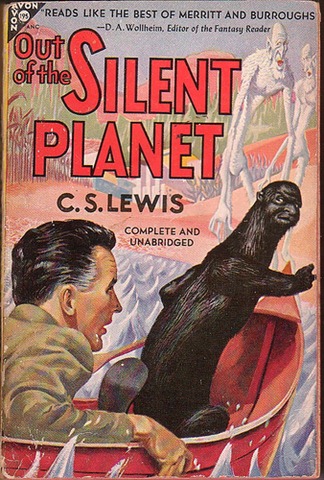
Out of the Silent Planet by C. S. Lewis

Out of the Silent Planet by C. S. Lewis should not be considered a science fiction novel, it follows more in the footsteps of The Devine Comedy and Paradise Lost than it does with H. G. Wells and Jules Verne.  I would go so far and say Out of the Silent Planet is an anti-science fiction novel, although it reads much like Stanley G. Weinbaum and other pulp writers of the 1930s, and was inspired by the 1920 fantasy novel, A Voyage to Arcturus.  Strangely enough, it reminds me of the recent film Avatar.

Please do not read any further if you haven’t read the book and want to avoid spoilers.  What I have to say is a reply to the philosophical implications of the novel and that indirectly gives away plot elements.

Out-of-the-Silent-Planet

The reason why I claim Out of the Silent Planet is anti-science fiction is because the story wants to convince its readers that outer space is the supernatural heavens of religious myths and is full of spiritual beings, even beings who live in the void between planets.  Essentially Lewis does this for religious reasons, and not scientific, and the story feels like medieval philosophy.  Now, this isn’t to say the story isn’t a ripping good yarn, nor does it imply a lack of old fashion sense of wonder about alien life on Mars, like most SF fans love from science fiction from the 1920s and 1930s.

What C. S. Lewis attempts is to claim outer space for Christianity, which is pretty interesting since most Christians focus heavily on Earth and ignore cosmology.  The ending to Out of the Silent Planet reminds me of the ending in Have Space Suit-Will Travel, where in both, humanity and Earth come under the judgment of higher life forms on other planets.  Strangely, the bad guy in Out of the Silent Planet makes the same case as the good guys in Have Space Suit-Will Travel.

Now this is a very essential difference in philosophy, and why I’m making a case that C. S. Lewis is writing anti-science fiction.  Heinlein and most of science fiction is pro mankind, even to the point of taking Satan’s attitude in Paradise Lost, “Better to reign in hell than serve in Heaven.”  Weston, a pathetic, spiritually blind, scientist in Out of the Silent Planet wants mankind to conquer the heavens and spread humanity to all the planets.  Oyarsa, the archangel like ruler of Mars, or Malacandra, has godlike powers and considers Weston bent, or evil.

I am reminded of Lester del Rey’s “For I am a Jealous People” where God takes the side of aliens and mankind declares war on God.  Science fiction is the ultimate hubris.  Of course all of this assumes there are spiritual beings and dimensions we cannot see with our science.  If you believe in those dimensions and beings, you will take the side of C. S. Lewis, but if you don’t, I expect most science fiction fans prefer to follow Heinlein and believe mankind is the most dangerous creature in the universe.

I think a new philosophy is emerging, that’s post-Lewis and post-Heinlein.  There are no spiritual beings, but then we’re not going to be rulers of the universe either.  I think in a few decades Heinlein will feel as archaic as Lewis in his philosophy, and Heinlein is my favorite writer.  I grew up believing in the manifest destiny of space but the relentless reality of science is convincing me otherwise.

Out of the Silent Planet is a throwback and could easily have been written in 1838 instead of 1938.  It’s the last of its kind, rather than being an early novel of future directed science fiction that dominates the twentieth century.  Out of the Silent Planet wants to incorporate the spiritual world into the physical world – to weld them together.  If you accept science there is no room in reality for angels, and the only hope of the spiritual world existing lies on the other side of the doorway of death.

JWH – 7/9/10

Does Jesus Matter?

When I became an atheist at 13 I figured I wouldn’t have to worry about who Jesus was anymore, and I could stop reading The Bible.  Around age 55, I returned to reading The Bible, to understand its place in history and to find out why so many people claimed it was so significant.  I’m still not religious, or even spiritual, but The Bible is like the world’s hardest jigsaw puzzle, you start to put a few pieces together and you get hooked.

In this week’s issue of The New Yorker, Adam Gopnik describes the latest crop of books about Jesus in, “What Did Jesus Do?”  I highly recommend you taking the time to read this essay.

Gopnik claims ten books came out about Jesus in just one month.  I always figured Jesus was a real historical person, that we have very little actual evidence about him, and that there is a difference between Jesus the philosopher and Christ, the deity with infinite aspects.  I might be right or wrong about all points.  In fact, there are so many interpretations of who Jesus the real person was that I have to wonder if I shouldn’t write him off as unknowable.

The trouble is about 2 billion people want to define reality by their interpretation of Jesus.  Would reading all of these books that Adam Gopnik surveys put enough puzzle pieces together to produce a consistent view?  No, you won’t get a conclusive answer to who was the historical Jesus, but your sense of history and reality would be greatly expanded.  Here are links to some of the books he reviewed, and some others I ran across.

And there is no end in sight.  I put “Jesus” in the search box at Amazon, and then set the order to date, and there were over twenty pages of books scheduled to be published.  So I have to ask, should I even study a subject that produces so many opinions?

I know the faithful will say Jesus is someone I should study forever, but I don’t think that’s true.  He either had a definite message or he didn’t.  I also know the faithful will claim the definitive message is found by reading The Bible, but that’s also not true, because of the zillions of books trying to interpret The Bible.

And why try to understand Jesus and not all the other religious figures who have thousands of books written about them?  I do know from the many books I’ve already read, that the more one studies Jesus, the more one tries to understand him in a historical and political context and not as a metaphysical being.

In other words, if we can get a clear picture of the time in which he lived, it reveals much about what he supposedly said.  Studying history is fascinating, but why spend so much time on one person in one tiny portion of the globe for one very short period of time?  Wouldn’t it be more important, and even more spiritual, to study now?  Let’s assume Jesus was an astute observer of life, and his message was different from the teachers of his time, because he was revolutionary, choosing not to look backwards. 

All religions eventually come up with the golden rule.  The basic direction of religion is to inspire people to be better people.  Do we really need to know about people and their problems 2,000 years ago, when we have plenty of people and problems now?  My guess is people would be more Christian if they forget the past and just worked and studied in the present to improve their own lives and help other people around them.

The only real reason to study Jesus is to study biblical history and that eventually leads to studying ancient politics and sociology.  I think the reason why there is so much scholarship on the historical Jesus is because his life is such a delicious mystery.  And if you study biblical times you’ll eventually migrate into classical studies and the study of prehistory.  It’s a deep well to fall into.  Obsessive scholars even take up ancient Greek and Latin.  Eventually these studies turn into the psychoanalysis of the western mind.  Look what happened to Bart D. Ehrman.  He started off as a Evangelical Christian and now he’s almost a  pure historian.

I’m not the kind of atheist that wants to convert the faithful to the scientific worldview.  I don’t want to argue The Bible with others.  I can live with an indifferent reality, but most people need the comfort of answers, even if they are fantasies.   I wish the religious wouldn’t kill each other, or go on jihads and crusades, but I can’t do much about that.  Attacking their beliefs doesn’t do much good.  I do think I contemplate many of the same concepts Jesus is said to have meditated on, and seek many of his same goals, but I just don’t believe any of the stories written about him after he died. 

I’m willing to accept Jesus as a philosopher, say like Plato.  But does he matter?  Not to me.  But then neither does Plato.  In terms of leading a good life one only needs to endlessly explore the golden rule.  The study of history is like the study of science, it is meant to explore the nature of reality.  In this content Jesus is the most famous person in history, and understanding why does matter.

JWH – 5/25/10