The Joys of Technology

Today, the title of my post is in all seriousness.  I’m having a very good technology day.  Other days, the title would be sarcastic.  For years now I haven’t quite figured out how to live with MP3 music.  I don’t like listening to music on my iPod – instead I want to play MP3 music on my living room stereo.  To that end I bought a Roku Soundbridge M1001 last year.  This nifty gadget plugs into my receiver and listens to my WiFi network and watches my computers for iTunes, Windows Media Connect, Rhapsody and other UPnP AV MediaServers where I store MP3 files.

What the Roku does is display a list of songs stored on my computers in other rooms that can be played on the connected stereo system.  It displays lists by artists, albums and songs via a small LCD readout and lets me select and play them with the aid of a palm-size remote.  The trouble is I have over a thousand CDs, and flipping through their titles one LCD line at a time is a pain.  I thought at the time I first set up the SoundBridge it needed a TV output which would let me select songs through a TV interface.  There are media servers that also fetch video and photos from your computer, as well as songs, which are controlled through your TV screen.  The SoundBridge is just for songs.  By the way, the newest Roku is for Netflix online films and does work with your TV.  It’s too bad they didn’t combine the functions for a single product.

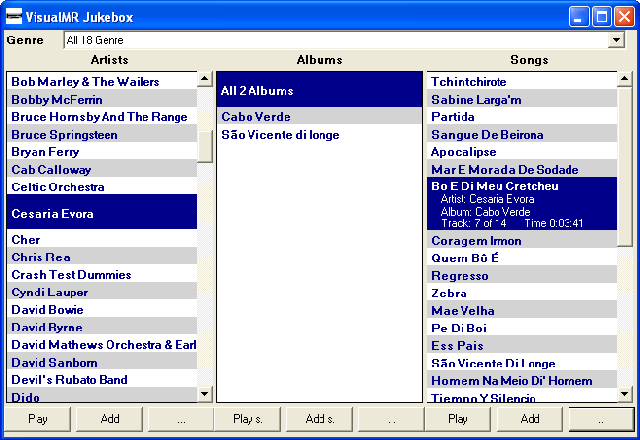
This morning I jumped on the web because I just knew there had to be an answer to my desires, and I found an excellent solution, Visual Media Remote.  Installed on my laptop, which normally sits in the living room, this program lets me to control the SoundBridge.  I know this sounds weird.  My music is stored on a machine in my library/office.  The SoundBridge is in the living room.  The laptop could be in any room but it controls the SoundBridge.  If I had SoundBridges in other rooms, it would control them too.  This screen shot taken from the VisualMR site best illustrates why the software is so useful:

visualmr_pc_jukebox

This display shows a listing of artists on the left, their albums in the middle, and the songs from the highlighted album on the right. And I can filter too, by genres. This very quickly lets me drill down into my collection and find songs and add them to the player queue. I can sit in my La-Z-Boy with my laptop on my lap and just lean back and play songs about as conveniently as I could ever imagine, other than using telepathic mind control over my computer.  VisualMR has been around a long time, but I didn’t have a laptop for the task before.  VisualMR will also work with PDAs.

Searching through Google shows a lot of people use this same setup, but I don’t think it’s a massive crowd.  My guess is most people give up on stereo systems when they get an iPod, or they buy a cradle that attaches to their receiver that lets them use their iPods as CD players.  And I thought about reducing my music world down to one handheld device, like the iPod.  I could reduce my equipment footprint if my laptop had a large enough hard drive to store all my music.  Or I could just buy some high quality headphones and listen to the music directly from the iPod.  Hell, no one seems to like to listen to music together anymore, although I got my wife singing and dancing last night while we made dinner when I was showing off my SoundBridge setup.  But I had to play the songs she liked.

I’m happy with this present setup.  I wished iTunes and Windows Media Player used the same three-pane approach to selecting songs like VisualMR.  I can pack up my CDs and store them away.  Now that music is sold as DRM-free MP3 songs, this kind of equipment might become more popular, because it’s very easy to just shuffle these tunes from machine to machine and room to room.  Microsoft has sold Windows Media Center for years hoping the idea would catch on, but it hasn’t – not big time.  Linksys, Dlink and Netgear all have media servers that work with their wireless equipment.  The tech is there, I just don’t know if they are popular solutions.

Like I said, the iPod has changed everything and I think people have just adapted to it.  It makes me wonder if sales of CD players and receivers have fallen since the success of the iPod?  Well, duh, if people aren’t buying CDs, sales of CD players must be tanking.

All of this reminds me of the fat people in the movie Wall-E – they don’t notice the world around them because everything comes through their video screen, inches in front of their faces.  Now that iPods have added cell phones, movies and television shows to the music lineup, as well as photos and audio books, there’s all the more reason to stay plugged in to your iPod 24×7.  Who knew that electronic gadgets would bring so much fun and joy to people.

Jim

What Does the Demise of the CD and DRM Mean?

Yesterday I went to my favorite Borders bookstore and was shocked to see that they had removed their entire music shopping area.  Life is getting mighty hard for record stores and High Fidelity type dudes.  Now, it’s been awhile since I bought any CDs at Borders, so I won’t miss it, but seeing that big gapping space in the back of the store made me realize that the era of the CD is over.

If you go to Google News and search on DRM, you’ll see all the announcements about how Rhapsody Music will now sell DRM-free songs and albums.  I’m in the process of ripping my old CD collection, which is very time consuming.  From now on, whenever I buy a new song or album I’ll just get the digital edition.  The last CDs my wife and I bought were a few Beatles titles we didn’t already have.  Beatles For Sale might have been our last CD purchase.

It’s a whole new world for music fans, that’s been evolving since the advent of the MP3 player, and especially since the iPod.  But what does this paradigm shift mean?

Cover Art

When music albums shifted from LPs to CDs, cover art moved from major galleries to refrigerator art.  Going from CD to MP3 we lose the art altogether.  I think a marketing angle record companies should pursue is adding cover art to sales of digital albums.  I’d recommend setting up a free standard for desktop art gallery software, like I envisioned in Inventions Wanted #4 – The Desktop Art Gallery.  Or at least back existing desktop software like Webshots.  Then if buyers select a whole album to buy, reward them with several desktop scenes of music related pop art.

Liner Notes

Another feature to be missed is liner notes.  I loved the liner notes on the old huge 12″ record jackets, but hated the microscopic booklets that came with CDs.  It’s time to bring back good liner notes with lyrics and band/fan info in elegantly designed Acrobat Reader files that size to the computer screen.  Maybe music lovers don’t buy albums because they aren’t the art form they used to be.  I know aficionados that still buy vinyl records because they miss the whole experience that was once part of buying an album.

Shopping and Listening

Hanging out in records stores used to a great way to waste time and even a prime activity for dates.  No wonder sales are down.  Without the word-of-mouth recommendations gained from social record buying there’s not a lot of incentive to shop for music like there used to be.  See my post, “Why Has Listening to Music Become as Solitary as Masturbation?”  Record companies need to invent software for FaceBook that puts people together for song listening parties.

Also, online record stores like iTunes, Rhapsody and Amazon need to create a virtual store experience that enhances the shopping experience beyond searching a database for new music.  One feature I would like to see is accurate discographies that list which songs are in print and are for sale and which are out of print.  There’s no reason in our digital universe that all an artist’s work should not stay in print.

Peach Crates

In the old days people stored their albums in wooden crates that made it easy to flip through the LPs one by one and easily see the covers.  When you met a new friend you’d go through their LPs to see what kind of person they were.  An album collection, with their beautiful artistic covers, were as revealing as a deck of Tarot cards laid out.  Kids today can give each other their whole collections, but what good is that?  Stolen music is indiscriminate.  And long iTunes Library lists are just rows and rows of black and white words.  No personality.  Record companies should allow music fans to decorate their blogs with songs, cover art and lyrics.

Ownership

The downside of digital music is ownership.  Protecting your digital collection is going to be a hassle.  Sharing is iffy.  Selling used albums on eBay will be weird.  Handing down your fabulous collection to your children probably won’t happen.

Personally, I think MP3s are not the ultimate format for music, and even wrote my opinions in “Are MP3s at the End of Their Lifecycle?”   My prediction, people are going to discover that owning invisible intangible objects will be a pain, lacking in style and glamour.

Unless music is freely traded, it’s going to be hard for songs to become hits.  If songs are freely traded, nobody will want to buy them.  Thus, the value of subscription music.

Playlists

Playlists will be the sharing medium of the future.  Everyone will be their own DJ – creating musical mood experiences, showing off talents for discovery, and defining identity.  Send your favorite playlist creations out to your friends, and if they have a subscription to the songs, they will play.  Or build blog pages and web sites around playlists, so when surfers drop by that are subscribers, they will have instant background music.

Next

I expect music to start disappearing from Targets and Walmarts.  Not everyone has a MP3 player yet, but the tsunami is bearing down on us.  It will be interesting to see what an all digital music world will be like.  Won’t it be strange to live in a world and never to see a LP or CD?

Jim

Living with Music Technology

The options of how you played music used to be rather simple.  You bought a record, put it on the turntable and played the songs you wanted.  Sure, you had to manually pick up the stylus arm and move it carefully to the exact track you wanted, and if you loved a particular song you had to jump out of your chair over and over again to keep that cut playing, but that technology required little thinking because there was little choice.  Of course if you were an eight-track or cassette user, the whole job was even more complicated and time consuming, but the tech skills were still pretty low.  In the twenty-first century you need to be a skilled computer operator to listen to your favorite tunes.

I am a fan of the Rhapsody Music service where I have no stylus arm to maneuver or cassette tape to position, and I no longer have to worry about scratching records or dealing with skips and pops, but it’s not all snap of my fingers easy.  I got so mad at Rhapsody that I almost canceled my subscription last week.  My browser kept disconnecting from the service, interrupting the songs I was playing, which was very annoying.  And I’ve yet to get the Rhapsody client software to play nice with Vista, even after being patient and giving Rhapsody a year to work out the kinks.

Luckily, the browser client has gotten better and better reducing the effort to listen to music down to being able to remember the name of the artist and track I want – not quite that easy as I get older – typing said information in the input box – again, not perfectly easy because I have to be able to spell those bits of data perfectly – but after that the only required effort to play a song is the physical exertion of a mouse click.  Just now I was in the mood to hear live versions of “Eight Miles High” by the Byrds.  Within seconds of thinking of this whim I discovered a newly released live CD on Rhapsody and was playing the song.  After that I remembered the live cut on the (Untitled)/(Unissued) CD, just a couple mouse clicks a way.  This is a breeze compared to the good old days.

This is not to say everything is perfect in tune heaven.  Ease of use depends on how closely tied I am to my computer.  If I’m writing like I am now, the work required is very minimal.  I have to keep a browser window open and pick out songs I want by typing their names and clicking on the play button.  If I want to play music away from the computer it gets more complicated, a lot more complicated.  My life would be easier if I just accepted I had to buy a compatible MP3 player to match Rhapsody’s requirements and pay the extra $5 a month, but I don’t like listening to music through earbud headphones.  What I’d like to do is go out to the living room, sit in my La-Z-Boy and play songs on my big stereo without having to get my lazy butt up whenever I think of a new song to hear.

Before I switched to Vista I had a nice setup with Windows XP, Linksys WiFi, Rhapsody, a Roku SoundBridge M1001 and Firefly Media Server.  I collected my favorite music by downloading files from Rhapsody, ran a system service called Firefly that talked to all my music libraries on my computer.  The M1001 was installed in the living and attached to my receiver via an optical cable and talked to my computer via WiFi.  I was in music nirvana except for all the clicking I had to do on my Roku remote to find songs I wanted to play.  And it was annoying I couldn’t stay in my La-Z-Boy to pick out the music either because the LCD readout on the Roku was too small to see across the room.

For months I dreamed of finding a small device that would allow me to control everything from my chair, with the ease of selecting music just like I was at my computer.  I thought of laptops, PDAs, and the emerging tech like the Nokia N800 Linux handhelds.  Before I could make a decision I upgraded to Vista and my lovely setup stopped working.

I wanted to give Rhapsody the benefit of the doubt and allow them time to catch up with Microsoft, however they never did.  I don’t know if it’s my HP computer, Vista or the Rhapsody software client, but they have never worked together.  Without the Rhapsody software, its DRM would stop Firefly from sending songs to the M1001.  Now I could have easily solved this problem if I was willing to spend a $1000 and buy a Sonos system.

Sonos talks to Rhapsody directly over the Internet, bypassing the computer, and even offers a handheld song selector device that would allow me to keep my fat ass in my chair and play music through my big stereo, or any stereo in my house if I that I was willing to purchase another Sonos connector.  Very cool tech but the price is too hot for me right now.  I keep hoping Sonos and Rhapsody will become a huge iPod level success and come down in price, plus give me some assurance that they have a long future before I invest even more money in my music system.

My wife recently got a new laptop and gave me back my laptop she had appropriated, so I decided to set it up as a Rhapsody music play station.  I reformatted the drive and put a fresh copy of XP on it, and then loaded the Rhapsody client.  I then took a patch cord and plugged the mini-headphone jack into the laptop’s headphone jack and the the split left and right channel RCA connects on the other end into my stereo’s CD input jacks.  I do believe the optical connector from the M1001 to the optical input on the receiver provided better sound, but I decided to leave the M1001 out of the mix right now.  My plan is to use a very long stereo cable so I can sit in my La-Z-Boy and put my laptop in my lap and use it as a music selector.

This isn’t a perfect setup.  The laptop is much bigger than a Sonos remote, and it gets hot on my thighs, but it does the job.  However, I can imagine a fair number of improvements.  Rhapsody provides an extremely large library for $120 a year, but it’s not complete.  It appears to offer almost everything in print – there are a few holdouts like The Beatles and Led Zepplin, but that’s not the big problem.  I have hundreds of CDs in my library that are out of print and no longer offered by Rhapsody.

Now I could consider Rhapsody’s millions of songs all I need and ignore my older CDs, or I’ll have to develop a dual music library system.  I’d have to rip all my old albums to supplement Rhapsody.  That would be a huge job that I’ve avoided until now.  I’d need a newer laptop with a larger hard drive, and I’d have to make backups and keep them off site, and all of that becomes a long job list that bums out thoughts of my future free weekends.  It makes me wonder if the old days were better, even if I could only play one LP in a sitting, and had to leap over to the stereo every time I wanted to skip a song.

I can understand why young people love the portable players like the iPod.  If only Steve Jobs would bless the concept of subscription music.  I could buy an iPod Touch and call it quits.  This past year I finally got rid of all my LPs I had been dragging around the country for forty years.  What a relief that was.  My wife and I still struggle with storing and shelving all our CDs.  Susan hasn’t embraced subscription music because she believes music should only be played in the car where God and 1950s America intended.  Susan recently discovered the powers of the iPod for music, a device she previously only used for audio books, and has began ripping her favorite CDs and taking her iPod for rides and leaving the CDs at home.  Sadly for me, she’s refused the job of becoming our MP3 librarian though.

Even if we did rip 2000 CDs, I can’t imagine using iTunes with so many songs.  Nor can I imagine protecting all those hundreds of gigabytes from now until eternity.  In my quest for finding simplicity in my old age I’ve considered following two musical paths.  One would be to give up digital music and go back to CDs.  The second would be to give up all physical music and live completely with subscription music.  There are even portable players out there that will talk directly to Rhapsody over WiFi, but can you imagine what the world will be like when iPhone 3.0 has subscription music?   Can you see the future where you have a device that goes anywhere and allows you to just name a song and it plays.  That’s pretty damn Sci-Fi to daydream about.

Why choose CD only?  Well, they’re paid for, and if I retire to some nice little town and never relocate again until it’s time to move into my coffin, taking care of all those CDs wouldn’t be too bad.  However, if I make several more moves before I retire, it will be a blessing to go all digital because my old back doesn’t like humping all those boxes of CDs.  To be honest, it’s no choice.  Since I’ve been a Rhapsody subscriber I’ve seldom even touched my CD collection.  I would make the decision right now if I knew subscription music had a solid future.  But except for one blogging friend, I don’t know anyone that enjoys subscription music.  All my music fan buddies prefers to buy digital songs or CDs.

No one seems to understand the Valhalla of digital subscription music, so I have to wait to make my decision.  If the concept of subscription music goes the way of the 78, LP and SACD, I’ll have to rip my CDs and start buying tunes from Amazon one at a time and figure out how to schlep those gigabytes around for the next thirty years.  If only Steve Jobs would give his kiss of approval, owning music would be over.  Why has he embraced subscription movies but not music?

I’m in a holding pattern with music technology.  I’ve heard that Rhapsody and other subscription music services can be had through Tivos and cable TV boxes, but I haven’t played with such devices.  What would be better than Sonos is selecting tracks to play through my HDTV that’s connected to my receiver in the living room with the same remote I use for selecting video to watch.  Now that would be converging technology!

When I’m working at my computer I could play Rhapsody.  If I was in my living room I could play Rhapsody though my TV.  For those people with portable players they can get music over cell phone technology.  And when the Internet comes to the car, music subscription could follow me there.  What more could I ask for from technology?  A chip in my head that when I think of a song it plays in my brain and I hear music like I had a $100,000 stereo system in my head?  Would people call us songheads, and look down on us like we’re dopeheads?

Jim
Young @ Heart – Don’t Wait for the DVD

There are some films that you need to see in theaters, and Young @ Heart is one of them.  I’m not the kind of guy who cries, but if I wore mascara my face would have been a mess during this great feel good movie.  I’m curious if this show has any impact on those are are currently young of body, but I think any middle-aged person will find this story of the oldest rock-and-roll cover band to be uplifting and inspire great reflection about dealing with getting old themselves.

This is a little story about a chorus of old people who don’t give up no matter what, even when two of their own die in one week, and their little revue gets an emotional jet assisted take-off by being seen on the big screen in the dark theater.  I never admired wrinkly-old-people more, because this tribe of oldsters rocked out and kicked my ass when it comes to living and gumption.  At Rotten Tomatoes its rated 87%, and I’ve got to figure that other 13% of reviewers are Dead @ Heart.

Sure these old farts would get the boot from Simon and the American Idol tribunal, but songs like Coldplay’s “Fix You” was totally owned by a really fat old guy with an oxygen breather in tow.  On the big screen, the lyrics of these songs were totally showcased in a way that made them sound far more meaningful than when sung as anthems to the young.  “Road to Nowhere” by the The Talking Heads and “I Wanna Be Sedated” by The Ramones took on whole new meanings.

I’m listening to Coldplay sing “Fix You” right now and it just doesn’t have the impact it did in the movie.  But I now admire the lyrics all the more.  I’m reminded of another movie about music I saw a few weeks ago, Once, and how the songs just don’t translate with the same impact off the screen without being able to see the tortured faces who were singing words that matched their expressions.

I can imagine some viewers thinking that all of this is camp, or stupid oldster tricks, but I found the ancient ones hard core for getting up and doing things I’ve been too scared to do all my life.  Janis and I sat up close and I think seeing these little people on the big screen magnified the issues of standing every day with Mr. Death in the room.

I think Young @ Heart had major impact with me because I’ve been around a lot of dying people in recent years, and I can read much more into the scenes than the film maker really worked to show.  The more you know about pain, suffering, deteriorating bodies and death, the more real this movie becomes.  Unless you have some inkling of what it takes to make such an effort late in life, then you’ll not truly get this film.  It might be fun and a lot of laughs but you’ll miss the Sigmund Freud lessons.

It’s one thing to rock in your teens, that’s fucking easy man, it’s a whole other thing to rock out when you’re in your eighties and nineties.  I think I’ll go play Mr. Young’s “Hey, Hey, My My (Into the Black).”  I’ve got to keep remembering those lessons.

[Here are a handful of YouTube clips to give you an idea, but they don’t work like being at the theater.]

Jim

1965

Yesterday I discovered Playa Cofi Jukebox, an Internet radio station that lets listeners time travel back to any year from 1950-1982 to hear a rotation of the top 100 songs from that year.  I immediately jumped to 1965 and was transported to my all-time favorite musical year.  Go look at that link and see if you can think of any year that has more fantastic hits.  What year do you most identify with musically?  While I natter away about 1965 always substitute your favorite year and remember your songs.

I’ve been wishing for such an invention for a long time now.  Actually, I’d even like to pick the month and year, but I’m overjoyed to have a by year destination for now.  I’ve often daydreamed of collecting music with an idea of creating playlists on my computer so I could fake late night radio shows I heard in my kid days while discovering science fiction books.

I’d love to hear the old WQAM and WFUN AM stations from 1961-1967 Miami – and poking around the Internet shows that other people remember those stations with lots of fond nostalgia too.  I’m guessing there is something in our biochemistry that burns the pop culture of our teen years into our brains so nothing else ever seems as exciting.

I often reread the books I discovered in 1965 – mostly the twelve Heinlein juveniles that were first published in the 1950s.  The books still move me as much as the music.  But I have discovered when I see TV shows from that year like Lost in Space, Green Acres, I Dream of Jeannie, The Wild Wild West and Get Smart I have to wonder if I wasn’t simple-minded back then.  I know that science fiction and rock music back then wasn’t that sophisticated either, but they feel like art today whereas the television shows seem silly.

I have to wonder how much of the 1965 me is still stored in my brain?  Physicists still grapple with the concept of time, some even theorize that time doesn’t exist – suggesting that we live in a continual succession of nows.  I know my old brain now is much different from my young brain then, but I’m guessing much of the same programming and circuitry still exist.  If I put on 1965 on the Playa Cofi jukebox and start reading Starman Jones by Robert A. Heinlein how close can I get to the original experience?  Time appears to be change, but what is changing?

What if I had a brain injury or Alzheimer’s and did this experiment?  What if I could move back to my old house in Miami.  Would it feel like 1965?  Would I feel like I’m 13 and something really bad happened to my body?

Why do science fiction writers and readers love the concept of time travel?  Wouldn’t time travel also involve space travel?  Wouldn’t we have to jump in a space ship and go back to the coordinates of where Earth was forty-three years ago?  (Oddly The Shangri-Las was singing “I Can Never Go Home Anymore,”  And “Turn! Turn! Turn!” by the Byrds just started playing.  Very appropriate songs for this essay.  What synergy with 1965.)

The Earth has gone around the Sun forty-three times, and the solar system has moved around the galaxy, and the Milky Way has moved in whatever direction it is heading, and the Universe is expanding.  It’s damn hard to believe that time travel will ever be possible, but it’s also hard to imagine that time does not exist either.

The question I really should ask myself:  Why would I want to time travel to 1965?  Is it because I had so much fun listening to WQAM and reading Heinlein and watching The Man From U.N.C.L.E. on television?  Don’t we all time travel every day when we turn on our TVs and watch movies from the past hundred years?

What is something I couldn’t do now, that I could do then?  For one thing, I could go see Bob Dylan perform during the height of his talent.  (“Mr. Tambourine Man” just started playing after I typed the words Bob Dylan – this is getting spooky.)  How important is that?  What does it tell me?  I guess I’d like to do all the things back in 1965 that I didn’t do the first time around but wanted to so badly.  (The Animals just started singing “We Gotta Get Out of this Place.”)

And I think the Animals song is informative.  I think one of the basic urges for time travel is the same as space travel, we just want to go somewhere in space-time where we think it’s better.  Was 1965 really a better place?  (Jesus, this is starting to weird me out, Sonny and Cher just started singing, “Baby Don’t Go.”)  Maybe they’re right, now is the only place that counts.

This makes me wonder how many science fiction fans would jump at a chance to go somewhere fantastic.  If a powerful being suddenly appeared in your room right now and commanded:  “Name a destination in the universe – any time, anywhere, and I’ll send you there right now” would you jump at the chance?  (The Shangri-Las are back and singing, “The Leader of the Pack.”  – Umm)

Let’s imagine I say, “Miami, 1965” – and pop I’m there.  What would I do then?  (I wished I had written “and clap I’m there,” because Shirley Ellis just started singing “The Clapping Song.”)  The first thing I’d have to do is get out of my old house because my parents, who would be younger than me now, would find a stranger invading their house very scary.  I’d be out on the streets and homeless.

(The Moody Blues just started singing “Go Now.” – I’m not making this up.  If you could hear the song like I hear it, it has mystical thrills.  It always had.)

The job of a time traveler is a tough one.  At least in 1965 Miami, everyone speaks my language, but walking the streets with only the clothes on my back and a wallet full of funny money wouldn’t be an easy start to a new life.  (I hear Joe Tex telling me to hold on to what I’ve got.)

A lot of science fiction stories starts with this very problem, remember John Carter arriving on Mars.  But how many of us would buy a ticket to another city and start an adventure by being homeless.  (The Four Seasons sings “Let’s Hang On” repeating and emphasizing the wisdom of Joe Tex “Let’s hang on to what we’ve got”)

I guess 1965 is telling me to stay home in 2008.  What if I never owned a radio or discovered Heinlein in 1965?  What if I had taken up sports instead and all my memories of 1965 would be about ball games – this essay would be about how I remember seeing some great games.  Time is always something we did.  The year 1965 is just a label I put on a period of my life when pop culture was very impressionable on my mind.  For other people that might be 1983 or 1942, and all my fond memories would be meaningless to them.  In forty-three years some guy is going to be writing about 2008 and his nostalgic memories of Rap music.

Last night my wife and I had a party at our house celebrating our 30th wedding anniversary and everyone sat around trying to remember 1978.  Our wedding reception had been at my wife’s parent’s house, the house where we live now.  And a number of people who had been there thirty years ago sat around looking at photos of the 1978 event.  We sure do love to time travel.  In 1965 I was terribly anxious to live in the 21st century.  I wonder if I’ll ever live in a year that is the one I want to be living in?

The Four Seasons just started singing, “Don’t Think Twice, It’s All Right (The Wonder Who).”  I think I spend too much time thinking twice.  I can’t go home to 1965, but along the way time has eroded my desire to live in the future.  I think reality has overtaken science fiction.

I keep waiting for The Rolling Stones to sing, “Time is On My Side,” which came out in late 64 and was popular in 1965.  I need to get over looking backwards.  What I really want from 1965 is a way to live looking forward again.  I need to stop thinking about 1965, and start planning for 2065.  Having a grand distant future inside of you waiting to unfold is the way to feel young again.

Jim