Living in the Cloud: Google Music, Amazon Cloud and iTunes Match

I have over 18,000 songs ripped from CDs I’ve been buying since 1983 or 1984.  It was a big project to rip them, and I bought a couple external hard drives to back up my work.  One of those drives stopped working recently, and it’s a pain to keep master library and backups in sync, especially since I keep one drive off site.  In fact, I gave up on keeping my collection and backups in sync.  So when cloud music storage came out I thought wow, this is a great idea.

The first service I tried was Google Music since it was free.  It has an upload app that runs as a background service and I spent a couple weeks getting my collection online.  I mainly listen to music at my home office computer, my work office computer, and in the den with a HTPC hooked up to my stereo system.  I have an iPad and iPod touch, but I don’t like listening to music on those devices.   I just don’t like hearing music through earbuds.

I did test Google music out on my iPad and strangely enough the album listings look best on the iPad.  Google Music looks bad on large screen desktop monitors because I think the album thumbnail images are optimized for phones and tablets.  Their web player has basic controls for play/pause, next, previous, repeat and shuffle – nothing fancy but gets the job done.

Here is the album view.  You can blow up all images by clicking on them.

google-music

Here is what it looks like to play an album – the controls are along the bottom.
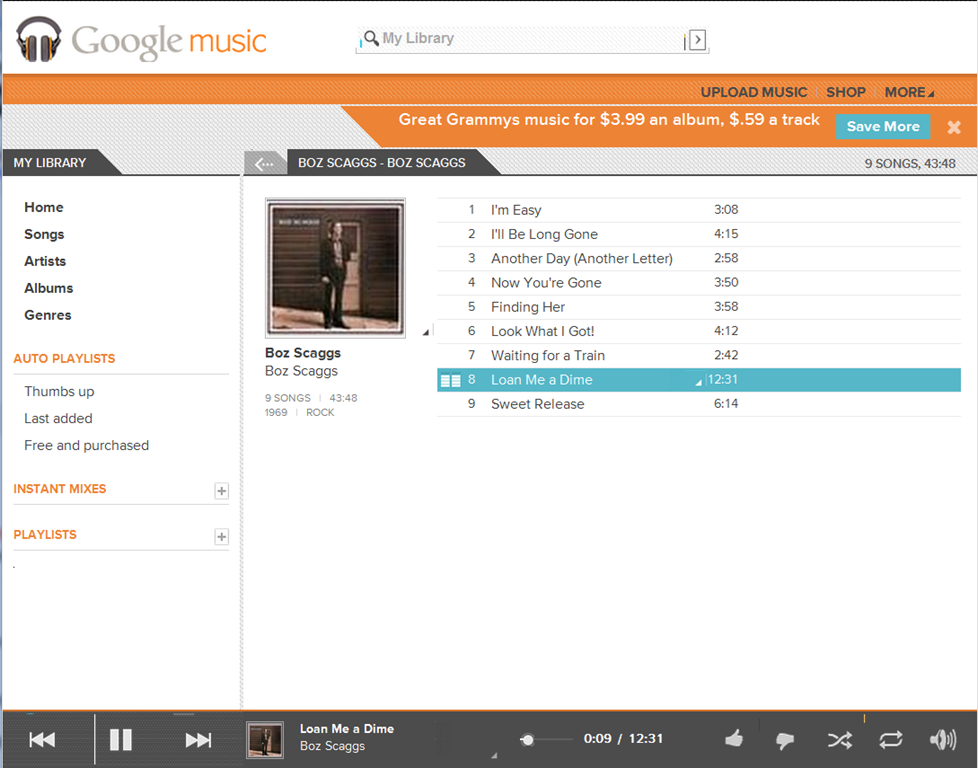
google-music-player

Then I uploaded my music to Amazon Cloud.  It also took a couple weeks, but it was a web app that kept crashing.  Also, Amazon’s upload app found all my audio books and uploaded them.  I really didn’t want it to do that, but it did.  I already had 20gb of storage at Amazon’s cloud because I had bought an album on promotion, and Amazon recently gave unlimited music upload space to anyone with 20gb of space or more.  When the renewal comes up, storing my music on Amazon Cloud will be $20 a year.  Here’s the album view for the Amazon Cloud player.
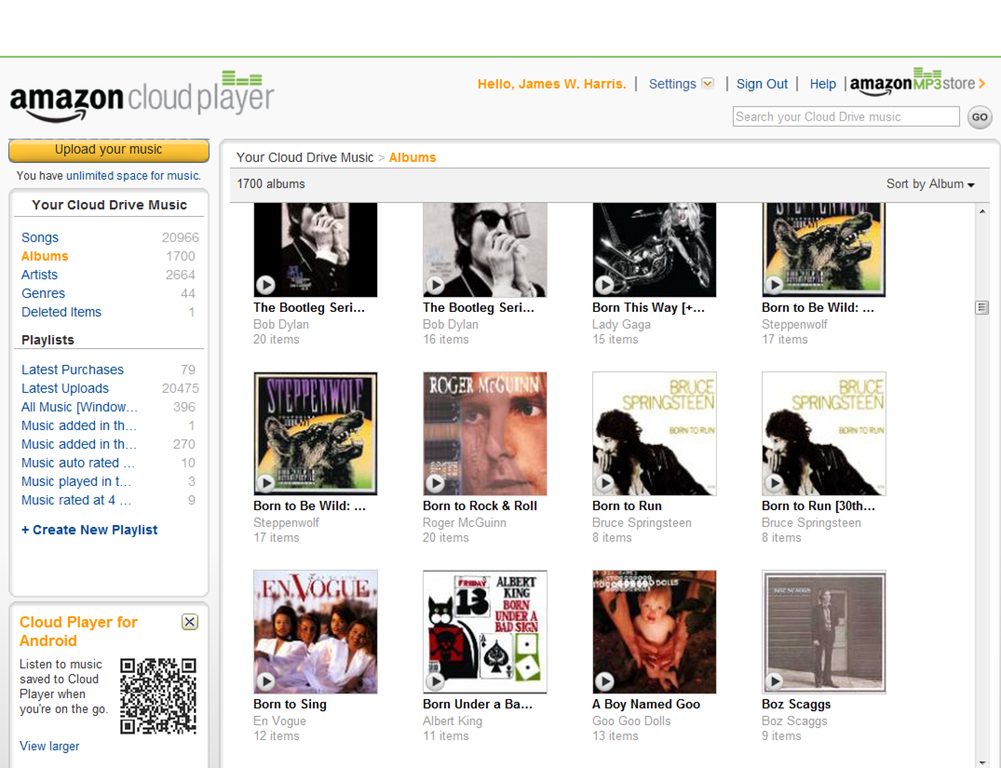
amazon.cloug

Notice the album covers are nicer looking.  Here’s what the album player looks like.  The same basic controls as Google Music.

amazon-cloud-player

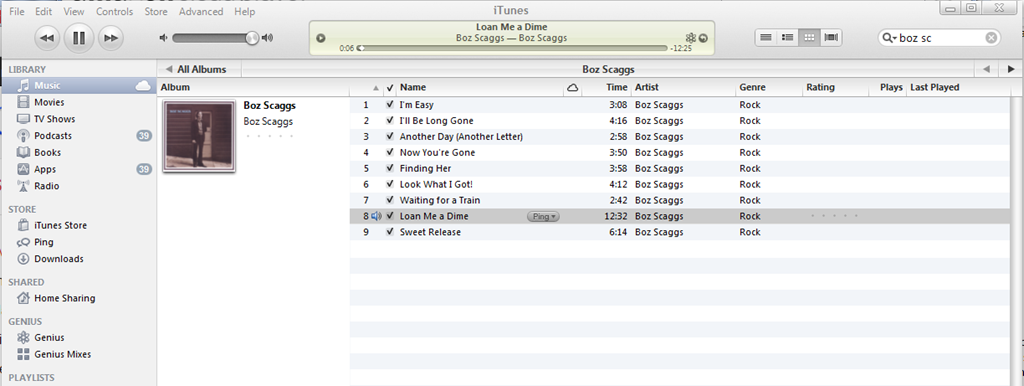
iTunes Music Match works different.  It works through iTunes – which I hate.  I was hoping it would have a web client too, but it doesn’t.  So I can’t play music on my Linux machines.  Nor do I want to install iTunes on all my machines.  And for some strange reason iTunes in album view iTunes sorts by artist, so I couldn’t recreate the album images like I did with Google Music and Amazon Cloud.

itunes

Here’s the player view.

itunes-player

Because iTunes Music Match costs $25 a year, and it’s from Apple, which has a reputation for style and slickness, I thought I would like it best.  I didn’t.  I like it least because it’s tied to iTunes.  The music match feature worked beautifully, and within minutes 15,000 of my albums were online.  It took two days to upload 3,350 unmatched albums.  This is a more sophisticated way to get albums into the cloud, but playing them is limited to machines with iTunes.

Another strange thing about iTunes is it did the poorest job of finding album covers.  Apple is so visual that I found this disappointing.  I have spent a lot of extra time trying to find the covers and put them into iTunes so I can enjoy album flow viewing, but I gave up somewhere in the D’s.  Now there’s a company that fixes this problem with a program called Tune-Up.  However, it’s expensive.  $39.95 per year, or $49.95 for a lifetime license.  It annoys me so much not having the artwork that I am tempted to spend the money, but I’ve decided that I just don’t like iTunes Music Match if I have to use iTunes.

Finally, iTunes plays music differently.  Google and Amazon streams from the cloud.  No internet, no music.  iTunes lets you download songs from the cloud.  The others do too, but iTunes seems to emphasize download.  You can have up to 10 devices sharing your Music Match cloud library, but what appears to happen is the music gets downloaded to each new device.  You can tell your satellite devices to intentionally download the music so you can play it offline, and this will be a great feature for most people who use iPhones and iPads.  However, it will fill up your device with music.  I prefer streaming.

As far as I was concerned iTunes Music Match was $25 down the drain.  However, Mac users who own Mac, iPhone and iPad will always have iTunes and so Music Match will be worth it to them.  iTunes Music Match seems geared to iPhone, iPod touch and iPad users, to help on-the-go users get music down from the cloud.

Now I have to decide between Google and Amazon.  Because I’m a dedicated Chrome user I’m partial to Google.  Because I’m a dedicated Amazon customer, I’m equally partial to Amazon.  I’m leaning towards the Amazon cloud because the player looks better.  However, it will cost me $20 a year.  I’m going to maintain both for now, or until I see what Google charges.  I’m an Amazon Prime user, so I wish they’d made unlimited music storage free for Prime members.

My next project is to thin out my collection.  I’m not sure how well Google and Amazon update their clouds.  I want to make one perfect copy of my library in Windows Media Player and hopefully Amazon and Google will keep this master library in sync.  Another test will be to download my collection to my work machine to see how well these clouds can be used as backup to restore my collection.  But these are for future reports because it will take months to do all this.

JWH – 2/12/12

The Quest for the Highest Fidelity

Neil Young wants us to go beyond MP3.  In this video interview he tells us that MP3 only has 5% of the music data of a master tape, and that CD’s only have 15%.  Which makes me wonder what percentage of the master tape is presented in vinyl.  I also wondered how Neil came up with those numbers.  Well, I found Fidelity Potential Index (see the graph).  By this chart, the vinyl records processes 415,000-625,000 bits per second, whereas a CD is 705,600, and a SACD does 3,500,000 and 24 bit Dolby True HD reaches 4,608,000, but I’m not sure how to compare this to a MP3 file, which have different rates of compression.  But I found “16 Bit vs. 24 Bit Audio” with a number of interesting tables.

That article says a 24 bit master recording at 96kHz sample rates produces a 99 megabyte file for a 3 minute song, and 128kbps MP3 takes up 2.82 megabytes of space.  So if Neil was using a better sample rate that creates a 5 megabytes file, it would be about 5% of the master.  And that’s for a 24/96kHz master, what about a 24/192kHz master recording – the MP3 becomes 2.5%.  But a CD would still have 30-33%, not 15%, unless he was comparing CDs to 24/192 masters, which would be about 15%.  And I still don’t know what vinyl would have.

I’m listening to streaming music right now, “Rudy” by Supertramp, which might be 256 kbps MP3, so I’m getting that 5% of the original musical data, at least according to Neil.  If I spent a bunch of money on audiophile equipment and found a 24 bit master file of this song, if it’s available, would I experience 20 times as much music?

I tried SACD years ago, buying a reasonable amount of equipment just to see what it’s like.  If I sat in my recliner, closed my eyes, and concentrated, I could tell the difference.  Sometimes it was dramatic.  But if I started doing stuff while the music was playing it no longer mattered if I was listening to a CD or SACD.

Listening to music on Rdio while I write my blogs, streaming is good enough.  If I go sit in the den and crank up my stereo, and kick back in my recliner and concentrate on the music like I concentrate on a movie, breaking out the CDs is worth the trouble.  But not if my thoughts drift.  I like to use music to pump up my thinking.  For that, streaming is good enough.

Every once in awhile I’ll listen to music on my iPod touch – like when I have insomnia – but I find music through earphones tiny and thin.  It’s okay for emergencies, but I can’t believe that’s most people’s first choice in listening conditions.

I could go over to HDtracks and buy Fleetwood Mac by Fleetwood Mac in 192kHz/24bit FLAC for $25.98 and find out if Neil is right.  But can my HTPC actually play the file in 192kHz resolution?  Is it even worth it?   Read this thread, “24-bit/192kHz is pointless?”  Or read “Coding High Quality Digital Audio” by J. Robert Stuart.  These people have explored the territory Neil Young pines for us all to live in and they aren’t so sure it’s the promised land.

Let’s think of it another way.  Neil can’t even get people to listen to CDs which have three times the music data, so how can he expect people to demand a technology that delivers 20 times as much data?  I got into SACD years ago just as SACD was failing in the marketplace.  I think Neil is hoping that Apple will come out with iPhones/iPods that have 24/192 technology, and iTunes and Amazon will start selling is 100mb songs that download and store just as easily as 5mb songs.  This could happen.  But music fans aren’t asking for it, so will it happen?  How many people rushed out to buy HD Radio receivers?

I loved listening to SACDs where I felt the musical instruments had so much more texture, and singers sounded like they were live in the room, but I only noticed those details when I paid attention.  How many people really pay attention to music?

And I still can’t find out why people cling to vinyl – the scientific numbers just don’t justify it.  Is there a chance that people love vinyl for its warmth because it has less music data?  If that’s the case, one day when Neil gets his way and Apple presents HD digital music, the young people will all cling to MP3 files for their warmth – all that extra music data will sound too harsh.

JWH 2/9/12

Rdio on Roku

I got a Roku 2 XS for Christmas and the first channel I configured after Netflix was Rdio.  Roku is a tiny box that connects to your TV and home network allowing you to watch various “Internet channels” on your TV.  Programmers create apps for the Roku that act like TV channels – some are free, others cost money, like Netflix and Rdio. 

Rdio is a streaming music service with several price levels to use, starting with free, $4.99, $9.99 and $17.99.  You need to be on the $9.99 Rdio Unlimited plan to use it with the Roku.  I love Rdio for streaming music because it has the best web page for managing music, and it has fantastic social networking features for sharing and discovering music.

rsz_rdio_logo

Rdio is also available on mobile phones and tablets if you have the Unlimited plan, so you might think, why listen to music on your television?  Well, if your television is hooked up to a surround sound system to support your home theater it can play music far better than what you can hear through computer speakers or through earbuds.  Most people have no idea how rich music sounds if they’ve always listened to it on earbuds.  Music on a home theater system is like listening to music in the car with a good car stereo system.

Now while the web interface to Rdio is rich and powerful on the computer screen, the Rdio interface on mobile devices and the Roku is severely limited.  You can play your music collection, playlists, and search for songs and albums, or go to the New Releases and listen to new albums.

BUT RDIO ON THE ROKU IS VERY LIMITED IN HOW YOU PLAY SONGS! 

First off there’s no random play.  Basically you see album covers and call them up to play.  You do not even see a list of songs on the album, or even told how many songs are on the album.  All Rdio does is show the first song and gives you three options:  play/pause, next song, previous song.  Now this is fine if you want to put on an album and listen to it, but that’s skips most of Rdio’s wonderful features.

I assume this is Rdio’s first effort and more features will show up on the Roku and mobile devices soon, but here’s a list of critical features I’d like to see much sooner than later:

  • Random play for playlists and albums
  • Show song list for albums with up and down arrows for selecting
  • Show song list for playlists with up and down arrows for selecting
  • Allow us to add album to collection
  • Allow us to add album to queue
  • Allow us to add song to playlists
  • Allow us to create a new playlist
  • Show large photo of album when playing (hey, we’re using 1080p TVs here)

After those very basic requirements are met I’d like to see:

  • All the current social networking features of the web version
  • Wikipedia like info about songs, albums and artists
  • Lyrics to songs (again, we’re combining music with a big screen.  I have a 1080p TV and computer monitor – make the most of it)
  • Allow us to create multiple collections on all devices (this isn’t even on the web version)

Many of these features are missing on my iOS version of Rdio too.  I’m hoping they will also be fixed there too.

Amarok, a music player from the Linux world and KDE, also available for the PC and Mac, has a central window for showing song lyrics and album, artist and song information.  Sitting in front of a TV listening to music sort of demands making use of the large screen don’t you think?  Of course, when I really get into a song I close my eyes.

I know we’re at the beginning of a new era for playing and distributing music.  Right now only MOG and Rdio are available for the Roku, which is the working man’s streaming device.  Rhapsody is on the Sonos, but I can’t afford that system, and besides, it doesn’t have the wonderful melding of music and TV that Rdio and MOG have with the Roku.  (Rhapsody, are you listening?)

I don’t know how many people have Rokus or other streaming music boxes.  Is Rdio available on the Apple TV box?  And I know these services are starting to be built right into TVs and Blu-ray players, but until millions of people see how cool it is to combine TV and streaming music they will not see the amazing potential.

I kid you not, this could be as big as MP3 music players.  Plopping down in front of the big screen and using the clicker to control a music library is brilliant.  I can lay my fat ass body on the couch and with one hand holding the tiny Roku remote and using just one finger, I can call up songs so easily that I went through a dozen new albums in the New Releases section in about 30 minutes.  Of course I didn’t play the whole albums but I play enough to get the feel for them, and if I had had a button to add them to my queue I would have saved three to play later, to give them my full attention.

Rdio has an amazing New Releases page.  Most other subscription services put up a screen or two of new releases each week, usually giving well known artists the promotion.  Rdio just shows what’s coming out from everybody and they have page after page of new releases.  Some of them are pretty crappy, but I often find stuff I like from groups I’ve never heard of, and that’s what its all about for me – discovering new music.  Playing subscription music on TV could be a huge way to promote new groups.

With the current software on the Roku if I want to remember a new album I need to have a pen and paper handy to write down the info so I can go to my computer and process it there.  That’s a drag.

I want Rdio to let us create multiple collections.  I also wish the Queue was a collection too.  Right now if you play an album in the queue it disappears when Rdio goes to the next album in the queue.  I’d rather the finished album stay there until I manually delete it from the queue.  I put stuff in the queue to study.  I’m trying to determine if the songs and albums are worthy of adding to my permanent collection or playlists. 

And that brings up another problem.  As my permanent collection grows it gets harder to find albums.  I want to organize my collection – so I want multiple collections and even sub-collections.  That way I could create a collection called Jazz, and then within it create sub-collections for Bebop, Cool, Big Band, Fusion, etc.

Rdio has tremendous potential, far more than I can even imagine now.  Listening to music ten years from now we’ll all look back and think how primitive these times are.  Politics might be a mess, and the economy is going down the drain, but the future of music looks very bright.

JWH – 12/27/11

1001 Classical Recordings: Carmina Burana

Today I started reading 1001 Classical Recordings You Must Hear Before You Die, edited by Matthew Rye.  I know next to nothing about classical music, and when I saw this book on the remaindered shelf I bought it thinking I’d go through the recommendations and try them out on Rhapsody or Rdio as an exercise in music auto-didacticism.   But starting with the first album, Carmina Burana quickly showed me what a vast undertaking this will be.  I thought I might could do one album a day, but that won’t be practical – not if I actually want to learn something.  I mean, I could just play the album and be done with it, but researching Carmina Burana on the internet has been a trip, and I think each album is going to take some work to appreciate.

To me, music as time traveling.  Up to now my adventures into old music has only taken me back to the jazz music of the 1920s.  Carmina Burana jumps me back to the 11th and 12th century – that’s quite a cultural shock.  Now here’s the problem with classical music – it’s old, sometimes very old, and unless it’s 20th century classical we don’t have recordings of the original artists and performances.  Classical music for the modern world is really listening to cover bands, and there’s lots of interpretations.  I hit a snag with the very first recommended album, Camina Burana, performed by Clemencic Consort, directed by René Clemencic, a 3 CD recording from 1975 that’s out of print.  Bummer.

CARMINA-CLEMENCIC

The 1001 Classical Recording guide recommends this recording because it’s supposed to be more authentic.  Of course that’s both subjective and theoretical because we don’t know what a bunch of monks sounded like from the 11th and 12th century.   However, there is a movement in classical music called historically informed performance which means they use research and scholarship to guess what the original music might have sounded like.

Please read this Wikipedia entry on the history of the songs.  But we’re pretty sure they don’t sound like the monster chorales of the Carl Orff interpretations.  It’s when I heard “O Fortuna” that I realized I’ve been hearing this old music all my life, making it the oldest of the oldies I know.  Here’s how most people hear something from Carmina Burana today:

I did find some Clemencic Consort recordings on YouTube to illustrate the contrast of interpretations.

And these guys even look like they could be monks if they had the right outfits.

Another problem is knowing that the singers are singing about.  Here are the lyrics to the Carl Orff’s Carmina Burana.  In all, there are 254 poems and dramatic texts that are open to musical interpretation.  I really do like Orff’s “O Fortuna” sound because the music goes with the lyrics:

O Fortune,
variable
as the moon,
always dost thou
wax and wane.
Detestable life,
first dost thou mistreat us,
and then, whimsically,
thou heedest our desires.
As the sun melts the ice,
so dost thou dissolve
both poverty and power.
Monstrous
and empty fate,
thou, turning wheel,
art mean,
voiding
good health at thy will.
Veiled
in obscurity,
thou dost attack
me also.
To thy cruel pleasure
I bare my back.
Thou dost withdraw
my health and virtue;
thou dost threaten
my emotion
and weakness
with torture.
At this hour,
therefore, let us
pluck the strings without
delay.
Let us mourn together,
for fate crushes the brave.

I’m nearly positive the monks never sounded like Orff’s mind-blowing space opera interpretation, but I can picture a bunch of guys singing the song above in medieval times and it might have sounded like the Clemencic Concert. 

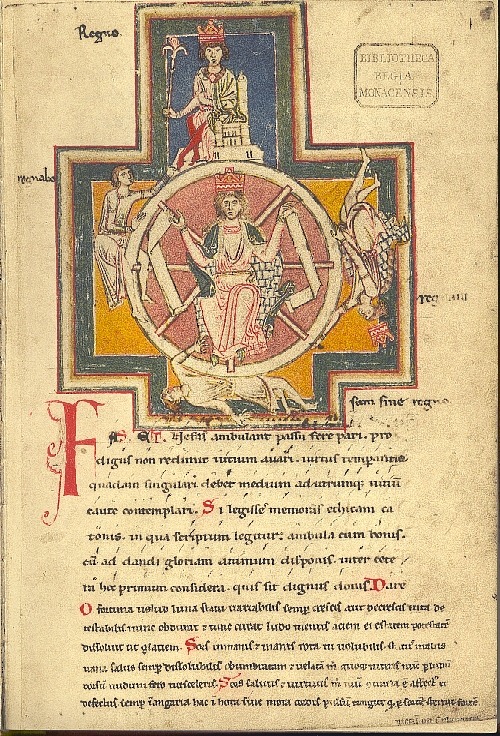
Here’s what the original manuscript to “O Fortuna” looked like:

CarminaBurana_wheel

Rhapsody and Rdio have many productions of Carmina Burana, although most of them are based on the Orff interpretation, which are more fun because they are so emotional.  Orff does rock out, but the old monk sound is appealing, I’m just not sure I’d put any those cuts on a playlist to listen to regularly, but that might change as I learn more about old music.

JWH – 12/17/11

Best Revenue Model for Musicians: Sell or Stream?

I’ve bought thousands of LPs and CDs in my life, and a surprising number of them I only played once.  Now I rent music from Rhapsody and Rdio – total cost $15 a month.  In my heyday of buying CDs, I’d usually spend 10x that or more per month.  I never got into stealing music.  I want the artists and record producers to make their money like they deserve.  However, it’s doubtful I’ll ever go back to buying CDs, and since I’ve acquired the streaming music habit, I have no desire to go back to buying music at all.

The question I’d like to know is:  Can the artists and producers make as much money by streaming as they do by selling?  Finding out about revenue from various music distribution sources is difficult, but there are some clues.

Problem #1 – Artists Used To Make a Lot of Money Off of Crappy Songs?

If I buy a CD for $15 and whether I play it once or a million times, the musicians and producers earn the same amount of money.  If I go to iTunes and sample an album and buy one song I like for $1.29, again it doesn’t matter how many times I play the song, they’ve gotten their money.

Now if I go to Rhapsody and play an album or song, the artist and their record company will get a tiny payment, I assume.  Now if I find one song that I love so much I play it 20 times a day for the entire month, that song should theoretically pay the creators of that song more money for my extra love.  But does it pay the music people enough?  Evidently not, according to The Black Keys, who have pulled their new album from streaming services.

I’m pretty sure selling CDs was the best way of making the most money.  Music lovers had to buy everything pretty much on faith.  The money was up front.  Money from streaming comes after fans play the songs.

Problem #2 – Can Streaming Succeed if Too Many Groups Pull Their Catalogs?

Artists and record producers want to sell albums.  But let’s be honest, how many albums in your collection are ones you like to play straight through and love all the songs?  Or even half the songs?  Or even one song?  Music lovers want to find songs push their music loving brain cells into ecstasy.  But we don’t know which songs do that until we play the album.  In the old days you bought a CD and rushed home hoping to find at least one, and hopefully several great songs on an album.   I’m through with that.  Those days are over.  I’ve been burned too many times.  Streaming music lets me try out all the albums I want, and the songs I love get added to playlists.  Life is easy, but will it last?

If music producers start pulling out of deals with the streaming music services it won’t.  Now we could see a tiered delivery service like we see for movies and DVDs.  Netflix is a cheap all you can eat service, but content comes there last.  This might work for streaming music, where albums go on sale for a period of time before they go to streaming.  I can dig that, but then I’m old and patient.

To get some idea what streaming music does offer, read “Spotify vs. Rdio: Who Has The Exclusives?” over at Wired.  I wished Rhapsody had an API to let it be compared too because I feel from just daily use Rhapsody has the best catalog.  What Wired did was look up 5,000 albums at both services to see which had the most.  Rdio was the winner to me, but Spotify had some much loved exclusives.

It also revealed the holdout groups for streaming music:  The Beatles, King Crimson, AC/DC, The Eagles, Led Zeppelin and Frank Zappa – but hell, I’ve already bought those, some more than once, some even three times.  Streaming music still has millions of albums, so for $4.99-$9.99 it’s a great deal.  But, how many groups have to pull their catalogs before people give up on streaming music?

Problem #3 – Can Artists Make Money Only On How Often a Song is Played?

To make money on streaming music services artists must create songs people want to play and play and play.   If you create an album with 10 songs and people only play one of them, then 9 songs won’t be earning revenue.  Streaming is a dog eat dog world of music competition.  Hit songs will make money.  But will they make the same kind of money as selling hit songs?  I don’t know, and I can’t find out.

Problem #4 – Can the Music Industry Convince People to Buy Music Again

Because of stealing sharing songs free on the Internet, a whole generation feel music should be free.  The convenience of streaming makes getting music for $5-10 a month far easier than stealing, so it might be a viable revenue stream, but can it compete with convincing people to buy music again?  And now that I’ve spent years using streaming music, I don’t know if I’d want to go back to buying music.  But then I’ve got 18,000+ songs I’ve already bought and I’m 60 years old, so I could coast awhile without buying.  If I did go back to buying music I’d buy single songs at Amazon and hope Amazon stays in business for the rest of my life.

Problem #5 – What Happens if Most Fans Go With Streaming?

Even though I own the Beatles, Frank Zappa, Eagles and others on CDs, I no longer play their music.  I went out and bought all the remastered Beatles CDs when they came out and then didn’t even play them.  Streaming music is too convenient and great.  I just don’t mess with my collection anymore.  I recently uploaded it to Google Music, but I don’t play it.  Spotify will call up my library when it can’t find it in theirs, and that’s cool, but I wished Rhapsody and Rdio did that.  I want all my music in one place – in one search engine, and I want it in the cloud, so my playlists work from any computer or mobile device.

Sorry Black Keys, but I’m not going to buy your new album.  Leaving Rhapsody and Rdio doesn’t make me want to go buy your album.  My world of music is now streaming.  If the song ain’t there it ain’t anywhere, at least in my musical reality.

Sources of Streaming Music News and Reviews

JWH – 12/14/11