
Time Travel

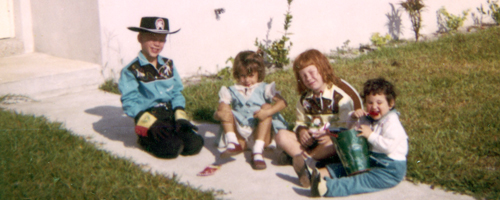
Looking at photos is time traveling. They say a picture is worth a thousand words – I think that’s underestimating the value of a photo. I’m the kid in the cowboy hat and my sister is dressed as a cowgirl. I had just turned seven. Before looking at this photo I could not have told you anything about Christmas 1958. Seeing this photo is triggering all kinds of memories. However, this photo has more details than any of my memories. I don’t know about people with photographic/mnemonic memories, but my memories are vague hazy affairs – more words than images. For example, I vaguely remember getting those cowboy outfits for Christmas. I remember playing quickdraw with my sister. I remember one time she invented a move that blew me away. We went to draw and she dropped to the floor and shot looking up. I thought at the time what a brilliant move for a girl. What a brilliant move for anyone thinking about it now. On TV cowboys always stood up to shoot at each other. What a radical idea to make yourself small and hard to shoot. Maybe it was a bit cowardly looking in terms of gunfighting ethics, but who cares, you’re trying to kill the other guy and stay alive.

See, that memory is really all words. I remember the gunfight took place across the street where a girlfriend of my sister lived. I can’t remember her name or what she looked like – I didn’t remember her at all until I recalled this memory. And I just remembered something else. The doors on our houses opened out, and that girl taught us how to break in by sliding a thin blade between the door and jam and forcing the curved end lock bolt to spring back. Pretty cool for little kids – and we went around the neighborhood trying it on on different doors. I don’t think we met any grown-ups. They might have been around but they obviously fear not from our gang of five to seven year olds.

That memory is also words – and words inspired by a photograph. If I wanted to I could study the photo above and conjure up even more details and incidents – all adding up to a lot more than a thousand words.

What I’m fascinated by is the clarity of the photo in terms of representing reality. Memories are dark cloudy things compared to this photo. Recording reality is one of my favorite topics. High definition video is the ultimate tool for recreating reality. Imagine if we were all given tiny HD cameras that we wore our whole life. Then anytime we wanted we could check back on any event in time. How would that change the world? Video has sound and that really adds more than one dimension to capturing reality. If only that photo above was a video and the camera man had taken time to interview us four kids. I have no memory of who took that photo. I have no memory of what I was thinking at that moment. This was before I read books, magazines or newspapers, so my sense of the world was rather limited. I watched a lot of TV, especially cartoons and kid shows.

If I had had a blog back then I’d probably be comparing Zorro and Paladin, from Have Gun Will Travel, or philosophising about which show had the cooler parents, Donna Reed, Ozzie and Harriet, Danny Thomas or Leave it to Beaver by comparing which kids got to have the most fun. I didn’t watch the news so my blog wouldn’t have had any comments about politics, world affairs or even the beginning of the space race which captured my attention in 1961.

TV was my life at age seven – I mean I don’t remember much about second grade, other than I had a crush on my teacher, Miss Huling. I even pretended to not print my letters correctly so she’d keep me after class for extra lessons. For the most part I lived in kidland. My father was in the Air Force and spent most of his time away from home. I don’t remember what my mother did. Sometimes she worked and we had baby sitters. I have very few memories of either parents from that time – most of my memories deal with the kids in the photo above – from kidland. That house and neighborhood was the key site of my childhood.

You see, the more time I spend with this photo, the more things I can dredge up from 1958. In the creative non-fiction writing class I took a couple years ago, my teacher Kristen Iversen told me that when you start working with writing memoirs you can train yourself to recover lost memories. They are there, you just have to find the links to snag them. Photos are one key for that. Another is books. I use The Complete Directory To Prime Time Network TV Shows to find clues to my early days. Since television was the dominant source of external information for a seven year old in 1958, it’s a vital tool. To a lesser extent information about current events of the time may trigger a memory. I usually start with Wikipedia’s Year listing. The only 1958 clue here is the reference to the F-104 Starfighter, my favorite jet plane as a kid, however I doubt if I knew about this plane at age seven, the year it was introduced, but it’s possible I had seen it on TV. They used to close out TV at night showing a F-104, if memory serves me correctly, and reading a poem about a pilot touching the face of god. I’d love to see that film clip now. Maybe it would trigger additional memories.

As a kid growing up in the middle of the twentieth century I was obsessed with science fiction. I really wanted to travel in space and time. Most people who dream of time travel dream of jumping to historical times and meeting up with famous people. I think I would rather go back and visit myself and ask, “Why the hell are you wasting so much goddamn time watching TV. Do something to give us better memories for the future.”



1,001 Photos

Patty Mike Becky

I’ve started the daunting task of converting our family photos to digital. My wife and I have boxes of photos – our photos, and the photos we’ve inherited from our parents. Plus, my wife was an amateur photographer for a while, and she has hundreds more photos that aren’t related to family history. If I converted them all, I’d have a hobby that would keep me busy for the next couple of years. How many photos do you really need to document a life? Since digital cameras came on the scene, I’ve noticed at holidays and parties more people snapping shots to record the events.

Our niece Hillary had a birthday Saturday night with three photographers. I wonder if she will have those photos when she gets old and what she will think about them. The difference between film and digital photos is quantity. The old film photos are rare treasures. Maybe more photos were taken, and all the poor shots were thrown away over the years, but it seems like digital cameras let people take more photos by several magnitudes. Now-a-days, My Photos folder has thousands of shots, and converting the film and slides will only add to the giant digital pile. How many photos are really needed to document a life?

I have few photos of my life before thirty. I wish I had more. I didn’t own a camera until I was sixteen, and then I took pictures of other people. My parents had an ancient Kodak from before I was born that was used occasionally. I often sit and think about people I knew and places I lived and wished I had a photo to help my memory. This has gotten me to think about how I wished I had documented my life. If I had one photo a week of my family and friends for my life I’d have about 3,000 photos. That’s probably too many. I don’t even have one a year of myself, which would be just 55 photos. If I had taken one a month to chronicle my life, I’d have 660 photos. That still might be too many, but I’m not sure. I think I would have liked four photos a year of myself, either alone or with family and friends just to document how we’ve all aged and show how fashions have changed. That would be 220 photos. That’s not a bad number.

That doesn’t really cover all the people I’d like to have photos of. I’d like a photo of all my teachers, and at least group class shots of all my classmates. Then there are the non-people photos. I would like to have had a photo of every house I lived in, and a photo of each room, and the yard and surrounding neighborhood. I’d like photos of all my schools, and photos of the classrooms. Things are adding up here. Then there are the vacations, school trips, clubs, weddings, funerals, and other special events.

Chronicling a life is adding up to a lot of photos. Wouldn’t it be great if there was a photo repository we could all share? You login and list when and where you lived and what schools you went to and then it would tell you if it had any photos of those times and places. Take for instance the photo above. That’s Patty on the left, and my sister Becky on the right, and my friend Michael Kevin Ralph from April, 1959. It was taken in the subdivision called Lake Forest, near Hollywood, Florida. Maybe Mike and Patty would like to see that photo now. Maybe their parents took photos with me and my sister in them.

Who knows how many photos that are out there would help my memory. I sure would give a lot to see photos taken of me and my classmates in our classrooms. The twelve years from grade one to grade twelve were the longest twelve years of my life, the most memorable, and the most forgotten. I have no photos of any of my teachers – not one. I can’t remember what they looked like, except for Mrs. Travis, my twelfth grade English teacher. I have a vague memory of her – but that’s because I once had a photograph of her, but it’s long lost. I only have one photograph of all my fellow students – and that’s because we’ve remained friends all these years and I have photos of him taken many years after he left school.

If you are young and reading this, my advice is to take your digital camera with you and take photos of all these things because one day you’ll become old like me and wish you had images to prompt your memory. I don’t know why, but school days are very memorable and very forgettable. Try as I might, I can’t remember any entire day. I can’t even remember a portion of a day from my school days. All I remember are tiny events. I don’t know how people write memoirs.

I’ve taken classes in creative non-fiction that deal with writing memoirs, and I’m amazed at what some people claim to remember. It’s not practical to remember everything, but I’d love to remember a few whole days – days that told a good story. I wish they had had blogs when I was growing up and I wish that on a few special days I would have chronicled with words and photographs what I did for twenty-four hours.

For instance, my dad took me and my friends Connell and George to see the Apollo 8 launch. That would have been a good day to have documented. I think when I get really old I’d like a book with 1,001 photos of my life. Too many to look at in one sitting, but enough that I could grasp the big picture of it all.

Super Men and Mighty Mice

During the Ozzie and Harriet years, when I was seven and people called me Jimmy, my sister Becky and our best friends Mikey and Patty, would beg old tattered terrycloth towels from our moms and pretend to be George Reeves. We’d tie those old faded pastel rags around our necks, stretch out our arms, hands flat, fingers pointing forward, tilt our heads down and run like Hanna-Barbera cartoon characters, occasionally jumping with all our might, with the hopes of getting airborne like Superman, or at least Mighty Mouse. And when we were burnt out and our little bodies too tired to try any more, we’d go to sleep at night and have flying dreams.

My sister and I moved around a lot while growing up in the 1950s and 1960s, but wherever we lived it was Kidland, either as part of a mob of kids running up and down the middle of our suburban streets, or in packs roaming the woods, or scattered in hordes over the vast plains of school playgrounds. Kidland was great. It was great because there were no adults. It was beyond fantastic because we were all fueled by our imaginations. Television rocket-fueled our little minds, jazzing our kiddie dramas and kicking those dreams into orbit.

A few years down the timeline, during the black-and-white Beverly Hillbillies era, we could be seen in backyards playing astronauts pretending we were Alan Shepard or John Glenn with cheap white plastic helmets on our heads. After that most of my efforts to fly were in my head and inspired by the philosophy of science fiction, especially the grand master, Robert A. Heinlein. Then the I Dream of Jeannie and Bewitched magic charmed us. We all desperately wanted the skills of being able to twitch our noses and make wishes come true with the flourish of a TV sound effect. Can anyone doubt why in the epic times of The Monkees, Star Trek and The Time Tunnel we turned in our terry cloth capes for grooving with micrograms? Later on into the 1970s, after growing up with Archie Bunker, we became disciples of Carlos Castaneda, studying the ancient wisdom of the New Age, or wishing for rides with little green guys of the third kind. And don’t forget our cousins the Jesus Freaks, Hari Krishnas and Moonies who chanted about the transformation of Earth into Heaven.

Is it too much to say that the Baby Boomers wanted transcendence? Why weren’t boomer guys satisfied with putting on our Brooks Brothers and dancing the nine-to-five? Why weren’t our sisters, the boomer gals, so unsatisfied with wearing stockings and bras and staying at home to be queens for a day every day with Donna Reid?

There is always reality. Meridith Grey cannot fly or make McDreamy disappear with a twitch of her nose, even though she has a nose that reminds me of Samatha. And are the post-boomer generations any different from the boomers? Hiro is our kind of guy. During Christmas I listened to my nephew, an Iraqi vet, talk fondly of the golden age of television cartoons, waxing nostalgic with his brothers over favorite episodes of The Transformers. I kept my mouth shut and just listened, but I was thinking, no way man, The Flintstones and Jetsons were the golden age of cartoons. Yet, it didn’t go unnoticed that the next generation wanted to fly too.

Mighty Mouse

Saving digital files forever

Will all your music, audio books, photos, movies, creative writing, diaries, blogs, email, web pages, business records, and other digital files be usuable and available in fifty years? I have a few files that I first created on my Commodore 64 back in the early 1980s converted to text files and saved in My Documents. I have some digital photos that are over ten years old. I haven’t been very careful with my MP3 files, and have thrown many of them out. I’ve even lost or misplaced some iTunes and Rhapsody songs that I’ve bought. Mostly, my My Documents folder grows and grows, becoming a giant trunk of junk that I move forward with every new computer. I’ve even started backing it up to an external USB drive – but if thieves stole both my computer and external drive it would all be gone. My wife’s computer is just as junky, plus she buys a lot of online games and if her machine died we’d be hurting for a lot of missing serial numbers.

Until we started scanning in old photos and slides I didn’t worry much about protecting my files. Some of the photos we are scanning are from the 1920s. We’re now in the business of protecting family memories that are 85 years old. I’m thinking of converting some of my record and CD collection that goes back to the 1950s. I’ve even been collecting old audio book tapes and converting them to digital to listen to on my iPod. All this stuff may not represent a lot of money, but it does represent a lot of time.

The only solution I’ve imagined so far is to copy files to my work computer. I’ve already started bringing work files home as a precaution. But it’s not very convenient at all.

I bought a program called Second Copy that automatically copies my hard disk files to my external USB drive. It has a FTP function in the new version 7.0 that I’ve been meaning to try. I’ve wondered about setting up a FTP server at work as a target for my home files. I haven’t asked my boss what he thinks of that, but I’m willing to offer setting up a FTP server at home to send my work files to. I need to research finding a secure FTP program that would run in background on my two machines.

This isn’t a solution for most people, although many people do work with computers and it could become a fairly common solution. There are probably all kinds of legal issues to deal with. Another possibility is making reciprocal deals with friends and family. The trouble with that solution is most people don’t have static IP addresses or even computers with unchanging domain names from a DHCP pool. I do know people play online games so there is a solution for computer to computer communication. I’ll have to research that.

I just did a Google search and discovered a company Mozy.com that promises unlimited online backups for $54.95 a year, or $4.95 a month. That may be far more convenient than messing with FTP servers – if I could trust Mozy. What I really want is a data bank – a bank for my data files that is as trustworthy as my regular bank is for money. I think I’ll clean up my My Documents folder and sign up with Mozy. I’m not sure how long it will take to transfer 60 gigabytes to them, or if they are really sincere about promising unlimited storage.


The Long Term Value of Personal Web Sites

I’ve been developing web pages since Mosaic first rolled out.  I ran gopher sites before that.  I work at a University in the College of Education and the internet has always been considered a great educational tool.  First, before the World Wide Web, it was just email, UseNet and FTP.  When home pages and HTML came on the scene, educators immediately took to the idea that all students should become writers, publishers and graphic designers and those skills should be universal like knowing how to do basic math.

 
This wonderful ideal was quickly shot down when it was discovered that most students hated creating web pages in HTML, or even with WYSIWYG HTML editors.  Millions of home pages were created and then left to die of neglect.  Most web users prefer browsing commercial sites, or sites created by highly motivated amateurs.  Entertaining pages are hard to write and develop.  A few years later blogging became all the rage because it allows the ordinary person to create web sites with limited technical skills that appealed to people you know.  Blogging has since exploded into a creative outlet of many forms.   Years ago the idea of anyone reading your diary would cause extreme emotional distress – now people think nothing of confessing their most personal activities, including sexual and criminal, as well as their favorite tedious boring ones too.

 
Most blogs have limited appeal and also die the great static death of neglect, but they are far more popular because they are much easier to create and they have actually proven to be purposeful.  It doesn’t matter if the whole world isn’t watching as long as a few friends are.  To inspire people to create web sites really means giving them a useful purpose that people will value.  Higher Education keeps promoting web development to students but they have yet to find a purpose that students appreciate.  The big thing now is student portfolios.  Except for educators who like the concept of student portfolios, there seems to be no one else, including students, who see a purpose in visiting them.  They remain a solution looking for a problem.

 
Blogs succeed, in their very limited fashion, because many people do have a slight drive to express themselves, and because blogs provide for a certain amount of social bonding.  Yet, I wonder about their long term success.  Back in the 1950s everyone liked trying out the hula hoop but few people stuck with the toy.  Email is a natural success replacing the age old letter.  Its purpose is evident to all.  Photo sharing sites are succeeding because they serve an obvious purpose.  The success of online gaming is a no-brainer.  But be honest, how many blogs do you read faithfully?  What about Wikis?  Wikipedia is a huge success because a big encyclopedia has obvious purpose.  Online shopping, online banking, online shopping – are all concepts that have obvious purpose.  But think for a moment – how many sites do you visit that were created by amateurs?  They have their limited appeal, but is creating web sites a skill that should be promote to all kids?

 
That leads me to wonder if there is anything about creating personal web sites that have obvious long term purpose.  Are there any reasons for the average person to express themselves on the web that has lasting value?  Famous people maintain web sites to manage their fame.  Experts like to keep websites to focus on special topics.  Politicians like web sites to gather voters.  I have a web site about the classics of science fiction that’s been up for years getting a constant 40-50 hits a day from people wanting to find a list of top science fiction books.  I maintain another web site about Lady Dorothy Mills, a long dead and forgotten writer of fifteen books from the 1920s.  I maintain this site to find her last few readers.  It gets handful of hits a month, and about one email a year.  Both of these sites have extremely minor purpose, but enough.  So do people find a purpose in maintaining web sites about what they watched on TV last night?  Or jotting down a few lines each day about their moods?

 
What aspect of human nature would lend itself to the creation of personal web sites of lasting value?  We know friendship motivates blogging and it might have a limited long term value, but it may end up being a fad.    Most people prefer phones, email and IM.  Scrap booking is a hot fad right now, and photo albums have been a part of family treasures since the invention of the camera.  Diaries and journals have always been kept by a small fragment of the population which accounts for some of the appeal of blogging.   List making is a habit of some people so it might have a certain appeal – but probably to people who also have a collecting habit.

 
The only additional trait of human nature I can think of now that might motivate people to create personal web sites is the desire to be remembered.  Genealogy is a popular hobby, and a good percentage of people like to hear stories about their ancestors.  I’d love to be able to read a blog written by my father while he was growing up in Miami in the 1920s and 1930s.  Or one written by my grandmother, who was born in 1881, and came to Memphis in 1902, to find office work as a single woman.  I have to be realistic though.  How many people would put in the hard work at maintaining a readable diary with the thought it might be read by their descendants?  My idea of creating a Wiki to store my own memories for me to read as a help to remembering might be of more realistic value since people are living longer and forgetting more.

 
No one really predicted the massive success of the World Wide Web.  Science fiction writers never saw it coming.  For the most part they failed to predict the impact of the computer.  It’s very hard to predict what the web will mean to people in 20 or 50 or 100 years – it’s been around for a dozen years and become integral to society.  It’s now taken for granted like electricity or automobiles.  The internet is always finding new uses – look how international terrorists have found new ways to use it.  I just wonder how many people will find a personal reason to publish on the internet.

 
Finally, can a personal website last a lifetime and longer?  Will any blogging site still be up and running 100 years form now?  Unless some governmental agency, like the Library of Congress, offers to host web sites with the charter of preserving them forever, I doubt personal web sites will have a long term existence.  If the web had been invented in 600 B.C., would sites of Homer, Jesus, Caesar, Galileo, etc. still be up?  I doubt it.  It’s going to be very hard to preserve the web.  The knowledge of history we do have comes mainly from recorded history.  Would the major religions have survived without their various bibles?  Anthropologists learn a lot about ancient societies from their business records, tax records and shopping lists.  A thousand years into the future a lot could be said about our times from the database of Amazon.com.

 
I think personal web sites, for whatever purpose, won’t achieve critical mass of value until they are considered permanent.  If people knew they were writing for their children, grandchildren and future genealogists and historians, then personal web sites might take on a whole new meaning.