Understanding Identity Theft-And the Scary Implications of Stopping It

With the recent Target hacking scare, identity theft has almost become a panic.  My goal here is to explain identity theft to myself and my readers so we can avoid it, but also to reveal a surprise side-effect of stopping identity theft.  One news commentator pointed out that Europe uses Smart Cards which are more secure against identity theft, and I wondered why we don’t use them in the U.S.?  This got me to thinking about the nature of identity theft.  To simplify, here are the basics:

  • Person
  • Proof of Identity
  • Financial institution
  • Transaction system
  • Business
  • Thief
  • Fake Identity

Because we now have electronic transfer of spending instead of money, the goal of a thief is to initiate a financial transaction with a stolen information about your identity.  When you deposit money in a bank or get a line of credit from a credit company, those institutions create an identity profile of you.  To spend money requires proving your identity at a transaction location.

identity_theft

Our old fashioned credit cards are rather simple.  The POS (point of sale) validates the card to see if it’s active.  The cashier must accept proof of identity from the person using the card.  If you are standing at the Target checkout counter, they will ask for an ID, or if you are buying from Amazon, they will ask for a password.  Both are easy to fake.  There’s a reason why many credit card thieves first go to gas stations – they don’t require any proof of identity. 

Even though the Target hackers stole over a hundred million card numbers and pins, they still have to find businesses that will process  transactions without a proof of identity, or create fake credit cards and fake identities.  Because they also stole names, addresses, and personal information, PINs, this is a scary possibility.

Proof of Identity

Every person has dozens of identities.  Your school or work has a system to identity you.  Your bank, credit card companies, insurance companies, health insurer, stock broker, library, utility company, phone company, etc., all have ways to identify you.  Even if you stood right in front of each of them, they wouldn’t know you personally.  They know you by your proof of identity.  Normally this is name, address, phone number, social security number, credit card number, library card number, customer number, etc.  Often this is in the form of ID card.  All of this information is easily stolen, and easily used by thieves.  In the old days, a fake driver’s license and stolen checks or credit cards was all it took to spend someone else’s money.  Now it’s just a name, debit card number and pin.

How To Stop Identity Theft

The current methods of protecting identity theft are far from perfect, but they are:

  • Keep your personal information as secret as possible
  • Use strong passwords and encourage the use of secondary pass phrases
  • Use credit cards from companies that have strong security monitoring
  • Monitor credit rating services
  • Hire a monitoring service

These efforts fall into two phases.  First, keep your information away from identity thieves, and second, stop thieves as quickly as possible when they do steal your identity.  What we really want is to stop thieves altogether. 

The best way to stop identity theft is absolute proof of identity.  This means creating a validation system to prove you are you in any financial transaction, whether in person or online.  I don’t believe Smart Cards are the solution.  Smart Cards are just credit cards with a computer chip – they make it harder for thieves but not impossible.  What we really want is biometric authentication.   This is technology that connects authentication to our biological selves – thumb print, voice pattern, retinal scan, face pattern, DNA, and so on.  Of course this means revamping our entire financial transactional system.  How does Amazon take your thumbprint?

There is new technology that might allow this transformation quicker than we thought – the smart phone.  But first some digression.

Let’s say a thumb print and voice pattern becomes the standard of identification.  How are they taken, and how are they validated?  There are a number of ways.  Smart Cards could store your voice and thumb print on a chip, and a POS terminal could take your prints and validate them against the card.  That would make things much more secure, but theoretically thieves could print fake Smart Cards with their prints recorded in them with your financial identity.  What we want is your credit card company to store a copy of your voice and thumb print, and the have the POS terminal authenticate your prints when you make a transaction.  Then we won’t need credit cards at all.  Identity will be bodily proof.

The trouble is our current infrastructure isn’t set up for this, so what would be the fastest way to transform our society into one secure from identity thieves?  Like I said, smart phones might be the answer.

There are many unique qualities about a smart phone.  The phone number, the IP address, the SIM card, the hardware address for the Wi-Fi card, etc.  All that’s needed is a way to tie your physical body to the smart phone.  Ultimately, in some science fictional future, I believe we’ll have a identity chip implanted in our bodies at birth and all our network connections will recognize us that way.  But until that future arrives, I believe smart phones are the answer.

Some smart phones can already do thumb prints, and voice prints can be done in software.  Newer phones could be designed to make biometric validation even easier.  Think of a smart phone as a genius level Smart Card.  To make a financial transaction you’d need your phone and your body.  That’s very hard for thieves to steal.  Not impossible.  A thief holding a gun to your head could make you buy things, give you money at ATMs.  But stress detectors might be added to smart phones to tell if a user is under duress.  We’re getting very close to foolproof.

Good Side Effects

If such a smart phone authentication system was developed it could have many positive side effects.  We’d have one of the best electronic voting systems possible.  It would allow for easy political referendums, or extensive public opinion polls.  This would change the nature of record keeping for school system, health insurance, all the way down to library cards.  Used in schools it would allow for instant testing and grading.  The spin-offs are endless.

Of course it would reduce identity theft.

Bad Side Effects

Identity theft is an easy way for thieves to steal from people without meeting them.  If we take this away, thieves will have to go back to being more personal about taking our stuff.  Switching to a smart phone authentication might increase robberies, muggings and burglaries.

However, the real scary thing about smart phone identity authentication is it creates a global identity card that’s extremely easy to track.  Americans have always been against a national ID card, and this system would be that to the nth degree.  Since we know the NSA is already tracking our phones, it’s not hard to imagine a whole host of governmental agencies, as well as businesses tracking our every move, communication and transaction.

It would make living off the grid almost impossible.  Anyone without a smart phone would have a very difficult time establishing any kind of identity with businesses, hospitals, insurers, libraries, credit agencies, etc.  If every policeman had a smart phone that could talk to your smart phone think of the Big Brother angle of that.

Other Solutions

Life on Earth is always evolving, and so does technology.  If we wanted, we could invent anonymous electronic spending.  Money is slowly disappearing, and with it privacy.  You can buy pre-paid credit cards and anonymous dumb phones to maintain your privacy, but that might not last for long.  If money disappears how do you buy pre-paid cards?  With direct deposit paychecks its now impossible to live without a bank account, and that requires a networkable identity, and thus a way to authenticate that identity.

People might not know it, but we’re on a path to no privacy.  For some people that might not matter, for others it matters a great deal.

JWH – 2/11/14

When Does Abnormal Become the New Normal?

There’s two films showing at Sundance this week about web addiction.  Web Junkie from China is about teens going through rehab for internet addiction, a condition that China deems a psychological category for severe treatment.  Then there is Love Child, about a Korean couple who let their real baby starved to death while obsessively caring for a virtual baby.  A while back there was a spate of articles stating that 45% of Japanese women 16-24 were not interested in sex.  Then there are all those stories about Japanese children never leaving their bedroom – it even has a name, Hikikomori.  And the long term trend in America is to live alone.  Any many young women today claim their boyfriends would rather play video games than have sex.

Now I imagine there are parents in America who would love to send their kids to camps to get them away from their computers, but I’m not sure we think of compulsive internet use as an addiction.  When everyone is a pod person, it’s hard to know there’s another way of life.

How much is too much of anything?  When does something become an addiction?  Are bookworms who read all day book addicts?  Lots of retired people spend their entire days watching television.  Are they TV addicts?  Of course, people who work 60 hours a week are sometimes said to be addicted to their jobs, and called workaholics.

Evidently, there’s an assume dichotomy:  normal life and escapism, so if we spend too much time away from normal, we’re addicted.  But what if living in front of a computer becomes normal.  I was a computer programmer, and often spent my entire work day in front of a monitor.  And, then I came home and spent my evening in front of a computer writing.  Was I addicted?  Or was that just life?

I spend a lot of time at my computer desk.  I don’t play games, and I don’t stream TV and movies.  I do write, listen to music and read news stories, all of which I did before computers and the Internet, and what I would do if I didn’t have the Internet.  A couple years ago I lived three days without power and in the evening I’d write by pen on a yellow pad, listened to books and music on my iPod touch, and played old radio show tapes on an ancient Sony Walkman, all by flickering candlelight.

web-junkie

I know what they mean about addiction.  Younger people do spend a lot of time on the net.  But women my age spend a lot of time on their smartphones, and panic when they don’t have them.  And more people than ever seem to love living alone, often with their TV, computer, and game console.

Is the real problem video games?  Is the main worry that video are games more appealing than day-to-day living?  In the film clip above one young guy says he played World of Warcraft for 15 days straight.  Now, maybe that is an addiction.  However, if you have lots of free time, isn’t a computer game a higher form of stimulation?  It’s certainly more engaging than reading or watching television.  We live in a world of growing unemployment.  A good portion of our population is without engaging work, so why not turn to the Internet.  It’s better than drugs – where the original meaning of addiction comes from.  And what does it say when video games are more appealing than sex?

And there’s one more thing to consider.  Humans are self-aware beings living inside a skull of an animal.  We have five senses bringing data in from the reality outside of our body.  Could the Internet be our sixth sense?  Or an extension to our sight and hearing?  Doesn’t the Internet just extend the range of our body’s normal senses?  Can living alone on the Internet be considered the beginning of a hive mind?

Is hearing a real tree fall in the forest different from hearing a virtual tree fall in the forest?

JWH 1/22/14

The Speed of Knowledge versus Copyright

No one yet knows the real impact of the Internet on human society.  If it wasn’t for copyright laws, the Internet could be the ultimate library. A dazzling library that it would surpass all existing world libraries and all libraries in history.  Even now, most people get more information from the Internet than they ever gotten from a library, or for that matter, from books, magazines, journals and newspapers.  Yet, the Internet is severely hobbled by copyright.

Writers need to make a living, and publishers need to make a profit, so it’s understandable that copyrights should protect intellectual property.  I don’t resent the need for writers and publishers to make money.  I do resent that making money impedes the flow of knowledge.  It’s a shame that the current distribution systems are so inefficient at spreading commercial knowledge.

the-new-yorker-january-6-2014-1

Take for instance the article I just read in The New Yorker, “The Gene Factory” by Michael Spector.  If you follow the link you’ll reach a teaser section of the article and information about how to subscribe.  This does not let you quickly read the article, which means you probably won’t.  If you’re already a subscriber and have set up your digital access, or can just grab your latest copy of the magazine, then reading is a little faster, but not quite as convenient as following a link.  Please make the effort, the article is worth it.

Many journals and magazines do offer to let readers buy an immediate reprint, usually for several dollars.  This is step in the right direction, but their pricing structure usually causes web users to skip the article.  Now I would prefer that the content of all magazines, journals and newspaper be free, but I’m no old hippie, and can understand the need to charge.  What I suggest is to make selling articles easier and price them at impulse buying fees.  What we need is a good micropayment system so publishers can charge 10-99 cents an article.

“The Gene Factory” by Michael Spector is an article that most people should read, but especially people worried about America’s future and science fiction writers.  If you’ve ever seen the movie Gattica then you’ll know what this article is about.  Then again, if you’ve ever been fascinated by the decline of the British Empire and wondered when and how the American Empire would start declining, then again, this article is for you.

gattaca

“The Gene Factory” is specifically about  Beijing Genomics Institute (BGI), but also about the impact of gene sequencing on human society.  The New Yorker article is very long and full of wonderful details and speculation, far more than I want to paraphrase here.  Which is why our society would be so much different if I could just provide you a link and you could go read the article.  Then if the article also included links to all the research that Michael Spector put into writing the article, we could all study what he has to say in depth.

Now, wouldn’t that increase the speed of knowledge?  And if you don’t feel the need for such speed, then again, I recommend you read the article.

Some magazines like The Atlantic and The Smithsonian put much of their content online for free.  I wonder if ideas in their content is spread faster and further throughout the world’s population than paywall controlled content?  That has to be the case, but I’d love to see the numbers.  Wouldn’t it be lovely to see public hit statistics for every article on the web?  Wouldn’t it be very cool to have a place on the web to see what people are reading, the Top 100,000 for the last hour, day, week, month, year and decade?  Think about the data mining possibilities!

Even cooler would be a raw hit score, plus a weighted score from people voting reading value.  So much more could be done for the Internet.  I feel like I’m thinking about television technology in 1939 and wondering what its real potential will be.

By the way, I use the Internet service Next Issue to subscribe to over 125 magazines for $15 a month.  It’s a quick way to get access to The New Yorker and many other magazines.  Next Issue might be worth trying just to read “The Gene Factory.”

JWH – 1/2/13

Rethinking My Kindle Magazine Subscriptions–And Electronic Magazines in General

Years ago I cancelled all my magazine subscriptions to go paperless.  I was finding plenty to read on the Internet for free, and I was experimenting with services like Zinio, which offers electronic magazines.  Then I got a Kindle and iPad and subscribed to Kindle magazines at Amazon.  I liked I could subscribe by the month, and quit any time.  But like paper editions of magazines, I often didn’t keep up, and unread back issues piled up.  So I cancelled my Kindle subscription to The Rolling Stone.  I thought I’d have all my back issues to read when I got some free time, but once you cancel, you can’t download the issues, even for the ones I’ve “bought.”  If you had previously downloaded an issue it stayed on my iPad.  Unfortunately, I discovered there were many I never downloaded, even though their cover image was in my library listing.

See, I was thinking all those back issues were mine to read whenever I wanted, even if I wanted to wait years.  But that wasn’t the case.  I’m not bitching about Amazon’s licensing restrictions, I’m just reporting how things work.  It turns out that when I re-subscribed I could go back and download those previously subscribed issues.  In other words, you can get past back issues if your currently subscribing and paid for them previously, but they aren’t accessible when you aren’t paying the current monthly fee.

Reading on the iPad wasn’t bad, but I had an iPad 2, the one before the Retina Display, and reading small print was a bitch.  Using a tablet for both bookshelf and reader has it’s drawbacks.  When I upgraded to iOS 7 and v. 4 of the Kindle Reader, it zapped my collection of old magazines, telling me I needed to download them again.  I had just cancelled my Kindle subscription of The Rolling Stone, because I had started getting the paper copy again, and thus I couldn’t re-download my old issues.

Okay, I thought, the reason I subscribed to the paper copy of The Rolling Stone was to get access to the complete archive online.  Well, that didn’t work out either.  The online viewer for The Rolling Stone has one of the worst screen readers I’ve ever used.  It magnifies better than the iPad, but moving around the page and between pages is just flat out horrible.  I can’t believe many people would take the time to read old copies of RS online.

[Update 10-18-13 – the RS online reader looks great on my 24″ iMac at work.  For some reason the reader controls and the bottom of the page are removed from my Windows 7/Chrome browsing.  I also tested it on Ubuntu 13.10, with Firefox on a 1280×1024 screen.  It worked better than Windows 7/Chrome but not as nearly as good as Mac/Safari.  Unfortunately, I don’t have a Mac at home.  I need to test Windows 7/IE and iPad 2 when I get home.  Maybe there’s hope.]

What’s funny is the reader that comes with the complete archive on DVD is much better, but still clunky.  They’ve had that reader for years.  The current online reader won’t even show the bottom of the page on my 23” 1920×1080 screen.  It’s a huge step backward.

You know what? It turns out the old fashion paper magazine is the real winner here.  Damn, technology goes down in flames.

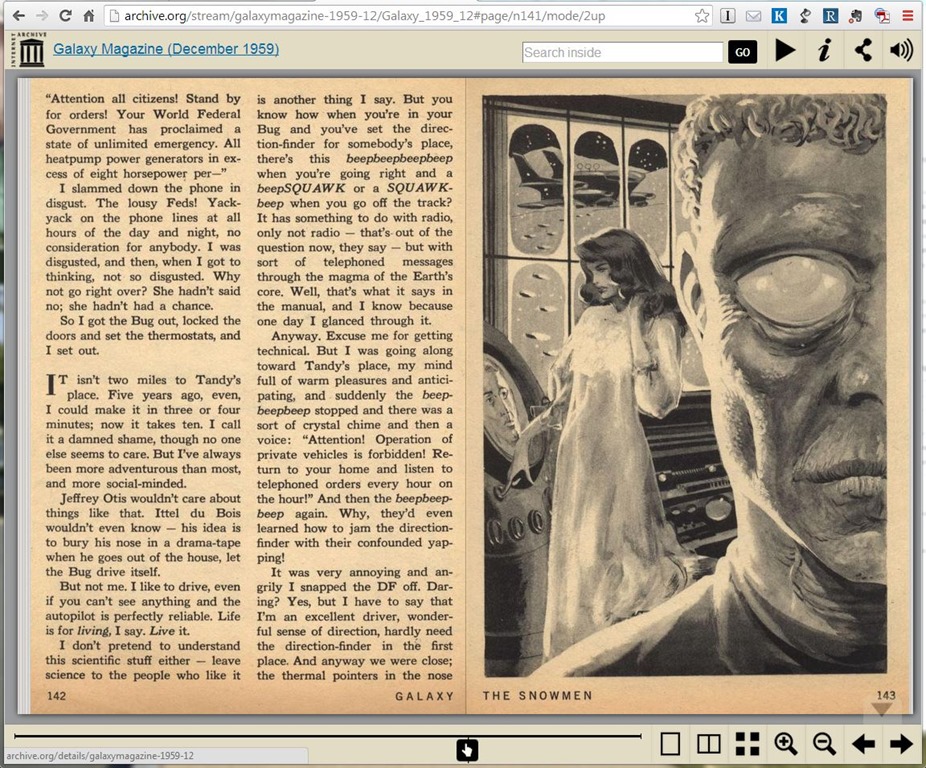
Now it is possible to create an elegant screen reader that shows old magazines, just look this December, 1959 issue of Galaxy Magazine at Archive.org.  If the folks at The Rolling Stone used this program to show it’s back issues I’d be in periodical heaven.

galaxy-mag

[Click to enlarge]

Now I’d love to have a complete back run of Galaxy Magazine in this format.  It would be better than owning all those shelves of moldy pulp paper copies.  And it would be great to have them on a modern tablet with 2560 x 1600 pixels screen.  The Archive.org reader works very well on my iPad, making it the most comfortable way to read this classic SF mag.

The ideal way to read magazines would be to have a large, very high resolution tablet, with the complete archive of a magazine online, and an excellent viewer app.  That way the environment benefits, and we wouldn’t be bothered by shelves and shelves of old magazines to maintain.

Right now I’m very disappointed with the electronic versions of The Rolling Stone, either tablet version or online version.  Reading the paper version is the easiest technology.  That’s a shame.  I was so looking forward to doing some serious reading of past years of The Rolling Stone.  Now that I start my retirement years next Wednesday I’ve got some real reading time.

JWH – 10/17/13

How Internet Pricing Influences My Buying Decisions

You can go out at night and see a movie for $10.  Watching a movie a night would cost $300 a month.

If you like to own and collect movies, you could buy DVDs and Blu-rays for the same amount of money if you shopped for bargains, ending up collecting 365 movies a year.  But if you’re buying a new movie every night to watch, when would you re-watch anything in your collection?  Ownership ain’t what it used to be.

Then there’s cable TV.  For $80 a month, 24×7 movies, don’t worry about going out, shopping, collecting or shelving.

But for $7.99 a month can join Netflix and get one disc out at a time, and if you watch them immediately, and live in a city with a distribution center, might squeeze in a dozen movies a month, paying 67 cents a movie.  $15.99 a month you can get 3 discs out at a time, and probably cover having a movie every night of the month, getting your per flick cost down to 53 cents.

For that same $7.99 you can get Netflix streaming, and theoretically watch twelve 2-hour movies a day all month.  $7.99 / (12 x 30), which is about 2 cents a movie, or a more realistic 26 cents a movie if you watching only one a night.

Of course, you could just steal movies on the net and pay 0 cents per movie, but hey, we’re not thieves.

In other words, the Internet makes things cheaper.  But does it improve our lives and society to let people watch a movie for 26 cents?

In 1965 I became a record addict, and averaged buying 2 to 4 albums a week until I found Internet Pricing.  In the old days I bought LPs, and then CDs.  At it’s peak I was spending $200-300 a month on music.  Now I spend a flat $9.99 a month at Rdio and get access to over 20 million songs.  Internet Pricing strikes again.

My wife and I used to subscribe to the local paper and over twenty magazines.  Except for a couple e-magazine subscriptions on my Kindle, I no longer subscribe to periodicals and read stuff off the internet for free.

I’d like to get The New York Times, but at $15 a month is too expensive to what I’ve got accustomed to from Internet Pricing.  For $18 a month I get Netflix streaming and Rdio, or tens of thousands of movies, television shows, documentaries, and a couple million albums.  So why would I pay $15 for a single daily paper?  Why isn’t there a company that charges $7.99 a month to read all newspapers from around the world?

Next Issue charges $15/month for access to 107 magazines.  That’s the same price The New York Times charges for 1 newspaper.  Sadly, none of my favorite magazines are available through Next Issue (The Atlantic, Rolling Stone, New York Review of Books, Scientific American, Smithsonian, Harpers, Discover, New Scientist, Sky & Telescope, etc.)

See, I’ve been corrupted by Internet Pricing.  At one time getting The New York Times for $15 a month would have been a tremendous bargain.  Now, I feel it’s too expensive when I compared other content I buy off the Internet.  My innate sense of pricing was also distorted by reading the NYT for free online for years, and the fact there are many good newspapers from around the world that are still free to read online.

Would we have a more vibrant economy, with more jobs, if the internet didn’t exist?

I’ve been corrupted by Internet Pricing in other ways.  Last month I wanted to buy an issue of Harper’s Magazine to read one article.  But I just couldn’t let myself spend $5.99 to read one article.  However Harper’s is tempting me.  For subscribers to their paper copy, they give access to 163 years of back issues on the internet.  I can get a year sub to Harper’s at Amazon for $15.  See how Internet Pricing is disruptive?  $15 for one month of the NY Times, or $15 for 163 years of Harper’s Magazine for a year.  The New York Review of Books recently offered me 10 issues for $10 that included 50 years of online archives.  The Rolling Stone also has a similar deal for $19.95 for a 26 issue sub and a complete run of back issues online.  I don’t want paper copies of anything, but I do want access to complete archives.  However, they won’t sell me just the archive access.  Those savvy magazines publishers have figured things out, sell their old technology at normal prices and give Internet Pricing for free.  I took the $10 deal, and I’m seriously considering subscribing to magazines again if I get their complete archive.

I go into a bookstore now and it kills me to pay list price for a magazine.  I’ve been corrupted by Internet Pricing.  Now I might just be a cheapskate, but what if I’m typical.  How is being corrupted by Internet Pricing affecting people across the world. What is its impact on GDP?

JWH – 9/23/13