Global Impact of 1 Watt of Electricity

When my computer, monitor and external hard drive are turned off they use 9 watts of electricity while still plugged in.  But if I unplug the external drive to shut it off completely, my system uses 8 watts in its off state.  So what’s the impact of saving 1 watt?  What if every person on Earth could save 1 watt, what would that mean, because 7,000,000,000 watts is a lot of watts.  That’s 7,000 MW of use.  Nanticoke Generating Station in Canada, can produce 3,964 MW of power, the largest coal fired plant in North America, and according to Wikipedia supports up to 2.5 million households.

In other words, saving just 1 watt would be equal to decommissioning two extremely large coal fired generating stations, or fourteen 500 MW smaller ones.  That’s nothing to sneeze at, especially when some people consider the Nanticoke plant the single largest producer of carbon emissions in Canada.

The Department of Energy reports that the average US household uses 936 kWh per month.  That 936,000 watts for one hour.  If I leave my external hard drive on, it will use 730 kWh, which doesn’t sound like much compared to 936,000, but every bit helps.  If I leave 10 extra watts burning, that’s 7,300 kWh.  I used 586 kW hours this month, so my energy saving efforts puts me about 30% below the average.  But if electricity was directly proportional to carbon use, then President Obama wants us to use 83% less by 2050.  That would mean bringing the average use down to 159 kWh per month, so I have a long way to go.  So you see why every watt counts.

However, electricity is not directly proportional to carbon usage.  It depends on whether you get your power from coal, nuclear, wind, oil, solar, natural gas, etc.  If I had solar panels on my roof it wouldn’t matter how much electricity I used.  Also, the global impact of 1 watt is not equal across the world.  Americans may use 936 kWh monthly, whereas some people use none.  Our impact on the environment is many times the global average, so the more we use the more the rest of the world suffers.  Of course, most citizens of the world would love to consume like Americans, so we also set the standard of desire.

Saving every watt we can is not about saving money, it’s an ethical and moral issue.  To justify our lifestyles we must either use less or generate more carbon free electricity.  Ignoring the issue only makes us sinners of omission.

JWH – 12/16/9

Can You Be More Specific About That 83% By 2050 Number, Mr. President?

Since I don’t want to put things off until 2050, I thought I might get busy doing my share of green duties now, but I’m not quite sure what this 83% number means.  Do I drive 83% less miles, eat 83% less food, buy 83% less clothing, watch 83% less TV?  Is buying a car that gets twice the mileage and driving half as far cover my personal obligation?  Or does buying that new car up my carbon footprint more than if I drove my old car for ten more years even if it only gets 19 mpg?  And will there be any gasoline in 2050 to use anyway?

Yesterday, I wrote about Designing an Energy Efficient Green PC, and showed how we could buy a computer now that already uses 83% less electricity than some machines from 2005.  The trouble is I don’t actually know the average energy consumption of a PC and monitor from 2005.  If we’re all supposed to use 83% less by 2050, we really need to know the 2005 baseline for all the possible things we use in our daily life.

How many kilowatt hours of electricity did the average American use in 2005?  How many gallons of gasoline?  How many cubit feet of natural gas?  How many gallons of fresh water.  How many pounds of clothing?  How many pounds of sugar, flour, beef, fish, vegetables, cheese, butter, etc.  Do I have to worry about my share of iron, aluminum, steel, nitrogen, etc?  Everything we consume creates a carbon footprint, but what is the 2005 baseline number for each item?  And most important of all, what is the average carbon footprint for a 2005 citizen of America?  Or what is the fair share for a world citizen of 2005?

And should poor Americans consume 83% less than what they were able to scrape by with in 2005, and will it be fair if billionaires cut their carbon footprint by the same 83 percentage but still use far more than the average person?  Or should there be one carbon expenditure for each person that makes them a good citizen?  And how does a rich person using a 1,000 times what a poor person uses rationalize their lifestyle?  Should the targeted carbon footprint be 1/7,000,000,000th of the whole world’s safe expenditure of carbon, rather than 1/300,000,000th of the U.S.’s 2005 expenditure?

Will COP15 United Nations Climate Change Conference in Copenhagen tell me these numbers I want to know?  Will they tell us the ethical answers to questions about the rich buying carbon credits from the poor?  And is the carbon footprint just the tip of the iceberg?  Are there other elements in the environment that we’re throwing out of whack?  Are the billions of humans on this planet akin to a cancer destroying all other life forms in its path?  What does it mean to design a lifestyle for a sustainable ecology for planet Earth?

Whether you support climate science, or are a climate change denier, it should be obvious we’re over consuming this planet and the age of material abundance is almost over.  Even atheists should recognize the spiritual crisis of our times, and even fundamentalists should recognize the mathematics of reality.

JWH – 12/7/9

Designing an Energy Efficient Green PC

If President Obama wants to reduce 2005 level greenhouse gas emissions by 17 percent by 2020, and 83 percent by 2050 then we have to make some significant changes – and one major area to do that is with computers.  Concurrent with the President’s news announcement is one at Computerworld that reported “Harvard study: Computers don’t save hospitals money.”  If you combine the idea that IT isn’t paying its way, along with the need to use less resources, with the fact that all over the world IT budgets are being cut, forcing IT folks to look for far better ROIs, it’s really time to rethink the value of the computer.

If the President wants us to reduce our energy use by 83 percent before 2050, that means computers running at 200 watts today need to run at 34 watts by mid-century.  It also means for every 100 watts used in manufacturing a computer now, should only take 17 watts in 2050.  Or for every 100 pounds of building materials that go into making computers today, Dell and others will need to build the same number of machines with 17 pounds of materials.

One way to maximize the efficiency of manufacturing is by designing a machine that will last longer.  If a machine with a lifetime of 5 years, lasts for 10, then you’ve created a 50% reduction in resources required to build the machine without changing the design.

There is no reason why computers can’t be designed to reach the 2050 goal well before 2020.  Green computers that have come out since 2005 already save 50% or more over earlier designs.  What’s needed is a tight focus on the problem by everyone, so when a home or office buyer is comparing computers to purchase they should see something like the EPA Mileage sticker numbers we see when buying a car. 

The President and EPA should mandate that all energy using products come with a label stating how much energy the products uses and what percentage that use is from the industry average back in 2005.  For example, on a computer system it might say Idle: 65 watts, Load: 95 watts,  Percent 2005 Average:  47%.   The figures I list are roughly possible from my general reading, so I’m pretty sure we could get to the magic 17% number far sooner than 2050.  (I hope my math is correct, 83% reduction should mean we’re still using 17%.) With newly designed computers, the target could be achieved sometime between 2012-2020. 

However, the energy a computer uses isn’t its only burden on the environment.  The physical resources and energy that go into manufacturing a computer is a huge factor too, as is the resources it takes to manage and maintain the machine over it’s lifetime.  Then there is the impact IT systems make on a business, the cost in dollars to buy and maintain equipment.  IT costs should improve the bottom line, not bloat the budget and staffing, or burden the workforce with extra time consuming duties that don’t improve their overall productivity.

In designing a computer for the future we should consider all of this and more.  For instance, how much manpower, time and carbon is wasted on viruses and other malware?  Maybe the whole concept of an upgradable computer OS should be examined?  Like televisions of old, which often had lifetimes of 10-20 years, they were sold intending to work the same, day in, and day out.  They didn’t slow down over time, or quit working because TV shows had dangerous video elements.  Our future energy efficient computer could have the operating system burned into motherboard and be instant on with the tiniest vampire electrical drain on the power grid.  If machines were instant on, people are more likely to turn them off.  If the main portion of the operating system is set in silicon, it shouldn’t be corruptible by malware.

Life Expectancy

Most PCs last 3-5 years before they are replaced, although some people push their machines to 6-7 years.  We need to quickly expand the life expectancy of a PC to 10 years, and then work towards making them last to 15-20 years.  Once they become a solid-state brick of a brain, that shouldn’t be hard to do.  And today’s quad processing CPUs have the power to be useful for a very long time.  Will an typical American worker ever need more then an Intel i5?

Size Matters

The average physical dimension and weight of computers have been shrinking for years because of laptops, but the average mini-tower desktop has not.  Even though more than half of personal computers used now are laptops, office workers and some home users prefer a desktop.  Designing a CPU box 1/5th the size of a standard mini-tower means reducing the resources needed to make it by 4/5ths.  Our goal should be to jettison the optical drive and expansion slots, and design a desktop that is basically a CPU/GPU/memory circuit board with a few ports.  Think of it as a silicon brain.

Dell-Zino

Laptops are quickly moving to slimmer designs, but they still can be improved.  Laptops need to be design to last longer and withstand more wear so they can thoroughly enjoyed for 10 plus years.

LCD/LED screens need to stay large though, because large screens often mean more productivity, but future displays can be designed to use less power, need less resources to build and last longer.  Like the powerful CPU, we want to maximize the benefit of the computer while reducing its environmental impact. 

Components

We need to get rid of all moving parts, and any unneeded feature that  requires physical resources, like ports, wires and cables.  Of course we need to do studies to see which is more efficient: wires or wireless.  The optical drive needs to go for sure, and so does the mechanical hard drive.  And most users don’t need powerful discrete graphic cards.  And how many people still use modems?  The evolution towards single chip computers is moving ahead nicely.  Today’s computers take far fewer chip sets then their ancestors.  CPUs are getting smaller and smarter, requiring fewer watts to run, running cooler, and do more motherboard jobs.

CPU

There are lots of CPU designs out there that use less than 20 watts, but they aren’t powerful enough for the average user.  The more we use computers the more we find for them to do, and this won’t change in the future.  The minimum computer CPU should at least be 2 cores, but probably 4 if we want the device to last 10-20 years.  If fact, I’d recommend getting 4 cores now because if you get a machine with just 2 cores today, you’ll probably want to replace it within the next 5 years.  The key is to buy the most efficient 4 core chip, like the Intel i5.  AMD needs to follow suit with an even more energy efficient chip to challenge Intel.

Operating System

All operating systems have been evolving towards better energy use, but there are other factors to consider.  As computers become smaller and more energy efficient they also become cheaper and much better deals for businesses, but operating systems like Windows and Max OS have not come down in price proportional to the price of machines.  Should Windows 7 cost the same $125 for a machine that’s $1200, $600 or $400?  What if we could build an energy efficient CPU brain for for $300?  It hurts to shell out so much for the OS.  That’s why many system builders switch to Linux, which is free.

What about the cost of support?  Apple brags they provide a better deal in their I’m a Mac commercials, but buying from an OS vender who wants to maintain a monopoly on computer hardware is silly.  Microsoft is more democratic, willing to sell to any hardware vender and has become the worldwide standard, but Microsoft still has a stranglehold over the industry that’s not efficient.  If this current recession had been a long one, I bet many businesses would have eventually switched to Linux because free is hard to beat.

Linux has already proved that it can be widely distributed without packaging and install disks, although most users burn an .iso image to a CD to install it, but new techniques of copying install files to flash drives is eliminating that wasteful practice too.  Think of all the packaging that goes into marketing Windows 7 and Snow Leopard, as well as the burden of shipping it around the world.

However, the best solution would be for operating systems to come on the motherboard where it can’t be altered by viruses and malware.  The operating system needs to become invisible to the user, and not a religion.  It doesn’t matter who’s a PC or Mac.  Because like the Harvard study about computers in hospitals, if you can’t reduce IT costs and make everything cheaper, then computers are not a solution, but a problem. A truly Green PC should be a tool to eliminate waste in all areas of life. 

Cloud Computing

As more computer applications move to the cloud it reduces the need for proprietary operating systems and hardware, which should reduce the overall cost of buying a machine.  Cloud computing saves resources in other ways.  Buyers no longer have to purchased boxed programs with DVDs and manuals, IT support staff don’t have to go around and install programs on client machines, and cloud computing apps are usually easier to use.

With cloud computing we should be able to hide the CPU brain inside the monitor and the user shouldn’t even have to worry about what OS runs it, or who makes it.  The more IT hardware melts away from the desks of the users, the more energy efficient it will be, and the more cost effective IT will become.

Paradigm Shifts

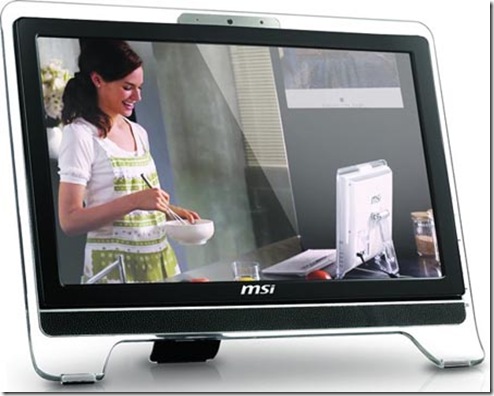
What does all this mean?  Well, computer sales should tank as computers become more energy efficient and we manage to make them IT efficient too.  A 22” inch LED screen with high-powered but energy efficient quad processer hidden away inside running a rock solid stable OS at 20 watts of power using a near universal interface, and costs just $500 while lasting 12 years will have a tremendous impact on society, business and computer sales.  The iMac is an elegant design showing the future of desktop computers, so when a competing product running a firmware version of Linux comes out built around cloud computing concepts then you might should pay attention.  Ponder where Google Chrome OS going?
new-all-in-one-1

Take for instance my desire to buy a new computer.  I’m looking at getting a 1-2 terabyte drive because of all the digital music and photos I have.  I have 18,000 ripped songs from my CDs to maintain, but if I knew I could always play them from the cloud, through Rhapsody or Lala, I could think about getting a smaller drive.  In fact, if I knew online storage was more reliable than hard disks I might even settle for a smallish solid-state disk drive.  Since I hardly ever buy shrink wrap software anymore, I’m thinking of doing without a CD/DVD drive.  Streaming Netflix and online video content also suggest a future without optical drives.

Once I get all my old photographs digitized I’m not sure if I’ll need my scanner anymore.  And I print so seldom that I worry that the print-heads on my Canon inkjet are going to die.  So if the CPU box and my all-in-one printer-copier-scanner disappear from my desk I’ll be overjoyed.

The Winning Design

The all-in-one desktop/monitor like the iMac, without an optical drive but with a SSD drive is the winning design for an energy efficient PC.  It does away with the whole CPU box, a major savings in resources and energy, plus it gets rid of so many wires, which is another area of savings.  And it has just one power supply.  Finally, its a design without moving parts.  This is a very elegant solution, and it’s a shame that Steve Jobs doesn’t allow other hardware makers to license the Mac OS – but the world economy can’t accept a system from a hardware monopoly.  Besides, it’s really time to get serious about Linux on the desktop – since it has become a world OS.

Here’s a review of four all-in-one machines that use 66-75% less now.   I don’t think it would take too much innovation to design machines with a 23″ 1920×1020 LED screen and have the power of today’s quad processors and reach 90% less power.  The machines reviewed are on the wimpy side for power users, so my point is I think its possible to design muscle machines for power users that are 2050 green too.

By the Year 2050

With the regard to computers, I’m not sure if the President even needs to mandate that they use 83 percent less energy by 2050 because computers are already evolving in that direction anyway.  Laptops are getting lighter, and to make them last longer on a batter charge, they have to be designed to use far less power.  Desktop all-in-one monitor/CPU designs also use less power and take less resources to make, and they take up far less desk space.  I’d be surprise if the average computer doesn’t use 83% less power by 2015.

At the beginning of the essay I said if the average machine today used 200 watts we’d have to design machines to run on 34 watts by the year 2050 to meet the President’s goal.  Well, here’s a machine reviewed at Tom’s Hardware that runs at 35 watts.  It uses a powerful E8600 Intel chip, and for 37 watts, you can get a motherboard with GeForce 9300 graphics.  How hard will it be for engineers to get such a system down to 15 watts?

If only we could change everything else so fast.  And maybe we can.  It might be a far less scary job than we think.  I got a new energy efficient HVAC last year and my utility bills are 30-50% less.  If I remodeled my house with better insulation I’d save even more.  The next time I have to buy a car I’ll probably cut my gas usage by 50%.  I think we’ll see change far faster in all areas before 2050.

Sites that review CPU Power Consumption

JWH – 12/5/9
The Weight of Paper

Nanny, my grandmother on my mother’s side, was born in 1881 and grew up before the automobile, airplane, radio and silent film.  She watched all the technology emerged that in my boyhood I took for granted, like electricity, the telephone, refrigerators, cloth washers and dryers, air conditioners, etc.  She died a couple years after Neil and Buzz landed on the Moon. 

My mother was born in 1916 and grew up with the radio, at a time when movies morphed from silent pictures into talkies, watched the television age emerge, drove across the country before the interstate highway system was built, and lived long enough to see computers become personal, phones stored in pockets and the world wired for computer networks, although she refused to own a cell phone or computer. 

I was born in 1951, and I’m not sure if I’ve seen as much dramatic cultural change as those two women, but I grew up in front of a TV, watching the advent of the space age, the computer age and the digital age, and if I live long enough I might see far more dramatic transformations.  They both lived to 91, and if I could live as long, I will see the world change as much as they did from 1881 and 1916 until 1951.

Computers are changing the way we all live, but have they changed us as much as the automobile, airplane, radio, movie and television?  Current digital technology often makes me dislike the way I used to do things, even though I feel strong nostalgia for how things were. Take reading for instance, all aspects of my reading habits have changed in my lifetime.  I now listen to books on an iPod, or read them printed on small digital screens like in Star Trek.  For a more specific example, my wife is nagging me about my magazine collection, housed in two six foot high bookcases. 

I love magazines, and spent six years working in a Periodicals department at a university library.  My home library contains hundreds of issues from dozens of titles.  Even Susan asks, “Can’t you get them on online?”  I stopped reading newspapers years ago, and I might stop reading magazines soon.  I prefer audio books now, even though I spent my whole life as a bookworm, and 99% of the words I read with my eyes each day come through my computer screen.  I even listen to magazines, like The New Yorker, and prefer it to reading.

The weight of a single sheet of paper is almost unnoticeable, but the weight of twelve shelves of magazines is quite heavy.  Since we had new flooring put in this month, I had to move four bookcases of books, and two bookcases of magazines and the weight of that paper was almost backbreaking.  How many trees went into making all that paper?  What was the impact on the environment?

Awhile back, to do my bit to fight global warming, I started going paperless, and cut my magazines subscriptions from over 20 to just 2 (Sky and Telescope and Rolling Stone – what an odd couple, huh?).  But I kept all my old issues hoping to get the maximum reading value someday, and maybe even clip the best articles to scan into my computer.  I’m at point in time when I’m shifting away from one kind of living, with paper, and moving into another way of life, without paper. 

I still buy an occasional mag at the bookstore, but even that makes me feel guilty, because that means my pile of unfinished magazines keeps growing, and more trees were cut down.  I tend to flip through a magazine and read the shorter pieces and tell myself that I’ve just got to find time for those great longer pieces someday, but I seldom do.  The weight of paper can also be measured in time, and I have a huge amount of time theoretically reserved for that reading.  Throwing all those magazines out will reduce the weight of possessions and free up a lot of imagined obligated hours, probably in the thousands.

I have nice long runs of Sky and Telescope, Astronomy Magazine, New Scientist, Scientific American, National Geographic, Smithsonian, Popular Photography and many others.  I like to think of them as my reference library, but honestly, I rarely refer to them.  Reading online has become my habitual way of info-gathering.  And since I often read online articles about the dwindling subscriber base to newspapers and periodicals, I’m guessing there are many people like me.  If only they made a Kindle-like reading device with a large full-colored screen, I’d probably do 100% my eye reading from online sources.

But I must also emphasize the shift from eye reading to ear reading has been very important to me.  That’s another paradigm shift, and I think it scares people in the literacy profession.

Throwing away my magazine collection would be like throwing away the past.  According to Wikipedia, general interest magazines started in 1731 with The Gentleman’s Magazine, so will we see the era of the printed magazine end before it’s 300th anniversary?  When I was born the pulp magazine format was dying and the science fiction and fantasy digest magazine was beginning.  Today those digests are disappearing and a new crop of online SF/F magazines are emerging.  Read Jason Sanford’s recent survey of these new short story venues for emerging writers of fantastic fiction.  Will getting published be as exciting?  It will certainly be easier to send copies to your friends.

Today I read “Ten things mobiles have made, or will make, obsolete.”  Among the ten items was paper, (also included were pay phones, landline home phones, MP3 players, netbooks, small digital cameras, handheld game consoles, wristwatches and alarm clocks).  It’s quite easy to read on an iPhone, whether it’s a book, short story, magazine article or news item.

There is also talk that the United States Postal Service is failing.  I can understand why, because only 1 piece of mail in 15 is something I actual need, and even that piece could be eliminated by electronic billing.  Nearly everything I get in my mailbox goes right into the recycling bin.  This is especially a shame for all those fancy full-color catalogs, resources terribly wasted because I don’t even flip through their pages.

The era of paper might be nearing its end.  The more effort I put into recycling the more I realize that most paper trees die in vain, and their lives would be better spent absorbing carbon dioxide.  I will agonize over all the people in paper related industries who will lose their jobs, but the history of the world is change, and nothing stays the same.

If I lived until 2042, to become 91 like my mother and grandmother, I might see the end of newspapers, magazines and books.  I’ll probably see the passing of paper photographs, 8-16-35-70mm film formats, LPs, CDs, DVDs, BDs and any other form of audio-visual physical storage.  Stranger still, I might see the end of libraries and bookstores.  Everything will be digital, and the net will be a universal library.  Newsstands are already disappearing fast.  Bookstore business is still growing, but if the Kindle and its kin catch on, that will change too.  And libraries aren’t what they used to be.

The age of wasting natural resources should end in our lifetimes, either from changing our lifestyles to avoid the worst of global warming, or by adapting to the new environments that global warming brings into existence.  It is impossible to know the future.  It is impossible to know what black swan changes are in store for us.  The folks of 1881 could not picture 1916 much less 1951 and 2009 is beyond anything anyone could imagine from the 19th century, so I can’t really predict 2019 or 2042.

However, when was the last time you put a coin in a pay phone or a letter in a letter box?  How many other things have you stopped doing in recent years that you haven’t even notice you stopped doing?  It’s easy to be amazed by new inventions, but will we even notice when the weight of all that paper is gone?

JWH – 11/24/9

Where are the Wholesome TV Shows?

I’m wondering if the TV shows I watch make a statement about my personality, or even more, if they influence it.  I constantly argue with my friends about the old nature versus nurture debate, with me believing biology is the stronger force, while my feminist friends holding firm to the power cultural influences.  If my lady friends are right, then television programs us.  If me and my males friends who side with biology are right, then television only reflects our baser instincts.

And I’m sure members of God’s flock will ask: Where do I, an atheist, get the moral authority to judge what’s wholesome about TV.  Maybe I can define “wholesome TV” in a way that both the spiritual minded seeking moral goodness, and the secular wanting uplifting humanism, can agree.  I’m afraid my definition will be tricky because it aims to be two things at once.  Fiction is both a mirror to personality and a microscope examining culture.  To question fiction’s purpose is akin to debugging one’s own programming.

My definition of “Wholesome Television Shows” are those teleplays that reflect positive cultural programming or ones that educate viewers about biology’s influence on human relations.  Wholesome TV should provide inspiring role models and illuminate the weaknesses we should all seek to overcome.  Wholesome fiction should constantly explore what it means to improve oneself and our species.  Whether you are a fundamentalist or a humanist, the desire for wholesome entertainment is a desire to improve the whole. 

TV shows from the 1950s often naively tried to do this, with each episode of “Leave it to Beaver” and “Father Knows Best” presenting a moral lesson, and reinforcing conservative beliefs.  Creating wholesome fiction is not the goal of most TV writers, they seek to make money by entertaining.  Most audiences find moralizing condescending.  Uplifting is a very difficult trick to pull off.

The other night I watched an episode of Leave it to Beaver, and then rewatched my favorite science fiction movie, Gattaca.  From my viewpoint, Gattaca is the perfect example of modern, adult wholesome entertainment.  I wonder what Christian fundamentalists would make of my evidence?  Just because I don’t see God in the universe doesn’t mean I don’t see the beauty of spiritually uplifting humanity.  Vincent Freeman’s relentless drive to overcome the dictates of genetics is a uplifting spiritual quest.

The average TV viewer doesn’t want morality plays about improving their souls, they want high impact entertainment that provides fabulous escapism.  In other words, Americans crave boob tube heroin, where they can kick back in their recliners and experience opium intense visions through their flat panel screens.  This adult audience doesn’t want wholesome TV.  Wholesome TV is primary a idealized concept that parents want for their children, and some adults want because they are tired of feeling like Romans at the Coliseum when turning on their TVs.

I’m too old to wonder what I’ll be when I grow up, but I have to wonder how kids today view their future.  And if I was a proud parent, would I want my kids watching television?  If my feminist friends are right, and cultural programming is the dominant influence on personality, then what kind of code are we loading into the brains of today’s rug rats?  As a concession to my feminist friends, young women of 2009 are far different from young women of 1909 or 1809.  I would argue they are the same because of biology, but freed of cultural repression, we are seeing more of their true instinct.

The overwhelming message to kids from modern television, is teaching them that if they aren’t extremely sexual active they are failures, losers and dorks.  Following that, television illustrates that wealth is everything, that money equals sexual partners, freedom, and power.  After that, the subtle message that’s constantly beaten into their heads is violence is the best solution.  Is it any wonder I claim biology is the dominant influence on personality?  Television constantly shows alpha males fighting for prized females, or females going to inhuman efforts to be sexual irresistible.

Don’t get me wrong, modern television does have it’s good messages about tolerance for diversity, preaching ecological education, promoting GLBT acceptance, often dealing with subtle ethical issues, while regularly championing societal underdogs, and exploring political controversial topics of the day.  However, it seldom promotes hard work and discipline and usually sees the academic successful as the socially challenged.  On TV, sarcasm is presented as the supreme method for demonstrating intelligence.

The television shows I like to watch reflect a deep addiction for fiction and escapism, but I can also imagine they could also represent moral failure.  My top three favorite shows right now are Big Love, Dexter and True Blood, in that order.  Critically I’d rate them A+, A+, A-, but none attempt to be Gattaca.  None of them are wholesome, although, strangely enough, I might advocate Dexter, a sympathetic look at a serial killer, as the most wholesome of the bunch. 

Dexter Morgan knows his genetic programming commands him to kill, but he constantly struggles with the ethics of being a serial killer, all the while trying to understand what it means to be a good human, because he knows he’s not.  Don’t get me wrong, I would rate all my favorite shows M30.  I’m not sure people under 30 should watch them.  In fact, I can’t think of any primetime ABC, CBS, NBC show I’d recommend for the under 18 crowd.  Over at Parents Television Council, they could only find one show they gave their Green light to, Are You Smarter Than a 5th Grader.  Most primetime broadcast TV shows are rated Red, and a few Yellow by the stoplight metaphor coding.

The most wholesome network show I watch is The Big Bang Theory, which the above group rates Red.  I love this geek fest show, especially because it’s the only show on TV about scientists, but I’m not sure if it’s a flattering portrayal, and it gives a bad message to kids:  Scientists are comic book reading dweebs, nothing but silly characters who can’t get laid, or worse still, don’t even think about getting laid.  What if television producers create a show about JPL scientists that was realistic, dramatic, inspirational, and encourage kids to believe science was a tremendously exciting career?  Television has totally failed at presenting science to the public.  Science fiction is usually fantasy escapism, and shows like CSI lamely present a silly, simplistic, and inaccurate view of science and technology.  CSI makes science look like slight-of-hand, only reinforcing Arthur C. Clarke’s famous comment, “Any sufficiently advanced technology is indistinguishable from magic.”

Is all of this a failure of television, or really a failure of fiction?  If we consider non-fiction, then there’s a true abundance of shows worthy of young people’s viewing.  Fictional television fails at presenting role models, and its efforts of cultural programming are mixed.  Nor is fictional programming that educational about burden of biology places on our personality.  It amply illustrates the sex drive, but never reveals it as a burden.  Television only reflects a worship of sex and never deconstructs sexual impulses.  We all know rubbing our genitals together is pleasurable, but why is the quest to find the right frictional partner so common in storytelling?  And if fiction isn’t about sex, it’s about conflict and violence.  Would the Harry Potter books been as satisfying if they lacked all the killing?

Sex and death are natural parts of life, but fiction gives the illusion that sex and death are the most common aspects of life.  By not watching the local news, my crime filled city seems peaceful.  In real life I never see other people having sex.  Mostly I see people struggling to get ahead at their education or work, or improving their house and lawn.  Is the craving for fiction the urge to see what we don’t in normal life?  Is my craving for wholesome television just a craving for what I don’t see in my life?

The defining moral and ethical issue of our lives is global warming.  Will we be the generation that fiddles while Rome burns?  Many scientists are now saying we only have one decade to transform ourselves before our habits push the environment past the point of now return.  We are a generation of Noahs, but instead of building an ark and collecting animals, we’re watching television.  As far as I’m concerned fiction has totally failed to address this issue.

If I had any backbone I’d beat my addiction to fiction and throw it off completely.  I crave wholesome fiction, because I feel it’s a time in our culture when we need it.  However, my addiction to sensational fiction is too great.  It’s beauty is to powerful to ignore.  However I am cutting back on my drug of choice by reading more non-fiction.  Mostly I fix my fiction habit with television and movies, and leave reading to non-fiction, but I’m starting to watch ever more documentaries.  If I was a parent, I’d urge my kids to watch quality documentaries, but there is a third force in the nature-nurture debate that may even be more powerful, and that’s peer pressure. 

The young will find their own art to admire.  We have no choice in the matter.  The young are programmed by biology and fuel by pop culture.  I can’t image what they will look back to in forty years and see in this decade as their wholesome television.  Two and a Half Men is no Leave it to Beaver.  And what kind of role models do Britney Spears, Fergie and Lady GaGa make for young women?  Read this interview with Megan Fox to see an example of a contemporary thoroughly modern Millie.

The moral majority’s demand for wholesome TV is really a tempest in a teapot.  Just watch ABC Family and Disney Channel TV shows.  Are they really that wholesome?  They might be cleaner, but are they uplifting?  And are their shows improving this generation of children?  Is Disney’s Britney Spears a reasonable example of a wholesome upbringing and current role model?

NBC’s ER was a reasonably good wholesome show because it was very positive about doctors and medicine, providing gritty, but realistic role models.  Compare that to Gray’s Anatomy?  Is there any show on TV now that have characters you’d want for your children to admire?  I hate to say it, but Dexter the serial killer is at least aspiring to be a better human.  I don’t even see that in most shows.

JWH – 8/13/9