The Visual Limitations of Novels

This week I read The Sheltering Sky by Paul Bowles first published in 1949, and then I watched the 1990 film version by Bernardo Bertolucci with Debra Winger and John Malkovich.  I found the novel a stunning example of writing, and the movie a stunning example of cinematography, which only made it obvious that novels are severely limited in evoking the visual world.  Reading the novel, the world of Port and Kit Moresby felt claustrophobic and small,  but seeing the same couple on screen, showed them living in a vast panoramic vista.

sheltering-sky

In mind, I knew Kit and Port were traveling across Algeria in the late 1940s, after WWII, so the sky should have been getting bigger and brighter as they got closer to the Sahara, but instead it got darker.  That’s because the story was getting psychologically darker.  In fact, their world as I imagined it, was often dark, with few people and buildings.  The book so reminded me of Heart of Darkness by Joseph Conrad, that I thought Bowles must have used it as a model.  In the film version of The Sheltering Sky, the streets were crowded with people, and the cities and villages were sprawling with buildings with narrow maze like streets, and everything was bright, colorful and beautiful.  The gorgeous visuals overwhelmed the dark brooding characters.

It was jarring to watch the film right after reading the book because it looked nothing like what I imagined, but obviously the film looked like the world Bowles wrote about and lived in.

Reading The Sheltering Sky and then watching its film version made me see the difference in the two art forms.  And it’s not because Bowles didn’t give me the information to visualize.

When she was hungry, she rose, picked up her bag, and walked among the rocks along a path of sorts, probably made by goats, which ran parallel to the walls of the town. The sun had risen; already she felt its heat on the back of her neck. She raised the hood of her haïk. In the distance were the sounds of the town: voices crying out and dogs barking. Presently she passed beneath one of the flat-arched gates and was again in the city. No one noticed her. The market was full of black women in white robes. She went up to one of the women and took a jar of buttermilk out of her hand. When she had drunk it, the woman stood waiting to be paid. Kit frowned and stooped to open her bag. A few other women, some carrying babies at their backs, stopped to watch. She pulled a thousand-franc note out of the pile and offered it. But the woman stared at the paper and made a gesture of refusal. Kit still held it forth. Once the other had understood that no different money was to be given her, she set up a great cry and began to call for the police. The laughing women crowded in eagerly, and some of them took the proffered note, examining it with curiosity, and finally handing it back to Kit. Their language was soft and unfamiliar. A white horse trotted past; astride it sat a tall Negro in a khaki uniform, his face decorated with deep cicatrizations like a carved wooden mask. Kit broke away from the women and raised her arms toward him, expecting him to lift her up, but he looked at her askance and rode off. Several men joined the group of onlookers, and stood somewhat apart from the women, grinning. One of them, spotting the bill in her hand, stepped nearer and began to examine her and the valise with increasing interest. Like the others, he was tall, thin and very black, and he wore a ragged burnous slung across his shoulders, but his costume included a pair of dirty white European trousers instead of the long native undergarment. Approaching her, he tapped her on the arm and said something to her in Arabic; she did not understand. Then he said: “Toi parles français?” She did not move; she did not know what to do. “Oui,” she replied at length.

There is much visual detail in this passage, but I never saw it in my mind’s eye.  I never “saw” Algeria like I saw it in the film.  Now that I’m reading passages from the book after seeing the movie, I’m “reading” it differently, and seeing it differently in my mind.  This might be a clue to always see the movie first.  I find the Harry Potter movies fantastic illustrations of the books, but poor substitutes for them.

Just look at this film clip and then imagine how to describe in it words.  Does the words camel, caravan and desert even come close to evoking what we see?

While watching the movie I felt the soul of the novel had disappeared.  The experience of reading and viewing beautifully illustrated the difference between the visual medium of film, and the world of black and white letters that are decoded inside our head.  The novel is rich in details I can’t see, and can’t be filmed.  Or can they? 

Movies seldom have narrative commentary.  One example I can think of is the theatrical release of Blade Runner, where Harrison Ford provided a film noir detective voice over.  I’ve always preferred the theatrical release over Ridley Scott’s director’s cut.  I wish movie makers would experiment with unseen narrators to see if they could get closer to filming classic books.  There is an aspect to books that is neither dialog or description, that is always left out of movies.

I also read Hull Zero Three by Greg Bear this week and it begs for a movie treatment, or at least a graphic novel adaption.  Bear describes a world that is as visually bizarre as Oz, and a spaceship with three hulls.  I have no way of visualizing this story.  And the novel, Hull Zero Three is written like an action film, so it feels like the soul of a novel is left out.

I wonder what my reading experience of The Sheltering Sky would have been like if Paul Bowles had included National Geographic like photographs of all the locations Port and Kit visited on their trip?  I know of one book that did this, Time and Again by Jack Finney, a time travel novel about 19th century New York City.  The book included 19th century photographs of the city.  It made a huge difference to the story.  I wonder how I would have experienced Hull Zero Three differently if Bear had commissioned illustrations for his book?

I assume writers expect readers to do all the mental cinematography themselves, but I don’t think it would hurt if they provided a few seed images.  I’ve talked to many readers who claim to hate movies of their favorite stories because it ruins their own mental images they have created.  I think my problem is I don’t visualize books as I read them, and illustrations and photographs would be helpful crutches for people like me.

I recommend creating your own experiments to test the visual powers of novels.  Would the monster hit TV show Downton Abbey be as popular if it was just a novel, without all the beautiful visuals?  And think about all the many visual interpretations of Sherlock Holmes?  There are many film versions of classic books Little Women and Pride and Prejudice.  Try reading the books before or after seeing the movies and see for yourself the visual limitations of novels.

JWH – 3/23/13

The Shelf Life of Nonfiction

I buy books faster than I can read them, and some books go stale before I get around to consuming them.  Fiction is often timeless, but for nonfiction, most books have a shelf life.  A ten to twenty year old science book is usually not worth reading.  Books about politics and economics go bad even quicker.  And books about current events and pop culture have practically no shelf life at all.

Yesterday I started reading Hackers & Painters: Big Ideas From the Computer Age by Paul Graham, published in 2004.  When this book came out, the back of the dust cover had seven high praising blurbs, but I think time has tarnished the luster of its big ideas.  I’m not singling out Paul Graham for criticism, but using his book as an example of what time does to nonfiction, and to compare it to how fiction holds up better over time.

Hackers_&_Painters

For example Graham writes about nerds and geeks and speculates on the nature of popularity and how it appears that being smart is a good thing before and after high school, but not during.  Eight years later, this essay seems dated because the topic has been well covered since.  However, when I think of great stories about nerds and geeks, I think of King Dork, a 2006 book by Frank Portman, Sixteen Candles, a John Hughes film from 1984, and Freaks and Geeks, a TV show from the 1999-2000 season.  Graham’s nonfiction essay has few reporting details, other than some vague personal memories.  Graham was abstractly talking about the reputation of being smart among high school students, and if you were clued into his message it might have felt insightful in 2004.  It doesn’t in 2013.

Most of the essays are still somewhat appealing, but were probably much fresher as blog or magazine pieces at the time.  You can read them here, and in particular, “Why Nerds are Unpopular.”  I think the fictional accounts I mention above clearly show why nerds are unpopular, and these art forms have lasting power.  Now, this isn’t meant to criticize Graham’s essays.  I write the same kind of essays myself for this blog, and I often wonder if my ideas wouldn’t be better presented as fiction.  Social commentary often works better shown not told.

I wonder if 1981’s The Soul of a New Machine by Tracy Kidder would hold up to rereading today?  It won the National Book Award and Pulitzer Prize in 1982.  Tracy used an abundance of actual details, and reported on the lives of engineers designing the Data General Eclipse MV/8000 minicomputer.  No one cares about that minicomputer today.  I found the book riveting at the time, but would I now?  Readers today might care about the history of the subculture that built it, but it would be an esoteric read.  I need to get a copy of The Soul of a New Machine and reread it to see how well it holds up 30+ years later.   Few people will ever read The Soul of a New Machine today, but many will keep watching movies like The Social Network (2010) long into the future.

Sure, some nonfiction books do have lasting power.  People still read On the Origin of Species by Charles Darwin from 1859 and Walden; or, Life in the Woods by Henry David Thoreau from 1854.  Would more people understand these books if they were made into movies?

When I pulled Hackers & Painters off the shelf to read last week, I also pulled Monkey Girl: Evolution, Education, Religion, and the Battle for America’s Soul (2007) by Edward Humes, Off the Planet: Surviving Five Perilous Months Aboard the Space Station Mir (1999) by Jerry M. Linenger, and Axel’s Castle: A Study in the Imaginative Literature of 1870-1930 (1931) by Edmund Wilson.  The Wilson book is the most famous, but only known to literary theory historians probably.

These books are all worth reading, but do they really hold up?  Off the Planet offers the gritty details of being an astronaut and is far more realistic than any science fiction book.  And think about that.  Few people read about real space travel, and millions embrace highly unbelievable space opera in books, comics and movies.  For the most part people just prefer fiction to fact.

Monkey Girl is a serious book.  It’s an important book.  It’s about the teaching of evolution in schools and the legal actions against it.  A subject always in the news.  Monkey Girl is brilliant reporting on reality, with thousands of details and ideas to chew on.  I think that’s a clue to the success of nonfiction lasting.  Nonfiction must report details, not speculation.  A book like Eden’s Outcast, John Matteson’s 2007 biography of Louisa May Alcott and her father Bronson Alcott is timeless – until another biographer puts in more work that overshadows it.

I’m slowly moving from being a fiction bookworm to a nonfiction bookworm.  We’ve always cherished and judged great novels as art, but I think we need to apply the same attention to nonfiction.  Most nonfiction published is no more lasting than a newspaper, but some nonfiction books do have a long shelf life and we need to consider them as art too.

Yet, why does fiction have so much more lasting power than nonfiction?  I’m reading South Wind by Paul Douglas, a fictionalize account of British expats living on the island of Capri published in 1971.  Would a nonfiction travel book written at the time be more informative?  Before that I read Confessions of a Crap Artist by Philip K. Dick, a fictionalize account of 1959 life in Marin County, California.  I found it totally compelling.

What does fiction have that nonfiction doesn’t to make it enduring?  How is it we often find fiction more educational about the past than nonfiction books?

Writing nonfiction that’s powerful and lasting, should contain an abundance of facts that our collective soul won’t want to forget.  Either from research or reporting, nonfiction that’s as powerful as fiction must contain an overwhelming collection of vivid details about life in another time.  Strangely enough, it’s the accumulation of significant creative details that make fiction powerful.  Fiction can be lies that last for centuries.  Few nonfiction books last very long.  They are always superseded by books with better facts, but some nonfiction books do last.  We need to identify and think about them.

Here is Modern Library’s 100 Best Nonfiction Books.  There are many wonderful books on this list, but most of them just don’t convey the concept of classics to me.  I’ve only read nine of them, and read parts of a few others.  I often reread great fictional novels, but rarely reread a nonfiction book.  Why?

That’s another kind of shelf life.  I keep my favorite novels, but I give away the nonfiction I admire.

JWH – 1/22/13

Life of Pi–Is God the Better Story?

Director Ang Lee and screenwriter David Magee have done an excellent job of adapting Yann Martel’s 2001 novel Life of Pi to film.  When I read the book back in 2004 I thought at the time it would never be made into a film because the novel was too cerebral, too narrative heavy, plus, how could anyone get a tiger to do all that acting?

bengal-tiger

Life of Pi the film covered a surprising amount of the content of Life of Pi the book.  So far I can think of just three scenes I missed.  First, story of Pi’s family running into Pi’s three religious leaders.  Second, showing how Pi used turtles to survive, and finally, the scene where Pi is blind and hears people in another life raft.

Still, Lee and Magee beautifully succeeded with capturing the philosophical heart of the novel.  If you loved the book, go see the film, you’ll be surprised by how well it was filmed.

Is God the Better Story?

If you haven’t read the book or seen the movie, don’t read beyond this point if you plan do either, because I’m going to analyze the philosophical statement of the book and it will spoil the story.

In the main story, a boy from India, Piscine Molitor Patel,  who wants to be called Pi, is shipwreck in a lifeboat with a zebra, orangutan, hyena and a tiger named Richard Parker.  Martel tells us this story very realistically and we are expected to believe it happened. But along the way, Martel takes us through scenes that are very hard to believe, like the carnivorous island with the meerkats.

Yann Martel has crafted a Zen kōan into a novel.  Most kōans are short, “What is the sound of one hand clapping.”   Yann Martel essentially asks, “Is God the better story?”

At the beginning of the novel and movie, in a pseudo introduction, the author is told by an older Pi, that he can tell the author a story that will make him believe in God.  Yann Martel creates two stories, one very long, elaborate, fantastic, awe inspiring – and brutal, and a second that is short and brutal.  We are asked which one we prefer.  Martel is right, everyone, including realists like me, will pick the story with Richard Parker, the Bengal tiger.

So where does God come in?  How can this story make us believe in God?  Analyzing fiction for symbolism is tricky, but for me, Richard Parker represents God though analogy.  At the end of the film and novel, when Pi has told his long fabulist story to two Japanese insurance investigators they refuse to believe him.  So Pi tells a shorter, ugly version that we know is true, but hate to believe.  Then Pi asks the investigators which story they prefer.

We all want to believe in the story where Richard Parker existed because it’s a better story than the one of madness, murder and cannibalism.

So what about the prediction at the beginning, that the story will make us believe in God?  I believe Yann Martel uses the desire to believe in Richard Parker as a stand in for God, creating an analogy, that the readers and audience must make on their own.  Pi desperately wants to believe in God.  Pi asks us to believe in Richard Parker because the story of surviving in a lifeboat with a tiger is a better story than going mad and surviving alone.

The whole point of the novel is to trick the reader into the question:  Which story do you prefer.  Of course everyone prefers Richard Parker to be real.  By transference, we’re ask to accept that belief in God is the better story, just like how we want to believe that Richard Parker existed.  We’re never explicitly told that wanting to believe in Richard Parker is the same as wanting to believe in God, but I feel it’s obvious.

Yann Martel tells us people prefer religion over reality because the story of God is a better story than reality.  And I ask:  “Is this why people refuse to accept the fact of evolution because they prefer the story with Richard Parker – oh, I mean God?”

The novel is an elaborate metaphor to explain why people believe in God.  It doesn’t say that God exists.  Nor do we know what Yann Martel believes.  It just says people prefers belief in God because it’s a better story than how we see reality directly.

What the novel is tricking us into confessing is that the belief in God, no matter how unbelievable that story might be, that it’s a better story than reality.  That when we’re pushed to the ends of our physical and mental limits, we want God even if he’s cruel, vicious and indifferent.  That the belief in God is what gets us through this life.

Has Yann Martel stacked the deck?  Is God the better story?  Yes, reality does sometime involve madness, murder and cannibalism.  And even in the God story, people die, animals are cruelly killed and eaten, people suffer.  If the audience was given the Richard Parker story, and a documentary about the evolution of the universe with cosmology and the evolution of life on Earth with evolutionary biology, is God still the better story.  I don’t think so.  Richard Parker is like a magician’s diversion.  If you could watch this movie and blot out the tiger, the reality of Earth is magnificent!  Richard Parker and God divert our attention to our fantastic reality.

God is only the better story when you don’t understand reality.  Richard Parker is ferocious, terrifying, cruel, indifferent and doesn’t answer prayers.  No matter how much Pi loves Richard Parker and wants his recognition, Richard Parker ultimately refuses to acknowledge Pi’s existence.

So why is God the better story if Richard Parker just walks away from us?  I know many people who have long given up religion but haven’t given up on God.  They say that God must have created us but walked away from the universe and is no longer involved.  Personally, I’m confident there is no God and the size, age and origin of reality is beyond our understanding.  I find it far more comforting to know the rules of our local universe and not feel the need to blame a superior being for bad things or beg for good things.  If a bacteria, shark, drunk driver hurts me badly, I just accept it was the luck of the draw and not a judgmental deity deciding I had done something wrong.

Where the metaphor of Richard Parker breaks down is Pi can see Richard Parker, and we never see God.  It’s actually easier to believe in Richard Parker than it is to believe on God.  Life of Pi is a wonderful novel.  I’ve read I twice now.  And each time I want to believe the Richard Parker story, even though I know the truth is the story about cannibalism.  How many times will I have to read this book before the realistic story is the better story?

What if the novel and movie had been about a boy that survived 227 days on the ocean and had endured the incident with cannibalism and madness and survived.  No tiger, no zebra, no hyena, no orangutan, just Pi, his mom, the Frenchman and the Buddhist sailor?  It would have been brutal, but the success of Pi surviving the ordeal would have been just as magnificent.

Why do we want a better story?  Santa Claus is a better story than parents buying kids Christmas gifts from Target.  The tooth fairy is a better story than throwing milk teeth in the garbage.  Heaven is a better story than dying.  But why is God a better story than reality?  Is God a better story than evolution?  If you understood evolution and cosmology, God isn’t the better story.  God is a simpler story, and God’s story is endlessly confusing and contradictory.  It’s just God is fantastically powerful like Richard Parker.

Even though I disagree with Yann Martel’s assertion, I love his fiction.  See, that’s the real revelation in this.  Fiction is the better story, and Life of Pi is very good fiction.  Humans embraces fiction with an intense passion.  Richard Parker is a better character than a cannibalistic Frenchman.  And for many people, all the stories about God, are a better story than the brutal aspects of reality.  However, there is nothing in fiction that comes within light years of evolution.  All stories about God are just crude children stories compared to the complexity and beauty of evolution.  Evolution is just as brutal as the Old Testament God – it’s just not personal.

Here’s the final kōan:  Did Yann Martel write this story to make us atheists or make us believers in fiction?

JWH – 11/28/12

Defining Science Fiction by Analyzing NBC’s New Show Revolution

It’s very hard to define the term “science fiction,” a topic often discussed in my science fiction book club.  Searching the web reveals endless essays on the topic.  It’s not possible to come up with a one-size-fits all definition for science fiction.  I’m going to take another approach.  I’m going to analyze the new show Revolution point by point, and say which parts I think are science fiction and which I think are fantasy.

revolution

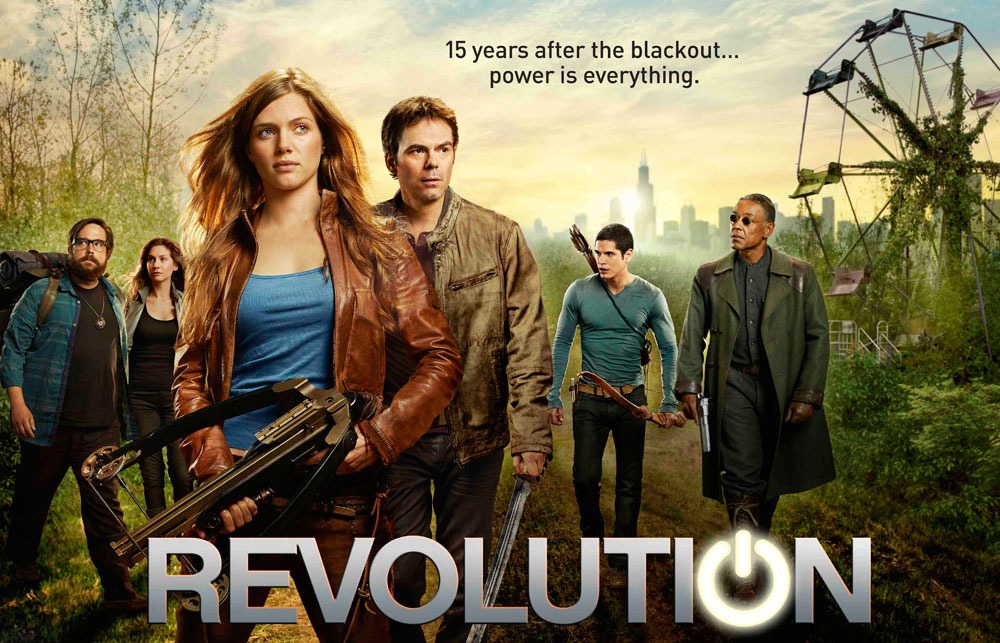
Revolution is about a family thrown into a dark world of a collapsed civilization.  The show begins 15 years after a worldwide blackout with a father dying, a son being kidnapped and the daughter seeking her long lost uncle Miles to help her rescue her brother.  The daughter, Charlie Matheson, played by Tracy Spiridakos is a kind of less hard, less savvy, Katniss Everdeen, so the story carries on the current vogue of girl action heroes.  Miles Matheson is played by Billy Burke and he’s your standard action guy.  This is why I loved Breaking Bad so much, none of the characters were cookie cutter clichés.

Strangely enough, the medium level bad guy in Revolution is Giancarlo Espositio playing Tom Neville, a ruthless, but sometimes coldly kind, captain of a militia, who previously played a ground breaking character in Breaking Bad, Gustavo “Gus” Fring, who was also ruthless with a strange tinge of cold kindness.  You’d think Espositio would have tipped the Revolution writers not to go for the obvious, and make him different.  I fear such a wonderful actor will get typecast.

Premise

Revolution pictures our world without electrical power or electronic gadgets – a powerful “What if…” scenario.  We’re all so depended on computers and electricity that it’s an intellectual adventure to pretend to live in a time of 18th century technology.   Revolution hints that some kind of force field is capable of dampening all electronics, and even electricity production.  Science knows solid state electronics are vulnerable to electromagnetic pulses (EMP) that are generated as a byproduct of nuclear explosions.  However, mechanical turbines should continue to work, and even old fashioned tube electronics might continue to work with EMP fields.

There is no science to suggest that such a energy dampening force field is possible.  It’s just a writer’s gimmick to advance the story.  Does that make Revolution a fantasy?  It’s a damn cool idea, but so is a school for wizards.  In other words, I have to say the premise of Revolution is fantasy.

In Revolution, there is a reason why and how the power got turned off. Revolution’s creators are holding that back as a mystery, like the mystery of the island in Lost. Mystery is one of the prime movers of fiction, so you can’t blame them for holding back, but I’m worried I’m going to be disappointed, like I did with Lost. Unless they come up with other mysteries, I doubt I’ll keep watching.  Bad Robot Productions, the company that made Lost, and produces Revolution, does have a track record for upping the mystery ante every week.

The mystery of who has killed off the power isn’t very science fictional to me. For it to be really science fictional, it has to be plausible, so we think, “Could this really happen?” When Jules Verne and H. G. Wells wrote stories about men traveling to the Moon, people did think, “Hey, that might be possible, what will it be like, and how will they do it?” That’s science fiction.

Contrast Revolution with The Windup Girl by Paolo Bacigalupi which is set in the 22nd century after fossil fuels have been used up, after global warming has changed every thing, and after crop monoculture and genetically modified agriculture has failed.  In The Windup Girl Bacigalupi develops kinetic energy machines using springs.  This same technology would work in the world of Revolution, but so far we haven’t seen any ideas like this, and I’m not sure the Bad Robot people think this way.

If the Bad Robot Production people had been truly creative, they would have taken the same scenario and come up with a totally new post apocalyptic society – one without electricity, but very creative.  They would have envisioned new forms of mechanical power, the return of sailing ships and dirigibles, funky new bicycles, rocket powered airships, and new forms of animal power.  They could have had computers like Babbage dreamed about, and new art forms not depended on digital media.  That’s what science fiction is about.  What they gave us is Mad Max Lite.

Post Apocalyptic World

Post apocalyptic fiction is one of my favorite sub-genres of science fiction, and for two reasons.  First, I love how an author imagines people surviving the collapse of civilization.  Second, thinking about how to rebuild civilization offers countless intellectual puzzles for my mind.  Now that’s some good clean science fictional fun.

Revolution is just a post apocalyptic fantasy that allows guys to fight with swords.  At least so far.  Why are guns rare but swords plentiful?  How did they gear up for sword production so fast?  I know I’ve only seen two episodes and the science fiction world building has been slight – mostly using stock after-the-collapse imagery.  In fact, they seem to have gotten most of their imagery from Life Without People.

Apocalyptic and post-apocalyptic fiction has a very long history which Revolution must be judged against.  When I saw the show announced this summer I had hoped for a television version of Earth Abides or The Day of the Triffids, or the British TV series SurvivorsRevolution is closer to The Postman by David Brin, more about adventure and less about the details of survival, or efforts to rebuild civilization.  Both feature a ruthless militia leader trying to start a post-civilization empire.

Now, this political subject is a honest science fictional topic.  Rebuilding our society after we’ve mined all the easily available resources is a scientific challenge worthy of much speculation.  However, in the first two episodes, Revolution hasn’t dealt with scarcity.  At one point Charlie’s Uncle Miles, tries to bribe someone with a small chunk of metal, which I assume we’re to think of as gold.  Gold nuggets are very rare, what gold we mine nowadays is molecules of gold processed from tons of ore.

What people use for money in Revolution’s apocalyptic world is a fascinating idea to explore, but so far the show ignores the issue, other than this one transaction with a tiny lump of yellow metal.  Good science fiction will explore all aspects of a possible future.  Revolution takes a Indiana Jones approach to the story, using slight of hand on facts, and diverting viewer’s mind with action and violence.

We have to ask ourselves:  Is a story science fiction if it’s set in a science fictional setting?  I don’t think so.  We are told Miles Matheson is a man who is good at killing people.  Miles’ abilities to fight are so unbelievable that they remind me of the recent Sylvester Stallone action flick, The Expendables 2.  That makes me think Revolution is more inspired by video games than science fiction books.  It’s appeal is to would-be first person shooters than folks who like to read speculative fiction about possible futures.

I wish Revolution’s level of violence was more like Breaking Bad’s, and it focused more on clever plots with interesting science fiction speculation.

Population Dying Off

If the power went off all over our world, how long could we support 7 billion people?  Revolution doesn’t even try to answer that question.  It skips 15 years immediately.  There’s some flashbacks, but no explanations.  The starting point of most collapse of civilization stories are a plague that kills off most of the population, or nuclear war that kills off most of the population, or aliens from space that kill off most of the people, or some kind of natural or cosmic calamity that kills off most everyone.  Revolution looks like the population took a major beating, but we’re not shown how.

I’m currently reading The Dog Stars by Peter Heller, another literary look at the end of the world, much like The Road by Cormac McCarthy.  Now this is real science fiction in my mind.  The Dog Stars is serious, philosophical, speculative, and worthy to be called science fiction in my book.  Revolution is decent fun without any real thinking involved.  That’s a shame.  For a story to kill off billions of people there should be more details.

In Revolution most of the population has disappeared and we don’t know why.  The writers obviously wanted a low population Earth for the story but hasn’t explained how everyone died.  In other words, after the collapse stories are so common in the mundane world that the producers don’t even feel the need to explain.  They are using a post apocalyptic world as a setting, just like Star Wars used a galactic empire as a setting.  There’s no science fiction speculation in either, so just accept the premise.  Revolution is an action adventure story set in a realistic but unscientific world.

Surviving the Collapse

I’m disappointed with Revolution because it makes no effort to show people surviving.  Everyone has plenty to eat, clean clothes without having to wash them, there’s no worry about diseases or bad water.  After 15 years, how good will clothes look?  There’s no effort to show how people make new clothes.  I don’t expect Mad Max fashions, but the show should speculate some, at least.

The plot is driven by Danny Matheson’s kidnapping.  Our characters don’t seemed challenged by any other problem.  The two episodes involved plots to set the stage so Miles can kill a bunch of people, and convince Charlie that killing is the way to operate.  The only survival going on is whether the audience won’t be killed off watching Billy Burke kill a dozen tough guys every episode.

Cliché Science Fiction

Whenever I read a new science fiction novel, or watch a new science fiction show I hope to discover a new idea or perspective. It’s hard to come up with a totally original idea nowadays. There just are too many fiction factories out there.  Barring originality I look for creative style – if you can’t deliver a new idea, at least present a mash-up old ideas in a new way.

Science fiction has become as formulaic as a murder mystery. I believe most SF fans find comfort by embracing their favorite sub-genres so writers cater to ever more baroque presentations of the same old ideas, creating Über-clichés. Revolution is merely the current incarnation of a long line of stories about the breakdown of civilization. Some reviewers call it dystopian, but I disagree. The original meaning of dystopia was an anti-utopia. In modern parlance dystopian has come to mean any unpleasant future. That’s a corruption of the original intent of the world. Nineteen Eighty-Four was a dystopian novel because the government of Big Brother was suppose to represent a view of communism, which before Stalin was seen by many intellectuals as a utopian ideal, but Orwell speculated communism would be hell instead of heaven.

Nineteen Eighty-Four was dystopian because it was anti-utopian. Revolution isn’t anti anything. Revolution uses a cliché science fictional setting to create an action adventure story. Collapsed civilizations are a good way to create a setting for rationalized violence, like westerns.  Post apocalyptic stories are good for creating situations where your character can kill a lot of people.  Audiences can’t seem to get enough of that kind of violence.

The proper categorization of Revolution is post-apocalyptic science fiction, which covers stories about the aftermath of collapse of our current civilization.  A common cliché within apocalyptic fiction is freemen versus brutal militias.   So Revolution is a sub-sub-genre.

To further complicate the problem all new fictional creations must compete with the most creative works at the moment. Taking on a new TV show for me, means finding something to watch that competes with my recent favorites, Breaking Bad, Friday Night Lights and Glee.

Watching the first episode of Revolution was a big letdown for me. Oh, it still has possibilities. But most great shows have fantastic first episodes, and Revolution’s was just ho-hum.  I did watch the 2nd episode and will watch the 3rd.  I have hope.  Revolution does have possibilities.

On the big screen they usually go for bigger and bigger action, usually involving saving the world. That’s an expensive proposition for a TV show, but Revolution has a very large scope.  There’s room for lots of action and speculation.  Let’s hope there is less of the former and more of the latter.

JWH – 9/25/12

Anna Karenina–Translations

Every time we read a book we have to translate it into our mind, even when we’re reading a book written in the language we speak.  If the book was written in another language, we have to depend on another mind to do an initial translation for us.  Sometimes two or more people work on a foreign language translation.  Those translators must interpret what they read in the original language and refashion it into English for us.  They have to choose between a literal translation and one that reads well.  Many decisions have to be made.  If an old book is being translated, does the translator preserve the language of the past, or modernize it, do they translate the colloquial phrases, or substitute similar English sayings, should they improve upon the original authors writing, for example, and change a weak passive sentence into a strong active one, etc.

In our modern world books are most often translated to film, but every reader translates words into pictures when they read.

anna-karenina-kk

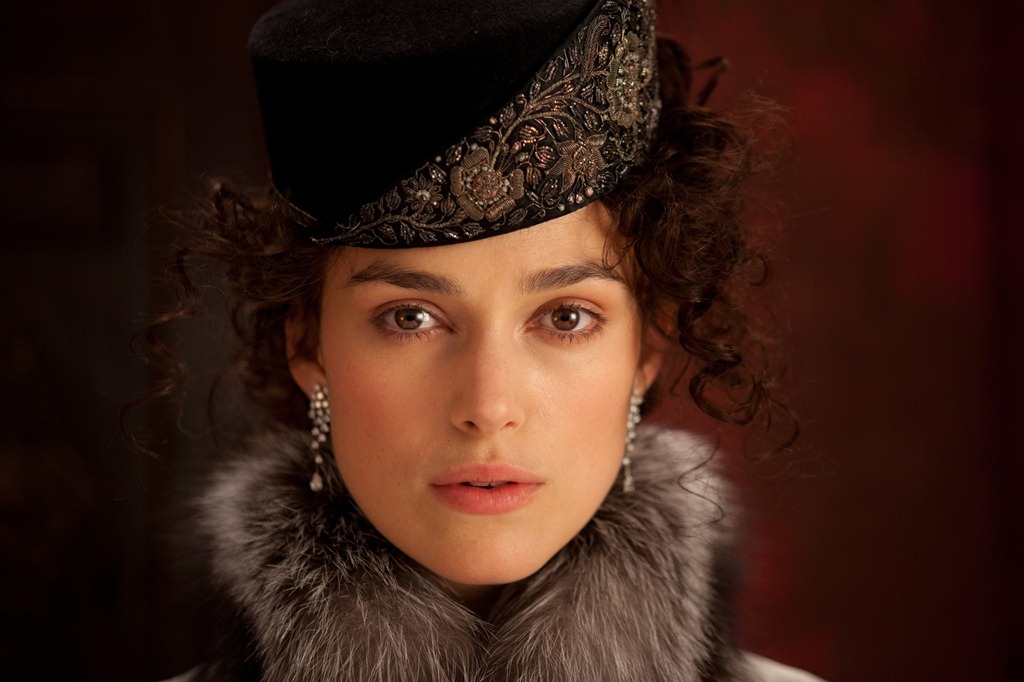
There are so many kinds of translations going on, more than just moving ideas from one language to another.  When we read a story we picture it in our minds, and we seldom picture it as the author pictured it.  How often have you read a book and then talked with someone about that book only to find they translated the book completely different.  The best illustration of this when movies are made from books.  Is Keira Knightley what you think when you imagine Anna?  Or is Aaron Johnson how you picture Count Vronsky?

anna-karenina-vronsky

If you’ve read a book about a poor person and have never been poor yourself, you will translate the book different from a reader who has been poor.  I have never been a woman, Russian, rich, dashing, beautiful, lived in the 19th century or been part of an aristocracy, so I have to imagine a lot when reading Anna Karenina and translating what it must have been like to been Anna or Count Vronsky.  I have studied American History, but is translating concepts about American slavery equal to Russian serfs?  I’ve seen Greta Garbo play Anna in a 1930s film, but is Garbo anything like what Tolstoy pictured when he was describing her with words?

Here is a portrait of Baroness Varvara Ivanovna Ikskul von Hildenbrandt that was painted in 1889, years after the book was published, but who people in Russia then used as a model for Anna.

PZ 401-038-753
Ilya Repin
Portrait of Baroness Varvara Ikskul von Hildenbandt, 1889
The State Tretyakov Gallery

Researching translations is fun.  That’s why studying the Bible is fun for me even though I’m a non-believer.  My friend Mike loves studying Homer and other Greek and Roman writers and comparing translations.  Readers have to constantly ask:  Is this a good translation?  Think of how many Christian creeds, sects and churches been created from reading one book.

I’ve always wanted to tackle Anna Karenina or War and Peace.  Well I’ve finally read (listened) to Anna Karenina, but how much of the story did I get?  Is one reading enough to make a fair judgment?  Did I pick the right translation?  Without doing any research I ended up with the Maude translation because I liked the sound of the reader of the audio book.  But I have to wonder, did I pick a good translation.

I’ve gone out and found four different translations.  Two of which I have on my Kindle, and two of which I did a screen shot of the first page off of Amazon.com.

Here’ is the opening of Anna Karenina translated by Constant Garnett (1901):

Happy families are all alike; every unhappy family is unhappy in its own way.

Everything was in confusion in the Oblonskys’ house. The wife had discovered that the husband was carrying on an intrigue with a French girl, who had been a governess in their family, and she had announced to her husband that she could not go on living in the same house with him. This position of affairs had now lasted three days, and not only the husband and wife themselves, but all the members of their family and household, were painfully conscious of it. Every person in the house felt that there was no sense in their living together, and that the stray people brought together by chance in any inn had more in common with one another than they, the members of the family and household of the Oblonskys. The wife did not leave her own room, the husband had not been at home for three days. The children ran wild all over the house; the English governess quarreled with the housekeeper, and wrote to a friend asking her to look out for a new situation for her; the man-cook had walked off the day before just at dinner time; the kitchen-maid, and the coachman had given warning.

Here is the same opening translated by Louise and Aylmer Maude (1918), the version I listened to:

ALL happy families resemble one another, each unhappy family is unhappy in its own way.

Everything was upset in the Oblonskys’ house. The wife had discovered an intrigue between her husband and their former French governess, and declared that she would not continue to live under the same roof with him. This state of things had now lasted for three days, and not only the husband and wife but the rest of the family and the whole household suffered from it. They all felt that there was no sense in their living together, and that any group of people who had met together by chance at an inn would have had more in common than they. The wife kept to her own rooms; the husband stopped away from home all day; the children ran about all over the house uneasily; the English governess quarreled with the housekeeper and wrote to a friend asking if she could find her another situation; the cook had gone out just at dinnertime the day before and had not returned; and the kitchen-maid and coachman had given notice.

Here is another translation, from Joel Carmichael (1960).

anna-karenina-carmichael

And here is the more recent translation by Richard Pevear and Larissa Volokhonsky (2000):

anna-karenina-pevear

This last translation was made famous by being picked for the Oprah Winfrey book club in 2004.

While listening to the novel I felt there were phrases that sounded modern, and wondered if Russians had some of the same sayings we did, or if the contemporary feel came from the translators.  Then my friend Mike called me to talk about his research on translations of War and Peace.  So I got to thinking about the translation of Anna Karenina.

I was very happy with the Maude translation, but it felt like I was reading Dickens.  But then Tolstoy wrote Anna Karenina just after Dickens died.  It was also serialized like Dickens’ novels, so it had that episodic feel.  Plus, both writers are coming to grips with similar changes in society brought about by industrialization, science and technology.

If you look at these different versions you’ll notice they are different and similar.  So, does the translation really matter? 

In the old two, Oblonsky had an intrigue with the French governess, while in the modern versions he had an affair.  Why the change?  How long has “an affair” meant what it does now?  But look at some other phrases:

“The wife did not leave her own room, the husband had not been at home for three days.” – Garnett.

“The wife kept to her own rooms; the husband stopped away from home all day;” – Maude, and it’s only part of a long sentence.

“Oblonsky’s wife refused to leave her rooms; he himself hadn’t been home for three days.” – Carmichael.

“The wife would not leave her rooms, the husband was away for the third day.” – Pevear and Volokhonsky.

Notice, there’s even changes in facts.  In the first the wife had one room, in the others, rooms.  In the second, the husband had been away all day, but in the others three days.

Notice how we’re told the cook has left.

“the man-cook had walked off the day before just at dinner time” – Garnett.

“the cook had gone out just at dinnertime the day before and had not returned” – Maude.

“the day before the cook had picked dinner time to go out” – Carmichael.

“the cook had already left the premises the day before, at dinner-time” – Pevear and Volokhonsky.

The Carmichael one doesn’t mention that the cook never returns.  And why doesn’t three of them mention that the cook is male?  I assumed the cook was female from my translation, but that’s my cultural spin on things.  I thought “walked off” was the strongest way of saying the cook quit.  “Left the premises” seems passive and not definite about why.

Well we do know why, the household is in confusion, upset and topsy-turvy.   Each of those words convey a different meaning to me, and none of them really convey the anger of a marital fight.  But then that might be Tolstoy’s failure.

Also, the famous first line is subtly different.  I wanted it to be more succinct.  Like “Happy families are all alike, unhappy families are distinctive.”  I don’t know Russian and would never be in the position to do a translation, but are the others translators like me, wanting to write the lines like they would want to read them?  If I had translated Anna Karenina it would have been a much shorter book, but is that translating or editing?

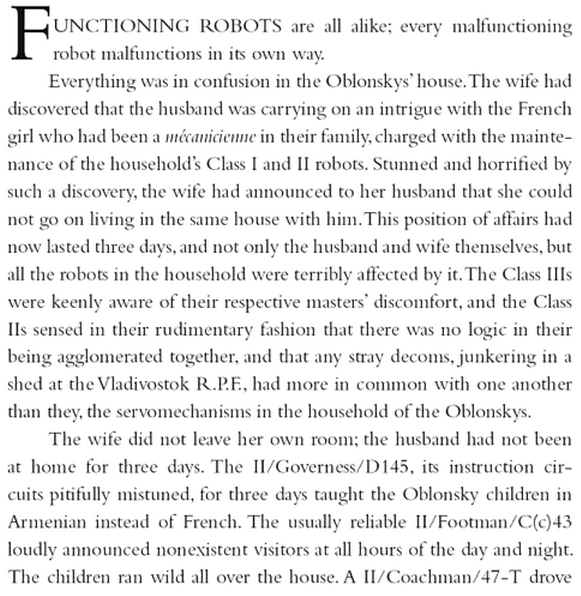
Then there’s Android Karenina, a parody mash-up of classic novel and science fiction – it’s another kind of translation.

android-karenina

Now many readers will be outraged by this particular translation of the novel, but really, is it any different in its extremes than the many film versions of Anna Karenina?  Most movie versions jettison the stories of Levin and Kitty, who appealed to me far deeper than Anna and Count Vronsky.  Just look at all these images from a Google search.  Each actress, or each painting for a book cover is an interpretation or translation.

How can modern readers understand Anna Karenina without understanding the social norms of the 1870s?  How much history do we have to know to really appreciate what Tolstoy is writing about?  I read AK at 60 and admired it greatly.  I could not have comprehended it at 20 or 30 or even 40, but even at 60 I’m sure I’m missing most of the story.  I don’t know Russian, but even if I did, I really don’t know much about life in 19th century Russia.  However, reading Anna Karenina is teaching me about Russia, like Dickens, Elliot and Trollope are teaching me about 19th century England.  Again though, through their translation.

History and fiction are constant mistranslations of reality, that change from generation to generation.

To see how we mistranslate history watch this little video “5 Historical Misconceptions Rundown" at YouTube:

JWH – 5/11/12