My old buddy Connell and I often talk about the unexpected scientific discoveries made in our lifetime. Back in the 1960s, we both grew up reading science fiction and we had certain expectations about the 21st-century. Now that we’re in our seventies living in that century we realized that science fiction missed so much, and so did our imaginations.
Because we grew up thinking the black and white astronomical photos made by the Mt. Palomar 200″ telescope were the pinnacle of astronomical awareness, we never imagined what the Hubble Space Telescope would show us in color. We never dreamed that astronomers would discover exoplanets or robots would roam the solar system. We thought people had to go to all those places.
Nor did we imagine society being transformed by computers and networks. I never pictured the computer I’m typing on now, or what I could do with my iPhone or iPad.
But one of the biggest discoveries we missed was about animal consciousness. We expected that we’d have to wait for interstellar spaceships to be developed before we’d meet another form of intelligent life. We never realized it was all around us on Earth and in the oceans.
Intelligence and sentience are on a spectrum. We grew up in a time when people believed they were the crown of creation, and all life below us was unconscious and stupid. We’re finally realizing just how stupid we were. See The Cambridge Declaration on Consciousness.
There are so many books to read to illustrate what I mean. The Soul of an Octopus is just one, but a beautiful work by a woman that has learned so much about animals by spending time with them. Sy Montgomery writes in a way that we follow her around as she makes her discoveries. You will fall in love with four beautiful creatures, Athena, Octavia, Kali, and Karma. You will cry when some of them die, but you will also get to meet intelligent alien lifeforms.
I still read a lot of science fiction, I can’t help myself, it’s a lifelong addiction that I no longer try to escape from. But I’ve learned if I really want to experience the far-out I need to read science books, books like The Soul of an Octopus.
My reading goal for 2022 is to read as many intensely great books as I can find. The Soul of an Octopus starts the year with a bang.
I do. I’m as indecisive as Hamlet when picking my next book to read.
I’ve just finished The Soul of an Octopus by Sy Montgomery which was a wonderful nonfiction book that made me go misty-eyed many times while reading it. It’s a memoir about getting to know octopuses. At first, Montgomery falls in love with Athena, an octopus at a New England aquarium, then spends years getting to know a succession of octopuses at that aquarium, before eventually learning to scuba dive so she can visit octopuses in the wild from the world.
I thoroughly loved this book, and whenever I read a great book, I want to be very careful picking my next book to read. I’ve had an impressive streak of great reads, both novels, and nonfiction, and I hate to break it. The Soul of an Octopus is the first book I’ve finished in 2022. I want my second book to be just as moving and inspirational.
Right now, I feel I’m in the mood for a novel, but I’m always feeling something different from one moment to the next. I started Around the World in 80 Days just before the premiere of the first episode of that story on PBS Masterpiece last Sunday. That novel is good, but I’m not sure it’s good enough for my next read.
I’m supposed to be reading The Uses of Enchantment by Bruno Bettelheim for my nonfiction book club, and I’ve started it too. But I’m afraid it’s going to be academic theorizing that will disappoint me. I’m intrigued by the idea of why reading fairytales could be significant to the moral development of children, but I’m not sure I buy the hypothesis. After reading the entry on Wikipedia on fairytales, I’m tempted to find a book about the history of fairytales but I don’t know if there’s an obvious book on the subject. Once Upon a Time by Marina Warner might be a good starting place. It gets raves from The New York Times and The Guardian.
Is my momentary pique of interest in fairytales just a fleeting distraction? This happens to be all the time. I read an essay and I want to gallop off to read a book. I don’t like reading fantasy fiction that much, but the Wikipedia entry got me very curious about writers studying fairytales. It’s not the stories themselves that attract me to the idea, but the study of them. I already have many unread books on the history of the novel patiently waiting on my shelves, so why should I go buy another book?
This is why I’m writing this essay, to reveal just how chaotic my mind is when it comes to making the decision of what to read. I have thousands of unread books sitting on shelves, both wooden and virtual. When I bought each of those books, I thought I would read it next. That didn’t happen. I got distracted by another idea or book before I could start. Thus my never-ending queue of books waiting to be read.
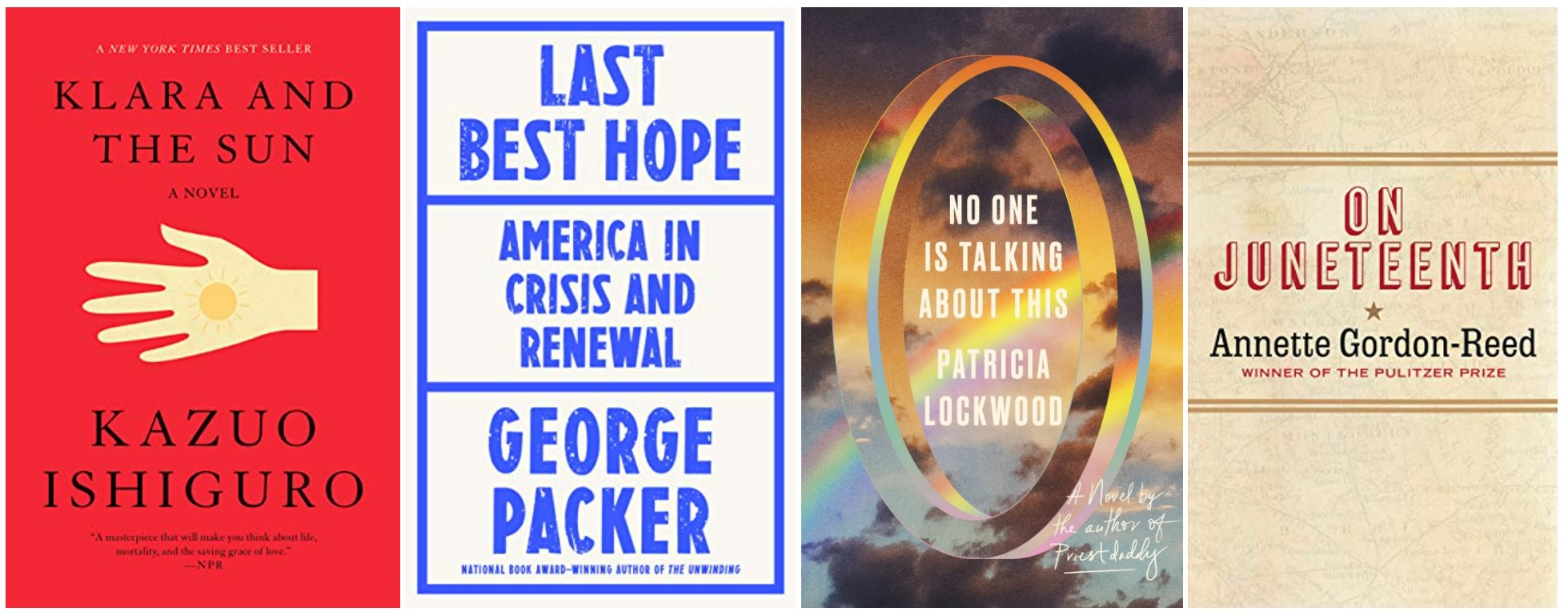
I also have the list of 2021 books I just blogged about. Rereading that list reminds me I was anxious to read two novels: Bewilderment by Richard Powers and Cloud Cuckoo Land by Anthony Doerr, and was strongly considering two more, No One Is Talking About This by Patricia Lockwood or Harlem Shuffle by Colson Whitehead. All four of them were on many best-of-the-year lists for 2021, and in all likelihood, would be tremendous books — just what I’m in the mood for.
Yes, I should very definitely read a great contemporary novel. I’m almost convinced that’s what I should do. Then, seeping up from deep down in my unconscious mind is the urge to read a science fiction novel. One that will thrill me like those science fiction novels thrilled me when I was 13. I think that desire comes from just getting over Covid. Whenever I’m sick, I get nostalgic for classic science fiction. I’m tempted to read Orion Shall Rise by Poul Anderson after researching reading his novella “No Truce with Kings.” I was intrigued by Anderson’s desire to write a novel about future societies trying to rebuild after our global society collapses.
My reading moods are far less varied than the number of books I want to read. Science fiction satisfies my sense of wonder. Literary novels, either from the 19th, 20th, or 21st centuries make me feel closer to people. Reading nonfiction gives the satisfying feeling I’m learning something.
I have ten large bookcases full of printed books that stare down at me with countless volumes begging to be read. My digital larder of Kindle books and Audible books wanting by eyes and ears is just as many. The reality is I can only love one book at a time. I can be reading on several if I’m only so-so into them. But if I really get into a book, I won’t read anything else until it’s finished.
That’s exactly what I’m in the mood for, to be completely consumed by wanting to finish that one great book. That’s what I’m always wanting. I keep thinking I can consciously choose such a book. I keep thinking I can intellectually figure out what such a book should be. However, it never works out like that.
Until I open a book and get hooked, I never know what book that will be. Yet, there is a part of me, my anal-retentive side, that wants to pick 52 books from my shelves and schedule them on my calendar to read during 2022. That aspect of my personality wants to command what will happen. That part of my personality thinks I bought all those damn books then I should get busy and systematically read them.
The La-De-Da part of my personality just wants to tell the anal-retentive me, “Fuck off.”
Reading is my sixth sense, how I explore the larger reality I can’t observe with my classic five senses. Every year I can only read so many books, making it important to wisely select the novels, nonfiction books, short stories, and articles I do read. Reading changes me. I shape myself by what I read. Each year I work to become more conscious by what I select to read. However, this self-improvement effort is very much like my efforts to eat healthily and avoid junk food. I’m never a saint.
At seventy, my mind is becoming like an old suit with moth holes. Words and thoughts leak out of my consciousness through little missing places eaten away by the moths of time. Remembering is something that’s become very important to me, as much as sex was on my adolescent mind.
The Reading List by Sara Nisha Adams is the 52nd and last book I read in 2021. It’s an accomplishment to read so many books in one year. And 52 is a good number. It means I averaged one book a week, and that’s a nice reading pace.
I’ve always wanted to be one of those superbookworms who could read 100 or 200 books a year, but my mind and memory can’t handle that much new content. I like to think one book a week is what my mind can handle, but I’m probably fooling myself.
52 is probably too many but I’d hate to read less. I feel I did a pretty good job of picking worthwhile reads, ones I still remember reading at the end of the year, but I have to admit, some of them were not necessarily the best books I could have picked. I will try harder next year. The problem is the conflict between reading books that expand my awareness, and books that soothe my soul.
One way to remember the books I read in 2021 is to remember my favorites, the ones I’d recommend. Links are to essays I wrote during the year.
LikeWar: The Weaponization of Social Media by P. W. Singer
Another way to remember is to recall why I read certain books. I’m in a two-person book club with my friend Linda, I’m also a member of an online nonfiction book club, I’m in a Facebook group that reads science fiction anthologies, I have a personal reading goal to read all 25 volumes of The Great SF Stories edited by Isaac Asimov and Martin H. Greenberg, I like to read science fiction novels, I love to read popular science books, and I enjoy reading some contemporary and classic fiction.
Two-Person Book Club With Linda
Evil Geniuses: The Unmaking of America – Kurt Andersen
Horseman, Pass By – Larry McMurtry
21 Lessons for the 21st Century – Yuval Noah Harari
Leaving Cheyenne – Larry McMurtry
The Art of Dying Well – Katy Butler
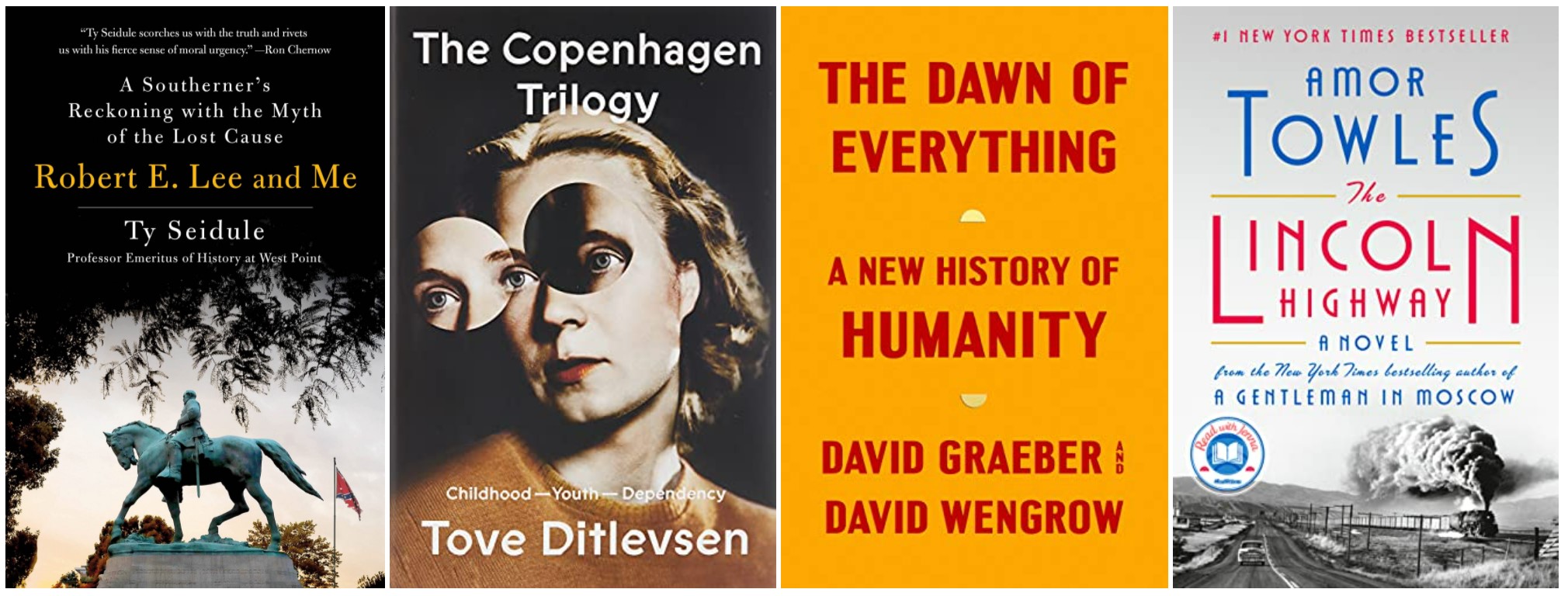
Robert E. Lee and Me – Ty Seidule
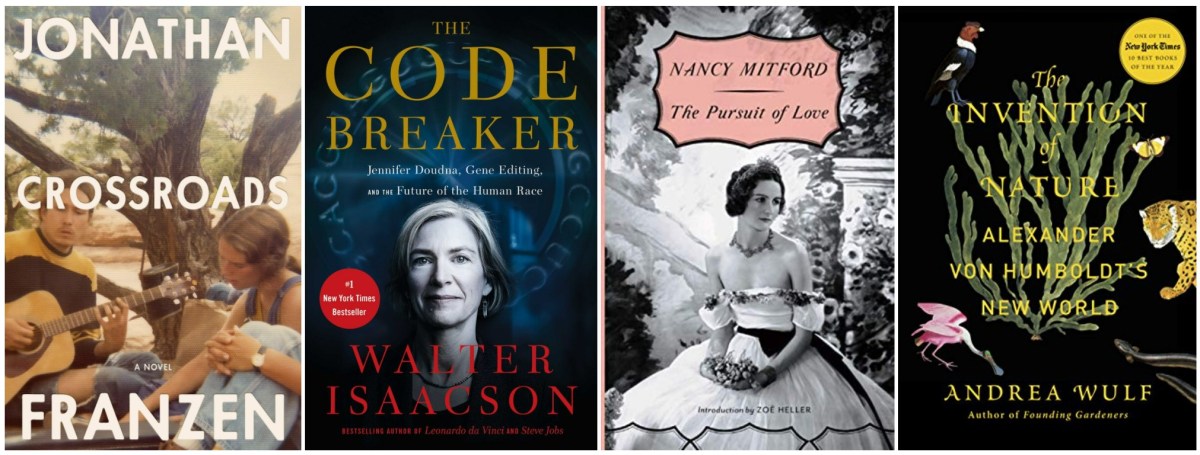
The Code Breaker – Walter Isaacson
Elderhood – Louise Aronson
Last Best Hope: America in Crisis and Renewal – George Packer
Crossroads – Jonathan Franzen
The Premonition: A Pandemic Story – Michael Lewis
Linda went on to read several more Larry McMurtry books, but I just couldn’t keep up with her.
Online Nonfiction Book Club
Underland: A Deep Time Journey – Robert MacFarlane
The Sisters – Mary S. Lovell
Robert E. Lee and Me – Ty Seidule
The Invention of Nature – Andrea Wulf
Noise (didn’t finish) –
Uncanny Valley (read in 2020) – Anna Weiner
Ten Lessons for a Post-Pandemic World – Fareed Zakariia (didn’t finish)
Fermat’s Enigma – Simon Singh (didn’t finish)
I had read The Sisters, Uncanny Valley, and The Invention of Nature on my own and nominated those books. I skipped four books this year: Entangled Life by Merlin Sheldrake, Forgetting by Scott A. Small, Kindred by Rebecca Waggs Sykes, A Promised Land by Barack Obama.
Nonfiction I Picked
Hackers – Steven Levy (reread)
Yesterday’s Tomorrows – Mike Ashley
LikeWar: The Weaponization of Social Media – P. W. Singer
A People’s History of Computing in the United States – Joy Lis Rankin
Fifth Avenue, 5 A.M. – Sam Wasson
I love reading about the history of computers, and the history of science fiction. Fifth Avenue, 5 A.M. is about the making of Breakfast at Tiffany’s. I also love reading about pop culture history.
Facebook Group – Best Science Fiction and Fantasy Short Fiction
Year’s Best SF 1 – ed. David Hartwell
Orbit 1 – ed. Damon Knight
The Very Best of the Best ed. Gardner Dozois
The Year’s Best S-F, 5th Annual Edition – Judith Merril
The Dark Side – ed. Damon Knight
World’s Best Science Fiction 1968 – ed. Donald Wollheim
The New Space Opera ed. Gardner Dozois
The Year’s Best Science Fiction 3rd Annual – ed. Gardner Dozois
The Big Book of Science Fiction – ed. Ann and Jeff VanderMeer (58% finished)
This group gets me to read a great deal of science fiction short stories. We discuss one short story a day, but I don’t read every day’s story. Still, probably over 200 stories. I really enjoy this group, and I’m learning a tremendous lot about the history of short science fiction. I’ve probably read over 400 short stories this year because of other SF anthologies and magazines I read on my own.
The Great SF Stories
The Great SF Stories 16 (1954) – ed. Asimov/Greenberg
The Great SF Stories 17 (1955) – ed. Asimov/Greenberg
The Great SF Stories 18 (1965) – ed. Asimov/Greenberg
I’ve been working through this 25-volume series since 2018. I’ve become immensely fond of this series. It’s a shame they are out of print. I own all twenty-five in paperback, but I read them on my iPad from pdf copies found on the internet. I keep hoping the Facebook group to vote to read the entire run. We do start volume 25 on the 29th of this month. I’d love to finish off the series in 2022, but that would be reading 7 more volumes in 2022 and that probably won’t happen.
Science Fiction
The Ministry of the Future – Kim Stanley Robinson
The Man Who Fell to Earth – Walter Tevis
Klara and the Sun – Kazuo Ishiguro
Children of Ruin – Adrian Tchaikovsky
The Clockwork Man – E. V. Odle
Past Master – R. A. Lafferty
Of Men and Monsters – William Tenn
Lords of the Psychon – Daniel F. Galouye
The Dying Earth – Jack Vance
The War of the Worlds – H. G. Wells
Danny Dunn and the Anti-Gravity Paint – Abrashkin & Williams
A Gift of Time – Jerry Merritt
The Best of Walter M. Miller, Jr. – Walter M. Miller, Jr.
To Say Nothing of the Dog – Connie Willis
That’s a total of 26 science fiction books. Far more science fiction than I believe I should be reading. Each year I tell myself I should read less science fiction and more other kinds of books, but I can’t seem to break my life-long science fiction addiction.
General Fiction
Horseman, Pass By – Larry McMurtry
Leaving Cheyenne – Larry McMurtry
The Girl on the Boat – P. G. Wodehouse
The Pursuit of Love – Nancy Mitford
Love in a Cold Climate – Nancy Mitford
Don’t Tell Alfred – Nancy Mitford
Crossroads – Jonathan Franzen
The Corrections – Jonathan Franzen
The Reading List – Sara Nisha Adams
I’m disappointed that I didn’t read a new 19th-century classic. Last year I read War and Peace. I did read The War of the Worlds, but I’ve read it a couple of times before. I had planned to read Madame Bovery.
2021 Books
Klara and the Sun – Kazuo Ishiguro
Yesterday’s Tomorrows – Mike Ashley
Robert E. Lee and Me – Ty Seidule
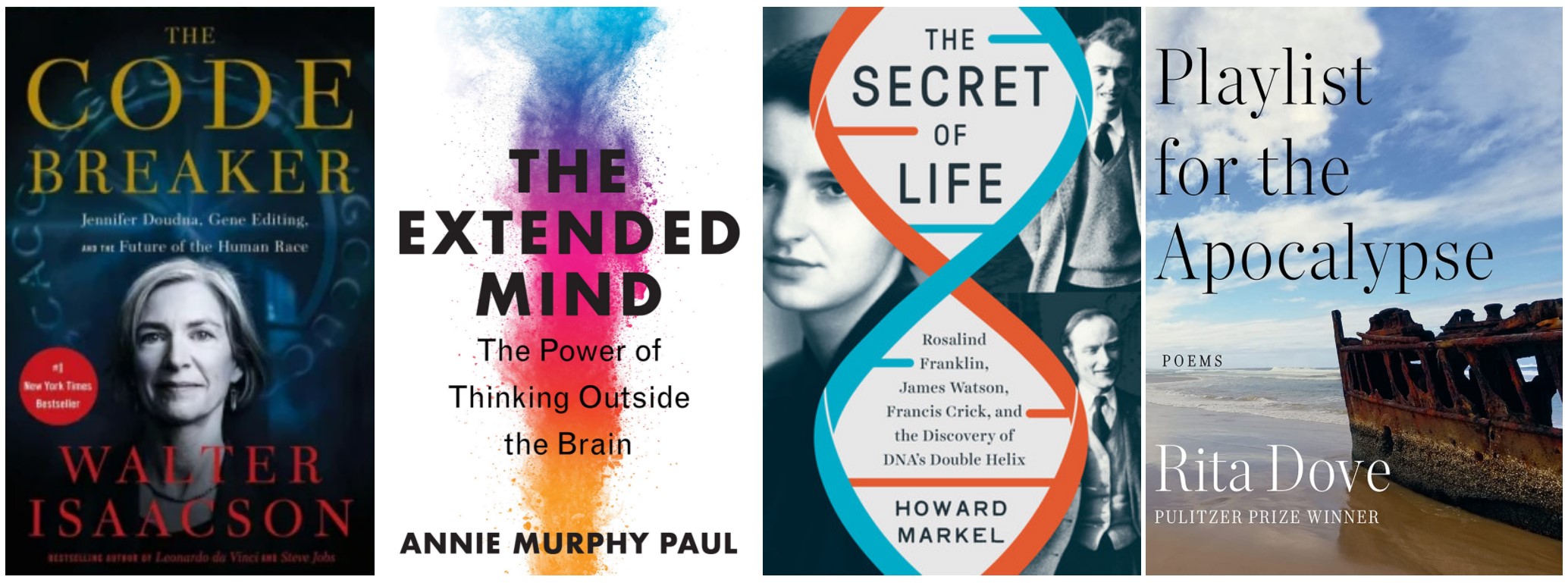
The Code Breaker – Walter Isaacson
Last Best Hope – George Packer
Crossroads – Jonathan Franzen
The Premonition – Michael Lewis
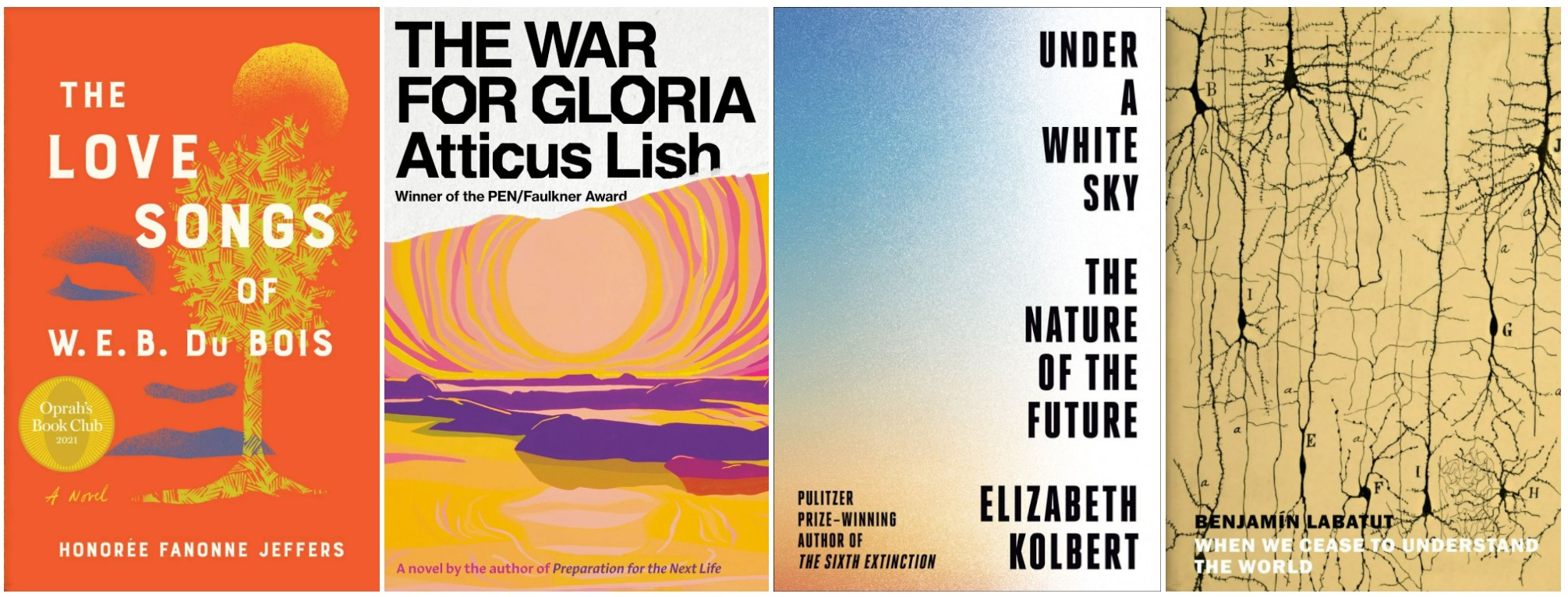
Under a White Sky – Elizabeth Kolbert
The Reading List – Sara Nisha Adams
Each year I aim to read a certain number of books that come out during the year. Nine is pretty good for 2021, but I’m going to aim for 12 in 2022.
December is the time when we get loads of best-books-of-the-year lists. I enjoy looking at all those lists because I love finding the books that are the most recommended. I can’t read everything. I can’t even read everything that’s great.
I’m lucky to read 4-6 new books as they come out during the year, and sometimes they are among the ones critics have loved. That’s satisfying. For any given year I probably read 10-12 of its best books, that’s including fiction and nonfiction. That’s out of thousands of books published each year, so I get a microscopic sampling of books published. That’s why I work to find the best books, and by best, I mean the most talked about, the most recommended, the most newsworthy books.
I read on average one book a week, or 52 books a year. Most of them are older books, usually from the 20th century, sometimes from the 19th, and on rare occasions even older. I don’t want my head stuck completely in the past, so I try to read 10-12 books each year from the most recent two years. I usually discover a handful of books as they appear during the year, and then identify several more to read in the following year from the end-of-the-year lists.
Over time I’m discovering the most useful best-of-the-year lists. Here are the lists I’m using this year:
Books We Love – NPR. NPR lists over 2,800 books, but they provide a filtering system to help you zero in on the ones you might prefer. Their site has yearly lists back through 2013. Just the button for Staff Picks lists 179 books, that’s way too many. What I do is study the covers. And then go on to other best-of-the-year lists. It’s like the old TV quiz show Concentration, I try to spot covers again from memory. But instead of finding the pair, I try to find covers that are shown on the most lists.
New York Times Critics’ Top Books of 2021. This is another very long list. But they also offer another shorter list, The 10 Best Books of 2021. Sadly, the long list doesn’t include cover photos, so it’s harder to play my Concentration cover game, so reading the short paragraphs about them is important. And The New York Times even offers an even longer list, 100 Notable Books of 2021, this time with covers. The critics at the Times picked many of the books the NPR critics picked, and many books I’ve already heard some word of mouth. These are the ones I want to try so far:
Vogue, Vulture, and Time have recommendations that are often similar to NPR and The New York Times. Time also recommends another book I’ve already read: The Code Breaker by Walter Isaacson. That makes me feel I did pretty good finding books coming out during 2021. And they recommend Empire of Pain: The Secret History of the Sackler Dynasty by Patrick Radden Keefe that’s been on most of these lists. I’m just not interested in that subject, but with so many recommendations I feel maybe I should try it. These lists also reinforce the books I list above that I already want to read.
Publishers Weekly has a website system like NPR that recommends way too many books to consider but has a filter system to narrow things down by genre and interest. Their database goes back to 2010, and their lists have links to the original reviews. Once again I’m seeing the same covers of books I’ve been wanting to read, but I’ve spotted two additional books to add to my list from their Top Ten List: All That She Carried: The Journey of Ashley’s Sack, A Black Family Keepsake by Tiya Miles and The War For Gloria by Atticus Lish. I’ve been remembering those two covers from the lists I’ve been seeing, and their descriptions are enticing.
I believe I’ve found a total of 23 books from 2021 that interested me most, and I’ve already read 7 of them. That leaves 16. I doubt I’ll get all 23 books read in the coming year. It depends on how many 2022 books attract my attention first, or how mired in the past I become. If I read all 23 that will double my normal current book consumption habit.
There is one last list to mention, Goodreads Choice Awards 2021. These are voted by members of Goodreads. Sometimes the bookworms pick the same books as the critics, and sometimes not. However, this list at Goodreads uncovers a lot more fun genre titles.
Lastly, I’ve discovered that if I keep these recommended novels in mind, sometimes they appear in sales at Bookbub, or in the Kindle Daily Deal, or on Audible. Also, many of them come to Scribd, a book subscription library. I think of Scridb as Netflix for books. Five of the sixteen books I want to read are already available at Scribd. It’s a bargain at $9.99 a month.
I’ve been learning about the gene editing tool CRISPR for years in bits and pieces. From reading news and magazines articles I had a vague idea that science had made a tremendous breakthrough, one akin to science fiction imagined in GATTACA and Brave New World. CRISPR/Cas9 will allow us to heal people with inheritable genetic diseases or cure people with conditions caused by defective genes, but more than that, it will allow us to program our own evolutionary developments, and change our reproductive germlines.
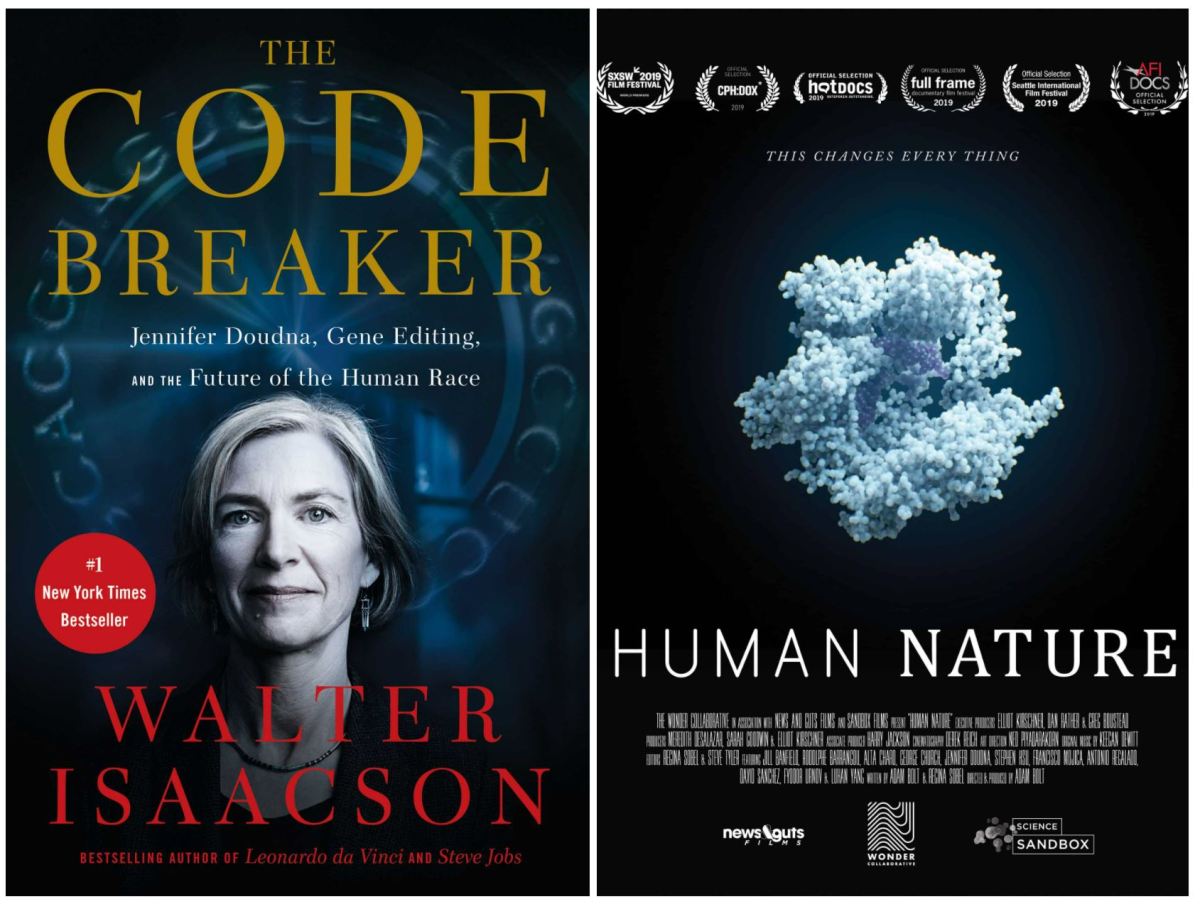
I don’t want to try and summarize CRISPR/Cas9 to you in detail because I’m recommending your read The Code Breakers by Walter Isaacson or watching Human Nature. But if you want a quick overview, here’s the Wikipedia entry.
My focus is to compare learning from a book versus a documentary. I’ve already acquired what I would consider rumors about CRISPR via Flipboard and The New York Times. Those are casual, everyday ways to absorb tidbits of information. But what’s the next level up? That depends on the time you’re willing to spend, and the amount of details you wish to digest.
Human Nature (2019) is a 1 hour and 35 minute documentary that’s currently available to Netflix or PBS Documentaries on Amazon subscribers, or to rent or buy from Amazon and other video sources. It’s a superior documentary that quickly covers the background of CRISPR with impressive infographic and animations, while interviewing the major scientists, then moving into the thorny ethical issues of gene editing, before finally wrapping things up by speculating about the future. After watching Human Nature you’ll have a good sense of what CRISPR can do and its science fictional impact on society. The documentary claims CRISPR will change the world more than the internet.
On the other hand, if you want go beyond the Gosh-Wow level, you could read Walter Isaacson’s new book, The Code Breakers. It’s 16 hours and 4 minutes on audio, or 552 pages of reading. The book tells the same story as the documentary but with far more detail. The framing of the book is a semi-biography of Jennifer Doudna, who shared the Nobel Prize with Emmanuelle Charpentier in 2020. Walter Isaacson is noted for his biographies (Leonardo da Vinci, Albert Einstein, Steve Jobs, Ben Franklin), and The Code Breakers is sort of a biography of Doudna, at least when it comes to her scientific career.
But The Code Breakers is much more. It’s a history of a technology that has emerged in our lifetime, and a chronicle how scientists work to discover and apply that new technology. We learn about publishing papers, going to conferences, building labs, forming startup companies, and competing for the Nobel Prize. If you loved books like The Double Helix by James Watson, The First Three Minutes by Steven Weinberg, or The Inflationary Universe by Alan Guth, then you should love this one too. I especially admired how Isaacson’s interviewed the various scientists competing for fame and glory, because he knew that they knew he was giving Doudna the scientific fame over them. Recognizing who came first in a discovery is a challenging piece of detective work that Isaacson pulls off with the skill of a master lawyer working the jury.
What also impressed me was how Isaacson told this complex story. I can’t imagine amassing so much information and then weaving it together into a compelling narrative. I’d love to see a documentary about how Isaacson researches and writes his books.
The Code Breakers will take you much further than the Human Nature regarding how genetic editing history unfolded, but the documentary has its own virtues, especially in compelling visuals. However, I wanted to go even further into learning how CRISPR works. Neither the book nor the documentary gave me the step-by-step concepts of what the lab work was like. Because CRISPR is so damn interesting, I went searching for even more information on YouTube. Both the book and film claims using CRISPR is easy, and that anyone can order educational kits to use the technology. I just couldn’t visualize that.
This short clip gave me more of what I wanted, but it’s still not enough, but I’m going to continue looking for more videos like this one. However, I also found this video about one of the CRISPR kits.
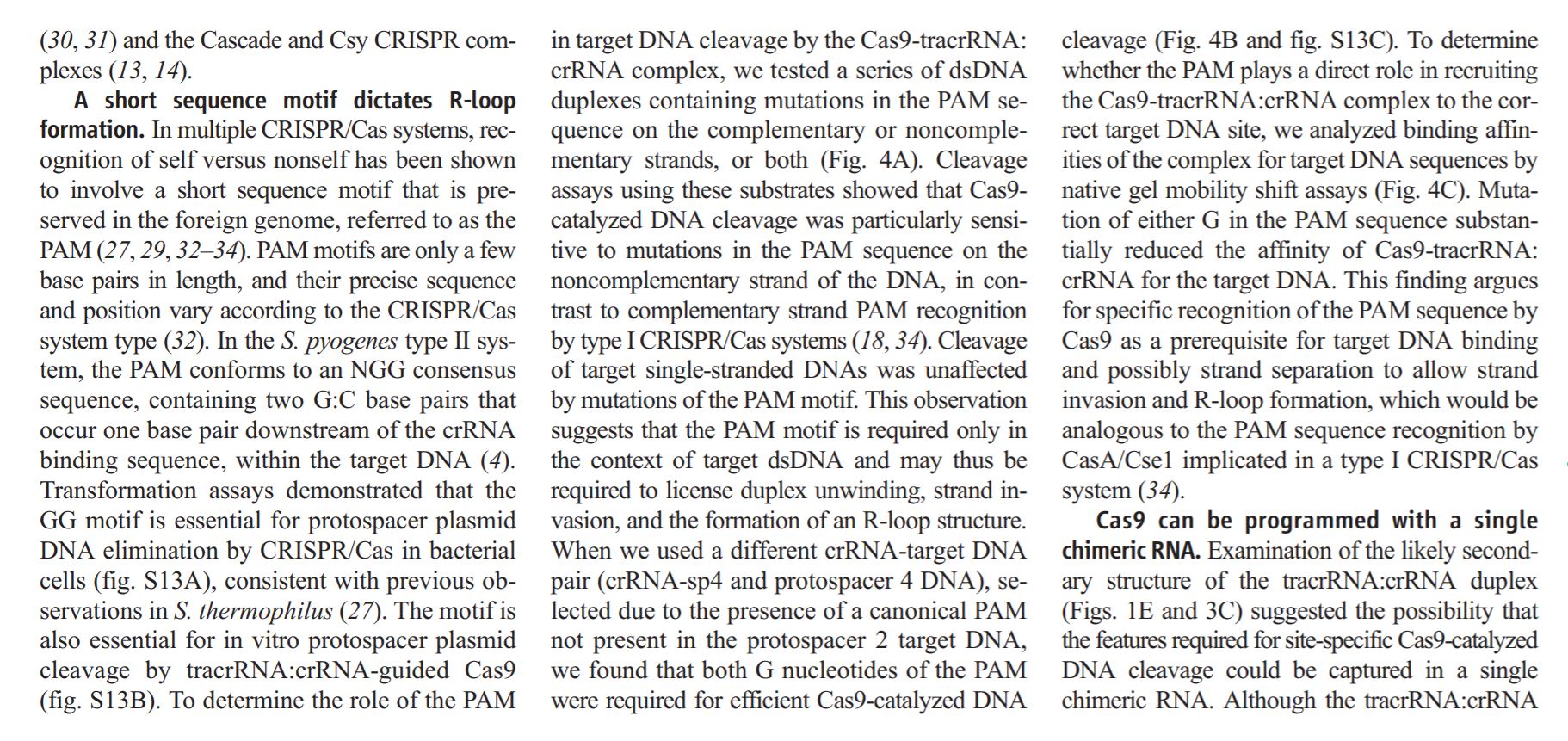
The trouble with wanting to understand even more is I run into the limits of my understanding. I found the 2012 article from Science that’s at the heart of the book. I can read it, and even spot ideas covered in the book and documentary, but 95% lies behind an event horizon of jargon I can’t penetrate. Just look at this one paragraph:
I love popular science books and magazines, but I have to take the working of real science on faith. I don’t like that. I’m hoping to find other books and documentaries that will help me in my quest to visualize how scientists do their work in a step-by-step process. Throughout the book Isaacson wrote about the experiments involved in discovering CRISPR, but I have no mental picture of what they were like.
For example, x-ray crystallography was often mentioned as a vital skill in this lab work. Seeing this video helps me visualize more of the narrative. What I would love is a Ken Burns type documentary, a 10-part series that visually illustrated The Code Breakers.
CRISPR is another example of the positive potential for our future, and another example that validates science. Sure, CRISPR offers all the potential evils of H-Bombs, but it also proves we have great abilities to solve incredibly complex problems.
I feel lucky to have experienced digital revolution, and I’d love to live long enough watch the gene editing revolution unfold. By the time the 2040s and 2050s roll around, society will be transformed again. But then, there will be other transformation happening in the same time frame. Our efforts to slow climate or our failure to do so will reveal another massive transformation. Talk about Future Shock…




 Auxiliary Memory