Classic Science Fiction Anthologies Wanted for My Kindle and iPod

Ebook publishing offers a new lease on life for reprinting old novels but what about short stories and classic anthologies?  Successful novels tend to stay in print, but not anthologies.  I suppose editors buy rights for a limited time and when the anthology goes out of print they no longer have the rights to use the stories any more. But I’d sure love to have a lot of classic science fiction anthologies on my Kindle.

I like my Kindle best for reading short stories.  I’ve been getting the annual Dozois and Hartwell/Cramer collections for my Kindle for a couple years now and it really works out well.  The Dozois book is HUGE with small print, so its much easier to plow through the volume reading on an ebook.

I wished Dozois and the Hartwell/Cramer collections were available on audio, but alas they are not.  But I do get  The Year’s Top Ten Tales of Science Fiction series, edited by Allan Kastor, now in it’s third year.

So I’m well covered on current stories, but what about classic science fiction short stories?

What if it was possible to reprint classic anthologies, which ones would I want?

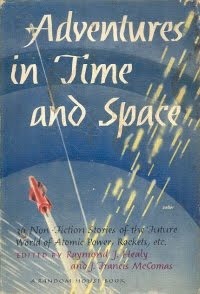
Adventures in Time and Space edited by Healy and McComas

Adventures_in_time_and_space

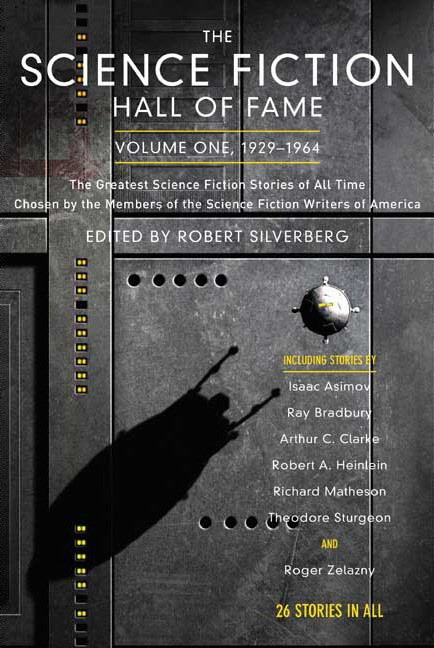
The Science Fiction Hall of Fame, Volume One, 1929-1964

sf-hall-1

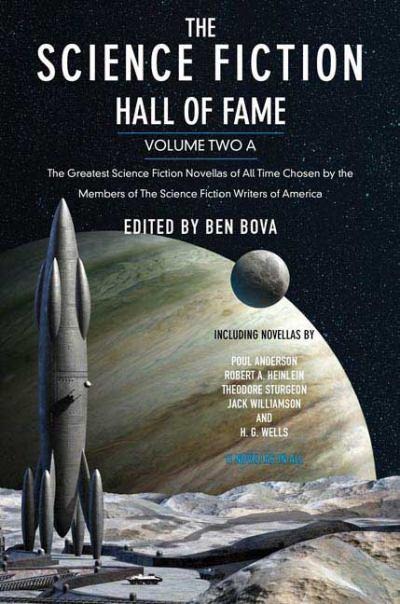
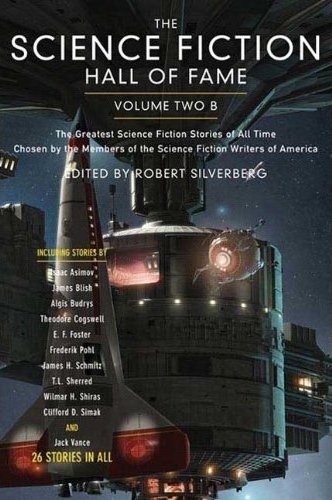
Science Fiction Hall of Fame, Volume 2

sf-hall-2a

sf-hall-2b

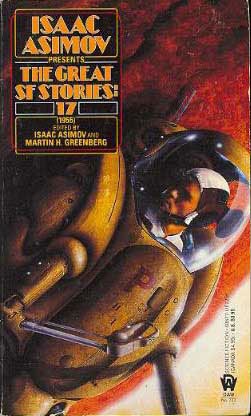
Asimov’s Great SF Stories (series 1-25, 1939-1963)

Asimov_Great_SF_stories17_Daw_1988

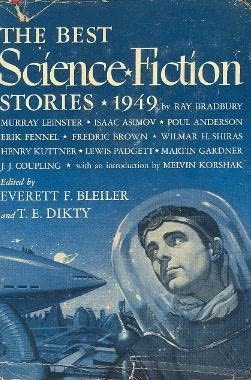
The Best Science Fiction Stories: 1949, 1950, 1951, 1952, 1953, 1954

Best_science_fiction_stories_1949

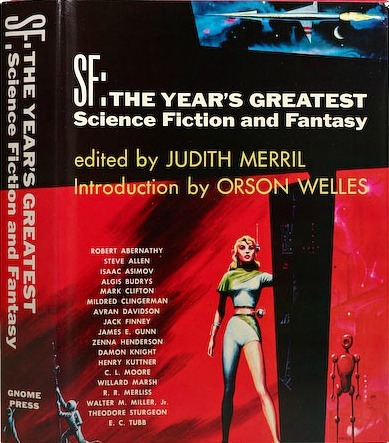
Judith Merril Year’s Greatest (1956-59) and Year’s Best S-F (1960-66)

SF-The Year's Greatest

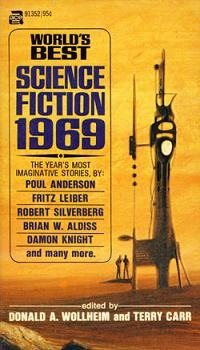
World’s Best Science Fiction (1965-1971) edited by Wollheim and Carr

Worlds_Best_Science_Fiction_1969_cover

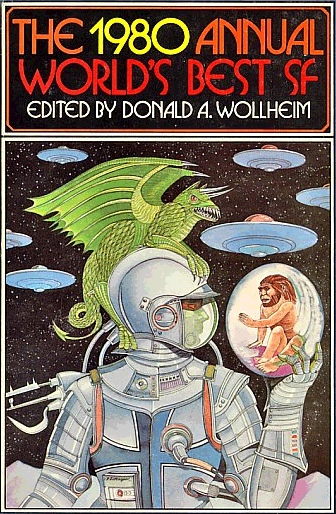
The 1972-1990 Annual World’s Best SF edited by Donald A. Wollheim

the_1980_annual_worlds_best_sf

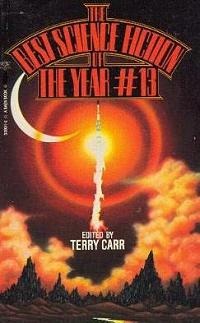
Best Science Fiction of the Year edited by Terry Carr (1-16)

Best_Science_Fiction_of_the_Year_13_cover

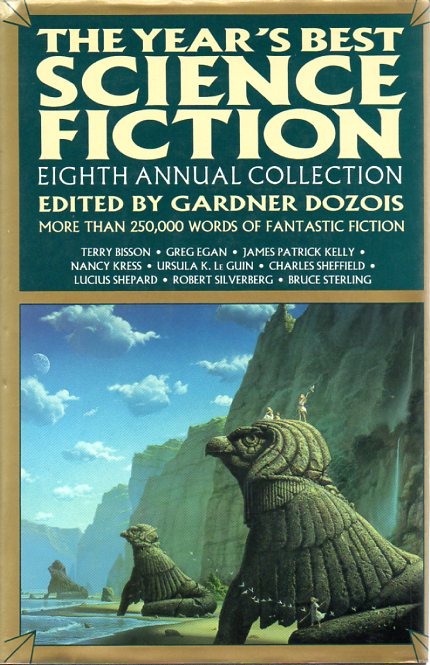
The Year’s Best Science Fiction edited by Gardner Dozois 1984-present

Year'sbestDozois


This hardly scratches the surface of great science fiction anthologies, but by using the annual bests it systematically covers all the years from 1939 to the present.  And we can capture the 1930s with these two collections.

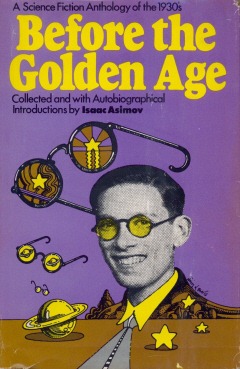
Before the Golden Age edited by Isaac Asimov

Before-the-Golden-Age

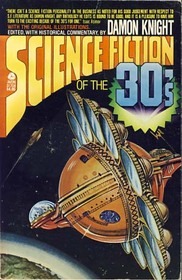
Science Fiction of the Thirties edited by Damon Knight

science-fiction-of-the-thirties

I could go back even further with the Sam Moskowitz collections like Under the Moons of Mars and Science Fiction by Gaslight.

If only all these fantastic collections could be reprinted as ebooks, or better yet, as audio books.  I suppose some enterprising publisher and editor could look at the stories in all these collections and seek to get reprint rights and create a new series of anthologies.  They could call it Classic Science Fiction for the Digital Age and publish it in a series of volumes for ebooks and audio.

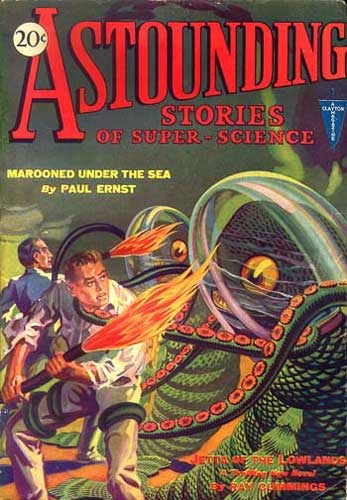
Would there be much of an audience for this old science fiction?  I don’t know.  Project Guttenberg is reprinting a lot of early science fiction in multiple ebook formats that often include the original art.  Take a look at this September 1930 issue of Astounding Magazine.  It’s beautifully laid out for html, but also offers many ebook formats here.

astound-1930-09

Copyrights will keep modern science fiction, like what’s in most of the best of the best-of anthologies above out of these public domain offerings, which is rather sad.  It means most of those stories will probably be never read again.  Of course, I don’t know if there are readers for these public domain reprints.  I do wish someone would make an easy to use app to add the Project Guttenberg issues of Astounding to my iPad.  I’ll have to experiment with this and write about it in a future blog.

JWH – 9/3/11


Empire of the Summer Moon by S. C. Gwynne

Empire of the Summer Moon by S. C. Gwynne is subtitled “Quanah Parker and the Rise and Fall of the Comanches, the Most Powerful Indian Tribe in American History.”  Empire of the Summer Moon is the kind of history book that makes you want to give up reading fiction, because it’s far more riveting than most novels.  Empire of the Summer Moon starts with the Fort Parker massacre in May of 1836, when Cynthia Ann Parker, then 9 years old, was captured by the Comanches.  After the gruesome attack on the private fort, S. C. Gwynne digresses by jumping back to give a bit of history of the Nermernuh, the Comanche name for their people, migrating down from what is now Wyoming, to Texas, Oklahoma, New Mexico and southern Kansas.

empire-of-the-summer-moon

Gwynne teases us through the whole book, by returning to the story of Cynthia Ann Parker, one of the most famous captives of the West, and her son Quanah Parker who became the final leader of the Comanches, which I considered the main story.  Gwynne often leaves their personal story to explore on the larger history of the Comanches, and how the Spanish and Mexicans came up from the South, and the Americans from the East,  to invade and destroy Comancheria over four hundred years.

Empire of the Summer Moon is a story about a clash of cultures between 19th century Europe invading the territory of what is essentially a late stone age hunting and gathering people.  If you’ve seen John Wayne’s great film The Searchers, then you’ve seen a cleaned up story based on the same real-life history chronicled in this non-fiction book.  I grew up loving westerns – movies, TV shows and books, but they don’t hold a candle to Empire of the Summer Moon when it comes to gritty realism.

This is a complex story.  It involves genocide, terrible acts of violence, rape, torture and war, with magnificent struggles of survival by individuals, and the  manifest destiny of one people against the way of life of another.  This is a meaty book that begs for the 12 hour Ken Burns documentary treatment.

It’s also a book of ethical issues.  Should the Europeans have destroyed the Indian way of life?  As Gwynne points out, the Indians loved warring amongst themselves, and everything the Comanches did to the whites they also did to all the tribes around them.  And for most of several hundred years the Comanches were the superior fighting force able to hold their own against the invading white man.  It wasn’t until after early Colt revolvers were introduced in 1844 that technology changed in favor of the Texans battling the Comanches, but it wasn’t until after the civil war ended that the U.S. got serious about ending the conflict for good.  Whether this was intentional genocide or just crushing cultural imperialism is hard to say.

Either way you look at it, we took away the Comanche way of life of living on the plains and hunting the buffalo.  The Comanches had their own form of assimilation.  They would attack their enemies, kill the males, rape and enslave the woman, but adopt the children.  Cynthia Ann Parker grew up with the Comanches and loved their way of life and did everything she could to keep from being recaptured by the whites.  The Comanches knew they couldn’t convert grown male captives, and didn’t try.  But that’s exactly what the Americans wanted to do, to convert the male Comanches from buffalo hunters into dirt farmers.  We thought we were being fair and enlightened, but maybe it was the most unethical and cruelest treatment of all.

Few Indians could adapt to the white man’s ways, especially in the corrupt reservation system, but Quanah Parker, a young Comanche chief and fierce raider did just that.  Did Cynthia Ann Parker’s genes help him?  I would think so, but I’m not sure.  Quanah Parker moved to the reservation in 1875 and lived to 1911, becoming quite successful and was even a friend to former enemies and presidents, often traveling east, and even got to act in an early silent movie.  I wished that Wynne had written twice as much material on this part of the story because Quanah Parker was an amazing man – especially when you consider his early life was spent in acts that would sicken all but the worst serial killers.

I’m not sure who the targeted audience is for this book.  I would think anyone who loves American history, especially history of the westward expansion in the 19th century, would love this book.  I would also think anyone who loves watching westerns would love this book.  I wonder what the 14,700 modern day Comanche readers would think of this book?  Was it a fair portrayal?  But I also wonder what the citizens of our country who dislike criticism of America will think.  Gwynne does make a good case that many 19th century Americans did want to flat out exterminate the Native Americans, and even showed the eastern liberals who wanted to do fair by the Indians failed miserably.

I highly recommend this book to fans of westerns though.  Empire of the Summer Moon proves that most westerns are inaccurate at best, but more than that, makes me realize that most fail to capture the time in any authentic way.  The book shows we have a collective fantasy about the old west that is absurdly simple minded.

JWH – 8/21/11

The Ten-Cent Plague by David Hajdu

I am not a comic book reader but I found this history of the comic book industry on trial in the 1950s to be a fascinating story.  The Ten-Cent Plague: The Great Comic Book Scare and How It Changed America by David Hajdu covers the origins of the comic strip, the appearance of the comic book in the 1930s, and its creative heyday in the 1940s and early 1950s, and then focuses on how some Americans got scared and eventually brought about book burning, censorship and laws against publishing comic books.  The mid 1950s was a long time ago, and I was just a kid, so I don’t remember these events.  But the comic book scare coincided with the red scare, the Joe McCarthy witch hunts.  Comic books lead to another kind of scare, not over communists, but the fear of juvenile delinquents and the corruption of the young.

Most of the focus of the 1950s comic book scare was on true crime comics and horror comics.  Today when comic book conventions are covered on Entertainment Tonight, showing famous celebrities in attendance, and many of the top grossing movies are based on comic books, it’s hard to think about a time when comic books would scare Americans into having book burning rallies.

The irony here is everything that the censors hated about comics is standard fare on prime time TV today.  The censors did not want children seeing stories about crime and criminals, or reading about vampires, ghouls, zombies, werewolves, and their undead kin.  Nor did they like stories about young women running off with the bad boy types, or leaving their husbands to find exciting careers.  Parents, congressmen and censors feared that comics were undermining the status quo.  Comic books were outlawed just as rock and roll hit the scene, and then came the beatniks, hippies and all the other counter culture bellwethers.

If we could take our present day pop culture back to the 1940s and 1950s it would blow the minds of Andy Hardy/Leave it to Beaver America, and the fear mongers back then would think they had been absolutely right about censoring the comics.  They censored comics and made kids read Casper the Friendly Ghost, but it didn’t stop the cultural upheaval they feared.  Does censorship ever work?

To get some idea about the censorship of this time, watch David Hajdu talk about the last comic book EC Comics published:

The surprising element of this story for me was how much this era was loved by the comic readers of the time.  They considered the advent of censorship as the destruction of a great art form.  To be honest, I never really liked comics, but then I never read any from the golden age that the The Ten-Cent Plague chronicles.  Comics to me always equaled stories about super heroes, but before the great censorship there were hundreds of titles about endless topics, that sold in the tens of millions each month.  But this was also before the success of television.  And Hajdu doesn’t mention that the pulp magazine was also dying at this same time even without censorship.  Evidently the boob tube put the kibosh on pulp fiction, both written and graphic.

A lot of things changed in the 1950s.  Radio stories died out, and so did Saturday afternoon serials.  Culture went through tremendous change in the 1950s, as witnessed by Bill Bryson in The Life and Times of the Thunderbolt Kid, which I read about a month ago for the second time.  I do have tremendous nostalgia for that time, and even though I dislike crime and horror stories in general, Hajdu makes me want to read those pre-Code comics.  I guess I sympathize with that comic culture because I love pre-Code Hollywood movies from the early 1930s.

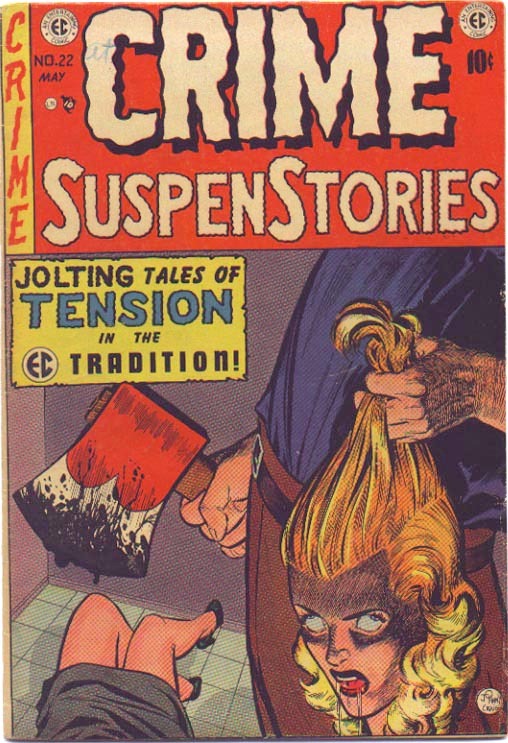
I listened to The Ten-Cent Plague, so I had no idea what these comics looked like.  I’m not even sure if the hardcover book had photos.  However, the comic book history is well documented on the web.  Here is the cover used in a senate hearing described in the book.  William Gaines, the publisher of EC Comics was asked by Senator Estes Kefauver if he thought this cover was in good taste, and Gaines shocked everyone by saying he did think it was in good taste.  I do have to wonder about this being reading material for children though, but then people wonder the same thing about kids and video games.  Gaines said this cover was in good taste because the artist didn’t show the severed neck on the head or body.  Since they do show those parts now in movies, I guess our movies are in bad taste.

crime_suspenstories22

I found this cover and many others at Classic Crime & Horror Covers.  That site linked me to Crimeboss, with an extensive collection of covers.  I wanted to see what the interiors looked like and found The Horror of it All.  I quickly discovered that the history of comics, and especially the pre-code era, is well documented on the internet.  Comic books are a sub-culture I know little of, and would probably be satisfied with reading one good coffee table book about its history to catch up.  The sub-culture is gigantic, and I wonder what Fredric Wertham, the author of  Seduction of the Innocent, and his disciples would make of the huge success comics have in our society today.

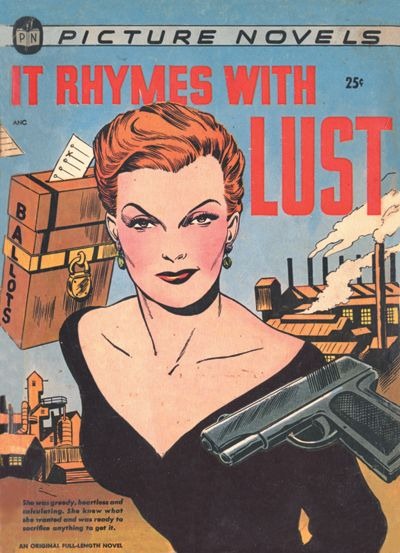
I’m an outsider to the fandom of comics, and I have little interest in reading comics.  I don’t mean to put them down, but they are like opera or ballet or polka music, I just never got into them.  However, there was one story Hajdu told about that I might seek out – It Rhymes with Lust, a comic book that some consider the first graphic novel.

ItRhymesWithLust

From what I can tell, the story is probably like a movie Joan Crawford or Barbara Stanwyck would have been in the 1940s, so why all the fuss?  Were ten year old kids really reading these film noir comic books?  And if comics were so pervasive in society in the 1940s and 1950s, why don’t we see characters in the movies from those times reading them?  From David Hajdu’s account, the history of the comics and their downfall was obviously more than a tempest in a teapot because many states and cities took the time to criminalize the sale of comics, and schools and PTA groups took the time to buy thousand and thousands of comics so they could burn them in PR events.  Evidently millions of people were buying comics then, so why hasn’t literature or film from those times featured stories about the sub-culture?  There were many films about early rock and roll fans, or jazz fans before that.

I found The Ten-Cent Plague a fascinating story, but I’d like to know more.  I wonder if my father or his brothers read the pre-code comics?  They never talked about them.  Except for these rare histories of the era, I wouldn’t have known these types of comic books even existed.  When the comics were banned many of the artists and writers had to hide their love of their art because they were treated like child molesters.  Is that why this sub-culture was so thoroughly forgotten?  Did America hate comics that much?

By the way, the 1988 documentary Comic Book Confidential makes a great visual supplement to The Ten-Cent Plague because they interview many of the people profiled in the book, and show some of the same court films that Hajdu described. Plus the documentary continues the history of comics after the code was enforced, which is where the book ends.  This film is available at Netflix and segments from it are at YouTube.

JWH – 6/23/11

The Warmth of Other Suns by Isabel Wilkerson

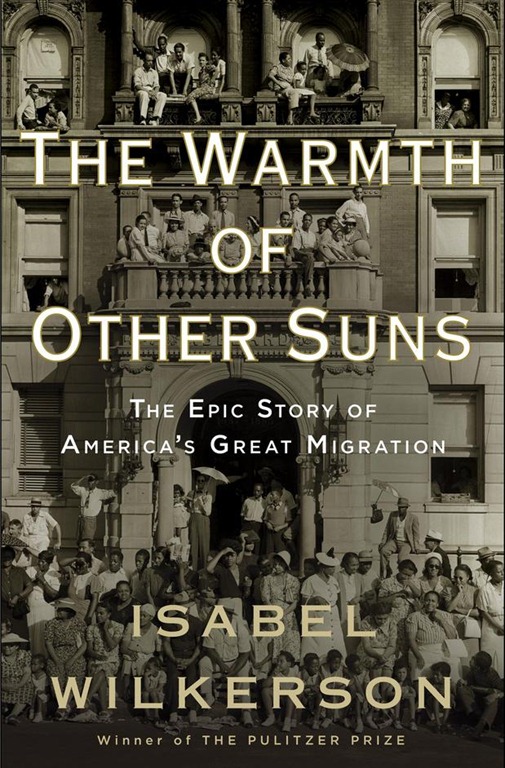
With a title like The Warmth of Other Suns you’d think this book would be about interstellar travel, but it’s not, this book is about how we’re all so alien to one another.  From 1915 until the 1970s six million African Americans left the old south to find freedom living up north and out west hoping to escape the cruel Jim Crow laws that continued to enslave them long after the Civil War had ended.  These immigrants fled a homeland filled with oppression and cruelty hoping to find freedom in a new land that was ironically part of the same country they were leaving.

warmth-of-other-sun_571052c

The Warmth of Other Sun reads like a novel, but it’s a history book, one if you’re old enough you might remember living.  This is a great book, a wonderful book, and a very painful book to read because it paints scenes from an inglorious America that we must never forget even though most people have.   This is a tremendous book to contrast the past with the present and show us how far we’ve come with changing our society for the better.  Race relations is a tired subject for most people, so I worry this book won’t get the audience it deserves.  People need to read The Warmth of Other Suns because it’s a great story, amazingly told, and yes, it will be good for you, even if it hurts.

Watching TV after reading The Warmth of Other Suns is startling, because this book chronicles the horrors of the Jim Crow era so vividly that seeing so much diversity on the television screen makes it hard to believe this book is true.  One of the great sad aspects of this book is none of the principal characters lived to read it, or to see Barack Obama become President.  We haven’t reach the promised land, but I think we can see it in our telescopes, if we look hard.

Growing up the phrase “silent majority” was often used to mean the common people that didn’t get heard in the press.  The Warmth of Other Suns tells us there are more than one silent majority, and we each bask in the warmth of different suns.  There is no one group of blacks or whites that represent their races.  I hate the term race because it’s an optical illusion.  To talk about specifics we use generalities.  In this book we have the black people who immigrated to the north and west, and we have the black folk who stayed home in the south, and we have the whites of the south and the whites of the north and west.  But in end, every last person is different.  I think Wilkerson reflects this reality.

Wilkerson writes about three principal characters to tell her story, after interviewing over 1,200.  She could have written about three different people fleeing the dying Dixie and told a completely different story.  She could have written about three people that stayed in the south and their story could have reflected an equal amount of bravery as those who left.

I’d like to coin a different term, “silent heroes.”  This is what The Warmth of Other Suns is about, about three people brave enough to build a new life.  Isabel Wilkerson’s three silent heroes are:

  • Ida Mae Brandon Gladney  – Mississippi sharecropper
  • George Swanson Starling – Florida fruit picker
  • Robert Joseph Pershing Foster – Louisiana doctor

The history of humanity has been the story of men and women seeking personal freedom, but Americans have for so long lived with security, success and smugness that I’m not sure they even know what freedom means anymore.  Reading The Warmth of Other Suns will remind them with intense details and powerful emotions.  Americans love to think of themselves as living in the land of the free, but stories like The Warmth of Other Suns reminds us we have a long way to go until everyone is free in this country.  And freedom doesn’t mean just being free of metal shackles – because the southern racists who mistreated, tortured and murdered the blacks are imprisoned by psychological chains stronger than any metal.

We all have physical and mental chains that bind us from being truly free – read this book and see what I mean.  In reality The Warmth of Other Suns is another chronicle of the Greatest Generation.  I could never have been as brave as Ida Mae, George and Robert.  I never worked as hard in my life at anything as they did just to survive most of their routine days.

In the United States we all love the heroic soldiers fighting for freedom in distant lands, but somehow we feel threatened by freedom fighters in our own country.  I’ve always loved movies about brave soldiers in war movies, or brave cowboys in westerns, or tough cops that fight crime, but there are all kinds of brave people we don’t celebrate in movies, and the people in The Warmth of Other Suns are very brave people indeed, ones that need to be saluted and remembered.

Isabel Wilkerson also needs to be amply rewarded and recognized for the many years she spent researching this story.  The Warmth of Other Suns is an amazing accomplishment.

If I had the time and energy I could write thousands of words about this book, but I don’t know if any more would convince you to read it.  Most people read fiction.  Most bookworms stick close to their favorite genre, whether it’s murder mysteries, science fiction or romance.  I suggest skipping your next novel and reading this this non-fiction book because you might just find it far more exciting, emotional and wonderful.

Other Reviews:

JWH – 5/16/11

The Way We Live Now by Anthony Trollope

I have never read an Anthony Trollope book before reading The Way We Live Now.  In fact, I knew so little about Trollope that I thought he was a French novelist, but of course I was wrong.  He was born and died in London, and was roughly a contemporary of Charles Dickens.  The only reason I listened to The Way We Live Now is because Audible.com had a sale on audio books priced at $4.95 each and I loaded up on them.  Whenever Audible has one of these $4.95 sales I buy just about anything that sounds good, taking chances on books that I normally wouldn’t buy at regular price.  This chance taking often pays off, and with The Way We Live Now was a huge success.
TheWayWeLiveNow 

I didn’t even mean to start listening to The Way We Live Now this month, I have several books needing to be read for book clubs, and it was extremely long.  But I was curious and once I started listening I couldn’t stop.  The BBC WW edition I listened to was wonderfully narrated by Timothy West who seems to have made a career out of performing Trollope.  The 32 hour and 25 minute audio book was broken down in four 8 hour plus digital sections, and as I finished each part I watched one episode of the 4-part BBC One production of The Way We Live Now (2001). 

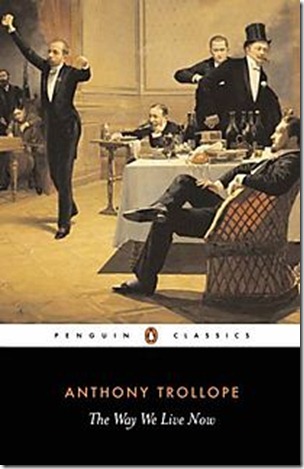
TheWayWeLiveNow2

That means 8 hours of book is turned into one hour of film.  Listening and watching was very educational about how movie makers distill a novel into a teleplay.  Sadly, four hours was way too short.  I think they needed a minimum of 8 hours to do the job well, and would have been a superior production if they had given it 12 hours like many HBO shows.  If a tiny 9.5 hour audio book like Dead Until Dark by Charlaine Harris can be made into a 12 part True Blood, imagine what the BBC could have down with The Way We Live Now at three times the length.

TheWayWeLiveNow2001

The film version uses the phrase “the way we live now” more than once, but I don’t remember it used in the book, but that’s essentially what the book is about, a time when things are changing.  People are having to change, and all the characters illustrate “the way we live now.”  The book is set in London during 1873 when everyone is caught up in an economic bubble.  The story has a very modern feel to it.

Augustus Melmotte is a very rich man who has come to London buying real estate and promoting a stock investing craze.  He has a Donald Trump quality to him.  His background is very mysterious, but he wants to be the wealthiest man in London and even has political aspirations.  He has a daughter Marie that he’s dangling in front of the English aristocracy hoping to wed her to another large fortune and get a title for the family to legitimatize his ambitions.  Unfortunately for Melmotte, many of the swells have titles but no money and see Marie as a solution to their own economic problems.

The story is about class and social climbing, and satirizes much about London life that Trollope didn’t like.  To stir things up even more he gives us two American characters Hamilton K. Fisker and Mrs. Hurtle.  Fisker is a wheeler-dealer promoting a railroad from Salt Lake City to Veracruz, Mexico and convinces Melmotte to lead the charge with  British investors.  Fisker wants Melmotte in on the deal because of all the lay about aristocrats he can get for the board of directors and use their names to sell stock to the gullible English.   And the English want to cash in on American empire building.

The story is long and leisurely, but never slow.  It has a horde of characters, many struggling to find appropriate mates, sometimes for love, sometimes for money.  Like most Victorian novels there’s no actual sex in the story, but Trollope seems to go further than his contemporary novelists at indirect suggestions.  He knows that people are having sex, he just doesn’t give us any sex scenes, or even directly implies his couples are having sex.  What’s interesting is the film version does bring the Victorian novel into the realm of PG-13.  I don’t think this hurt Trollope’s story except when Mrs. Hurtle tells another woman she was sleeping with Paul Montague, and that just doesn’t happen in the novel.  But we the reader knows that Hetta is thinking it.

The film versions leaves a lot out, and actually changes the story in key places, and totally screws up the ending.  If I hadn’t been reading the book I would have given the film a B- for a Masterpiece Theater type show, fun, but not great, like the A+ Downton Abby.  Knowing the book I’ll have to give the film a D+ at best, but well worth watching if you are hard up for Masterpiece Theater kind of shows, which I often am.

The novel is full of great characters that illustrates different layers of London life.

Sir Felix Carbury, a young penniless baronet, lives by his looks and title, mooching off his mother Lady Matilda Carbury while gambling at cards all night, and half-heartedly chasing Marie Melmotte.  Felix is as modern as any slacker son today, and gives his mother endless grief.  Lady Carbury, his doting mother, tries to get by on writing, but she writes terrible books such as, Criminal Queens: Powerful Women as the Playthings of Love that are full of inaccuracies and quickly cribbed from other sensational books of the time.  Trollope uses her literary ambitions to make fun of writers and publishers of the day.  Again, its very modern.

Roger Carbury is the novel’s decent man and suffers for it.  He’s always been in love with Felix’s sister Hetta, but she’s not in love with him.  Lady Carbury pushes her daughter to marry her cousin so the family would be  rich again and Hetta would inherit the Carbury estate.  Hetta is in love with Paul Montague, English partner and civil engineer to Hamilton Fisker’s great railway project.   Paul is Roger’s protégé and best friend.  It’s quite a nasty love triangle.

Paul is tangled up with Mrs. Hurtle, an American adventuress that might have killed more than one husband for being scorned or cheated on, and has taken to the English gentleman thinking he is honorable.  In the novel Trollope portrays Americans as bold, calculating, brash, uncouth, immoral and uncultured.  Mrs. Hurtle dominates Paul and he wants to run, so she chases after him like a big game hunter, refusing to let him escape her clutches.

Marie Melmotte, played by Shirley Henderson (Moaning Myrtle in the Harry Potter films) steals the show in the film version, and for the most part fulfills the character of the novel.  In the novel, Marie is boy crazy for Felix, but her domineering dad, Augustus sees right away that Felix has no money and is worthless for his plans.  At the beginning of the story Marie is weak and mousy, but by the end she’s in command of her fate.  The Way We Live Now is very much a feminist novel, or as much as it could be for the time.  One young social climbing girl is even willing to marry a Jewish man to get what she wants.  Trollope deals a lot with anti-Semitism in the novel, again showing the way we live now involves accepting Jewish people into society and politics, and I think he’s sympathetic to this issue, but I’m not sure.

I doubt few people will run out and read The Way We Live Now because of my recommendation.  Giant Victorian novels just aren’t that popular anymore.  But I do give it an A+ for entertainment value.   It has become one of my favorite 19th century English novels – and the very best include Pride and Prejudice, Great Expectations and Middlemarch.

JWH – 4/24/11