Vertigo (1958)

James Wallace Harris

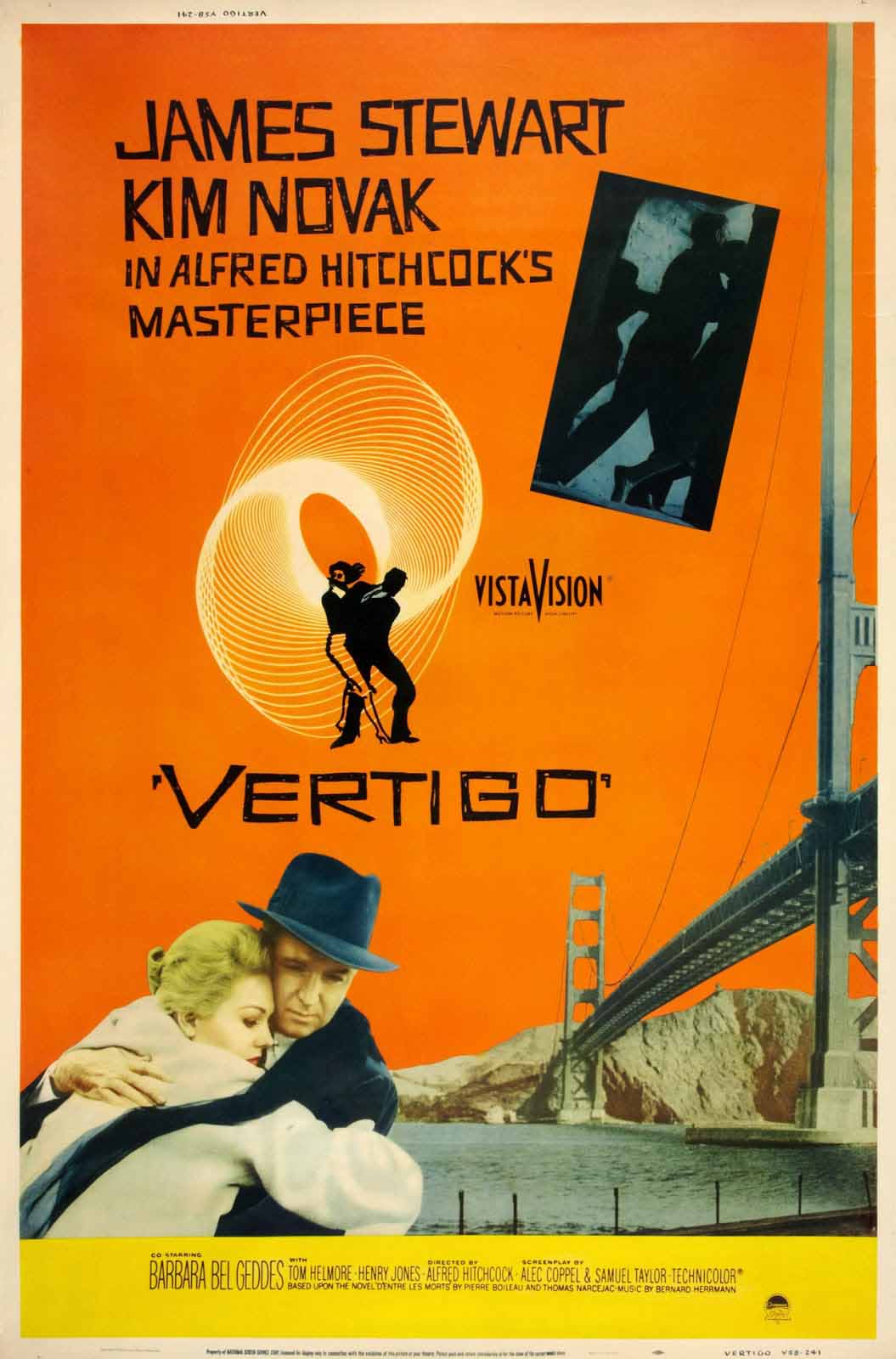
Read the Wikipedia entry for a concise overview and evaluation of Hitchcock’s Vertigo — especially the sections “Reception.” When Vertigo was first released it got very mixed reviews, but over the years its reputation has risen. Some polls have even placed it as the best film ever made. Quoting this one paragraph should give you an idea of what I mean:

Over time the film has been re-evaluated by film critics and has moved higher in esteem in most critics' opinions. Every ten years since 1952, the British Film Institute's film magazine, Sight & Sound, has asked the world's leading film critics to compile a list of the 10 greatest films of all time.[83] In the 1962 and 1972 polls, Vertigo was not among the top 10 films in voting. Only in 1982 did Vertigo enter the list, and then in 7th place.[84] By 1992 it had advanced to 4th place,[85] by 2002 to 2nd, and in 2012 to 1st place in both the crime genre, and overall, ahead of Citizen Kane in 2nd place; in 2022, the Sight & Sound poll ranked Vertigo 2nd place.[86] In the 2012 Sight & Sound director's poll of the greatest films ever made Vertigo was ranked 7th.[87] In the earlier 2002 version of the list the film ranked 6th among directors.[88][89] In 2022 edition of the list the film ranked 6th in the director's poll.[90] In 1998 Time Out conducted a poll and Vertigo was voted the 5th greatest film of all time.[91] The Village Voice ranked Vertigo at No. 3 in its Top 250 "Best Films of the Century" list in 1999, based on a poll of critics.[92] Entertainment Weekly voted it the 19th Greatest film of all time in 1999.[93] In January 2002, the film was voted at No. 96 on the list of the "Top 100 Essential Films of All Time" by the National Society of Film Critics.[94][95] In 2009, the film was ranked at No. 10 on Japanese film magazine Kinema Junpo's Top 10 Non-Japanese Films of All Time list.[96] In 2022, Time Out magazine ranked the film at No.15 on their list of "The 100 best thriller films of all time".

If you haven’t seen Vertigo, you should go watch it before reading my reaction.

I’ve seen Vertigo twice in the past year, and it is a mesmerizing film. But what makes it great, or even the greatest? I love dozens of films, but I have no idea which one is best, even for me. How can critics think in terms of ranking films? By what criteria do they judge them? If you search on YouTube, you can find several documentaries and short films about Vertigo. Some people are quite passionate about this movie and what they see in it.

I know there is one thing missing from Vertigo, and maybe all Hitchcock films – and that’s an uplifting experience. His films are pure movie storytelling. There are no messages, no moralizing, no philosophy, no expressions about Art, and they aren’t studies in sociology. Some critics analyze them psychologically, but I’m not even sure they express anything consistent about psychology.

This summer, Time Magazine picked one hundred movies the editors considered the best to celebrate its one hundred years of publication. Three of Hitchcock’s films made the list, The 39 Steps, Vertigo, and Psycho. What qualities did the editors of Time and other list makers use to rank films?

I can’t answer that without months or years of study. What I can do is give my reaction to Vertigo. Is there something in my reaction or yours that points to the quality that makes films great?

On a simple level, Vertigo is a murder mystery, but the audience doesn’t know that until two-thirds way into the show. And then it doesn’t matter. The film starts with San Francisco detective John “Scottie” Ferguson (James Stewart) chasing a fugitive across rooftops. He jumps a gap, misses, and hangs by a gutter several floors above an alley. A uniform officer comes to help Scottie and falls to his death.

Next, we meet Scottie in the apartment of Marjorie “Midge” Wood (Barbara Bel Geddes). It’s a beautiful room overlooking San Francisco and the bay. Midge an artist who makes her living illustrating women’s underwear. Midge and Scottie were once briefly engaged. Stewart was 49 at the time, and Bel Geddes was 35. I found that age difference surprising. This scene is used to show how Scottie has become afraid of heights and the resultant vertigo. This is important to the plot, but I don’t think it’s important at all to the story.

Soon after that Scottie meets with his old college friend, Gavin Elster (Tom Helmore). Helmore is four years older than Stewart. He asks Scottie to tail his wife who is acting weird. Madeleine Elster is played by Kim Novak who is only 24. I also found this age difference hard to accept. I’ve even read that Hitchcock thought the age differences were a problem, but since many people consider this film about sexual obsession, and in recent years we’ve been learning about how obsessed Hitchcock felt over his female stars, it makes the age difference mean something. However, I doubt Hitchcock planned that.

Novak plays two characters, Madeleine Elster and Judy Barton, but moviegoers don’t know that until two-thirds way into the film. The first two-thirds of the movie is Scottie following Madeleine around and falling in love with her. It’s all rather mysterious.

There are two McGuffins in Vertigo. One is a murder mystery. Some critics have even called Vertigo a film noir. I think that’s bullshit. From my experience of watching the film three times, it’s all about lusting after Kim Novak’s characters. The second McGuffin is Madeleine’s obsession where she thinks she’s a reincarnated woman from the 19th century who committed suicide. The 1950s were full of weird psychological studies and stories like Bridey Murphy, The Three Faces of Eve, and Edgar Cayce. Starting in the late 1940s and through the 1950s, mental illness was a big theme in the movies. Madeleine’s obsession is colorful, but it’s another McGuffin.

That’s because Judy Barton is playing the role to help Gavin kill the real Madeleine. They are using Scottie’s fear of heights. Gavin and Judy make up this obsession to trick Scottie. It’s not real or valid.

The audience doesn’t know about this subterfuge, and that’s why I don’t think it matters. What we really enjoyed while watching the film is Jimmy Stewart chasing after Kim Novak. And we’re just as shocked as Scottie when we think we see her die. This is Hitchcock’s obsession – to surprise and shock his audience. He loves building suspense. Suspense and surprise are his core values.

Scottie goes through a year in a mental hospital helped by Midge. Of course, we wonder, why isn’t Scottie chasing after Midge? Then Scottie sees a woman who looks vaguely like Madeleine, but who claims to be a poor shopgirl named Judy Barton. Novak as Madeleine looked classy, Judy looked trashy. For the rest of the film, Scottie slowly convinces Judy to change her appearance to look like Madeleine while he woos her. Judy finds this creepy.

The audience and then Scottie learns that Judy is really the same girl who impersonated Madeleine. However, Scottie doesn’t turn her in. He’s obsessed with recreating Madeleine and recreating his experience of the murder scene. He tells Judy he wants to confront his fear of heights. Scottie becomes increasingly creepy, pushing Judy into doing things she doesn’t want to do. Personally, I felt sorry for Judy. Even though she committed a murder for money, she seems less amoral than Scottie. Yet, I’ve never seen any critic call Scottie amoral.

In the final scene, Scottie frees himself of his fear, but a nun scares Judy, and she falls from the same tower as Madeleine. Damn, in this movie, anyone that goes up several floors with Scottie falls to their death. And that’s three for three.

I love watching this film, but I don’t care about the story. I don’t care about the plot. I don’t care about who the characters are. All I love is the visuals, the cinematography, the sets, the costumes, the interiors, the street scenes, the cars. It’s all gorgeous. And I love looking at Kim Novak.

Is beautiful to look at a reason to make Vertigo one of the greatest films of all time? If I made a list of my favorite 100 films, I would include it.

But damn, I wish I could rewrite this story!

The story follows the point of view of Scottie. It should have followed the point of view of Judy. Then it would have been a true film noir murder mystery. Kim Novak would have had a deep character to play. Imagine how Judy would have gotten involved with the scheme and what it would have taken to pull it off. Think about all those details. Imagine, how afterwards Judy realized she had fallen in love with Scottie and let herself be found. Imagine how hard she would have wanted to be Judy and loved by Scottie, and how upsetting it would be to have Scottie remake her into the woman she murdered.

Hitchcock missed something big. The story was based on a novel, and the screenplay had to be rewritten several times. They should have rewritten it again.

JWH

If You Love Old Movies on TCM, Try Old Movies on YouTube

by James Wallace Harris, 10/20/23

Turner Classic Movies (TCM) is the gold standard for old movie lovers. Nothing beats it if you’re addicted to watching movies from the past. However, TCM doesn’t show every old movie, and I’ve found a great secondary source for films from yesteryear. YouTube (not YouTube TV) is another giant cinematic library. It’s not as convenient to use, and the quality varies greatly, but there are plenty of old movie gems there to see.

Warning: YouTube also rents and sells movies. I’m referring to films that are part of YouTube to watch for free.

I subscribe to YouTube Premium to avoid commercials, so I don’t know if I’m getting some content that’s not available to the free version of YouTube. I’m going to present several examples, so it should be a test of that. It also helps that you sign into YouTube with your free Google account so it can remember what you like. 99.99% of YouTube content is hidden away, but YouTube will follow what you like and recommend more of the same. Once I started watching old movies it kept offering me more. It’s well seems endlessly deep.

First, you need to have the YouTube channel added to your television. You can watch on your phone or table, but these movies look great a large screen TVs. YouTube app is available for most smart TVs, or for streamers like the Roku, Fire TV, Apple TV, etc.

Next, go to YouTube on your computer and find a movie you like — I’ll be linking to several. Hit the save button and create a folder called Old Movies. If you want to save movies by categories, create them now. You can’t create these folders from your TV, but you can save movies you find on your TV to these folders.

When you see a movie you might like, start playing it. Check the settings icon to see what resolution the film is using. Films loaded years ago tend to be 240 and 360. Avoid them. Lots of films are being uploaded at 1080p or 720p which is high resolution, like what’s on a Blu-ray disc. 480p is the quality of DVDs. Occasionally, you’ll see higher resolutions, but 480p, 720p, and 1080p are fine to great.

I tend to save films that look interesting as YouTube recommends them. Then I go to my Old Movie folder when I want to watch one. I’m not sure how long these films stay on YouTube, or even if they’re legal. My guess is some copyright holders or companies licensing the copyright of old movies are putting them up on YouTube to earn ad revenue, or a share of YouTube Premium revenue. Since I’m seeing more movies all the time, I’m guessing it’s becoming a feature. (By the way, you’ll also need to use your computer to delete the movies from your folders once you watch them.)

I often read about movies to find ones I want to watch. I check the JustWatch app on my iPhone to see where they are streaming. If the movie isn’t listed, I often I find them on YouTube. Evidently, movies first go to premium streaming channels, then to the ad-support streaming channels like Roku, Tubi, Pluto, etc. After that, they are in limbo. And some of those are showing up on YouTube.

I’m finding lots of movies on YouTube from American and British studios that don’t often appear on TCM. Movies I’ve wanted to see for years. Movies I used to buy on DVD.

There is one downside to movies on YouTube. Their Closed Caption is AI generated, and horrible. If you need to see the words on the screen, you’ll probably be disappointed.

Now for some examples. Links are to Wikipedia. Here’s a real gem, This Happy Breed (1944), about England between WWI and WWII, directed by David Lean.

I thought Mister 880 (1950) about Edmund Gwenn being a counterfeiter of $1 bills to be an afternoon feel good flick.

Here’s a less famous Alfred Hitchcock flick with Gregory Peck, The Paradine Case (1947). It’s quite good.

Here’s the first Mr. Belvedere film with Clifton Webb called Sitting Pretty (1948). It’s from a YouTube channel called DK Classics III — they have tons of great old movies. Clifton Webb made three of these Mr. Belvedere movies. The first two show up on TCM all the time, but I’ve never seen the third, Mr. Belvedere Rings the Bell (1951). I found it on YouTube, but sadly only in 360p. I still watched it, and liked it so much I bought the DVD. I’ve now watched several Clifton Webb movies on YouTube.

Here’s a film noir with Lucille Ball. Clifton Webb plays an evil art dealer in The Dark Corner (1946). It’s only in 480p, but nice enough. One thing that’s important is to read about these movies on Wikipedia. It got decent reviews when it came out, but over time, it’s considered a respectable film noir and has a 100% rating on Rotten Tomatoes.

Not all old movies are great, but some I want to see for a reason. Project Moonbase (1953) was the second film Robert A. Heinlein worked on as a screenwriter. The first being Destination Moon, which TCM shows often. I’ve never seen Project Moonbase though. And here it is at 720p.

Susan and I are getting into old English movies. Here’s a fun romantic comedy with Vivian Leigh and Rex Harrison (his first film) called Storm in a Teacup (1937) about a reporter siding with a dog’s owner in a political brouhaha. It has the feel of a Frank Capra movie.

This should be enough to give you a taste of what I mean. These aren’t famous films, but they are fun to watch. If you’ve been watching TCM for decades, you might like to give YouTube a try and unearth some unseen treasures.

JWH

Strangers on a Train (1951)

by James Wallace Harris, 9/13/23

Annie and I got together this afternoon to watch our second Alfred Hitchcock film together, Strangers on a Train. Of the four Hitchcock films I’ve seen this month, it’s the one I liked best by far. See my reactions to Notorious, Rebecca, and The Man Who Knew Too Much. I say reactions, because these essays aren’t reviews, they chronicle how I felt and come with spoilers.

I had some problems with Strangers on a Train, but this 1951 film showed Hitchcock had evolved creatively since Notorious in 1946. Visually, it was much more exciting, and the plot was far more believable — until the end. The acting felt deeper too.

Tennis star Guy Haines (Farley Granger) is recognized by a fan, Bruno Antony (Robert Walker) on a train. Bruno comes on very friendly and forward, and admits he knows a lot about Guy because of what’s in the newspapers. Bruno knows Guy is married and wants a divorce so he can marry Anne Morton (Ruth Roman), a daughter of a senator. Eventually, Bruno tells him his theory of how to get away with murder. He offers to kill Guy’s wife if Guy will kill his father. He says each of them won’t be a suspect because neither will have a motive. Guy thinks Bruno is nuts and goes on his way.

But Bruno does kills Miriam Joyce Haines (Kasey Rogers) assuming he and Guy had a deal. The film hits high gear when Guy learns his wife has been murdered and Bruno starts pestering him to fulfill his part of the bargain.

This is a perfect setup for a Hitchcock film. It’s based on a 1950 novel of the same name by Patricia Highsmith, which has a significantly different plot. It’s a psychological thriller, and the reason the film Strangers on the Train is so good. Of the four Hitchcock films I’ve seen this month, two were based on successful novels, Rebecca, and Strangers on a Train. From my small sample, I assume Hitchcock creates his best work from a tightly plotted story. The two other films, The Man Who Knew Too Much (1934) and Notorious felt like they were a succession of scenes that tied together a plot but weren’t tightly integrated into a seamless interconnected whole. The two films based on books were both brilliantly plotted.

Bruno is a realistic portrayal of a psychopath. His character is quite believable, living in his own fantasy reality. The idea of Bruno shanghaiing a sane person is fascinating, and believable. I wish Strangers on a Train had maintained that believability until the end. Unfortunately, the plot derails when Guy and Anne hatch a plot to catch Bruno planting evidence.

Hitchcock loves generating tension, but I thought the tension turned up too high at the end, and the action sped up too fast with it. The whole rushed tennis match didn’t work for me. And I thought the Merry-Go-Round scene was silly. The Merry-Go-Round went too fast to be believed, and seeing it crash to pieces hurt the whole experience. I figured Hitchcock wanted a BIG climax, but it was too big.

I wish the realistic pacing had stayed constant throughout. The film lost control of the characterization. Even the cinematography fell apart as the pacing increased. I have not read the Highsmith novel, but I might. From what it says on Wikipedia it’s a much different story.

After Annie and I finished with Strangers on a Train, we watched two little shorts about Hitchcock that were quite informative. I have a feeling that the more I learn about Hitchcock the more I’ll like his movies. I also expect to be more forgiving of his films when I rewatch them. There’s a chance that I need to learn how to watch Hitchcock.

Even though I’m complaining a lot about the Hitchcock films we’re watching, I ended up buying two collections of his films. This gives me twenty of his most famous films to study. Many of Hitchcock’s films are on YouTube. TCM showed several of them this week. And many are available for rent on Amazon Prime. The Blu-ray box set was exceptionally nice with its packaging and extras.

JWH

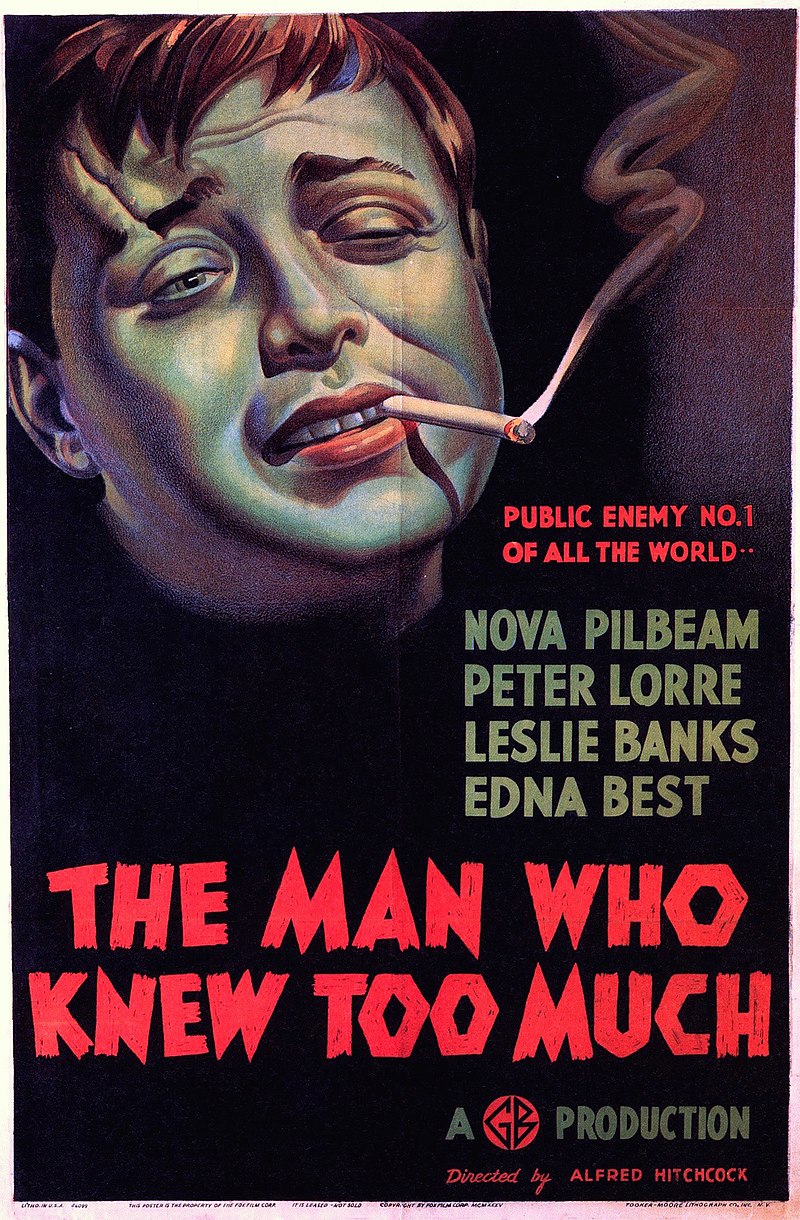
The Man Who Knew Too Much (1934)

by James Wallace Harris, 9/13/23

Do you ever think about why you watch movies? Do you ever think about why people make movies? The obvious answer is people want to be entertained and diverted and other people want to make money off those impulses. However, there are filmmakers with something to say, and audiences who want more than to be just entertained.

Alfred Hitchcock aims at pure entertainment. I don’t believe his films are philosophical, uplifting, meaningful, spiritual, or have anything specific to communicate. Hitchcock shows an evolution in the artistry over time, and his 1934 film The Man Who Knew Too Much is not as creative as his on 1956 remake. However, I don’t want to compare the two, I want to consider the 1934 film on its own.

The Man Who Knew Too Much is based on book title, a collection of detective stories by G. K. Chesterton. The film uses nothing of the stories.

The plot of the film is basic. Foreign agents plan to assassinate a prominent figure in London. A British couple vacationing in Switzerland with their adolescent daughter intercept a warning for the British consul. The agents kidnap the daughter and tell the couple if they relay the message to the police, they will kill their daughter. The couple return to London where British officials meet them. They have guessed the situation. They tell the couple they must tell them the message or else the assassination could cause a war like WWI. The couple refused, saying they only care about their daughter.

This hostage setup is common in thrillers. Hitchcock uses it clumsily. The criminals are willing to kill anyone at any time. Why didn’t they just kill the parents and leave the child? And why do the parents find the criminals almost instantly, faster than the police? And what’s with the silliness of the dentist scenes? Or the silliness of the cult of sun worshippers (nudists)?

Hitchcock switches between humor, violence, humor, violence, throughout the film. And for modern audiences, the stage and special effects are crude. They are on par with movies from 1934, but most modern film viewers won’t know that.

Hitchcock has said he was an amateur filmmaker when he made the 1934 version of The Man Who Knew Too Much, but a professional when he made the 1956 version. To me, the only reason to watch the 1934 version is if you want to have seen all of Hitchcock’s films.

My favorite film of 1934 is Treasure Island with Wallace Beery, Jackie Cooper, Lewis Stone, and Lionel Barrymore. Even still, most modern movie watchers will find it crudely made. Treasure Island is superior to The Man Who Knew Too Much in every way, plot, acting, costumes, sets, and special effects, but Treasure Island probably had five times the budget, and was made in Hollywood. The Man Who Knew Too Much is more comparable in quality to Charlie Chan in London from 1934.

The best thing about The Man Who Knew Too Much (1934) is Peter Lorre. He couldn’t speak English yet and had to memorize his lines phonetically. He’s not particularly evil or menacing in this film, but he does stand out as a fun bad guy.

However, as I watch these Hitchcock films, I’m disappointed that they never try to rise above just being thrilling or funny. They give no sense of place, history, or society. They offer no psychological insights. Later Hitchcock films offer style, but not this early one.

Comparing it to Rebecca made just six years later in 1940, but in Hollywood, Hitchcock shows a tremendous evolution in filmmaking. It offered so much more, but then Rebecca was based on an impressive book. Then six more years, in 1946 Hitchcock made Notorious, which I found problematic. It wasn’t based on a book and the plot seemed silly.

My current hunch is Hitchcock on his own or working closely with a screenwriter, focuses on pushing just a few kinds of emotional buttons. He likes to create suspense and tension and uses comedy to keep things within control. That’s what we see in The Man Who Knew Too Much (1934).

It’s okay if that’s what you like, but I wanted more.

JWH