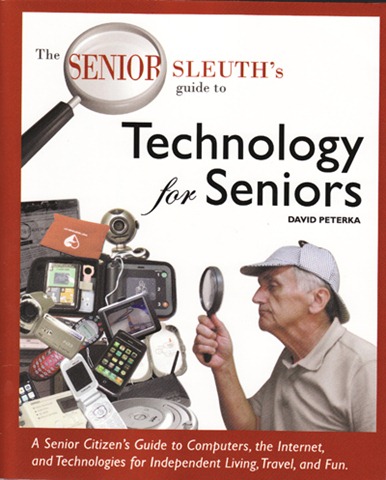
The Senior Sleuth’s Guide to Technology for Seniors by David Peterka

The common joke is if you need help with technology, find a kid.  Well, David Peterka wants us older folk to be our own tech gurus with his book The Senior Sleuth’s Guide to Technology for Seniors.  His book covers a spectrum of technology, not just computers, like robotic lawn mowers, cell phones, iPod, GPSes, remote controls, medical alert necklaces, home entertainment systems, pill reminders, medical monitoring and so on.  Peterka also covers social networking, texting and all the trendy communication systems kids embrace.  You don’t have to be a senior to find this book useful.

senior-sleuth

I help older people with their computers all the time and I know they often get stressed by technology.  Some just flatly refused to embrace it.  And that’s too bad because technology is enabling by its very nature.  This book is a quick overview for people new to gadgets and computers. 

Recently I help a woman about to retire who likes to do oral history interviews.  For years she had been relying on a cassette recorder and just typing up transcripts, but she wanted to be able to give people MP3s and CDs of edited and cleaned up copies of the original recordings.  For awhile she relied on the kindness of tech strangers to help her, but I’m the kind of person who likes to teach people to fish rather than just giving them away.

So I showed this lady how to install, configure and use Audacity.  At first she was hesitant and afraid to try stuff, but since I wasn’t offering to do the job for her, she stuck with it.  I’d come back every week to see how she was doing.  At one point she explained her interviewee cough frequently.  I showed her how to remove the coughs.  She mentioned some of the tapes had hiss.  I told her Audacity had a noise-reduction feature and sent her a link with instructions.  She figured it out.  She’s learned a lot, and now she’s confidently producing digital recordings of her interviews.

I’m in an online book club for audio books and one of the members is a guy who lives in a retirement home but he has become an Internet expert on MP3 players, helping hordes of online users to play digital audio books, collect music and old time radio, converting and watching movies, and other handy tasks for small players.  He’s in several online groups, include some for the blind.  His knowledge and willingness to help other people, many seniors, is a tremendous resource.  He proves that if you gain a skill, pass it on, and he also proves you don’t need to be a youngster to be a tech whiz.

I’m not sure how big the market is for Mr. Peterka’s book because old people are jumping online fast.  Ronni Bennett after she retired started Times Goes By, a web site for elder bloggers that is a wonderful resource for wise people wanting to share their experiences online.  I wished David Peterka had a supporting website to help his readers once they get beyond the book.  This 2009 book is still current, but technology books age fast, so Mr. Peterka will need to keep coming out with new editions until everyone is up to speed.

The advice in David Peterka book for seniors is quite broad and a good place to start if you’re nervous about gadgets and electronic doodads.  He provides a wealth of URLs to find additional knowledge, plus he teaches about how to find your own solutions online.  The print in the book is nice and large, easy to read. 

At work people are amazed I know so much about technology, but often when I meet a new tech problem, I just search on Google.  So this Senior Sleuth volume will be best for complete newbie’s who haven’t learn that trick.  It nicely distills lots of information in one handbook, and is a good volume for older children helping their aging parents.

It’s a Catch-22 situation.  If you had more knowledge, you’d use it to find the same information online.  So David Peterka book is a stepping stone.  Like I said, I wished he had an web site devoted to the same subject because having all of this information in one convenient location would make a very useful web site.

I’m hoping, as I get older there will be more and more technology solutions for aging.  In fact, I hope by the time I get frail there will be robotic caretakers.

JWH – 4/22/10

What I Want To Be When I Get Old

I’ve picked twelve areas of knowledge to pursue in the last third of life.  It’s a conscious effort to organize my thoughts and actions.  Twelve specialties sounds like too many, but I’ve selected them like building blocks to work together as a whole.  Essentially what I have done is analyze what I’ve been doing for years unconsciously and state them here publicly to make them clear to me.  The pains of aging remind me of my limited time left on Earth and inspire me to change.  What I’m really doing is deciding what I want to be when I get old.  

Areas of knowledge might sound too lofty.  I could say I have twelve self-improvement topics I want to study, or even call them twelve goals for going the distance.  We do not have the language to express ideas of self-programming.  I’ve always loved John Lily’s book title Programming and Metaprogramming in the Human Biocomputer, but sadly the book is about a great scientist going off the deep end with hallucinatory drugs and sensory deprivation.  But I digress.  Self-improvement is a vast topic for the publishing industry but has a poor connotation, but that phrase might come closest to my task.

I am a fat, lazy, late middle-aged man who has tumbled through life like big rolling weed acquiring random knowledge and wisdom through undisciplined osmosis.  Since I’m a programmer and work with computers, I think with cyber concepts, so picture an old PC that’s been running Windows XP for years.  This dusty old machine takes forever to boot up, and runs  slower and slower each day.  It’s time for a tune-up!  I want to delete all the clutter and crapware, cleanse the registry, run malware utilities, uninstall all the programs I don’t use, and decide on which programs are the most productive to keep.  I’m realistic.  I don’t expect to suddenly become a new Intel i7 machine running Windows 7, but I can make the old hardware run much more efficiently.

When we are young we have great ambitions about growing up.  We want to be somebody special and find the perfect mate.  During our middle years we expand our ambitions, seeking security, wealth and success.  But for the last third of life our goal is retirement, where we reduce our workloads and seek simple pleasures.  I say bullshit to that.  Maybe it’s because I didn’t find the success I wanted in youth and middle age that I hold out hope for an ambitious last third of life.

I’m not worried about the outward appearance of aging, the wrinkles, baldness, age spots or hobbled gait, what I’ve discovered that’s hard to see as a young person, is getting old is a state of mind that deals with wearing out mentally.  Avoiding pain, illness and injury becomes a relentless occupation.  My daily pains are minor compared to what I’ve seen in others, but the decline in health I’ve experience so far is wonderfully educational.  So for my first study goal is pretty obvious, and probably universal.

1. Maximize Health

I don’t need to become an authority or expert on this subject, but I do require major studying and practice.  Hell, I know the basics, eat right and exercise. Where I need to specialize is in the discipline of of mind over matter, or more precisely, mind over body.  I could greatly improve both the quality and quantity of my sunset years if I could lose weight.  I’ve been slowly gaining weight since my late twenties, and the only time I was actually able to lose poundage was due to illness, not a practical long term solution.  Of course, the secret to weight loss is knowledge many have sought and few have found.  I need to study books about the mind, and maybe even woo-woo subjects like yoga, meditation and will power.  This is one subject I wished I had mastered in childhood and practiced lifelong.

2. Enlightened Citizenship

I wanted to become an expert in green living, but I’ve decided that focus is too narrow.  I am deeply disturbed by partisan politics and our lack of will to make tough decisions about all our problems.  I believe in social democracy; we vote daily on countless issues with our every decision.  I am reading The Great Transformation by Karen Armstrong and I’m reminded of her description of how the ancient Chinese practiced their religion.  Instead of being concerned with invisible gods and abstract concepts of the sacred, these people sought perfection by improving the simple acts of everyday life.  In other words, how you clean your house is more spiritual than religious rituals you embrace. 

3. XHTML/CSS/PHP/JavaScript/JQuery/CodeIgniter

After thirteen years of programming in classic ASP  I need to learn a whole new suite of programming languages and tools.  This is putting me way out of my comfort zone, but it’s my chance to prove that an old dog can learn new tricks.

4. Internet Living

I’ve been living on the net since the mid-80s with BBSes, Genie, CompuServe and Prodigy.  I’ve embraced digital life.  I’m fascinated by it’s potential.  I don’t think we’ve seen anything yet, so I want to explore all the emerging possibilities and even write about what will happen in the future.

5.  Clear Writing

I want to be a much better writer.  I love blogging, but I want to go beyond dumping out my thoughts.  I’m a wordy bastard that can’t structure an essay, much less a book.  I need to remove the clutter from my sentences and learn to assemble  paragraphs into larger structures that build coherent ideas.  I’m best at 500-1,000 words, but I want to write larger essays and even a book.

6.  Techniques of Fiction

I’ve been trying to write fiction since a high school creative writing class.  Like my failure at dieting, I can’t break through the writing discipline barrier either.  I’ve taken many writing courses and workshops.  At best, I can crank out words, but except for one time in endless tries, I can’t reach the critical mass of fictional fusion.   I need to master the language of fiction in the same way I write a computer program, so the story works without major bugs.

7.  Robot Novel

I’m struggling to write the great American robot novel.  After space travel, time travel, and alien encounters, robots are about the most over-written topic in science fiction.  Yet, I believe I have a fresh idea if I can crank out 100,000 readable words of fiction.  Notice how specializations 5-10 relate?  I’m not going off in twelve different directions, but hope I’m pursuing twelve skills I can integrated into a synergy of effort.

8.  Evolution of Mind

To say anything fictional about robots will require understanding artificial intelligence, and AI has always depended on studies of the mind.  I find my library is full of books on robots, AI, mind and evolution.  I bought all those books because they were individually interesting, but now I’m going to read them as fuel for my novel.  If we are the pinnacle of intelligent life on Earth now, what will occupy that position in a million years?  Or a billion?

9.  Sense of Wonder

I’ve been a reader and scholar of science fiction my whole life.  People who adore science fiction claim its because it generates sense of wonder.  Sense of wonder has been around far longer than science fiction so it can’t claim exclusive rights, but I do believe that science provides a special kind of sense of wonder.  For too long now science fiction has been living off past glories.  It’s time to find new concepts that push our sense of wonder button.

10.  Cosmological Perspective

Our perceived position in the universe has always been very philosophical.  It is very hard to grasp our location in relationship to the rest of reality.  Even the shape of the universe is impossible to fathom.  If we are God’s supreme creation, why are we so small?  And can any religion or philosophy be valid that doesn’t fully incorporate our knowledge of cosmology?

11.  Learning in Old Age

What are the limits of acquiring new knowledge in an old brain?  Could I learn something in my last third years that I wasn’t able to learn in my first third years?  Could I go back and finish Calculus II, or learn to play the guitar?  There is a discipline barrier that I’ve never been able to crash through.  I find my wisdom grows as my body declines, but will I ever be wise enough to overcome the limitations of my body?

12.  Our Existential Relationship with Fiction

We can’t understand reality so we make up stories.  It is impossible to predict the future yet we constantly create fiction to envision what will come.  And I don’t mean science fiction.  These twelve areas of knowledge I am pursing are a fiction.  The odds are I’ll just get older, fatter, suffer more, watch even more television while waiting to die.  I invent fictions about how I will change myself and fight the inevitable.   But that’s my point about programming and metaprogramming in the human biocomputer.  Is life no more than meta-fiction?

* * *

These twelve topics of specialization are ambitious, but I don’t think impossible to achieve.  It will make me a Renaissance (old) man.  And success can be measured across a range of achievement levels.  No one gets out of here alive, so death can’t be considered a failure of life.  I am reminded of the many books I’ve read about Eastern religions where the last third of life is set aside for spiritual pursuits.  At the end of the rat race, wisdom is the only possession worth pursuing.  But I grew up with a Western world mindset.  Reality is a savage land meant to be conquered, not accepted like our friends, the Eastern gurus teach.

Christians love the concept of the eternal soul.  As an atheist I’m not sure souls exist, at least not in the past.  That doesn’t mean we don’t want to fashion our own souls.  That doesn’t mean we aren’t evolving towards creating souls.  Through discipline we program our identities.  Through metaprogramming we program our programming.

JWH – 2/27/10 

Being An Old Dog Learning New Tricks

I’ve been in my present programming job since 1987.  I’m a database programmer, but I’m not part of IT, but was hired by a college within the university where I work.  I was employed way back then to set up a Novell network and develop a multi-user dBase III system to shadow the university’s canned student information system.  In the mid-nineties, I rewrote everything in HTML and classic ASP for IIS and Microsoft SQL Server, and switched our network to Windows and TCP/IP.  I have cranked out hundreds of thousands of lines of custom code since.  Now our university IT department wants all us non-IT programmers to rewrite our code to meet IT standards that runs on their servers.  I’m totally behind that, because I know when I retire someone will have to maintain my code.

The trouble is, I’m 58 and this means I’ll have to learn a whole slew of new languages – XHTML 1.0  Strict, CSS 2.0, PHP, and JavaScript, new frameworks JQuery and CodeIgniter, switch from Textpad, a programming editor to Eclipse, an IDE, and they want me to learn generic SQL that works with an abstraction layer in case we switch backend databases.  Plus I’m switching web servers from ISS to Apache.  This is a lot of new stuff for an old dog to take in.  My very comfortable environment that I’ve lived and worked in for 15 years is now totally Alice in Wonderland.  It’s like moving to Paris and having to learn French.

I do believe this is good for me, especially for exercising my aging mental stamina, but I can feel that it’s pushing the limits of what my mind can handle.  I’m sure in several months I’ll be comfortable in the new paradigm, but for now I feel like I’m a couch potato going on the Biggest Loser.  I wonder if all this mental weight lifting and running, all this programming huffing and puffing, is going to kill me.

Now that I’m getting old, I know why old dogs don’t want to learn new tricks.  It’s so much easier to stay in the comfort zone of doing my old tricks.  What’s weird is I’m learning all this new technical stuff at the same time I’m becoming so forgetful in everyday life.  More than anything, I’m in a USE IT OR LOSE IT phase of life.  It feels like I’m surfing and the only thing I can remember is the wave I’m riding right now.

The famous urban legend is we only use 10% of our brains.  I’ve read about scientific experiments that disprove that.  One set of experiments had test subjects learn something new and test their retention ability, then after awhile, switched them to studying something different.  As they learned new stuff they forgot old stuff.  Other experiments mapped the brain with various scans.  There aren’t any unused portions.  What they learned is we all use our brains fully, but fully varies from person to person, and I’m guessing also varies at different times in our lives.  It’s like that circus act where a guy keeps 30 spinning plates all twirling at once.  When we’re young we can keep 25 things going at once, but as we get older, that number decreases.

Learning my new programming paradigm is like trying to be young again.  It’s fun and exciting, but this time around I realize I’m pushing my limits.  I can feel my limits in a way that I never imagined when I was young.  I wonder how far and how hard I can push those limitations, and for how long.

JWH – 1/20/10     

She Had a Mind Like an Intel Core i7

As I get older, I realize my mind is slowing down. I was never a quad-processor kind of thinker, but I’d like to believe my brain could chug along like a good ole AMD X2 chip.  Now my thoughts feel like they are powered by the original Pentium.  I’m starting to pay attention to the people around me, and realize we have unequal minds when it comes to gray matter CPU speeds.  I’m also wondering if working with machines is pushing everyone to think faster. 

In our culture, we mostly judge people by their covers, but when it comes to brain power we’re as diverse as our physical features, and we seldom take that into account when communicating.  In a classroom of third graders or even a college calculus class, all the students are expected to learn the same material at the same pace.  Is that fair?  When I was a kid I had supercomputer ambitions.  It took decades to accept my brain was just ordinary, like computers built to run Microsoft Office.

At work I’m a computer geek, and friends envy my tech knowledge.  I’m thankful I’m good at something because I’m so bad at everything else.  My brain struggles to remember the names of the people I already know, and it seldom remembers new names, but I’m surprised at how fast I learn technical tidbits.  But even that ability is eroding with age.

The other day I was helping a young women who had asked me about putting words on photos in Microsoft Word – something I didn’t know how to do within Word.  Her hands flew over the keys showing me her project and files, and I was amazed by how fast she could think, type and traverse folders with keyboard shortcuts.  I pulled up Google and searched on her problem and found a good solution, but before I could tell her anything, she read over my shoulders what to and was ready to go.  This girl had a mind like an Intel Core i7. 

I could tell her young brain, about a third in age of my rusty noggin, could process input far snappier than I could.  I admired and envied her fast thinking, wishing I was young again, because now is a fabulous time to be young working with computers.  On the other hand, I have to worry about slower thinkers, and the fact that I’m slowing down myself.

Is it me, or does the world feel like it’s speeding up?  Aging has me feeling like a lethargic cold blooded lizard living among fast thinking mammals.  My wife often gets impatient with my slow mental processing and tries to finish sentences for me.  This is why I love blogging – I can take as much time as I want to put my thoughts together.

Speed of thought is relative though.  Usually people complain that I go too fast when I help them with their computers, so I have to slow down.  When helping most people I show them the routine, let them walk through it once on their own, and then they are usually good for solo flying.  Some people I have to repeat the steps 2-3 times.  Occasionally I get people who have no knack for computers and I can show them how six times, let them write the steps down exactly, watch them four more times and then they still call me back 15 minutes later.  Often I have to learn on-the-spot how to solve the problem people want me to teach them, but few people notice how I do this.  Google is the magic word, folks. 

On one hand, I worry about these people who don’t seem to be adapting well to the machine age.   I admire the ones who refuse to run at gigahertz speeds and reject interfacing with machines.  I think I stand between two generations, the ones who lived without computers and didn’t need them, and the next generation of cyborgs that think like a CPU co-processor.  

But computer literacy doesn’t always run along generational lines.  Even though it seems we’re forcing everyone in our society to use a computer, not everyone is a PC or a Mac.  My friend Laurie, who is a scholar of reading literacy, hates that other skills add the word “literacy” behind their noun to refer to their minimum standard of expressing knowledge, so we need to think of another term for people who work well with computers – cyberbiotic?

As much as I admire fast thinking, I also have to worry if speeding thoughts aren’t the best way to think.  Has anyone notice how fast they edit TV shows and movies today, with the average length of film cut getting shorter and shorter over the years?  This makes the action go faster and faster.  I can’t watch The Amazing Race anymore because its quick edits are jarring to me.  When I watch an old movie from the 1930s, the pace suggests their time had calmer thoughts, and the long meandering sentences in a 19th century novel implies even more leisurely thinking.

I think it’s unfair that practically everyone has to use a computer in their jobs in the 21st century.  Computers do enhance creative pursuits, but does every task need to be computerized?  It’s as if we’re all adapting to living inside a new digital reality.  Will this cause us to breed humans with faster and faster minds to keep up with computer evolution?

I’m not sure the average person ever thinks about the speed of thought, but it’s obvious one of the inequalities of life that we suffer.  And I’ve noticed not all young people are fast thinkers either.  In the old days, when kids had learning disabilities they were called slow.  When everything speeds up, will people with average ability be considered slow too?

Minds are not like computers, but there are many fascinating comparisons.  Fast thinking can be compared to having a brain like the latest Intel chip, while old minds can be likened to the ancient 386 CPU.  Human memory is a far cry from computer RAM, because computing would be impossible if machines had recall times and error rates of gray matter memory.  Now that my memory is slipping away, I know that memory is often more important than processing speed.  I can still think fairly fast, but it often takes me hours to recall specific words and names.  The computers in the Apollo space capsule that went to the Moon were less powerful than the computers in today’s cheap telephones.  Efficient programming and accurate memory can overcome major CPU limitations.

I’ll bet a person with a slow mind but good memory can beat out a fast mind with a poor memory in many job categories.  But there are other factors, such as Howard Gardner’s theory of multiple intelligences.  A person with a mathematical mind can pursue careers that average Jacks and Jills can’t.  Nor would gimpy math minds want to have to work with numbers.  I wanted to be an astronomer when I was a kid, and got through high school physics, college calculus and several college physics courses before I ran out of mathematical momentum.  I also wanted to follow in the footsteps of Bob Dylan, but I have zero point zero musical ability.

If I had been tested in the 7th grade and told about the limits of my brain, and informed that I could be an astronomer if I was willing to practice math two hours a day, would my life have been different?  The mind is like a muscle, it can be improved with exercise – like I pointed out in “10,000 Hours to Greatness.”  This really is a case of “If I knew then what I know now.”

We all hear about kids in other countries that must grind through hours of study to keep up with the standard.  Now that everyone is competing with machines, will everyone have to run faster and faster?  Maybe I could have pushed myself to work harder as a kid to become an astronomer, but will future kids compete with AI astronomers?

We all hear about how our educational system is in crisis, whether that’s true or news media chicken-littling, I think it’s a mistake to make an educational system that essentially tries to be one size to fit all.  Would kids try harder if you customized their curriculum to fit their personal ambitions, matched to their brain speed and the amount of time they wish to practice?

Politically we like to think we live in an egalitarian society.  And as growing adolescents we like to think we can be anything we want when we grow up.  Socially we like to think we live in a classless society and can marry whomever we wish.  Our churches teach us to believe that God created us all equal.  Good or bad, I think we’re diversely unequal in our ambitions, the speed of our thoughts, and how much attention time we can apply to any task.

As I make my to-do list of projects I want to pursue in my waning years, I think I’m far more realistic because of this knowledge about my limitations than when I was young daydreamer planning what I could do with my life.

Maybe I’m just feeling sorry for myself and my slowing mind.  Maybe it’s the way of the world for every new generation to speed past their elders, and for the elders to crab about the speeding youngsters.  I turn 58 in eleven days, which is still pretty young, but I’m already looking forward to living in a retirement community where things move at a slower pace.  Hell, if I move to the land of the ancient, they’ll think I have an Intel Core i7 mind, at least for awhile.

JWH – 11/14/9

The Loneliness of Facebook Friends

We all know people who tell us they have hundreds of friends on Facebook, but do people really have that many good friends?  Friends that would pick them up at the airport or take them to the doctor’s when getting a colonoscopy?  Now don’t get me wrong, I do believe Facebook is a marvelous invention for tracking all the people you meet throughout life, and if it had been invented before I was born, I may have paid more attention to the folks I associated with at each stage of my life.

I think young people today grow up more social than I did back in the 1950s, belonging to all kinds of groups, starting with their daycare centers.  Some kids today seem to move through life in cohorts, and Facebook is perfect for them.  I moved around so much that I can’t remember any individual classmate before the 5th grade.   My memories are of neighborhood kids I played with after school.  I only have one friend on Facebook from all my K-12 years, but then I’m 57 and not really part of the Facebook generation.  However, I do know lots of people my age that are reconnecting with old names from their memories.

As my wife Susan told me, when I mention I was writing about Facebook, she thinks the young of today are adverse to talking to one-another directly, but instead love to tweet, text and write on each other’s walls, as if email or phone calls provided TMI.  In other words they prefer scads of friends to share bite-size facts with frequently.  I’ve never texted or tweeted, but then I’m a verbose bastard, and even feel silly typing a simple snappy line on someone’s wall.

I’ve yet to find much value in Facebook, to be perfectly honest.  When I scan my Facebook home page and read what all my “friends” are doing it makes me lonely because most of my “friends” are people I never see, especially not daily.  It makes me sad that I don’t want to keep up with all the tiny details of their lives, and I worry I’d bore these folks if I wrote about the little things in my life.  Or would they be bored?  Is it heart warming to follow a group of acquaintances – like watching a favorite soap opera?  I have to wonder if Facebook provides a kind of mini-fame, so the young feel good about the number of people that follow their lives.  But I have to ask, do people read as much about their friends as they write to them? 

I like seeing my friends face-to-face, like last night when Anne invited me over for dinner when Susan went to play trivia at Swanky’s.  We listened to the original cast recording of Phantom of the Opera while she cooked me a wonderful dinner and then she made me soothing herbal tea for my cold.  So, should I describe our evening on Facebook?  Would my other friends want to know what Anne and I did on Saturday night?  Since there was no hot sex would they find our chit-chatting boring and again, too much information?

The question I’d like to explore is:  How well does Facebook help with maintaining current friendships?  Is it a good tool for genuine friendships?  My wife loves Facebook because it’s useful for keeping tabs on all our nephews and nieces and other extended family members, and I know other women in our generation that use Facebook in the same way to follow children and grandchildren.  We have so many friends that never had children we could create group just for them, and Facebook seems perfect for this task of keeping up with relatives.

Of course, how do all the kids feel about their old Aunty keeping track of their doings?  Maybe they would prefer it to their Aunts interrupting their lives by calling them once a week to get the news.  In my day my mother made me write my Aunts occasionally “Dear Aunt Sissy, How are you?  I am doing fine” kinds of letters.  I wonder if they would have loved Facebook?

I have to wonder if people really enjoy tracking the daily events of their old classmates.  I’m curious about what happened to them all, but I’d just like to read a summary like those short where-are-they-now updates for each character at the end of American Graffiti.  My memories are stuffed with fond recollections of childhood, but I don’t think I could regain paradise by tracking down old friends.  A cooler invention akin to Facebook would be Photobook where everyone could register their old group photos to share with forgotten people in the photos or Memorybook where you could chronicle a memory of an event featuring past friends hoping they would chronicle the same event from their point of view.

If people are truly friends they stay in touch.  I think a cool feature of Facebook would be the chance to collaborate old memories, but I doubt I’d want to make new memories with old acquaintances.  Is that sad?  I wouldn’t mind apologizing to some old teachers for not pulling my weight when they were trying so hard to help me, but I’m guessing those teachers, if they were alive, wouldn’t even remember me.  

I know a number of people my age that joined Facebook and then quit after a few months.  Is it just a fad for the youthful that will disappear in a few years, or will a new generation grow up and maintain lifelong contacts via the web?  Will Facebook become as integrated into society as the telephone?  I shall stick with Facebook a bit longer even though it makes me feel lonely to use it.  I hope I’m an old dog that can learn new tricks.

Currently, I think I have two kinds of friends.  The people I will spend real time with, either in person or on the phone, or those folks who I commune with via blogging.  I tend to think blogging is my Facebook, but most of my real life friends don’t blog or read my blogs.  Blogging seems to be a communication technology that has limited appeal, rather than the mass appeal of Facebook, Twitter or texting.  What this all implies is we have many kinds of friends, and many ways to communicate with them, Facebook is just one tool in the toolbox.  One that I haven’t trained with thoroughly, or learned its advantages.

Theoretically this means we can have Facebook Friendships that never overlap the real world.  At this time I have no idea what value such friendships would bring, but then no one can predict the future.  I love the TV show, The Big Bang Theory.  I suppose I could use Facebook to find other folks who love the show too.  I assume young people already do that.  But do such friends reduce loneliness?  Are people happy just having Facebook friendships?  If Facebook has real value, what will it be like in 50 years?

JWH – 10/11/9