Why Would Anyone Want to Be President or Queen?

by James Wallace Harris, Monday, December 12, 2016

I’ve been watching The Crown, an excellent 10-part biopic on Queen Elizabeth II. It’s a Netflix original. I’ve never cared about royals before, but this show is riveting. John Lithgow as Winston Churchill makes the series compelling, just for his part of the history. However, the show gives a somewhat realistic portrayal of the duties of a British monarch, and it looks so painful, I wouldn’t wish it on Donald Trump. Why would any little girl want to be a princess after seeing The Crown? Poor Elizabeth goes on one tour of the Commonwealth that lasts for months. At one point she has to have her cheek shot up with a muscle relaxant because of smiling at the crowds for hours at a time has frozen her face. Another time she has to ride in an open car in hundred degree heat for two hours so the possession can go at a pace safe for horses.

Obama-2008-and-2016

I also wonder about Donald Trump. Why would a billionaire used to absolute freedom want to be President? It’s like being a rock star wanting an office management job, one requiring 80 hours of drudgery a week. I always thought the point of getting rich was to escape a day job. Trump is already fighting his bridle by refusing to take all his daily briefings. What’s going to happen to him when he’s on the job and his life is scheduled 24×7? If it’s anything like QEII’s schedule, I’ll actually feel pity for that lying deluded megalomaniac. Solitary confinement in a maximum security prison would be a more human punishment.

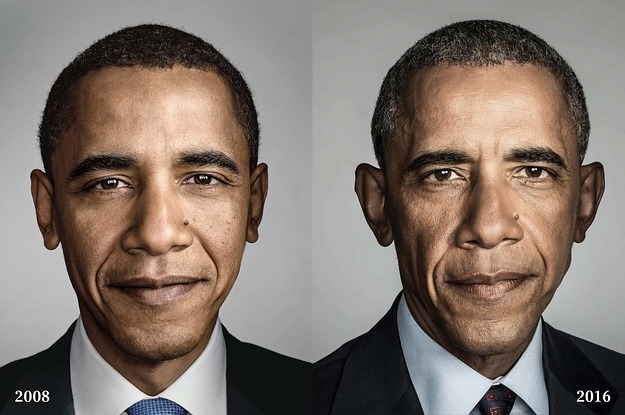
Just look at what eight years did to poor Obama, and he was a young man. Donald Trump is starting the job at 70. Will he age normally in the next four years? Of course not. Why waste precious golden years choosing to be chewed up by history?

Trump is already annoyed at Saturday Night Live, but didn’t he know becoming president means being the most hated person on Earth? Sure millions will love him, but there’s always a larger segment of the population that reviles the CEO of the USA. Doesn’t every person dreaming of living at the White House know they’ll be mocked in a thousand ways a thousand times a day? Even with a “good” approval rating, a president gets endless barrages of flack, much of it mean-spirited. I feel sorry for presidents. Everyone on the planet wants a piece of them, and the burden of office is a great deal more than tremendous. Talk about a plot for a horror flick. You spend 4-8 years in stressful conflict with countless nightmare inspiring issues. I’m pretty sure a week of that job would kill me. We know Trump and Clinton are very strong old people because they survived over a year of campaigning. But won’t that be a fun 10k compared to Iron Man triathlon of serving one term?

I’m very curious how many hours a day Trump will occupy the Oval Office. I bet he’ll spend most of those moments daydreaming about being an ordinary billionaire, jetting around, making deals, playing golf, and grabbing you know what.

I really can’t understand why anyone would want the job of President, or Queen. In The Crown, Winston Churchill seems obsessed with creating a political order that matches his passionate ideals. QEII feels the weight of centuries. What drives Donald Trump?

JWH

How Much Time Do You Spend Escaping Reality?

by James Wallace Harris, Monday, October 31, 2016

I often worry if I spend too much time escaping reality. Mostly I check out via television, books or daydreaming while listening to loud music. However, sometimes I just enjoy a sensual nap even when I’m not tired. I don’t allow myself drugs or alcohol, and my heart doesn’t allow mindless gluttony. I wonder why escapism wasn’t one of the original seven deadly sins? Or does sloth cover it?

Reality can be relentless. Sometimes we want to turn it off. What’s you’re preferred method? Some people have perfect lives. They love every moment of living. Other people need occasional breaks from reality. They want to take a few hours off and think about something different. Then, there are the sad souls, who need to completely abandon their wretched fates. From hobbies to heroin, how do you switch channels on reality?

desert2

This makes me think about all the ways we interact with reality:

  • Manipulate reality for our needs (gather food, find mates, clean house)
  • Study reality (science, history, journalism, philosophy)
  • Admire reality (meditate on the beauty of nature, enjoy works of art)
  • Add to reality (create a beautiful work of art)
  • Destroy/create (Cut a tree down to build a house)
  • Mess with our perception of reality (drugs, fantasy, delusions)
  • Turn off (sleep, become unconscious, inward meditation)
  • Escape (create an alternate reality in your head for entertainment)

I’m using the word reality in a specific way. It’s everything that’s outside of myself. I like to think of conscience beings as black boxes floating in an infinite objective reality. We exist in our box of subjectivity, gathering input through our senses, constructing a model of reality. Much like the Holodeck in the old Star Trek show. We never perceive reality directly, only by interacting with our model. Reality is too vast to actual grasp or perceive directly, but being realistic means working with an effective model. Escapism is when we consciously choose to ignore our inputs from the external reality and use our modeling mechanism to create fantasies. I’m never sure if escapist fantasies are how we wish reality was, or if we just prefer our substitute models of realities?

When I was growing up, I used science fiction to escape reality. My parents were alcoholics that should have divorced. Instead, they dragged my sister and I around the country hoping to find greener grass for themselves. I don’t blame them in the least, because I know they were just coping with reality the best way they could. Because of their alcohol abuse and my own experiments with drugs, I know about the paths of chemical escapism. But for this essay I’m not going to explore them. Those are negative forms of escapism. Are there positive forms of escapism? Is reading a great novel a positive form of escape? Or is it still an unhealthy negative way of dealing with reality?

Should we always face up to reality? Should we continuously keep our eyes focused on living in the now? When J. K. Rowling wrote her Harry Potter books was she escaping reality, or creating an artistic work of art for reality? Or a little bit of both? Happy people are often people who spend most of their time concentrating on being creative. Is building a house more reality based than writing a science fiction novel? Is a news junky living more realistically than someone who binges on The Walking Dead? Both spend endless hours watching TV.

Does watching TV always equal escapism? What about compulsive novel reading? Is taking a two-week Mediterranean cruise escaping reality or embracing it? Is sleep the body’s natural form of escapism, or a neutral state when we cease to exist in reality or subjectivity? We are taught by mindfulness instructors our thoughts get in the way. That idle brain chatter keeps us from seeing reality. They claim sitting quietly, ignoring our thoughts, but observing reality intently, is the best way to live in the now. Is that true? When is reading Gravity’s Rainbow by Thomas Pynchon a better choice?

Is living in the now, with a razor sharp focus on our inputs from reality more important than being creative?

Last night, my TV-buddy Janis and I binged on the first three episodes of Good Girls Revolt, an original series on Amazon, about women working at a fictionalized Newsweek in 1969. It’s based on the nonfiction book, The Good Girls Revolt: How the Women of Newsweek Sued Their Bosses and Changed the Workplace by Lynn Povich. The show is very entertaining – but it’s also making a statement about reality. So was this three hours of TV watching escapism or education? The story reminded me of Gail Collins’ When Everything Changed: The Amazing Journey of American Women from 1960 to the Presentbecause dozens of women changed reality by pursuing lawsuits for equal treatment under the law. However, did Janis and I improve the accuracy of our models of reality what watching Good Girls Revolt? Or were we each escaping from other things we should be doing? Both of us have projects and obligations that would have benefitted from those three hours.

Is living a binary condition – where we exist either interacting with reality or hiding from it? Aren’t our ambitions about how we wish to alter reality? Isn’t the desire to get rich, laid, or fed essentially wanting to alter reality? Think about that for a moment though. Picture yourself as an amoeba, swimming around looking for something to eat or mate (assuming amoebas mate). Our soul is programmed to interact with reality like any other creature in existence. Could escapism just be another bodily function? Could we be programmed to find food, shelter and mates, and when not doing either, just kill time?

Take virtual reality (VR) – which we’re told is the next big thing in entertainment. Could there be a more perfect form of escapism? Isn’t VR a rejection of reality? They should market it as AR – alternative realities. Who really wants to simulate actual reality? What people want are better realities to take their minds off the fact their bodies exist in a reality of growing threats.

If you start thinking about it, are most of the great forms of escapism based on alternative realities. Books, movies, comics, television, are all designed to move you mind out of reality into an artificial construction. Think of it as Noah Ark for your mind. You read a science fiction novel hoping when you finish reality will be more appealing, and you’ll want to get back to work.

Which reminds me of all those people who want to travel to other planets. Isn’t space travel the ultimate form of escape? Wasn’t the film Interstellar all about escape? Time to toss Earth in the trash heap and head someplace new. I’m a lifelong science fiction fan, but that philosophy seems ugly to me. If we can’t build a perfect civilization on a paradise planet, why think we could do better elsewhere?

Look at the explosion of heroin addiction, the expanding acceptance of legal marijuana, the endless stories of designer drugs, or just sit in your car outside a liquor store and watch the steady flow of customers. I suppose the folks who can’t find comfort in fiction turn to chemicals.

Of course, healthier people have work and hobbies, and rich folk have conspicuous consumption. People with talent have art, invention and science, Caring people have charities to keep their minds focused. But if you’re sick and poor, what do you have?

What’s amazing is the small number of people actually working on solving the world’s problems. Most people pick escapism instead. You’d think working on solving our problems would be an overwhelmingly attractive form of escapism. It could keep our minds busy for the rest of our lives. Of course, I still can’t get over the fact that 7 billion minds lack the imagination to turn this planet into heaven. Evidently, as a species we’re pretty bad at parallel processing – or cooperation.

It’s rather ironic that Iraq and Syria, once cradles of civilization, are now our best examples of civilization collapse? People over there are about as close to reality as it gets. Maybe the purpose of civilization is to provide security from external reality, so we have time to indulge in artificial realities. Work is essentially manipulating reality. Play can be enjoying reality, like swimming at the beach, but quite often play is indulging in artificial realities – television, movies, plays, books, games, sports.

Traditionally, work is a virtue, and play is a vice, or at best a short vacation from work. Western culture teaches that reality is something we conquer, and idleness is a sin. Is that still true? I’m retired, and don’t have to work anymore. Many people do think of retirees as a burden on society. A large segment of the working age population can’t get work. Maybe we need to make new ways to interact with reality, and consider them new virtues.

JWH

What I’ve Learned After Three Years of Retirement

By James Wallace Harris, Monday, October 24, 2016

October 22nd was the 3rd anniversary of my last day at work. The time has zipped by, but I feel I’ve already gone through several psychological phases. For the first year I used to occasionally revisit my old work place, but I don’t do that anymore. Even though I was at the university for over 35 years, I no longer feel part of that world anymore. I’ve entered a new territory, and I’m slowly learning to colonize it.

Joining Medicare feels like the gateway to the land of the aging. I don’t feel old, but I know I’m new old. I’m in the toddler phase for growing up to be old old. I now ask about senior discounts, and I notice just how much advertising is targeted to the elderly. Am I eventually going to need all that stuff? (Home catheterization, lift chairs, slim fit adult diapers, hearing aids, step-in bathtubs, electric stair chairs, medical alerts, motorized chairs, etc. – and all those zillions of drugs.)

Old-Pug

I now watch out for scams. I keep seeing stories on the news about con artists scamming the elderly. I don’t know if its my new wariness, but I sometimes do feel extra sales pressure at stores or from hired workmen. I screen all my house-phone calls. Even though I’m on the national do-not-call list, I still get lots of calls. I assume since most people have switched to cellphones, there’s far fewer landlines to cold-call. And they seem more desperate. Most of calls I get are about selling stuff to people my age. Is that direct marketing targeting, or are older Americans the only ones with land lines?

And I hate charity calls. I feel bad about saying no to worthy causes, but I resent they feel they have a right to call my house and interrupt my life. Because I’m one of the last people on Earth to have a landline, it means I get a lot of calls. I just don’t answer my phone anymore, letting my machine reply for me. Supporting charities that call my phone only encourages them to call more. It’s time that all telemarketing becomes illegal, even for charities. (I’ve had three calls while writing this essay this morning.)

I spend a lot of time alone. My wife still works out of town, so I only see her on weekends. I visit with friends, but I like being alone. I’m getting addicted to it. I love puttering around with my projects. I hate when strangers come to my door. I can feel myself evolving into a crotchety old man. I used to be polite to con artists, salesmen, and church people knocking on my door. Now I just get rid of them as fast as I can. I’m not mean, or rude, but cut their spiel off quickly. Who knows how nice I will be in ten years.

I love quiet – unless I want to play my music loud. And I love to play my music loud for an hour or two a day, especially when I nap. It’s emotionally uplifting to hear my favorite oldies when I’m coming in and out of consciousness of a nap.

And my taste in TV has taken a very weird turn lately. I don’t have the patience to watch movies anymore. I can watch them if I have friends over, but not alone. And I still love new TV shows if I’m watching with friends, but again, not alone. My attention span for TV has shorten. At night, when watching TV by myself, I’ve become addicted to seeing an old Perry Mason before going to bed. That’s about 45 minutes. Growing up Perry Mason was my mother’s favorite TV show, and The Fugitive was my father’s favorite show. I couldn’t stand either. I’ve always hated mysteries – either books, TV shows, or movies. But for some strange reason, since I signed up for Medicare I love Perry Mason. I can always spot who is going to get kill, but I never can guess the murderer. Are we supposed to figure that out? I always feel they’re pulling a fast one at the end, plot-wise. But I’m not sure I care. I love the show because it’s in black-and-white, has old 1950s and early 1960s cars, and all the actors and actresses aren’t beautiful and buff. They even have a fair amount of bald guys, wrinkled, and fat people. Folks I can identify with.

One thing I have to keep remembering about getting older, is young people often feel squeamish about our appearance. Of course, most of my women friends have a great deal of self-loathing for their looks. They often complain about themselves and others looking bad because of age. They find getting old depressing. It doesn’t bother me. At least not yet. I was never good looking to begin with. And I have started noticing the affects of age on my friends. But I prefer looking at old folks to young people. I have nothing against the young, but I just feel alienated from the world of youth. I’d love to move to a small 55+ community. Somewhere where it felt like thinning gray hair, sagging flesh, and baldness, was the norm.

Being retired means living with less stress. I want complete control over my environment and habits, and I want to avoid all surprises, which usually involve me breaking in some way, or the things I own breaking. Everything wears out. Being old is mainly about worry about wearing out. I’m having to spend hundreds on my HVAC this morning. A couple weeks ago I had to replace the roof. Too bad they don’t have Medicare for houses. I wonder which of us will go first, me or the house? I’m trying to time it so the house collapses around my body when my heart stops beating.

And like I said, I’m just a toddler at this getting old thing. What will it be like to be in my 70s, 80s, or 90s? I get the feeling I’ve got many more psychological phases to pass through.

JWH

Agoraphobic Writing

By James Wallace Harris, Monday, October 17, 2016

Recent essays written for other sites:

In many ways I prefer writing for this blog, Auxiliary Memory, than writing for other sites. I’m somewhat agoraphobic, so I spend most of my time at home. And the older I get, the stronger that tendency becomes. Now those feelings are carrying over to my writing. I’m inclined to become a writing hermit, and just write for this blog. I like having all my thoughts in one cozy familiar place.

fish-leaving-bowl

However, it’s mentally healthier for me to get out of my house and my blog. Sticking to my comfort zone can be debilitating.

Writing for Book Riot is interesting because I’m way out of my element. Most of their readers and writers are young, diverse, and I’m guessing, female. It’s a challenge to create something they will want to read – and I’m not sure I am. But I like the challenge. Trying to resonate with readers from other generations is educational, enlightening, and good for my literary agoraphobia.

Writing for the Classics of Science Fiction or Worlds Without End doesn’t take me far from home. I’m out of the house, but I’m only standing in my front yard next to the street. I created the Classics site with my friend Mike. And WWEnd is about science fiction and lists, matching my own quirkiness. Their readers I assume are SF/F/H bookworms and book collectors. Some are like me, old white guys remembering the science fiction we read growing up, but others are young, reading books and authors that are unknown to me.

I’ve always said blogging is piano practice for writing. But blogging tends to be cozy and comfortable. The more I remove myself from the story, struggling to write something objective and journalistic, the more I have to mentally push myself. I can actually sense a barrier. Age and ability has it’s limitations, and I often feel like I’m a fish in an aquarium scoping out the edges of an invisible force-field that holds me in.

Even though I want to push myself into new writing territory, I have to admit that I’m most comfortable writing about science fiction. It’s what I know. Whenever I write about something else, I have to do significant research – and that’s time consuming, requiring much mental effort, and psychic straining. It’s like weightlifting. I have to build up my muscles to handle the new load.

Whenever I read a magnificent work of nonfiction, I’m always impressed by the bibliography. That tells me how much work they did. Even when I write about other subjects I’ve been interested in all my life, I feel like I’m leaving the comforts of home. I assume everyone has a touch of agoraphobia about doing new things, but that might not be true. Are there people that are always willing to dive into unfamiliar waters?

Before my mother died, I got annoyed at her when she refused to leave her home, and it was obvious she couldn’t take care of herself. We tried to get her to live with us, but she refused. Nor would she consider assisted living. Now that I’m getting older I understand. I worry that I’m getting so attached to this house that I’ll never move again. I also think about just writing for my blog.

I figure I have another ten years to try new things, until I’m about 75. Because by then the urge to stay home will be too overwhelming – if it isn’t already.

JWH


Aging, and Reading Science Fiction

By James Wallace Harris, Friday, September 23, 2016

Humans are either doing something, or thinking about doing something. Evidently as we get older, we do less, but do we also think about doing less?

Do you ever wonder why we do the things we do? Why do we read science fiction? Most people read for entertainment and escape. Most bookworms dedicated themselves to one genre, even though there are so many wonderful kinds of storytelling. Why have we fixated on science fiction? When I was young, I mass-consumed science fiction, almost shooting it in my veins. Now the craving is falling off. I’m afraid there might parallels to my sex drive. When young we want sex all the time, because our hormones are in full production. When we get old, biology begins to fail. Desire may stay, but practicality wanes. Isn’t that true of science fiction too? I don’t fantasize about young women anymore, so why should I keep reading about going to Mars? Now that I think about it, my reading tastes have changed as I’ve gotten older.

VIRGIL-FINLAY--Galaxy-Science--October-1956_900

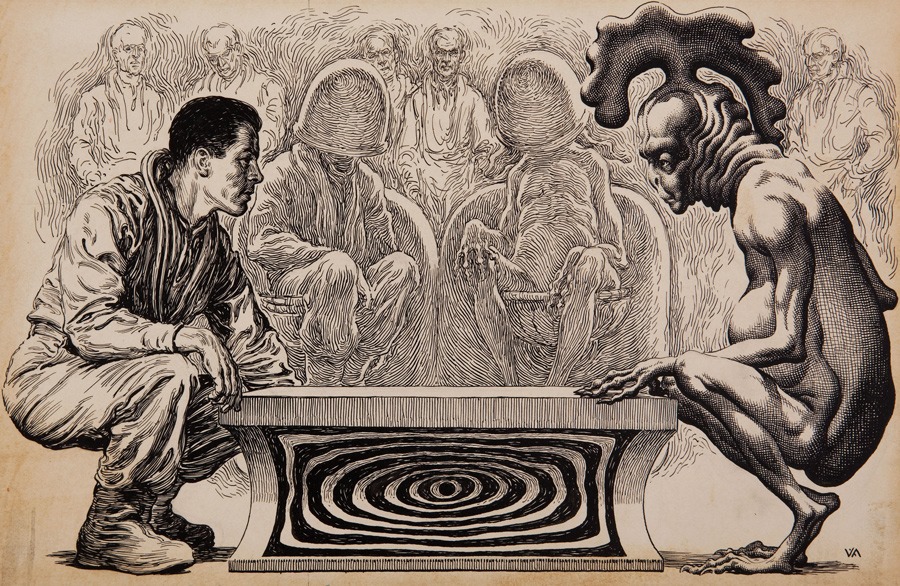
When we were young, our hormones compelled us to procreate. What motivated us to read science fiction? Have you ever psychoanalyzed yourself about that? I have a theory. I doubt its any more scientific than dream analysis, but its worth considering. I believe we read science fiction because we wanted to exist in a different location in time and space. I think all bookworms want to be somewhere else. Literary, mystery and romance fans are quite content with this reality, maybe preferring a slightly different temporal location. Generally, they want a little more than their ordinary life gives them. SF/F fans appear to reject the mundane completely. Fantasy fans want to visit exotic places that can’t exist, and science fiction readers want to live in places that could exist, but on the edge of probability. In other words, science fiction readers want a degree of believability in their fantasies. Of course these fantasies are generally no more realistic than the sex fantasies of horny teenagers.

Strangely, as I’ve gotten older, my science fictional fantasies have become more realistic and closer to home. So have my thoughts of sex. I wonder if mystery fans who once loved thrillers now prefer cozies? If readers of romance novels imagine more realistic lovers?

frpaul_01_amazquar_1929win_ralph124c

We’re motivated by what we don’t have. Few people are content to sit and claim, “I have everything I need and want right here.” Most of us are tied to the mundane routines of our life. A few bold folks enact their dreams with great effort and determination, but most of us just VR what we want with books and television. If we live on a steady diet of science fiction, shouldn’t we assume its an indication of what we really want? Or, do we really desire, to just sit in a chair, holding pulped wood and stare at black ink stains, and imagine far out ideas?

I’m getting older, but not that old. Old enough to still dream, but too old to believe. Let’s say I’ve reached that age when I can’t pretend I’m young. If NASA or a beautiful woman offered to make my youthful fantasies come true, I’d probably turn them down. No use proving myself an old fool. So why do I still love books about colonizing the Moon and Mars, or generation ships traveling to other stellar systems? Or do I? Have my science fiction fantasies changed with age? I think reading science fiction is also a kind of collective fantasizing, or collective dreaming. This still parallels the sex drive. Sex is about making children, and children are about making the future. Everyone is future oriented to a degree. Science fiction fans just project a little further than average. But as we get older, the future has less potential. So don’t our fantasies become smaller? (By the way, if they had Viagra for your science fiction drive, would you take it?)

O--REILLY-American--20th-Century.-Science-Fiction-Plus--story-illustration_900

Of course, science fiction isn’t always about the future. For young readers who love Military SF, they could join the Army today. For readers who crave romantic science fiction, there are plenty of romantic locations on Earth, many of which are quite alien and exotic. And fans of post-apocalypse could travel to Syria, if they really wanted to live what they read. Bookworms could live more exciting lives if they made the effort, but is that what we really want? I use to think yes. Now I think no.

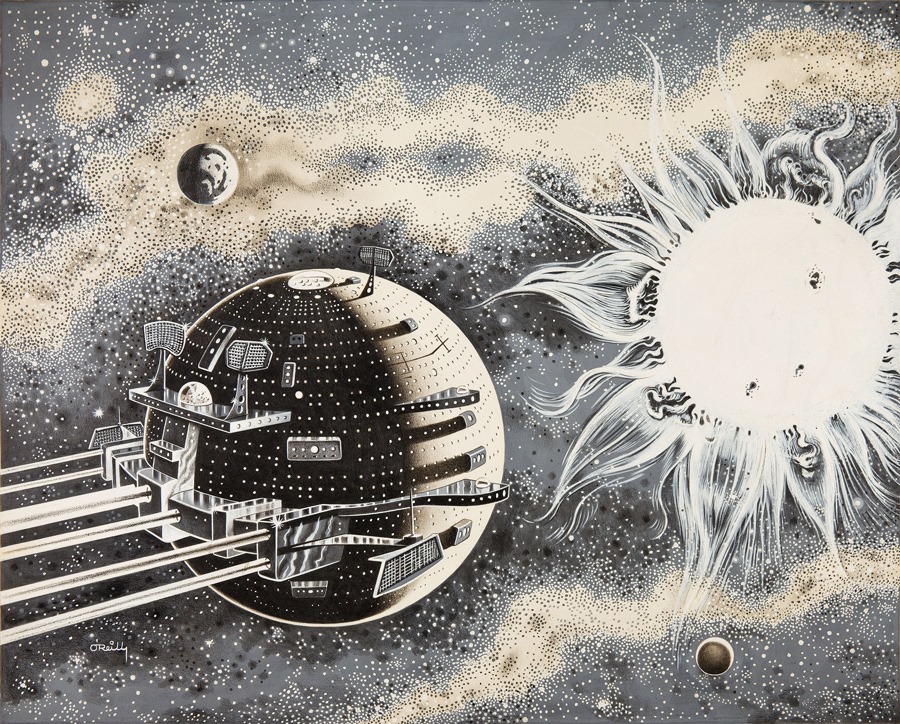
What we really want are spaceships, cities on Mars, brilliant chatty robots, contact with alien intelligent beings, immortality, to download ourselves to virtual computer worlds, or supplement our brains and bodies with cybernetic attachments. Or do we? I seldom chat with Alexa, my cybernetic companion. And if I had to really choose between retiring to Mars or Florida, I’m pretty sure I’d pick the Sunshine State. And I’m not looking forward to hearing aids, exoskeletons,  and cataract replacement lens.  Nor does living forever have any appeal to me.

Being old has changed my attitude towards science fiction. I’m less concerned with new science fiction, preferring to study the history of science fiction. Older people reevaluate their lives. Well, I’m an old science fiction reader, reevaluating the genre. For some reason, science fiction stories written in the 19th and 20th century are more fascinating than reading science fiction stories written in the 21st century. WTF? What a pitiful excuse I am for a science fiction fan. Well, so what.  Now, I’m just more interested in how I got here, rather than where I’m going. When I was young, where I was going was everything. Now, not so much.

I just started reading The Scarlet Plague by Jack London, from 1912, and it immediately reminded me of Earth Abides (1949) and The World Without Us (2007). How long have we been thinking up the same old science fictional ideas and assuming they are innovative? That reminds me of the essay, “The Graying Lensmen” by Alec Nevala-Lee. There is value is studying SF history. Alec is focusing on the 1940s, but I think we need to go further back.

All of this is making me rethink the common assumptions of science fiction. Maybe the future isn’t visions of science fiction coming true, but more science fiction. Science fiction that repeats itself. I used to think serious science fiction prepared us for living in the future, and less serious science fiction provided amusement and escape in the present. Now I’m wondering if the purpose of science fiction is a cognitive tool, for thinking science fictional thoughts. Religion, science, mathematics, history, logic, philosophy, journalism, etc., are all cognitive tools for understanding reality. Science fiction is not a very precise tool, more like religion than science. But thinking science fictionally, is a way to contemplate reality. I’m wondering if we think science fictionally different as teenagers, than we do collecting social security?

JWH