Clarion West 2002

Eight years ago around this time of year I attended the Clarion West writer’s workshop in Seattle.  Seventeen of us all shared the same ambition to become science fiction writers, but so far I’ve failed to succeed.  A few of my classmates haven’t.  We were told only a handful of us would get ahead with our dreams, and it would take years, and it would not always be as planned.  And that’s come true.

Strangely enough, my Clarion West 2002 group had three guys who were 50 that year, seeking new ambitions for the second half of their lives.  Most of the class were in their twenties, with a couple in their thirties.  At 50, I decided to do something new with my life by going back and pursuing one of my teen ambitions, to write science fiction.  In the eight years since I’ve written damn little fiction, but I’ve written a lot about science fiction on this blog and at Classics of Science Fiction.

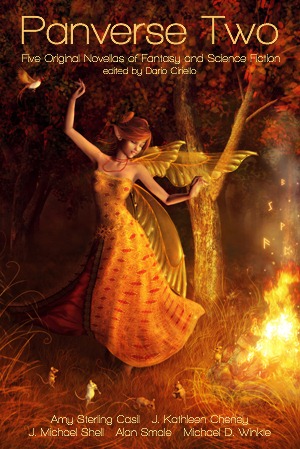
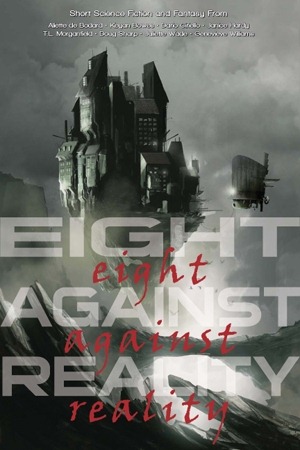
Dario Ciriello has taken a different tack and started Panverse Publishing, and editing anthologies of original stories, with an emphasis on the novella.  With two titles in print and another due in September, Dario has hit the ground running with a promising new career as an editor.  The books have been getting good reviews and they have stunning covers.

PanverseOne

PanverseTwo

 EightAgainstReality

You can get Panverse One and Eight Against Reality now at Amazon, or order direct from the Panverse site.  Panverse One is even available as a Kindle book.  Panverse Two will come out in September.  If you are a patron of writers and small presses, you can get copies of the books and make donations at Wonder. Story.  They’re Back! where Dario talks in a short film about his small press and publishing new writers.

The other Clarion West student that was 50 like me back in 2002 is Doug Sharp.  Doug has spent years living out in the wilderness finishing up his wild science fiction novel and is now looking for an agent.  The epic adventure turned out so long after many revisions that it will be two novels, Channel Zilch and Hel’s Bet!  Doug’s blog Walden 3.0 is fascinating account of a modern Thoreau living in a cabin in the Minnesota woods with his dogs while writing science fiction.  Doug takes beautiful photos of the wilderness and wildlife and should write a book his real life, something I envy.

I on the other hand, have written practically no fiction since 2002.  I found a writing outlet with blogging and my website The Classics of Science Fiction.  But the longing to write fiction never stops gnawing at me, and every summer around this time, I remember fondly my weeks at Clarion West and my ambition to write short stories and novels.  Each year I reevaluate the question:  Can an old dog learn new tricks.

I’ve taken off this week to work on a short story as a mental return to Clarion West.  I agonize over my lack of discipline, but the reality of me not writing fiction is probably not about discipline but talent.  Hard work and talent does pay off.  T. L. Morganfield, one of my younger Clarion West classmates has had great success with publishing a string of short stories based on Aztec mythology.  Recent publications include one in the July issue of Realms of Fantasy and another story in Dario’s anthology Eight Against Reality.  What I admire about Traci is her constant work at achieving her goal.  I wish I could be more like her.

Ysabeau S. Wilce, another younger Clarion West 2002 alum, won the 2008 Andre Norton Award for young adults, for her novel Flora’s Dare.  I haven’t heard much about my other classmates except for notices about a story published here and there, and other kinds of artistic success.  I especially wish the young classmates all the luck in the world.  They have the time to make their dreams come true and I hope they succeed.

I hope by next summer when I think of my time at Clarion West that I will have finished the short story I’m working on now, and maybe a few more.  I want to prove that an old dog can learn new tricks.

JWH – 7/6/10
How Kindle and Nook Can Better Compete With The iPad

Last weekend I wrote “To Ebook or Not To Ebook” and I’m still agonizing over which ebook reader to get.  There are two main issues I’m still worrying over.  First, which book is the most comfortable to read for long periods, and second, which ebook reader is the most universal in terms of buying ebooks.  I imagine the light E-Ink readers, the Nook and Kindle, are easier to hold for long periods of time, but it’s obvious the iPad can read books from Amazon, B&N, iBooks, and many other smaller ebook sellers.  The iPad is almost the universal ebook reader and I’m leaning towards buying it.

My need for reading comfort might put me in a limited market so my buying desires are of less concern to ebook engineers, but I wished they’d consider them.  I have bad eyes, and back problems that make it uncomfortable to sit long in one position, and an arm problem that makes holding a book pain inducing over time.  I’m getting old and wimpy.  I’d love to sit and read for hours like I used to, but it’s a struggle.  That’s why I fear the iPad – many reviewers have complained its difficult to hold for lengthy reading sessions.

And, besides that, I don’t want Apple to just crush the competition, so how could the Kindle, Nook, Kobo and Sony ereaders better compete with the iPad?

Universal Reader

First off, Amazon, Barnes & Noble and Borders should make a cross license deal to display each other’s DRM material.  That way any Kindle, Nook or Kobo owner could buy and read books from all the leading booksellers.  The obvious solution would be a universal ebook format and DRM, but that might take years to hammer out.  It might be easier to add competitor’s software to each others readers.  Obviously, the iPad does it with ease.

The reason why I’m leaning towards the iPad is because I can buy books from all the major ebook retailers and read it on the iPad.  If the E-Ink readers want to compete they need to do the same thing.  It was foolish of Amazon to start the trend for proprietary readers.

Add a Handle with Trigger

The second way to compete with the iPad is make the E-Ink readers even more svelte and easier to hold.  I wished they came with a detachable handle so the ebook reader would look something like a church fan.  A nice handgrip with a trigger to page forward would make holding an ebook reader nicer, and make the page turning more convenient.  You can leave the back page button on the reader because it wouldn’t be needed that often.  I don’t know this for sure, but I imagine a handgrip handle would be more comfortable to hold than holding the ebook reader like a book. 

I’m talking about making the device comfortable for reading 8 hours at a stretch.  This is where the iPad is weak.

The Third Option

I’ve even thought of another option, but this one by-passes the E-Ink technology.  Keep the books in the handle and beam the content to a pair of special glasses via Bluetooth.  I wonder if it’s possible to make a pair of glasses that displays words that are even easier to read, something that helps the reader tune out the world and become one with the word.  In the music world we’ve moved the speakers into the ears, why not move the page right in front of the eyes?

Why Reading is Specialized

iPad fans lord their gadgets over the E-Ink readers claiming its a universal solution.  They ask why anyone would want a specialized device when one device, the iPad, can do so much.  I think the iPad is a revolutionary device, it moves the computer screen off the desk or lap and into the hands where it makes a big functional difference.  But is that the ultimate location?  And is it the right weight and form factor?

Bookworms like to read for hours on end, and the ultimate ebook reader will cater to that need.  I tend to believe the lower weight of the E-Ink technology gives it a chance to compete with the more glamorous and universal device of the iPad if they are optimized for streamline reading of text.

Many bloggers and journalists have written about the approaching doom for the E-Ink reader, but I tend to doubt those predictions.  That doesn’t mean I won’t buy an iPad any day now, but it also doesn’t mean I won’t buy a Kindle 3 when it comes out.  The new Pearl E-Ink technology is appealing.  It just galls me to think about buying ebook reader that can’t read all ebooks.

The Deciding Factor

To be honest, the universal ebook reader of the iPad sways me more than comfort of the smaller E-Ink technology readers, and I’ll probably buy an iPad for now.  That doesn’t mean I wouldn’t buy an E-Ink reader too, especially if they become a universal reader.  I’m greatly disappointed that most books I’m reading right now aren’t available for any ebook reader.  That sucks.  But we’re living in transitional times for books and times will change soon.

JWH 7/4/10

Julian Comstock by Robert Charles Wilson

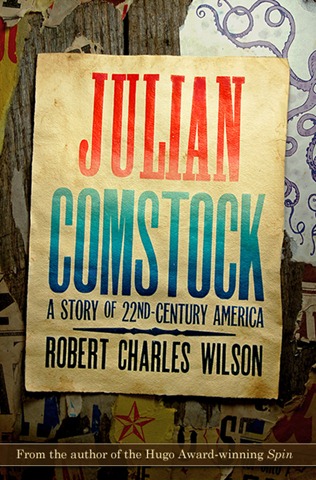
Julian Comstock: A Story of 22nd Century America by Robert Charles Wilson is the fourth novel I’ve read that’s up for the Hugo Award this year.

  • Boneshaker, Cherie Priest
  • The City & The City, China Miéville
  • Julian Comstock: A Story of 22nd-Century America, Robert Charles Wilson
  • Palimpsest, Catherynne M. Valente
  • Wake, Robert J. Sawyer
  • The Windup Girl, Paolo Bacigalupi

juliancomstock

This is the first time I’ve tried to read all the nominees before the awards were given and it has proven to be a rewarding endeavor.  I’ve got Boneshaker and Palimpsest to read before September 5th.  I listened to all four books, and will listen to Boneshaker next, and Palimpsest last, since it won’t come out on audio until August 15th.  This is a sign about how successful these novels are because they are all getting the audiobook treatment.

Even though I’ve thoroughly enjoyed each of these books, so far I’d bet that The Windup Girl will win because it’s gotten the most attention.  Wake has been the story most like a traditional SF novel, and covered my favorite subject matter, but the other three have been the most literary ambitious.  The Windup Girl makes for an interesting bookend to Julian Comstock since they are both about the 22nd century after the oil runs out.  Strangely, their imagined futures couldn’t be more different.

The Windup Girl portrays science progressing after the collapse of oil, whereas Julian Comstock pictures the world de-evolving into technology that’s downright 19th century, and some people have even called the novel steampunk, but I wouldn’t.  For instance, people of the United States in Robert Charles Wilson’s future live under a flag of sixty stars but ride horses again and sail across the oceans on schooners.  They even have to reinvent the repeating rifle and have reverted back to silent films with a strange twist.

These books don’t try to predict the future but tell complex stories set in strange worlds far different from ours.  Each book does speculate on current trends, but they diverge in fascinating ways.  In Julian Comstock America is ruled by the Executive Branch of the Presidency, the Military and the Dominion of Jesus Christ, a new Orthodox church that apparently grew out of today’s fundamentalism.  Society has restructured itself around severe class distinctions, including indentured servitude, feudal land owners and an aristocracy.

Julian Comstock is a rich story that has the flavor of 19th century dime novels.  The Dominion of Jesus Christ has brought back puritanical beliefs and censorship so the characters think and speak like people from the pioneer days of the old west.  Julian Comstock is the nephew of a murderous President who must hide out in the western states because the Presidency has become an inherited title and his uncle fears any possible challenges to his rule.  Julian is raised with Adam Hazzard, a son of an indentured worker who narrates this modern picaresque tale.  Wilson uses Adam to make some fun swipes at his own profession of writing.

Julian Comstock is a colorful novel that would make a beautiful movie, perfect for Hollywood’s liberal philosophizing, but I’d like to see a more balanced treatment.  Even though I’m a liberal myself, I think the story could have been improved if the Dominion of Jesus Christ hadn’t been so one dimensional.  It would have been far more fascinating and scary to see a more realistic theocracy taking over America, as many fundamentalists dream about.  This is an odd subject for science fiction, but Heinlein explored it back in the early 1940s with some of his first stories collected in Revolt in 2100.

Wilson never gives enough reasons why in his world of Julian Comstock so much technology and science from our era is forgotten, like radio communication, or needs to be reinvented, like machine guns, which leaves me to think the story is less science fiction and more allegory about the dangers of religion in politics.  But this story does make me wonder just how much we could forgot?

JWH – 6/27/10

To Ebook or Not To Ebook

This week Barnes & Noble lowered their price for the Nook to $199, and came out with a Wi-Fi only model for $149, and on the same day Amazon lowered the price of the Kindle to $189.  Unfortunately, the iPad remains $499.  Once again I’m thinking about buying an ebook reader, but there are so many things to consider that I’m left undecided.

For instanced, I’ve been to three local bookstores trying to find a copy of Texasville by Larry McMurtry without coming home with a book to read.  If I had an ebook reader, either Nook or Kindle, I could have started reading it immediately after realizing I wanted it.

Score 1 for ebooks.  If the book is available ebook readers win on instant gratification.

Score 1 for paper.  On the other hand, both Amazon and Barnes & Noble sell the ebook edition of Texasville for about the same price as the trade paperback edition, so I wouldn’t have saved any money towards paying back the investment of $149, $189 or $499.  Why buy an ebook when the real book is the same price?  I could read the real book and give it away or sell it, which I can’t with an ebook. 

Score 1 for paper.  I just ordered Texasville as a used hardback for 1 cent and $3.99 postage.  You can get used books but not used ebooks.

Score 1 for ebooks. If I had bought the ebook edition of Texasville, Larry McMurtry would have been paid.  Buying used cuts out the author.  If all books sold were ebooks then writers will always get their cut.

Score 1 for paper.  If everyone buys ebooks bookstores will go out of business, now that would suck, wouldn’t it?

Score 1 for ebooks. The price of The End of Biblical Studies is significantly cheaper for the ebook edition.  It’s $21.77 for paper and $9.99 for the Kindle, but it’s not available for the Nook.  Bummer, because I was thinking about getting the $149 Nook.  But that’s $11.78 I could apply towards the iPad, since it does have Kindle and Nook reader software.

Score 1 for paper.  I’m going down my Amazon Wish List to test things, and it’s score another point for paper, because The Year’s Best Science Fiction 2010 is not available for ebook readers.  Actually, paper will score many points here because many books on my Wish List aren’t available in an ebook edition.  That will change.

Score 1 for iPads.  There are books that are available for the Kindle but not the Nook, and other books like Darwin’s Armada that’s available on the Nook, but not the Kindle.  The iPad has software readers for most dedicated ebook readers.  But $149 + $189 is still cheaper than $499.

Score 1 for ebooks because they offer large print and that makes reading easier for me.

Score 1 for ebooks because they are environmental friendly.

Score 1 for paper because I can share books, give them away or sell them.

Score 1 for ebooks because they are easier to hold.

Score 1 for paper to save money.  By buying used, going to the library, getting books off the free table at work or borrowing books from friends I could significantly reduce my annual reading budget.  It’s even possible to spend no money on reading if I stuck with paper.

Score 1 for ebooks because they stimulate the economy.  Not only do you need to buy an ebook reader, but you have to pay for all your new books.  This is bad for libraries and bookstores, but great for publishers, writers and the economy.  The move to a Green Economy means creating as many environmental friendly jobs as possible.

Score 1 for iPads because they are good for magazine reading.

That’s 6 for paper and 9 for ebooks, with a leaning towards the iPad.  I’m leery of spending $499 for the iPad.  I spent $199 for the iPod touch and $399 for a Toshiba netbook and really don’t use either.  I’d hate to spend another $499 for another gadget I’d end up not using too.  But I’m wanting to read more but I can’t because small print strains my eyes.  An ebook reader promises help for this handicap.

Finally, my stand on giving up paper means I don’t read magazines like I used to, and I miss that.  I can read magazine articles online from my computer desk, but that’s not the most comfortable way to read for fun.  The iPad “appears” to offer a better solution, but I won’t know until I bet my $499.

I look at my wall of books next to my computer desk and I wonder what life would be like if all those books were inside an ebook reader.  Many of them are reference books with photos, drawings and diagrams – so I can only imagine those working on an iPad. 

I had to move my wall of books when we put down new flooring and all of those books were very heavy and hard to move.  It would be strange to hold all of them in one small device.

If I was born in a future age of ebooks, would my ebook reader at age 58 hold every book I had ever read?  That’s a weird thought.  Writing this is making me lean towards buying the iPad, and maybe even spending $599 to get the 32gb model, although I’m also tempted to hang onto paper for just a while longer until the iPad 2 comes out next year.

I keep thinking of more things to consider.  Will I take my expensive iPad into the bathroom to read?  If there are four best of the year SF anthologies to consider and only two of them are sold in ebook editions, will that force my buying decision?  Will I choose Dozois and Hartwell over Horton and Strahan because they don’t have ebook editions?

Once I buy an iPad will that make me prejudice against books that don’t have ebook editions?  It’s like my friend who took a rotary phone to show his fifth grade class and one girl asked “How do you send text messages?”  If I get used to an ebook reader and then pick up a book, will I think, “Where’s the button to change the font size?”

JWH – 6/27/10

Best Buy Lying

I was helping a lady friend of mine, J,  buy a computer yesterday from Best Buy.  She took a long time to test a lot of laptops and finally settled on a Samsung NP-R580-JSB1US.  She told the salesman which one she wanted.

“That one there is the last one we have,” he told us.

“Do you really want to get the floor model,” I asked J.  She looked at me puzzled, and I said, “I wouldn’t.”

“I just got this one out of the box.  It’s brand new,” assured the salesman.

“What do you think?” I asked.  J isn’t very good at buying computers and was scared of the whole process.

“I just put it out,” he promised us again.

I turned to J and asked her quietly if she had seen him put it out.  She whispered back that she saw him put another computer out, but not this one.  She wasn’t sure, but he could have. 

“Well, do you want to take a chance?” I asked.

“I don’t know.”

“Since it’s a floor model I can ask if they will give you more off,” said the salesman.

“How much?” she replied, J was anxious to save money.

The salesman went off and brought back a saleswoman and she said they could let that machine go for $699, down for $746, which was a clearance price, even though it was a new Intel i5 machine.

J agreed to this and they started taking the display table apart to get to the power cords and the cable lock.  It was a fair bit of work.  I asked, “And you have the box and all the contents that go with this laptop?”

“Oh yes.”

When they got the computer out they took us to a sales station next to where people were bringing in machines to be fixed.  The salesman told a young guy at the counter that the saleswoman said the machine would be $699.  The young guy said that was more than what they normally took off for floor models and they’d need to get another person to approve it.  We waited.  When the other people did show up I asked about the box and was told they didn’t keep the boxes on the floor model.

“The salesman told us he just took it out of the box, so look around, it should be nearby,” I said.

Buy then we had three people helping us, discussing the discount for floor model and I could tell they didn’t have the box, and that machine wasn’t just put out.  One of the new comers said something about the machine being out since the store was open three weeks ago not knowing we were told something different.  Then another girl came up said the same thing.

“We were told this laptop was brand new.” I said.  J was dazed by the whole process.  The last three people finally admitted they had no box and they were sure the machine had been out on the floor since the store opened.

“Do you have a new one in the box at another store?”

“I’ll check.”

I turned to J, “Do you want to drive to another store to get a new one?”  She said she would if it was the same price on the sale sign by the computer which advertised a clearance price.  I was starting to wonder if they had a batch of refurbished machines they were passing off at new.  However, the sales lady assured us the other store had 5 new ones in the box.  J agreed.

They rang up the computer and added $2.99 for something and $17.00 for anti-spyware, and I told the salesclerk we didn’t want those things.  She assured us they were free.  The ticket had a lower price for the computer, so when it was totaled it came to $746.  It made me wonder if this was another lie.

J paid and headed off to the other store. 

I told her I would meet her at her house and help her set up the new laptop later that night.  When I got there the first thing I noticed was the Samsung seal was broken and a clear tape covered the Samsung seal with a noticed that it had been inspected by the Geek Squad.

“This machine has been opened.”  I couldn’t believe she’d drive all the way to another story and not inspected the box.

“What!” she explained both puzzled and surprised.

“Yes.  Now that doesn’t mean anything is wrong with it, and it might not even be a floor model, but companies like Apple and Dell will inspect and put returned machines back in new packaging so it looks completely new and call them refurbished, or something like that.  They are completely upfront about selling you a returned machine.  Best Buy isn’t doing that.  This machine is probably one that’s been returned, and maybe not a floor model.”

“What should I do?”

“It’s up to you, but they lied to you again.  I’d take it back, complain that you were lied to and either get your money back or a new machine in the box.”  She said she would the next day.

J called me back tonight and told me she had called Best Buy and they had given her some line about Geek Squad opening the machines, removing the crapware, optimizing them, and then resealing the box.  “Is that possible?”

“That might be a service they offer, but I would think they would only do it on a machine someone had just bought.  I doubt they would open all their new machines.  That would make all their computers look like used machines.  I think they are lying to you yet again.  I think someone brought this machine back.  That doesn’t mean it’s bad, but they were lying to you.”

“Who can I trust?”

“I always ask for new in the box when I buy anything, and I’ve had other stores pass returned merchandise as new.  It pisses me off.  But I also know people feel they can take anything back.  And I’ve often seen people write on the net about intentionally buying three different models of something and taking two back. 

“This is your Karma,” I told her.  “You’re always taking stuff back.”

“What should I do?”

“Me, I take it back and get my money back.  But if you really like this machine, then take it back and get one new in the box.  They shouldn’t lie.  Best Buy should tell people up front they are selling them a returned machine and reduce the price.”

She went on for a bit about how frustrating all this was.

“You could keep this machine and it might work for years and you’ll never know anything different from one that was completely new.  But you don’t know what people might have installed on it before they took it back.”

She finally decided to return it.  I don’t know how long this story will take to finish, but I’ll submit a sequel if anything exciting happens.  And I haven’t even gone into the lies they told J trying to sell her an extended warranty.  They essentially said the manufacturer warranty did very little and offered no support. 

I still buy lots of stuff from Best Buy, even after all their shenanigans, but I’m a wary consumer.

I remember once me and a friend each taking a laptop up to the checkout to buy and the Best Buy people given us such a hard sell on the extended warranty that I turned to Mike and said, “You ready to go?” and he said “Yes” and we walked out leaving the computers on the counter.  We went immediately to Circuit City and bought two laptops.  They asked once if we wanted the extended warranty and when we said no, they never said another word.

When I bought my netbook at Office Depot and they got it from the back I asked the guy if it was new in the box and he assured me with an honest face that it was.  I got home and it wasn’t.  Everything was open and all the parts were just thrown back in the box not even pretending to wrap things up neatly.  I went back and told the manager that his salesman had lied to me.  I don’t think he cared, but he politely got me another machine new in the box and apologized.

I actually feel sorry for these retail places because people are too quick to return stuff.  They think nothing about the merchandise having to be sold again.  I only take things back when merchandise is broken or when I’ve been lied to and sold something as new in the box.  Makes me want to mail order everything from NewEgg or Amazon.
JWH 6/21/10