Nonfiction, Fiction, History, Myth and States of Consciousness

Have you ever read a book about a real life event and then watched a documentary about the same subject?  The contrast of what we can learn from words and what we can learn from film is often jarring and sometimes shocking.  One of my favorite books from youth is The Electric Kool-Aid Acid Test by Tom Wolfe.  Wolfe made literary fame by pioneering “new journalism” which is now called creative nonfictionThe Electric Kool-Aid Acid Test was considered the book that defined the hippies and their philosophy.  I read this book back in 1969, and now 42 years later I got to watch Magic Trip, a documentary that used actual film footage of Ken Kesey and the Merry Pranksters.   Wolfe interviewed all the principal people right after the events, and he also must have seen the original 30 hours of film, and I was blown away by the difference between the two ways of telling the same story.
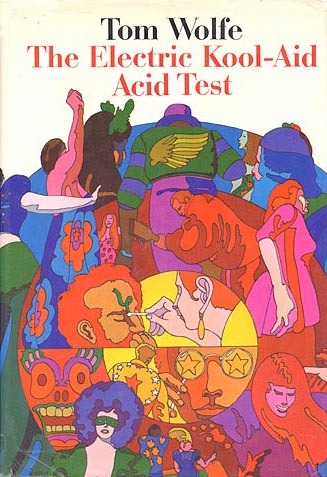
KoolAid_1stUSEd_front

Truth is the actual events.  How close can we ever come to reconstructing the truth?  What is the best evidence for the truth?  When Farmer Ted bets his geeky friends he’ll hook up with Samantha in Sixteen Candles and his friends demand proof, he asks them what kind, and they say in unison, “Video!”   As far as I can imagine, video comes closest to the truth as any evidence we can find – but even then it’s far from perfect.  For centuries, before the advent of video, our knowledge of past events was based on writing.

How much can we know from reading?  Before writing was invented our worldview was limited to the here and now.  We had oral storytellers that conveyed news from distant lands and remembered events and people from the past, but it was very limited.  Most of the time people’s consciousness was focused on the present and the immediate world around them.  Then reading and writing was invented and information about endless places and countless past moments could be recorded so people could conjure up in their minds things that weren’t here and now.  But how effective is reading at reproducing the past?  How accurate can reading describe distant places and events?

All my life I’ve been a bookworm, spending hours a day with my head in a book.  When young I most read fiction, and felt that time away from reality was just escapist entertainment, but over the decades I’ve shifted to reading more nonfiction, and felt I was learning stuff about other places, people and the past.  But am I?

Lately I’ve been reading nonfiction books and then seeking out documentaries and photographs to supplement my reading, and in every case I’m shocked by how different my mental image from reading is from the photograph or film.  Words are black marks on white paper, but they attempt to encode information that comes through our five senses.  How well does any word for a color convey the actual color? Does the word blue suggest any particular shade of blue?  Picture the wall of paint sample colors at your local Home Depot.  Which of the thousands of blues are the one we call blue?  Now think about the other four senses and words for sounds, textures, tastes and smells.  How close do words come to the infinite varieties of sensual details?

Last night I watched a documentary Magic Trip about Ken Kesey and his band of Merry Pranksters taking a bus from the west coast to visit New York City for the 1964 Worlds Fair.  In 1969 when I read “The Electric Kool-Aid Acid Test” by Tom Wolfe it blew me away by how exciting his non-fiction writing was at vividly conveying the story of these freaks on acid traveling across the country.  Over the years I’ve read more books and articles about this event, and the people involved.  To me this cross country trip was the legendary beginning of the hippies.  Of course I was wrong.   Kesey and his Merry Pranksters met the real hippies, like the Grateful Dead, when they got back from the trip and started promoting their acid test events.  Hippies already existed in 1964.

The documentary Magic Trip was created around the actual film the Pranksters took while on the trip and it blew my mind again.  It was absolutely nothing like I pictured from the Tom Wolfe book.  First off, Kesey and the Pranksters didn’t look like hippies – only the women had long hair.  And they all looked ordinary – I wouldn’t have named them the Merry Pranksters – that moniker seems way to grand for them.  The people in the film looked like college kids from the late 1950s or early 1960s acting really silly.  They looked more like early Beach Boys wearing stripe shirts.  Their antics looked as sophisticated as old episodes of The Monkees.

In some of the film clips Kesey and the Pranksters are on heavy doses of acid but you couldn’t tell that from what you see.  Now I know what they were feeling, I can remember that from those days.  Acid is like having a hurricane in your head, but you don’t see that from the outside.  What you see is kids being goofy and stupid.  Now in the book, Tom Wolfe tries to convey the epic psychological discoveries they were making – things going on in their heads, and the Magic Trip film tries to suggest that too, but the physical evidence of visuals from the film and sound recordings from tape just don’t back it up.  Wolfe wrote about what was going on in their heads and we can’t see that in the film.

As evidence of what actually happened I credit the film over Wolfe.  But is that fair or even accurate?  How much can we judge the truth of an event from what we can see and hear?  As counter evidence, how much do people know you from seeing you and hearing you talk?  See what I mean?  Reality and truth is deceptive.

It’s impossible to convey a psychedelic trip in words – and the clips of the trip festivals at the end of the movie don’t even come close.  What you see is kids dancing and acting weird and idiotic – no wonder the silent-majority Americans were freaked out by the freaks.  Back then the claim was drugs took you to a state of higher consciousness, but I always felt like they took me to a state of animal consciousness – a lowering.  Don’t get me wrong, it’s quite revealing, and you can learn a lot about how the mind functions, but all that talk about higher states was bullshit.  But then I value the verbal mind over the nonverbal mind.

In one part of the film, the west coast Merry Pranksters, along with their legendary bus driver Neal Cassidy, famed beat character Dean Moriarty from On the Road, meet up with his fellow real life On the Road beat characters Jack Kerouac and Allen Ginsberg.  Hippies meet their beatnik idols.  But things don’t go off well.  Jack is morose and turned off by the silly pranksters.  Then the west coast psychedelic legends go and meet the east coast prophets of LSD, Timothy Leary and Richard Alpert.  Leary is so turned off by them that he runs away and hides and leaves the future Ram Das to deal with them.  Leary and Alpert were trying to make LSD a serious tool for studying consciousness and these proto-hippies were abusing acid like teenagers breaking into their parents liquor cabinet.  In 1964 most people did not know what to make of these crazy kids.

Seeing Magic Trip was shocking to me.  Imagine how disturbing it would be to discover films of Jesus and his merry band of disciples.  Christianity has created thousands of different interpretations of the history of Jesus – so imagine if we got to see what Jesus really said and did?   Video can be so shocking to see after studying words.  We have no idea what Jesus was like or what he said.  Everything he supposedly said was recreated decades after the fact.  In The Electric Kool-Aid Acid Test, Tom Wolfe is deifying Kesey and his disciples just three years after the real event, and it’s impossible to know how much of the legend is Wolfe and how much is Kesey?

Tom Wolfe had used words to make this trip into an epic adventure, a transcendental experience of the first order.  He totally mythologized the people involved – of course the Pranksters were trying to do that themselves even while they were on the trip.  They gave each other funny names making themselves into characters on an epic adventure traveling in their legendary bus Further.

Now I don’t mean to suggest that these folks weren’t experiencing eye opening philosophical experiences.  They were exploring a new consciousness, breaking out of the rigid 1950s stereotypes, and exploring new experiences that would come to be known as the psychedelic sixties – but it wasn’t new consciousness.   Throughout history groups of people have rediscovered the Dionysian joys of intoxication and ecstasy – and wanting to escape from the rigid confines of society.  Even in the film Kesey says they were too young to be beatniks and too old to be hippies.

I remember my psychedelic days from over forty years ago, and it pretty much followed the Pranksters.  Me and my friends did a lot of silly and stupid things while exploring the doors of perception.  I had been inspired by Timothy Leary and Aldous Huxley and wanted my trips to be scientific experiments into the mind, but they weren’t.  It was just me and my friends doing many of the same exact things the Pranksters did in Magic Trip – going group swimming, driving around in funny vehicles that got a lot of attention, trying to play musical instruments when we had no ability, getting zonked out by nature, admiring the beats, upsetting the older people.  Oh, I learned a lot, but I can safely say to kids today, don’t bother, there are much better ways to explore the mind.  Read Steven Pinker, Edge.org and learn how to achieve Zen mindfulness.

But does any of this answer the question about how much truth we can attain from words?  In terms of acquiring knowledge, words can get you far higher than any amount of acid.  Truth and experience are wordless – ineffable.  I’ve experienced wordless states of consciousness through drugs and a mini-stroke, and that’s not a normal human state of consciousness.  As humans, like it or not, our consciousness minds are based on words and language – and language and words do not mirror reality perfectly.  Or even closely.  I know there are non-verbal conscious states of mind but the past and future don’t exist in those states.  The mere act of trying to recreate the past is a verbal state of consciousness.

The real question is:  How close does the nonverbal reality match our verbal reality?  I don’t think very much at all.  My proof is the fact that we all live in different verbal realities, and even when several people experience the same event they seldom recreate the shared reality with the same words.

A good lesson in understanding this is to study writing creative nonfiction.  I took two MFA writing courses with Kristen Iversen dealing with Creative Nonfiction and I learned quite a lot about “telling the truth” with words.  It’s actually very hard, if not impossible.  One of the first writing lessons she gave our class was to take a memory from when we were young and put it into words.   Even here I’m being misleading.  I can’t remember the exact assignment.  I think she might have told us to pick a memory from when we were twelve, but I’m not sure.  What immediately occurred to me to write about was a memory of me staying with my grandmother who maintained an old apartment building on Biscayne Bay in Miami, and the night she gave me an old fishing tackle box left in one of the apartments, and how I went out alone to fish off the concrete wall by the bay.  The more I thought about the memory the more details I could dredge up, but eventually I realized I couldn’t be sure of any of the exact details.  Memory is so faulty, but they’re also tricky.  It’s easy to create false memories. But my final essay was praised in class for its vivid details.

Was the essay absolutely true?  No, it wasn’t.  But I didn’t feel I was lying either.  I had recreated in words what were vague impressions and memories in my mind.  Mining those memories took work.  There’s a quality of effort in recreating memories that is very enlightening.  But still this brings us no closer to explaining the difference between nonfiction, fiction, history and myth.

I have read many nonfiction books on Wyatt Earp.  I have seen many documentaries on Wyatt Earp.  I have read many fictional stories about Wyatt Earp.  I have seen many fictional movies about Wyatt Earp.  I have heard many people discuss Wyatt Earp as a legendary mythic character of the old west.  Which of these various modes of learning about Wyatt Earp are the best for knowing who the real Wyatt Earp was like?  Is Tombstone the movie better than The Last Gunfight the nonfiction book, or Doc, a fictional novel where Wyatt is a prominent character?  Or the  PBS American Experience episode about Wyatt Earp?

Here’s what I can tell you.  It’s only based on personal feelings.  Wyatt Earp the man who lived in the nonverbal reality of the 19th century is long gone and unknowable.  That kind of reality is unknowable.  That’s why it’s called ineffable.  I can say some fictional versions of Wyatt Earp vary far from the actual reality of the nonfictional evidence, but can we say the Wyatt we create with historical evidence is actually close the to real flesh and blood Wyatt?  Yes, I think we can, even though there are many nonfictional Wyatt Earps to consider.  Every account, whether fiction or nonfiction creates a new edition of Wyatt Earp.  But I actually doubt we really get that close to the real man – some accounts are just more factual than others.

Scientists like to entertain the idea of multiple universes because there should be an infinity of these other universes allowing endless versions of our own world, many just slightly different.  That’s how verbally reconstructed Wyatt Earps exists.  There’s an infinity of them.  Some of them are close to the real world that did exist, but it’s very hard to judge which are the closest.  We can spot the absurd examples easy enough like all the Wyatt Earps in science fiction stories, but we can’t say which historical Wyatt is actually the best.

I think we’re getting closer to understand nonfiction, fiction, history and myth, but we’re not there yet.  I am reminded of a book called The Origins of Consciousness in the Breakdown of the Bicameral Mind by Julian Jaynes.  What Jaynes suggested was for early humanity they had a different state of mind than we do now, which he called the bicameral mind.  I don’t want to go into the details of his theory other than to say that in the past we shifted from one kind of consciousness to another.  I just want to suggest that as our verbal consciousness evolved, we’re now shifting into a third state of consciousness.  This new consciousness is based on sharing facts and building a consensus model of reality based on science.

We’re not that good at it yet – the proof can be seen by how Democrats and Republicans model our political reality.  And even conservatives and liberals seldom share the same ideas.  But in theory we believe through science and other forms of knowledge, that we can model our complex social reality in political and economic laws, as well as nonfiction, history and even fiction.

In other words, many of us believe given enough facts we could prove to each other the validity of a model of reality.  Science has gone the furthest by explaining the physical world.  The consensus is very strong with that – there’s very little fiction or myth in science.  All other areas of knowledge, like politics, ethics, law, economics are a long way from matching reality with any kind of common agreement.  In other words, they are mostly built on fiction and myths.

What I’m saying finally is, we all like to believe that we can separate nonfiction and history from fiction and myths.  Whether that’s true or even possible, is still open for scientific evaluation.  In other words, if you hold any beliefs other than those covered by a narrow range of scientific study, you can’t be sure if there is any difference between nonfiction, fiction, history and myth.

There is no way to know who Ken Kesey or Wyatt Earp was scientifically, but is there any emerging discipline that could use consensus like science, to measure the accuracy between nonfiction and fiction?  Is the scholarship of History rigorous enough to make that claim?  Or will all areas of knowledge outside of science always by undermined by subjectivity?

JWH – 12/30/11
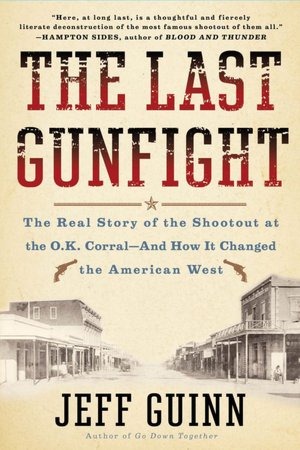
The Last Gunfight by Jeff Guinn

The Last Gunfight by Jeff Guinn has a subtitle that perfectly describes the book:  “The Real Story of the Shootout at the O.K. Corral – And How it Changed the American West.”  I’ve been reading about Wyatt Earp and the gunfight at the O.K. Corral for decades, and the story just gets better and better as historians gather more and more data and keep putting the pieces together over and over looking for the historical truth.  Jeff Guinn’s book is the best yet, but I also liked Inventing Wyatt Earp by Allen Barra.  Both have come a tremendous distance down the trail since Stuart Lake’s Wyatt Earp: Frontier Marshal in 1931.

the-last-gunfight

Growing up in the 1950s meant watching a lot of westerns on television.  Western movies have been around since the earliest days of silent films.  The allure of the wild west began in print way before the famous gunfight at the O.K. Corral in 1881 with newspaper stories and dime novels.  Stories of the west have always been mythic, and the truth has always been hard to know.  We know the wild west through fiction – through the myths.   In recent years historians have been examining and writing about those myths and the reality is startlingly different.

Back in the 1950s Wyatt Earp on TV was a squeaky clean good guy.  But before the real Wyatt Earp got to Tombstone he had mainly worked in whorehouses, probably as a bouncer, but maybe as investor, and had been arrested a couple of times, including for horse stealing.  After the gunfight he killed three men in cold blood, and only one in a gunfight, because he was tired of waiting for the law to catch the killers of his brother.  Wyatt Earp essentially got away with murder.  Many people also felt the Earps and Doc Holladay murdered the three men at the O.K. Corral.   Wyatt Earp had worked for the law, but never as full Marshal or Sheriff, just as a deputy.  But this work brought him in contact with criminals that wanted him and his brothers dead, and the Earps killed the cowboys first.

In the myths of television and movie westerns violence is the solution.  We like to think the white hat cowboys represent good and the American way of life, and the black hat cowboys represent lawlessness and evil.  Jeff Guinn’s book goes beyond those stereotypes to explain things were far more complex.  As ambiguous as any complex issue today.

Even as the conflict between the cowboy rustlers around southern Arizona and New Mexico was taking place with the city folk of Tombstone, press reports about the violence was entertaining newspaper readers all over the country.  At first the Earps were praised for warring against criminals and maintaining the peace, but after the famous gunfight, when Wyatt went on his famous revenge vendetta ride, the public turned against him too.  He became just another killer that society needed to deal with.

Wyatt Earp lived another forty something years and fame dogged him the rest of his life.  He wanted to square his story with the public, which is why he worked with Stuart Lake on his autobiography.  But Earp died before it was finished, and Lake had to make it into a biography.  But because of Earp’s wife Josephine, Lake was forced to clean up the story.  Wyatt had already been telling lies for years about his life, and before he died already had his own mythic view of his past ready.  People wanted to read about a gunman, but Earp wanted them to believe he was a peace officer and businessman.

Then the movies started coming out and the legend began to grow and Wyatt Earp was turned into one of most famous men in wild west history.  He’s even eclipsing Wild Bill Hickok and other men who were more famous at the time.  Jeff Guinn explores this in the last chapter of his book.  I think it deserve a whole book itself.

The story is complicated.  Just read the “Gunfight at the O.K. Corral” at Wikipedia.  It’s so complicated that it makes for a Rashomon like tale.  Jeff Guinn strengthens this story by giving a lot of American history that leads up to why the various principle characters acted the way that they did.  Much of the story is political – can’t get far from the Republicans and Democrats today, can we?

Because of television and movies we picture old west towns with one long street, with a sheriff’s office, several saloons, a hotel, a general store, a telegraph office and a livery stable.  1881 Tombstone was far more urban than that.  It had two opera houses, a bowling alley, an ice cream store, tennis courts, a stationary story, many hotels, mines, factories, countless bars, countless whorehouses, two newspapers, and lots of businesses, including those that sold the latest fashions for women from the east and Europe.  The wild west in 1881 was already becoming what we know as modern – and thus the famous shootout was less about wild west gunslingers and more about of a complicated crime.

Wyatt Earp and his brothers had common law marriages to prostitutes, mainly earned their money from gambling, and Wyatt hoped to make it big by becoming Sheriff who got to keep 10% of the taxes he collected.  The Earps were near the bottom of the social/economic heap and hoped to climb up in status by working as lawmen.  Unlike the movies, they weren’t famous citizens of their town.  Their names got in the papers when they arrested cattle rustlers or arrested drunk and disorderly cowboys, but that wasn’t that often.  They were just tough guys hired to deal with more unpleasant tough guys.

We see westerns today where the good guys kill countless bad guys.  How many men did Marshal Matt Dillon kill over the course of Gunsmoke?  Well Wyatt Earp is the most famous gunfighter in history for being involved in killing six men, but none in quick draw duels.  There were damn few gunfight duels like we see on television that you have to study hard to find them.  Most gunfights were drunken brawls and cowardly ambushes.  Even the famous gunfight at the O.K. Corral was not men whipping out six-shooters from their holsters.  Wyatt had his pistol in a coat with a specially made pocket for a handgun.  I don’t know if any of the men had guns in holsters slung low on the hip like we see in the movies.  One man the Earps shot apparently didn’t even have a gun – but they probably didn’t know it since they let another man with out a gun, Ike Clanton, the man they really wanted to kill the most,  get out of the way.  Something like 30 shots were fired in 30 seconds by six people.   More of a close fire fight than a duel.

The gunfight at the O.K. Corral was an insignificant event in America history that’s been elevated into myth and legend.  Because the event is at the intersection of history and myth, like stories we find in The Bible, people can’t let them go.  The gunfight at the O.K. Corral is like a meme that grows and grows.  We can no longer tell reality from myth when it comes to stories about the American wild west, but there is something about these stories that deeply resonate with us.  We want to define ourselves and our history by the myths rather than reality.

I predict there will be more movies about Wyatt Earp and Doc Holliday in the future, and with each new generation of films, they will redefine the story again and again.  Sometimes the pendulum will swing towards reality and other times towards fantasy.  The Kevin Costner and Kurt Russell portrayals glorified Wyatt Earp even though they both tried to be realistic.   The new book Doc by Mary Doria Russell tries to de-glorify them, and make them more human, and demystify the violence – but I’m worried she went to far in making them likable.  My personal guess is they were both pretty damn unlikable.  But the fact is we’ll never know.  We can make Wyatt Earp and Doc Holliday into whatever we want – and will, time and again in the movies and books.

JWH – 12/28/11

Rdio on Roku

I got a Roku 2 XS for Christmas and the first channel I configured after Netflix was Rdio.  Roku is a tiny box that connects to your TV and home network allowing you to watch various “Internet channels” on your TV.  Programmers create apps for the Roku that act like TV channels – some are free, others cost money, like Netflix and Rdio. 

Rdio is a streaming music service with several price levels to use, starting with free, $4.99, $9.99 and $17.99.  You need to be on the $9.99 Rdio Unlimited plan to use it with the Roku.  I love Rdio for streaming music because it has the best web page for managing music, and it has fantastic social networking features for sharing and discovering music.

rsz_rdio_logo

Rdio is also available on mobile phones and tablets if you have the Unlimited plan, so you might think, why listen to music on your television?  Well, if your television is hooked up to a surround sound system to support your home theater it can play music far better than what you can hear through computer speakers or through earbuds.  Most people have no idea how rich music sounds if they’ve always listened to it on earbuds.  Music on a home theater system is like listening to music in the car with a good car stereo system.

Now while the web interface to Rdio is rich and powerful on the computer screen, the Rdio interface on mobile devices and the Roku is severely limited.  You can play your music collection, playlists, and search for songs and albums, or go to the New Releases and listen to new albums.

BUT RDIO ON THE ROKU IS VERY LIMITED IN HOW YOU PLAY SONGS! 

First off there’s no random play.  Basically you see album covers and call them up to play.  You do not even see a list of songs on the album, or even told how many songs are on the album.  All Rdio does is show the first song and gives you three options:  play/pause, next song, previous song.  Now this is fine if you want to put on an album and listen to it, but that’s skips most of Rdio’s wonderful features.

I assume this is Rdio’s first effort and more features will show up on the Roku and mobile devices soon, but here’s a list of critical features I’d like to see much sooner than later:

  • Random play for playlists and albums
  • Show song list for albums with up and down arrows for selecting
  • Show song list for playlists with up and down arrows for selecting
  • Allow us to add album to collection
  • Allow us to add album to queue
  • Allow us to add song to playlists
  • Allow us to create a new playlist
  • Show large photo of album when playing (hey, we’re using 1080p TVs here)

After those very basic requirements are met I’d like to see:

  • All the current social networking features of the web version
  • Wikipedia like info about songs, albums and artists
  • Lyrics to songs (again, we’re combining music with a big screen.  I have a 1080p TV and computer monitor – make the most of it)
  • Allow us to create multiple collections on all devices (this isn’t even on the web version)

Many of these features are missing on my iOS version of Rdio too.  I’m hoping they will also be fixed there too.

Amarok, a music player from the Linux world and KDE, also available for the PC and Mac, has a central window for showing song lyrics and album, artist and song information.  Sitting in front of a TV listening to music sort of demands making use of the large screen don’t you think?  Of course, when I really get into a song I close my eyes.

I know we’re at the beginning of a new era for playing and distributing music.  Right now only MOG and Rdio are available for the Roku, which is the working man’s streaming device.  Rhapsody is on the Sonos, but I can’t afford that system, and besides, it doesn’t have the wonderful melding of music and TV that Rdio and MOG have with the Roku.  (Rhapsody, are you listening?)

I don’t know how many people have Rokus or other streaming music boxes.  Is Rdio available on the Apple TV box?  And I know these services are starting to be built right into TVs and Blu-ray players, but until millions of people see how cool it is to combine TV and streaming music they will not see the amazing potential.

I kid you not, this could be as big as MP3 music players.  Plopping down in front of the big screen and using the clicker to control a music library is brilliant.  I can lay my fat ass body on the couch and with one hand holding the tiny Roku remote and using just one finger, I can call up songs so easily that I went through a dozen new albums in the New Releases section in about 30 minutes.  Of course I didn’t play the whole albums but I play enough to get the feel for them, and if I had had a button to add them to my queue I would have saved three to play later, to give them my full attention.

Rdio has an amazing New Releases page.  Most other subscription services put up a screen or two of new releases each week, usually giving well known artists the promotion.  Rdio just shows what’s coming out from everybody and they have page after page of new releases.  Some of them are pretty crappy, but I often find stuff I like from groups I’ve never heard of, and that’s what its all about for me – discovering new music.  Playing subscription music on TV could be a huge way to promote new groups.

With the current software on the Roku if I want to remember a new album I need to have a pen and paper handy to write down the info so I can go to my computer and process it there.  That’s a drag.

I want Rdio to let us create multiple collections.  I also wish the Queue was a collection too.  Right now if you play an album in the queue it disappears when Rdio goes to the next album in the queue.  I’d rather the finished album stay there until I manually delete it from the queue.  I put stuff in the queue to study.  I’m trying to determine if the songs and albums are worthy of adding to my permanent collection or playlists. 

And that brings up another problem.  As my permanent collection grows it gets harder to find albums.  I want to organize my collection – so I want multiple collections and even sub-collections.  That way I could create a collection called Jazz, and then within it create sub-collections for Bebop, Cool, Big Band, Fusion, etc.

Rdio has tremendous potential, far more than I can even imagine now.  Listening to music ten years from now we’ll all look back and think how primitive these times are.  Politics might be a mess, and the economy is going down the drain, but the future of music looks very bright.

JWH – 12/27/11

Rethinking Ebooks

The other day I bought The Long Ships by Frans G. Bengtsson because of a review I read by Eva at A Striped Armchair that was so compelling that I had to buy the book.  I went to Amazon and found the trade edition for $12.21 while the Kindle edition was $9.87, and I thought for $2.34  I’d spring for the beautiful New York Review Books Classic paper edition.  Now that I have that book in my hands, which is a very nice trade paper copy, I’m wishing I had gotten the Kindle edition.  Or waited until just when I was ready to sit down to read it before buying it.  I’m finding several ways the Kindle is making me rethink my book buying and reading habits, and I’m not sure publishers and writers will like these changes.

the-long-ships

The addiction to own beautiful books is one thing, but to read them is another problem, and I’m discovering that it’s much easier to read books on my Kindle.  Mainly I’ve been using my Kindle to get free and cheap books, because I’ve always liked to collect books, and owning the Kindle edition doesn’t feel like I own the book.  This is an emotional conflict.  I like holding the real book until it’s time to sit down and read, and then I wished it was on my Kindle so it would be easier to hold and easier to read because I can magnify the font.  But I hate the thought of spending $9.99 for electrons.

Ebooks look better on my iPad, but it’s actually harder to hold than a hardback.  Ebooks are easiest to read on the Kindle.

I took some extra days off here at Christmas and I’m cleaning  up my bookshelves today to make room for all the books I’ve bought in the last few months that are just sitting in piles around the house.  Which brings me to problem #2.  I buy far more books than I read.  I figured I’ve got 40-50 years worth of books waiting for me to read.  I really should stop buying books altogether.  Especially since of the 50-60 books a year I do read, most are listened to as audio books. 

Okay, I’m crazy.  Yes, my name is Jim, I’m an addict.  I’m addicted to book buying.

If I was wise, I’d stop buying books in 2012.  Or not buy any book until I’m in my chair ready to read at which time I can order it from Amazon.  The Kindle really does facilitate a chain reading habit.  Finish one book, order another and start it in 30 seconds.

Collecting ebooks is just plain no fun.  If Amazon kept all my books online in some kind of virtual library where I could admire their number, see their colorful dust jackets, and flip through their pages and feel like Midas with his pile of gold, then maybe it would be fun. But as it stands now, my growing number of books on my Kindle is only annoying because it makes finding a particular book more difficult.  Note to Kindle developers – invent some kind of interface for organizing books into various collections and topics.  Just archiving isn’t good enough.

If I become a total Kindle reader then I’m not going to buy books way ahead of time.  I’m going to assume that anything I want to read that’s in print as an ebook will stay in print as an ebook and I can get it when I actually feel like reading it.  I doubt the Amazon planned for this when it started pushing ebooks.  They probably thought we’d buy books just like we’ve always had but just electronically.

Instead of buying ebooks ahead of time, I might just download the sample chapter.  That will leave a place holder that reminds me that I want to read that book someday.

I bought two more books today, and all my Christmas presents I’ve asked for from my wife are books.  But the two I bought today are picture books, books about western films.  That’s not something I’d want to read on the Kindle.  But I would like them on the iPad if they were fully multimedia.  Whoops – Amazon doesn’t sell iPad app books.  I bought a special iPad edition of The Magic of Reality: How We Know What’s Really True by Richard Dawkins.  I’m not sure it would even look good on a 7” tablet like the Kindle Fire.  Now I have to worry about two virtual libraries – one at Amazon, the other at Apple.  And the book by Dawkins is an app, so it won’t even be in the iBooks library.  What a pain for the future.  I’m also thinking about buying the multimedia edition of On The Road by Jack Kerouac, but now I wonder.  How do I save such books for the rest of my life?

I have a wall of books that sits across from my La-Z-Boy where I read.  It’s quite wonderful to gaze at, and to think about all the wonderful books I have sitting there.  Old friends that go back to when I was a kid, and all the unread books that will be uncharted territory to explore.  What will it be like if my library was in the cloud?  Can computer programmers ever develop a virtual library that’s fun to gaze at, or offer just as much fun to pull titles down from a virtual shelf and flip through their pages?  I don’t know, but I suppose some brilliant young programmer will think of something.

mybooks

[click photo to enlarge]

First, ebooks have changed the way I read.  Now they are changing the way I buy books.  Next they will change the way I store and collect books in my lifetime library.  What will an ebook reader look like five years from now, or ten?  What are the possibilities of a virtual library?  And where will my virtual library reside?  At a bookseller’s server farm?  Or will I pay to keep them elsewhere?  Can we trust our lifetime of book collecting to Amazon, B&N, Google or Apple?  And would I want to have multiple libraries?  That’s already the case now that I have books at Amazon and Apple.  And will I continue to own books?  I stopped buying music because I rent it from music libraries like Rhapsody and Rdio.  Could that happen to books too?

Has anyone really thought what the ultimate results of ebooks mean?  If I stick with Amazon will it be around in 30 years, or 50?

I wish it was possible to rip books like it is for music.  Digital music is so much nicer to manage.  Whenever I move my collection of books and CDs they’re a pain in the ass to box, ship, unbox and re-shelve.  I wouldn’t mind the simplicity of going completely digital, but what will that mean?  If I was a child getting my very first digital book, what’s the chance of me keeping it my whole life?

One way publishers could solve this problem is to give away an ebook edition with the purchase of a hardback edition.

JWH – 12/19/11

1001 Classical Recordings: Carmina Burana

Today I started reading 1001 Classical Recordings You Must Hear Before You Die, edited by Matthew Rye.  I know next to nothing about classical music, and when I saw this book on the remaindered shelf I bought it thinking I’d go through the recommendations and try them out on Rhapsody or Rdio as an exercise in music auto-didacticism.   But starting with the first album, Carmina Burana quickly showed me what a vast undertaking this will be.  I thought I might could do one album a day, but that won’t be practical – not if I actually want to learn something.  I mean, I could just play the album and be done with it, but researching Carmina Burana on the internet has been a trip, and I think each album is going to take some work to appreciate.

To me, music as time traveling.  Up to now my adventures into old music has only taken me back to the jazz music of the 1920s.  Carmina Burana jumps me back to the 11th and 12th century – that’s quite a cultural shock.  Now here’s the problem with classical music – it’s old, sometimes very old, and unless it’s 20th century classical we don’t have recordings of the original artists and performances.  Classical music for the modern world is really listening to cover bands, and there’s lots of interpretations.  I hit a snag with the very first recommended album, Camina Burana, performed by Clemencic Consort, directed by René Clemencic, a 3 CD recording from 1975 that’s out of print.  Bummer.

CARMINA-CLEMENCIC

The 1001 Classical Recording guide recommends this recording because it’s supposed to be more authentic.  Of course that’s both subjective and theoretical because we don’t know what a bunch of monks sounded like from the 11th and 12th century.   However, there is a movement in classical music called historically informed performance which means they use research and scholarship to guess what the original music might have sounded like.

Please read this Wikipedia entry on the history of the songs.  But we’re pretty sure they don’t sound like the monster chorales of the Carl Orff interpretations.  It’s when I heard “O Fortuna” that I realized I’ve been hearing this old music all my life, making it the oldest of the oldies I know.  Here’s how most people hear something from Carmina Burana today:

I did find some Clemencic Consort recordings on YouTube to illustrate the contrast of interpretations.

And these guys even look like they could be monks if they had the right outfits.

Another problem is knowing that the singers are singing about.  Here are the lyrics to the Carl Orff’s Carmina Burana.  In all, there are 254 poems and dramatic texts that are open to musical interpretation.  I really do like Orff’s “O Fortuna” sound because the music goes with the lyrics:

O Fortune,
variable
as the moon,
always dost thou
wax and wane.
Detestable life,
first dost thou mistreat us,
and then, whimsically,
thou heedest our desires.
As the sun melts the ice,
so dost thou dissolve
both poverty and power.
Monstrous
and empty fate,
thou, turning wheel,
art mean,
voiding
good health at thy will.
Veiled
in obscurity,
thou dost attack
me also.
To thy cruel pleasure
I bare my back.
Thou dost withdraw
my health and virtue;
thou dost threaten
my emotion
and weakness
with torture.
At this hour,
therefore, let us
pluck the strings without
delay.
Let us mourn together,
for fate crushes the brave.

I’m nearly positive the monks never sounded like Orff’s mind-blowing space opera interpretation, but I can picture a bunch of guys singing the song above in medieval times and it might have sounded like the Clemencic Concert. 

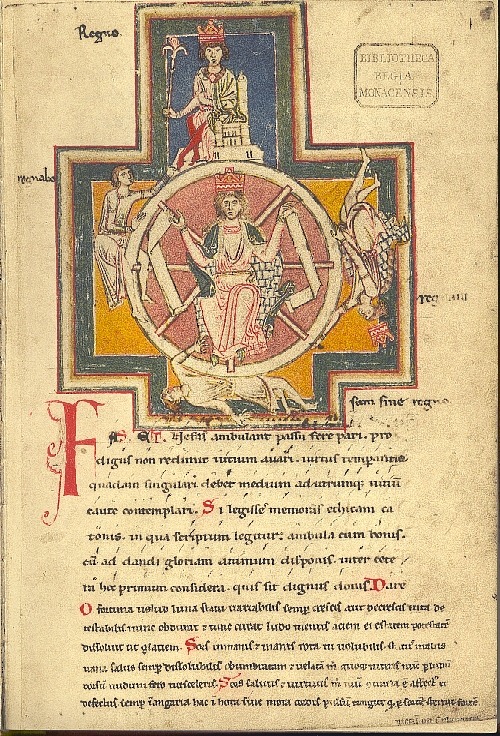
Here’s what the original manuscript to “O Fortuna” looked like:

CarminaBurana_wheel

Rhapsody and Rdio have many productions of Carmina Burana, although most of them are based on the Orff interpretation, which are more fun because they are so emotional.  Orff does rock out, but the old monk sound is appealing, I’m just not sure I’d put any those cuts on a playlist to listen to regularly, but that might change as I learn more about old music.

JWH – 12/17/11