The Origins of Higher Intelligence in Science Fiction

In the physical realm of reality, we humans have always believed we were the crown of creation, the smartest beings in a long chain of animal and plant creatures.  Yet, as far back into history that we have memories, we have speculated about metaphysical beings that were far smarter than us, who had amazing abilities.  God and gods, angels and devils, and a whole zoology of spiritual beings.  Over the centuries of progress and the development of science, we have come to doubt the existence of such metaphysical beings.  We’ve even asked ourselves, are we alone in the universe, and wondered if there are beings elsewhere in the vast multiverse that are as smart as we are, or even conscious of living in the multiverse.

Ancient Greeks speculated about life on distant worlds.  They even imagined the universe composed of atoms and concluded our world must not be unique.  Ever since then there have been people who thought about life on other worlds, or even the creation of better humans, or even the wilder ideas of the creation of smart machines and artificial life.  We just don’t want to accept that we’re alone.

For most of history, most of humanity has assumed we’re not alone, that spiritual beings existed and they were superior to us.  After the Renaissance and the Enlightenment, religious thinking decline and scientific thinking rose.  Among the population, a growing number of us has come to accept that physical reality is the only reality.  Instead of waiting for God to give us higher powers after we died, we started speculating on how we could give ourselves immortality, greater wisdom, and control over space and time, and we wondered more and more if there are other intelligent, self-aware creatures living in the universe with us.  Slowly, a form of literature developed to support this speculation and it’s generally called science fiction.
mary_shelley

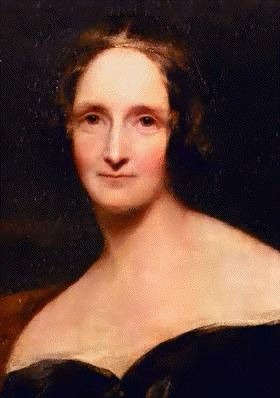
In 1818 Mary Shelley spread the idea in her book Frankenstein; or, The Modern Prometheus that we could find the force that animated life and overcome death.  That’s a very apt subtitle because Prometheus was a god that uplifted mankind.  Mary Shelley also promoted another great science fictional concept in her 1826 book The Last Man, which speculated that our species could go extinct.  If there is no God we must protect ourselves from extinction, and fight against death.  But actually, we wanted more.

HG-Wells 

Then in 1895 H. G. Wells suggested to the world in his novel The Time Machine, that humanity could even devolve, as well as go extinct.  Not only that, he showed how the Earth could die.  This was all inspired from On the Origin of Species by Means of Natural Selection by Charles Darwin, which first appeared in 1859.  In The Time Machine Wells imagined life in 802,701 A.D.  Instead of picturing the obvious, a superior race of humans evolving, he envisions two species that had branched off from ours, and neither of which were superior.  He hints that there were greater versions of humanity in between the times, but now we had devolved.  At the end of the book, he suggests that humans devolve even further into mere creatures without any intelligence.  This powerful speculative fiction defined the scope of humanity for us.  We can become greater, lesser or ceased to exist.

Then in 1898 Wells gets the world to think about another brilliant science fictional idea, what if there are superior alien beings that can visit Earth and conquer us.  In The War of the Worlds, intelligent beings come to exterminate humans.  We don’t know how much more intelligent they are, but the Martians can build great machines and travel across space.  There had been other books about alien invaders and time travel, but H. G. Wells made these ideas common speculation.

John_Davys_Beresford 

In 1911, J. D. Beresford published The Hampdenshire Wonder, a book about deformed child with a super powerful brain, a prodigy or wunderkind of amazing abilities.  Beresford, his novel and ideas, were never as famous as his contemporary H. G. Wells, but The Wonder was an idea whose time had come.  How much smarter could a human become?  Readers of science fiction, and some people in the world at large were now wondering about the powers of the mind, as well as speculating about how powerful could alien minds be.  Stories about robots had existed before now, as well as Frankenstein and Golem like creatures, but the public had not fixated on the idea of superior machine intelligence or artificial life.   But we were on our way to imagining a superior man, a superman.

Prodigies were well known and speculated about, like musical prodigies and math geniuses, but Beresford suggests the human mind had a lot more potential in it.  He also zooms in on the resentment factor.
Gladiator_(novel)

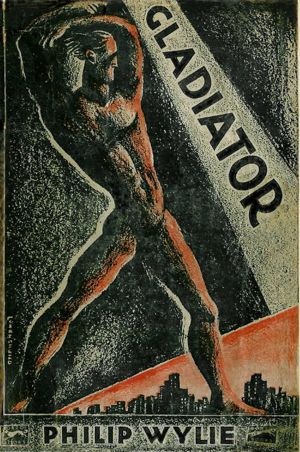
The 1930 novel Gladiator by Philip Wylie suggests it’s possible to enhance humans with a serum to improve their physical strength.  There is no scientific reasoning behind this, other than to suggest we could have the equivalent weight lifting power of an ant, and the jumping power of a grasshopper.  All of this merely foreshadows Superman comics (1932).  The theory behind Superman is he’s an alien with advanced powers and not an enhanced humans.

Action_Comics

Comic books embraced the idea of super-heroes speculating about an endless variety of ways to get humans with more features and powers.  Comics have never been very scientific, and instead copied the ideas and themes from ancient gods and goddesses.  It’s all wish-fulfillment fantasies.  People are exposed to radiation and lightening all the time and don’t mutate.  However, all of this led to speculation about what humans could become, and how evolution might produce Homo Sapiens 2.0.
Odd_John_first_edition_cover

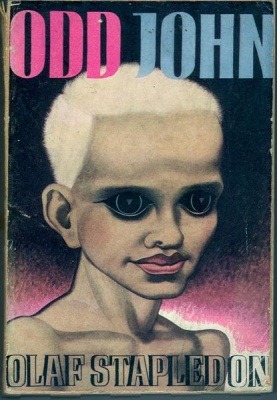
In 1935 Olaf Stapledon published Odd John: A Story Between Jest and Earnest.  Stapledon went far beyond comics in his speculation about what a superman might be, how they would act, and how society would react.  Science fiction is now seriously philosophizing about the future and potential of the human race.

Olaf_Stapledon

Olaf Stapledon was a far reaching thinker and a serious science fiction writer.  Last and First Men (1930) describes eighteen species of humans, while Star Maker (1937) tried to write a history of life in the universe.  These books are not typical novels, but more like fictional narratives.  The scope of Stapledon’s speculation was tremendous, and few science fiction writers have tempted to best him.

Gray_lensman

1930s science fiction was full of stories about accelerated evolution, such as “The Man Who Evolved” by Edmond Hamilton, and this culminated in the super-science stories of E. E. Smith and his Lensmen stories (1934-1948).   Science fiction fans ate this stuff up, and many people consider the ideas in the Lensmen series as inspiration for the Star Wars series.  The stories involve two super alien races fighting a galactic war over vast time scales using client races that they uplifted with knowledge and superior technology.

Smith ideas weren’t completely new, but he put them together in an exciting series that really jump-started the science fiction genre of the 1940s and 1950s.  Smith presented the idea that aliens could be godlike or devilish in their abilities, wisdom and knowledge, and they could bestow great powers on those who follow them.  The science behind all of this is hogwash.  It’s pandering to ancient religious beliefs by presenting the same ideas in pseudo-science costumes.

Star Wars has the same exact appeal.  Humans, especially adolescent boys, and now liberated girls, want power and adventure.  These powers and adventures are no different from what Greek, Roman, Hindu and Norse gods experienced.  The excitement of Golden Age Science Fiction from the pulp magazines of the 1940s and into the psycho-social science fiction of the 1950s represents the unleashing of great desires.  Desires for immortality, of ruling the heavens, telepathy, telekinesis, teleportation, flying faster than light, becoming as all-knowing as God.

Starting in the 1950s, especially with movies, and expanding in the 1960s with television shows like Star Trek, these ideas became widely popular, almost universal, and during the next 50 years, they came to dominate the most popular films.  There is a huge pent-up desire here for the fantastic and the transcendental through the powers of science.

Science fiction writers have often faced the challenge of presenting a super-advanced being, either a very evolved human, a powerful alien, or an AI being with vast intelligence as a character in their stories.  Generally, the assumption is super-intelligence equals ESP like powers.  How often in Outer Limits, Star Trek, Star Wars, or in written science fiction, have you seen a highly evolved human read minds, or move matter with thought, such as Valentine Michael Smith in Stranger in a Strange Land?  This goes way back in science fiction.  The same thing is true when aliens come down to visit in their flying saucers.  If they are presented as from an ancient civilization, they might not even have bodies, but they can manipulated space and time at will.

Isn’t that all silly? How does higher IQ equal overcoming the physical laws of reality?

stranger_in_a_strange_land_cover

Back in 1961 Robert Heinlein suggests that a very ancient race of Martians had conquered space and time with their minds, and they taught their techniques to a normal human, as if it was no more difficult than learning yoga.  Really?  Is that believable?  Well, science fiction fans ate this up too.  And then in 1977 Star Wars suggested similar powers for the Jedi.  Why do people want to believe thinking can be that powerful?  Well obviously, they hoped to have such power.

Valentine Michael Smith could make objects move or disappear.  He could kill people at will by sending them into another dimension.  He also had fakir like control over his body that allowed him to hibernate and appear dead.  He could also talk with ghosts.  Heinlein gives us no reason how these wild talents developed, or how they could function within the rules of physics.

Like Luke Skywalker learning to use The Force, people hope to transcend their old way of being through will power.  So far we haven’t had much luck with that concept.  The next step is to invent machines that could enhance us.
lthesixthfinger

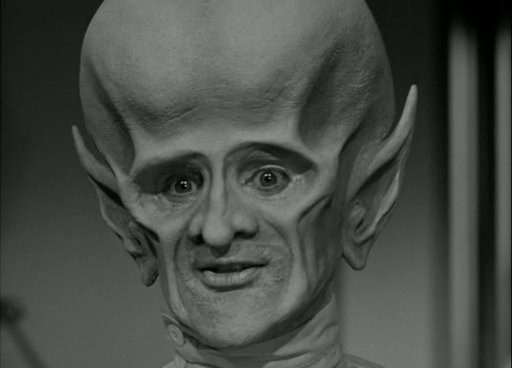
In 1963, one of the classic episodes of the original Outer Limits has David McCallum, an ordinary miner, put into a mad scientist’s chamber and his body evolved with speeded up evolution.  McCallum’s brain gets huge, he grows a sixth finger on each hand and his mental powers become enormous.  This superman moves beyond love and hate and sees normal humans beneath his consideration.

This is a step beyond Heinlein.  It suggests that evolution will eventually produce a smarter human.  It gives us no reason why we should believe this.  One real theory about why humans actually evolved was to adapt to climate change so we could survive in many different environments and climates.  Humanity  has faced all kinds of challenges and we’ve yet to morph into anything new yet.

more-than-human

Back in 1953, Theodore Sturgeon proposed that mutations might exist in the population, in the case of More Than Human, suggested that six such individuals getting together to blend their talents into a gestalt consciousness.  The first part of the story is called “The Fabulous Idiot” and reminds us we’ve long known about idiot savants that have wild talents.  We have to give Sturgeon credit for sticking close to reality and not just making up some science fiction mumbo-jumbo, except that he suggests that misfits have ESP or telepathy, that darling concept of 1950s science fiction writers.  Without telepathy we can’t create the gestalt. 

There are humans with magnificent mental abilities, with photographic minds, wizards with numbers and math, but most of them have other weaknesses that keep them from being fully functional as social beings.  There seems to be a problem with the human mind focusing to closely on any one talent at the expense of general abilities.

Chocky

John Wyndham comes up with a solution of having an alien intelligence inhabit a boy.  This is sort of a cheat don’t you think?  Without explaining  how an alien mind can occupy our mind and why it’s mind is superior, this is no more than waving a wand and saying, let it be so.

Gary_Mitchell_After

Star Trek explores accidently accelerated evolution when the Enterprise hits a magnetic storm on the edge of the galaxy and crewman Gary Mitchell develops godlike psionic powers.  Like many stories about evolved beings, Gary becomes a threat to the normal people and feels no moral restraint about killing people.  Heinlein presented Valentine Michael Smith as being just with his use of powers to disappear people, but Captain Kirk and Mr. Spock see Gary Mitchell as evil and must be destroyed. 

This show was a second pilot for the original Star Trek series and Mr. Spock is very aggressive, brandishing a rather large and powerful phaser rifle.  Later on Mr. Spock becomes the ideal of mental self-control and evolved being, but then he’s a Vulcan.  The implication is control over feelings will lead to greater mental powers.
heinleinra-themoonisaharshmistress-berkley-001-500

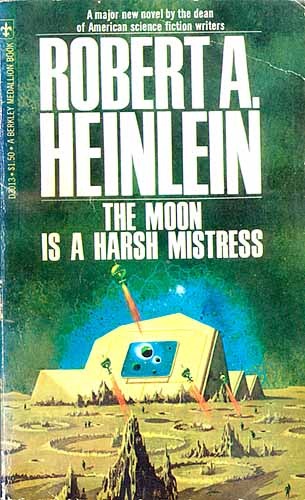
In 1965 Heinlein returns with a newer version of Mike from Stranger in a Strange Land.  Once again, this Mike is an innocent, but a machine coming into consciousness.  Once again he has to learn about how the world works and to develop his own talents.  Being a machine he has new abilities that humans don’t and can’t have.  Now we’re onto something.  If we can’t evolve our brains, why not use our brains to build a better brain.  Mike is a friendly computer, but many people fear this idea.
colossus

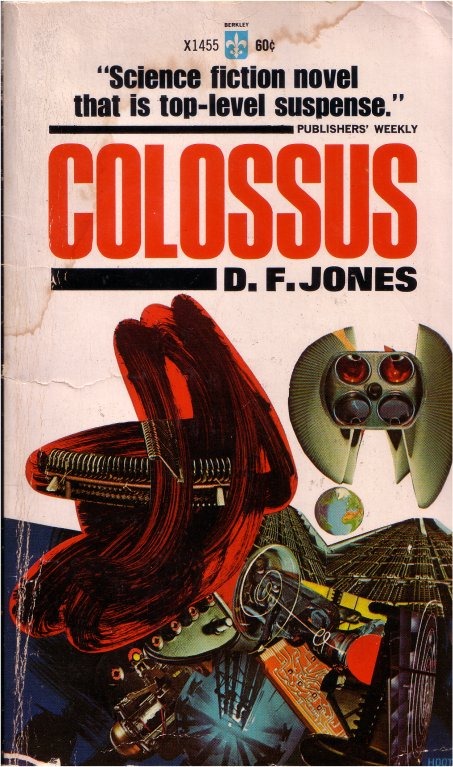
Just a year later, in 1966, D. J. Jones images the world controlled by two giant military computers.  Of course, in 1983 the film War Games imagines another dangerous military computer with consciousness.  This happens quite often in science fiction, uppity computers that must be outwitted by slower minded humans.  We seldom get to explore the potential of a smart computer.

when-harlie-was-one

David Gerrold actually writes a science fiction novel that thoughtfully explores the idea of an emerging machine intelligence in 1972, and even speculates on many interesting ideas that eventually become part of the computer age, including computer viruses.  Gerrold builds on what Heinlein started with The Moon is a Harsh Mistress.

galatea-2.2

In 1995, literary writer Richard Powers explores the idea of machine intelligence with Galatea 2.2, where scientists build a computer named Helen to understand English literature.

wake

Then in 2009, Robert J. Sawyer began a trilogy about an emerging AI that evolves out of the Internet.  Webmind, as it names itself.  Webmind works hard not to be threatening and wants to help humanity.

Let’s imagine a Homo Sapiens 2.0, or BEM, or AI with an IQ of 1,000.  I don’t know if that’s appropriate for the actual scale, but the highest IQ recorded are just over 200, so lets use 1,000 as a theoretical marker.  Let’s imagine IBM’s Watson that had all that brainpower and more, so he/she was like a human with computer thinking speed and memory.

What would it mean to have an IQ of 1,000.  It would mean the AI, Alien or Homo Sapiens 2.0 would think very very fast, remember incredibly well, and solve brain teasers faster than anyone on Earth.  It wouldn’t mean it could read minds or move matter at will, although I’d expect it to deduce information about people like Sherlock Holmes.

Probably all math and physics would be a snap to such a being.  In fact, it would think so fast and know so much that it might not find much of interest in reality.  It wouldn’t know everything, but lets imagine it could consciously imagine calculations like those made in supercomputers to predict the weather, solve subatomic particle experiments or run the Wall Street Stock exchange.

What would such a being feel?  How would it occupy its mind with creative pursuits?

We feel as humans at the crown of creation, that intelligence is the grand purpose of the universe, but when you start studying the multiverse, that might not be so.  We’re just one of an infinity of creations.  There might be limits to intelligence, like physical limits in the universe, like the speed of light.

Science fiction hasn’t begun to explore the possibilities of higher intelligence, but I do think there are limits of awareness, limits of thought and limits of intelligence.  All too often science fiction has taken the easy way out and assumed higher intelligence equals godlike powers.  What does it truly mean to know about every sparrow that falls from a tree?  Is that possible?

Computers are teaching us a lot about intelligence.  Up till now they show that brilliance is possible without awareness.

Science fiction has explored the nature of alien minds, machine minds and evolved human minds over and over, yet these explorations have come up with very little of substance.  I often wonder if the universe doesn’t appear simple with only a moderate amount of intelligence, education and self-awareness.  If we could couple the mind of a human with IBM’s Watson, the resulting mind might be smart enough to fully comprehend reality and build almost anything that needs to be built or invented.  Such a being would know if it’s worth the effort to travel to the stars, or just sit and watch existence as it is.

JWH – 5/15/12

The Privatization of Education–The Hidden Political Battleground of the Conservatives

The United States of America was an early adopter of public education – free education paid for by tax dollars, and managed by local governments.  Now conservatives want to change that and privatize education – free education paid for by tax dollars, but run by corporations.  Education costs, both K-12 and higher education, are skyrocketing into unaffordable realms.  You can’t really blame big business for looking at very large public budgets and thinking there’s a gold rush in education.

K-12 education has been getting bad grades for years, and resentful taxpayers want change.  K-12 education is a fascinating concept.  Basically it prepares each new generation to function in society.  We spend monstrous amounts of money on education, and we’d like to produce very functional citizens.  But does anyone know what constitutes a good education?  The new trend is teaching core content, and that sounds like a dandy idea.  But the history of education is a trail of dandy ideas that have failed miserably.  Will shifting teachers paid by the city and states to profit making corporations solve our educational woes?  I have no idea.  I do think it’s a fascinating problem – but we need some ground rules.

Conservatives and the rich have been hard selling the idea of charter schools and vouchers for some time with no real data supporting their ideas.  Their sales pitches are appealing.  Their ideals are appealing.  Unfortunately, I’m not sure their motivation is anything other than greed.  Conservatives have a one track mind:  pay less taxes.  It galls them to pay for anything that other people get for free.

To reduce the education tax requires reducing the costs of education, but because these corporations also want to make money, lots of money, and reduce taxes, they will have to slash educational costs dramatically.  That means cutting teachers salaries, using fewer teachers, shrinking administrative systems, shrinking the infrastructure of schools, and shrinking every other line item that goes into funding education.  I can’t help wonder how they can produce a better product.

Of course, if they can do more for less, shouldn’t we welcome their revolution?  Sure, but they haven’t proven their methods work, and it appears all we’ll get is badly educated students and new class of teachers that are paid more like fast food workers than professionals that teacher deserve to be.

Like I said earlier, we should have some ground rules for this great social experiment.  I think the number one key to analyzing the success or failure of this experiment and all future educational experiments is doing away with grading by educators and moving to national standardize tests that are administrated by other private corporations that have no ties to the public or private education systems.  This would allow any city to try out any new-fangled educational system they want and tell if it’s effective or not.  Of course, this means experimenting with a whole generation of kids.

Back to that core content idea.  At a national level we have to decide what every kid should know.  Most people will think about the academic content, but I think we also need to add social skills, work stills, health and physical education, etc.

The next idea hasn’t been mentioned yet, and that’s responsibility.  I don’t think the weight of education should fall totally on the educational system.  I think students and parents should be held accountable too.  There is no pedagogical system that produces 100% success, even if teachers, students and parents give 110%.   I believe public education often fails not because of teachers, but because of students and their parents, but the teachers get all the blame.  So in setting up this grand experiment, I believe we need to assign a degree of accountability to students and parents.

Students need incentives to work harder, and grades are no real incentives.  Nor do students equate education with later success in life, because such delayed rewards are no incentives to young minds.  We need to find ways to reward kids for working hard.  Parents should have the built-in incentive to work harder for their kids, but that genetic incentive isn’t trustworthy either.  Parents need their own carrots.

If I was a kid and was told summer starts as soon as I finish the core content for the year, even if that’s two months after the academic years starts, I think I’d study harder, especially if failure means no summer and Saturday classes, ever even Sunday classes for falling behind.  Or if I was told I could play sports, video games, take music lessons, read, or pursue other free activities each day as soon as I finished up my assignments, I’d study harder.  I believe the real incentives for students to get a better education is the reward of less schooling.  This will only work if the core content is practical, manageable, and efficient.  One failure of education is we try to teach too much.

Many of these corporate ideas for schools involve virtual schools and online education.  Most parents want K-12 schools for free daycare, so there’s going to be a real clash there, except for the parents advocating home schooling.  Many of these corporate teaching systems advocate fewer teachers and larger class sizes – and that’s only going to work if students are motivated by self-study.  Their hope is video lectures will replace live lectures, and teachers will be used as guided homework helpers.  Whether this idea has merit is yet to be proven.

If all privatization of education is going to give us is overcrowded schools, with low paid teachers, we can’t really expect much.  And the only way these privatization advocates can prove cheaper education is better is by test scores.  However, anything less than standardize tests conducted by separate national corporations can be scammed.  Grade inflation and cheating is the scourge of education.  Separating educators from testing is the only possible way to solve this problem.  And this kind of testing only works if we have a national core curriculum.  Many advocates of privatization of education secretly want to control curriculum for religious reasons, so this will be another battle.

There will be other corporate opponents too.  Education involves a lot of money and lots of people want get their hand into the pie.  Textbook costs add a lot of red ink to educational systems.  A national core curriculum could hurt the textbook industry and they will fight that with all the lobbyists they can buy.  Privatization advocates know you can’t make education cheaper without reducing all the factors that go into the total cost of education and textbooks are a major issue.  Since many cost reductions depend on the Internet and online education I expect the core content to be public domain in the future.  However, there will be a booming business to sell supplemental textbooks, computer programs, videos, and other training material to parents of affluent students that will give the rich an edge competing with the poor.

There will be side-effects to the core content theory.  If everyone has a good core content education how can the exceptional stand out?  With standardize national tests, with no grade inflation, we’ll actually know what every individual is capable of and comparisons between individuals will be easy, but will an array of standardize scores covering a variety of subjects really let employers hirer the right people they need?  Maybe, if they want math wizards and science geeks, but I image they’ll want more, and thus even with national core content we’ll find ways of making society un-egalitarian.

Personally, I think a good education for all will cost more and not less, but I can’t prove that.  It’s only a hunch.  However, I believe the tide is shifting quickly towards the idea of educational privatization.  We’ll just have to try it out for a generation and see how it works.  I don’t think most people know about the political battles that are going on right now.  It’s not a very newsworthy topic, but the battles are being fought and won in state capitals around the country.   Liberals don’t have a clue.  Liberals don’t work at politics like conservatives do.  That’s why I think the conservatives will get their way.  Most people focus on presidential politics when the real political decisions are being made in the shadows of the political limelight.

Keep an eye on ALEC (American Legislative Exchange Council).  ALEC is leading the effort of the privatization of education.  If you do a Google search you’ll find many conservative and libertarian think tanks devoted to this topic.  This is a very political topic.  And ALEC is revolutionary, so many other corporations oppose it because ALEC ideals conflicts with their efforts to make money from education the old fashioned ways.

To understand more, read these links:

For more, just search Google for “ALEC Education”

JWH – 5/14/12

Anna Karenina–Translations

Every time we read a book we have to translate it into our mind, even when we’re reading a book written in the language we speak.  If the book was written in another language, we have to depend on another mind to do an initial translation for us.  Sometimes two or more people work on a foreign language translation.  Those translators must interpret what they read in the original language and refashion it into English for us.  They have to choose between a literal translation and one that reads well.  Many decisions have to be made.  If an old book is being translated, does the translator preserve the language of the past, or modernize it, do they translate the colloquial phrases, or substitute similar English sayings, should they improve upon the original authors writing, for example, and change a weak passive sentence into a strong active one, etc.

In our modern world books are most often translated to film, but every reader translates words into pictures when they read.

anna-karenina-kk

There are so many kinds of translations going on, more than just moving ideas from one language to another.  When we read a story we picture it in our minds, and we seldom picture it as the author pictured it.  How often have you read a book and then talked with someone about that book only to find they translated the book completely different.  The best illustration of this when movies are made from books.  Is Keira Knightley what you think when you imagine Anna?  Or is Aaron Johnson how you picture Count Vronsky?

anna-karenina-vronsky

If you’ve read a book about a poor person and have never been poor yourself, you will translate the book different from a reader who has been poor.  I have never been a woman, Russian, rich, dashing, beautiful, lived in the 19th century or been part of an aristocracy, so I have to imagine a lot when reading Anna Karenina and translating what it must have been like to been Anna or Count Vronsky.  I have studied American History, but is translating concepts about American slavery equal to Russian serfs?  I’ve seen Greta Garbo play Anna in a 1930s film, but is Garbo anything like what Tolstoy pictured when he was describing her with words?

Here is a portrait of Baroness Varvara Ivanovna Ikskul von Hildenbrandt that was painted in 1889, years after the book was published, but who people in Russia then used as a model for Anna.

PZ 401-038-753
Ilya Repin
Portrait of Baroness Varvara Ikskul von Hildenbandt, 1889
The State Tretyakov Gallery

Researching translations is fun.  That’s why studying the Bible is fun for me even though I’m a non-believer.  My friend Mike loves studying Homer and other Greek and Roman writers and comparing translations.  Readers have to constantly ask:  Is this a good translation?  Think of how many Christian creeds, sects and churches been created from reading one book.

I’ve always wanted to tackle Anna Karenina or War and Peace.  Well I’ve finally read (listened) to Anna Karenina, but how much of the story did I get?  Is one reading enough to make a fair judgment?  Did I pick the right translation?  Without doing any research I ended up with the Maude translation because I liked the sound of the reader of the audio book.  But I have to wonder, did I pick a good translation.

I’ve gone out and found four different translations.  Two of which I have on my Kindle, and two of which I did a screen shot of the first page off of Amazon.com.

Here’ is the opening of Anna Karenina translated by Constant Garnett (1901):

Happy families are all alike; every unhappy family is unhappy in its own way.

Everything was in confusion in the Oblonskys’ house. The wife had discovered that the husband was carrying on an intrigue with a French girl, who had been a governess in their family, and she had announced to her husband that she could not go on living in the same house with him. This position of affairs had now lasted three days, and not only the husband and wife themselves, but all the members of their family and household, were painfully conscious of it. Every person in the house felt that there was no sense in their living together, and that the stray people brought together by chance in any inn had more in common with one another than they, the members of the family and household of the Oblonskys. The wife did not leave her own room, the husband had not been at home for three days. The children ran wild all over the house; the English governess quarreled with the housekeeper, and wrote to a friend asking her to look out for a new situation for her; the man-cook had walked off the day before just at dinner time; the kitchen-maid, and the coachman had given warning.

Here is the same opening translated by Louise and Aylmer Maude (1918), the version I listened to:

ALL happy families resemble one another, each unhappy family is unhappy in its own way.

Everything was upset in the Oblonskys’ house. The wife had discovered an intrigue between her husband and their former French governess, and declared that she would not continue to live under the same roof with him. This state of things had now lasted for three days, and not only the husband and wife but the rest of the family and the whole household suffered from it. They all felt that there was no sense in their living together, and that any group of people who had met together by chance at an inn would have had more in common than they. The wife kept to her own rooms; the husband stopped away from home all day; the children ran about all over the house uneasily; the English governess quarreled with the housekeeper and wrote to a friend asking if she could find her another situation; the cook had gone out just at dinnertime the day before and had not returned; and the kitchen-maid and coachman had given notice.

Here is another translation, from Joel Carmichael (1960).

anna-karenina-carmichael

And here is the more recent translation by Richard Pevear and Larissa Volokhonsky (2000):

anna-karenina-pevear

This last translation was made famous by being picked for the Oprah Winfrey book club in 2004.

While listening to the novel I felt there were phrases that sounded modern, and wondered if Russians had some of the same sayings we did, or if the contemporary feel came from the translators.  Then my friend Mike called me to talk about his research on translations of War and Peace.  So I got to thinking about the translation of Anna Karenina.

I was very happy with the Maude translation, but it felt like I was reading Dickens.  But then Tolstoy wrote Anna Karenina just after Dickens died.  It was also serialized like Dickens’ novels, so it had that episodic feel.  Plus, both writers are coming to grips with similar changes in society brought about by industrialization, science and technology.

If you look at these different versions you’ll notice they are different and similar.  So, does the translation really matter? 

In the old two, Oblonsky had an intrigue with the French governess, while in the modern versions he had an affair.  Why the change?  How long has “an affair” meant what it does now?  But look at some other phrases:

“The wife did not leave her own room, the husband had not been at home for three days.” – Garnett.

“The wife kept to her own rooms; the husband stopped away from home all day;” – Maude, and it’s only part of a long sentence.

“Oblonsky’s wife refused to leave her rooms; he himself hadn’t been home for three days.” – Carmichael.

“The wife would not leave her rooms, the husband was away for the third day.” – Pevear and Volokhonsky.

Notice, there’s even changes in facts.  In the first the wife had one room, in the others, rooms.  In the second, the husband had been away all day, but in the others three days.

Notice how we’re told the cook has left.

“the man-cook had walked off the day before just at dinner time” – Garnett.

“the cook had gone out just at dinnertime the day before and had not returned” – Maude.

“the day before the cook had picked dinner time to go out” – Carmichael.

“the cook had already left the premises the day before, at dinner-time” – Pevear and Volokhonsky.

The Carmichael one doesn’t mention that the cook never returns.  And why doesn’t three of them mention that the cook is male?  I assumed the cook was female from my translation, but that’s my cultural spin on things.  I thought “walked off” was the strongest way of saying the cook quit.  “Left the premises” seems passive and not definite about why.

Well we do know why, the household is in confusion, upset and topsy-turvy.   Each of those words convey a different meaning to me, and none of them really convey the anger of a marital fight.  But then that might be Tolstoy’s failure.

Also, the famous first line is subtly different.  I wanted it to be more succinct.  Like “Happy families are all alike, unhappy families are distinctive.”  I don’t know Russian and would never be in the position to do a translation, but are the others translators like me, wanting to write the lines like they would want to read them?  If I had translated Anna Karenina it would have been a much shorter book, but is that translating or editing?

Then there’s Android Karenina, a parody mash-up of classic novel and science fiction – it’s another kind of translation.

android-karenina

Now many readers will be outraged by this particular translation of the novel, but really, is it any different in its extremes than the many film versions of Anna Karenina?  Most movie versions jettison the stories of Levin and Kitty, who appealed to me far deeper than Anna and Count Vronsky.  Just look at all these images from a Google search.  Each actress, or each painting for a book cover is an interpretation or translation.

How can modern readers understand Anna Karenina without understanding the social norms of the 1870s?  How much history do we have to know to really appreciate what Tolstoy is writing about?  I read AK at 60 and admired it greatly.  I could not have comprehended it at 20 or 30 or even 40, but even at 60 I’m sure I’m missing most of the story.  I don’t know Russian, but even if I did, I really don’t know much about life in 19th century Russia.  However, reading Anna Karenina is teaching me about Russia, like Dickens, Elliot and Trollope are teaching me about 19th century England.  Again though, through their translation.

History and fiction are constant mistranslations of reality, that change from generation to generation.

To see how we mistranslate history watch this little video “5 Historical Misconceptions Rundown" at YouTube:

JWH – 5/11/12

How Much Information Can I Process?

Like that old phrase, “Your eyes are bigger than your stomach,” I tend to put too many words on my plate to read each day.  The saying, “My eyes are bigger than my brain” doesn’t seem to say what I mean, so I’m looking for a pithy saying to express various flavors of information overload.  Obviously we’re all taking in more megabytes of data than our brains were designed to handle.

If I went on an information diet, how much is a reasonable amount of data to take in each day?

Like most people in 2012, I suffer from information overload, but unlike many people I know, I’m trying to do something about it.  Cancelling cable TV really helped.  Reducing my channel choices from over 200 down to 5 feels great.  My wife works out of town and when she comes home on the weekend she gets pissed off that I hate to add a 6th channel to the clicker – her favorite.  She doesn’t understand how much it pains me to flip through 6 channels.  To show my wife how much I love her, I added her channel to the clicker, but I don’t think she appreciates the sacrifice I’m making.  She just thinks I’m a TV wimp. 

(“You watch more than you can see” – not bad phrase, almost mystical, and philosophical, but too Chauncey Gardner.)

I’ve cancelled the newspaper and all my print magazines years ago.  I bought a Kindle and iPad to help manage information, but I haven’t gotten them under control yet.  Because of the novelty of the gadgets, and Amazon’s low monthly pricing, I quickly subscribed to several magazines.  I’ve been cutting back on those too.  I still hope to regularly read The New Yorker, National Geographic, The Rolling Stone, Discover and The Magazine of Fantasy and Science Fiction, although I fail miserably to keep up with all these magazines.  I never did in the decades of subscribing to the paper editions, so I don’t know why I think it will be different on the iPad.  At least I don’t see the mags grow in large piles around the room.

(“Your data intake exceeds its processing time” – not very catchy.  “I take in more data than I can shit out” – rather gross, but does imply I’m bloated with data.  I’m factulent!)

Just now I was trying to catch up on The Magazines of Fantasy and Science Fiction, and discovered they are filled with novellas.  I don’t have time for novellas, or even novelettes.  So I switched to the book review sections, and quickly found two great sounding books I want to read, The Future of Us by Jay Asher & Carolyn Mackler, about two friends in 1996 discovering their Facebook pages from 15 years in the future, and A Bridge of Years by Robert Charles Wilson, about a guy who gets to time travel back to 1962 Greenwich Village.  I had to add both to my Audible.com Wish List. 

(“You’ll need nine lifetimes to read all those books” – not too bad, but not accurate either.  I’d need ninety lifetimes.  “If you can’t handle 200 channels of TV, how can you handle 200 unread books?”)

It sure would be pleasant if I only had 5 books laying around waiting to be read.  You have any idea what it feels like having a to-be-read pile 700 books high?  Why do I keep buying books?  I’m insane.  And the highlight of this week is the annual library book sale. 

(“I’m a glutton for words.”  “I’m a bookaholic.”  “I need to go on a data diet.”  “I’m obese from eating too many words.”)

I feel I’ve gotten TV under control, now I need to get my books and magazine reading roped in and tied down.  I think part of the problem is we all feel we must keep up with what’s going on around the world, whether it’s news, pop culture, music, literature or even TV celebrities.  We don’t like other people to think we’re living under a rock.  But is it vital that I keep up with European politics and economics, with South American mining, with Chinese manufacturing, with Russian crime, and so on?

Do I help the world in any way by watching all the sparrows?  Aren’t we using the internet, smart phones, and cable  TV news in an attempt to be omnipresent?  Of course, I’m assuming my addiction to information is common, and that may not be true.  Most people might eat a healthy diet of data and never feel full with information overload.

I feel if I quit trying to read everything I’m going to miss something, something important.  Like I’ll be a work and people will laugh at me because I didn’t know about Africa sinking below the ocean or when the aliens from space landed in Tibet.

Sometimes I think I shouldn’t worry about news at all.  I’ve had a fantasy about writing a novel, and just forgetting what goes on in the real work, and only concentrate on creating my fictional world.  But it’s so weird to think about shrinking my world to the size of house and office, and what I see from my truck and bicycle. 

That would be like living in some 19th century novel.  That would be bad, right?

JWH – 5/6/12

“Sucker for Your Marketing” – Sarah Jaffe

You know how a song gets stuck in your head and you can’t stop playing it? Well, I was listening to The Body Wins, Sarah Jaffe’s new album and got hooked on “Sucker for Your Marketing.”  If you have Rdio or Spotify you can listen to it here.

http://rd.io/x/QJhDK72U3w

The lyrics aren’t much, but I find the music hypnotizing.  Of course, it’s rather basic with Indian tribal dance like drumming, and an angry bass, and Sarah’s singing with far more emotion than the words convey, and then there’s the chorus of oh, oh, oh that reminds me of an exotic bird.  It’s a very sparse arrangement depending mostly on the rhythm of the drums and Sarah’s bass playing,  accented by a few piano riffs, and a violin that uplifts the song to sound like a much bigger production.  In fact, the violin sounds more like a strings section than a violin player.

My friend John Grayshaw suggested we write about demos of famous songs for my music blog, and this got me to thinking about how “Sucker for Your Marketing” was thought up and arranged.  I got on the net and found several live performances of “A Sucker for Your Marketing” as the song was called in its earlier forms.  Here’s one of the earliest.

As you can hear and see, the song is not the same as it will become on The Body Wins.  What’s interesting, is the song appeared on an album The Way Sound Leaves A Room, released in September of last year.  So it’s development is in between that of the live performance and the newest album released last week.  Again if you have Rdio, you can listen here.

http://rd.io/x/QJhDK_JQjw

This recording is rawer than the new version and the violinist didn’t play on this version.  However, here’s a video from 2010 that does have the violinist – I think she adds a lot to the song.  I’m not sure if the newest version has that violinist or a hired strings section.

That makes me wonder why she released the same song on two different albums with different arrangements?  Jaffe must obviously love it too, as well as her fans.  Maybe it will appear again on future albums with more development.  I’d like to see a longer jam version.  I’ve looked through many YouTube live versions, but none extend the song.

I think the song is evolving over time, becoming more powerful.  It’s a shame the lyrics don’t live up the the emotion I feel from the song.  I’m quite in love with The Body Wins.  I think it shows great development over Jaffe’s earlier folk album Suburban Nature, which I also liked very much.  One of the questions I had while listening to The Body Wins is whether or not these musical changes are Jaffe’s creative development, or a producer’s effort to make her more popular.  Watching the videos makes me think its her and the band evolving together.

Now here’s a live performance from February of this year that shows the band has gotten tighter, that Sarah’s singing is more in control, and their performance skills have gotten slicker.  This version also includes “Vulnerable” a song from Suburban Nature that often follows “Sucker for Your Marketing” in the videos on YouTube.

Here’s another version that I think was filmed by the record company and is probably an official video.  I don’t know if it’s been enhanced in editing.  But it really sells the song.  Try and watch it full screen at 1080p.  Sorry, but I can’t embed the video.

Sucker for Your Marketing

If you don’t like “Sucker for Your Marketing” try “Glorified High” at her site.  That’s what worked on my friend Stormey after “Sucker for Your Marketing” didn’t turn her own.

JWH – 5/5/12