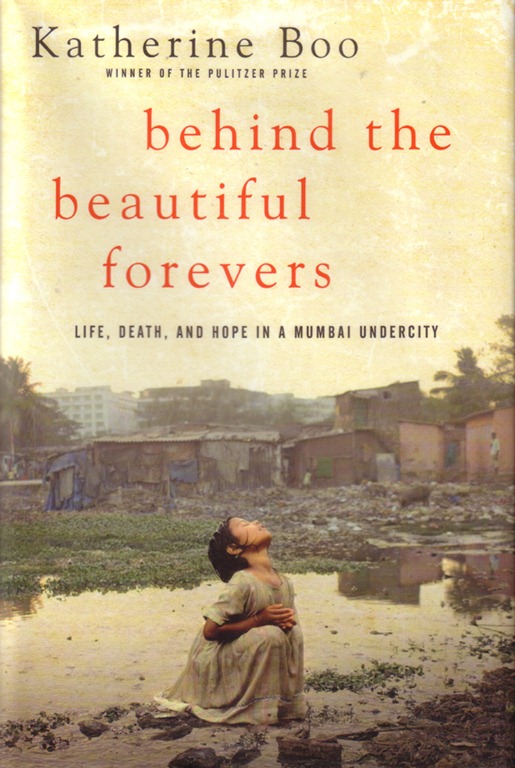
Behind the Beautiful Forevers by Katherine Boo

Are you one of those people who believe too much of our taxes go to entitlement programs and the poor are underserving of a helping hand?  Well, if you want to see what America would be like without Medicare, Social Security, Food Stamps, Unemployment Insurance, Aid to Dependent Families, etc, then you need to read Behind the Beautiful Forevers by Katherine Boo.  In this novel-like nonfiction book, Boo spent over three years getting to know the people of Annawadi, a shanty town that’s grown up next to the Mumbai Airport, where three thousand people struggle to survive at the bottom of the economic ladder by any means possible.  She focuses on a poor Muslim family living among even poorer Hindu families.  Katherine Boo beautifully weaves a web of stories around the connected lives of Abdul, a teenage garbage recycler, his mother Zehrunisa, their neighbor Fatima, a one legged prostitute, Asha, a middle age woman, corrupt wheeler dealer, slumlord, and low level politician, Manju, Asha’s daughter who is college educated and tutors slum kids, and a dozen more people who are friends and relatives to these main characters.

Behind-the-Beautiful-Forevers

Behind the Beautiful Forevers: Life, Death and Hope in a Mumbai Undercity won the National Book Award for Nonfiction this year and is on so many Best Books of 2012 lists that I’ve lost count.  That’s why I bought it from Audible to listen to over the Christmas holidays.  Strangely, it makes a wonderful holiday book for contemplating good will and compassion for our fellow humans.  Katherine Boo is my Ghost of Christmas Present.

Not only does reading about some of the poorest of the poor on Earth make me grateful for my comfortable life, but it makes me ask:  What is self-reliance, charity and basic human rights?  How can we help people like those living in Annawadi?  Should we let human beings live like this?  The folks in this story are all hustling to get ahead.  They all have dreams of a better life, although most of them have tiny dreams compared to our huge ambitions.  I’m a life long liberal that grew up with LBJ’s Great Society, so is food stamps a welfare the answer?  I don’t know.  And even in Behind the Beautiful Forevers, these people aren’t failures, as described by Slate Magazine,

Abdul and Zehrunisa are two of a handful of Annawadians whose fortunes Boo follows closely in the book. Behind the Beautiful Forevers is the product of Boo’s three and a half years of reporting (with the help of translators) in Annawadi.  The slum is home to 3,000 people (crammed into 335 huts) and unknown numbers of goats, feral pigs, and water buffalo. Lest you get the wrong idea: “Almost no one in this slum was considered poor by official Indian benchmarks.” In spite of the fact that a few residents have to trap frogs and rats to fill out their meals, the slum is officially reckoned a success story, full of people on their way out of poverty, and the frog-eaters give other, non-frog-eating Annawadians “a felt sense of their own upward mobility.” Annawadi was built illegally on land next to the Mumbai International Airport and is under constant threat of slum clearance. It is surrounded by new luxury hotels, which make it “magnificently positioned for a trafficker in rich people’s garbage.”

The strange thing about this story is the biggest problems these people face are caused by their own making.  Abdul and his family were getting ahead with their garbage recycling business until they angered their neighbor Fatima and she caused a feud that brought the two families down tragically. 

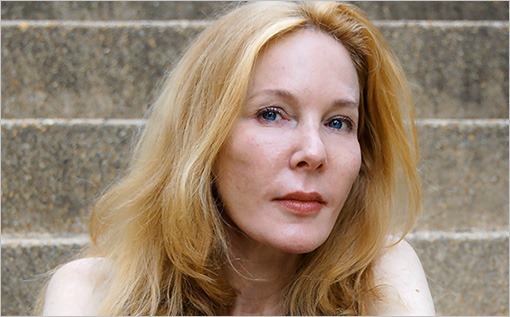
In a way, I wished I had heard the last chapter first, where Katherine Boo explains how she wrote the story.  In fact, I wished she had chronicled her writing methods within the story throughout the book.  How she became accepted by these people is just as fascinating as their lives.  Katherine Boo does not look like she belongs in a Mumbai slum, so it’s incredibly hard to imagine her fitting in with these people.  One telling piece in the last chapter is where she admits her Annawadi friends got annoyed with her pestering them about the negative aspects of their lives.  They wanted to forget the bad and get on with the good.  So is our fascinating with their misery really a fair picture of their world?

Katherine-Boo

I highly recommend reading her web site for the book before reading he book, because having the images of Annawadi and it’s people in my mind would have enhanced my reading pleasure.  Here’s the video from her site on YouTube.  My mental illustrations for the story was nothing like the real pictures.

In this interview Boo talks about her ambition to write a book about poverty without being sensational or sentimental, and I think she succeeds wonderfully.  When you read Behind the Beautiful Forevers it doesn’t make you want to look away in horror at their poverty.  I wish Boo would make a documentary out of her research, notes and videos she took.  One thing we see in the videos and photos is the people sometimes having fun.  That’s not in the book, and I wonder why?

Katherine Boo wrote a piece about Mumbai before, for the New Yorker about Slumdog Millionaire, “Opening Night” that gives another view of Mumbai’s slums.  Poverty is a more complex issue than just a lack of money.  We really are a global economy.  We really are all interconnected with a web of economics and culture.  We really are becoming a world society.

Other Reviews to Read

JWH – 12/28/12

Django Unchained–Reviewing a Film I Wanted to See But Won’t

I grew up in the 1950s on a steady diet of western movies and TV shows.  The western is my favorite movie genre, and sadly few are made anymore, so I was really looking forward to Django Unchained.  That was before Sandy Hook.  And even before the mass child killings in Newtown, Connecticut, I worried that Django Unchained was going to be too violent and over the top.  I love realistic westerns, or at least westerns that feel historical.  Watching the trailer to Django Unchained didn’t remind me of any history I knew about.  It’s a strange revisionist fantasy of 19th century America.

True Grit and Open Range were good westerns in my book, but I have to admit there’s little real history in westerns.  Westerns are a genre that teaches us that guns are the answer to social conflict.  Westerns are Darwinian tales about the survival of the fittest, but in the 1950s, westerns were stories about the fittest bringing civilization to the west.  In modern westerns, civilization isn’t the focus, but gun play.  It’s still good versus evil, but the good guys are pretty much as vicious as the bad guys.

The trouble with modern westerns is they often are just gun porn, and from the previews and what I’ve read, it appears that Django Unchained is a killing fantasy like a sex fantasy.  Pornography is hard to define, but for me, porn films are those which merely press our brain buttons and set off our neural programming for sex, violence and fear, providing little else artistically and intellectually.  In the old days if films showed actual sex or violence they were deemed pornographic and illegal.  Over the years we’ve accepted more sex and violence in movies because the sex and deaths were artificial.  We called it art.  But art can push them same buttons as real sex and snuff films.

Movie makers want to make millions so they need big audiences, and action movies with massive body counts are among the top selling films.  Such films need a bad guy that filmmakers can manipulate the audience into hating.  And since our love for violence seems to have no bounds, movie makers need really evil bad guys to justify the extreme violence they wish to recreate on the screen.  Django Unchained selects slavers in the Old South.  These guys were plenty evil, so no one will feel bad if we watched them get killed in horrible ways.  And evidently Quentin Tarantino didn’t feel actual historical slavers were evil enough, so he made them even more repulsive in his film, so the audience could enjoy watching them be punished with an orgy of good clean gun killing fun.  What an emotional release it must be to see those slavers get their retribution.  But is enjoying that retribution divine or evil?

Now I’m not saying I wouldn’t have enjoyed Django Unchained, because I probably would, I’ve been conditioned by decades of violent movies.  I’m not going to see Django Unchained because part of me is telling myself that it’s sick and disturbing to be enjoying such gluttony of violence, in the same way part of me tells myself I can’t gorge on Ben & Jerry’s Ice Cream.  Too much of anything is bad.

I don’t plan on giving up all violent movies, or westerns.  However, I need violence to be presented realistically.  We should be shocked and horrified by violence, not getting off on it.  Gun porn is just giving the little angry guy inside of us a hand job.

I read three books this year that covered the subject of slavery and violence in America around the time of the Civil War.  Midnight Rising by Tony Horowitz, about John Brown the abolitionist terrorist, Reconstruction by Eric Foner about the horrors of the South after the Civil War, and Freeman by Leonard Pitts, Jr., a novel about a freed black slave returning to the South to find his wife after the Civil War ends.

Reading the lengthy plot summary of Django Unchained on Wikipedia and looking that the previews on YouTube convinces me that Tarantino’s history of this time period is some kind of strange fantasy created to justify the gun violence.  Movie goers will not learn any history about slavery or the Civil War South, just like they didn’t learn anything about WWII from Inglourious Bastards.  Where is the justifying art?

In fact, if you wanted to make an artistic anti-slavery film Mr. Tarantino, there’s actual slavery going on in the world today that needs our focus of attention.

The real issue is how we use fiction.  Fiction has always been about entertainment, and it’s always manipulated us by pushing our emotional buttons.  If fiction is high art we should learn something about reality, people and ourselves.  Fiction should not masturbate our base instincts, but isn’t that what much of fiction has become?  Low art.  Our most powerful instinct is to reproduce, so most films deal with sex and romance.  However, instead of dealing with them as a topic for enlightenment, all too often films just stimulate our urge for intense romance and hot sex.

We are all animals with a strong fight or flight instincts.  Most violent and horror movies stimulate that deep biological programming.  Fiction is based on conflict, and the plot must go through several stages before bringing its audience to a release of tension, which for gun porn usually involves the hero killing more and more people – a mass killer.  On screen body counts have gotten ridiculous.  Action violence is choreographed like live action cartoons, so unreal they are on the level of Roadrunner cartoons and Three Stooges films.   Can anyone really watch The Expendables 2 without feeling insulted?

Our world is full of real violence, so why do we need pseudo violence to thrill us?  Even if television news wasn’t presenting us weekly stories on mass murders, isn’t it time to wonder about why gun porn is so entertaining?  Have we seen so many fictional killings that only visions of extreme slaughters can thrill us?  Haven’t we become so jaded to violence if it takes the Sandy Hook killings to make us question violence in our society?

Maybe I’m just getting old and my testosterone is petering out, but gun porn has gotten too absurd.  I just can’t ethically rationalize enjoying the big screen killings to myself anymore.  I’m not immune to the thrill of violence.  I can still rationalize Breaking Bad because the show is not about violence, but about a good man becoming evil, and there are many episodes where people don’t get killed, and when they do it’s horrifying.  To me, films like Django Unchained are only about the thrill of violence, and other aspects to the story are just straight men setting us up for the high caliber penetrating punch line.

I’m tired of pretending it’s all in good fun.  I’m not even suggesting that these films escalate violence in our society.  I’m asking:  Isn’t it weird we get so much fun out of watching people being killed?

JWH – 12/27/12

Going Paperless with Dropbox

Life is full of paperwork, both printed and digital.  Our lives generate thousands of documents that chronicles our existence.  When my mother died several years ago I had to go through boxes and boxes that were a paper trail of her life.  It took months to close out her affairs to the point where I could destroy the paperwork.  In the end I had one small folder of documents and many boxes of photographs.

When I die I hope to leave my wife a well organized Dropbox folder that is a digital snapshot of my life.  I want to die paperless.  I’ve been working on going paperless since 2008.

People have been talking about our society giving up paper for decades but it’s never been practical.  We’re getting close.  By 2025, we’ll essentially be a paperless society I hope.  I doubt the printed document will go away entirely, who would want a digital diploma or marriage certificate?

We still need to save all those digital documents somewhere, and I think Dropbox, or its kin, will be the answer.  Years ago I had hoped regulated data banks would have appeared for us to use, but I guess that was wishful thinking on my part.

What’s needed is transition technology.  Businesses have been using optical imaging systems to go paperless since the 1980s.  Home users have had scanners for almost as long, but developing a complete home system for storing documents safely has not been practical until cloud storage became cheap, and it’s still not as safe as the data banks I imagined.  Nobody is regulating data storage.

Three technologies have emerged that move us closer to the goal of being a paperless society.

  • Dropbox
  • Evernote
  • Scanners with PDF scanning

dropbox

Dropbox, and it’s competitors Google Drive, Amazon Cloud Drive, SkyDrive, Box.net, etc., offers us reasonably safe places to put our digital files.  Scanning files to a laptop that could be stolen, burned up in a fire, or eaten by viruses wasn’t a good solution.  Leaving your important paper files at home in a cheap filing cabinet wasn’t really that safe either.  If you treasure your family photos, they’re one disaster away from oblivion if you only have a single copy – paper or digital.  Digitizing important files and keeping them in multiple locations is the prudent way to go.

I’ve been using Dropbox for awhile and it’s taken time to appreciate what Dropbox can do for me.  It’s also taken time to learn how to create a folder organization structure to use with Dropbox.  Although my system is not perfected,  I feel I’m finally on to something.  It takes time to learn all the tricks, like naming documents by date order (i.e. 2009-05-17-connell-letter.pdf) or configuring the default scan to folder.  I like scanning to a \scan folder on my c: drive so I can easily drag and file to another window that contains my Dropbox folders.  Right now I have a flatbed scanner but I’m looking at a Fujitsu S1300i ScanSnap that has simple document feeder that can scan both sides of a document and works directly with Dropbox and Evernote.

The idea is to store all my paperwork and photos digitally in an electronic folder system that makes finding stuff easy, and it’s protected by backing up to multiple sites.

What really made things come together was when my wife got out our old flatbed scanner to scan her family photos for Christmas presents and I noticed the PDF Scan feature.  I tend to let papers and mail pile up on my desk until the top gets covered in a foot paper.  Every year I swear I’ll never let this happen again, but I do.  This year I discovered how easy it is to scan documents I want to save and file them in Dropbox.

At first I didn’t trust Dropbox for long term storage.  I just used it for temporary storage, like if I had a document at work that I wanted to work on at home.  Then I realized how Dropbox functioned.  I had assumed the files were only stored on a remote server.  That’s not how it works.  Your files are replicated from your Dropbox folder on your local machine and the working copy remains on your computer.  A copy is stored at the Dropbox site.  This means Dropbox acts like a backup system.  Not only that, if you have a second computer, the files are replicated to that computer too.  My Dropbox files are replicated to five computers.  I can also call up those files on my iPad and iPod touch.  That’s two PCs at home, and on a PC, Mac and Linux machines at work.

Counting Dropbox’s storage, that means my files are stored on six machines in three locations.  That’s pretty safe I think.  I assume Dropbox backs up my files too because they offer 30 days of free undeletes and for $39 a year, unlimited undeletes.  And Dropbox encrypts files and uses https to transfer files.  I could also encrypt those files again with something like TrueCrypt, if I was worried about Dropbox poking into my business, which I’m not at the moment.

Right now I have 14gb of unpaid space on Dropbox and I’m using 6gb.  That’s not enough for my MP3 songs and audiobooks, but it is for all my writing, photographs and scanned paperwork.  I do have my music library backed up on Amazon and Google Music cloud drives, so I’m well covered for MP3 files.  I also have 20gb of space at Amazon for non MP3 files but it’s not as flexible and convenient to use as Dropbox.  And I have 25gb on SkyDrive.  Eventually, as an extra backup protection I might replicate my Dropbox folder to one of my other cloud drive folders.

The key to making this work is the folder filing system I’m creating.  So far these are my top level folders:

dropbox-files

My original idea was to create top level folders based on file format types, but I wanted easier access for my most used folders, so I broke Fiction and Nonfiction out of Word Documents.

Under Biographical I have folders for Medical History, Timeline and Notes.   I was keeping text files of to do lists, phone lists, email lists, book lists, etc. in a folder called Notes but I moved it under Biographical.  Do I want to think, “Oh it’s a text file, so look under Notes,” or do I want to think, “Where’s that timeline of schools I went to,” and think Biographical?  I decided to file by meaning rather than file format.

I also have Photos and Wallpaper which both store .jpg files, and I might combine them, but it’s nice to separate family photos from my archive of desktop pictures, screensaver art and art history galleries.

Most everything I save for reference gets scanned and made into a PDF, which has a more elaborate folder structure.  I haven’t scanned my entire filing cabinet yet, and probably won’t, at least not any time soon.  However, I have scanned current paper work and certain old folders, and it wasn’t that much work.  I wish I had a sheet feeder system like our optical imaging systems at work, but I don’t know if they’re worth the buying right now.   I listen to audiobooks as I scan, killing two birds with one stone.

I had a folder of old letters, some 50+ years old, that existed before email, that I scanned and put into Dropbox.   I haven’t decided yet about banking, tax and other business documents.  I worry about privacy and whether or not my digital copy is valid in a legal dispute.  Some paper documents I might save for sentimental reasons, like old report cards or letters from my grandmother, but I do want them digitized.

I’ve discovered that many paper manuals I’ve been saving for my TV, receiver, CD player, cameras, etc. are online as PDFs.   So I saved those PDFs to my Dropbox and threw away my paper copies.  I also found articles I have clipped are often still online, so I found and saved those to Evernote, and threw away my paper copies.  Others I scanned and saved to Dropbox, although Evernote also will store PDF.  In fact, some of the documents I’m storing in Dropbox might be better suited for Evernote, which indexes files for quick retrieval.

For 2013 I need to study the pros and cons of Evernote versus Dropbox.  Right now if I wrote it, it goes in Dropbox, if someone else wrote it, it goes in Evernote.  Except for ebooks.  Normally Amazon handles all my ebooks, but occasionally I get ebooks from places other than Amazon, and I have to maintain the original.  Although I’m thinking about converting .epub books to .mobi with Calibre and sending them to my Kindle.   So that folder might disappear.

One thing I’ve learned is to depend on companies that maintain my digital purchases like Amazon for music and Audible for audiobooks.

Right now I’m using Dropbox as my primary storage for photographs but that could change if I find a photo site that does more.  But Dropbox is so universal that I find it hard to believe other sites could compete.  And if I combine Pixlr.com with Dropbox I can do snappy photo editing on the fly.

Back in 2008 I started down my road of Going Paperless by cancelling my magazines and newspapers.  This has been a slow process.  My mailbox probably gets 90% less paper each week.  I still have to write companies telling them not to send catalogs.  And I still get mail for people long dead.  Most of the other stuff is official documents I feel I must save.  I’m going to look into seeing about getting my health insurance, 401K, credit card and banking statements online, but I want to research the legal safety issues about that first.

Cleaning Out Computer Files

Once I started filing scanned documents into Dropbox I realized I could clean up my computer drives by copying files to Dropbox too.  I have several computers and many external drives that have filled up with up with decades of digital crap, and backups of crap, and backups of backups.  I’ve been going through them copying important files I want to save to Dropbox and then deleting the others.  I’ve found unique photographs I want to keep hidden on different drives, so this process has helped consolidate my picture library.

I’m still worry about the ultimate safety of Dropbox.  Because it replicates copies to all my computers it makes me feel fairly safer overall.  I’m off for the holidays, so I remotely connected to my computer at work and verified that all the files I’m been saving to Dropbox were replicated to my work computer, and they are.  My fear now is Dropbox will go crazy and delete all my files off all my computers.  If you delete a file from Dropbox it’s eventually deleted from all your computers.  If Dropbox went berserk I could unplug the Ethernet cable before I turned on one of my computers and rescue those files.  I could use a replicating program and copy my Dropbox files to my Amazon Cloud Drive or Microsoft SkyDrive, but I’d really like to trust Dropbox.  Once I clean out all my computer files, scan my paper files and create the perfect folder filing system, I don’t want it to get out of sync again.

I also made Dropbox my default folder in Windows.  Thus I won’t be tempted by having a real folder of files and a Dropbox folder of files to maintain.  It’s all one now.

Future Dropbox Projects

Susan’s family history photo project was a big hit at our Christmas Eve party.  She assembled a three generation history of her family starting with her mother and father that was told in 386 photographs.  I’m encouraging her to move it to Dropbox or another cloud site to expand on it.  I also want to create photo histories for my mother and father’s families, and get my cousins to add their photos to mine to build a super photo history.  When my mother died several years ago I inherited all her family photos, and my dad’s family photos.  I’ve been meaning for years to make copies for my cousins.  Now I’m thinking Dropbox will solve that problem.

The Future of Dropbox

I’m not sure Dropbox is the ultimate digital bank vault for my files, but it’s what I’m using at the moment.  I might get burned.  Dropbox could go out of business.  Right now I have enough free space that I don’t need to pay.  What it’s that’s true with everyone?  How can Dropbox make money.  Right now the cheapest plan is $99 for 100gb.  I wish they had a $49 plan for 50gb, that would make a better introductory price.

Or better yet, I wished Dropbox charged a straight $1 per gigabyte per year and we could buy as few or many as we wanted.

You can get free space on Dropbox.  You start with 2 gigabytes by joining but you earn more by getting others to join, and you get bonus space if you join from a referral.  If you don’t have Dropbox use this link and both of us will get 500 megabytes of additional free space.  That means you start with 2.5 gigabytes by using my referral.

As I switch to reading on the Kindle and iPad, I tend to think my book collection will shrink.  Dropbox works wonderful from tablets.  I tend to think sometime in the near future all my books, magazines, photographs, personal documents, videos, music albums, etc. will be on my tablet computer, and my home office will have just furniture and a computer with a big screen and great sound system.

Other Dropbox Tips

JWH – 12/26/12
I Can’t Watch Movie Violence Without Thinking About Sandy Hook

Last night I was going through my DVDs looking for something to watch and popped in The Matrix.  The opening scene is of the police trying to arrest Trinity.  It had some pistol shots, and I immediately thought of Sandy Hook.  I felt guilty watching the movie.  I watched a little longer because the shooting was over, but as I watched I remembered the scene where Neo rescues Morpheus in an orgy of semi-automatic and automatic weapons violence.  I had to turn off the movie.  I knew as soon as the assault rifles showed up I’d imagine their bullets impacting little bodies of six and seven year old girls and boys.

Sandy Hook is my turning point for rejecting violence in our society, like Hurricane Sandy is the turning point for many about climate change.

We’re all asking ourselves how can anyone become a mass murderer of children?    That’s too monstrous to comprehend much less accept.  But this is after decades of accepting other kinds of violence as part of our ordinary life.  Haven’t we long taken serial killers, terrorists, gangs, drug cartels for granted?  There have always been terrorists, serial killers and even mass murderers, but the horror of their crimes keeps growing bigger and bigger.  When will this escalation of violence end?  How much can we accept before it drives us all into a terminal depression?  If we don’t do something, then we will accept mass murder of children as part of life too.

And I’m afraid watching violent movies, television shows and video games is a form of acceptance.  If we could plot the rise of violence in our society with the rise of violence in the movies I bet the lines would parallel each other on the chart.  And if we also plotted the number of weapons and kinds of fire power civilians now own, that graph would match the others.

When I was growing up policemen carried revolvers and  automatic weapons were carefully controlled.  The average citizen couldn’t own machine guns.  If people owned a gun for protection it was usually a simple .38 Smith & Wesson or a small .410 shotgun.  Now families have whole military arsenals including assault rifles with extended clips.  In the 1950s movie action heroes were cowboys that carried a single pistol on his hip.  Now action heroes blaze away with assault rifles cradled in each arm, and when their ammunition runs out, whip out two large semi-automatic handguns from concealed holsters.  Both in real life and screen life, we can’t seem to get enough firepower.  What are we afraid of?

I was looking forward to the new western by Quentin Tarantino that comes out Christmas, but after Sandy Hook I can’t handle any more violence, real or fun.  And isn’t it weird we accept so much violence as fun?  Something is wrong with us.

Are all those assault rifles and semi-automatic pistols in movies just product placement for arms dealers?  Have the arms industry just shifted it sales from warring countries to American consumers?  When average Americans feels the need for night vision goggles and laser scopes, I have to wonder who is promoting those sales and what emotions are they playing upon.

I used to believe that there was no correlation between violent video games and movies and real life violence, but I’ve changed my mind.  Hurricane Sandy and Sandy Hook are warnings about the future.  Our environment is overheating in both weather and violence.

Sometimes we vote in a polling station, but most of the times we vote with our dollars.  Sorry Mr. Tarantino, but you and other action film makers have taken violence for escapist fun too far.  I think some of our gun fantasies have become porn and we need to classify them XXX and keep them away from people under 21.

But  what level of gun violence is obscene?  Back in ancient Greece, they believed violence should occur off stage.  Sometime between 400 BC and now we’ve crossed a line.  I think it’s time to think about where that line should be and return to an earlier standard of violence in art.  We’ve gone too far.

JWH – 12/18/12

Is Dieting a Test of Free Will?

Ever since I read The Blank Slate by Steven Pinker I’ve been obsessed with the concept of free will.  I’ve read enough books on brain studies in recent years to doubt the existence of free will.  Now I’m not saying we’re all robots, but I question whether or not we’re making decisions on our own, as if we were independent souls sitting in our heads driving our bodies around, and making impartial decisions based on weighing all the evidence and facts.

red-pill-blue-pill-matrix

I remember a freshman philosophy course I took in 1969 and my professor challenging us to come up with an example of free will.  That class inspired many arguments between me and my friends.  Free will is a philosophical concept that few people think about in normal life – mostly because it feels like we do make our own decisions so why even ask about free will.

When Neo makes his choice between the red and blue pill in the film The Matrix, is that an act of free will?  If he’s the One, wouldn’t that make him born to take the red pill?

Everyone assumes they have free will and they are acting on their own volition, but the older I get the more I assume that’s just an illusion.  So I’ve been wondering if I can come up with a test for free will.  I think I’ve found one with dieting.  Our bodies and hunger represent the power of nature and the hardwired programming of genes.  The need to diet comes from our environment, where we constantly learn that fat is sexual unattractive, unhealthy, and like Pavlov’s dog, we’re constantly conditioned that being fat is bad.  Without that nurturing my nature would run wild.

If we have free will we should be able to evaluate all the outside data and decide to diet and lose weight because of its own philosophical merits.  Then why do so many people have trouble dieting?  Is it because our bodies, genes and physiological wiring program us to eat and free will can’t overcome that?

I started a diet today and at this very moment my body is already nagging at me to eat something fun.   “What a puss,” my mind tells my body.  I say no, it says yes.  If I can keep saying no, is that proof of free will?

Now there are two factors here:  free will and will power.   Scientists are throwing water on the concept of will power too.  And what’s the difference between free will and will power?  Deciding to diet might be an act of free will, but failing to diet might be a lack of will power.  And if I succeed in losing weight is it really because I have free will, or has outside stimuli overcame my genetic programming and reprogrammed my eating habits?  Where is the me in all of this activity?

Or is it a case of “I diet, therefore I am.”  (I wish I knew the Latin equivalent to cogito ergo sum that includes the word diet.)  Is thought good enough to prove the existence of free will?  Without thought I’d just eat anything I wanted and never think to lose weight.  However, all those thoughts about losing weight come from the outside world.  If I really had free will, wouldn’t it have been my idea to lose weight? 

But who comes up with original ideas???!!!  Einstein and the theory of relativity comes immediately to mind.   Imagining the concept of space-time had to be an act of free will.  Do we discount the billions of years of cosmological and biological evolution that produced Einstein as not part of the equation, or is Einstein’s discovery of space-time really the universe’s act of free will?  Einstein couldn’t have made his discovery without a long history of other scientists and thinkers.

When I choose to diet, is it my decision, or society’s?  Like Neil Armstrong’s “That’s one small step for man, one giant leap for mankind.”  Can we ever separate our will from the world’s?  The urge to eat is genetic.  How much I want to eat is probably genetic too.  Choosing to eat between steak and veggie burgers would seem like a free will choice, but is it?  If I had never read about vegetarianism would I ever considered the choice?

That’s the weird thing about asking ourselves if we have free will.  Genetics might be our hardwiring, but the environment seems to be doing all the software programming, so where is there room for free will?  Would that be self programming?  Even if I could write my own personality programming, wouldn’t the “free will” writing the programming been created by outside programming or genetics?

If I really had free wouldn’t even the urge to eat be my choice?  Is thwarting the urge to eat free will, even thought he idea didn’t originate with me?  Is free will the ability to choose among the various outside impulses we get from society?  Society tells me not to eat, but advertising on TV is doing a major brainwashing job to get me to eat.  Every time I see a Sonic commercial I want one of their shakes.

Dieting is a test of will power and maybe even an example of free will.  It’s a shame I always flunk it.

JWH – 12/15/12