
Reading Novels To View Reality From a Diversity of Mental Spectrums

We all like to think we’re normal.  We tend to assume everyone else sees the same reality we do—but do they?  We only know one mental world, and it’s pretty obvious that there’s a huge diversity of mental states, including many forms of mental illness.  We now talk of spectrums rather than specific states because our minds are like a recording studio’s mixing board, with hundreds of sliders for various brain functions, and thus a infinity of different settings.  The only art form that truly explores the interior world of other people’s view of reality is the novel.  Poems and short stories are also revealing, but it’s the novel that explores the depth of dark worlds of other people’s minds.

Novels are the only art form that attempts to paint what the inside of the mind looks like, and the unique perspective of how different people see out.  In the 20th century, stream-of-conscious novels emerged specifically to give readers the illusion of following the thinking of the characters.  And it is the first person stream-of-conscious narrative that lets us feel the strongest we’re looking out with eyes that are not ours.  Most novels have third person narrators that see characters from the outside and from the inside, whereas in movies and television shows we’re always watching people from the outside.

in search of lost time

Novelists who write semi-autobiographical books tend to be even more believable for giving readers the feeling we’re viewing the inside of someone else’s mind, especially those by writers like Joyce, Proust, Wolfe, Woolf and Kerouac that wrote book after book chronicling their life in thinly disguised fiction.  These writers were sensitive souls that saw their own lives as the best subjects for their art.  Most novels are about made-up characters, with the best of them feeling like we’re reading about real people even when we’re not.

Autobiographical and roman à clef novels give us a tremendous boost in authenticity, even to the point that we feel more like voyeurs and less like readers.  And this is most especially true when we read about tortured souls, people living in extreme situations, and those who suffer mental illnesses.  The more inner nakedness the better, because these writers want to live on the razor’s edge between absolute honesty of life and the truth of fictional art.  These writers know they can never let us actually see from their minds, but they can give us enough concrete details that we can almost imagine being them.  Sure, like Mark Twain said, “The difference between the right word and the almost right word is the difference between lightning and a lightning bug.”  The difference between what other people see and what we think they see is tremendous, but if they give us the right words we sometimes feel we’re seeing the lightning.

the bell jar

I recently reread The Bell Jar by Sylvia Plath, which reminded me of how much of my knowledge of mental illness comes from novels.  Since I and my friends are getting older, we often talk about dementia and mental decay, and so mental illness seems to loom closer.  The Bell Jar is first person semi-autobiographical story of a young woman having a nervous breakdown, attempting suicide and then spending months confined to psychiatric care and getting seven shock treatments. 

I have had two girlfriends who have had shock treatments, and one buddy at work that also had them, and I have a number of family and friends that had had various kinds of mental illnesses.  My mother suffered from life-long depression, and probably was bi-polar.  As far as I know she never saw a psychiatrist, but starting in the 1970s and for the rest of her life took different kinds of anti-depressant pills that provided varying levels of relief.  The reason I read The Bell Jar the first time back in the 1970s was because of my girlfriend who had had the shock treatments and she asked me to read it to understand her and her experiences.  The novel continues to illuminate, because I know many people who suffer depression.

the-catcher-in-the-rye

In the course of my lifetime, our cultural attitudes towards mental illness have changed dramatically.  When I was in high school in 1968 my English teacher got me to read The Catcher in the Rye by J. D. Salinger, which made me sensitive to the idea of “crazy” people.  Catcher came out in 1951, the year I was born, and was about a young man, Holden Caulfield, in New York City having a nervous breakdown.  For the rest of my life The Catcher in the Rye and The Bell Jar have been tied together like bookends, the male and female stories about young people losing their minds.  Both of these books helped change society’s attitudes towards mental illness, but they also let us empathize with the plight of fragile minds, and see a different view of reality. 

It’s very hard to describe this change in attitude toward mental illness in my lifetime.  Even as a teen in the 1960s, kids and adults, were often cruel towards people with mental problems.  There was even a comedy song about going crazy, "They’re Coming to Take Me Away, Ha-Haaa!" which some radio stations banned for being insensitive to the mentally ill.  During the 1970s and 1980s as conservative policies swept the nation, we deinstitutionalized the mentally ill, with many ending up in jails or living homeless on the streets.  In many books, counselors, psychologists, psychiatrists and mental facilities were extremely helpful to people, but in other stories, like On Flew Over The Cuckoo’s Nest they were seen as evil.  We hear less about people being committed, but a lot more about people taking drugs that work on brain functions.  As we learn more about the brain, we learn more about the chemistry of the mind.

As a kid, I grew up watching learning much about life from old movies, and the films of the 1940s and 1950s often explored psychology and psychiatry.  Nineteenth century novels seldom suggested that they knew much about the scientific workings of the mind, even though there were many novels that were very psychological, like Crime and Punishment.  It took a couple decades for Freud and Jung to come to American pop culture.  Often mental homes were seen as snake pits of fear.  The first half of the twentieth century was filled with horrible experiments on people to fix their minds.

As readers shock treatments (electroconvulsive therapy) were often seen as barbaric torture and other times as transformative cures.   After Esther Greenwood in The Bell Jar gets her second shock treatments she become better, and we know Sylvia Plath lived another ten years after her own treatments, writing many poems that would earn her a Pulitzer after her death, a novel, getting married and having two children.  Do shock treatments help people or not is hard to say, but the point of fiction is to see another view on reality.  Sometimes it takes many views to add up to wisdom.  We as readers get to experience shock treatments twice in The Bell Jar – once as a horror, and once in a positive light, and see how Esther’s mind turns around for the better.   How intense we see Plath’s reality depends on how closely we read and decode her words.

When I was growing up in the 1950s and 1960s it was very trendy for intellectuals to brag about their psychiatrists.  They proudly talked about Freudian vs. Jungian analysis, and it was generally believed with the right psychic guru we could fix our heads.  Sometime between then and now people for the most part gave up on talking cures and switched to chemical solutions.  My childhood would have probably been far more pleasant and stable if my parents had had access to modern pills for fixing their chaotic minds instead of self-medicating with alcohol.

When I read The Catcher in the Rye I think of my parents, because Salinger’s 1919 birth was right between the years my parents came into being, 1916 and 1920.  Plath, was born much later, in 1932, but her book also helped me understand my mother.  However, in the 1970s, I was much too selfish as a young twenty-something to really empathize and sympathize with her mental states.  Rereading both books now later in life, after I’ve gotten older, and past the age of my parents were when they were raising me, I began to understand these novels better, and my parents.

Neither my father or mother were very good at communicating their inner thoughts to me or my sister.  What I had to do was read books by people that were like them, and hope these literary people were better at expressing life with their demons.  I have always felt Jack Kerouac (1922-1969) was a great analog for my dad (1920-1970).  Both committed slow suicide by alcoholism, and died in their late forties.  Holden Caulfield was a bit younger than my dad, but I saw a lot of my dad in him.   Esther Greenwood was much younger than my mother, and very much different, but I can still find descriptions of mental states in The Bell Jar that makes me wonder if my mother had felt such feelings too.

For some reason I was different.  I’ve always been fairly stable despite the fact of having two alcoholic parents  that should have made my life miserable as a kid.  My intense selfishness was a kind of shell that protected me.  As a rebellious teen I avoided alcohol because I figured that’s what screwed up my parents and took drugs instead.  I remember the first time I got passing-out drunk how I wondered why my folks loved to drink.  But I realized alcohol was a drug that shut you off, and that’s what they needed.  When I tried psychedelic drugs, I realized this must be like to be mentally ill.  My occasional trips would last eight or ten hours, where I visited a world where my mind felt like a category five hurricane was blowing inside my head.  It was these experiences where I felt like I was close to understanding mental illness.  One of the reasons I stopped taking drugs was I was afraid I’d permanently screw up my mind.  Knowing how the mind works when it’s broken provides wonderful incentive to avoid mental illness.

Big-Sur-500

I think the best novel to help me understand my Dad is Big Sur by Jack Kerouac.  The details of their lives were much different, but the giving up, the drinking, the acceptance of suicide by alcohol was the same.  Both had a romantic conservative side, and a rebellious adventurous side.  Neither could connect with other people and settle down.  My dad was saved by the Air Force.  It gave his life structure that he couldn’t maintain after his medical discharge.  I think both Kerouac and my father shared the same failure to connect with women and children.
zen and the art of motorcycle maintenance

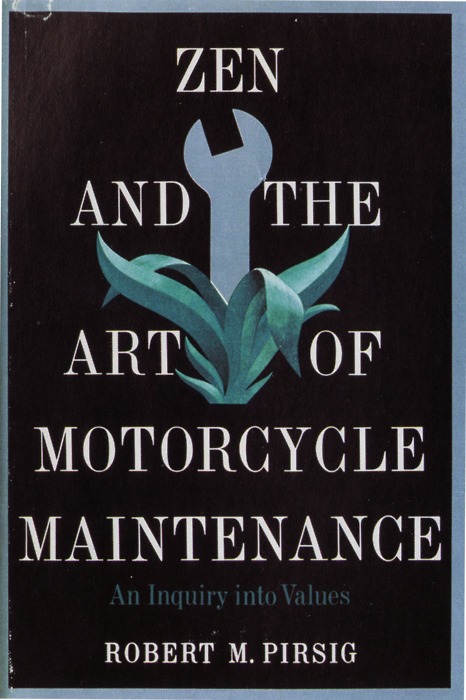
Of course, this begs the question of what novel best represents our own view of reality.  Zen and the Art of Motorcycle Maintenance is published as nonfiction but has the structure of an autobiographical novel.  Pirsig is philosophical in ways that are similar to my ways of being philosophical.  If I was to write a novel about myself it would be about relating experience to ethics, aesthetics, science and technology.  If I was to point to a book that revealed what my view of reality looked like, Zen and the Art of Motorcycle Maintenance might be it.  I need to reread it for a third time to answer for sure.  I’m overly analytical.  I never suffered the breakdown like Pirsig did, but I’ve always wanted to seek perfect insight through philosophical analysis. 

What novel would you pick to give to friends to reveal your inner workings?

My awareness of gender views on reality that aren’t like mine, from women, gays, transgender, alpha males, etc. come from reading novels.  This is true for all the kinds of people I could never be, like musicians, artists, explorers, adventurers, businessmen, etc.  The concept of understanding the unlimited number of mental states that aren’t like mine through fiction is much too large of an idea to explore in one blog post.

HouseRules

My views on autism have been dramatically enhanced by the books I’ve read.  Is autism a mental illness or a mind tuned to looking at reality very different from how we look at reality.  We like to assume average is the healthy normal state, but is that true?  When I read House Rules by Jodi Picoult I felt like I was in an alien mind, but to wish for the character Jacob Hunt to be normal would be to wish for a very unique person not to exist.  Picoult is obviously not an adolescent boy with high functioning autism, yet her carefully crafted novel feels like I’m looking at reality with an autistic mind while reading the novel.   This is also true of The Curious Incident of the Dog in the Night-Time by Mark Haddon.  Both of these well researched novels about autistic children help me understand my autistic niece better, and maybe get a slight glimmer of what she sees, because these writers researched the science behind the mental state of autism.  

I have also read Temple Grandin and Oliver Sacks on extreme mental states, and their nonfiction books are extremely educational, however, it’s the great novels that get us closer to looking out another person’s window on reality.  Actually, with me, I tend to become obsessed with the novels and the novelist.  I’ve written about that before in “The Ghosts That Haunt Me.”  After reading The Bell Jar again I’m tempted to start reading biographies of Plath, and her poetry.  I know if I do, Plath will become another ghost that haunts me.

JWH – 8/11/14

Are Humans Superior Creatures?

I believe the people of the future will look back on these times and judge us harshly, like we judge the people of the 19th century for slavery, colonialism, genocide and other atrocities those folks committed without any apparent ethical qualms.  They will see even the most liberal of us as heartless in our neglect of poor people, animals, the Earth and the environment.  I’ve always wondered how people like the abolitionists gained their insight to see beyond the ethical status quo.  There have always been a few people that were more empathetic than the common crowd, and I think they were the bellwethers of their times.  If you you read and watch the news carefully, there are always stories that portend the future of human kindness.  To change requires going against the tide of common opinion, and that’s hard.

We like to think humans are different from animals.  That we’re the crown of creation, made in God’s image, that we’re the unique species on the planet that has a soul.  I believe different.  I think we’re ahead of all our fellow creatures in the thinking department, but we share a whole lot of behavioral experiences with them.  If you look at this seal pup in the video above, it’s obviously enjoying itself.  It hung out with these surfers for an hour.  Maybe it didn’t think, “Look Ma, I’m riding a surf board,” but it did feel a sense of fun, play and curiosity.

I’ve been watching a lot of documentaries on animals lately, and reading many books about them too, and the more I study, the more I see animal behavior in the people around me, and human behavior in animals.  Religion falsely teaches us we have dominion over the Earth and animals in a way that is harmful to both our humanity and animals.  Our sense of superiority blinds us to the evil we create.  And to maintain our illusion forces us to ignore just how close we are to animals in our behaviors.

the elephant who found a mom

For instance, we like to elevate sex to love and sanctify our mating habits with legalities and romantic notions, yet it’s still  animal courtship rites based on biological programming.  We like to think our emotional needs are vastly more complex than our four legged friends, but are they?  We like to think our self-awareness and intelligence puts us a quantum leap above all other creatures we share this Earth with, but the latest animal studies show the gap isn’t as wide as we’d like to think.

This summer PBS showed two new 4-part series that emphasizes my point:  My Wild Affair, and Sex in the Wild.  The first episode of My Wild Affair, “The Elephant Who Found a Mom”  will make you cry your eyes out and make you want to go to Africa to shoot poachers.  The other shows in the series are “The Ape Who Went to College,” “The Rhino Who Joined the Family” and tonight’s “The Seal Who Came Home.”  Each episode is a very emotional story about an individual animal bonding with humans, revealing how close we are to our evolutionary cousins.

Sex in the Wild gets down to the nitty gritty of how elephants, orangutans, kangaroos and dolphins get it on.  In fact, it’s XXX animal sex.  These shows are graphically educational, so you might not want your little ones to watch, but then again, they are very educational.  This series is less about individual animals and more about general behavior.  But the courting behavior of our wild kingdom friends often reveal insights into human courtship.  I found a lot to identify with in the love life of orangutans.  Even the strangest animals they profile have distant similarities to the two legged animals we see in episodes of Sex in the City.

Just watch and think about how women judge men, and how men compete for women.   Then the next time you watch a romantic comedy pretend you’re an animal scientist studying that weird species of two legged creatures that inhabit the urban jungles of the world.

Sadly, these eight documentaries are through showing on PBS, but you can still catch them at streaming sites like PBS Roku,  Amazon streaming, or on DVD.  But even if you don’t catch these particular shows, just keep an eye out for nature shows in general.  Nature on PBS’ regular season is tremendous.  Or just watch funny videos on YouTube about dogs and cats.  Sooner or later it will come to you what they do is not that different from what we do.  That the tricks Caesar uses in The Dog Whisperer can be applied to human children and adults, or even to your mother-in-law.  If you’re really savvy in your observations you’ll begin to see your own behavior and how it formed.  If you’re a guy who can’t get lucky with the girls, or a girl that can’t land a Mr. Right, you might study animal behavior.

But beyond learning more about who we are by how we evolved to get here, the real issue is animal rights.  We haven’t worked out human rights yet, but animal rights are just as important, for them and for us.  If we are the crown of creation on this planet then it’s our ethical job to manage the Earth.  I can’t help but think that’s to preserve biological diversity and not destroy it.  I worry that a hundred years from now, those who look back will see us as the worse mass murderers of history.  They will ask themselves over and over, “How could they have been so cruel?  Could they not see what they were doing?  Could they not feel the suffering they were causing.  Did they not foresee what they were doing to all the future generations to come?”  They may see us being more evil than Hitler, Stalin and slavers because we made species after species extinct, unbalanced the environment, extracted the wealth of the many for the pleasure of the few, poisoned the oceans and air, and killed everything that ran, swam, flew, crawled, slithered, or hopped for food and sport.

Future generations will despise us for our hubris in believing we’re the crown of creation when they think we’re the cancer that killed the Earth.

Billions believe they will find heaven when they die, not knowing this world is the heaven of the universe, and we destroyed it.

JWH – 8/8/14

Boyhood (RT=99%) vs. And So It Goes (RT=16%)

Lately I’ve been fascinated about the relationship between the movie ratings at Rotten Tomatoes and my actual reactions to the films.

Boyhood is the much anticipated, critically acclaimed art movie that is getting overwhelmingly great reviews.  Friday night Janis, Laurie and I went to see Boyhood with great expectations of being wowed.  We weren’t quite – it was close though.  Boyhood is mostly impressive and yet, somewhat dull in places.  The same could be said about life though.

Saturday I went to see An So It Goes with my friend Anne, who is in love with Michael Douglas.  I went thinking I would hate it because the film was getting almost universal bad reviews.  As you might ironically guess, I enjoyed this film.  It was far from great.  It was slight and clichéd, yet it had a satisfying story, although there was much in it that annoyed me.

There was something in the “bad” film the “good” film needed, and vice versa.  Films are mainly commercial products meant to make lots of money, but we all hope to go see something great, something memorable, something that will even have the brilliant insight of art, or the emotional impact of a classic.  Boyhood is a unique film, and comes very close to being the winning Lotto ticket, but not quite.   There was something missing that I can’t quite put my finger on, something that might have been in And So It Goes, but I’m not sure.

Part of this essay is about the ambition and success of movie making, and part of it’s about movies about males.  Oddly enough, these two films make a good set of bookends about young and old males, about the nature of characterization, and what it means to tell a story.  Richard Linklater’s Boyhood is almost like a documentary in that it chronicles the life of Mason from age 5 to 18, and his life with his mother, sister, father and two step fathers.

Watching Boyhood reminded me of my own time growing up.  Nearly everything Mason experienced I remember going through, although things were different over a half century ago.  It’s obvious the writers wanted us to identify with the film, although why the focus on the boy, when the sister was so much part of the story too?

My parents were alcoholic, so like Mason I have memories of mental and physical fights between my mom and day, of hurling dishes and much worse, and car rides with drunken drivers.  This part of the film was a post-card memory of my boyhood.  It bothered me that the story had to race over these incidents because living through such experiences deserves far more story than the glossy note taking we’re given.  Growing up with alcoholics deserve Marcel Proust volumes.

Like Mason I moved around a lot, and was always the new kid in school.  However, Boyhood did not convey this experience with any depth either.  Being the new kid involves a lot of different experiences.  And being the new kid time and again has its own stories too.  Learning the new environments, meeting new people from different regions, finding new friends, making a new best friend, over and over.  The first kids that check you out are always the tough kids.  I was always a year younger than everyone else in my grade, and a bit of a pussy, yet I always ended up hanging out with kids in trouble with the school administration or the police because I was willing to go along.  Normal kids aren’t that open to new people right away.  However, I was good at eventually finding the geeky oddballs, my kind of people, and making friends with them.

Again Boyhood just glossed over these kinds of events.  To me it seemed Mason always had it easy, even when things were hard.  I’m sure the writers and director didn’t want us to think that.  I’m thinking this is where the artifice of art would have helped this movie.  The movie is a series of snapshots taken over a dozen years.  It needed some kind of thread to tie them together.  We only get to watch Mason from the outside, so we don’t know what’s going on inside his head.  Books like A Catcher in the Rye and The Bell Jar tell us interior of such suffering, but this movie doesn’t.  Even when Mason becomes an artist, either from graffiti or photos, we don’t see any expression of his internal world.

Another memory I share with Mason was looking at panty and bra ads as a little kid.  Back in the 1960s it was very hard for boys to come by porn, so we were limited to Sear’s catalogs and National Geographic magazines in our quest to find female nudity.  I envy modern boys the internet.  I was surprised the film didn’t have more unique takes on Mason’s boyhood sexual experiences.  Actual boyhood is being tortured by horniness.  It’s also filled with desperate longing for naked girls, either real, imaginary or on paper.  This desperation didn’t come through in this story.  And neither did any distinctive unique experiences that might have conveyed it.

I remember in 7th grade, my third of three 7th grade schools I attended in two states, where a new found buddy and I discovered we could get into the crawl spaces under houses pretty easy, and sometimes there was good  junk hidden under houses.  In one abandoned house on a back country road we found a big stash of girlie magazines.  We guessed the boy who lived there had been too chicken to try and take his treasure with the movers.  This pile of cheap Playboy wannabes made Chucky and I heroes with other boys at school for a couple weeks, as we gave, sold and traded them away.  What really surprised me was how popular they made us with the girls on the school bus.  They went crazy all wanting to sit next to me to look at the naked women too.  Boyhood could have used an incident like this that would have made Mason’s life felt more unique and less generic.

And how could Boyhood pass up tales of masturbation?  What a missed opportunity.  Onanism is a huge factor in boyhood.  All guys accidently figure things out on their own at first, and go through a period of worry about doing something very weird, until they talk to other guys and then discover that all the guys are doing the same thing.  Then you have all those family years of furtively trying to sneak off a quick tug once or twice a day wondering if your family suspects.  I can’t believe they left out that universal boyhood experience.

Boyhood is very impressive but also dull in a way.  Maybe American city life in the 21st century has a lot of homogeneity to it.  Mason and his sister lead sort of a slow frustrated existence.  Their suffering didn’t seem that awful, and their peak experiences didn’t seem that high.  I guess real life is like that, and we’ve gotten used to movie life being more exciting.  I did share many of the exact experiences Mason had.  Like having a religious relative give me a Bible and explaining the red words in the back, having an old guy teach me to shoot a shotgun, having a teacher or boss try to explain how to get ahead, or meeting strangers and getting high.  But in this movie, these incidents has a sort of plain vanilla take to them.  My memories were more intense, more complicated, more full of details.  I guess that’s the problem of trying to squeeze twelve years into about three hours of art.

And that brings us to the other movie, And So It Goes, which is only 93 minutes.  Michael Douglas plays a major asshole Oren Little, who openly promotes his animosity with everyone.  Oren is a realtor that wants to make one final sale, his own house, which he insists is worth 8.6 million no matter what offers he gets.  However, Oren lives in a run-down little four-plex he owns that he calls Shangri-la.  His next door neighbor is Diane Keaton, who apparently is attempting to make a late life move into the lounge singing profession.  Because this film is directed by Rob Reiner, you hope this old couple will give us another When Harry Met Sally. Well, no such luck.  The film is so full of such old clichés that you feel insulted.  I love geezer flicks, but I’m getting tired of the senile plot of old woman with heart of gold taming boyish asshole, especially when they add the help of cute kid and stupid dog.

Unfortunately, Hollywood doesn’t make many movies for us people with wrinkles, so we sort of have to like what we get.

One interesting take in And So It Goes is the contrast between the Michael Douglas character and the Rob Reiner character, Artie.  Artie plays the piano for the Diane Keaton’s character Leah.  He’s the safe, nice guy friend to her, who obviously dreams of getting lucky with Leah.  The movie makes fun of Artie,  which irritates me, because I’d look somewhat like Rob Reiner if I wore a bad toupee.  What And So It Goes does is reinforce the cliché that women will go to bed with assholes and forget the nice guys completely, unless they need a favor.  Which Artie fawningly obliges.  See, And So It Goes doesn’t attempt to be anthropological about males like Boyhood, but it pulls off a good deal of insight with little time and effort.  That’s where art pays off.

A tiny piece of dramatic conflict can say so much.  To me, the most painful conflict Mason experiences in Boyhood is when he discovers his dad, played by Ethan Hawke, has sold off his antique Pontiac GTO to buy a minivan for his new replacement family.  Mason has believed since the third grade that the GTO was his legacy.  I felt for him, because as a teenager I wanted a 1967 Pontiac GTO badly.  My father did buy the cheaper Pontiac Tempest in 1967, and so that was a strange compensation.  To me, this one very specifically detailed experience Mason had was the most important emotional scene of the movie.  I could tell what he was thinking in greater detail because this fictional incident felt more real, as if it could have been based on a real incident.  Boyhood isn’t a documentary, and its characters are fictional, yet, it fictionalizes them in a very plain vanilla way.

And So It Goes is also fictional, but its fictionalize details have more color to them.  Unfortunately, Michael Douglas gets all the character attention in this film.  Keaton, kid and dog have very supporting roles.  Oren is redeemed when he delivers a baby in strained humor and eventually accepts responsibility for the grand kid.  Nothing is very good in this movie, yet I still enjoyed it.  Movie makers know how to churn out generic feel good for the most part nowadays, partly by being inventive with character details.  It’s a product, not an art.  We give them $10 and they give us a couple hours of reasonable escapism.  A good hack writer has no trouble making up details to paint a character.

Now an important psychological insight into me could be that I can see colorful details in movies about old people, but not about modern young people.

The trouble is Boyhood is being treated like James Joyce, and And So It Goes is being dismissed as a step up from fan fiction, and to me, the movie watcher, neither are as good or bad as the critics claim.  I will soon forget both thoroughly, yet while I was watching I didn’t regret spending my time or money for either.  That’s because we don’t really judge our escapism as real art.  Boyhood was an extremely neat film hack, but it didn’t go deep enough to be art.  The only other film I watched this week was Fahrenheit 451, a Truffaut film from 1966, that I think was the fifth time I seen it since it came out.  Now, that’s art, at least in my mind.  Any film you watch over and over again for a whole lifetime has to have a special tag.  Art is good enough for me.

Art is something that will last, will be remembered, and has something unique to express.  With movies and novels, the most artistic of them, will have a great story.  That’s what was missing from these two films.  Boyhood was too naturalistic, And So It Goes too contrived.  And So It Goes had too many attempted stories in it.  I can completely buy an old man obsessed with selling his house for a price that he believes in that no one else does.  I can completely buy a story about an old man who has to raise his granddaughter because his heroin addicted son has to go to jail.  I can completely buy an 65-year old woman trying to break into music as a Lounge Singer.  But doing all three in a 93 minute film is a farce.  Putting twelve years of boyhood into three hours is a stretch too.  The shorter movie needed more realistic details, and the longer film needed more artificial structure.

JWH – 8/4/14 (Happy Birthday Janis)

I, Sisyphus, Blogger

Sisyphus was a Greek dude the gods condemn to roll a rock endlessly up a hill.  Albert Camus came along in the 20th century and gave The Myth of Sisyphus an existential twist.  Camus said living is like endlessly rolling a rock up a hill, but if we can find personal purpose while we’re doing something so meaningless we can overcome the meaninglessness of reality.  I think of blogging as chronicling my life of endlessly rolling  a rock up my hill.  I beat the gods by understanding the nature of reality, even if I have no higher metaphysical purpose.  Camus saw the lack of meaning in reality as a form of absurdity, but I don’t.  The randomness of reality might feel like we’re rolling a rock up the same hill over and over again, but we’re not.  Humans have always lied to themselves that we serve God’s purpose to console ourselves with imaginary meaning, but isn’t finding our own purpose in an indifferent multiverse actually more empowering?  Sisyphus was condemned to his task by the gods for having hubris.  A godless reality has condemned us to a short existence of self-awareness in an awe inspiringly huge existence.  Although we are born into the limits of our natural design, it appears we have a mind that will allow us to out think those limits.

Sisyphus-wide

Blogging is not a chore for me, but it does require I make an effort.  In fact, I want to make the best possible effort.  If I don’t, I’m just rolling a rock up a hill.

Blogging has to be more than puking words out through my keyboard.  Blogging is anti-entropic.  This universe is entropic, so overall things are coming apart, but as it does, there are swirling eddies of highly organized anti-entropic events.  Life is one of those events.  Even though I shall return to dust someday, and the atomic elements in my body will dissipate and join less organized states, I exist momentarily in a highly organized, self-aware, anti-entropic state.  I have a window on reality.

We are all windows on reality, observing existence.  I can see why pantheists like to think that everything is God—but that’s an illusion too.  Reality is unaware of itself, only we rare eddies of complexities, swirling in the dust of existence, notice that something is here.  We’re quite insignificant in the scheme of things.  We roll our rocks and then we die.  Our window on reality closes.

Blogging is my way organizing words in highly anti-entropic arrangements about what I see from my window.  We all struggle in our own way against the heat death of the universe.  We each see different views while looking through different windows, but we’re all looking on the same reality.

Each essay I write for this blog is an effort to create order against the tide to disorder.  My body has long past the point of its most organized state, but I believe even though my mind is beginning to come apart, I’m making the most organized observations of my life.  Sometimes the most complex eddies of organization come when larger organized structures are breaking apart.  Creation always comes from destruction. 

There are dynamics to blogging that I’m still learning, and will always be learning.  The medium is sometimes more complex than the messages.  My job is to write.  If I write something interesting, something that’s anti-entropic and interesting from your window of observation, you’ll enjoy what I’ve written.  The more I’m read, the more I’m challenged to write even more interestingly. 

How long can I do this?  Sometime between now and when I die, I’ll run out of mental momentum and my writing will fall apart into disorder.  But until it does, I’ll struggle to write more and more precise observations.  If dementia doesn’t overcome me, I should get better at writing, which is creating ever more ordered anti-entropic essays and observations.

Some days when I sit down to write my mind is not very orderly, and I produce crappy essays.  Other days, something comes together, and the words come out in patterns I didn’t anticipate and I catch a wave to ride, and writing feels like I’m surfing something big and moving.  I know what I do is a product of my conscious and unconscious minds in relationship with the random events of my life.  Life really is like a routine of rolling a rock up a hill over and over again.  It’s seeing the patterns and making the observations that give our meaningless existence an existential fulfillment.

JWH – 7/31/14

Finding Sense of Wonder Science Fiction in My Social Security Years

Back in 1964, when I was twelve, the future was so bright we really had to wear shades to read science fiction.

Fifty years ago,  when I was twelve, I discovered sense of wonder in science fiction books from the 1950s.  Those books were more exciting than getting high—and I knew, because, by a few years later I was smoking dope to jet assist my science fiction take-offs.  My teen years in the 1960s was a combination of rock and roll, counter-culture and science fiction.  My mind flew interplanetary high with great expectations for the future.  In the 1970s I jettisoned the drugs, and coasted though the decades, living off the hope of 1950s futures.  Music and science fiction stoked the fires of the future, and kept the old dreams simmering.  Music stimulated my emotions and books energized my mind, but after fifty years we never reached the futures I once saw so clearly.

Between 1964 and 1969, I read book after book, that wowed my evolving mind with far out ideas.  Now my brain isn’t so young anymore, and I need some science fictional Viagra.  My future vision has been darkened by cataracts cause by living through years of reality.  Is it just me, or do kids growing up today see  different futures?  They look all cyborg cool in their Google Glass specs, but they don’t seem to see as far as we used to.  I’m not sure what they see, or what drugs they are on, but I’m not sure I like their dreams of the future.  Where’s the dazzle?  Where’s the vision?  Where’s the great expectations?  Or was science fiction no better than psychedelics at getting us Baby Boomers off Earth?

wake-us-cover

I still depend on music every day to boost my emotional self, but I’ve developed a tolerance to science fiction.  It just doesn’t give me that old sense of wonder high that thrilled by twelve-year old self.  Maybe the future I see from my retirement years doesn’t work with modern science fiction.  Maybe I need to be young to love today’s science fiction.  But I can’t help but believe there’s new science fiction out there for us old Baby Boomers that will help us keep the old 1950s dreams alive, but where is it?

Oh, I can find plenty of books to escape into, books that make me want to turn the page to find out what will happen, but I rarely read a science fiction story that gets me sensawonder high anymore.  No offense or criticism to modern science fiction writers, but they seem more into story than ideas, especially ones that can turn into a series of books.  Many of my SF reading friends love finding a character to stick with book after book, but that doesn’t appeal to me.

Back in 2009 I wrote “My Science Fiction Thrill is Gone.”  In the almost half decade since then I’ve found a handful of really good science fiction novels that I liked:

  • Wake/Watch/Wonder trilogy by Robert J. Sawyer
  • The Windup Girl by Paolo Bacigalupi
  • Little Brother by Cory Doctorow
  • The Age of Miracles by Karen Thompson Walker
  • Ready Player One by Ernest Cline
  • The Martian by Andy Weir

Actually, averaging one great science fiction book a year isn’t bad.  Looking back over the history of science fiction, most years only produced one or two books I really loved.  But in the past I had a lot more near misses to keep me going through the slow times.

I’ve read many fun books I’m not listing, but they aren’t the kind of SF I’m talking about.   Nor am I talking about non-SF books that impressed me with other kinds of sense of wonders.  I sometimes stumble on older science fiction books I missed from earlier times, like Dawn by Octavia Butler and The Day of the Triffids by John Wyndham, as well as rereading many of the classics of SF I’ve encountered over my last half-century.

Yet, what I really crave is great new mind-blowing sense of wonder science fiction.  The kind I have to wear shades to read.

I can go for long stretches without any science fiction sense of wonder boosts in my life.  I miss that.  Such withdrawals are depressing.  Are all the great far out ideas used up?  I know many of my favorites concepts from my Golden Age of Science Fiction years have been done time and again.  Just how many aliens invading Earth or time travel stories can one consume in a lifetime without becoming bored with them?  How many stories about astronauts stranded on Mars before the thrill of being on Mars becomes dull?  Is there a new way to present societies developing colonies on the Moon and Mars?  And don’t get me going on how jaded I am about military SF and galactic empires.

When I look at the science fiction selection at Audible books sorted by relevance, giving the most popular and highly rated books, giant fantasy epics fill the top of the list.  A few science fiction books show up, like Ender’s Game and Ready Player One, both of which I’ve read.  However, fantasy dominates the list, for page after page.  The few new science fiction books that I haven’t read are books that I consider retreads of old ideas.  Sure, they might be great stories, but I just don’t want get involved with trilogies and longer multipart series just because of action and heroic characters.  I guess military SF give many science fiction fans something to read that feels like the old days, but I’m just too worn out on action to care anymore.  I don’t even like action SF at the movies anymore.  I was thrilled by Her.  Action packed, military based SF, including those set into galactic empires, feel like fantasy worlds to me, like reading Tolkien.

I hate to be an old fart bitching about how today’s science fiction ain’t as good as the stuff I read growing up, but well, shit I am.  I sped through The Martian by Andy Weir and it felt like I was twelve again, reading science fiction back in the 1960s, but we should be reading realistic literary fiction about life on Mars by now.  What the fuck went wrong?  Are the futures of 1950s all played out?  How can being a grunt in an interstellar fleet be such a popular future today?  And why did kids switch from space explorers to endless wars with the undead?  Really, is that what you want to grow up and do?  Is the only kind of alien you can imagine is the one you want to kill on your PS4 gun sight?  It’s no wonder that military SF is so popular, kids today grow up game-trigger happy, and they can only imagine futures where cardboard enemies pop up endlessly.

I want science fiction where I explore.  I want futures where fantastically far out ideas are possible.  In a way the failure of science fiction vision can be seen in the history of the various Star Trek series.  Over time stories became routine, usually about conflict with standard enemies.  Science fiction was better when it was like The Twilight Zone or The Outer Limits, where they had to invent a new concept every week.

Did all the concepts get imagined?  Have they all been used up?  Have the bright futures become boring?  Or am I just a foolish old fart?  When I was young, I remember old farts claiming their youth was better than ours, so I’m assuming I’m going through the same stupid phase they were, but still, why does things in the past now look so bright I have to wear shades?

JWH – 7/29/14