by James Wallace Harris, 10/21/25
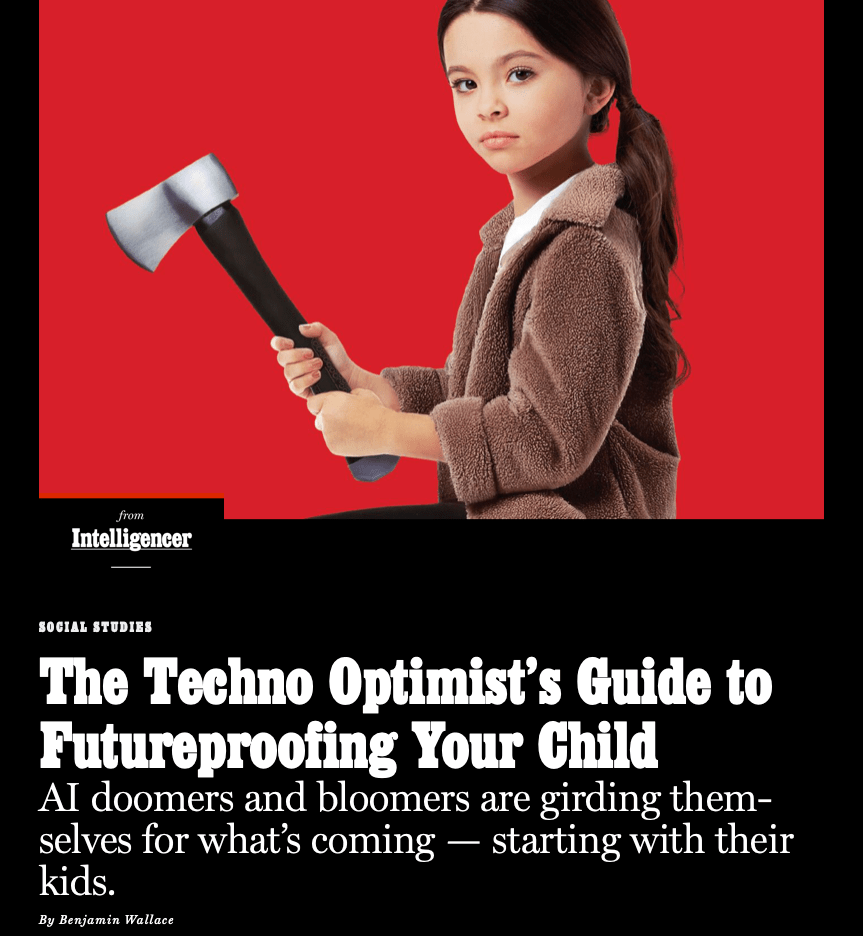
I recently read “The Techno Optimist’s Guide to Futureproofing Your Child” by Benjamin Wallace. The article was subtitled: “AI doomers and bloomers are girding themselves for what’s coming — starting with their kids.”
I don’t have a kid, but I do have me. The gist of the article is exploring new ways to teach kids. Many parents believe that a good college education is no longer the path to success in life. They fear AI will put everyone out of work, that climate change will disrupt society, and that the rapid progress is making everything unstable.
These parents ask: How can I prepare my kids for an uncertain future?
I ask: How can we all prepare for an uncertain future?
Generally, education is seen as preparation for a career. I’m retired. I don’t plan to work in the future. Sooner or later, I’m going to die. That’s another kind of uncertain future. This sense of affinity made this article relevant to me.
The article begins with a profile of Julia and Jeff Wise, who have three children. Wallace called Julia and Jeff “Effective Altruists.” I had to go look that up. To quote Wikipedia:
Affective altruism (EA) is a 21st-century philosophical and social movement that advocates impartially calculating benefits and prioritizing causes to provide the greatest good. It is motivated by “using evidence and reason to figure out how to benefit others as much as possible, and taking action on that basis”. People who pursue the goals of effective altruism, who are sometimes called effective altruists, follow a variety of approaches proposed by the movement, such as donating to selected charities and choosing careers with the aim of maximizing positive impact. The movement gained popularity outside academia, spurring the creation of research centers, advisory organizations, and charities, which collectively have donated several hundred million dollars.
Wallace quotes the Wise’s as saying, “We and some other parents we know have been thinking, Okay, it looks like there may be big changes in the next decade or two. What does that look like for how we prepare our children for the world?” They worry that their kids could die in disasters before they grow old, or find themselves in a post-scarcity utopia of abundance and not need a job.
Parents can’t decide; should their kids attend Harvard, train to be HVAC technicians, or become survivalists?
I could die any time now, since I’m approaching the statistical average age for death, or I could live another twenty or thirty years if I’m an outlier. That’s a big unknown. I could die with my mind intact or not know who I am. If society collapses, my retirement arrangements will fall apart.
What inspired me most about this article was the Alpha School, which sounded like a super-duper version of the Montessori school.
Founded in 2014 as a tiny K–8 private school in Austin, the Alpha School has opened 15 additional campuses, from Scottsdale to San Francisco, on the strength of a tantalizing pitch. Using its AI-driven digital platform, Alpha asserts students learn “2.6” times faster on average than in regular schools while doing only two hours of schoolwork per day. The school has named this platform, which knits together proprietary and third-party apps, “TimeBack.” With those newly liberated hours, students focus on learning the life skills that Alpha’s co-founder MacKenzie Price believes standardized education neglects — things like entrepreneurship and developing “a growth mind-set.” At the flagship campus, a second-grader, in order to ascend to third, must complete a checklist that includes running five kilometers in 35 minutes or less; delivering a two-minute TED-style talk with “zero filler words, 120–170 [wpm] pace, and 90% confidence,” as judged by an AI speech coach named Yoodli; and calling “a peer’s parent” to “independently plan and schedule a playdate.” At Alpha’s middle school, projects have included starting and running an Airbnb and sailing a boat from Florida to the Bahamas.
Basically, the Alpha School teaches kids to be independent learners. The teachers don’t teach; instead, they guide students to study independently.
The article covers theories about educating the young. We tend to think youth is the time of education. I feel like I’m learning more at the end of life than at the beginning. We also think of education in terms of goals. Shouldn’t education be a continual transformation? And we seldom think of learning in old age other than as a hobby.
How can I create my own pedagogy? And for what am I studying? I remember fifty years ago reading Be Here Now by Harvard LSD researcher Richard Alpert, writing as Ram Dass. He claimed that old age was the time to go on a spiritual journey to prepare for death. I’m a life-long atheist. I don’t believe in what most religions teach. But Ram Dass might be right; it might be time to go on a spiritual quest.
I don’t feel the need to study anything specific. First of all, my mind can’t retain information anymore. I love learning, but I have accepted that I forget almost as quickly as I discover. That doesn’t bother me. Like they say, it’s the journey that counts.
However, I don’t forget everything. I seem to lose the facts and details, but somehow, I retain a tiny bit of a new perspective.
My new method of educating myself is to subscribe to printed magazines. I’ve stopped trusting the internet and television. And I’m not too keen on podcasts either.
What I read helps me let go of lifelong beliefs. I’m learning that people live by delusions.
Our minds are corrupted by words. Strangely, the antidote for words is more words. To dissolve decades of thoughts that crust our minds like barnacles requires constant reading.
Our trouble, starting in childhood, is that we embrace beliefs that we never let go of. Most people are programmed by beliefs acquired early in life that they spend the rest of their lives defending.
Home schooling in my seventies is all about unlearning. But it’s not about forgetting. This isn’t intellectual Alzheimer’s. It’s about clarity.
When you watch the news and see reports about bad things happening, ask yourself: Is this because someone believed something wrong? If you are troubled by anything, consider letting go of something you believe true. See if that reduces your anxiety.
For example, much of what I believed in came from reading science fiction. Many billionaires are pursuing goals based on reading science fiction. But I’ve come to see that many desired science fiction futures are no more realistic than what religions have promised.
JWH
 Auxiliary Memory
I liked your piece. As for the fear and uncertainty you spoke of: When was the last time the future appeared certain? Your perspective is correct. Move forward – create yourself along the way. And don’t let the news derail your self-improvement and discovery plan.
Hi Jim:
Many people are turning to Stoicism. According to Stoic philosophy the way to a happy life is to cultivate virtue. The four cardinal virtues of Stoicism are Wisdom, Temperance, Courage, and Justice. The more one realizes these virtues in one’s life the more peace they experience.
The good death is a death of completion. Completion means actualization of potential. It is this actualization of potential and sharing the blossoming with the world which contributes to satisfaction, fulfillment, and peace.
My mother told me repeatedly, “David, all you do is do your best.” So, I often ask myself as I go about my daily life am I doing my best, and if not, are there ways I could manage myself better?”
I am a bit older than you at age 79 soon to be 80. I ask myself and others my age, “What do I (we) still have left to do?”