
by James Wallace Harris, 10/12/25
Humanity is plagued by delusions generated by words. We struggle to distinguish between words that point to aspects of reality and words that point to fictional mirages. In other words, we can’t differentiate between what is real and shit we make up.
I’m partial to an unverified quote attributed to James Michener, “The trick to life is to make it to 65 without being either a drunk or insane.” Sanity is notoriously hard to define. Many of us can stay sober until 65, but do any of us stay sane till then? Don’t we all end up seeing things that aren’t there? Don’t we all embrace cherished delusions to cope with life?
Of course, you will disagree with me. We all know what we believe is real.
Language allows us to be self-aware and manipulate reality, but don’t many of our words point to theoretical concepts that don’t actually exist in reality?
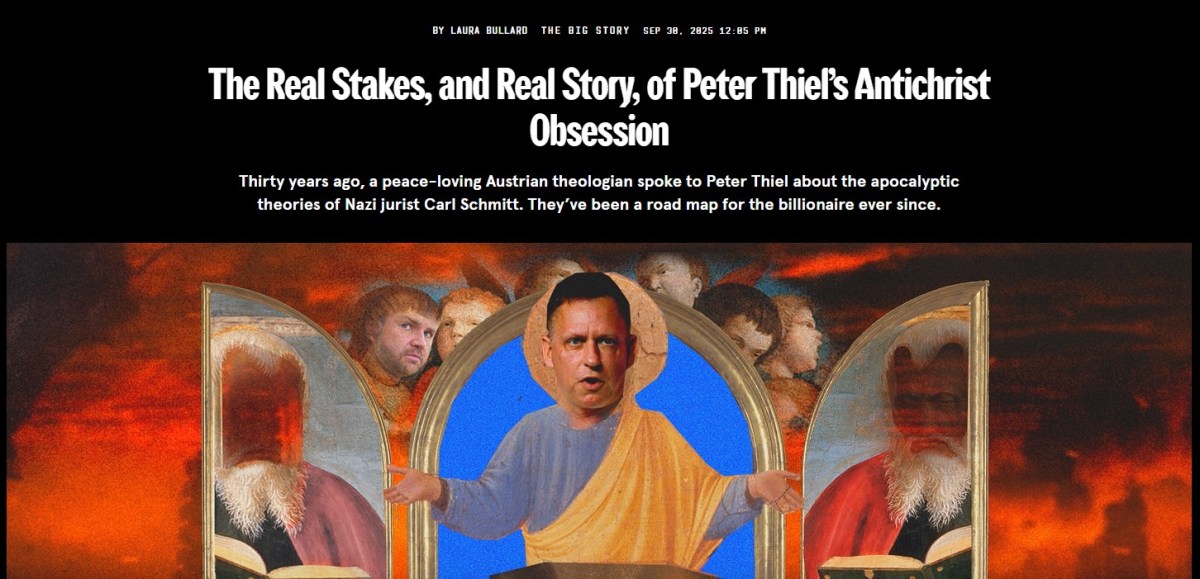
I recently read “The Real Stakes, and Real Story, of Peter Thiel’s Antichrist Obsession” in Wired Magazine. [Nearly everything I read is behind a paywall. I use Apple News+ to access hundreds of magazines and newspapers that exist behind a paywall. Wired shows the entire article for a few seconds. If you immediately right-click and select Print, a copy of this article can be read in your printer preview window. If you don’t catch it the first time, refresh the page. Or read other articles about this.]
Recently, Peter Thiel gave a four-part lecture on the Antichrist and the Apocalypse. In her Wired article, Laura Bullard attempts to decipher what Thiel is preaching.
By Thiel’s telling, the modern world is scared, way too scared, of its own technology. Our “listless” and “zombie” age, he said, is marked by a growing hostility to innovation, plummeting fertility rates, too much yoga, and a culture mired in the “endless Groundhog Day of the worldwide web.” But in its neurotic desperation to avoid technological Armageddon—the real threats of nuclear war, environmental catastrophe, runaway Al—modern civilization has become susceptible to something even more dangerous: the Antichrist.
According to some Christian traditions, the Antichrist is a figure that will unify humanity under one rule before delivering us to the apocalypse. For Thiel, its evil is pretty much synonymous with any attempt to unite the world. “How might such an Antichrist rise to power?” Thiel asked. “By playing on our fears of technology and seducing us into decadence with the Antichrist’s slogan: peace and safety.” In other words: It would yoke together a terrified species by promising to rescue it from the apocalypse.
By way of illustration, Thiel suggested that the Antichrist might appear in the form of someone like the philosopher Nick Bostrom—an Al doomer who wrote a paper in 2019 proposing to erect an emergency system of global governance, predictive policing, and restrictions on technology. But it wasn’t just Bostrom. Thiel saw potential Antichrists in a whole Zeitgeist of people and institutions “focused single- mindedly on saving us from progress, at any cost.”So humanity is doubly screwed: It has to avoid both technological calamity and the reign of the Antichrist. But the latter was far more terrifying for the billionaire at the podium. For reasons grounded in Girardian theory, Thiel believed that such a regime could only—after decades of sickly, pent-up energy—set off an all-out explosion of vicious, civilization-ending violence. And he wasn’t sure whether any katechons could hold it off.
Thiel draws theology from the Bible, philosophy from studying with René Girard, and apparently combines them with ideas from Carl Schmitt, a political theorist from Nazi Germany, to create a rather bizarre warning about our future.
Because Thiel is a billionaire, he’s able to spread his beliefs widely. And because our society is overpopulated with people searching for meaning, we have a problem.
I’ve been collecting news stories and sorting them into two categories. The first deals with delusions that affect individuals. The second collects reports showing how we’re failing as a species. I could have filed this Wired article under both.
Whether as individuals or as a species, we act on false assumptions about reality. We often assume things to exist that don’t. Such as the Antichrist, or for that matter, The Christ. There may or may not have been a historical person we call Jesus. That may or may not have been his name. The concept of Christ was created over several generations of his followers. It has no real existence in reality. And neither does the Biblical Apocalypse or Antichrist. Those concepts have been redefined repeatedly over twenty centuries.
Among the thousands of Christian denominations that have existed over the past two millennia, there is no consensus on what Jesus preached or what is meant by the term Christ. In other words, there is no common denominator between Christians. This is because their beliefs are imaginary concepts that each individual redefines for their own use in words.
Religious beliefs are fine as long as they remain private to an individual, but when they are used to shape reality, they become dangerous. I often read about people who want to use their beliefs to make others conform to their illusions. That disturbs me.
But I’m only now realizing why. It represents a failure of language. Language is useful as long as words point to aspects of reality. The closer words stay to nouns and verbs that have a one-to-one relationship with things or actions within reality, the safer we are. It’s the words we fight over their definitions. That’s when things get dangerous.
Peter Thiel’s bizarre philosophy becomes dangerous when he can get others to accept his definitions. As I read news stories, I see this validated time and again. How many Russians and Ukrainians would be alive today who died because of Putin’s mirage of words? Look at any war, political conflict, or personal argument, and you can often trace it back to the ideas of one person.
Even my words here will incite some people.
As my last years fade away, I struggle to comprehend the years living in this reality. I’m starting to see that most of the confusion comes from interpreting words. The more I approach my experiences with the Zen-like acceptance of what is, the calmer things get. Eastern religions took a different approach to reality. In the West, we work to shape reality to our desires. Eastern philosophers teach that we should accept reality as it is. There are also dangers to that approach.
The reality is that humans create climate change. Many people can’t accept that reality. They use language that creates a mirage that many want to believe. That is one form of action. It’s a way of manipulating the perception of reality. That will actually work for those people, for a short while.
The weakness of our species is that we manipulate the perception of reality instead of actually making real changes in reality.
That’s how I now judge the news. A plane crash is a real event, not a mirage. But how often are men seeking power describing something real?
JWH
 Auxiliary Memory
Excellent assessment and just think Peter Thiel is JD Vance’s mentor and he is also gay, which the Republicans seemed to hate, yet they make an exception for him.
I personally think we are living in an alternate universe ever since 2016 or perhaps an artificial simulation as Nick Bostrum believes.
Thiel considers Nick Bostrum part of the antichrist. He thinks anyone that criticizes technological progress is part of the antichrist.
Unfortunately, I don’t think we’re living in an alternate universe. We’re just stuck in a very weird universe that has always been very weird.