by James Wallace Harris, 10/7/25
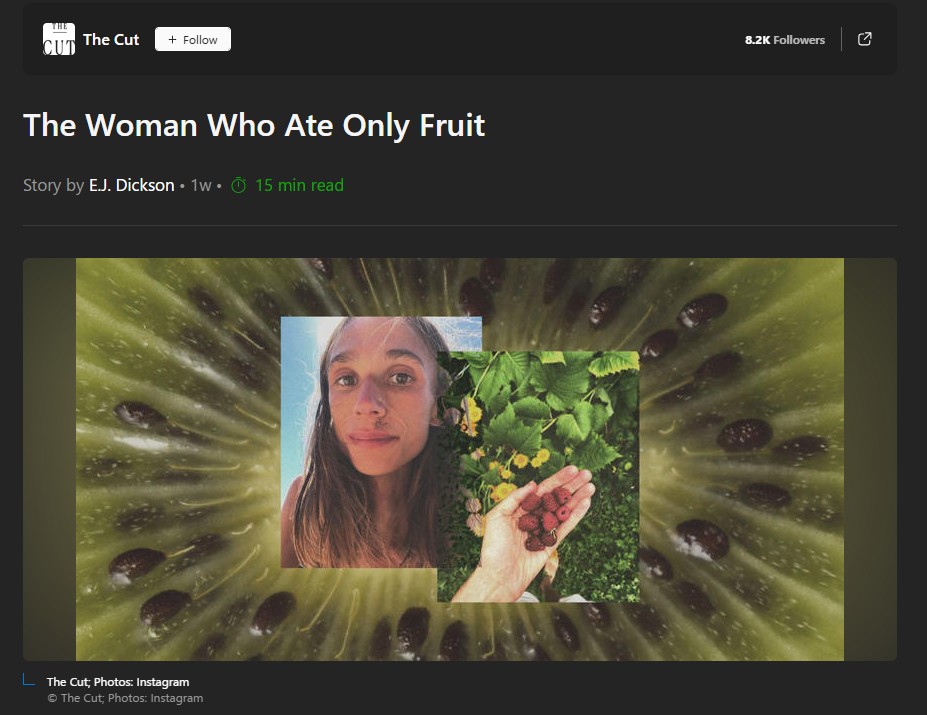
I recently read the article “The Woman Who Only Ate Fruit,” which made me think about why we do things because of our beliefs. The piece was about a Polish woman, Karolina Krzyzak, who died at a resort in Bali because she believed in only eating fruit. It turns out that Bali is a popular destination for people following a vegan lifestyle. Krzyzak followed an even more restrictive diet than veganism, where people only ate fruit.
For some reason, Krzyzak believed that following a fruitarian diet would lead to health and happiness. She had a small following on the Internet as an influencer and hoped to meet other more famous influencers in Bali. However, she soon died after getting there. She was just 27, and weighed 27 kilos, which is slightly less than 60 pounds.
Eating disorders are far from uncommon, but the article didn’t focus on Krzyzak having a medical issue. Instead, it focused on her following influencers on the Internet.
Are eating disorders caused by beliefs or a physiological condition? Are delusions mental or physical? Like many people with an eating disorder, Krzyzak was concerned with her appearance. I believe most people assume culture imposes that on us. But does it?
I don’t know the answers to these questions. Every day, the news brings me stories about delusional people. It makes me feel that everyone is delusional, in one or more ways. I don’t exclude myself.
On the surface, it appears our delusions come from what we believe. And we often judge people’s actions by what they claim to believe. It’s quite easy to say Krzyzak died because she thought only eating fruit would sustain her. But are beliefs really that powerful? History is full of accounts of famines that suggest something different.
People will eat almost anything when they are starving. Wouldn’t Krzyzak’s body have compelled her to eat something rather than starve to death? Are beliefs more powerful than biological drives?
Eating disorders obviously have a biological connection. But what about something that doesn’t? For instance, conspiracy theories. I believe most people think beliefs are completely derived from thinking and thoughts. What if they’re not? What if people prone to conspiracy theories have a biological reason why they embrace delusional theories?
Could there be something in our biology that predisposes us to be more conservative or liberal? I have no idea. I’m just thinking out loud.
If beliefs can change us, why do so few believers change their beliefs? You’d think beliefs would be open to logic and new evidence. But that doesn’t seem to be the case. Many people tried to convince Krzyzak that her beliefs were wrong with strong evidence, but she wouldn’t change.
There is overwhelming scientific evidence that humans are causing climate change, but millions of people refuse to believe that evidence. Is that a logical decision, or a biological reaction? We often use the term “gut reaction” to explain why we think something.
If we’re genetically programmed to perceive reality in certain ways, can any amount of logic or evidence change a person’s perceptions?
I feel like I have changed my beliefs hundreds of times due to new knowledge, and I know other people who claim their beliefs are open to persuasion. Is that a delusion on my part? A possible answer might be that some people are open to change, and others aren’t. I need to research that. I bet scientists have studied that.
I used to believe we could create a sane society if we all worked together to form an enlightened consensus. I doubt that now. The world seems to be going insane despite what we learn. The only way to have hope is to recognize our own delusions and change the way we act. But is that even possible?
I don’t think so if our delusions are tied to our biology.
JWH
 Auxiliary Memory
I cannot answer your questions definitively, but I can give you another extraordinary example which might allow you to put the pieces together. In 1975 I went to University to read Physics. One of my fellow students (a very bright guy) had done all the research (so he said) and he was convinced he could live on a diet of Savoury Rice. After a few weeks of his Savoury Rice diet he was carted off to hospital in a very poor condition. After a few weeks in hospital, where he was made to promise he would not continue with this nonsense, he returned to University. Promising not just to eat Savoury Rice, he in fact continued with is Savoury Rice diet convinced he could not have got it so wrong. This time, in a few weeks, he died!! This guy was Academically very bright. His logic would have been pretty good. So how could it all go so wrong?? I have no idea.
We have to assume the guy you knew and the woman fruitarian saw reality far differently than we do. But why? I’m sure DSM-5 will have a diagnosis for such people. But can that condition be explained in terms of physiology?
My worry is there are endless conditions we all suffer from that distort reality for us. What am I seeing that I act on that is not real?
Likewise – what are you NOT SEEING that you act on that is actually real!
I can give you a personal (very weird) example of that one, if you’re interested.
Sure. But are these comments too public?
Copilot gives this ..
https://copilot.microsoft.com/shares/JsvcyjDoXkurQEfEbEq6h
Whoa! That’s a lot to think about! I keep forgetting that I don’t believe in free will. CoPilot certainly provides enough examples to back that belief up.
Will anyone be self aware of all those chemical processes to claim they are master of their own thoughts?
I really like copilot. I think it’s better than ChatGPT.
Copilot went on to differentiate between religious beliefs, income, education, and race differences.
I need run my essay through my CoPilot. I wonder if it will give the same answer?
This makes me wonder something else. What if we all had an AI that monitored our words and actions and could become our guardian angel? Like a little angel on our shoulder? Of course, it could act as a little devil too.
Amazing and very interesting. AI shows us how much information is really out there and where it’s sourced from. we couldn’t possibly come up with answers, even though they’re out there, like this, in such a quick amount of time. to me that is their value. Saves us a lot of work and gives us a lot of food for thought.