
by James Wallace Harris, 9/2/24
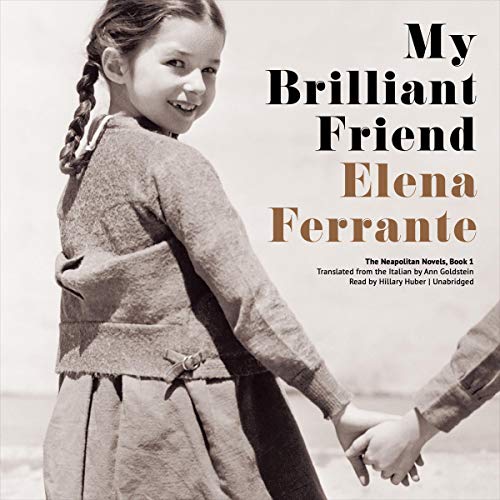
I just listened to My Brilliant Friend by Elena Ferrante because it was voted the best book of the 21st century so far by The New York Times. Well, it was #1 on the list voted for by 503 writers, critics, and editors. It was #8 on the list voted for by the NYT’s readers. And it was #11 on a list created by The Guardian. It wasn’t my #1 twenty-first century read, but it might be in my Top Ten. I should create a Top 100 list for the books I’ve read so far this century. Right now, #1 would be The Warmth of Other Suns by Isobel Wilkerson.
Ranking books is ridiculously hard. Even describing my exact feelings about a book is extremely hard. But I can say, My Brilliant Friend is the kind of novel I rate as being the best kind of novel, and those are the ones that feel autobiographical.
We don’t even know who Elena Ferrante is, so there’s no telling if the novel is autobiographical. There is even speculation the author could be a man, but I doubt it. This book reads like the absolute best of women writers. However, it also reads like it describes the author’s own childhood and adolescence. And it feels like it’s about two very real people. Of course, the story could be entirely made up.
When I was young, and an English major in college we used to argue over whether a novel is best understood as a standalone work, or from a larger context of when, where, why, and who wrote it.
Back then, when I was young, I argued that a novel had to be judged as a standalone work.
Now that I am old, I disagree completely with my younger self. Just judging a book by itself is like looking at the tip of an iceberg that floats above the ocean. You also need to consider the rest of the mountain of ice below the waterline to get the complete picture.
Because Ferrante hides her identity, I can’t do that. Without reading several biographies and collections of letters, plus interviews and other works about her writing, I can only react to My Brilliant Friend as a standalone work.
My Brilliant Friend is very readable, compelling, engaging, moving, and sometimes inspiring. It’s told in two sections: Childhood and Adolescence. The narrator tells us that the story is about Raffaella Cerullo, who her friends call Lina, but she calls Lila. The narrator’s name is Elena Greco but is called Lenuccia or Lenù by others in the story. The story is set in Naples in the 1950s and early 1960s. In the first section the girls are eight or nine, and in the second section, they are fourteen to sixteen.
The first section is about how the two girls compete in grade school. Lina is the smartest, and Elena works hard to keep up with her. In the second section, Elena soars ahead academically. She gets to go to middle and high school. Lina does not and stays home to work in her father’s shoe repair shop. Yet, Lina reads on her own and is often far ahead of Elena intellectually and in maturity.
In My Brilliant Friend, the girls read Little Women. It’s so important to them, they reread the book until it falls apart. I have only read Little Women once, but I’ve seen several film adaptations, and I’ve read three biographies and watched one documentary on Louisa May Alcott. Little Women didn’t become impressive to me until I read those biographies.
I don’t think readers can deeply appreciate Little Women until they read a couple of biographies of Louisa May Alcott. I think that will also be true of My Brilliant Friend. Little Women was my mother’s favorite book from childhood. It was a favorite of her mother and sisters, and aunts. I’ve known many women for whom Little Women was something important that crossed generations. But then for hundreds of millions of readers and film goers, the story is good enough by itself. But I’d say, it’s just a wonderful sentimental tale until you get to know Louisa May Alcott.
I think the same could be true about My Brilliant Friend. I don’t know if My Brilliant Friend will be popular like Little Women has been in the 19th, 20th, and 21st centuries. I won’t live long enough to know. It might be.
I wonder why Elena Ferrante hides their identity. I wouldn’t want to be famous either. All that attention would be annoying. But if her novels are just made-up stories, ones with incredibly detailed character development, I think they will only be popular reads. However, to become classics, we need to know a lot more about Elena Ferrante.
At least I do.
JWH
 Auxiliary Memory
I read the four books in the original Italian and I think it helps to understand the culture at the time when the girls were growing up in southern Italy. The book exposes many of the problems there at that time and many people were even offended by the blunt portrayal of the people from the south of Italy to those from the north. I believe this is why she wrote anonymously (it has also been suggested that she, is actually as he, but I doubt this). The books were also among my favorite reads. I enjoyed reading your take!
Then maybe you can explain something to me. The narrator constantly points out when the characters switch from dialect to Italian in the story — so what language are they speaking when speaking in dialect?
I didn’t know there was a different between the south and north of Italy. I went to Google while reading the book and searched on pictures of Naples from the 1950s and 1960s, but I haven’t read anything yet. The whole time I was reading the story I pictured it like an early Fellini picture, like La Strada, La Dolce Vita and 8 1/2. I was hoping to get an idea about how Naples looked then when I sign up for Max and watch the series.
Is the portrayal that blunt? I’ve only read the first book, and it doesn’t seem that harsh. I started the second book today.
The dialects in Italy can vary from region to region and even from town to town. It is all considered Italian but the standard Italian, I have heard, is based on the Florentine dialect. The dialect in the book is based on the Neopolitan dialect and it sounds quite different from the standard Italian. The economy in Italy is better in the north than the south and in the 50s and 60s poor families (which where many) did not always send their children for higher education because of the cost. This has changed for the better. I recall the books that followed will tie into the political climate of the time which was the beginning of the change for the south. I think the portrayal is pretty close to what the reality was before the 1970s and that is why it may have offended people but also made them face the reality of the conditions of many towns in the south and maybe even lead to their improvement.
I thought the first book was the best of the four and I did watch the series. I had to get passed to first couple of episodes of the series before warming up to it, but that is usually the case with me – I usually like the book better than the movie.
When this novel first came out, I saw it called “autofiction”. I despise autofiction on principle* (I’ll never read Knausgaard, for example, and his using the title My Struggle certainly doesn’t help) so I passed on the Ferrante books. But, really — why is this called “autofiction” if we don’t even know who the author is? Seems more likely fiction with (probably) some autobiographical influences — reminding me, for example, of a novel I recently read, Edna O’Brien’s The Lonely Girl (and its predecessor, The Country Girls.)
*If you want to write memoir, fine, go write a memoir. If it’s lightly fictionalized — well, so are most memoirs, I imagine.