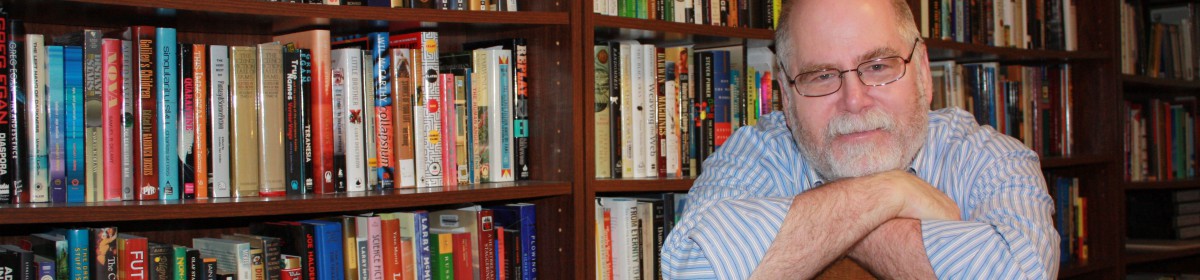
Their Wonderful Lives

by James Wallace Harris

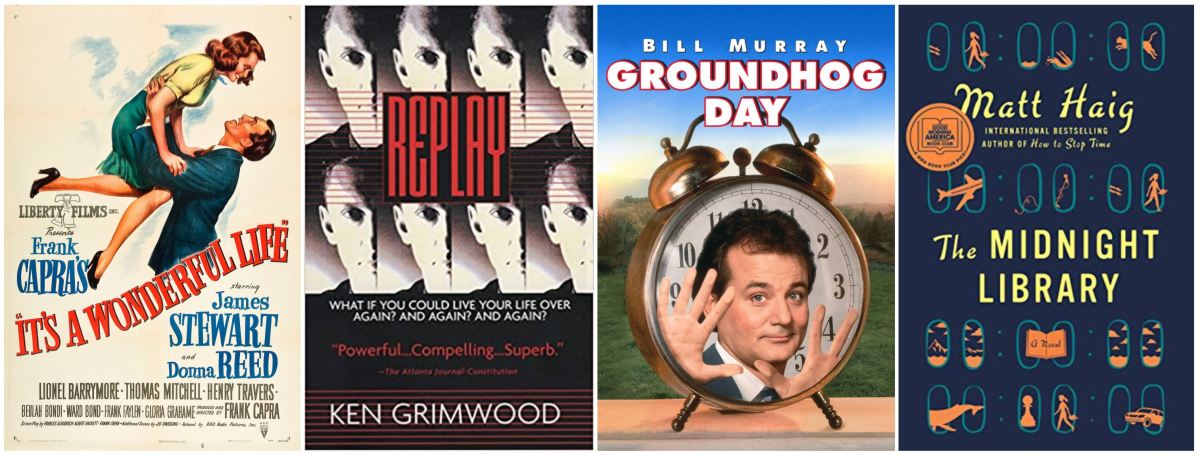
Do you look back over your life tallying a long list of regrets? Do you fantasize about taking roads not taken? Are there people you wished you had thanked, or expressed your love, or just gotten to know? Do you remember saying things you wished you hadn’t? Are there ambitions you regret not chasing? Are you the kind of person that wishes they had some do-overs? Well, I have a book for you – The Midnight Library by Matt Haig. It belongs to a group of books and movies that represent a tiny subgenre of fantasy about living life over:

The Midnight Library is a current bestseller that came out in August. It’s attracting bookworms like crazy for its feel-good inspirations. The Midnight Library offers the same kind of life lessons found in It’s A Wonderful Life, Replay, and Groundhog Day. Evidently, if we’re allowed to live our lives over, we would all learn similar insights. Could that be true? Can we learn just as much by consuming stories about characters with life do-overs?

In The Midnight Library Nora Seed is a 35-year-old woman full of regrets who commits suicide but finds herself not in heaven or hell, but a library. Nora lived in the small town of Bedford, England. Remember, George Bailey lived in the small New England town of Bedford Falls. Unlike George, Nora doesn’t get to see what Bedford would have been without her, instead, she gets to relive her life in countless ways based on taking different forks in her past. That’s somewhat like what Jeff Winston gets to do in the novel Replay who lives his whole life over and over trying different paths each time, and a little bit like Phil Connors experiences in Groundhog Day.

The creator of these stories teach us a kind of philosophy by showing us lives lived over, or even over and over. I do not want to spoil The Midnight Library for you, so I won’t go into its unique plot details or metaphysical conjectures. Let’s just say I found it a very compelling idea for a fantasy pick-me-up.

Have you ever pictured yourself dying and instead of being reborn into any of the traditional religious destinations, imagine yourself coming to in some higher dimension with the true meaning of existence coming back to you? Sort of the ultimate V-8 head slapping moment where you exclaim, “Oh, that’s what life was all about! Now I remember.” Something impossible to comprehend or predict in this life.

I have often wondered that. It’s not what Nora Seed experiences in The Midnight Library, but her story offers an interesting alternative like that. If I had to place a bet, I’d bet that death is oblivion. But it sure would be nice if after dying we found ourselves in some kind of logical reality where all of our existence on Earth made good sense.

Fantasies like The Midnight Library, Replay, Groundhog Day and It’s A Wonderful Life offer a kind of existential hope, a fairytale for adults. The Midnight Library was one of the few bright spots of 2020.

JWH

Memory Management in Humans 1.0

by James Wallace Harris, Thursday, November 26, 2020

Even though I often bitch and moan about my memory problems, I don’t feel they’re a sign of early dementia. Humans just have poor memory management compared to computers. If Homo sapiens sapiens ever have a spinoff species I wonder if it will have better memory management? Science fiction writers often imagine Homo superior with superhero superpowers but I tend to believe whatever traits that sets our descendents apart from us will be rather mundane. I hope improved memory is one, but it will probably be the adaption to hotter weather and resistance to toxic pollutants.

Today I felt the need for the specific kind of memory if I was Jim Harris 2.0. I belong to a small group of people who discuss science fiction stories by email. This week we’re discussing “Utopian” by Mack Reynolds, which came out in 1970 about the problems people would face in the year 2000. I read two or three short stories by Mack Reynolds this summer and I wanted to reference them in my comments about “Utopian.”

However, I couldn’t recall anything about those stories – at first. Slowly, as I strained my constipated mind, I shat out a few rabbit turds of recollections, that eventually allowed a few larger memories to flow out. The results looked unrecognizable to what I had consumed. It’s a shame. We have rich experiences and all we retain are little piles of memory shit.

What would it be like if everything I read stored perfectly in my mind and I could recall it whole later? Yeah, I would be a computer then, wouldn’t I? But I’m not, so what’s the best work around?

I’m currently reading a novel, The Midnight Library by Matt Haig that’s about a young woman, Nora Seed, who commits suicide at 35. On the road to oblivion she is offered the opportunity to live a different versions of her life, ones based on paths she had not taken when younger. On one path she became an Olympic swimmer, but Nora realized once she was in that successful life just how much she had to give up to become an elite athlete. It required such a single-minded focus that she had to drop everything else she loved.

If I wanted a mind capable of remembering and writing about the work of Mack Reynolds in the kind of depth that I’m fantasizing about, I’d have to have ignored a whole array of other writers and stories I’ve been enjoying. The reason why I’m not great at anything is because I’m half-ass at everything else. I’m not finished with The Midnight Library, but one of the lessons I’m wondering Nora learns is the virtue of being a dilettante at many things.

I’ve tried diaries, journals, blogs, spreadsheets, databases, text editors, note taking software, 3×5 cards, clipping files, mind mapping tools, and so on trying to organize my thoughts and memories. Nothing works. I’m always surfing on a foamy wave of chaotic fragments of memories that I wished were whole. My mind craves the autistic trait of compulsive organizing but I can’t put everything in visually appealing stacks.

Each day I get up thinking of a new project to pursue. Whatever memories I can dredge together and hold in my mind for the course of the day become my entire set of tinker toys to build that project. Once I go to sleep at night, everything gets reset. I feel like Leonard Shelby in the 2000 film Memento waking up and starting over. I can carry a project over to another day, but I must rethink everything about it the next day. Often that takes me in a completely different direction. This explains why on a number of occasions when researching on Google I found articles I had written on the very topic I was thinking about writing that day, but had forgotten I had written. That really produces an eerie feeling.

What I keep searching for is a external tool or a mental discipline that would allow me to build a larger project by not having to restart everything the next morning. I marvel at people who can create large complex creative works over weeks and months. How do they keep everything in their head day after day? I have to assume their minds have laser focus ignoring endless distractions. I’m always seduced by distractions. I love distractions. I can’t resist squirrels and shiny objects.

Even knowing that distractions are keeping from doing what I really want, I can’t ignore their siren calls. There seems to be two kinds of people in this world. Those that get things done, and those that don’t. And it doesn’t appear that memory recall is the key difference between the two types. I’m guessing it’s more about limiting the amount of items the head juggles that’s more important. That managing a smaller set of data is the key to focusing. Which makes me wonder if Walter Isaacson had to forget all about Steve Jobs to write about Leonardo di Vinci?

If I could only think about one project until it’s finished. Maybe that’s the key to managing memory. I sit here thinking about all the interests my mind would have to ignore in one day, and that makes me feel like Wile E. Coyote trying to walk on air high above the canyon below.

JWH

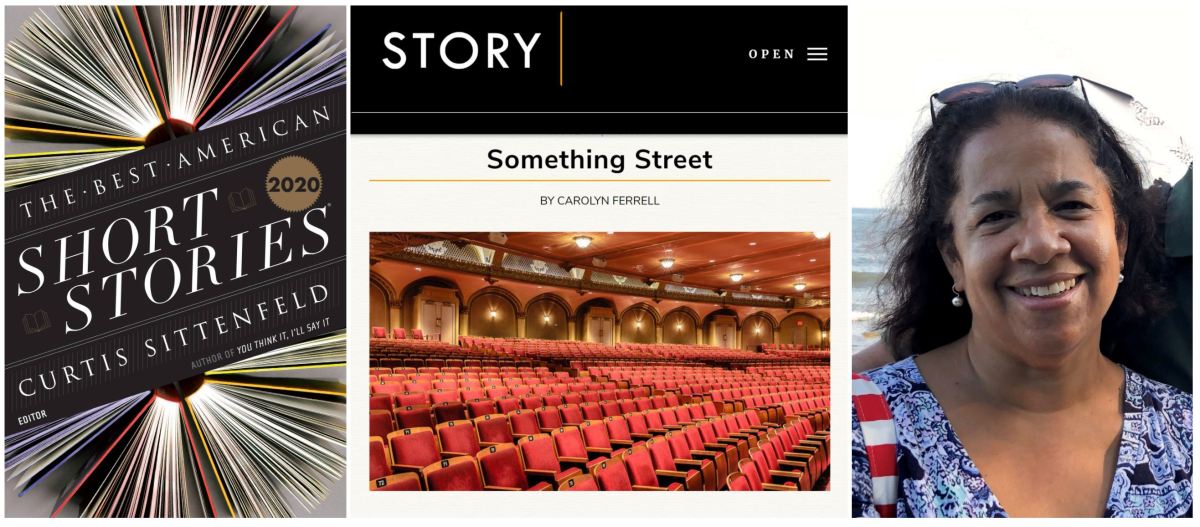
BASS 2020: “Something Street” by Carolyn Ferrell

by James Wallace Harris

Something Street” is exactly the kind of story I was looking for when I bought The Best American Short Stories 2020 (BASS 2020). It’s a Category 3 hurricane in its emotional intensity, with anguished gusts pushing into Category 4. The only other story with any powerful emotionality I’ve reviewed so far from BASS 2020 is “Godmother Tea,” but it was only a Category 1. “Something Street” roars with pain and anger.

“Something Street” was an hour and nine minutes on audio, making it the second longest story in the BASS 2020 anthology. Technically by some yardsticks it’s a novelette. However, I do recommend that you follow the link above and read it online before reading any further here. Actually, I highly recommend getting the audiobook edition of BASS 2020 to hear the powerful narration by Robin Miles. She brings Parthenia’s story to life like a one-person show on Broadway.

Trigger warning: This story is about a fictional famous black comedian who is a rapist. It’s obviously inspired by Bill Cosby. Carolyn Ferrell has divided the story into sixty sections. Cosby was accused by sixty women. This is Parthenia’s story, the wife of the comedian nicknamed Craw Daddy. I’m not sure how much it intentionally parallels Camille Cosby’s life but it feels like it faintly does. This makes me somewhat queasy because I wonder about the ethicality of using famous people for fiction. Not just here, but at any time.

I don’t intend to describe or summarize “Something Street” because it’s long, complex, and very deep. I’m afraid any description or quote I might give could dissuade you from reading it. Besides it so rich that I could write a dissertation on it, and I just don’t have the energy and time. “Something Street” is available to read online, and I recommend that you do so. But like I said, if you want the full force gale experience, get the audiobook of BASS 2020.

I do want to talk about why I crave powerful short stories. We live in a far-out reality that we mostly ignore because of our endless pursuit of diversions and duties. Reading an intense short story canes me over the head and shoulders like a Zen master telling me to pay attention.

I don’t feel my day has been worthy unless I read one or two stories that give me an that intense existential wake-the-fuck-up rush. “Something Street” did that for me today. Another recent read that did that was “Second Person, Present Tense” by Daryl Gregory. The link provides both the story to read and audio to hear.

You need to read “Something Street” very closely to get all the implied horror, some of which I goes beyond its real life inspiration. The reason why this seventh story in BASS 2020 stands out is its dramatic voice. Parthenia is painted in hyper-realistic details. “Something Street” has a baroque structure, with a rising arc ending in a tragic epiphany. I seldom use this term, but “Something Street” is a tour de force. Carolyn Ferrell hit one out of the park.

Menu: The Best American Short Stories 2020 Project

JWH

BASS 2020: “Halloween” by Marian Crotty

by James Wallace Harris, Tuesday, November 17, 2020

Menu: The Best American Short Stories 2020 Project

Evidently teenage lesbians can go just as girl crazy as other girls go boy crazy. In “Halloween” by Marian Crotty, seventeen-year-old high school senior Julie can’t control her impulses for college girl Erika and gets strategic dating advice from her thrice-married grandmother. “Halloween” is a nice little love story that moves from beginning to end in a linear progression. It does offer a small subplot about Julie’s jealousy for her mother’s growing transfer of affection for her boyfriend as Julie gets old enough to move out, and it digresses a delicious bit about the colorful grandmother, Jan. Maybe a little too much because Jan almost upstages Julie in this story.

Although “Halloween” is told with a decent concentration of embellishing details such as working at Yotopia, everybody else’s love life, bits of academic demands, and a few faint details about Tallahassee, Florida, the story is pretty much about Julie’s obsession with Erika. Sure, love stories dominate fiction, and its mildly interesting to learn about the sex lives of the latest generation, but it’s also a kind of ho-hum mundane love story. Because part of the story was set at Yotopia I couldn’t help compare it to John Updike’s classic teens at work story, “A&P.”

“Halloween” is an engaging story but won’t be memorable. Why is “A&P” still being taught in schools over a half century after it was first published and “Halloween” won’t? Why has “A&P” stuck with me ever since it was assigned to my English class back in the 1960s? How do you describe ineffable qualities?

There are milestones in the life of short stories. Getting written is a kind of conception. Getting published is a kind of birth. Getting selected for a best-of-the-year annual is a kind of graduation. Getting reprinted in retrospective anthologies is a kind of career. Becoming a classic is a form of longevity, even immortality. With every story I read that I like I have to ask if it has what it takes to keep living. And if I don’t think it will, I have to ask what would it take to survive.

“Halloween” needs something. Either more Julie, or more Erika, or more of both. If you compare Julie with Joy in “Godmother Tea” you’ll know what I mean. I wanted a lot more details about Julie’s inner world, and a lot more details about what she sees in Erika. For “Halloween” to survive we readers would have to feel what Julie feels when she can’t stop herself from going to the Halloween party. The story as is made me intellectually understand, but for it to reach the next level I’d have to feel it.

Jake Weber’s review. He found some comic elements that I didn’t. I recently wrote an essay about science fiction stories that could be read straight or as humor depending on your current perspective or mood.

Other Reviews:

Karen Carlson framed her insights around the three generations of women with relationship problems.

Jake Weber was fascinated by the questionable dating advice Jan gives Julie.

JWH

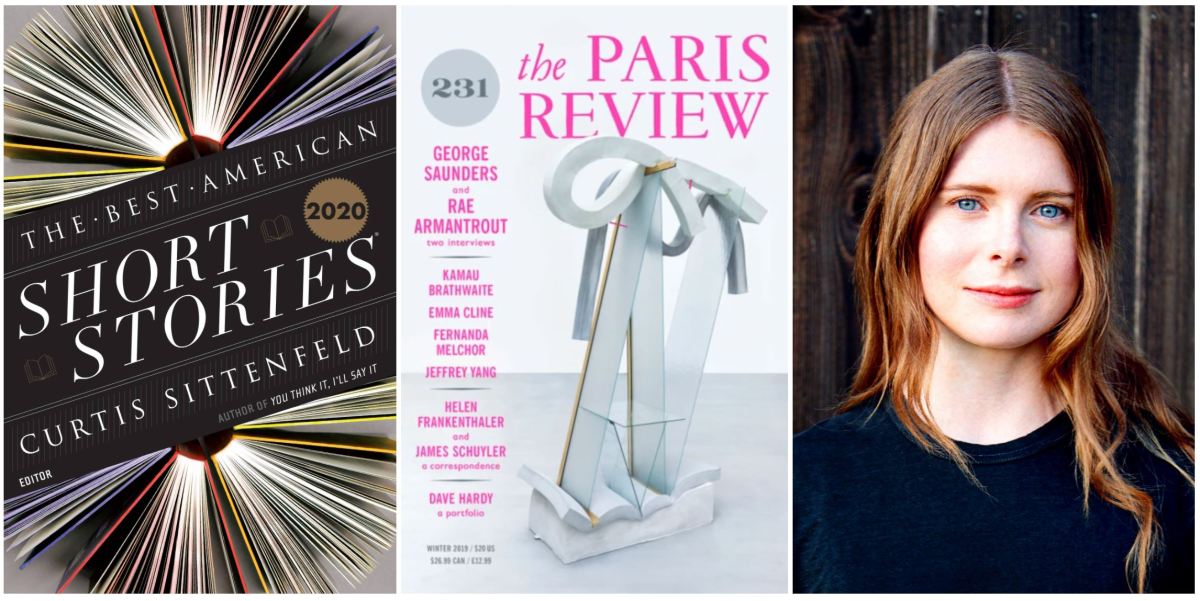
BASS 2020: “The Nanny” by Emma Cline

by James Wallace Harris, Sunday, November 15, 2020

“The Nanny” by Emma Cline is available to read online at The Paris Review.

Have you ever dreamed of writing fiction? I have. I’ve even studied it in college. Writing stories is much harder than it looks. I don’t know if I fail because I’m a bad writer or because I don’t understand how stories are told or constructed. I’m reading and reviewing The Best American Short Stories 2020 (BASS 2020) this year to see if I can spot what good writers do that I don’t.

Even though I’m about to nitpick another story, I must reiterate that all these stories are well written and entertaining. However, I’m not sure what kind of reader will like them. Few bookworms read short stories, and I think that most that do are would-be writers. Getting short stories published is like making it onto farm team in baseball – but the real goal is to get into the show.

Emma Cline has already made it to the big time with The Girls in 2016, so I expect her short story production to fall off as she writes more novels. This makes “The Nanny” an important story to study because we know Cline has the knack for attracting readers. And as soon as I started reading “The Nanny” I noticed that her story is full of significant details. And “The accumulation of significant details is the key to great fiction” is the most important piece of advice I got at Clarion West in 2002, a six-weeks writing workshop.

However, writing techniques are not the only thing I’m studying with this BASS 2020 project. I’m also analyzing what do people like to read and why. And even more than that, why do people read short stories. There’s several answers to that. First and foremost, we naturally like the art form, but more specifically, we get hooked by the opening:

There isn’t much in the house,” Mary said. “I’m sorry.”

Kayla looked around, shrugged. “I’m not even that hungry.”

Mary set the table, bright Fiestaware on place mats alongside fringed cloth napkins. They ate microwave pizzas.

“Gotta have something a little fresh,” Mary’s boyfriend, Dennis, said cheerily, heaping spinach leaves from a plastic bin onto his pizza. He seemed pleased by his ingenuity. Kayla ate the spinach, took a few bites of crust. Mary poured her more water.

When Kayla asked for a beer, she saw Mary and Dennis glance at each other.

“Sure, sweetie,” Mary said. “Dennis, do we have any beer? Maybe check the garage refrigerator?”

I didn’t find this opening very enticing. Kayla appears to be our protagonist, and she’s being fed on the fly, maybe even an inconvenient or unwanted guest. I can vividly picture this scene though.

Cline gets down to business in the next hunk of description:

Kayla drank two over dinner, then a third out on the porch, her legs tucked up into the oversize hoodie she had taken from Mary’s son’s room. The wildness of the backyard made everything beyond it look fake: the city skyline, the stars. Reception was awful this high in the canyon. She could try to walk closer to the road again, out by the neighbor’s fence, but Mary would notice and say something. Kayla could feel Dennis and Mary watching her from inside the kitchen, tracking the glow of her screen. What would they do, take her phone away? She searched Rafe’s name, searched her own. The numbers had grown. Such nightmarish math, the frenzied tripling of results, and how strange to see her name like this, stuffing page after page, appearing in the midst of even foreign languages, hovering above photos of Rafe’s familiar face.

We really don’t know what’s happening. Evidently Kayla is hiding out because she’s become notorious on the internet with a famous person named Rafe. I do know what’s happening because I’ve already read the story, but at this point for first time readers, the motives of this paragraph are a mystery. And that bugs me. I don’t like stories that withhold information from the reader to create suspense. Of course, that’s a pet peeve of mine, and it might not be yours.

Everything that unfolds in “The Nanny” is a mystery because Cline doesn’t tell us upfront what’s going on. Now this might be a great technique for hooking some readers. Since I don’t think I should spoil the story for you, I can’t tell you why Cline is doing this.

But how can I talk about the story then? Can I trust you to go read the story and then come back? It is online. Should I just warn you to not read beyond this point until you’ve finished reading BASS 2020? I don’t think many people who are reading this blog plan to read these stories. In that case, any benefit you get from reading what I say comes from my observations, so I matter as well spill the beans.

Kayla is hired by Rafe and Jessica to nanny their son Henry. Rafe is a movie actor, and Kayla ends up having sex with him. Then Kayla is on the run from paparazzi and bad press. At first I wondered if this was going to be a #MeToo story, but it’s not. It’s really about Kayla attitude towards the world. Cline captures a young woman who flows along with an almost nihilistic outlook. At one point we are told:

The thing was, she was a smart girl. She’d studied art history. Her first class, when Professor Hunnison turned out the lights and they all sat in the dark—they were eighteen, most of them, still children, still kids who had slept at home all their lives. Then the whir of the projector, and on the screen appeared hovering portals of light and color, squares of beauty. It was like a kind of magic, she had thought back then, when thoughts like that didn’t feel embarrassing.

How mysterious it seemed sometimes—that she had once been interested or capable enough to finish papers. Giotto and his reimaginings of De Voragine’s text in his frescoes. Rodin’s challenge to classical notions of fixed iconographic goals, Michelangelo’s bodies as vessels for God’s will. It was as if she’d once been fluent in another language, now forgotten.

Evidently, Kayla once had academic ambitions, even hopes of having something to distinguish herself, or at least impressing her professor. Through the course of the story we learn she wasn’t smart enough. Her affair with Rafe might have been another hope for Kayla, but it was only out of boredom for Rafe. She thought the relationship made her special, but when everyone turned against her she had to run. She just goes through the motions as Mary and Dennis take care of her out of pity. In the end we are told the sad reality of Kayla’s dreams:

Dennis scanned Kayla’s face, her eyes, her mouth, and she could tell he was seeing what he wanted to see, finding confirmation of whatever redemptive story he’d told himself about who she was. Dennis looked sad. He looked tired and sad and old. And the thing was, someday, she would be old, too. Her body would go. Her face. And what then? She knew, already, that she wouldn’t handle it well. She was a vain, silly girl. She wasn’t good at anything. The things she had once known—Rodin! Chartres!—all that was gone. Was there a world in which she returned to these things? She hadn’t been smart enough, really. Even then. Lazy, grasping for shortcuts. Her thesis moldering in her college library, a hundred labored pages on The Expulsion of Joachim from the Temple. She’d messed with the margins and font sizes until she barely made the required page count. Professor Hunnison, she thought miserably, do you ever think of me?

Kayla lives in a society that admires people who create successful identities and she struggles to find anything at all to set herself apart. The story concludes in a way that turns even us against her:

At least he had given up on the idea of lecturing her. Convincing her there was some lesson in all this. That wasn’t how the world worked, and wasn’t it a little tragic that Dennis didn’t know that yet? No use feeling bad. There wasn’t anything to learn. Kayla smiled, sucked in her stomach, just in case—because who knew? Maybe there was a photographer hidden out there in the darkness, someone who’d been watching her, who’d followed her here, someone who had waited, patiently, for her to appear.

Would the story had been just as successful is Cline had told us right up front that Kayla was on the run for having sex with a married actor and the popular opinion was against her? What if we were told Kayla was a graduate school dropout at the beginning of the story and she was searching for any kind of recognition she could latch onto?

Was it fair of Cline to hide Kayla’s faults from us? Mary and Dennis hope to help Kayla, and see her as a good person – at first. We assume Rafe and Jessica did too. And haven’t we held out hope for Kayla too, also assuming she was a good person. Then how do we feel at the end when we learn she’s pathetically wants a paparazzi to find her?

Is it good storytelling to hold off a surprise until the end? Personally, I would have preferred to know the ending right up front, and then got to watch Kayla closely throughout the story to understand all the interactions of the characters. If we had known the ending at the beginning, then these paragraphs at the front of the story would have taken on different meanings.

Before Tuesday there had been hardly any record of Kayla: an old fund-raising page from Students for a Free Tibet; a blog run by a second cousin with photos from a long-ago family reunion, teenage Kayla, mouth full of braces, holding a paper plate bent with barbecue. Her mother had called the cousin and asked her to take the photo down, but by then it had passed into the amber of the internet.

Were there any new ones? She looked through the image results again, in case. They had dug up photos of Kayla lagging behind Rafe and Jessica, holding Henry’s hand. Rafe in his button-down and jeans, surrounded by women and children. Kayla had no photos of her and Rafe together. That was strange, wasn’t it? She came across a new photo—she looked only okay. A certain pair of jeans she loved was not, she saw, as flattering as she’d imagined it to be. She saved the photo to her phone so she could zoom in on it later.

Kayla made herself close the search results, then let her text messages refresh. A split-second reprieve where she could believe that perhaps the forces in the universe were aligning and aiming something from Rafe in her direction. She knew before they finished loading that there would be nothing.

Knowing the ending would change my attitude about the information given here. I wonder if Cline always saw Kayla’s faults and wrote the story thinking about them, and didn’t realize some readers might follow different assumptions before learning the truth?

It’s not that we eventually turn against Kayla completely, but it would have been more useful knowing her weaknesses sooner. I assume Cline wanted us to get to know Kayla slowly like everyone in the story. But then, we wouldn’t know the breadcrumbs Cline sprinkled throughout the story meant unless we read the story twice.

Of course, that brings up a whole other issue. So many of the stories I admire require two or three readings before all the author’s efforts are revealed. Should we always read short stories twice immediately? Should we write them assuming people will read them twice? That rarely happens.

Is it possible to keep the reader completely informed with one reading?

The point of “The Nanny” is to create a psychological portrait of Kayla, but is that what readers want from short stories? There is no plot. There is no ending. Nothing is wrapped up. I accept that in literary stories, but do most readers?

Menu: The Best American Short Stories 2020 Project

Jake Weber’s review

JWH