
Category: Writing
Why Write a Novel?
Have you ever dreamed of writing a novel? I have since high school. Evidently tens of thousands, if not millions of people, also have that fantasy. But just what does it mean? Why write a novel? For the third time in my life I’m trying to write a novel and it’s been a very revealing experience. Novel writing is hard. Oh, it’s easy enough to crank out the words and keep writing until you have a novel length manuscript, practically anyone can do that if they persist.
Is 100,000 words of fiction a novel? By the least common denominator definition maybe, but a novel is a story with certain elements like characters, plot, conflict, epiphany, etc. Let’s say we have a gadget that measures the power of each of these aspects in a novel and you can run your draft through it and get a readout, with ratings of 0-100 for each element. 100 represents what the best novels ever written would measure. Unless you have a lot of talent, or have a lot of practice writing short stories, more than likely your first attempt at writing a novel will barely register 1 or 2 on any scale, and maybe if you have a knack for a certain element, hit a 10 or 20.
I’m working on NaNoWriMo and even though I’m able to crank out chapter after chapter I’m not sure if any of them have value to readers, or would register very high on our novel analyzer. In my head I fantasize about writing a novel of the future where humans and robots fight over politics, philosophy, science, religion and the environment – but making that real is hard. Yesterday I saw a movie, Martha Marcy May Marlene, that was so intense and bleak that it made me emotional sick. Why did they tell that story I asked myself leaving the theater. That make me ask myself about the story I’m working on: What am I telling my readers. Would it entertain, inspire or depress?
I’m not sure most bookworms ask themselves why they are reading a particular novel – they just hear about a book and get it. I’m sure every reader hopes the next book they buy will be a page turning wonder, but generally they’re not. Often we have to push ourselves to keep reading, hoping we’ll “get into” the novel. To get hooked. That’s what readers want – they want to get hooked – the more addictive the better. Bookworms love finding books that compel them to read all night long, or even all weekend long.
Then, is the primary reason to write a novel to hook readers? The movie I watched yesterday hooked me but ultimately it was extremely dissatisfying. The story was about a mentally ill young woman who had gotten caught up in a Charles Manson like cult. The review I read said the film was about a young woman readjusting to life after leaving a cult – so I assumed it was a religious cult, and expected a film about a person coming to grips with reality. That sounded fascinating to me and I went to the movie with great expectations. If I had known the cult was of The Family kind I wouldn’t have gone. In other words I wanted a story that had a positive outcome. This story was very realistic, leaving viewers with an implied ending that would be horrific and nasty, but very real-world.
I bring this incident up to make another point about why write a novel. Are you writing escapism or are you saying something about reality? Martha Marcy May Marlene was saying something about life I didn’t want to experience, but I have to admit that it was deeply perceptive about reality.
If you think about all your favorite books and movies you’ll probably realize you admire the ones most that have lovable characters that you identify closely. It’s very hard to tell a story about truly unlikable characters. It takes great talent to create a Hannibal Lector or Dexter Morgan, where the readers learns to like evil people, but people would rather read about a likable serial killers than read a book where all the characters are realistic and depressing.
When most people dream of writing a novel they do so because they imagine fortune and fame. Few writers get rich, and even fewer gain any kind of fame. Writing is a lonely business demanding huge amounts of time creating black marks on white screens. It’s a painful process giving birth to story that people will want to read, and I’m talking about anyone wanting to read. Few would-be writers produce stories that get read. Sure they might coerce a few family and friends to read their story, but that’s about all. Even the successful ones who actual sell a story to a publisher, most of those books never recover their advance and fewer than a thousand people buy them, and its doubtful that even those books get completely read. It’s just a huge task to compose a story that requires ten, twenty or even thirty hours to be read. It’s a monumental task to create one that many people will actually read, and its even a winning a Powerball kind of event to write a story that millions love to read.
Why write novel? Many people believe if they write something they will love to read themselves, others will want to read it too. That’s the first goal of writing – to please yourself. I believe this, but I’ve got to ask: How many people can write something and have the objectivity to know if it’s something they would want to read? And furthermore, and I think this is even a greater philosophical question: How many people know what they like to read? I even wrote about this in “My Kind of Story.”
My guess is few writers ever ask: Why write a novel? Just as few readers ask: Why read a book? I’m pretty sure Charles Dickens, Anthony Trollope, Stephen King and J. K. Rowling all knew or know what makes a good novel and why people will want to read it. (I’m a bit doubtful about Rowling since she’s only had a one-hit-wonder.) Most other writers I believe write something they throw at the wall and hope it sticks. If understanding how a novel works equals the ability to produce a novel that readers will love, then we should be able to write computer programs that churn out bestsellers.
Now the question I have to ask myself is: Why do I want to write a novel? I’m not driven by fame or fortune. So why torture myself to write one? Coming home every evening after work to write on the novel for NaNoWriMo takes quit smoking kind of willpower. It’s worse than dieting, at least when I’m not eating I can go do something fun. Writing is all consuming. It eats up time like crazy. And like the robots in my story, I have to ask where the base programming comes from that provides my motivation.
This now brings me to the nitty-gritty of the question: Why write a novel? For me it’s because I have two characters I want to bring to life. What I discovered writing for NaNoWriMo is I have no plot for my two characters to exist in. Now I could write a literary story that has no plot, like James Joyce or Virginia Woolf, or I need to find my inner Steven Spielberg and invent a story for them.
And I think that answers my question, you write a novel to tell a story or create a character, or hopefully both. I can’t even tell jokes because I never remember the plots much less the punch line, so creating a story for a novel is very hard for me. Rowling spent years imagining her story and characters. She saw it in her mind so well she could draw scenes from the story. Now that’s a vivid imagination.
Well, I need to get back to my NaNoWriMo work – this essay is almost as long as my word quota for the day. But I took the time off from the novel to think about why I want to write this novel and that is helping me with the plot. October should’ve been NaNoPloMo – National Novel Plotting Month. Writing a novel is a soul searching endeavor. Can you imagine a story that takes ten hours to tell and one that people will want to read? Try doing it sometimes. It will teach you a lot about reading and watching movies and television shows.
Writers obsess over their opening paragraphs because they know its the success or failure moment as to whether you can get people committed to reading your work of art. Why write a novel? Because it’s a challenge to dazzle readers with a beautiful feat of imagination.
[Aside to myself: Now that should make you try harder! Go write!!! Sorry to everyone else for having to read my pep talk to myself.]
JWH – 11/13/11.
NaNoWriMo
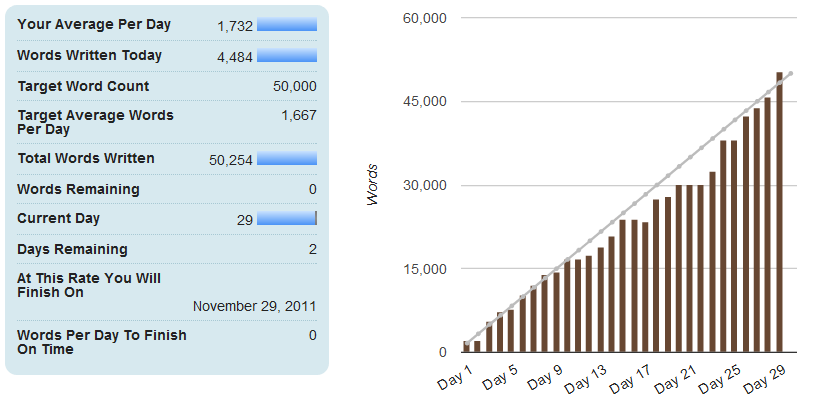
I’m doing NaNoWriMo – November is National Novel Writing Month, where participants join an online communal boot camp and urge each other on to write 50,000 words of fiction in one month. Yesterday I passed the 10,000 word mark. This also means I’m writing less for my blog, so I’m taking a bit of time off tonight to explain my absence.
I’ve tried writing novels before and usually crash and burn around the 100 page mark, or about 20,000 words.
Novel writing appeals to the amateur in people – because most people feel they can write their first novel and be a success. That’s sort of like sitting down at the piano for the first time at Carnegie Hall. I’ve written 473 posts for this blog, so I consider that my piano practice for writing, but it’s not enough, especially since it’s nonfiction. I’ve written about 30 short stories for various MFA writing classes and Clarion West Writer’s Workshop in 2002, but that’s not enough practice either. I’ve read that most writers have to complete several novels before they get one published.
The NaNoWriMo people don’t expect word marathoners to complete a finished and polished novel, they just expect participants to go the distance. And even at the 10,000 word mark I’ve learned a lot. I’ve been thinking about the story I’m working on now for years, thinking I was writing it in my head when I was too lazy to write at the keyboard, and what I’ve discovered is that all the thinking I’ve done so far is no where near enough story for a novel. I discovered that by day 3.
At day 6 I discovered the ending I had planned wasn’t really an ending and I had to blast right on past it. This morning while in the shower thinking about what to write for day 7 I realized that I needed to blend in another story I was thinking about, so two novel ideas become fuel for one. I just doubled the characters I have to bring to life and now have two settings to paint, and I’m not sure how far that will get me either. Novel writing is MUCH harder than it looks. Just read one page of any great book and count the number ideas the writer had to imagine on that page. A novel isn’t about one idea, but thousands.
I’m already thinking of converting ideas I had plan to use for blog posts into subthemes for the novel. This story is becoming a black hole for all my words and ideas. And I know NaNoWriMo is just the start, because come Dec 1 I’ll have my 50,000 words, but a modern novel is really closer to 100,000. And those are 100,000 polished words that have gone through many drafts. And that means I need to think in terms of NaNoWriYears.
I love puttering around after work pursuing all kinds of fun activities that capture my whim. What I’m realizing now is how much writers have to give up to create their work. I see that it’s got to be all consuming. Damn, I wished I smoked cigarettes and took speed. I need to drive myself on, and now I can see why writers are often so addicted to stimulants. All I have is loud music. Tonight I’m listening to my “All Along the Watchtower” playlist that’s contains 117 different versions of the Dylan classic. I’m playing it loud!
Well, back to the word mines…
JWH – 11/7/11
Blogging and Novel Writing
I’ve always wanted to write a novel but never had the focus or determination to complete one. November is National Novel Writing Month, or NaNoWrMo. The goal of NaNoWrMo is to get would-be novelists to complete a first draft of 50,000 words. Now that’s about the minimal length of fiction to be called a novel, and most editors usually want twice as many words if you submit to them, but the NaNoWrMo consider 50,000 a good writing marathon for one month’s writing. Their goal is not for people to complete a polished novel, but just go the distance. They’ve yet to make December National Novel Rewrite Month, but many bloggers have suggested it.
Essentially this means knocking out 1,667 words a day of fiction. I have no trouble writing as many words on a blog post, but fiction is different. I love blogging and don’t expect to give it up for the month of November. Blogging is therapeutic for me. Writing about something that requires research exercises my memory. And I definitely need help with my memory – it’s slipping away more every day.
But I want to write a novel. Of course I’ve been wanting to write a novel since I was in high school over forty years ago. Rationally I’d think if I hadn’t written one by now I never will. Well, I’m looking at NaNoWrMo as a shit or get of the pot test. Either I’ve got to finish a novel now or give up thinking about ever writing one. All my blogging indicates I like writing essays, which suggests I should work harder to polish that skill. If I fail to produce a first draft in November that’s what I will do – but for now I want to give it one more try.
What I should do is publish my daily NaNoWrMo work here but that might screw up my chances of getting the novel published in the future. I’ve read that most authors have to write several novels before the get one good enough to publish, so maybe I’m being too protective of my first first draft. Also, I believe, and this might be naive, that I’ve got a unique science fiction idea and and I don’t want to spoil it by letting people read a first draft. However, I might be willing to show versions of the opening here as a marketing research to see if anyone responds.
Working on a novel will seem strange though. My blogging is about watching the world and reacting. It’s about looking outward. Novel writing is about looking inward and creating everything from scratch. That might be why I’ve never been able to write a novel. I’ve written about 30 short stories and even 5,000-12,000 words are an agony to produce. I recently put my best effort online and it sank like a stone. Writing non-fiction is engaging – writing fiction is lonely.
I haven’t signed up with NaNoWrMo yet, and I still might chicken out. The idea of coming home from work every evening and turning off the world, shunning all my favorite hobbies to focus on one activity is scary. I love my evening routine. Writing fiction will be like working two jobs. So why do it? I don’t know. I read a lot of fiction and I’ve always wanted to create a fictional work of art. It’s like going to a party and always listening to everyone else talk. Writing a novel would be like having my say.
JWH – 10/18/11
All Agony and No Ecstasy
In 1961 Irving Stone published The Agony and the Ecstasy about Michelangelo’s struggles to produce great art. I never read the book but saw the 1965 movie. I think most artists are driven. I always wanted to be creative as a great artist, but I’ve never wanted to be that driven – it scares me because it seems like possession. But man, I need to be a bit more driven than my laidback lazy self. Where does drive come from? Inside or out? Can it be self-induced? Would I take a pill to produce it like in the film Limitless.
Once again I’ve taken a week off from work to write on my novel, and once again it is all agony and no ecstasy. I have no trouble writing non-fiction, but fiction is painful to produce. And yet, writing fiction is the one ambition I still have left in life.
This morning Zite brought me a link to “To Who it May Inspire,” a letter at Letters of Note. It’s a handwritten note from Austin Madison, a Pixar animator, who tells people to persist, and reminds them that only 3% of the time is it fun to be creative, and the other 97% of the creative process is painful, and finally he encourages people to always persist in working through the 97%.
That’s always been my problem, I keep waiting for the 3% mood to hit, and not putting in my 97% of the time actually drudging away. And that’s the regret of my life I would say. I don’t know how to persist through drudgery.
I’ll turn 60 soon and I wonder if I shouldn’t give up on this last dream. I don’t know if I can though – it might be a permanent fantasy that runs in my head no matter what. When I was young I dreamed of writing novels as a way of getting out of 9 to 5 work, but over the years I’ve learned that it’s easier to go to work every day than write. In a couple of years I’ll be able to retire and the incentive to write to avoid work won’t matter any more. What then?
I don’t think about writing for money anymore, anyway. I hope this won’t sound silly, but the reason why I still feel guilty about not writing is because I have so many characters that will die unless I create a story for them to live in. Even though I don’t write regularly, I do fantasize about my characters all the time. I think my main problem is I don’t have a good plot for them to live out. I started watching this week Martha Alderson’s 27 part series on YouTube about plotting. She discusses many examples from classic and current books, so these videos are enlightening even if you don’t want to write. They would also be good for people who like to review books.
Martha reminded me of something I’ve learned from many writing classes – that is my character must want something. And my characters are ambitious, but they are like me, they don’t want to work at the drudgery any more than I do. So now I’m working on two dimensions of persistence – I must persist and making my characters persist.
Another piece of advice from Martha is I need to know where my novel is going. That’s always been my biggest weakness. I’ll start writing, and crank out scene after scene, and eventually realize I’m not going anywhere. I’ll stop for awhile, maybe months. Then I’ll return to it and start at the beginning again and write all new scenes until I once again peter out. I’ve finished 30+ stories for writing classes, but only two of them were ever liked by other people, and that was because I created satisfactory plots.
My best example is “Annaclara’s Heroes” written almost ten years ago. It’s as closest to Martha’s advice as anything I’ve written. I went ahead and published it on my blog this morning to see if seeing it inspires me to write more. Also, I feel bad about not letting Annaclara out of her desk drawer dungeon.
“Annaclara’s Heroes” is the best I was ever able to do with fiction writing. It was 12,000 words and I wanted to make it a real novel. I was only able to complete it because it was the major class assignment for a Historical Fiction course. Reading it now reminds me of how much work it took to produce. I had to focus very hard for weeks. And I think I did because I wanted to impress my classmates and teacher. I don’t have that incentive when I write stories now.
That’s the thing about writing fiction, it takes weeks of intense focus. And for what? Let’s say I sold a story to F&SF or Asimov’s and got $400. That’s not a lot of monetary incentive. I think the real motivation is to create something beautiful, and I do have that kind of motivation. Just not the drive – but can I reprogram myself to have the drive? That’s a fancy way of saying, “Can you teach an old dog new tricks?”
I think about writing when I retire, and I take off a week now and then to imagine being retired to see if I can get to work. But a week is never enough. I usually have a zillion things to do with my meager week of freedom. And that might be key to my failure. Creative people can focus on one ambition with laser-like focus. My inner light is like a campfire that flickers, jumps, pops, flares, fades, and never stays focused – it creates more heat than light.
I’ve got hundreds of books on my shelf waiting to be read, and hundreds of movies waiting to be watched, and a dozen half-ass hobbies I want to spend more time on – and all of this distracts me from writing. I keep telling myself I must free myself from all desires but one, but I can’t.
I am reminded of the movie Destination Moon from 1950. The crew of the first rocket to the moon uses up too much fuel landing and can’t take off unless they can get rid of enough mass. They end up throwing everything imaginable out onto the surface of the moon to lighten the ship, including their radio and space suits. If I ever really want to be serious about writing I’ll need to jettison all my other distractions to sharpen my focus. In the film the astronauts have one great incentive – they’ll die if they don’t. I don’t have that kind force driving me.
I think I’m not a writer because of lack of drive rather than talent. I’m not sure talent is critical to the equation, at least I hope not because I’ve never felt talented. I’d like to believe its how hard you work, and I’m just too lazy. The fascinating question is whether or not laziness is a quality I can change. After fifty years of not applying myself diligently I should be able to answer that question without equivocation, but that old adage about hope springing eternal seems to trump it.
I tend to think we all have unfulfilled ambitions we carry around our whole life. At what point do we give them up. I have friends who claim they gave up long ago, but I wonder about their secret fantasies they never tell about. I like to contemplate changing myself. I don’t know if its possible, but I tend to think I’m not alone.
JWH – 9/9/11
 Auxiliary Memory