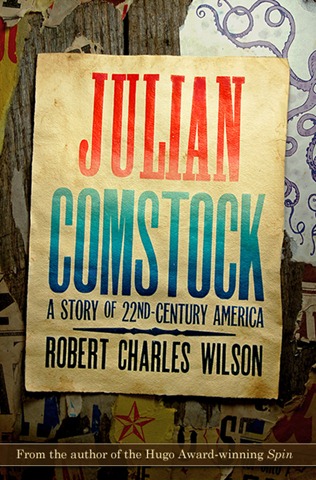
Julian Comstock by Robert Charles Wilson

Julian Comstock: A Story of 22nd Century America by Robert Charles Wilson is the fourth novel I’ve read that’s up for the Hugo Award this year.

  • Boneshaker, Cherie Priest
  • The City & The City, China Miéville
  • Julian Comstock: A Story of 22nd-Century America, Robert Charles Wilson
  • Palimpsest, Catherynne M. Valente
  • Wake, Robert J. Sawyer
  • The Windup Girl, Paolo Bacigalupi

juliancomstock

This is the first time I’ve tried to read all the nominees before the awards were given and it has proven to be a rewarding endeavor.  I’ve got Boneshaker and Palimpsest to read before September 5th.  I listened to all four books, and will listen to Boneshaker next, and Palimpsest last, since it won’t come out on audio until August 15th.  This is a sign about how successful these novels are because they are all getting the audiobook treatment.

Even though I’ve thoroughly enjoyed each of these books, so far I’d bet that The Windup Girl will win because it’s gotten the most attention.  Wake has been the story most like a traditional SF novel, and covered my favorite subject matter, but the other three have been the most literary ambitious.  The Windup Girl makes for an interesting bookend to Julian Comstock since they are both about the 22nd century after the oil runs out.  Strangely, their imagined futures couldn’t be more different.

The Windup Girl portrays science progressing after the collapse of oil, whereas Julian Comstock pictures the world de-evolving into technology that’s downright 19th century, and some people have even called the novel steampunk, but I wouldn’t.  For instance, people of the United States in Robert Charles Wilson’s future live under a flag of sixty stars but ride horses again and sail across the oceans on schooners.  They even have to reinvent the repeating rifle and have reverted back to silent films with a strange twist.

These books don’t try to predict the future but tell complex stories set in strange worlds far different from ours.  Each book does speculate on current trends, but they diverge in fascinating ways.  In Julian Comstock America is ruled by the Executive Branch of the Presidency, the Military and the Dominion of Jesus Christ, a new Orthodox church that apparently grew out of today’s fundamentalism.  Society has restructured itself around severe class distinctions, including indentured servitude, feudal land owners and an aristocracy.

Julian Comstock is a rich story that has the flavor of 19th century dime novels.  The Dominion of Jesus Christ has brought back puritanical beliefs and censorship so the characters think and speak like people from the pioneer days of the old west.  Julian Comstock is the nephew of a murderous President who must hide out in the western states because the Presidency has become an inherited title and his uncle fears any possible challenges to his rule.  Julian is raised with Adam Hazzard, a son of an indentured worker who narrates this modern picaresque tale.  Wilson uses Adam to make some fun swipes at his own profession of writing.

Julian Comstock is a colorful novel that would make a beautiful movie, perfect for Hollywood’s liberal philosophizing, but I’d like to see a more balanced treatment.  Even though I’m a liberal myself, I think the story could have been improved if the Dominion of Jesus Christ hadn’t been so one dimensional.  It would have been far more fascinating and scary to see a more realistic theocracy taking over America, as many fundamentalists dream about.  This is an odd subject for science fiction, but Heinlein explored it back in the early 1940s with some of his first stories collected in Revolt in 2100.

Wilson never gives enough reasons why in his world of Julian Comstock so much technology and science from our era is forgotten, like radio communication, or needs to be reinvented, like machine guns, which leaves me to think the story is less science fiction and more allegory about the dangers of religion in politics.  But this story does make me wonder just how much we could forgot?

JWH – 6/27/10
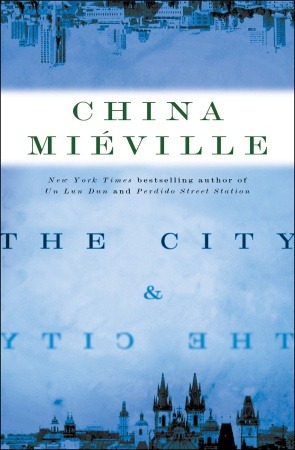
The City & The City by China Miéville

The City & The City by China Miéville is the third novel I’ve read that’s up for this year’s Hugo Award and my least favorite.  But don’t get me wrong, if I wasn’t comparing it against other stunning novels, The City & The City would stand out on its own as a major novel.  So far, I’ve read three of the six nominees and they’ve all been impressive. 

I really don’t want to say much about the story itself because the novel creates a rather unique fantasy world that readers should slowly assemble in their minds.  Please don’t read reviews or plot summaries of this story beforehand.

the-city-and-the-city  

The City & The City is a murder mystery, like the 2009 Hugo Winner, The Yiddish Policemen’s Union, by Michael Chabon, which was about another fantasy city, but one from an alternative history.  China Miéville’s cities might be considered from an alternative history, or just an extra invention for our own world we never learned to see.  I don’t know, but it’s extremely clever.

 Michael Moorcock at The Guardian sees the story as science fiction, trying to tie in string theory physics, but I don’t buy that.  Don’t read Moorcock’s review until after you’ve read the book, he gives away practically everything, but do read his review, it has a lot of good stuff to say.  A case could be made that The City & The City isn’t fantasy or science fiction.

The City & The City depends on believing something that’s pretty hard to believe, or imagine, although I think it would make a wonderful movie if it could be pulled off visually.  Miéville ask his reader to believe the mind is far more powerful than most people suspect.  I think the mind is capable of this kind of power.  I don’t know how psychological Miéville intends to be with his story, but I can read a lot into it.

How far can culture condition us?  We know suicide bombers commit horrendous acts because their beliefs have programmed their minds to see reality very different from the rest of us.  But how much do we perceive and not perceive from our training in childhood?

I am reminded of an experiment I read about decades ago.  Kittens were raised in two control environments.  One environment only had vertical lines, and the other only had horizontal.  After some months the cats were removed to live in a normal environment.  The kittens who grew up with only horizontal lines would walk into chair legs and other objects that were made up of vertical structures.   Kittens that were used to vertical lines wouldn’t jump up on shelves or chairs seats.  Whenever I think about this experiment I wonder what I don’t see now because I never learn to see it in childhood.

We follow Inspector Tyador Borlú, of the Extreme Crime Squad, as he searches for a murderer in a city of Besźel.  I had never heard of this city before.  Because I was reading a novel up for a science fiction award, I first thought it might be new pronunciation of one of our existing city’s name in the far future, but I was wrong. 

I’m not a mystery reader, but I have read several of the classics like The Maltese Falcon by Dashiell Hammett and Farewell, My Lovely by Raymond Chandler.  Cities are very important to the mystery genre.  In fact, I don’t care who commits the murder in mysteries, it’s the details of the setting and character that have to enchant me when I read one.  And it’s character and details I like in The City & The City

As an untrained mystery reader I can’t say how successful Miéville is at writing a murder mystery.  The City & The City is very readable and entertaining, but it’s not science fiction, what I am trained to read.  Nor do does it really feel like a fantasy novel.  It’s hard to categorize this tale, but I think it’s main appeal will be with mystery readers.  Oddly, it wasn’t nominated for the Edgar Award this year, so I don’t know if mystery readers are even giving it a chance.

This novel seems targeted to some unseen genre, like the cities in this story.  I think it was best summed up by Denise Hamilton at the LA Times, “If Philip K. Dick and Raymond Chandler’s love child were raised by Franz Kafka, the writing that emerged might resemble China Mieville’s new novel, The City & the City."

The City & The City is such an odd novel, that I’m having fun reading reviews of it after I finished it, to see what other readers made of this very different story.  That’s the strength of fantasy writing, writers can write about anything they can imagine, but all too often writers crank out the same old crap.  I make and rest my case with the current vampire craze.

JWH – 6/12/10

Lightspeed – A new science fiction ezine

Lightspeed is a new online science fiction magazine edited by John Joseph Adams.  Adams was an editor for the print magazine F&SF for nine years, as well as ongoing editor of many exciting theme anthologies, so he has lots of experience looking for good SF stories.  It’s an exciting time for short story writers as they transition to online and ebook markets.  Lightspeed is a good looking site, offering a number of innovative options, including audio versions of stories, as well as the ability to purchase issues in a variety of ebook formats, including Kindle, iBook, ePub and Mobipocket.

Lightspeed

Reading Lightspeed online is apparently free, with “Our regular publication schedule each month includes two pieces of original fiction and two fiction reprints, along with four nonfiction articles. Fiction posts on Tuesdays, nonfiction on Thursdays,” but you can buy the entire monthly issue for reading immediately on your ebook reader for $2.99.

I tried to buy the first issue online, with the hope of using PayPal, but aborted my order when asked for my address and no payment method was stated.  Since they take donations via PayPal that might be an option.  It would be nice if that information was at the top of the checkout page.

I’m thinking about buying an iPad, so I’m looking forward to seeing Lightspeed on the beautiful iPad screen.  I also discovered I can buy Lightspeed as a Kindle edition through Amazon and read it on my Kindle Reader for my iPod touch, so I purchased it that way for now.  That took less than 30 seconds, and maybe less than 15.  I wish all ebook magazines were this easy to get, and $2.99 is a very fair price I think.

I’m glad I didn’t buy the first issue online now because I would have had the hassle of downloading it to my computer, importing it into Stanza Desktop, and then going to my iPod touch and copying it over by WiFi.  The Amazon method was much more direct. 

So if you’re an ebook reader, check your different ebook stores for Lightspeed.  It would be helpful if the Lightspeed site had a page about all the various ways to get it on your ebook reader program and device.  This magazine is perfect for the iPhone crowd, and it would be extremely cool to see them combine their print and audio editions into an iPhone App.

I hope Lightspeed plans to distribute with Fictionwise because they are great at selling editions for almost any kind of ebook reading device, and they are a great site for getting all the major science fiction magazines in ebook editions.

Ebook editions might be the future of science fiction magazines.

JWH – 6/6/10

Nebula Awards Showcase 2010

WTF?  You’d think an anthology with Nebula Awards in the title would be filled with all the award winners and as many of the nominees as they had room to cram in.  Not this one.  It has the winners for each category, and even an excerpt from the winning novel, but all the runner-ups get the hook.  See this Locus page for the entire list of nominees.  Winning must be everything to the editor Bill Fawcett, but I like reading all the nominees for the awards because more often than not, I don’t agree with the voting.

Everything else in these 420 pages is padding, and there’s lots of it.  And to be honest, I also bought the volume for several essays that promised to be a history of science fiction in the 20th century decade-by-decade, but even on that count I was burned badly.  But for a book subtitle, “The Year’s Best SF and Fantasy” I’d have to say I’m extremely disappointed.

To give the publisher and editor the benefit of the doubt, most of the 2009 nominees were available on the net for free reading during the voting period – but so was lots of the padding, like a listing of all the Nebula Awards back to the beginning.  The non-fiction portion of this volume was so slight in actual information, with some essays showing no more work than blog level nattering, that I’d rather trade them all for fiction from the non-winning nominees.

On the cover and title page is “Nebula Awards Showcase 2010 – The Year’s Best SF and Fantasy – Selected by the Science Fiction and Fantasy Writers of America.”  From that I expected all fiction, no non-fiction filler.  I would also expect fiction that the SFWA endorses as their absolute best writing for the year.  Of course even this is confusing.  The title says 2010, because that’s when the volume is published, but it’s for the 2009 award year, for fiction first published in 2007 and 2008.  This volume contains two excerpts from novels that I wouldn’t have include either, to make more room for complete stories.  I would have called it Nebula Awards 44.

When I found Nebula Awards Showcase 2010 at my bookstore I thought cool, a good collection of stories to keep.  When I flipped through the table of contents and saw this listing of additional essays below, I bought the volume thinking it had two reasons to add it to be collection.

  • Early SF in the Pulp Magazines by Robert Weinberg
  • The Golden Age by David Drake
  • Science Fiction in the Fifties: The Real Golden Age by Robert Silverberg
  • Writing SF in the ‘60s by Frederik Pohl and Elizabeth Anne Hull
  • Science Fiction in the 1970s: The Tale of the Nerdy Duckling by Kevin J. Anderson
  • Into the Eighties by Lynn Abbey
  • Science Fiction in the 1990s: Waiting for Godot … or Maybe Nosferatu by Mike Resnick

These essays are really disappointing.  I’m sure part of their fault lies with my expectations.  I assumed in an anthology about great fiction, the essays would be surveys of the best fiction from each of the decades covered.  It appears the business of SF/F is more interesting to the SFWA writers. 

I was wanting to be reminded what were the best novels, novellas, novelettes and short stories from each decade.  How can you write an essay about SF in the 1960s and not mention the New Wave?  And, not mention work by Samuel R. Delany and Roger Zelazny, the two authors I think of as the decade’s brightest stars?  Delany won 4 Nebula awards in the five years they were given in the 1960s.

What I would have loved from these essays, is for their authors to list, with brief comments, the novels and stories that they felt were Nebula Award worthy before 1965, and for the years after that, comment on how the winners have been remembered and what stories have emerged as more memorable since the awards.

If the Nebula Awards Showcase 2010 had just included all the winners and nominees from the non-novel categories I would have been very happy with the collection.  It would have been a keeper, instead I’m going to leave it on the free table at work.

JWH – 5/31/10 

The Windup Girl by Paolo Bacigalupi

The Windup Girl by Paolo Bacigalupi just won the Nebula Award, and is one of the finalists for the Hugo Award to be announced at the end of summer.  Time, in their Top 10 Everything in 2009, called The Windup Girl the #9 novel of 2009.  Jason Sanford gave The Windup Girl five stars at SF Signal in his insightful review.  In fact, The Windup Girl gets so much great press I don’t think I should try to review it.  When I read Wake by Robert J. Sawyer, also up for this year’s Hugo award, it was so good I couldn’t imagine another novel beating it.  Well, The Windup Girl is such a tour de force that now I can’t imagine anything beating it.  I’ve got four more novels to read before September, including Julian Comstock: A Story of 22nd Century America by Robert Charles Wilson, that like The Windup Girl is another view of our world gone mad next century.

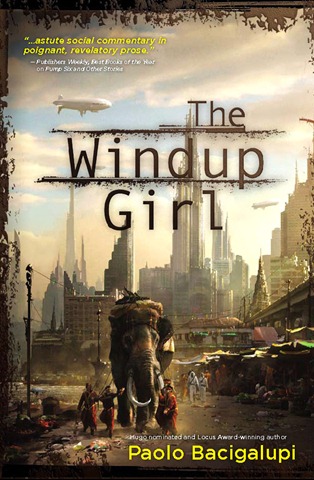
Look at the cover of The Windup Girl to see the future:

the-windup-girl-by-paolo-bacigalupi

Paolo Bacigalupi pictures the future without oil,  powered by weird clockwork “kink-spring” devices that stores kinetic energy, plagued by relentless blights on genetically engineered food crops, a future that struggles against the rising oceans and global warming, while enduring complex political intrigues.  But the most interesting aspect of this future is the new people, called windups, designed by gene splicing, who are outlawed and despised.  The title of the novel refers to an abandoned Japanese new person struggling to survive in Thailand as a sex slave.

As one of my reading friends told me, “The Windup Girl is dark.”  One reviewer even called it a dystopian novel, but I don’t think that’s correct.  Let’s just say it’s a very gritty future.  I suppose every century is full of hardships, so this future might not be any more bleak than the next.  If 19th century people could have read about a fictionalized but true version of the 20th century, they would think we lived through hell.  But the overall quality of life now is better than any time in the past, even though we might have millions complaining about how our present time sucks.

I really admire Bacigalupi’s creative vision of the future, but I don’t expect the 22nd century to be like The Windup Girl.  Our current problems, can be seen as evolving into the world of The Windup Girl, but on the other hand, I think by then we will have solved those problems and the 22nd century will have new problems we can’t imagine today.

No one can predict the future, but I’d like to believe in a future where we get smarter and solve our present problems.  But our world is diverse beyond any measure.  How would the past judge 2010 if they saw two films:  It’s Complicated and The Girl with the Dragon Tattoo?  One film shows the world as light-hearted and cheery, and the other as brutal and perverse.

If we read dozens of science fiction novels about the 22nd century, will they all be bleak?  I want life to be like Wake, where the problems are mathematical and scientific, which is why I liked that book so much.  I loved Wake, but I have to admire the creative writing of The Windup Girl.

JWH – 5/20/10