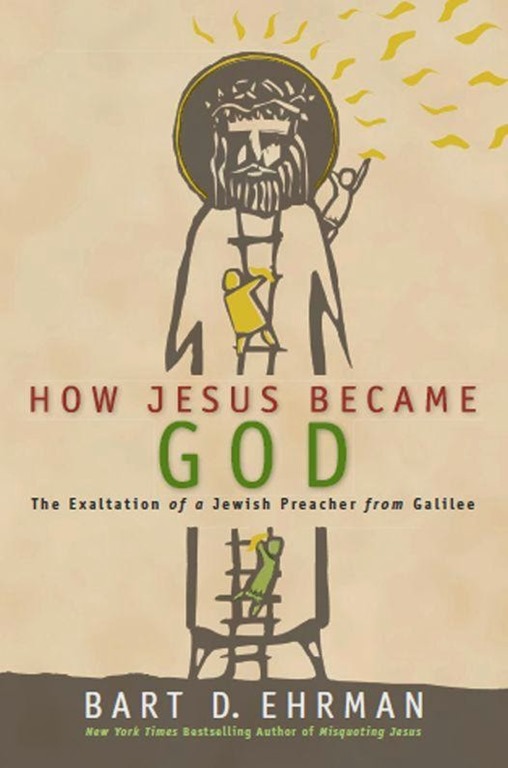
How Jesus Became God by Bart D. Ehrman

There once was a guy named Jesus.  He sounded like a pretty cool guy if you believed some of the savings he was supposed to have said.  Then his followers made him into God, and people became more interested in what was said about him, rather than what he said.  That’s too bad.  Bart D. Ehrman, has written a book that explains how Jesus became God after he died, and then became God while he was alive, and then became God before he was born, and then became God before any of us were born.  Ehrman’s book could have also been called When Jesus Became God, and to a very minor degree, it could have been called Why Jesus Became God.

I would have entitled it, Too Bad Jesus Became God.
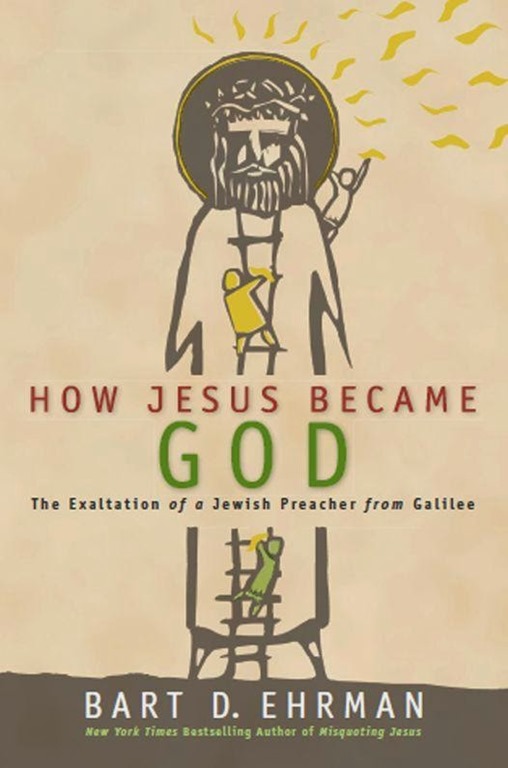
How Jesus Became God

How Jesus Became God is a history book.  It’s not about theology, but many readers will find it undermines their beliefs.  To be fair, Ehrman bends over backwards, constantly explaining how and why he’s writing history, wanting to avoiding any theological implications.  We’ll never know the theological truth in this life, but we can get ever closer to the historical truth.  By summarizing how the followers of Jesus changed their opinions about the man they worshipped in the decades and early centuries after his death, we don’t learn anything new about Jesus, but a whole lot about the history of Christianity.  Because Jesus left no primary sources about what he believed, we can never know anything about the man, all we can know is what other people thought about him long after he died.

I’m afraid when the faithful read this book they will bring their beliefs to the reading and that will distort what Ehrman has to say.  Ehrman  stands outside of Christian faith and ask the question:  How did Jesus become God?  He is a historian, so he makes no assumption whether Jesus is actually God or not, but analyzes what we know about early Christians to decide how they made Jesus into a God.  Ehrman uses textual analysis to date each idea about Jesus that emerged after his death, and to pick through the paltry facts like a CSI detective hoping to find additional clues.  Ehrman tries to answer two main questions.  First, did Jesus think of himself as God or divine?  Second, studying the writings of Paul, the four Gospels, and Acts, Ehrman asks, when did his believers think Jesus became God – at his resurrection, his Baptism, his conception, or from the beginning of all time?

Bart D. Ehrman introduces his book at Huffington Post.  It’s a good summary to read if you’re thinking about buying the book.  He opens with:

Jesus was a lower-class preacher from Galilee, who, in good apocalyptic fashion, proclaimed that the end of history as he knew it was going to come to a crashing end, within his own generation. God was soon to intervene in the course of worldly affairs to overthrow the forces of evil and set up a utopian kingdom on earth. And he would be the king.

It didn’t happen. Instead of being involved with the destruction of God’s enemies, Jesus was unceremoniously crushed by them: arrested, tried, humiliated, tortured, and publicly executed.  And yet, remarkably, soon afterwards his followers began to say that — despite all evidence to the contrary — Jesus really was the messiah sent from God. More than that, he was actually a divine being, not a mere human. And not just any divine being. He was the Creator of the universe. After long debates among themselves they decided that he was not secondary to the one God of Israel, the Lord God Almighty himself. On the contrary, he was fully equal with God; he had always existed for eternity with God; he was of the same essence as God; he was a member of the Trinity.

How did that happen? How did we get from a Jewish apocalyptic preacher — who ended up on the wrong side of the law and was crucified for his efforts — to the Creator of all things and All-powerful Lord? How did Jesus become God?

To Christians, Jesus is God, but to historians, Jesus is no different from any human in history.  Ehrman is studying the theologians and not the theology.  If you are willing to take How Jesus Became God as a purely history book it’s quite fascinating and illuminating about the early development of Western civilization.  If you are a believer, this book could be painful because it treats Christianity no different from pagan mythology that also existed in the first centuries of the common era.

I hope this won’t be insulting to Christians, but most of the ones I know aren’t very intellectual about their theology.  Most, just want to believe in God, an afterlife, heaven, and the promise they will meet their dead kin and friends again.  How that happens is inconsequential to them.  That’s why modern Christianity is based on faith and belief.  Reading How Jesus Became God will show there is a complex history of theology to how belief in believing evolved.  Ehrman makes an excellent case that while Jesus was alive, and even just after he died, Christians believed you had to do good deeds to get into heaven, and that Jesus did not think of himself as divine.  It took decades, centuries even, to evolve the theology that Jesus was Christ who existed since the beginning of time as God and believing in him will earn you eternal life in heaven.

This book is about how the followers of Jesus went from thinking of Jesus as a human being to thinking of him as the Trinity.  Ehrman documents this from what we know from history.  Unfortunately, most of what we know comes from The New Testament, Apocrypha writings, and Gnostic texts.  Ehrman’s history is really close textual readings because we have few outside sources about these events.  Christians might appreciate Ehrman’s careful delineations between the writings of Paul, the four Gospels, and Acts.  What it comes down to is Paul, and the writers of the four gospels had different ideas on when Jesus became God – resurrection, Baptism, conception or the beginning of time.  Then the early church fathers argued over these concepts for centuries.

That might seem like meaningless quibbling to most believers, but it does explain why the four Gospels differ.  The Gospel of Mark doesn’t include the story of the virgin birth, but that’s because it suggests that Jesus became divine at the resurrection.  The writers of Matthew and Luke seem to imply Jesus became divine at Baptism or conception.  To have Jesus become divine at conception you need the virgin birth tale.  The author of John recreates the ontology of Genesis to put Jesus as God back at the beginning of time.

Now I’m an atheist, but I find all of this fascinating.  And I might have a different take on Ehrman’s book, but since I’m not widely read in Christian history, I don’t know how common my questions are.  Jesus and his disciples were lower class folk, who were probably illiterate and spoke Aramaic and Hebrew.  The writers of the Gospels were educated, literate, and spoke and wrote Greek.  I’m wondering if they knew about Greek philosophy and if their theology is a mixture of Hebrew mythology, stories about Jesus, and Greek philosophy.  Is The New Testament a cold front of religion meeting the warm front of philosophy?

By the way, we’re leaving Ehrman and moving into my own ideas.  I’m into science, but science wasn’t invented yet.  At the time of evolution of The New Testament people had very few tools to understand reality.  The first, and oldest tool is religion.  Religion basically says “God did it” to any question about the mystery of reality.  Why is there thunder?  It’s a god.  How did the universe start?  God created it.  In terms of understanding the truth, religion offers no validity or real answers.  It’s all speculation and wild ideas.

Then came philosophy.  Philosophy assumes humans can figure out how things work.  Philosophy starts observing reality for clues, but all too often it comes up with bizarre theories for answers, and eventually these are contrived into elaborate beliefs.  Because philosophy uses logic and rhetoric, it gives the impression that it’s intellectually superior to religion, even though most of its answers about reality are hardly better than religion.  However, logic is sexy, so believers prefer philosophical answers over the dictates of religion, which is basically, “God did it.”  Paul is the Plato of Christianity, and Jesus is his Socrates.  And the guy who wrote The Gospel of John is out there, way out there, both mystical and philosophical, like one of the Pythagoreans.

From my perspective, Paul is the real creator of Christianity, but he lost control of his religion to the later writers of The New Testament.  What Ehrman’s book does is try to chronicle how these later writers change the scope of Christian theology.  Even more fascinating is the Gnostic gospels, which appear to try to take Christianity in even stranger directions.  What became Orthodox Christianity in the first four centuries of the common era is what worked best at selling a belief that took hold of the Western world for the next sixteen centuries.

Modern day believers of Christianity believe because they hear a few ideas in childhood that are so powerful it overwhelms all their thinking.  What Ehrman’s book attempts to do is explain how these memes got created.  Many other writers of Christian history attempt to do this too, but Ehrman seems to be particularly good at it, with clear writing, sensible logic and a humble attitude.  Ehrman has written a series of books that reflect a lifetime of careful research that explain how and why The New Testament was written.  He’s very knowledgeable about The Old Testament, but The New Testament is his specialty, his life’s work.

Most Christians aren’t interested in an intellectual history of their faith.  Their religion gives them a wonderful sense of community, beliefs that comfort them in life, and faith that assures them they won’t die, so they know they will meet their departed loved ones in the next life.  However, there are Christians, especially evangelicals and fundamentalists who are profoundly interested in the intellectually validity of their beliefs and will go to extremes to validate their faith.  Ehrman’s book will cause these people problems.  This gets back to my point about philosophy.  Philosophy appears to reveal the truth, but it doesn’t.  Science is the only system we’ve invented yet that reveals consistencies in reality that we can accept as being true.  What we’re experiencing now is the cold front of philosophy banging into the warm front of science.

What Ehrman brings to the table is history, a discipline that is far more consistent than philosophy, but still not science.  The fundamental faithful are strong adherents of philosophy, which includes rhetoric and logic.  They are confident these tools reveal the truth of reality.  But science is showing them that their philosophy is a very poor tool for understanding the truth of this reality.

What Ehrman has accidently taught me is fundamentalists love philosophy because The New Testament is a product of philosophy, and not religion.  The Old Testament was pure religion.  The New Testament is a hybrid of religion and philosophy, with the later writers of The New Testament being the most philosophical.

And it’s not that philosophy can’t be a useful tool, but it’s only useful if it incorporates the rigors of science.  Science depends on logic, and to a degree rhetoric, but is actually about consistency of observations.   Science, for the most part, can’t be used to verify theology, because most theology involves the metaphysical, which can’t be observed, tested, and is not falsifiable.

Christianity met up with Greek philosophy again when it kicked the Muslims out of Spain.  But that’s not part of Ehrman’s book.  I’ve always thought that was Christianity’s first encounter with Greek philosophy, but now I’m thinking different.  The New Testament writers were the first influence of Greek philosophers on Christianity, they just didn’t mention their educational background.

It would be fantastic to have a time machine and track down the real Jesus and give him a copy of The New Testament and How Jesus Became God.  I get the feeling he’d probably read them and say, “Hey, these stories are about a guy with my name,” and never notice they were about him.

I’m am reminded of stuff I’ve read by Karen Armstrong and Robert Wright, especially in A History of God and The Evolution of God.  The God of The Bible has gone though quite a lot of changes himself.  He’s a combination of several gods that slowly evolved over a very long period of time.  Each time one people would conquer another people, their gods would merge, or one would supplant the other.  To me, Jesus became God because Christianity supplanted older religions and had to incorporate or bury older deities, creeds, traditions, etc.  Jesus essentially becomes the new God that usurps the Jewish God of The Old Testament, in the same way Yahweh supplanted earlier gods like El, Asherah and Baal.

The early Christians had to do this to succeed and thrive, and boy did they thrive.  But it sure is sad that they lost Jesus along the way.  It would be interesting to compare the revisionists techniques in the Quran and The Book of Mormon to see how they try to supplant Christian theology.

I wish Jesus had written down his ideas like Plato.  To me, humans are interesting, gods are not.

JWH – 7/8/14

Why We Can’t Know Jesus

It’s almost a certainty that anything you think you know about Jesus is wrong because what you know has gone through two thousand years of constant reinterpretation with additional imagined added facts through suppositions and speculation.  And if by chance you held just one right fact, it would be impossible to know which one it was because there are almost an infinity of possible imagined facts about Jesus to confuse you.

I’ve read a lot of books about Jesus over the years, and I’ve come to the conclusion that it’s impossible for us to know the truth about what Jesus was like.  Absolutely impossible.  Every book I’ve read gave the author’s imagined interpretation of what Jesus was like based on all the books they had read, each of which was also an interpretation.  Since Jesus left no writings on his own, and all the gospels were written long after the fact, by people who got their information from hand-me-down sources, we have no foundation of verifiable knowledge to work with.  In fact, each of the four gospels are different, written at different times, with new interpretations and added material.

All this is obvious, and I should have concluded it decades ago, but the nature of Bible study makes it fun to try to figure out the truth.  Everyone wants to solve the puzzle and is only too eager to add their interpretation with new speculated possibilities.  Just look at how many early Christian sects there were, and how much the Catholic Church has changed over time, and how many differ protestant denominations there are, with their own splinter groups.  Every church has a different view of Jesus, and so does every human being.  There are billions of different  Jesuses – will the real one please stand up.  It reminds me of that old short story by Arthur C. Clarke, “The Nine Billion Names of God.”

rabbi-jesus

All this became more obvious to me when I was reading Rabbi Jesus: An Intimate Biography by Bruce Chilton.  Now, I’m an atheist, so you might be wondering why I’m reading a book about Jesus.  The origins of Christianity is a minor interest of mine, as a study of history, like how some people study classical Greece for a hobby.  I was intrigued by Rabbi Jesus because the book claimed to have a deep understanding of Judaism of the times, and to use current anthropological knowledge about the time period Jesus lived, to create a biography that jived with the Gospels.  Here’s a quote from Craig L. Blomberg in his review of the book:

There are strengths to Chilton’s work to be sure. Prompted by his editors he has eschewed formal, detailed footnoting for brief references to key literature for each chapter and has written in highly readable, even gripping prose. His descriptions of the customs and geography of Israel bring the stories of Jesus alive as few other writers have done. His portrayal of the probable thoughts, motives and behavior of such characters as Caiaphas and Pilate is more vivid and compelling than any I have read. Over and over again, one senses that one is seeing the Jewish milieu of Jesus more clearly and accurately than in countless other “lives” that have been produced over the centuries. But when one asks what Chilton actually claims Jesus to have said and done, in what sequence, for what reasons and by what power, most of the answers are at best speculative, without the kind of defense and documentation to make one convinced of them. At worst, they simply seem baseless. In a classic understatement, Chilton recognizes in his foreword that he “will doubtless make both Jews and Christians apprehensive” with his portrait of Christ (p. xxi).

Chilton is able to paint a very vivid picture of Jesus with lots of links to related established knowledge, yet in the end it’s all speculation even though the book is very convincing.  If you haven’t read very widely with similar books, this book would be very persuasive in making you think you knew Jesus better.

zealot

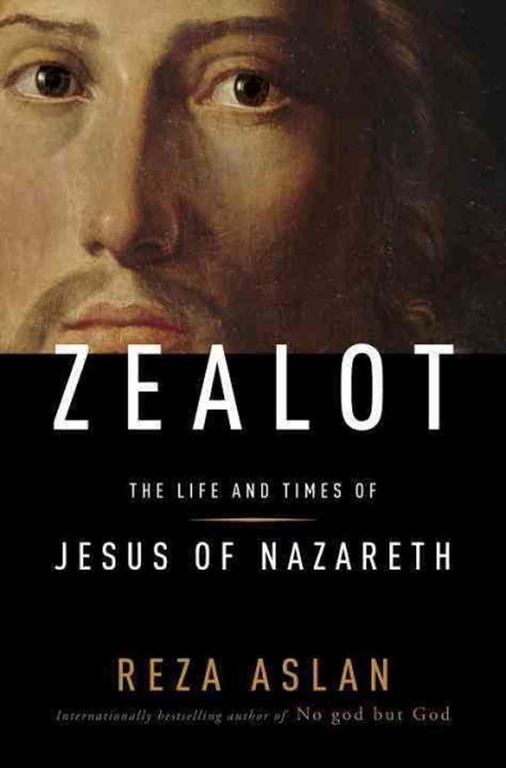
Another recent controversial biography is Zealot:  The Life and Times of Jesus of Nazareth by Reza Aslan.  Aslan is a scholar who takes another approach to finding the truth about Jesus.  That’s the game here.  Use all the available knowledge you can to paint a supposedly accurate portrait of Jesus.  But just read what Wikipedia said about the book:

Dale Martin writes in The New York Times that although Aslan is not a scholar of ancient Christianity and does not present “innovative or original scholarship”, the book is entertaining and “a serious presentation of one plausible portrait of the life of Jesus of Nazareth”. He faults Aslan for presenting early Christianity as being simply divided into a Hellenistic, Pauline form on the one hand, and a Jewish, Jamesian form on the other. Martin says that this repeats 19th-century German scholarship which now is mostly rejected. He also says that recent scholarship has dismissed Aslan’s view that it would be implausible that any man like Jesus in his time and place would be unmarried, or could be presented as a “divine messiah”. Despite these faults, Martin praises Zealot for maintaining good pacing, simple explanations for complicated issues, and notes for checking sources.[6]

Elizabeth Castelli, writing in The Nation, finds that Aslan largely ignores the findings in textual studies of the New Testament, and relies too heavily on a selection of texts, like Josephus, taking them more or less at face value (which no scholar of the period would do). Near her dismissive conclusion, she writes: “Zealot is a cultural production of its particular historical moment—a remix of existing scholarship, sampled and reframed to make a culturally relevant intervention in the early twenty-first-century world where religion, violence and politics overlap in complex ways. In this sense, the book is simply one more example in a long line of efforts by theologians, historians and other interested cultural workers.”[7]

The summary of these two reviewers shows that speculation about Jesus is a kind of academic game to scholars, but to religious people, knowing who Jesus was is very serious.  These two books give us two different Jesuses.  Both are from scholars claiming to work with the latest knowledge about the past.  Both books seem to present reasonable results.  If you read a hundred scholarly books about Jesus and they all invent a different Jesus, who is right?  Do you just average the 100 and assume Jesus was something like all of them?  Or assume he was like none of them?  If it was possible to extrapolate what Jesus was like from current knowledge don’t you think most of those 100 books would produce a standard Jesus?

Most of the faithful ignore modern books and just study The New Testament.  But if you study New Testament scholars like Bart D. Ehrman and his latest books you’ll only feel doubtful about what is actually supposed to be the word of God.

How Jesus Became God

I’m quite a fan of Ehrman having read Jesus, Interrupted, Misquoting Jesus, and Forged, and was about to buy and read How Jesus Became God, when I stopped to think about what I’m writing here in this essay.  Why read another book about Jesus?  Well, this one promises to be a history of the history of Jesus, so it’s not quite the same, but I’m now asking myself should I give up even studying the history of this whole era.  To me studying the early centuries of Christianity is like studying how half the world went insane believing a massive fantasy about a guy they can’t even know, but think they know through the lies they believe are the truth.  It’s like driving past the largest car wreck ever and trying not to look.

One reason I keep reading books about Bible history is I’m trying to completely exorcise Christianity from my brain.  Forced early exposure to Christianity caused mind-washing at the lowest levels of my brain and I’m trying to deprogram myself.  Every time I read another Ehrman book I delete a few more lines of old code running in my head.

I keep wondering when is humanity going to be free of the evils of religious fantasies?  Then I hear about the Sunni-Shiite conflict in Iraq and realize probably never.  Many atheists hope by studying religion they can explain it’s illogical nature to its believers.  But would any amount of facts convert Iraqis away from their war?  Would any number of lectures convert evangelicals to science?

I’m starting to feel that completely ignoring religion is my best course.  I’ve sufficiently deprogrammed myself that I’m now free of such thinking.  And I don’t feel obligated to deprogram others—I think that’s something you must do for yourself.  Wouldn’t I be better off mentally, and more productive if I studied other areas of history?  I think society has a sense of guilt about knowing all history, or a sense of obligation.  But how much history do we really need?  Wouldn’t I be better off studying the history of science and mathematics?

I think I’m over trying to figure out who Jesus was for whatever reason.  It’s all speculation.  Jesus is impossible to know.  If only they could invent a time machine to go back and filmed his life, then we’d have the answer, but that ain’t going to happen.

JWH – 6/25/14

The Science of Faith

cosmos3

I am writing this in response to attacks on the TV show Cosmos by religious believers.  Cosmos represents a litmus test about the public’s understanding of science.  The series represents an overview of what science has learned in the last four hundred years.  Despite all the efforts of modern secular education, I think many of the ideas presented in Cosmos are new to a majority of the public.  Science and technology succeed in our society without the majority of the population even understanding it.

Cosmos represents a good consensus of what science knows about reality, and yet it is often in conflict with many people’s personal beliefs about how reality works because of their religious education.  Whether they accept it or not, science is in direct conflict with religion.

16_religionist_symbols

Religion is wildly popular  because people want to believe.  People want to believe because of psychological needs.  Religion is 100% hope for certain fantasies to be true.  Believers validate their beliefs by getting other people to share their hopes.  But, what if the faithful applied the rigor of philosophy and the discipline of science to their religion?  Truth about reality is revealed not through our personal desires, but through what works for all people.

Why are there so many different religions, sects, creeds, beliefs if they are true?  They can’t all be true.  Why is there little consensus among believers, and much contention and hatred?  Religious wars are infamous for their cruelty.  Now the faithful feel under siege by science.  And some even invent pseudo-sciences to defend their beliefs.  If their beliefs were an actual feature of reality wouldn’t they be universal and testable?

Instead of attacking science, or making up fake science, the faithful should apply science to their beliefs.  First, they should find the core beliefs they all share and develop a consensus as to what is true about God or gods.  Anything your religion believes that all the other religions don’t, should be immediately crossed off the list of things that are probably true.  If something is universally true, it should be universally believed by all people.  False beliefs can be infinite because we can imagine anything, but universal truths should be finite because reality only works one way.  What are the universal truths in religious beliefs?  If a religious concept doesn’t apply to all humans on Earth, or even all aliens on every planet in the multiverse, then it should be doubted.

Science works by seeking such universal truths, and this is why the faithful feel under attack.  Not only does science work in a consistent manner, with a fantastic track record, but it’s truth works the same for Americans and Chinese, for Russians and Iranians.  Catholics, Protestants, Jews, Muslims, Buddhists, Hindus can barely agree on anything amongst themselves, much less with other religions.  If the religious really want to prove themselves, they need to band together and make one religion.  The obvious reason why religion is false is because there are too many of them.

If you are a firm believer in any metaphysical concept, you have to consider it a desire on your part unless you can find consensus with others.  That’s why religious people are so big on converting new recruits.  Getting someone else to believe like you do, validates your own fantasies.  If you really want to believe in something that’s true outside of your head, you need to be more scientific.  Any belief you hold that isn’t shared by a majority of the other seven billion people on this planet should be considered suspect.  Science succeeds because it’s under constant suspect.  Ideas have to taking a beating and keep on ticking – by everyone.

Even if six billion believers get together and form an absolute consensus on Laws of Religious Concepts, it won’t necessarily mean these beliefs are true without additional proof.  If the consensus is there is one God and that God listens to everyone’s prayers, then you need to test this hypothesis.  Let’s say every day six billion people all pray for the same unique thing each day.  If the prayers are answered repeatedly over years, then you can assume your theory is correct.  If it is not, you will have to alter your theory to there is a God but he doesn’t listen to people.  You will need to find a way to test this hypothesis.

However, even without scientific proof, the beliefs of the faithful can never be considered real unless they find more consensus.  Religious minded people would help their cause if they sought agreement rather than constantly splintering into smaller groups.  You can’t beat science by altering the rules of science.  You can’t beat science by lying about it.  You can’t beat science by putting your head into the sand.

I can think of two beliefs that a majority of religious believers might embrace.  One, there is a creator.  Two, the Golden Rule.  And those two might still cause a lot of arguments.  But beyond that, there is little agreement among the faithful.  Which to me, means there’s little reason to believe them.

Instead of attacking science, the religious should embrace each other.  You can’t elevate religion by undermining science.  Religions have always succeeded by war – by killing the unbelievers.  If you want to prove your religion is true, prove what you believe, not what everyone else believes is false.  Science succeeds because it proves what’s true, what works.

My challenge to the faithful, start proving your beliefs work universally.  I’ll consider the first step towards that proof when all religions become one.

JWH – 4/7/14

Who Is Watching Us If There Is No God?

One of the prime appeals of religion is a father figure who watches over everyone and everything.  I’m a lifelong atheist, so I don’t think about a personal God who listens and watches over me.  Yet, I know that the faithful need a higher power they feel is watching over them.  That desire to be noticed is very important to most people.  People cling to the concept of God for just a few reasons despite all the endless varieties of religions and their verbose theologies.  They don’t want to die, they want to be protected, they want someone to always care about them, and they want divine justice.

Last night I watched TB Silent Killer on the PBS documentary series Frontline.  This incredibly intense show on drug resistant tuberculosis in Africa was very hard to see, but I think very important not to miss.  Follow the link to watch the show.  It answers my question:  Who is watching us if there is no God?  We have to watch each other, either personally, or by films like this, or on the news, or by any other form of journalism, and even by the Internet and smartphones.  People have always wanted a God to watch over us, but as we evolve and learn about the scientific nature of reality, it’s obvious there is no father figure watching us 24×7.

What people want is to be saved from death and suffering.  The people in TB Silent Killer suffered greatly for months and years, and often died.  They felt no one was watching, that no one cared, and most importantly, no one would rescue them from their fates.  And they hated the unfairness that they were sick when others were not.  It wasn’t a just reality to them.  Watch this film to see how deeply you care, and contemplate possible answers.

As a self-aware species, and as we become enlightened and realize there is no magic in the sky, we have to learn how to create substitutes for all those hopes we put into God.  We really do want a superior being that cares for every sparrow that falls from a tree.  I can understand that desire.  I believe the human race has to become its own father figure.  We have to care for everyone else on Earth, and for all the animals too.  We have to learn to answer each other’s prayers.

frontline

At end end of the show they asked each person what hope they had.  Most of the people were waiting for death, for after years of suffering, their hope of being rescued was long gone.  But the little girl they featured, Nokubheka, said she wanted people to invent safe pills that would cure TB.  She had been taking highly toxic medicines for months.  And she was right.  The way to answer her prayer is for science to find a cure for TB.  That should be something everyone wants because TB is airborne and it’s fast becoming drug resistant.  The show teaches about MDR TB (multi-drug-resistant TB) and XDR TB (extensively drug-resistant TB).  Remember how AIDS began in Africa, well it was a hard to spread retrovirus.  TB is very easy to spread, and it’s airborne.  You don’t have to have sex with the infected to catch it, just stand near them.  Yes, you should watch this show.  You should care.

While watching the show I also wondered how else we could help these people, or anyone that suffers a horrible disease like them.  All the victims in this documentary talked about being lonely, afraid, isolated, and bored.  Because of their contagion, they have to be isolated, but I wondered if they would have been happier if they had the Internet or smartphones.  Maybe a charity could be created that provides a social network for the sick and dying – one that would create a sense of being watched and cared for.  Call it The Sparrow.  It might even be a substitute for the desire to have a caring father figure watch over them.

When it comes down to it, we can plead for magic from an invisible being, or we can answer our own prayers with our own real abilities.

JWH – 3/26/14

The Theological Implications of the Multiverse

Because of recent research in gravity waves and inflation, the theory of the multiverse moves further toward reality.  While creationists are still fighting for equal time to oppose the 1859 theory of evolution, science has gone on to discover endless other aspects of reality that counter the Biblical view.  I don’t know why creationists focus so exclusively on evolution when millions of other scientific discoveries are also thorns in their theological sides.

When humanity thought the Earth was the center of everything, contained within the celestial spheres, it was possible to imagine our reality being constructed by a super being, especially if you believed the whole thing was only 6,000 years old.  Even then it was an extremely far out idea to buy.  After the sun was moved to the center of the universe, and Earth was just the third planet, it became a lot harder to imagine a God that could create the solar system with some kind of magic spell.  For a long while after that, we assumed all of reality was the Milky Way galaxy.

As reality got bigger, it got harder to imagine a single being creating it.  But still, reality was manageable with just a billion stars.  Then Edwin Hubble came along and showed us reality is composed of billions of galaxies.  How can any theology handle a reality that big?

If we live in a multiverse, it might not be billions of universes, but an infinity of them.  Or there might be another layer, so there are billions of multiverses in a megaverse.  It seems science can’t find any end to large or small, nor a beginning of time.  This has got to wipe out all ancient theological theories.  It’s time to start over.  Reality is too big for any kind of God, and we’re too small for any kind of special consideration.

Humanity needs to start over and throw out all theology and come up with a new working hypothesis about our place in reality.  Instead of thinking of ourselves as the crown of creation, we need see ourselves closer to an intelligent virus that accidently came about through random evolution with no  higher being watching.  Seen from orbiting telescopes, humans are little smudges that have infected this planet.  We’re quite deadly, killing off most of the other life forms on Earth.

We have a decision to make.  Shall we take responsibility for our actions?  There is no God judging us.  We only judge ourselves.  And it might not even be possible for our species to become fully conscious of its actions and act.  We might breed ourselves out of existence.  It should be pretty obvious to all by now that no God will intercede.  We will not be punished if we don’t act, nor will we be rewarded if we do.  We merely can choose to act.  We can preserve ourselves, other species, and the planet Earth – for a while. 

Nothing last forever in the multiverse.

Please read.

JWH – 3/24/14