The Swerve: How the World Became Modern by Stephen Greenblatt

The Swerve by Stephen Greenblatt is subtitled “How the World Became Modern” but I don’t think that’s accurate.  The Swerve is a history of a book, On the Nature of Things by Lucretius, born 99 BCE and died 55 BCE.  And On the Nature of Things is about Epicureanism, which is based on the teachings of Epicurus, a Greek philosopher born 341 BCE and died 270 BCE.  The Swerve is about the evolution of an idea that’s taken a long time to emerge.  I would have subtitled the book, “The Evolution of Atheism” – although that wouldn’t be a perfectly accurate subtitle either.  Epicureanism is not atheism, but the roots of atheism lies in Epicureanism.  Epicurus and Lucretius figured gods might exist, but they also thought the gods didn’t care about us, and religion was all a bunch of hooey that people used to fight their fear of death.

swerve

What The Swerve tries to chronicle is the idea that religion has held a tyrannical grip on mankind for thousands of years and Epicurus and Lucretius were among the first to say, “Hey, religion is all nonsense and reality is much different from what religion says it is.”  Lucretius wrote all this up in his book On the Nature of Things, but the Catholic Church suppressed his ideas and the book became forgotten for 1400 years until On the Nature of Things was rediscovered in January 1417 by Poggio Bracciolini.  Bracciolini was a humanist scholar and papal secretary, and The Swerve is his story too.  Bracciolini made copies of On the Nature of Things that went on to inspire many of the great men of the Renaissance, and many more great thinkers since then.  Thus, the subtitle, how the world became modern, or how I would think of it, how atheism took root.

I’m an atheist, so this is a thrilling history for me.  If you are a theist, and among the faithful, The Swerve might be more challenging to your faith than The God Delusion by Richard Dawkins, even though it’s not about atheism and skepticism.  I’ve always found studying the history of the Church to be more undermining of its ideas than attacking its cherish beliefs directly.  The Catholic Church does not come off well in this story, and Greenblatt isn’t even trying to be critical.

Just the stories of Hypatia (d. 415), who was murdered by a Christian mob, and Giordano Bruno (1548-1600) who the Inquisition burned at the stake is enough to make me judge the Church harshly, but the stories on several of the Popes and practices at the Papal Count are downright damning.  And the history of Catholic Church destroying libraries, burning books and suppressing ideas are acts of evil against humanity in my mind.

Most people think of early Christians as those meek folk eaten by lions in the Roman coliseum.  The reason the Romans persecuted Christians was because those early Christians refused to coexist with other religions and demanded their religion be the only true one.  And for the first four centuries of the Christian era, it was about one group of Christians stomping out other Christians in a survival-of-the-fittest theological free-for-all.  The orthodox Christianity we know today exists because of it’s aggressive tactics on fighting heretical Christian sects.  Not only did they use book burning, but they also used forgery, smear tactics and killing to get rid of the ideas and thinkers they didn’t like.

In terms of thought control, the Catholic Church makes Communist regimes look like children at play.  And I don’t want people think I’m attacking just the Catholic Church, but it was the only church during this time period.  The Catholic Church inspired violent fanaticism like we see in Islamic countries today.  The mob that attacked Hypatia acted just like the Islamic mob in Afghanistan recently when they went on a rampage after the Koran was burned.

It’s a miracle that a copy of On the Nature of Things survived 1400 years of the Catholic Church, and when it was rediscovered that it wasn’t immediately destroyed and all the people who had read it killed.  If the church leaders at the time had known what it really meant they would have done that.  However, it was seen as a ancient poem from Classical Rome that reflected Greek philosophy.  After Islam was pushed out of Spain, Greek philosophy was rediscovered by the Catholics and re-interpreted for Christian philosophy.  Stephen Greenblatt does cover how some of the faithful tried to re-interpret On the Nature of Things to make it Christian, but it took them awhile to realize what an explosive book they had to deal with, and they failed.

A good portion of the narrative in The Swerve is about Bracciolini’s book hunting, and about the rise of humanism in the early days of the Renaissance.  Smaller portions of the book deal with Rome at the time of Lucretius and how On the Nature of Things influenced people after its rediscovery.   One of the more fascinating parts of the book deals with the Villa of the Papyri library at Herculaneum.

This kind of book history is delicious reading for me, and I wouldn’t have minded if the The Swerve’s 263 pages had run to a 1,000.  Greenblatt provides almost 70 pages of notes and bibliography for those who want to read deeper into this history, and I do.  This is one of those books I wish PBS would make into a 10 part series.

The Ideas of Epicurus and Lucretius

It is hard to separate the ideas in On the Nature of Things from originating with Lucretius or belonging to his philosophical hero Epicurus.  And it will hard for me to separate the details I learned from reading The Swerve and the actual details in On the Nature of Things.  I bought an audio edition of On the Nature of Things to listen to, but I haven’t heard it yet, plus I’m going to listen to an English translation.  This is one time where I wished I knew Latin so I could read the original and decide for myself.  The concepts Lucretius puts forth are amazingly modern and even prophetic when you realize that science wouldn’t back him up for more than sixteen centuries.  His basic beliefs were:

  • The universe is a physical reality made of atoms and there are no metaphysical worlds
  • Everything that happens in the physical world have explanations that can be understood – there is no magic
  • Religion is make believe and a delusional system to sooth people’s fear of death
  • We are not immortal.  We die.  The universe is eternal, but not everything in it.  There is no heaven.
  • Everything in the universe is made of atoms and their properties dictate the nature of things
  • We should accept that we are going to die and learn to appreciate the life we have
  • Avoiding pain and pursuing pleasure is natural – but he didn’t advocate hedonism.

You can read the poem here at Gutenberg, but it takes effort.  Here is a sample of the English translation.

                            Whilst human kind
     Throughout the lands lay miserably crushed
     Before all eyes beneath Religion—who
     Would show her head along the region skies,
     Glowering on mortals with her hideous face—
     A Greek it was who first opposing dared
     Raise mortal eyes that terror to withstand,
     Whom nor the fame of Gods nor lightning's stroke
     Nor threatening thunder of the ominous sky
     Abashed; but rather chafed to angry zest
     His dauntless heart to be the first to rend
     The crossbars at the gates of Nature old.
     And thus his will and hardy wisdom won;
     And forward thus he fared afar, beyond
     The flaming ramparts of the world, until
     He wandered the unmeasurable All.
     Whence he to us, a conqueror, reports
     What things can rise to being, what cannot,
     And by what law to each its scope prescribed,
     Its boundary stone that clings so deep in Time.
     Wherefore Religion now is under foot,
     And us his victory now exalts to heaven.

The Stanford Encyclopedia of Philosophy has a nice summary of Lucretius and his ideas from On the Nature of Things, and how the book is structured.

Alternate History

What would life be like in the 21st century, if Lucretius’ ideas had caught on 2,000 years ago instead of Christianity?  That instead of getting caught up in a heaven craving fantasy we all started studying reality to see how it works.  What if the age of science had begun sixteen centuries earlier?  Greenblatt wants to subtitle his book “How the World Became Modern” but we’re not all Epicureans yet.  Religion still controls the minds of the majority of the human minds on Earth.  It keeps the faithful from seeing reality. For example, global warming.  We’re on a self-destructive path, but the faithful refuse to see that because they are still blinded by reality distortion field of religion.  People who believe like Lucretius are a minority.  But what if they were the majority?

JWH – 3/10/12

What If I Only Bought Books Just Before I Read Them?

I’ve always bought books far faster than I could ever read them.  That’s always been true for physical books, and it’s even truer for audio books and ebooks.  I just can’t pass up a bargain, like Audible.com’s recent sale that priced hundreds of audio books at $4.95 each.  I bought 10 and I’m thinking about buying more, even though I have 60-80 audio books I haven’t listened to yet because of previous sales.  Now my Kindle is filling up full of ebooks waiting to be read.

Amazon has been offering 100 ebooks each month for $3.99 or less.  Plus Books on the Knob keeps me informed of a constant stream of free ebooks and ebooks at bargain prices.  And SFSignal announces almost daily free SF/F/H ebooks to try.  There are so many free ebooks deals out there, and not just crappy books, but books worth reading, that it would be possible to never buy another book again.

I already own more books than I have time to read even if I lived to be 100.  I’m a book addict.

IMG_0894

I know why writers and publishers give away ebooks.  They want exposure.  New writers wants readers.  I’ve read blogs by new writers who say when they price their books free hundreds and even thousands of them get downloaded.  Of course, they also say, when the put a price back on the books, the downloads slow to a trickle, but that trickle is more sales than they got before they offered their books for free for a few days.  Even established writers offer some of their books for free hoping to get attention for their other books.

I’ve yet to read any of the free ebooks I’ve collected.  And I’ve only read a handful of the bargain priced ebooks.  And I wonder if I’m typical?  Does free ebooks just inspire a kind of hoarding and not reading?

If I was practical I’d only buy a book just before I was ready to start reading it.  Now this is like believing I’m only going to eat food that’s good for me, but it is quite logical.  Even if books were $50 each I would save a tremendous amount of money if I only bought books I actually read.

What if all readers actually followed through on this practically plan of book buying?  What percentage of book sales go to unread books?  What percentage free books get read?

Maybe I just like shopping for books.  Maybe I just like reading book reviews.  Maybe I could find a way to collect books I want to read but probably won’t, without buying them.  I’m in a book club and I made up a list of potential books to read and found that very enjoyable.  I even like rereading the list.  I could build a virtual library of the books I think I want to read.  Growing up I wanted to own a bookstore.  Maybe that’s why I hoard books.  I also worked in a library for years – that could also explain my instinct to collect books.

If I bought books only just before I read them would I feel the need to collect them afterwards?  If I become just a reader can I divorce myself from my collecting instincts?

Also, if I bought books just before I read them how would that change my life?  I’d have more money and time, but what about the subtle changes?  I spend a lot of time shopping for books, reading reviews, looking for bargains.  There’s a table at my work we’ve designated as the free book table and people bring in books they want to give away and leave them on the table.  I’m all the time looking through those books, often taking many, but seldom reading them.  My public library has a used bookstore within the library that I like to visit too.  I guess if I spent less time shopping for books I could actually read more.  And I’d spend less time pouring over online sales and book catalogs.

All of this sounds very practical and positive, but I don’t know if I can give up my book hoarding addiction.

JWH – 3/10/12

A Universe From Nothing Lawrence M. Krauss

As far back as I can remember I’ve often contemplated why there is something rather than nothing.  And by nothing, I don’t mean empty space, because even that would be something.  I finally decided that nothing can’t exist.  That it’s impossible for “nothing” to exist, because if it could, we wouldn’t be here, and there would be nothing.  I concluded that reality is all the possible some-things coming into being. 

When I first saw a copy A Universe From Nothing by Lawrence M. Krauss I wondered if he had a scientific theory to explain why nothing cannot exist to support my own philosophical theory.  Sad to say, he doesn’t actual work with the same concept of nothing as I imagined it, but I think he’s getting close.  Theology has always been burdened with the question that intellectual pesky kids eventual ask, “Who created God?”  Smart kids will also ask scientists, “What created the Big Bang?”  Sooner or later the ontological question has to be:  “How did something come from nothing?”

Cosmology has always invaded the territory of theology and Krauss does not shy away from this conflict.  In fact, Christopher Hitchens had promised to write the introduction to A Universe From Nothing, but he died too soon, so Krauss got Richard Dawkins to write the afterward, which uses the science in this book to attack theology rather sharply.

It seems like every popular cosmology book I read has to reiterate all the cosmological discoveries since Edwin Hubble figured out that nebulae are galaxies existing outside of the Milky Way, and they are speeding away from us.  For a short 224 page book, Krauss gets the background covered quickly and moves on to the title topic, but it requires the reader to grasp quite a bit of recent research.  To understand nothing requires understanding a lot of some-things.

Now here is where I wish I had the writing skills of Brian Greene, my current favorite science writer.  Of course, if I had such writing skills I’d end up writing a book much like what Lawrence M. Krauss wrote – however, I’d still like to summarize what I learned from reading A Universe from Nothing.  I’ve lost count of how many books I’ve read on cosmology, or documentaries I’ve seen, but I feel the need to summarize just to get things straight in my head by listing them on paper.

And if Krauss and Dawkins are right, and cosmology deposes theology, then the average person needs to learn a lot to catch up with science.  Cosmology is science’s Book of Genesis.   But unlike the Bible myths, cosmology explains how the universe came about by studying the evidence, a lot of evidence, a whole lot of evidence.  And for some concepts, like the Big Bang, there are multiple paths that prove the theory that makes the scientific research more and more definite.  This is a lot of learn and its no wonder that most people prefer the Bible to answer their origin questions.

Here’s quick and dirty study guide to modern cosmology.  The more you know will make understanding A Universe From Nothing easier to understand and comprehend.  Also, it’s impossible to understand cosmology without understanding particle physics.

Now this is a lot to learn, and even after reading many books I only have a vague layman’s idea of what’s going on, but what’s fascinating is how everything interconnects.  Reading A Universe From Nothing just inspires me to read more, to keep putting more puzzle pieces together to get the big picture. 

Just take what we’ve learned about the cosmic microwave background radiation in my lifetime.  Reading The First Three Minutes by Steven Weinberg and The Very First Light by John C. Mather tells the long story of how the CMB was theorized, discovered, and measured to finer and finer accuracy.  The Very First Light is about building the COBE spacecraft to measure the CMB.  Then I read about the Wilkinson Microwave Anisotropy Probe that studied the CMB with even more accuracy.  Then there was Planck spacecraft that explores even deeper.  If you aren’t familiar with the cosmic microwave background radiation then I beg you to study it.  It’s a near perfect example of how science works.   Just look at the list of the major experiments studying the CMB.  This history shows how experiments are constantly refined and evolved to find more evidence, or how to look for evidence from other sources, or from other approaches.  Science is a beautiful Chinese puzzle where the pieces interlock in elegant ways.

Don’t worry about not knowing mathematics to enjoy reading about cosmology.  Most of the popular science books are about the men who invented the mathematics, and their stories are told by the experimental evidence.  Their numbers are validated by real world experiments and applied engineering.  Did you know that GPS systems in your smartphones depend on mathematics that involve relativity?  Without Einstein’s equations they wouldn’t work.

Back to the book – does Krauss explain how something comes from nothing?  No.  But he does explain the current theories on dark energy, which suggests that powerful forces come from apparently empty space.  Of course, once we understand how dark energy, and dark matter work, they won’t seem like nothing anymore – they will be some-things.

The nothing Krauss is talking about are just some-things that science can’t see right now.  The nothing I say can’t exist is pushed further back into the unknown, into the multiverse.  Like the kid who asked who created God, I’m asking what created the multiverse, but if science could tell me, there would still be another layer of unknown to explore.  It’s still turtles all the way down.

Other Reviews:

JWH – 2/24/12

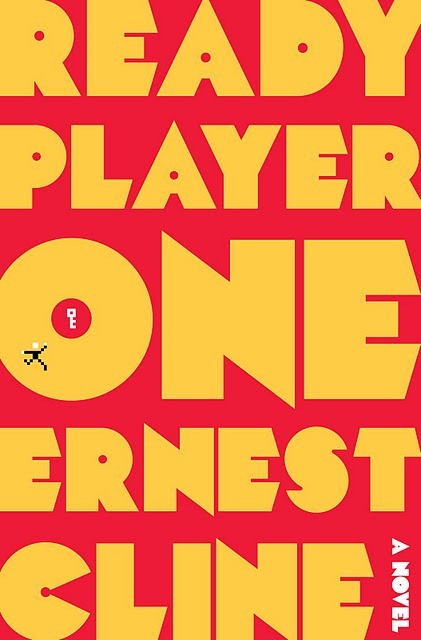
Ready Player One by Ernest Cline

If you were a teen in the 1980s, loving Sesame Street, the Muppets, Atari 2600 games, John Hughes movies, D&D, MTV music, Zork, and nerdy Commodore 64s, then I have a book for you:  Ready Player One by Ernest Cline.  I lived through the 80s too old to play D&D but I dug the music, films and computers.  Cline made me terribly envious I hadn’t grown up in his decade.

Ready_Player_One

I wish I could understand why this book was so much fun to read!  I’d use the formula to write bestsellers.  This story reminds me of a hip new version of Citizen Kane that doesn’t take itself so seriously.  Set in mid 21st century, aging billionaire James Halliday dies leaving a rather unique Last Will and Testament.  Halliday made his fortune developing a virtual reality universe called OASIS that most people use to attend school, work and play in because the real reality is rather bleak.  Halliday’s avatar tells the world he’s worth over $200 billion and that the first person to find his Easter Egg in the OASIS will win his fortune and company.

Now this gets the attention of the world’s foremost video gamers, as well as corporations hot to own the OASIS.  Our story begins with Wade Watts, a poor kid living in the trailer park from hell, whose only access to OASIS comes from his public school gear, but in his own 21st century Horatio Alger, Jr. way climbs out of poverty to compete with legendary gamers.

The contest designed by Halliday is hard, so hard that no one gets anywhere for five years.  It becomes obvious that the clues are hidden in Halliday’s childhood, just like Charles Foster Kane’s secrets, and only the most obsessed fans of 1980s trivia have any chance of solving the puzzles.  Ready Player One is perfect for people who grew up in the 1980s, but the story is so well told bookworms from any decade will love it.

I wonder how many people born forty years after the the 1980s will ever find our times so fascinating?  It would be like me devoting my whole life to the 1910s – but wait, I am madly in love with Downton Abbey.  And just look at the success of Steampunk!

This might be the clue to Cline’s success – creating great characters set in an fantastically detailed milieu, because if we had an OASIS system to visit, I think we all would find virtual worlds based on the past quite seductive.  Nostalgia is a powerful emotion.  At work the favorite topic of guys my age is music from the 1960s and 1970s.  I’m in a classic science fiction book club where we read and reread books from the 1940s-1970s.  Start paying attention to movies (Hugo, Sherlock Holmes, TinTin, War Horse) as more are set in the past.  Maybe it’s the bad economic times and we just need escapism.  Ready Player One sure made me forget about now.

Other Reviews and Sites – probably to read after reading the book

JWH – 1/12/12

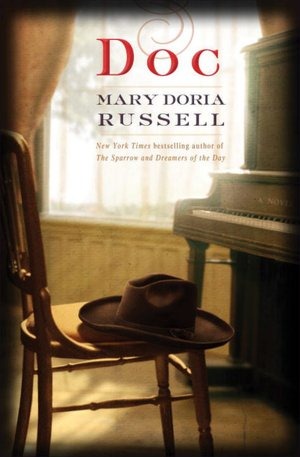
Doc by Mary Doria Russell

Doc is John Henry Holliday, legendary figure from the old west and most famously remembered for standing with Wyatt, Morgan and Virgil Earp at the gunfight at the O.K. Corral in 1881 as Doc Holliday.  All too often fictional accounts of famous people of history tend to be heavy on the fiction and light on the history, but this ain’t so with Doc, the new novel by Mary Doria Russell.

doc

To see how serious Russell treats the history start reading her blog at Starting the Next Novel.  Blogs are annoying for reading older posts, but if you start here and read forward with the link at the bottom of the article, you’ll be able to track her comments about writing Doc and the next novel dealing with Wyatt.  Russell even took a five day horseback ride that recreates Wyatt Earp’s Vendetta Ride.  But keep reading her blog and you’ll be charmed by Russell and understand how she put so much biographical research into her fictional character.

Even covering this material in a nonfiction books like The Last Gunfight by Jeff Guinn it’s very tricky painting a portrait of a real person.  History leaves a limited set of facts that’s never enough to be definitive.  Like I said in Nonfiction, Fiction, History, Myth and States of Consciousness it’s extremely hard to discern nonfiction from fiction, and history from myth but Mary Doria Russell makes a climbing Mt. Everest effort to portray John Henry Holliday as fully and accurate as possible in the context of a novel.

I enjoyed this story immensely.  I’ve read many books and seen many movies about Doc Holliday and the Earps and Russell’s picture of them in 1878 Dodge City is nothing less than brilliant – not in the Einstein way of thinking, but in the way the Harry Potter kids use the term.  I have no idea how true this story is, but it feels right.  At worst I’d say she worked too hard to make Doc likable, and even elegant and tragic.  She elevates Morgan over Wyatt, but history has favored Wyatt because he survived.  I do believe Russell is right in suggesting that Doc was mainly Morgan’s friend, and after Morgan was killed and his murdered avenged, Doc didn’t have much reason to stick with Wyatt.

Now if you’re not caught up in the mania for Tombstone and the Gunfight at the O.K. Corral you might not give a fig about this book.  It is a well written western that stands on its own even if you aren’t caught up in the history, but I think you’ll at least need to love western movies to enjoy this book.  And I love westerns.  And this was one of my favorite books of 2011.

JWH – 1/2/12