Time Management for Work, Hobbies, Skills, Chores, Pastimes, and Interests

by James Wallace Harris, Sunday, March 26, 2017

I don’t have the time to do everything I want – and I’m retired! I assume everyone gets up daily hoping to do more than they do because I’m constantly seeing time task management advice on the web.

Time is never on our side.

Time Management

If I could distill all that web advice it would be: Focus on the fewest goals, avoid distractions, start your day early, stick to what’s important. Of course these advice lists are aimed at people who want to make it big. What if you’re less ambitious? What if the only person you have to please is yourself?

This got me to thinking about retirement and goals. There’s nothing stopping me from being completely whim driven. The other day I got a jury duty summons. It made me realize I had my first work schedule in years. Except for doctor and dental appointments I seldom punch a clock. My main time pressure is to finish essays, but even then I don’t have actual deadlines.

Does a retired person need to worry about time management skills? That depends on how productive retirees want to be. I’ve decided there’s a hierarchy of using time productively.

  1. Ambitions. If you want to be successful at anything then you have to put in the time. Generally, your ambitions are your major goals in life. And it really helps to only have one at a time. Everything else is subordinate. The most successful people can focus so intensely on their ambition that it becomes their life. Few people go that far.
  2. Hobbies. It’s possible to have multiple hobbies, and even get pretty good at several of them. Just putting in 30-60 minutes a day can lead to remarkable results.
  3. Skills. Over our lifetime we develop various skills. Whether it’s chopping vegetables or fixing computers, skills come with practice, but we don’t routinely focus on them like hobbies.
  4. Chores. Chores are like skills, but we don’t even think about how good we are at doing them. Doing the dishes or grocery shopping are just things that have to get done.
  5. Pastimes. Watching TV can be mindless but fun. We often fill up our life with activities that are pleasant, but we don’t think about improving our pastime abilities. Watching basketball on TV is a pastime. You can make playing basketball into a skill, hobby or even ambition, but most people don’t.
  6. Interests. There are topics you enjoy talking about at parties but on subjects you’d never study. Watching the news might be a pastime, and sometimes it covers your interests. Our interests are our least active pursuit. We waste time thinking and talking about them, but we don’t work at become specialists. We’d probably do poorly if we were tested on our interests because we treat them so haphazardly.

If your goal is to be the best at something, than spending time on activities 2-6 are detrimental to your ambition. Few people are that driven. Most of us don’t even have hobbies we systematically work at. Probably the average person is content with skills, chores, pastimes and interests.

I came across a video yesterday that perfectly illustrates what applying an hour a day can achieve. It shows the progress of a young woman learning to play the violin from week 1 to 2 years. In a separate video she explains how much she practices. I don’t know if this means anyone could learn the violin, or if this woman had music ability that made her more suited to the hobby. She does claim the violin is her first instrument, and she started playing in her twenties.

In recent years, whenever I needed a new skill, from opening a mango to repairing a toilet, I’ve learned from YouTube. That suggests we can learn almost anything if we try. The above video is proof we could get good at a hobby if we spent 30-60 minutes a day working at it. Which means even employed people have time for one or two hobbies.

My problem is I have too many interests that I want to develop into pastimes, skills and hobbies. Right now writing essays is my main hobby. It’s not even an ambition – yet – because I haven’t dedicated myself to it. If I wanted to be a great essayist, I’d need to ignore casual interests,  abandon hobbies, and only pursue skills that related to writing.

I’m not that focused or disciplined. I wish I was, but I’m not. I do wish I could get good at a second hobby. I’m hitting a wall that might be age related. I seem to have only so much activity energy to apply at learning each day. Once it’s used up I fall back to pleasant pastimes and interests. I haven’t figure out if active pursuits are like muscles which can be built up, or like chemical energy, which is consumed.

Off hand, I’d say being active in the above pursuits is related to health and age, which means our time on target dwindles as we get older. I’ve recently got much better at crosswords, so that was encouraging about being an old dog learning new tricks. But then I read “Here Are the Age You Peak at Everything Throughout Life” and saw that 71 was when we peaked at vocabulary. Unfortunately, they didn’t mention essay writing, photography, drawing, and other skills I’d like pursuing. I am past the age for peak arithmetic skills – 50, which might explain my trouble with relearning 6th grade math.

JWH – Happy 39th Anniversary Susan
A Personal God of My Own

by James Wallace Harris, Wednesday, March 1, 2017

Sometimes I wish I had a personal God for amicable chats when I have insomnia in the wee hours. Lying in the darkness, I often wish I had someone to share philosophical thoughts. I picture this personal God like a kid’s imaginary friend, or even a big pooka rabbit, like the one Jimmy Stewart conversed with in Harvey. I imagine my imaginary deity as a mashup of Mark Twain, Robert Sheckley, and Kurt Vonnegut. Maybe this God should look like Clarence the guardian angel, clueless and hapless. (Again, a Jimmy Stewart reference.) I suppose my guardian angel could look like the suave Dudley (who looked like Cary Grant), but that wouldn’t be as funny. Loretta Young would make a sexy guardian angel, and I can picture her being very insightful.

(I wonder how many people under 60 get my angelic movie references?)

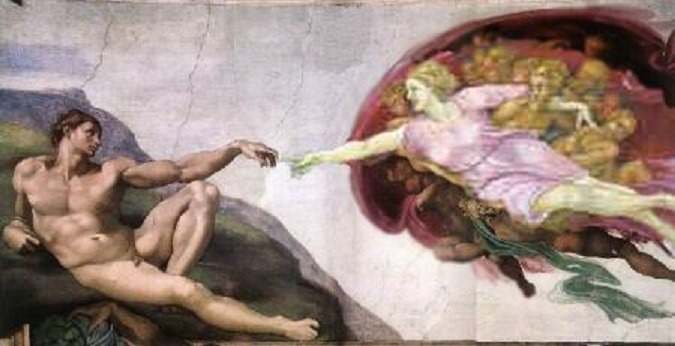
female-god1

I once dreamed I had sex with God and was shocked (in the dream) to discover God was a woman. She was a stout matronly female in her sixties, with big soft bosoms, who looked somewhat like an older Sophia Loren. In this dream, I’m having very pleasurable sex with this zaftig lady, and my reaction was fucking an older woman was a lot of fun, especially one so jolly – but then I realize she was God. Seeing my shock she laughed at me with a deep throaty laugh, like the laugh my father’s mother had. I’ve always wondered what Freud would have made of that dream.

I was in my forties at the time. When I woke I was a little embarrassed to be enjoying a sex dream with a grandmotherly woman. (It didn’t bother me she was God.) I’ve had some very strange dreams over the years, and I’ve run into God before – but not as this woman.

So I suppose my personal God could be a she. I might even prefer that. When I first thought of having a personal God the name Fred popped into my mind. A good, no-nonsense name. I could have some great conversations with a God named Fred. But I sort of like God being a woman. Probably, I’ll call her Gladys or Gloria.

I’ve been an atheist since I was eleven years old. I remember my mother making me go to church as a kid, and me trying hard to believe. I even asked to be baptized thinking it would let me see what everyone claim to see. But after nothing was revealed, I took the path of unbelieving. I’ve never been the kind of atheist that advocates disbelief. I know too many people who find great comfort in theism to ever want to take it away.

And when I say I’m an atheist, I mean I have no doubts. God does not exist for me. When I talk with God, I know I’m pretending. It’s better than talking to myself, but not by much.

I believe we are all bubbles of consciousness that have accidently emerged into this infinite sea of random reality. I use the word reality because I don’t believe the universe is everything. I believe reality is quite indifferent to us and infinite in all directions and dimensions. People want a God because they want a father figure. They want their lives to mean something. When I think of my imaginary personal God, I’m really pretending I’m talking to reality. I know reality isn’t listening and doesn’t give a shit, but I like to pretend otherwise.

Many of my atheist friends would like to talk to God too, to curse the creator for all the suffering they see and experience. I’m not that way. I’d like to thank God for my existence. I used to have a lot of questions, but I’m satisfied now with what I know and don’t know. There are some things I’d like to kid ole Gladys about, though.

Like last night, I had friends over to watch A Man Called Ove, and at one point in the film, I glanced to my left and noticed my friend’s foot. It was beautiful. And I don’t mean in a sexual fetish way, but in an existential existence way. Gladys, why is one portion of reality more beautiful than another? Why are we here and not nothing? Why is the foot more aesthetically appealing than other objects in the den? You can be very weird at times. Your sense humor can be so trying – I can understand how I got old, fat, and bald – but why not shut off the sex drive as we age? Very funny, Gladys.

I accept the random nature of existence. I even accept what I fear and don’t want. So I’m content without God, but bantering with a personal God could be satisfying. It would be fun to have Gladys to chat about the beauty and absurdity of this existence.

“By the way Gladys, can you explain Donald Trump? That’s really going too damn far!”

JWH

More Sense of Wonder Than Science Fiction

by James Wallace Harris, Monday, February 20, 2017

Origami-NOVA-3

For the first two-thirds of my life sense of wonder mostly came from science fiction, but in the last third science is supplying more wonder. I have theories as to why. First, aging is making me more fascinated with reality. Second, I’ve lived long enough to feel the real world is science fictional. For example, my science fiction book club is reading Little Fuzzy by H. Beam Piper, a 1962 novel about the discovery of cute creatures on a distant planet that might be sapient. As a kid in the 1960s, that was an exciting idea. But in 2017 we know animals are far more intelligent than we thought and in ways far more exciting than an old science fiction novel. Learning how and why has a great sense of wonder.

The dimensions of sapient behavior have become far more fantastic than fiction, including old stories about robots. For example, The Door Into Summer by Robert A. Heinlein, published in 1957, and first read by me in 1964. Heinlein’s character Dan Davis built household robots – which dazzled me back then. But today I could build my own robot with a Raspberry Pi kit, producing a completely different kind of sense of wonder. I could also download open source machine learning toolkits. This era of Makers and DIY produces a different kind of wonder. Science fiction is great, but I believe I would now give a kid a subscription to Make Magazine before telling her to read science fiction.

More and more when I watch a great documentary I want to know the details about how things are actually done. I don’t want to just be an observer. Last night I watched a wonderful episode of NOVA on PBS that has more sense of wonder than any science fiction novel I can remember reading in a very long time.

It was about origami.

Origami?

Yes, origami. You know, paper cranes…

It was titled “The Origami Revolution” – about how the art of folding paper has inspired scientists, mathematicians, and engineers. The producers completely blew me away. Origami is a fascinating craft, even an art form, but not one I ever paid much attention to. The program began by reporting the latest developments in the art, which go way beyond making simple paper cranes. Using a single sheet of paper, it’s possible to make very elaborate 3D shapes by just folding paper (and without cutting).

Origami-NOVA-2

Cranes are simple, requiring about thirty folds. Modern advanced origami art like above requires hundreds of folds involving very complex geometry. This is where the excitement started for me – because they brought in mathematics. The program introduced Erik Demaine, showing him working on a 60-page mathematical algorithm with Tomohiro Tachi for computerized origami folding. Can you imagine the mathematics of creating the above work of origami? I can’t, but I wish I could. Tachi has developed a software program Origamizer that the two of them hope will eventually be able to create any 3D figure from a 2D piece of paper. Their theorem should prove it’s possible.

Origami-NOVA-5

“The Origami Revolution” then goes on to survey wide-ranging work in biology, genetics, chemistry, physics, astronomy that have been influenced by what we’re learning from folding. This has been happening for decades, so I feel a little left behind. The program generated a tremendous sense of wonder in me, probably because this new research offers so much far-out potential, including building robots and spacecraft, and even claiming that dark matter theoretically reveals folded shapes in the structure of the universe.

Here’s a 2008 TED Talks by Robert Lang which give more details than the episode of NOVA, including some examples that are more impressive than shown in the TV show. Follow the link in his name to his website for even more information.

Understanding how modeling 3D structures from a 2D source teaches us about nature, because once the mathematics of folding were revealed scientists began seeing folding in nature, including plants, insects, and even the cosmos. From there it goes into applied engineered structures.

(This isn’t folding per se, but I think it’s related. See SmartFlower Solar.)

If you watch “The Origami Revolution” count all the far out bits of technology. You’ll realize that many of them were never discussed in science fiction. When I was young, I thought science fiction explored ahead of science, but after all these decades I’ve learned something different. Science fiction trails science. This show could inspire countless science fiction stories. Even while watching the TV show I imagined other folks seeing it and thinking up science fiction stories as they watched. They will magnify the demonstrated concepts, extrapolate, speculate, imagine, and come up with possible future scenarios to dramatize. I’m sure they will create far-out tales.

But I think getting older is making me both more patient and less patient. I’m becoming impatient with fiction. It’s easier to skim over the drama, and just zero in on the current science. Now that I’m retired, I have more time to fool around with tech toys. I spend less time reading about imaginary futures, and more time trying to figure the details of now.

You can also watch the full episode of “The Origami Revolution” on YouTube.

JWH

Catching Words With Crosswords

by James Wallace Harris, Friday, February 17, 2017

I like to imagine my conscious mind as a small boat floating on a sea of memories. Words I readily use swim in schools near the surface. I can  grab them quickly. Other words swim deeper, take longer to catch. Some words dwell in the darkest deeps of my memory sea, taking hours to reel in. Doing crossword puzzles helps me catch words I haven held in my mind for a long time. After I release them, they swim close to the boat for a while, making them easier to catch again.

crossword_puzzle

For most of my life crossword puzzles had little appeal for me. I’ve never been good at games. But last year I started doing the mini-puzzles in the New York Times. I liked them because I could actually finish the grid, which I couldn’t with the full-size puzzles. The mini-puzzles provided positive reinforcement, and only took a few minutes. Which is the limit of my gaming patience. As my confidence grew I looked forward to doing the mini-puzzle each day. My wife Susan, who works out of town, does them too. We do them before our last phone call at night, and compare our completion times. I’ve only beaten her once.

Recently the New York Times sent me an sales pitch – get a year of the full-size puzzles for just $19.95. My new sense of crossword ability con my ego into pressing the buy button. As soon as I started the first full-size puzzle I had buyer’s remorse. They were way too hard for me. They were over my head. I did find it satisfying that I could answer many clues, more than ever before, but felt bad about leaving most boxes empty.

I’m not giving up. I just figured I needed more practice. Then my friend Linda told me about the Dell Crosswords puzzle books. I bought one called Easy Crosswords. And they are easy! Maybe too easy. But it’s very encouraging to complete whole puzzles, and they’re more practice than the mini-puzzles. I’ll get to the big puzzles someday.

I noticed something else. Doing the crosswords made me think of words I seldom used. Ones that swam deep in my sea of memories. This must be why the social security set love doing crosswords. I’ve already started my battle of recalling words (which I know I’ll ultimately lose but will fight the good fight anyway). Every year more nouns and names hang out on the tip of my tongue. Which reminds me of a poem by Bill Collins my friend Connell sent me, called, “Forgetfulness.”

The poem begins:

The name of the author is the first to go

followed obediently by the title, the plot,

the heartbreaking conclusion, the entire novel

which suddenly becomes one you have never read, never even heard of,

as if, one by one, the memories you used to harbor

decided to retire to the southern hemisphere of the brain,

to a little fishing village where there are no phones.

In my struggle to recall words, I’m not sure if they completely disappear, or merely sink too deep to be captured. I’m always surprised by forgotten vocabulary suddenly returning. Doing crossword puzzles churn the words in my sea, keeping them near the surface. One scientific study found that doing crosswords could delay the onset of memory loss by 2.54 years. Other studies show elderly minds can retain elasticity and even grow new brain cells and connections, although those studies focus on aerobic activity, and not games.

Then there is the issue of speed. I feel my mind goes slower than other minds. My wife Susan and my friend Linda can do the mini-puzzles 2-5 times faster than I can. That might explain why I’ve never liked games. It makes me wonder if people who think faster are attracted to games. When I first started doing the NYT’s mini-puzzles they took me 5-12 minutes to complete. I now do the easy ones in 2-4 minutes. Susan and Linda often finish in 1-2 minutes, with occasional times below a minute. I think Susan’s best is 43 seconds.

I’m wondering if I think slower than other people. My wife used to get very impatient with me, finishing my sentences before I could. I complained and she’s been more patient. Which is nice of her, but I can tell I’m slowing her down. Maybe that’s why I like writing better than talking. I can say what I want at my own chosen speed.

Anyway, the point of this story is to express my thanks for crossword puzzles. Hope I didn’t take too long in doing it.

JWH

5 Goals vs. 25 Goals

by James Wallace Harris, Monday, February 6, 2017

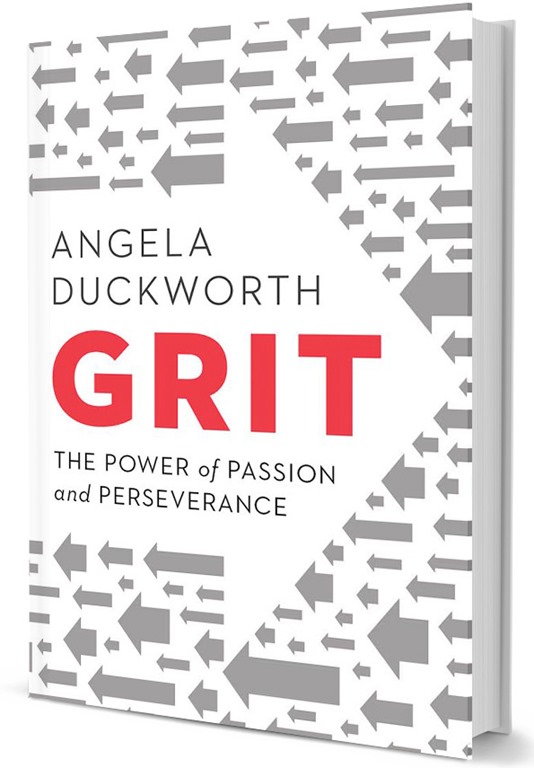
Grit-by-Angela-DuckworthI’m reading a wonderfully inspiring book, Grit: The Power of Passion and Perseverance by Angela Duckworth. Duckworth won a MacArthur “genius” grant, pursued several interesting careers, and is currently a teacher focused on helping students find their true passions, showing how grit will get them what they want. The book was often praised in 2016 book reviews, getting on several best-of-year lists, and was featured on PBS’s NOVA program “School of the Future” (also at YouTube). Grit is Duckworth’s first book, and continues to blaze the trail set by other books I’ve admired on the same topic: The Outliers, Talent is Overrated, The Talent Code. They all preach effort counts more than natural abilities. Duckworth observes people who apply themselves persistently getting ahead, a quality we know as grit. Since I’ve never been a particularly gritty person, I love reading this book.

Duckworth profiles many successful people, and I was particularly taken by a story she heard about Warren Buffett, the billionaire investor. Buffett’s advice was to write down 25 career goals. Then do some soul searching and select the five that matter the most. Finally, look at the leftover twenty, and accept they must be ignored at all costs. This bit of ambition triage is a common advice among productivity gurus. It’s old wisdom about focusing. However, I was intrigued by applying this advice to my general goals. Could I boil them down to just 5?

We all want too much, own too much, do too much, befriend too many people, consume too much. It’s much easier to narrow our desires down to a manageable number. But is 5 the right number? If we list everything we want out of life, it will tally more than 25. Now Buffett was specifically referring to career goals, but I want to use his advice for general ambitions. To apply his wisdom holistically.

Rationalizing Buffet’s Advice – Approach #1

I’m also going to do a bit of cheating. I could say my goal is to finish reading Grit. That’s something I can accomplish. But is it what Buffett meant? He meant something bigger. I could say I want to read 52 books a year and I want to get good at math. That would be two goals. Is it cheating to say I have a goal of being well educated and combine my reading and math goals into it? Reducing two to one?

Let’s say we have sixteen hours a day to divvy up between our goals. That’s a little more than three hours for each if we have five goals. But if you have to work, that has to count as one of the goals, and it takes up over half of the day, leaving little for the other four.

Now that I’m retired, I won’t have to waste one of my goals on working. Because of aging, my biggest goal is health. Staying healthy means I can pursue my other goals. Should it count it as a goal? Shouldn’t it just be part of living? I say yes it does count as a goal, because pursuing my health is hard. I show the most grit in life when it comes to staying healthy. I have to, because it’s so easy to careen into unhealthiness.

If I listed every last thing I want to do each day, it would run more than 25 items. But, if I list goals by their intent, I can get them down to 5 items:

  1. Constantly work at improving my health
  2. Constantly work at improving my writing
  3. Constantly work at improving my relationships
  4. Constantly work at learning more about reality 
  5. Constantly work at making the world a better place

Notice that all my goals will never be accomplished? And to be honest, I do very little towards number five. And because I’m getting older, and my mental and physical abilities are in decline, means my ability to work harder is declining. All my goals are losing battles. I can’t stop and cross off any as finished.

Below are many goal categories that could cover countless specific goals, but in general, they are goals that do have finishes. For example owning a new car or learning statistics with R.

  1. Possessions
  2. Careers
  3. Pleasures
  4. Hobbies
  5. Entertainments
  6. Skills
  7. Games
  8. Accomplishments

Improving my health does require many sub-goals like eating better, exercise, taking medicine, going to the doctor, learning to cook healthy meals, shopping for natural foods, etc. I no longer eat for pleasure, entertainment or even socializing. If I was a gourmet, I’d have to list it as one of my main goals. If I loved cooking or growing food, they would have to be a separate goal too. If I loved playing golf or cross-country biking, I couldn’t count them under health as exercise, I’d have to count them as sports goals. If I pursued both passionately, they would count as two.

I don’t know if this is cheating on Buffet’s advice or not. I think of a goal as a specific quest, but all the things I’ve defined as goals can’t be finished. Buffet might have been thinking of something that could be accomplished, and scratched off a list – like making a million dollars. My goals are states of being I constantly strive to attain and never abandon.

With all my present goals I could show more grit. I would be much healthier if I could lose weight, and that would take some severe persistence I haven’t shown in a long time.

My shifting away from specific goals is due to aging. Take for example games. I’ve never really cared much for winning games, and generally when I played them it was to be social. When video games first appeared in arcades I felt challenged to get high scores, but tired of that after turning over Space Invaders. Now I play games like crosswords to improve my memory and focus. Pleasures like eating, drinking, drugs, travel, are becoming pointless because my body can’t handle them. My plant based diet isn’t miserable, but it’s certainly not something I desire. Eating for fun only hurts now. My only indulgence is dark chocolate covered almonds. It meets the requirement of the diet – barely, and I enjoy them, but it’s hardly a goal of eating gourmet food.

My main goal after health is writing. I could call that goal seeking identity. We all need a goal that defines us, where we find a sense of identity by pursuing. I think of myself as a blogger. When I worked, I thought of myself as a programmer. I can say that blogging also applies to my goal of health. Regular writing exercises my brain. Writing also gives me to look forward to and to get up and do each day.

I put friendships and socializing as my third goal, even though being social is also part of staying healthy. I’m mostly a hermit, but I do feel a certain need to socialize. At one time I would have put movies and television as two of my major goals because I loved them so much, and spent so much time with them, but I use both now as methods of socializing. I’m slowly fading away from enjoying fiction as a solitary pursuit.

Number four is about education. My reading is veering towards learning, and not pleasure. Nonfiction might be my new entertainment. Learning has become my new fun, maybe even my escapism. And in this crazy world of Donald Trump, learning to tell shit from Shinola is more vital than ever.

My last goal, and one I spend almost zero time on, is helping the world. I suppose if I wrote something useful, that could count, but if I’m totally honest, writing is for me. I work a recycling, conserving energy, consuming less. I try to be ethical in my behavior. I donate a little money here and there. At minimum I try to do no harm and maintain a small footprint on the environment. I’m 99% selfish though, and I think most of us are. I think all the problems in the world are due to selfishness. We all should give more time to altruism. I admire people who spend a great deal of their time being selfless. This is where I show the least grit.

Following Buffet’s Advice Without Rationalization – Approach #2

  1. Get a book of nonfiction published
  2. Get a novel published
  3. Get an essay published in a print magazine
  4. Get a short story published in a print magazine
  5. Learn to draw simple scenes of nature
  6. Learn to program digital music
  7. Digitize all my photographs and store them in three cloud locations
  8. Relearn math through calculus, linear algebra and statistics
  9. Write a blog about the best albums that came each year since the invention of the LP
  10. Become a really good minimalist
  11. Live in New York City for a year
  12. Build a parallel processing super-computer out of Raspberry Pi modules
  13. Write a program to produce meta-lists from multiple lists
  14. Sell the house and get a perfect apartment in a high-rise in a 55+ community
  15. Learn to travel cross country and not be afraid to travel alone
  16. Create a blog post that outlines the history of impressionistic art
  17. Learn to grow plants indoors for healthy air, herbs and maybe fruits and veggies
  18. Write an essay about the best jazz albums of the 1950s
  19. Learn Python and get into machine learning and text processing
  20. Learn R and statistics
  21. Decorate the house so it reflects my personality
  22. Move to a city where I can live without a car
  23. Build a robot that does something interesting
  24. Move to a foreign city for a year – London, Paris or Tokyo
  25. Take up bird watching

These are 25 things that popped into my head that I want to do. I could list a lot more. If I opened my folders of unfinished essays, novels and nonfiction books, I’d have hundreds of items to add to the list. What Buffett really meant was to pick 5, and to stop thinking about all the rest. What Duckworth’s book is all about is finding the few goals that align with our passions and persist at working towards those goals hour after hour until they are finished.

What I need to do is figure out which kind of goal oriented person I want to be. My first approach works well with my retired lifestyle, and my actual personality. The second approach is about succeeding at specific accomplishments. I’ve never been that kind of person, probably because of a lack of grit. But I’ve always wanted to be.

When I woke up I had the single goal of writing “7 Generations of Science Fiction.” I thought the many ways I could write it before I got up. I still plan to write that essay, but for some reason this essay grabbed me in the shower and wouldn’t let go. Every morning I get up and something grabs my attention, and it becomes my goal of the day.

Ultimately, it comes down to one goal, the one you work on.

JWH