Reviewing books is a touchy subject. On one side of the coin, publicly calling someone’s creative baby ugly is just a mean thing to do. Flipping the coin over reveals the whole needy world of authors begging for any kind of press they can get. I’ve always dreamed of writing a book and getting published – what joy that would bring. But I can also imagine the soul wrenching torture of waiting for reviewers and readers that never come. Anyone who takes the time to review books is a generous human being, at least in the eyes of new writers. Most magazines and newspapers have cut way back on their space devoted to book reviews, and I think bloggers have come to the rescue.
I wish had the time and talent to review books. Those reviewers who can read a new novel and write a review that promotes the book without giving anything away, that sets the context in relation to other books of similar style and stories, who gives just the right snippets to hook potential readers and provides a bit of background about the writer, are people with a very special knack. Really good reviews of this sort will not only introduce you to a new book but will teach you something about literature in general.
I don’t have that knack, so I don’t try to review books. However I love books and I love talking about them and I love exploring where books take me on intellectual safaris. I like to think of myself as an explorer of reality, but I’m not a pioneering explorer. I follow in the footsteps of others where they leave notes along their path – those clues are called books. I don’t read to be entertained, although I do love entertaining reading. I think of books as very complicated messages – not messages with meaning, but messages with information about exploring reality.
Most people get bored if their friends spend more than a minute talking to them in a stretch. Few people have the patience for lectures. Well, a book, either fiction or nonfiction, is a very long speech from another person, sometimes ten or twenty hours, and even forty or fifty hours in some special cases. No one will be patient enough to let a friend drone on and on like that. Thus writing, either essay or fiction, is the art of capturing attention.
This long winded intro, which I hope hasn’t tried your patience, is leading up to something. I’m trying to do two things here. One, get clear in my mind what I’m doing when I talk about books, and two clarify or justify statements I have made in the past that have caused problems. I’m hoping the next time you say, “I hated that book” you will have a new context to express yourself, because this essay will be about calling people’s intellectual babies ugly. The public often hates critics because they come off as superior, and it is true, some critics are downright snooty, gleefully firing down their cannonball sarcasms from a superior vantage point.
I sometimes annoy people with sweeping statements I make about books. For example, I frequently say I find books written by Robert A. Heinlein after The Moon Is A Harsh Mistress are painfully unreadable. Now I know there are many Heinlein fans that love these later books even more than his earlier classics that I cherish, and I think its these people I annoy the most. I don’t mean to offend or be inflammatory. At one level when I say I find a book painfully unreadable all I mean is I personally experienced those books as painfully unreadable. The real question here, for scientific purposes we might say, is whether or not books have absolute qualities that can be judged and compared.
I don’t like reviewing books in the sense that I’m going to say yea or nay as to whether someone should buy and read the book. I love reading good book reviews, and I consider quality reviews a real art form. I’ll mention again, I can’t carry that tune. What I do like writing about is my impression of books, and how they affected my life. Hey, it’s all about me, isn’t it? That’s a joke, and not my vanity slipping, but it’s also a truism. Blogging is news at a personal level. Blogging is memoirs in bite-size chunks. I’m can’t write scholarly reviews like I read in The New York Review of Books. I would love to be that well educated so I could put each book I read into a larger context and relate it to its peers.
When I write about a book I want to relate how it fits into my life. When I criticize Heinlein’s later books people need to know I how much I admired Heinlein’s earlier books. The first paycheck I ever earned when I turned 16 was spent on ordering all twelve of the Charles Scribner’s Sons books by Heinlein in hardback direct from the publisher. I once wrote an essay for Lan’s Lantern, an old fanzine from the 1980s, about how Heinlein was my father figure growing up. I remember waiting for each new Heinlein book after The Moon is a Harsh Mistress, expecting so much and always be so disappointed.
There are many factors to explore here. Did I change by growing up? Did Heinlein change as a writer? Or if I had read the later books at age 13 when I discovered and read all my favorite Heinlein books would my opinions be different about them? Have I gotten older enough, and well read enough, to look at all of Heinlein’s books and judge them with a mature perspective?

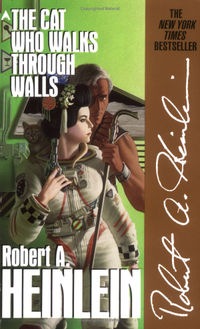
I just finished listening to The Cat Who Walked Through Walls which many Heinlein fans love because this story includes so many characters from Heinlein’s earlier much loved books. Now I’ve read this book once and listened to it once, and it is probably the least offensive of all the later Heinlein books to me, but my personal opinion is the book is still mediocre Heinlein. Oh, it’s more readable to me than The Number of the Beast or Friday, and its amusing to see what he does with the characters I loved from his older classic stories, and I do get a kick out of the meta-fiction, but ultimately I have to come down hard on this story.
Now if you love The Cat Who Walks Through Walls I’m not here to convince you that you are wrong. I think the reasons why we bond with books are emotional and out of the range of analysis. However, I do believe books have qualities that can be discussed and compared and maybe even judged. The qualities are not as precise as the elements of physics and chemistry, but they are concepts we can get behind and even point to and say they exist. Some of these qualities are characterization, plot, narrative, point-of-view, the accumulation of significant details, drama, and emotional conflicts.
If you enjoy reading The Cat Who Walks Through Walls and don’t want to be an English professor, critic, writer or literary scholar than these points won’t matter to you. You buy the book, get your kicks and go on to your next read. No big deal. Maybe books do not have qualities that can be absolutely measured with scientific instruments, but those qualities can be discussed and judged. The quality of any ruling is related to the quality of the judge and jury. The judgement of giving The Cat Who Walks Through Walls to the MFA professors at the Iowa University writer’s program or Harold Bloom will be different from a group of fans at the hotel bar of a science fiction convention or panel discussion.
It is my thesis that The Cat Who Walks Through Walls could have been an outstandingly great novel but instead is a huge belly-flop. Getting back to that explorer metaphor, let me say that Heinlein was aiming at a very ambitious idea, exploring new fictional territory with his World as Myth theory. I don’t know if he was old and losing his writing abilities, lazy, or just corrupt by the power of writing, but The Cat Who Walks Through Walls fails miserably as a work of art. I’m sure there are hordes of Heinlein fans who reread this book every year and find it delightful, but I’m not one. Heinlein let me down big time.
Now here’s where my slip starts showing. As an amateur explorer of the realms of fiction can I leave the notes that scientifically explain where I’ve been? A good novel is built from many kinds of building blocks, and a great novel reflects the craftsmanship of each. When I was a kid I liked to take mechanical alarm clocks apart to stare at the fascinating maze of mechanisms. Exploring the world of fiction means learning how stories tick.
I know Heinlein intimately knew story engineering because he wrote so many masterpieces. How can I judge him? I’ve read a lot of great novels, and I’m slowly developing the sense for what makes them great. I’m still in high school though. How do I know that the later Heinlein books don’t involve master skills that I haven’t even come to recognize? That’s a good question. Like I said, I’m an explorer that follows in the footsteps of others. I only have a vague sense of where the event horizon of the unknown lies.
I think quite a lot can be said about how The Cat Who Walks Through Walls is put together. First off its a book that depends on older novels for characterization. If you haven’t read The Rolling Stones, Stranger in a Strange Land, The Moon is a Harsh Mistress, The Number of the Beast and other stories, you’re shortchanged when you read The Cat Who Walks Through Walls. And even if you are very familiar with these stories, there is still trouble. Hazel Stone is not the same character in The Rolling Stones and The Cat Who Walks Through Walls.
I know I’m about to make one of my statements that offends people, but here goes anyway. The Cat Who Walks Through Walls is fan fiction, but of instead of being written by fans of Heinlein, Heinlein is writing the book for his fans. However, the quality of the story telling is more like fan fiction in general, a poor parody of the original. I know this was probably an emotional book for Heinlein to write, and I know his fans have a great emotional attachment for his characters, but is it only me that feels this books does a great disservice to the fictional people living in the original stories?
I’m not a reader who like sequels or long story series. I often find a great novel is best left to stand alone, and writers shouldn’t cash in on earlier successes. As far out as the concept World as Myth is, I can’t help think such stories are not much better than daydreaming about your favorite books and characters and making up your own fantasies. I consider Heinlein a master storyteller – and I think it would have been far better for his career to have kept inventing new stories, characters and plots instead of recycling old ones.
However, if The Cat Who Walks Through Walls had at its foundation a novel as good as Have Space Suit-Will Travel, Tunnel in the Sky, Starman Jones and The Rolling Stones, and the World as Myth unfolded naturally as part of the storytelling this would have been a brilliant work of fiction. Instead it’s a long meandering novel about crappy topics Heinlein was obsessed with and then near the end he throws in some World as Myth ideas and wraps things up quickly. He should have stopped the book when he got these ideas, thrown out what he had, and then worked out a real plot to fit the idea.
To make this book a masterpiece requires letting the reader in on the gimmick as soon as possible, like the Jasper Fforde novels. Second, and this is absolutely vital, is he needs to make his classic characters act and sound just like they did from the original novels. Third, an again this is vitally important, he needs to make the mysterious enemies vivid and realistic. To build proper tension and page turning power readers need to know what’s at risk as soon as possible. A last minute explanation of the bad guys told and not shown at the end of the book is just pathetic writing.
I’m not a prude, but my most vicious attack on this novel will make me sound like one. Having all of his “good” guys sound like a convention of smarmy talking wife-swappers is just gross. I hate to sound like a teenage girl, but damn, Heinlein’s kissy-kissy talk and innuendo just made me want to puke. And making his classic characters act out in this limp-dick porn flick is just tragic. Having them go on and on about how they were going to kill people for bad manners is just a little psycho to me. Evidently a lot of people and situations annoyed the hell out of Heinlein and he used this book to vent. Some people want to call this satire but I think that’s whitewash.
Maybe Heinlein lost his mojo and these multiverse stories were the best he could do. Personally, I thought The Rolling Stones was a perfect novel, and bringing back Hazel Stone was a fictionally fuck-up of an idea, ditto for the cast of The Moon is a Harsh Mistress. Maybe I am a prude because I just don’t want the Hazel Stone, grandmother of Castor and Pollux, joking about being stretched out of shape by giant 25 centimeter cock.
All of Heinlein’s personally favorite characters get put into a fictional juicer and blended into weird rabble of sex obsessed mob that chirp a weird innuendo patter and are almost impossible to tell apart. When I read these multiverse stories I can’t help but believe that horniness was driving Heinlein crazy. These later stories are preoccupied with sex, killing people, responding to annoying people, the reliability of witnesses, rude people deserving capital punishment, and so on. Not only does Heinlein recycle his characters to death, he constantly recycles his pet peeves.
The trouble with writers who keep recycling characters is their lovely fictional children get abused and mangled till they become unrecognizable from the characters of the original classic works. The books Heinlein wrote in the 1950s contain some of the most inventive science fiction ever written. He create fantastic science fictional ideas and matched those ideas with believable characters. At the time he was on the cutting edge of exploring the boundaries of science fiction.
The Cat Who Walks Through Walls like the other multiverse stories, end up being a convention of swingers flirting with each other in endless pages of cutesy sex talk and solipsism arguments. The lesson here for writers is don’t write in too many characters, and don’t have them all sound alike, and most especially don’t have them all sound like teenage girls trying to write porn. Two people in a complicated plot that leads to sex is one thing, but stories that end up in orgies of leering conversation is a huge writing mistake.
Another story telling mistake is to give your characters too much power, and The Cat Who Walks Through Walls illustrates this perfectly. If your heroes can time travel, dimension travel, live forever, then nothing feels real or believable, and no fictional conflict builds tension, and all bad guys feel like straw men put up for target practice. Characters are built through the limitations they face, not from the magical powers they weld.
I actually believe that The Cat Who Walks Through Walls could have been as great as any of my favorite Heinlein stories. Heinlein hated editors, but if he had his own Maxwell Perkins it’s no telling how good these later books could have been.
I do think Heinlein was exploring new territory, he just left poor notes. As Heinlein neared death I think he feared his own end and worried about the mortality of his beloved characters, so these World as Myth stories created a heaven for them and himself to live in. It’s a fantastic idea, and maybe why so many Heinlein fans love these stories. It doesn’t mean they are good novels. What I ask is to imagine if they had been great stories with the same theoretical ideas. I don’t know why Heinlein became so sex-obsessed in his later years. Maybe he always had been like that but stern editors censored him. Or maybe he believed if we were all free from hang-ups and lived in the future we’d be wife-swappers, and all men and women would be horn-dogs.
Right after I finished The Cat Who Walks Through Walls I put on Ethan Frome by Edith Wharton to listen to and instantly heard master story telling. Ethan Frome was first published by Charles Scribner’s, the publisher of Heinlein’s best books. If Heinlein could have written The Cat Who Walks Through Walls with Wharton’s skill of narrative and characterization it would have been lighthouse on the shore of a new fictional ocean. Recycling famous characters and authors into new stories is sailing on a dangerous sea. Look at what they are doing to Jane Austen and her children. Theoretically it might become a new art form, but it’s going to be hard to please the lovers of the original classic stories. Heinlein couldn’t please me and he’s my favorite author.
Finally, I have to wonder if the sexual relationships that Heinlein wrote about is something he really expected for future people. Today conservative thinking believes that sex should be between couples, and we’re arguing over whether those couples can include same sex partners. We liberals answer yes. Heinlein is speculating that in the future we’ll accept group sex marriages and even relationships we consider taboo now, such as incest, which I think is hard to believe even for liberals. Like I said, I think of these ideas as swinger fantasies. And we are a lot more liberated about sex than we were before Heinlein wrote Stranger in a Strange Land. Even Ethan Frome is exploring the boundaries of sexual relationships in 1911. What human behavior will be in the future is solid ground for speculative fiction, so I can’t object to Heinlein trying.
However, even the best of Heinlein’s stories shows a weak knowledge of human behavior. Heinlein wrote great stories for teenagers, but his adults all seem a bit daffy, mainly because the characters from his adult novels were talky, opinionated and horny to strange degrees. For all his later stories that speculate about group marriages he never once wrote realistically about people in such a dynamic relationship.
Now this gets me back to novels being complex messages. The best novels contain treasures of data about how humans and society work. They contain lots of intimate observations. Heinlein didn’t write these kinds of stories. He wrote about fantasy people, like the fantasy people of the Oz books or the Edgar Rice Burroughs books. Look at how many lives that Tarzan has lived. I think Heinlein was hoping his characters would have the fictional vitality of of Tarzan, John Carter, Dorothy, Toto, and The Wizard of Oz.
In these times of genre writers stretching out the lifetime of their characters in book after book. like some Days of Our Lives never-ending soap opera, was Heinlein’s ambition all that strange? Readers love hanging onto favorite characters, but I don’t know if that’s healthy. If the Heinlein juveniles would have been twelve books about one character it would have meant eleven fictional universes never seeing the light of creation. Will we ever know if seven Harry Potter books are superior to seven different stories J. K. Rowling could have written?
Again, I think if Heinlein had written The Cat Who Walks Through Walls with original characters about a fictional reality where authors, fans, editors, movie directors and other writers could easily reshape the lives of those characters in fantastic ways he could have created a memorable original novel. I think he confused the idea by recycling his older characters, because they aren’t his old characters really, nor are they new original characters, that get to be born fresh into a new virginal fictional reality.
Ultimately, The Cat Who Walks Through Walls is an excellent lesson for me on how not to write a novel. Heinlein, indeed was exploring new territory and I have learned from his efforts. I could write a whole book tearing this story apart line by line but would it really be worth the effort? I wouldn’t mind seeing other writers try using this idea and inventing a World as Myth with Heinlein and his characters. Especially if the writer was very astute at analyzing Heinlein psychologically. And just because I don’t think this is a very successful book it doesn’t mean I don’t think Heinlein fans shouldn’t read it.
Jim

 Auxiliary Memory